Connect with us

Published

on

Volcanic eruptions pose a fundamental challenge for scientists and their climate models.

It is well known that explosive eruptions can cause sudden cooling at the Earth’s surface and that multiple eruptions shape climate variability over decades and centuries.

When sulphur dioxide is injected into the stratosphere during an eruption, it forms aerosols that block sunlight from reaching the Earth’s surface.

Unlike human influences on climate change, which occur slowly and can be accounted for in climate models under a range of socioeconomic scenarios, the sporadic nature of volcanic eruptions poses a challenge for climate projections.

Scientists cannot currently forecast the occurrence of volcanic eruptions – including when and where they will occur and how much sulphur they will emit.

How, then, to account for the climate impact of volcanic eruptions when projecting into the future?

In a recent study, published in Communications Earth & Environment, we show that volcanic eruptions make a substantial contribution to the uncertainty in projections of global temperatures.

Our findings suggest that, when sporadic volcanic eruptions are included in climate projections, breaching of the Paris Agreement’s 1.5C warming limit is slightly delayed – but we will also see more decades with rapid rates of warming and cooling.

Volcanic forcing in climate projections

Climate scientists refer to the influence volcanic eruptions have on the climate – largely through the release of sulphur dioxide gas into the atmosphere – as “volcanic forcing”.

Current climate models apply a constant volcanic forcing value when running future projections. This value is calculated based on the historical average of forcings from 1850 to the present day.

This is the case with the Coupled Model Intercomparison Project (CMIP), the international modelling effort that feeds into the influential assessment reports from the Intergovernmental Panel on Climate Change (IPCC).

However, this approach has significant limitations.

For starters, historically averaged forcing does not capture the episodic nature of eruptions.

Large-magnitude volcanic eruptions happen sporadically – sometimes clustering within decades and other times leaving century-long gaps between events.

Meanwhile, the reference period of 1850 to the present day has seen a relatively low frequency of large-magnitude eruptions that emitted more than 3 teragrams (Tg) of sulphur dioxide (SO2), when compared to multimillennial records.

Finally, volcanic forcing reconstructions used in earlier generations of CMIP climate models did not include small-to-moderate magnitude eruptions that emitted less than 3Tg of SO2.

This is because these eruptions went largely undetected before the satellite era began in 1980. Nonetheless, these smaller, but more frequent, eruptions contribute to 30-50% of long-term volcanic forcing.

Taking a new approach

Traditionally, climate scientists have recognised three main sources of uncertainty in climate projections: internal variability, model uncertainty and scenario uncertainty.

Here, “internal” variability refers to natural fluctuations that are generated within the climate system, such as by El Niño; model uncertainty refers to the differences in the results between multiple climate models; and scenario uncertainty refers to the different ways that the world could develop over the decades to come.

Our results show that volcanic eruptions should be specifically considered as a fourth significant source of uncertainty in climate projections.

To explore how climate projections change when accounting for volcanic forcing uncertainty, our study uses a probabilistic approach that builds on a 2017 methodology developed by Bethke et al.

To do this, we develop “stochastic forcing scenarios” – essentially, 1,000 different plausible timelines of volcanic activity extending to the end of the century.

These scenarios draw from past volcanic activity recorded in ice cores going back 11,500 years, along with satellite measurements and geological evidence. Each scenario represents different combinations of eruption magnitudes, location, timing and frequency.

(In mathematics, “stochastic” systems involve randomness or uncertainty of outcome, making them unpredictable. This is in contrast to “deterministic” systems, which are characterised by having outcomes that are completely predictable based on initial conditions and a set of rules or equations.)

We then simulate climate projections using both stochastic and historically-averaged volcanic forcing between 2015 and 2100, exploring temperature rise under three different emissions scenarios drawn from the Shared Socioeconomic Pathways (SSPs). These are a low-emission scenario (SSP1-1.9), an intermediate scenario that is in line with current climate policies(SSP2-4.5) and a very-high emissions scenario (SSP5-8.5).

For this step, we use a simple climate model, or “emulator”, called FaIR.

By simulating 1,000 different volcanic futures, we find that the climate uncertainty caused by future 21st century eruptions could exceed the internal variability of the climate system itself over the same period.

We also find that volcanic eruptions could account for more than one-third of total uncertainty in global temperature projections until the 2030s.

You can see these results in the plot below. It shows the contribution to the total uncertainty from the different sources. The colours represent volcanoes (orange), internal variability (dark blue), climate model response (yellow) and scenarios of future human emissions (green).
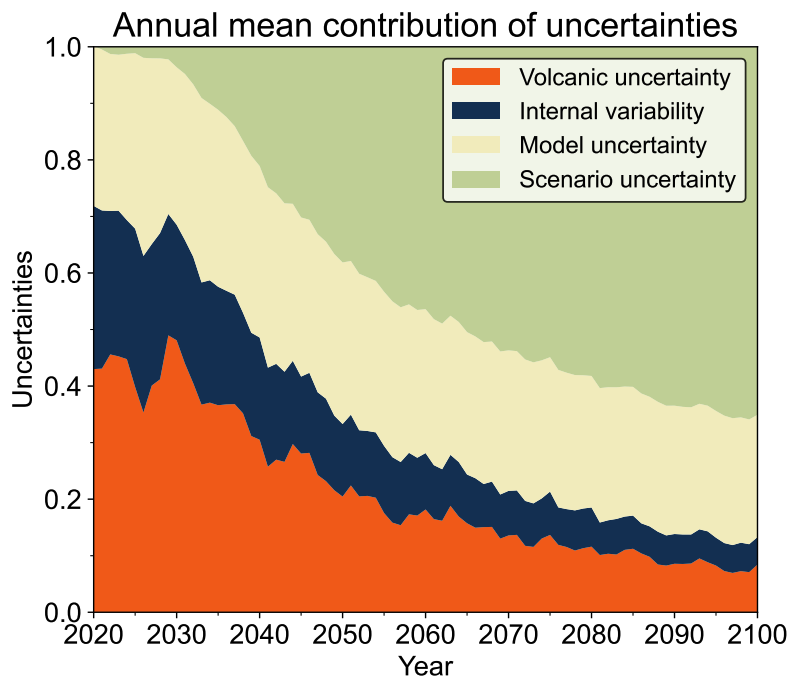
Chart: Annual mean contribution of uncertainties
Annual average contribution to the total uncertainty in global average surface temperature from volcanic eruptions, internal variability, climate model response and human emissions scenarios from 2020 to 2100. Credit: Amended from Chim et al. (2025).

What this means for the 1.5C threshold

Our simulations demonstrate that incorporating possible timelines of volcanic activity slightly reduces the probability of crossing the Paris Agreement’s aspirational 1.5C temperature limit in the near term.

We find that – depending on the emissions scenario – the probability of exceeding 1.5C decreases by 4-10%, compared to projections using constant volcanic forcing.

While this might sound encouraging, future volcanic activity does not provide any long-term mitigation of human-caused warming.

The eruption of Mount Tambora in 1815 offers a dramatic illustration of this point. While the event cooled global temperatures by an average of 0.8C, it led to a “year without a summer” and caused crop failures and widespread famine across Europe, North America and China.

Eruptions produce temporary cooling lasting just a few years. They do not alter the underlying warming trend driven by human emissions.

Our study finds that, taking into account a range of future volcanic activity, global warming will still exceed 1.5C within decades under all but the very lowest emissions scenarios.

A high level of volcanic activity over the 21st century would help offset just a small fraction of global warming – meaning that emission reduction remains essential for meeting long-term climate goals.

The charts below show the probability of scenarios exceeding 1.5C using stochastic volcanic forcing (solid lines) and constant volcanic forcing (dashed lines) under three emissions scenarios (top) and the difference in probability between the two forcing approaches (bottom).
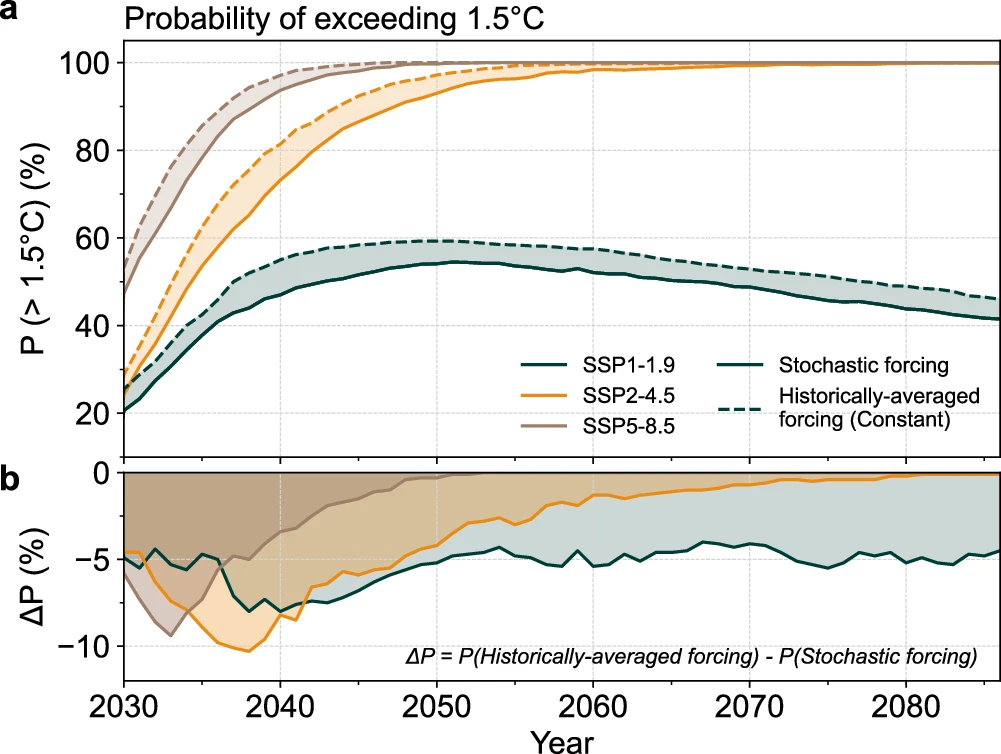
Charts: Probability of exceeding 1.5C
The top chart (a) shows the probability of scenarios exceeding 1.5C using stochastic volcanic forcing (solid lines) and 1850-2014 mean historically-averaged forcing (dotted lines) for SSP1-1.9 (very low emissions), SSP2-4.5 (approximate current policies) and SSP5-8.5 (very high emissions) scenarios. The lower chart (b) shows the difference in probability in exceeding 1.5C between the simulations and historically-averaged forcing and stochastic volcanic forcing. Credit: Chim et al. (2025)

Decadal-scale temperature variability

Another important insight from our research is that extreme warm and cold decades become more likely once the variability of volcanic forcing is accounted for.

We find that the chance of a negative decadal trend – a decade where global surface temperature cools on average – increases by 10-18% under the intermediate emissions scenario.

We also find a corresponding increase in the probability of extremely warm decades, reflecting how volcanic forcing variability enhances the likelihood of both cooling and warming extremes.

This underscores how volcanic eruptions could introduce significant variability into the global temperature trends over decadal timescales.

Toward better climate projections

Understanding volcanic effects on the climate is essential for comprehensively assessing future risks to agriculture, infrastructure and energy systems.

Running thousands of volcanic scenarios with full-scale Earth system models is not practical as it requires too much computing power. On the other hand, current approaches have significant limitations, as described above.

However, there is a middle ground for future climate modelling efforts.

The next phase of future climate modelling experiments – the Scenario Model Intercomparison Project for CMIP7 – can use a more representative “average” volcanic forcing baseline that incorporates the effects of small eruptions often missed in historical records. This bias has now been addressed in the historical volcanic forcing dataset that will underpin the next generation of climate model simulations.

Additionally, modelling teams should run additional scenarios with high and low future volcanic activity to capture the range of volcanic uncertainty on climate projections.

While human-caused greenhouse gas emissions remain the dominant driver of climate change, properly accounting for volcanic uncertainty provides a more complete picture of possible climate futures and their implications for society.


The post Guest post: Investigating how volcanic eruptions can affect climate projections appeared first on Carbon Brief.

Guest post: Investigating how volcanic eruptions can affect climate projections

Continue Reading

Climate Change

“Next year is too late for regulations”: Beetaloo Energy’s 2GW gas-powered AI data centre a “disaster proposal” destined to cause climate chaos

Published

on

SYDNEY, Wednesday 22 July 2026 — Beetaloo Energy has secured land from the NT Government for a massive $40 billion “hyperscale” AI data centre near Darwin, which would be powered by 2 gigawatts (GW) of gas power fracked directly from the Beetaloo basin, prompting calls from Greenpeace for urgent federal legislation.

The proposal marks a dangerous escalation in the AI data centre industry’s expansion, which threatens to entrench fossil fuel infrastructure for decades and put immense pressure on the region’s fragile water resources — while continuing to be unregulated.

Joe Rafalowicz, Head of Climate and Energy at Greenpeace Australia Pacific, said: “This disaster proposal for a 2GW gas-powered AI data centre in the NT is a shocking example of the unchecked expansion of hyperscale data centres in Australia. It is also, critically, more evidence for the urgent need for a moratorium on all new data centres until strong, binding regulations are put in place to protect our communities and climate.

This proposal mirrors the frenzied, unchecked expansion currently wreaking havoc on communities in the US. We are seeing cowboy data centre operators treat Australia like a playground, steam-rolling ahead with projects that would lock down precious water resources and spike emissions, despite the overwhelming community opposition.

Every day, more councils, communities and environmental groups are joining Greenpeace’s call for a moratorium on data centres, yet as of today there is still no system of safeguards or rules in place to regulate these companies.  

While Beetaloo Energy and the NT Government prepare to bulldoze ahead with this climate and water disaster, the Prime Minister is asleep at the wheel, promising to legislate a vague set of standards next year.

Next year is too late, and anything less than mandating data centres cover their own energy demand, and then some, with new renewable energy is not enough.” 

-ENDS-

Media contact

Lucy Keller on 0491 135 308 or lucy.keller@greenpeace.org

“Next year is too late for regulations”: Beetaloo Energy’s 2GW gas-powered AI data centre a “disaster proposal” destined to cause climate chaos

Continue Reading

Climate Change

Allegations of harms at China-backed transition minerals projects rise

Published

on

Reports of human rights and environmental abuses linked to Chinese companies’ overseas investments in the mining and refining of minerals needed for the clean energy transition are on the rise, research by a monitoring group has found.

The number of recorded allegations of harm at projects tied to Chinese firms have increased every year since 2021, rising to 148 in 2025, according to the Business and Human Rights Centre (BHRC). On Wednesday it released new data showing that a total of 434 allegations of abuse were made against Chinese-backed projects over the five-year period in projects across the world.

The world’s top cleantech manufacturer, China is also the leading financier of critical minerals projects worldwide. The country has committed more than $120 billion in foreign direct investment into mineral mining and processing since 2023, Australian think-tank Climate Energy Finance recently found.

“China plays a central role in global transition mineral supply chains, and as such has a unique opportunity to raise the bar on human rights and community engagement at every stage of mining,” said Michael Clements, BHRC’s executive director.

“While there have been encouraging developments, from stronger regulations to more company engagement, there remains a gap between human rights commitment and action,” he said.

The report comes as communities affected by Chinese-backed mineral projects have filed the first two cases to a Beijing-based mediation mechanism intended to bring willing Chinese companies to the discussion table with affected communities.

Allegations of harms on the rise

BHRC’s latest analysis – including data for the period 2023-2025 – covered mining, smelting and refining projects for 11 minerals considered key to manufacturing clean energy technologies such as batteries, EVs and solar panels needed to move away from climate-heating fossil fuels.

The highest number of abuses was recorded in Indonesia, the world’s largest producer of nickel, which is used to make EV batteries. After the Indonesian government banned exports of raw nickel, Chinese firms invested billions of dollars to develop a large-scale nickel smelting and processing industry in the Southeast Asian country, largely powered by coal.

Other countries with a high number of recorded harms include the Democratic Republic of Congo, where Chinese firms dominate cobalt and copper production; Myanmar, where unregulated rare earths mining has caused widespread environmental destruction; Serbia, where Chinese-backed mining of some of Europe’s most significant copper and gold deposits is swallowing land and homes, and Zimbabwe, where Chinese investments have turned the nation into Africa’s top lithium producer.

Growing risks for people and nature

Allegations tracked by BHRC included negative impacts on local livelihoods, health and land rights, workers’ health and safety and work-related deaths, as well as water pollution and environmental contamination. In addition, 18 people were attacked for raising concerns about Chinese transition mineral projects between 2023 and 2025.

The report shows that 10 Chinese companies, including Zijin Mining, Tsingshan Group and Zhejiang Huayou Cobalt, accounted for nearly two-thirds of all allegations recorded in the last five years. It found that some Chinese companies “still appear to turn a blind eye to these issues” but noted that several others have been more responsive to allegations of abuse. However, even among companies with human rights policies, implementation remains a challenge, BHRC warned.

    Zijin Mining and Zhejiang Huayou Cobalt repeatedly responded to the allegations of harm by saying they take environmental and social risks seriously and adhere to international standards. Tsingshan Group never responded to BHRC’s requests for comment.

    Platform for dialogue between communities and Chinese firms

    At the same time, Chinese authorities have made “significant progress” on introducing a more specific framework for managing environmental and social risks in overseas investment, BHRC said.

    This includes global consultation on a draft Sustainable Mining Code, adherence to UN guiding principles on business and human rights, and greater emphasis on oversight of companies operating overseas.

    The China Chamber of Commerce of Metals, Minerals & Chemicals Importers & Exporters (CCCMC) set up a mediation and consultation mechanism intended to provide a platform for dialogue between affected communities or civil society groups that have raised concerns and Chinese companies.

    More than three years since its launch, the mechanism has now received its first two complaints from local communities and many more are considering filing a case, Margaux Day, executive director at the nonprofit Accountability Counsel, told an event hosted by Climate Home News last month.

    “This is incredibly exciting in that it fills a governance and accountability gap where often communities who are seeking to protect their rights and the environment can’t reach someone who will respond to them,” she told the panel discussion at London Climate Action Week.

    Climate Home News understands that the complaints were filed by communities in Latin America and Southeast Asia over labour rights and resettlement issues. No information about the cases has yet been made public. The mechanism’s secretariat did not respond to Climate Home News’ questions.

    The mechanism was set up after the Chinese regulator for banks and insurers called on investor-level institutions to establish complaints bodies to hear from communities outside of China. But whether the new initiative will prove effective in tackling grievances remains an open question.

    “Real potential” for better mining practices

    Participation in the mechanism is voluntary for Chinese firms and it doesn’t have a fact-finding function, nor can it impose provisions for compensation or compliance with human rights standards.

    But Day told Climate Home News that, if successful, it could bring companies to negotiate an outcome that is better for people and the planet and leads to more sustainable mining practice.

    Chen Yu, an independent China advisor for campaign group Global Witness, agreed that the mechanism holds “real potential”.

    “There exists nothing else at a similar level to promote dialogue between communities and Chinese mining companies in particular,” she said.

    For companies, the mechanism opens “a channel for problem-solving and dialogue with communities”, she added, as “Chinese companies often remain cautious of approaching affected communities directly, afraid of making the problem bigger”.

    However, Chen said the mechanism remains at an early stage of development, faces resourcing challenges and is not yet sufficiently understood by communities in mining areas or Chinese firms.

    To help it address some of these challenges, the secretariat is currently seeking technical support from a range of organisations, including civil society groups. But, Chen said, “it will take time for the mechanism to show its value”.

    The post Allegations of harms at China-backed transition minerals projects rise appeared first on Climate Home News.

    Allegations of harms at China-backed transition minerals projects rise

    Continue Reading

    Climate Change

    Energy transition policymaking must evolve to fit an age of rupture

    Published

    on

    Andreas Sieber is head of political strategy at 350.0g. Cat Abreu is director of the International Climate Politics Hub.

    From the US abduction of Venezuela’s president at the start of this year to the Iran war which rumbles on, disruption is the new normal for global geopolitics, more often than not linked to conflict over supplies of oil and gas. 

    Events so far in 2026 – driven largely by the desire of the Trump administration to grab control of fossil fuels around the world – show that the climate community’s approach to energy diplomacy will have to evolve if we are to operate effectively and push for climate action in such a volatile landscape.

    Today’s climate and energy governance must be able to cope with trade wars, genocide, fascism, spiralling inequality and challenges to multilateralism. The increasingly dominant paradigms of economic competitiveness, energy security and green industrialisation can help drive the transition but they also challenge our collective mission to deliver an equitable green shift.

    US-China rivalry dominates

    Longer-term geopolitical trends that are seeing power move from West to East and North to South have fuelled a US–China “superpower rivalry”, which is pulling the global economy apart and reining in trade.

    A key question will be how the fracture “lines” are drawn: by the US and China, or also by other countries or blocs? Many governments will try to remain “in the middle” between the two giants to capture economic gains from both sides. Yet despite the language of “strategic autonomy”, Washington and Beijing may be in a position to force choices via market access, export controls and sanctions.

      At first glance, this may not seem particularly relevant for climate and energy politics. But Huawei’s exclusion from 5G operations across the political West and India following the so-called Clean Network Campaign by the US government serves as a warning of what could happen to climate green tech.

      And the recent debate to cut out Chinese inverters from European markets follows the same pattern – US security forces perceive a risk and start encouraging their allies to drop Chinese technology.

      The new drivers: competition and security

      Despite this fracturing geopolitical and economic context, energy transition is still happening. To ensure it is effective and equitable, we need to understand what is driving it and how to adapt climate politics so that it better responds to these drivers.

      Put simply, China is supplying the world with low-cost renewables (roughly 60% of critical wind and 80% of solar components), batteries, EVs and other key elements. Other countries now also want their piece of the green tech pie and are forming industrial policies to get it.

      It is this new competitiveness-driven logic that will shape the quest for decarbonisation, which has shifted from cooperating around the cost of tackling climate change to rivalry for the benefits of climate action.

      Over 90% of new renewables projects are now cheaper than fossil alternatives. Gas-fired power is 3–4 times more expensive than solar and wind. In 2015, most decarbonisation policies were “traditional” emissions-cutting strategies like carbon pricing or net zero dates, whereas green industrial policies now underpin the majority.

      Iran war could boost fossil fuel phase-out push, says Colombian minister

      Meanwhile, security has become a central driver of energy politics. We are living through the second major fossil fuel crisis in just four years. Elevated oil and gas prices will impose up to $1 trillion in additional costs on the global economy by the end of the year if disruption continues in the Strait of Hormuz. Fossil fuel supply chains have exposed countries to conflict, coercion and brutal price shocks.

      Fossil fuel volatility destabilises whole economies – higher fuel costs drive up food prices, increase political instability, and push millions into poverty and hunger. This incentivises governments to shield themselves from global shocks, especially in countries that are net fossil fuel importers and home to roughly three-quarters of the world’s population. 

      Yet security fears can cut both ways. The same instability that makes fossil fuel dependence untenable is also sharpening concern over China’s dominance of critical clean technologies and supply chains.

      Equity, cooperation and the opportunity for change

      Developing countries benefit from the rapid uptake of renewables enabled by low-cost Chinese technologies. But significant fiscal space and public investment is needed for the electricity grids and infrastructure required to fully unleash the energy transition, as well as for green industrialisation to diversify revenue streams.

      Despite this, industrial-scale domestic production and ownership often remain out of reach for too many countries that lack the fiscal space to allow green supply chains to flourish and compete with their traditional industrial base. But more just and diversified green tech supply chains could be achieved with concomitant support.

      Can giant batteries unlock Africa’s green industrial future?

      For the first time in decades, the international order is being substantially reshaped. If within this context, decarbonisation is increasingly driven by green industrial policy, energy security and competitiveness, the climate policy community must better anticipate where these debates are moving. We must speak the same language, and enter the forums where decisions are made, including security, trade and bilateral or trilateral spaces.

      We should build on an enlightened self interest recognising that cooperation remains essential and beneficial. This includes using the UN climate process differently: less as an ever-expanding negotiation machine, and more as a space for norm-setting, political alignment and deal-making. In an age of fragmentation, effective cooperation must not only be framed as necessary but thought of as a strategically compelling source of resilience and shared advantage.

      The post Energy transition policymaking must evolve to fit an age of rupture appeared first on Climate Home News.

      Energy transition policymaking must evolve to fit an age of rupture

      Continue Reading

      Trending

      Copyright © 2022 BreakingClimateChange.com