

Since its head office opened in Johannesburg 16 years ago, the African arm of environmental campaign group Greenpeace has made a name for itself, battling governments and corporations to defend forests, protect oceans and tackle climate change. It was an organisation staff said they were proud to work for.
But an internal restructuring – which Greenpeace Africa’s board asked newly-appointed executive director Oulie Keita to implement in June 2023 – has left management fighting affected employees as well as the planet’s foes.
Climate Home spoke to former staff and has seen leaked documents, meeting recordings and email correspondence that expose the disarray caused by the drive by Greenpeace Africa’s management to lay off around 40 people – about half of its total staff – at three of its five offices, in the Democratic Republic of Congo (DRC), South Africa and Senegal. The organisation cited financial and security reasons in justifying the job cuts.
Some ex-employees interviewed by Climate Home, however, expressed doubt about those motives, saying they felt unfairly targeted for dismissal. They also criticised the new management’s approach to interaction with African governments, as well as Greenpeace Africa’s stance on LGBT+ rights and trade union representation.
Sign up to get our weekly newsletter straight to your inbox, plus breaking news, investigations and extra bulletins from key events
In a written response to those grievances, Climate Home was told that Greenpeace Africa “values the rights and voices of our employees and fosters an inclusive and collaborative work environment”. “Our policies align with the legal requirements in each country,” it added.
As one of the highest-profile environmental organisations on the African continent, Greenpeace has an ambitious vision to bring about “an Africa where people live in harmony with nature in a peaceful state of environmental and social justice”. The internal turmoil uncovered by Climate Home raises questions about its ability to meet that goal.
The terms of reference for a three-month operational review of the organisation, which was due to start in August 2023, cited a need for cultural change as a key reason for the restructuring. It said collaborative processes intended to boost productivity and accountability had failed, slowing down the delivery of a 2022-2025 strategic plan.
As COP Troika dithers on 1.5C-aligned climate plans, experts set the bar high
That four-year strategy “aimed to transform Greenpeace Africa, to be a viable organisation working on campaigns delivering systemic impacts in Africa, with an operating model that is fit for purpose and responsive to the challenges facing the continent”, the document added.
It also showed that Greenpeace Africa wanted to ensure it had enough of a presence in richer African nations to improve fundraising – an argument that was later used by management as a justification for downsizing offices in poorer nations like DRC.
Greenpeace told Climate Home this shift was “part of a broader effort to ensure that Greenpeace Africa remains financially sustainable. This approach strengthens our capacity to promote environmental justice in all regions, including those with fewer resources.”
Following the shake-up, Climate Home understands that more than 10 former employees have launched legal action against Greenpeace Africa in labour courts in South Africa and Senegal, alleging unfair treatment by the organisation. Greenpeace Africa did not respond to questions on the cases, which are ongoing.
It said, however, that its 2023-2024 restructuring was conducted “with the utmost care”, and “in accordance with all relevant labour laws in each of our countries and ethical guidelines”.
New strategy
On March 1, 2023, the Greenpeace Africa board announced that, after a series of interim bosses, Keita had been appointed as executive director.
In a statement, it said she would “lead the implementation of the organisation’s new strategy which, grounded in African consciousness, seeks to dismantle systems which have historically served only to benefit the colonial powers, still plundering Africa for its resources”.
Amazon state that will host COP30 strikes “largest carbon credit sale in history”
Then board chair Oury Traoré, a fellow Malian who resigned this year, said in the statement that it was “critical to build a movement led by women and youth”. As a woman joining from the United Nations youth platform YouthConnekt Africa, Keita seemed well-placed to do that.
She had studied law, sociology, international development and human rights at universities in Morocco, the US and Austria and then worked as a trainer, facilitator and consultant for NGOs and Western embassies across Africa. She joined the Greenpeace Africa board in April 2012.
Staff were initially pleased with Keita’s appointment as executive director, which ended the long hunt for a permanent leader. “We were very excited,” said one then staff member in Senegal. “We had the sense that the organisation would become more stable.”
But that did not happen. Just a week later, an email landed in the inbox of Greenpeace Africa’s people and culture director Paul Ngugi and its then lead campaigner on climate and energy Melita Steele, flagging earlier support by Keita for Rwandan President Paul Kagame.
Sent by the head of Greenpeace Africa’s Congo rainforest campaign at the time, and signed on behalf of “the Congo Basin team”, the email raised “serious concerns” about Keita’s appointment, due to her alleged “very high admiration of Paul Kagame and her public communication to praise and admire him”.
The email, seen by Climate Home, included 15 posts by Keita on X (formerly Twitter), sent between November 2020 and October 2022. They praised Kagame’s “exemplary leadership”, calling him a “visionary”, “rare jewel” and “my Favourite President in the world”. Keita said she had moved to Rwanda “because of the admiration and respect I have for this man!”
A post on Oulie Keita’s X account on November 14, 2020 (Screenshot)
Commenting on this, the email from the Congo Basin team said that having a leader of Greenpeace Africa with that kind of admiration for Kagame was a serious problem for them and their work.
The United Nations has accused the military forces of Rwanda, governed by Kagame since 2000, of sending 4,000 troops to invade parts of neighbouring DRC and of backing Congolese rebel group M23. The violence has displaced millions of people in the DRC, which is home to large swathes of the world’s second-largest rainforest – a huge carbon store whose protection is regarded as vital to curbing global warming.
The email noted that the Congo Basin team had been preparing a statement on the DRC conflict for Greenpeace Africa’s leadership to endorse, “as for us our organisation’s silence on this conflict is no longer acceptable”. It added that the DRC office now believed “our new ED [Keita] would never accept such a statement”.

A mourning ceremony for the victims of the DRC conflict took place in the city of Goma on September 2, 2024. (Photo: Arlette Bashizi/Reuters)
Internal “smear campaign”
The email led to frantic activity at the top of Greenpeace Africa. The organisation’s engagement director brought forward training on social media use and prepared what she called a “risk mitigation comms plan for this particular concern”.
On March 16, 2023, Greenpeace Africa’s then head of communication, Johannesburg-based Mbong Akiy Fokwa Tsafack, sent an email to staff on the subject of “the smear campaign” against the new executive director.
Greenpeace Africa, it said, wanted “to express its ultimate concern and disgust at the onslaught”. It accused unnamed people of using a “colonial approach, of divide and rule, taking advantage of the fragile political situation in the DRC to drive their agenda” and to “resist the transformation that is required to bring credibility to the presence of Greenpeace in Africa”.
UN climate chief warns of “two-speed” global energy transition
Shortly afterwards, Keita herself sent a conciliatory email with no reference to Tsafack’s message. Keita said she had “heard with distress, yet with solidarity, the cries of the staff in the DRC who are rightfully disturbed about tweets on my social media handle”.
The posts, she noted, were made while she led YouthConnekt, which was chaired by Rwanda. “Cheering, supporting and celebrating the political will of these African leaders towards investing in the youth of Africa, including the main Champion the President of Rwanda as the co-initiator of this continental initiative was a big part of the job,” she wrote.
Keita added that she had “no personal political affiliations with any African countries”, thanked colleagues for raising “valid” concerns, and appealed for unity “to build the Africa we all want to live in”.
Keita did not respond to a request for comment for this article. Greenpeace Africa’s website states that the organisation “does not take sides in conflicts and wars on the African continent”, in line with Greenpeace’s global policy on peace.
Congo office closure
About seven months later, in October, Greenpeace Africa’s finance director, South African Gerhard Combrink, held a video call with the DRC office to tell staff there that management had decided “to close down” their office and centralise activities for the Congo Basin in Cameroon.
The announcement seemed to come as a surprise to those attending, many of whom criticised the decision. Combrink said the Greenpeace Africa board had “consulted widely with Greenpeace International and with other [national or regional offices], especially Belgium”, the DRC’s former colonial ruler. But staff in the DRC said on the call they had not been included.
The then lead for the Congo Basin team said that, as three-fifths of the Congo rainforest is in the DRC, losing the office there would be a “historical error” and would damage the organisation’s credibility globally.
The forest – and its central role in keeping climate change in check – is threatened by government-backed efforts to drill for oil and by industrial logging.
“It’s like closing an office in Brazil, and you say you’ll be campaigning from somewhere else to try to save the Amazon forest. It doesn’t work,” the team lead said. “Closing it will send a signal to many other African countries saying that no, this Greenpeace is not an organisation that we can count on,” she warned.

Environmental activists, with a banner co-signed by Greenpeace Africa, protest in Kinshasa, DRC, on November 29, 2019. (Photo: Hereward Holland/Reuters)
Combrink said one “fundamental” reason for the decision was “the security issues we face and our inability to openly confront the government without placing our staff at risk”. He noted that the organisation had evacuated staff to safeguard them against threats. The campaigner, who did not respond to Climate Home’s request for comment, replied that these evacuations had only been “preventive” and no DRC employees had been arrested.
Fundraising prioritised
Combrink said another reason for shutting the DRC office was that, due to the war in Ukraine, funding from Germany – a key source of income for Greenpeace Africa – was drying up. He said that “the [Greenpeace Africa] board is adamant that if we do have activities, it is necessary that we focus on fundraising within those countries”, adding it was not possible to “substantially” raise funds in the DRC, one of Africa’s poorest countries.
In the terms of reference seeking an external consultant to conduct the review – to be hired in August 2023 and reporting to Combrink and Keita – Greenpeace Africa stipulated that its future footprint should “reflect adequate presence in countries affluent enough to raise income for the rest of the organisation”.
In its earlier June 2023 letter to Keita, mandating her to carry out the restructuring, the Greenpeace Africa board had noted that Greenpeace’s global revenue was decreasing against inflation, with the war in Ukraine negatively affecting its donor base and leading to a reduction in grants to regional offices including Africa.
It said staff alone accounted for almost two-thirds of Greenpeace Africa’s total annual projected costs, leaving it “poorly equipped to reduce its expenditure in the short term when its income streams diminish”.
“Given the large fixed overhead costs required to maintain a formal office within a country, it is crucial that we utilize current grant income streams to grow within geographical areas that can provide future donor income streams,” it added.
Several months later, on the call with DRC staff, Combrink said the review had identified Ghana, Nigeria and Mauritius as good targets for expansion, adding that fundraising in Kenya had “started to pick up”.
Responding to his comments, Greenpeace’s then Congo Basin lead argued that, while decisions on where to locate offices should be based on more than finances, DRC was “getting a lot of money compared to other offices”, particularly for its campaign to save the country’s huge rainforest.

A PhD student measures the circumference of a tree in a forest reserve near the village of Masako in the DRC on August 8, 2012. (Photo: Ollivier Girard/CIFOR)
In spite of the subsequent restructuring, which led to most of the DRC office staff leaving, Greenpeace Africa told Climate Home its operations in the country had not ceased and had been strengthened in 2024.
During its latest mission to the DRC in August, to engage with “key stakeholders”, including the government, Greenpeace Africa said the Hydrocarbons Minister confirmed his government’s commitment to remove oil concessions overlapping protected forest areas, including in the Virunga National Park, and invited Greenpeace Africa to help identify the areas threatened by the concessions.
“Such political dialogue provides us a platform to campaign to achieve positive outcomes for the environment and the people in Africa,” Greenpeace Africa told Climate Home by email.
It added that the board’s decision to conduct a “geographic footprint” exercise to consider fundraising potential across the continent also supported this objective – and was not a threat to its activities in poorer countries like DRC.
“This approach does not diminish – in fact it strengthens – our capacity to promote environmental justice in all regions, including those with fewer financial resources,” it told Climate Home.
Union members sue in South Africa
As part of the broader restructuring of the organisation, further job cuts were announced at Greenpeace Africa’s offices in Senegal and South Africa.
Sources who worked at Greenpeace South Africa at that time said unionised staff members were affected by the retrenchment.
A document put together by trade union members, seen by Climate Home, lists 34 union members in Greenpeace Africa’s head office in Johannesburg. Of these, ten were in the fundraising department which trade union sources said was excluded from the restructuring.
Of the remaining 24, 15 were deemed “not suitable” for their positions and were laid off, as were several non-union staff, out of an overall headcount of around 50 employees.

Chart: Climate Home News
A legal document seen by Climate Home, dated May 2024, shows that lawyers acting for affected union members filed a case against Greenpeace Africa with the Labour Court of South Africa in Johannesburg alleging unfair dismissal and failure to follow due process.
It said court-ordered efforts at consultation between the employees and Greenpeace Africa had not resulted in any agreed selection criteria for retrenchment, but their contracts were terminated nonetheless. The case is pending and if not resolved in arbitration, will be heard by the court. Greenpeace did not comment on the proceedings.
Sources also raised questions about whether new staff, brought in after the restructuring, were permitted to unionise in the workplace.
A Greenpeace Africa employment contract from the end of 2023, seen by Climate Home, asked a potential employee in South Africa to “acknowledge that Greenpeace Africa is a non-unionised employer due to the nature of its operations, being a Non-Governmental not-for-profit institution relying on external grants for its survival”.
It requested that the employee “acknowledge that any [trade union] recognition agreement signed before 1 January 2024 is deemed cancelled and should a recognition agreement be required under local labour law, a new agreement will need to be signed in line with Greenpeace Africa’s new policies”.
Senegalese banker Ibrahima Cheikh Diong picked to lead new loss and damage fund
It is not known whether this is a standard clause in employment contracts for Greenpeace Africa staff. The organisation did not respond directly to Climate Home’s questions on this issue, or provide information on its unionisation policy, as requested.
In Senegal too, Climate Home understands that three former staff members have taken Greenpeace Africa to the local labour court. They are seeking damages and a declaration that their dismissals were unfair after they were accused of financial irregularities and other misdemeanours – which they deny. Greenpeace Africa declined to comment on the case, which is at a pre-trial stage pending conciliation efforts.
While Greenpeace’s management have insisted the job losses across their African offices were necessary to keep the organisation financially sustainable, many former staff members told Climate Home the restructuring was used as a way to ram through the changes wanted by the board in the face of internal opposition.
“It’s just a way to kill [the influence of] some activists who do not agree with what they say,” said a former staffer in Senegal “They want people who are very docile.”
Greenpeace Africa told Climate Home it recognised that “some people may not be happy with the growing success of the new management”.
“We understand that organisational changes can be challenging, and we made sure that the change management process was carried out legally, fairly and transparently,” it added.
Row over LGBT issues
During the restructuring period, Greenpeace Africa management also took issue with staff members’ criticism of its approach to LGBT+ rights.
In June 2023, Greenpeace Africa debated internally how to mark Pride month and how to respond to the Ugandan government’s new Anti-Homosexuality Act.

Ugandan LGBTQ activists protest against their government in the South African city of Pretoria on March 31, 2023. (Photo: Alet Pretorius/Reuters)
Some LGBT+ employees criticised a plan to hold an all-staff meeting in Johannesburg to discuss these issues, where LGBT+ workers were going to be asked to share their experiences.
In a letter to Greenpeace Africa management, they said this would require them to out themselves and “identify us for further victimisation later”.
Instead, they proposed that external experts on South African labour law, discrimination and gender sensitivity should be brought in to educate staff.
They accused management of “a refusal to maintain professional standards” and of not following South African labour and equality law.
Their email elicited a strongly worded response from Greenpeace Africa governance officer Eugene Perumal, who wrote that they did not represent all of the organisation’s LGBT+ employees. He added that it was “disingenuous and disrespectful to insinuate that Greenpeace Africa Management paid no attention to this particular area”.
He then warned them: “You need to revise the disrespectful manner you engage with Greenpeace Africa senior management, the defamation, false statements and undermining are unacceptable behaviour patterns and [Senior Leadership Team] will take action accordingly.”
COP29 aims to boost battery storage and grids for renewables, as pledges proliferate
Greenpeace Africa told Climate Home it had engaged external experts to provide LGBT+ education and support, and ensured that “all staff feel safe and respected during these discussions”. A training workshop in March on this issue “proved very successful”, it added.
The organisation, it said, is “firmly committed to promoting the principles of Justice, Equity, Diversity, Inclusion, and Safety (JEDIS) across all aspects of our work”, including by fostering and maintaining “a safe, inclusive, and supportive environment for all employees, including our LGBTQ+ colleagues”.
More government “collaboration”
The organisational strife and contentious reforms inside Greenpeace Africa have been accompanied by a shift in external strategy, according to documents seen by Climate Home.
An internal report on Greenpeace Africa’s activities at the COP28 UN climate summit in Dubai last December, said that, during meetings, ministers from the Republic of Congo and Cameroon “expressed their strong displeasure with Greenpeace’s confrontational approach in trying to address the issues around climate change”.

A screenshot of Greenpeace Africa’s internal report on the COP28 climate summit
The report did not describe what they objected to, but said that Keita “reassured [the ministers] of a new approach of collaboration” and noted they “were willing to reset the relationship with [Greenpeace Africa] under the new leadership and map out areas of collaboration in the near future”.
This approach was criticised by former staff members. “It’s not the DNA of Greenpeace,” one said. “How can you be friendly with the government and it is killing people?” Another said, “it felt like we were being neutered.”
Greenpeace Africa, told Climate Home that, under its current management, it “supports the building of a climate justice movement across Africa to hold the extractive industries and governments to account”. It had launched its first such movement in the DRC, Cameroon and Ghana, with plans to expand into the Republic of Congo and Nigeria in 2025, it added.
In addition, Greenpeace Africa pointed to its lobbying work against the oil industry and its impacts on the continent, as well as its advocacy calling for plastic waste to be cleaned up in Kenya, and more protection for oceans and the livelihoods of African fishing communities, among other campaigns.
Greenpeace International silent
Despite the apparent turmoil experienced at Greenpeace Africa over the past 18 months, Climate Home understands that its parent organisation Greenpeace International has not intervened to help resolve the documented issues. Greenpeace did not respond directly when asked about this.
Greenpeace Africa is one of 26 Greenpeace branches around the world, known as national/regional organisations or NROs. They all have some independence but are overseen by Greenpeace International, which is based in the Dutch city of Amsterdam.
Nairobi-based development officer Yvonne Muyoti, who is in charge of monitoring Greenpeace Africa for Greenpeace International, was copied on the emails from Keita and Tsafack about DRC staff concerns over Rwanda.
Greenpeace Africa told Climate Home it is an independent NRO guided by its board of directors but collaborates closely with Greenpeace International. “We value the support and oversight provided by Greenpeace International,” it said.
Some former staff members of Greenpeace Africa, however, are concerned that a lack of racial diversity in the upper levels of Greenpeace international – whose senior executives are mostly white and from rich countries – is preventing the global parent organisation from intervening in the African disarray.
One black female former Greenpeace Africa staff member told Climate Home she believed Greenpeace International was reluctant to challenge Keita over her leadership style: “I think they are worried about how it will look – a Eurocentric organisation taking on a black woman.”
Another former employee described Greenpeace Africa as his “baby”, but said those now in charge “don’t know the DNA of the organisation”.
“People in Greenpeace have to be strong and be up against all the injustice they are facing in the organisation,” he said. “The fight must start inside before it goes outside.”
_
Nairobi-based development officer Yvonne Muyoti, who is in charge of monitoring Greenpeace Africa for Greenpeace International, was copied on the emails from Keita and Tsafack about DRC staff concerns over Rwanda.
Greenpeace Africa told Climate Home it is an independent NRO guided by its board of directors but collaborates closely with Greenpeace International. “We value the support and oversight provided by Greenpeace International,” it said.
Some former staff members of Greenpeace Africa, however, are concerned that a lack of racial diversity in the upper levels of Greenpeace International – whose top executives are mostly white and from rich countries – is preventing the global parent organisation from intervening in the African disarray.
One black female former Greenpeace Africa staff member told Climate Home she believed Greenpeace International was reluctant to challenge Keita over her leadership style: “I think they are worried about how it will look – a Eurocentric organisation taking on a black woman.”
Another former employee described Greenpeace Africa as his “baby”, but said those now in charge “don’t know the DNA of the organisation”.
“People in Greenpeace have to be strong and be up against all the injustice they are facing in the organisation,” he said. “The fight must start inside before it goes outside.”
(Reporting by Joe Lo; fact-checking by Sebastian Rodriguez; editing by Megan Rowling, Sebastian Rodriguez and Matteo Civillini)
The post Greenpeace Africa in disarray as restructuring meets resistance appeared first on Climate Home News.
Greenpeace Africa in disarray as restructuring meets resistance

The African continent’s hopes for a legally binding agreement to combat drought have been dashed again, as UN land restoration talks in Mongolia passed the issue onto the next set of talks in Egypt in two years’ time.
For over a decade, Africa has pushed for a UN protocol on drought risk management that would acknowledge drought as an issue requiring a regional and global – not just a national – response, potentially paving the way for more finance to help ensure water is available when drought hits.
A formal protocol would enable countries to transition from reacting to drought once it hits to “a proactive enabling mechanism to address drought and its effects such as migration”, said a Tunisian negotiator on behalf of the African Group of countries last week. Once land is regularly too dry and infertile to grow crops or graze animals, people often leave to seek a living elsewhere.
But this effort to adopt a protocol, led by Africa, has been resisted at successive land restoration COPs under the UN Convention to Combat Desertification (UNCCD), mainly by developed countries, which argue that a legally weaker alternative – a framework – would be faster and cheaper to set up.
Governments at the previous COP in Saudi Arabia in 2024 failed to reach agreement despite talks running past midnight, while this year’s saw African officials coordinate a walkout from negotiating rooms on Wednesday morning, according to two sources at the talks.
Drought deal delayed until 2028
The IISD’s Earth Negotiations Bulletin, a non-governmental organisation which unlike the media is allowed to watch and report on closed-door talks, said a call to suspend negotiations on Wednesday showed negotiations had reached “boiling point” and “made some jaws drop”.
Negotiations resumed after a lunchtime meeting with the Mongolian COP presidency although governments were only eventually able to agree that they could not find consensus in Ulaanbaatar and should resume talks on an instrument to deal with drought in 2028.
Christine Colvin, WWF’s head of freshwater policy, told Climate Home News that, with droughts hitting from Honduras to the English region of Hampshire, something concrete – whether a protocol or a framework – is needed urgently “rather than the can being kicked down the road for another two years as will now happen with the protocol procrastination”.
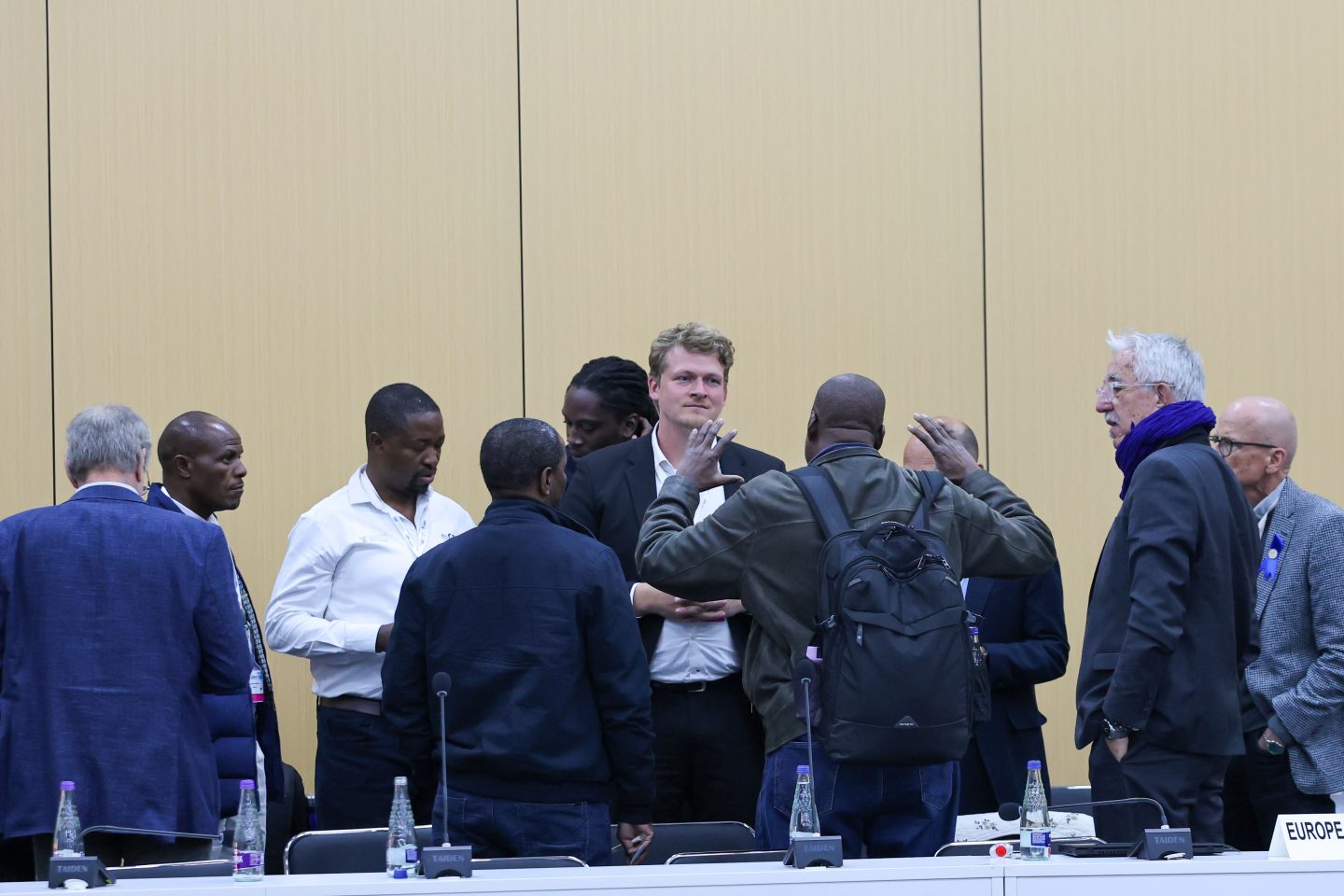
But, in a closing press conference on Friday, the Mongolian minister presiding over talks celebrated that governments had reached consensus on several “contentious” issues and that agenda items blocked at this year’s COP17 would be put on the agenda for COP18 in Egypt.
US blocks agenda items
Other agenda items that divided countries were on measuring land degradation’s effects on women, enhancing the involvement of civil society and women in land COPs, and the UNCCD working more closely and effectively with the UN’s climate and nature conventions.
On the COP’s opening day two weeks ago, the US representative said the Trump government objects to these agenda items “on their premise and no amount of negotiation will allow us to join consensus on these items. As such we request that they be struck from the agenda at which time we will then be able to approve it, saving us valuable negotiating time.”
A US State Department spokesperson later told Climate Home News that the US wants the UN “to get back to basics by refocusing on its core mandate, eliminating overlap, and reducing competition for scarce resources”.
The spokesperson added, “that means prioritising the concrete work member states created [the UN] to do – rather than diverting limited time, attention, and resources toward social and political agendas, including gender-related initiatives.”
On COP’s first day, the European Union and Brazil pushed back against the blocking of these agenda items, with a Brazilian negotiator saying his country attaches “great importance” to them. But the Mongolian presidency directed governments to adopt the rest of the agenda without the controversial items, which were discussed privately with countries throughout the two weeks.
An EU statement, read out later by Irish minister Timmy Dooley, accused “some parties” (meaning national governments) of having adopted a “less constructive approach” and preventing “discussions on important matters from even commencing”.
The agenda items the US refused to engage with were never discussed and were only placed onto the agenda for the next COP on the last day. Those talks will take place in Egypt in two years’ time, with Donald Trump due then to be in his last year as US president.
No restoration without women
The blocking of the gender agenda item has stymied attempts, agreed on by governments at the last COP, to develop gender-specific indicators for the UNCCD’s next overall framework and to facilitate more women delegates at COPs. Women made up only about a quarter of delegates to COP15 in 2022, UNCCD analysis with the latest data shows
Criticising the move to keep gender off the agenda, the EU said in a statement that it welcomes “the attention being given at COP17 to women pastoralists and herders, recognising their contribution to sustainable land management and resilient rural livelihoods”.
The head of the UNCCD, former Egyptian environment minister Yasmine Fouad, said on Friday that “regardless that the agenda item was blocked”, she was proud that she and COP17 President Batmunkh Battsetseg had led the COP as women and attended the gender caucus (a meeting of groups supporting women at the talks).

“Without the women,” she told the closing press conference on Friday, “we will not be able to restore land, restore hope, restore life or restore even our children and grandchildren. And we will keep on pushing that agenda.”
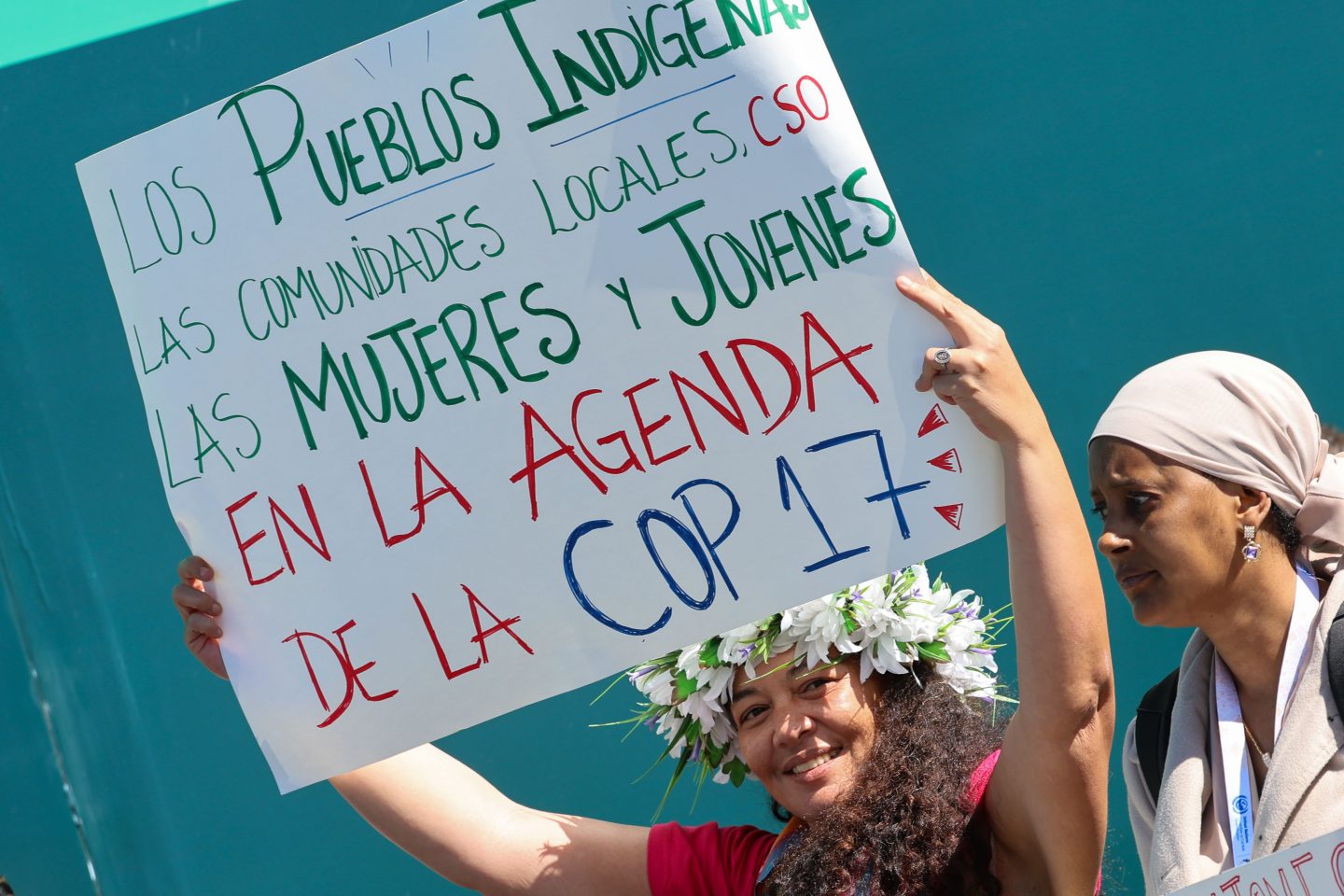
The civil society agenda item aimed to allow NGOs to attend land COP negotiations, as they do at climate COPs, and included terms of reference for an Indigenous Peoples Caucus.
A representative of Indigenous Peoples told the COP’s closing plenary meeting that the group had “deep disappointment that the agenda of this COP has removed the dedicated space for indigenous peoples”. “We cannot restore the land while removing the voices of those who care for it,” she said.
On Tuesday, the UNCCD’s deputy head Andrea Meza was asked about Indigenous Peoples’ participation. She said that the blocking of “one agenda item” is “generating uncertainty in the progress” towards creating caucuses for Indigenous Peoples and for Local Communities within the talks.
Because of the “complex geopolitical situation” making it hard to obtain consensus, coalitions of the willing have become more important, she added.
Mining out, money in
Outside the formal negotiations, the summit was marked by a focus on the strongly Mongolian issues of the role played by pastoralists and rangelands like grasslands, as well as mining, in both degrading and restoring land.
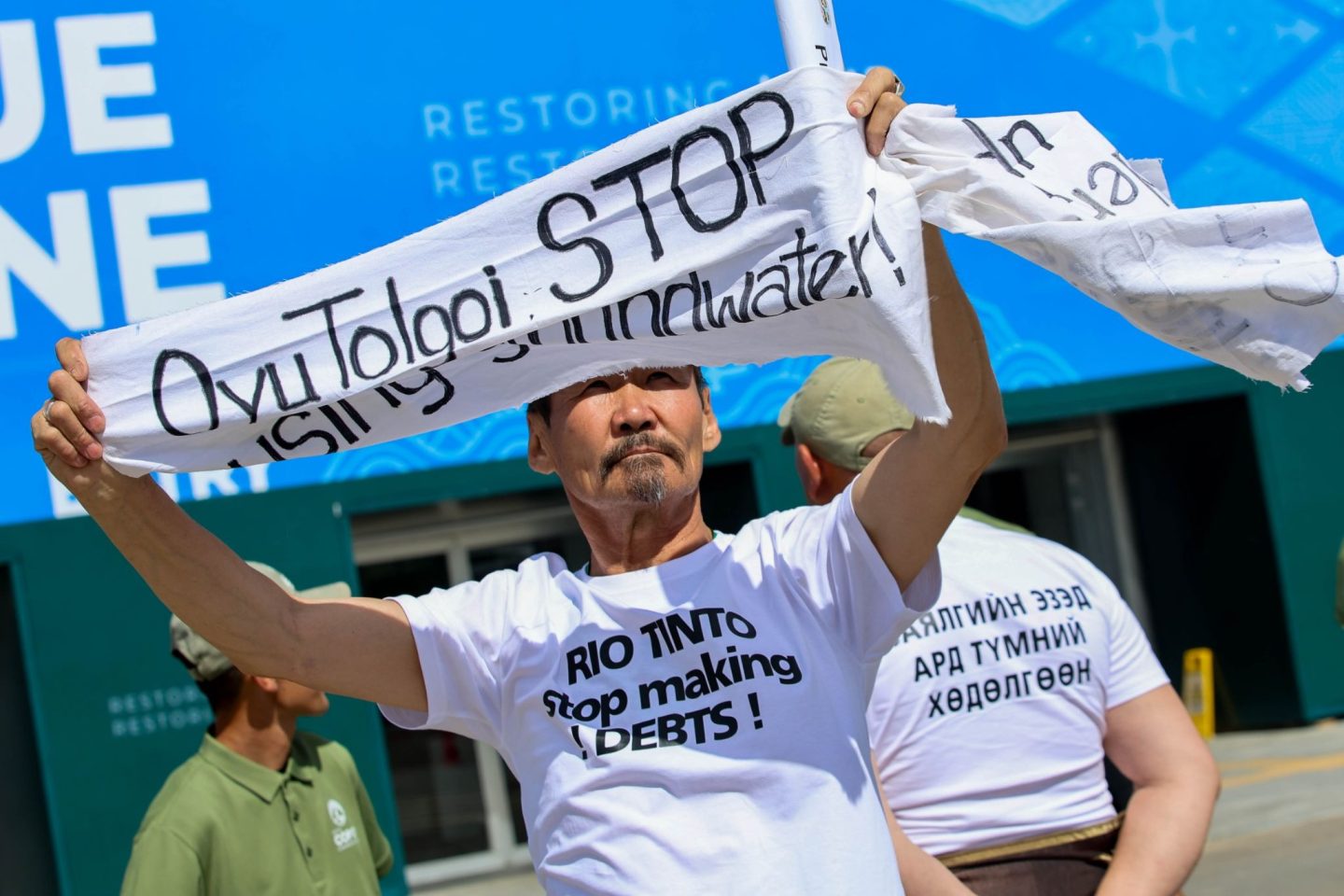
Part of the conference was sponsored by Australian mining company Rio Tinto and its local partner Oyu Tolgoi. Their presence was protested by campaigners wearing T-shirts calling on the companies to “stop wasting drinking water” and to “get out of Mongolia”.
The UNCDD and others praised the success of the summit in raising more finance for land restoration. The COP saw institutions like the Asian Development Bank and Global Environment Facility pledge money to combat land degradation, with the UNCCD estimating that $645 million of new commitments were made.
An estimated $355 billion a year is needed through 2030 to meet global land restoration commitments, compared with around $77 billion currently invested. Private finance accounts for only around 6% of global investment, according to the UNCCD.
UNCCD chief scientist Baron Orr told a press conference that many of the announcements were public-private partnerships that use government money to “even the playing field” for companies that want to protect land, in a bid to ensure they are not disadvantaged compared with those that do not.
Such partnerships are a “huge opportunity”, he said, especially as “we’re not in a moment of public finance – public finance is tight in every country.”
The post Despite African walkout, fractious land COP ends without drought deal appeared first on Climate Home News.
Despite African walkout, fractious land COP ends without drought deal
Burdened by rising fuel import costs and an “ocean crisis” of record-breaking heat, Pacific island nations are seeking to build support for a new regional fund ahead of COP31, intended to channel investment into renewable energy, community resilience and ocean protection, experts said.
Leaders from the 18-member Pacific Islands Forum (PIF), including Australia and New Zealand, are expected to issue a call for global pledges to the Pacific Resilience Facility (PRF) at a high-level meeting this coming week in Palau, seeking to build a new model for financing climate action.
The new regional fund was formally launched in May this year and is meant to “serve communities at a community level”, swiftly channelling investments for their projects on the ground, according to Fiji’s assistant minister for foreign affairs, Lenora Qereqeretabua.
“We are expecting pledges for the PRF, and these funds will go to communities that apply,” she told journalists at an online briefing. “We have organised it in such a way that it makes our application processes much, much easier than applying for global funding.”
Qereqeretabua added that she expects that PRF funds will be “utilised by communities to protect themselves from climate change and the effects of climate change.”
The Pacific Islands Forum meeting is expected to shape the region’s priorities ahead of this year’s pre-COP, hosted by Fiji and Tuvalu, and COP31, which will be co-led by Australia and Türkiye.
At COP31, a dedicated session on the climate finance needs of small island states will seek to drive pledges into the PRF. The fund has so far received about $172 million in capital – with about $67 million coming from Australia – and aims to close the year with $500 million.
-
Battle over cleaning up shipping set to resume at London talks
The US and Saudi Arabia want to scrap shipping’s Net-Zero Framework and have swung behind a far less ambitious alternative -
As marine heat breaks records, countries seek ocean roadmap at COP31
Africa and the EU are leading a push for COP31 to deliver a roadmap that lays out measures to protect fast-warming oceans -
Indonesia’s nickel production cuts are not enough to create a sustainable industry
The government is restricting nickel production to push up prices but producing more sustainable nickel for a premium requires addressing the industry’s coal issue


Ocean heat and fossil fuel shocks
Leaders from the Pacific will meet in Palau from Sunday amid an “ocean crisis” of record-breaking ocean heat caused by this year’s “super El Niño”, according to Kevin Chand, Pacific ocean policy director at National Geographic’s Pristine Seas conservation project.
Leaders at the PIF are expected to put forward commitments towards new marine protected areas, which will be key for shielding ecosystems from future climate extremes, Chand said. The forum is expected to issue a statement on the need for ocean action at COP31, and announce commitments towards reaching the global goal of protecting 30% of the planet’s land and sea ecosystems by 2030.
Rising ocean heat could lead to food insecurity and lost government earnings in the region, as key fish stocks like tuna start migrating away from their coastline in search of colder waters, said Coral Pasisi, director of climate change and sustainability at the Pacific Community (SPC).
Climate shocks are deepening existing economic pressures, as Pacific nations have spent up to a quarter of their GDP on fossil fuel imports due to the war in Iran, according to a recent report by the University of New South Wales (UNSW) in Australia.
Wesley Morgan, one of the study’s authors, told journalists that partner nations “ought to be putting their money where their mouth is”, and should support the energy transition in the Pacific by covering the upfront costs of switching from polluting diesel to solar power, batteries and electricity grid upgrades.
China keeps Indonesia’s battery dream afloat but future less certain
Given the increase in climate-related shocks and sea-level rise, the PIF should also mention the need to phase out fossil fuel extraction and consumption, said Sindra Sharma, international policy lead at the Pacific Islands Climate Action Network (PICAN).
Last year’s COP30 failed to deliver a global roadmap on transitioning away from fossil fuels, which led to a group of countries – including several Pacific island nations – pursuing their own fossil fuel phase-out summit in Santa Marta, Colombia. Next year’s conference will be hosted by Tuvalu and co-chaired by Ireland, which should also receive backing from the PIF, Sharma said.
Both the chairs of the Santa Marta coalition and the Australian COP31 co-presidency have vowed to continue a push for this topic to be discussed at COP31.

New fund to test allies
As local communities in the Pacific struggle to access global climate funds, the PRF’s planned model for quick, direct disbursements has “very solid and good” intentions, Sharma said, but it will need political and financial backing from donor countries.
“The proof is going to be when the fund actually starts operating and delivering to communities,” she added. “If there is too much bureaucracy in being able to access the funds, for example. These things will have to be scrutinised.”
The facility aims to deliver funds in two categories: one for climate adaptation and “disaster resilience”, and another for social and community resilience that includes areas like community capacity-building, education, data analytics and financial management, among others. It will launch its first call for proposals at the PIF.
Morgan added that Australia will need to “leverage global interests” so that funding is directed to the Pacific Resilience Facility “or else the Pacific won’t be able to trust Australia as a partner”. The country ratified the PRF treaty in May, triggering its entry into force.
“The perception [of Australia] in the region is genuinely divided, and it’s worth being honest about it,” Sharma said, adding that the pre-COP31 in Fiji, which is usually limited to a technical space for negotiations, will determine how meaningful Australia’s advocacy for the Pacific can be.
This time, Pacific nations want to use the pre-COP in early October as an opportunity to demonstrate the challenges their largely low-lying islands face and to advocate for their political priorities, including a renewed global effort to limit global warming to 1.5C by cutting emissions faster and deeper. World leaders are due to visit Tuvalu to experience the frontline of rising sea levels, although Australia and Fiji have yet to confirm who will attend.
“In Bonn, Australia was largely missing on the negotiated outcomes that we so urgently need to see. It’s not enough to get Pacific priorities on the agenda. Agenda placement is not delivery,” Sharma added.
The post Pacific islands seek backing for new regional fund ahead of COP31 appeared first on Climate Home News.
Pacific islands seek backing for new regional fund ahead of COP31
Climate Change
Climate change exposes 580 million children to 20 extra ‘heat-stress days’ every year
More than 40% of children under the age of 10 globally are already experiencing at least 20 additional “heat-stress days” due to climate change.
This is according to a new attribution study, published in Science Advances, which combines climate models with demographic data to assess the age groups and regions that are exposed to the most hot, humid days.
The study finds that children up to the age of nine already face more additional heat-stress days globally as a result of climate change than any other age group.
It adds that south Asia and west Africa are recording the greatest childhood exposure to dangerous levels of humid heat – largely because these regions have a rapidly growing population with the highest proportion of young children.
As the climate warms, children will continue to be more exposed to heat stress than any other age group, the paper warns.
The lead author of the study tells Carbon Brief that the findings should inform discussions about climate justice, noting that children in developing countries “have contributed the least to historical greenhouse gas emissions”.
Humid heat
High temperatures can be deadly. For example, the heatwaves that swept across Europe in the summer of 2026 have been linked to tens of thousands of “excess deaths”.
A prominent 2021 study found that children born in the 21st century will be exposed to more extreme weather events in their lifetimes than their parents and grandparents.
Four years later, a study conducted by scientists from the same team found that more than half of children born in 2020 – around 62 million people – will experience “unprecedented lifetime exposure” to heatwaves, even if warming is limited to 1.5C.
Now, the latest research from the same team finds that children already face greater exposure to dangerous levels of humid heat than adults as a result of human-caused climate change.
Extreme heat is particularly dangerous when combined with high humidity. In hot weather, the human body produces sweat to cool itself down. However, as humidity increases, sweating becomes less effective.
The study uses wet-bulb globe temperature – a measure of temperature that takes humidity and wind into account – to calculate heat stress. It defines a “heat-stress day” as any day with a wet-bulb globe temperature above 28C, as this is considered the threshold for “moderate heat stress”
The authors then use climate models to simulate global temperature patterns in the present-day climate. (The authors use the climate of 2023, in which human activity has caused 1.3C of warming, to represent the “present-day”.)
They then count the number of heat-stress days that each country records on average, per year. The authors then repeat this exercise, simulating a pre-industrial climate without human-caused warming.
By comparing the number of heat-stress days in the present-day climate with the number in a pre-industrial climate, the authors can determine how many extra heat-stress days were driven by climate change. They refer to these as “extra” or “attributable” heat-stress days.
The authors find that “low-latitude” countries, located in the tropics, record the most extra heat-stress days.
For example, the paper finds that people living in Côte d’Ivoire currently face 112 heat-stress days every year. It adds that around half of these are due to human-caused climate change.
In contrast, Germany sees only 0.1 heat-stress days per year in today’s climate on average, which is largely attributable to human-caused climate change.
Rosa Pietroiusti, a PhD student at Vrije Universiteit Brussel and lead author on the study, explains why this number may seem lower than expected.
She tells Carbon Brief that the paper “really focuses on humid heat, at levels that are relatively rarely felt in Europe”. She adds:
“Our data also doesn’t capture the urban heat island effect, due to the resolution of the data we use, which also would lead to underestimations of heat stress locally, and lead to a mismatch with what people are experiencing at local scales, particularly in cities.”
Inequality
Extreme heat affects some people more severely than others. Children, people over 65 and those with pre-existing medical conditions or certain disabilities are among the most vulnerable. This is because their bodies are less able to regulate their temperature.
The authors use gridded demographic data to determine the age structure of each country. From this, they calculate how many people from each age cohort are exposed to extra heat days as a result of climate change.
The research finds that globally, 583 million children under the age of 10 already live through at least 20 attributable heat days every year. This accounts for 44% of all children in this age bracket.
In comparison, 190 million people aged 60-69 face at least 20 attributable heat days per year, accounting for 30% of this age cohort.
The authors find that children face the greatest exposure to humid heat for two main reasons.
First, there are more young people alive today than older people, with 1.3 billion children aged under 10 in the world, compared to 0.6 billion people aged 60-69.
Second, they find that countries in Africa and Asia typically have rapidly growing populations with more young children. In contrast, many countries in the northern hemisphere – which are typically cooler – have older populations.
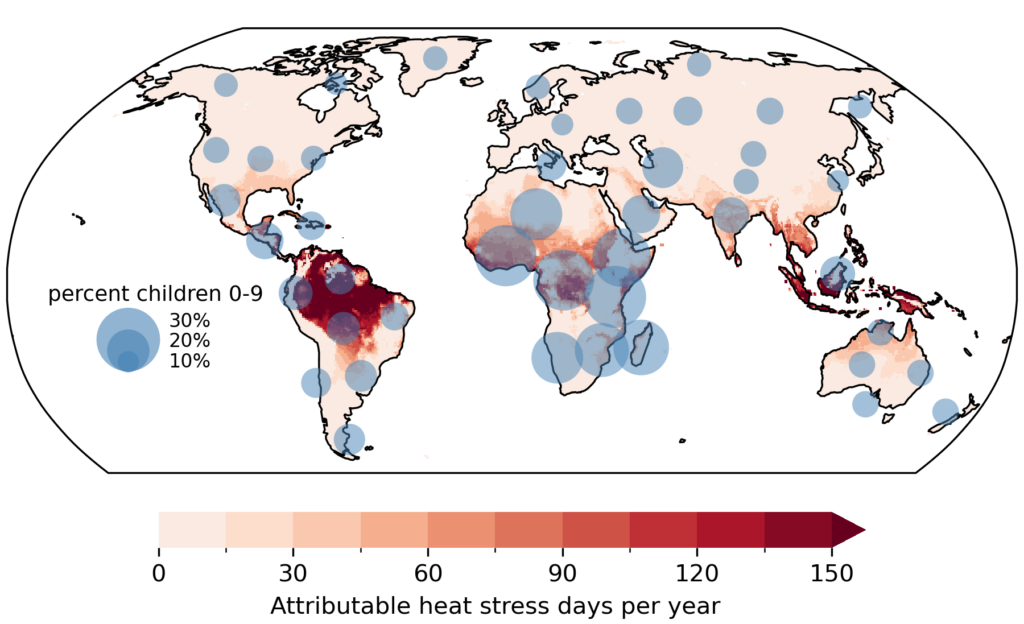
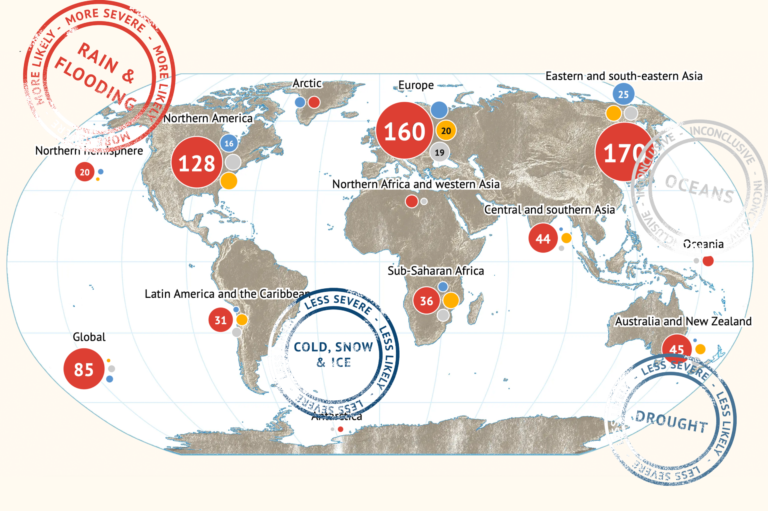
The map below shows how many extra stress heat days each country currently faces as a result of human-caused climate change. Darker reds indicate a higher number of attributable heat days. The blue circles show the percentage of the population under the age of 10, with larger circles indicating a higher percentage.
Warming world
The authors also repeat their analysis for a 1.5C and 2C warmer world. They use population estimates from the SSP2 scenario, which projects that the world’s population will peak at more than nine billion in the second half of the 21st century, with most growth occurring in low-latitude regions – especially in sub-Saharan Africa.
The research finds that, in today’s climate, 11% of all under 10s currently experience 100 or more extra heat-stress days per year due to climate change. In worlds warmed by 1.5C and 2C, the percentage rises to 13% and 23%, respectively.
In contrast, only 6% of all people aged 60-69 currently face 100 or more extra heat-stress days each year due to climate change. This number rises to 9% and 17% for 1.5C and 2C worlds, respectively.
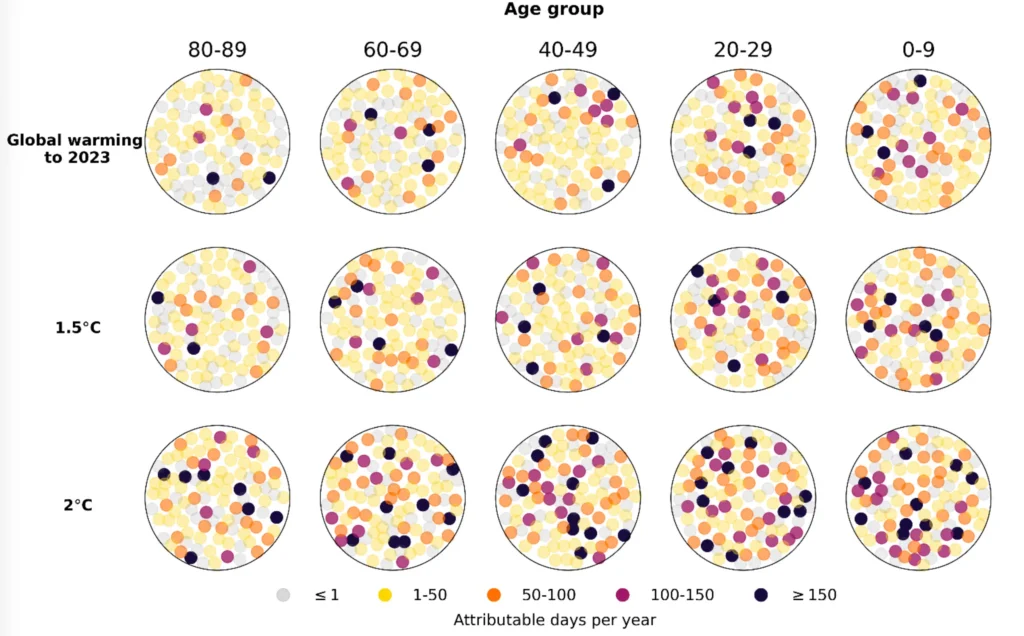
These results are shown in the plot below. The three rows represent the climates of 2023 (top), a 1.5C world (middle) and a 2C world (bottom). The columns show different age cohorts, from the oldest on the left to the youngest on the right.
Each circle contains 100 coloured dots, with each dot representing 1% of the age cohort.
The colour of the dot represents exposure to annual heat-stress day, with darker dots indicating more heat-stress days. Grey dots mean that people experience fewer than one extra heat-stress day per year due to human-caused climate change, while black dots mean more than 150 extra heat-stress days due to climate change.
The figure shows that higher warming levels expose more people to heat stress and that younger cohorts tend to be worst affected.
For example, the top-right circle represents heat stress for under 10s in the present-day climate. Three of these dots are coloured black, indicating that 3% faced at least 150 attributable heat-stress days in 2023.
Pietroiusti tells Carbon Brief the study uses wet-bulb temperature because it is a “well-established heat stress metric”. However, she notes that it was not “explicitly defined to focus on children”. She continues:
“A really important step forward in the research community would be to link up climate science and health science experts to do research on what metrics are really most representative of, for example, health impacts and educational impacts that children will be suffering.”
Vulnerability
Dr Qinqin Kong, a postdoctoral researcher at the departments of medicine and health policy at Stanford University, who was not involved in the study, praises its “robust” methodology.
He tells Carbon Brief that the research provides “a timely quantitative evidence for discussions of climate justice, children’s rights and intergenerational equity”.
However, Kong suggests that the paper “may overstate the contrast between children and the elderly and underestimate the relative burden of older adults”.
He says:
“The elderly may also be more vulnerable due to their social circumstances. Children often benefit from parental supervision and caregiving, whereas many older adults live alone, have limited mobility and face barriers to accessing cooling or emergency assistance during heat events.”
Kong also notes that “people and societies in the mid-latitudes [for example, across much of Europe and North America] are less adapted to heat”, which may make them vulnerable to its impacts.
For example, he says that Europe “shows substantially stronger relative risk of heat mortality likely due to less heat-acclimatised populations, lower air conditioning prevalence and urban designs that don’t favour heat dissipation”.
Similarly, Dr Daniel Vecellio – a researcher at the University of Nebraska, who was not involved in the study – tells Carbon Brief that children are an “understudied cohort”.
However, he says there is “reason for hope” because “children are typically pretty good behavioural adapters to extreme heat” and because people who are “chronically exposed to extreme heat” will “have a better chance at better acclimatisation”.
Pietroiusti tells Carbon Brief that global reporting on heatwaves is often skewed towards wealthier nations.
For example, she notes that large-scale databases of disasters, such as EM-DAT, often underrepresent heatwaves in Africa, due in part to a lack of news coverage and formal reporting. She adds:
“Studies like this, which start from the climate data, can start to fill some of these gaps.”
She adds that the paper should inform discussions about climate justice, noting that children in developing countries, who are most severely affected by the increase in heat-stress days, “have contributed the least to historical greenhouse gas emissions”.
Pietroiusti, R. et al. (2026) Age-specific exposure to human-induced increases in humid heat, Science Advances, doi:10.1126/sciadv.aeb3232



The post Climate change exposes 580 million children to 20 extra ‘heat-stress days’ every year appeared first on Carbon Brief.
Climate change exposes 580 million children to 20 extra ‘heat-stress days’ every year



-
Climate Change1 year ago
Guest post: Why China is still building new coal – and when it might stop
-
Greenhouse Gases1 year ago
Guest post: Why China is still building new coal – and when it might stop
-

 Greenhouse Gases2 years ago
嘉宾来稿:满足中国增长的用电需求 光伏加储能“比新建煤电更实惠”
-

 Climate Change2 years ago
嘉宾来稿:满足中国增长的用电需求 光伏加储能“比新建煤电更实惠”
-
Climate Change2 years ago
Bill Discounting Climate Change in Florida’s Energy Policy Awaits DeSantis’ Approval
-

 Renewable Energy10 months ago
Sending Progressive Philanthropist George Soros to Prison?
-
Greenhouse Gases1 year ago
嘉宾来稿:探究火山喷发如何影响气候预测
-

 Carbon Footprint2 years ago
US SEC’s Climate Disclosure Rules Spur Renewed Interest in Carbon Credits