Connect with us

Published

on

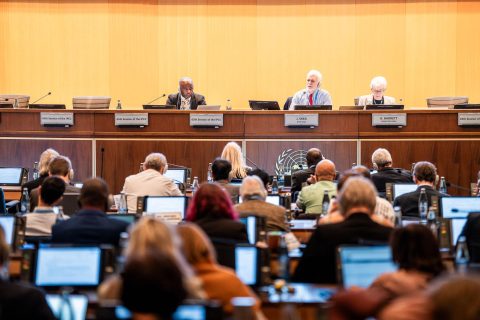
The board of the UN’s fledgling Fund for Responding to Loss and Damage (FRLD) has decided to consider its first package of projects for support at its next meeting in December, confounding expectations that it might back an initial set of four proposals this week.

The fund faces a substantial dilemma about how to select projects to receive its limited resources after its first call for proposals saw nearly 180 submissions requiring around $2.8 billion. It currently has only $250 million available to allocate, although the board agreed on Friday to release $100 million more in the face of overwhelming demand.

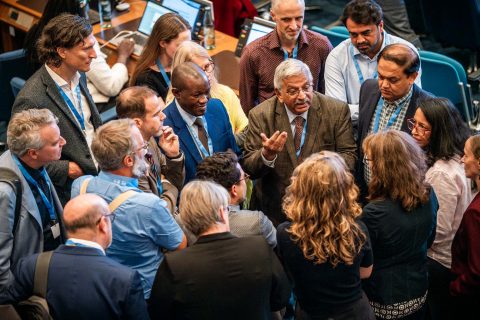
Much of the three-day board meeting in Manila was held behind closed doors, making it difficult for civil society experts present to know what was happening. Draft decisions were projected on a screen and finalised at the end of the meeting before being adopted on Friday.

During the closing session, government board members and observers alike expressed frustration at the huge gap between the growing needs of communities struggling with worsening climate change disasters and the paltry amounts on offer to help them recover.

    At an initial pledging session at COP28 in 2023, wealthy governments offered around $820 million to the fund, of which only 55% has been delivered into its coffers.

    “Every proposal represents real people,” who are expecting in good faith to receive resources from the fund, said Milagro Matus from Belize, calling for its ambition to be strengthened.

    Mismatch between needs and contributions

    Several other board members, especially from developing countries, as well as climate justice advocates expressed disappointment over the fact that the fund has so little to spend and called for efforts to increase contributions from rich nations.

    The fund will consider how to mobilise more resources in the short term, as well as a longer-term replenishment process, at its December meeting.

    Richard Sherman of South Africa, the board’s former co-chair and now a board member, had proposed a high-level pledging session for the FRLD to take place before the COP31 climate summit in November but this now seems unlikely to happen as it was not included in Friday’s decisions.

    Adao Soares Barbosa of Timor-Leste said this week’s board meeting – its ninth – should show the world that more financial contributions are required as collective needs to tackle loss and damage are far higher.

    Iran war fuel shocks threaten Africa’s clean cooking push, IEA says

    He called for enough extra money to be found so that at least one project can be approved for each least-developed country and small island developing state, which have so far submitted 72 proposals between them. Half of the fund’s resources are meant to be reserved for those two groups of especially vulnerable nations.

    Brandon Wu, ActionAid USA’s director of policy and campaigns, said the board’s decision not to opt for quick approval of the first four projects presented “is the most obvious example of how developed countries’ failure to adequately resource the FRLD is constraining a fund that was meant to be the central flagship institution responding to climate impacts across the Global South”.

    More time to consider proposals

    Other board members spoke about the uncomfortable situation the fund faces in having to select projects from such a huge number, introducing “unhelpful competition” into the process. Isaac Glassie-Ryan of the Cook Islands said he was concerned that the approval process pits “the vulnerable against the vulnerable” and argued that each project should have “a fair shot at equal treatment”.

    The FRLD’s secretariat checks project documentation and ensures they qualify for funding, but it remains unclear exactly how projects will then be chosen for the board to approve and in what order. The next meeting has been postponed from October to mid-December to allow more time for a first set of proposals to be prepared for the board to examine.

    The extent of FRLD resources available means that only around 15-20 projects are likely to be approved at that meeting, as there is a limit of $20 million per proposal.

    Friday’s decision noted the “need for the fair and equal treatment of all funding requests” under review by the secretariat and requested that the initial set of projects backed by the FRLD should test diverse approaches and ways of providing its money.

    Civil society frustration

    At the end of the Manila meeting, civil society observers said they were dissatisfied with both the slow speed of approvals and their exclusion from a large part of the discussions. Harjeet Singh, global convenor of the Fill the Fund campaign and founding director of India’s Satat Sampada Climate Foundation, called the meeting “deeply disappointing and frustrating”, saying it had been non-transparent and non-inclusive. 

    A number of board members supported that complaint, saying the issue needed to be addressed and a policy for civil society participation in board meetings agreed.

    As blue economy gathers pace, communities must benefit from ocean boom, activists say

    Board co-chair Camila Rodríguez Tavárez said the issue would be considered. She described the meeting as “productive” yet “challenging”, adding that a lot of progress had been made and the board had been able to arrive at “a balanced set of decisions”.

    Singh nonetheless lamented that the FRLD has not yet “been able to provide a single penny to people who are suffering right now”.

    The post Loss and damage fund delays first project approvals as needs dwarf resources appeared first on Climate Home News.

    Loss and damage fund delays first project approvals as needs dwarf resources

    Continue Reading

    Climate Change

    Test of nature law standards is major curb on deforestation

    Published

    on

    SYDNEY, Thursday 20 August 2026 — Commenting on the release of the government’s final nature law standards made today, including for Matters of National Environmental Significance, the following lines can be attributed to Glenn Walker, Head of Nature at Greenpeace Australia Pacific:

    “Ultimately the test of the new nature law standards will be whether they materially bring down Australia’s shockingly high rates of deforestation caused by bulldozing for beef and logging of native forests.

    “Deforestation severely threatens the forest homes of some of Australia’s most threatened species including the koala, greater glider and swift parrot. In Queensland the bulldozing of forests is causing mass erosion and the run off of hundreds of thousands of tonnes of muddy soil on the Great Barrier Reef each year.

    “Unless these standards deliver protection for the Great Barrier Reef from deforestation runoff and ensure the healthy recovery of wildlife under threat then they will have failed.

    “There’s clear improvement on the draft standards that were released, which we welcome, but what we have today still falls well short of what would be optimal. In particular, the heavy reliance on offsets and the failure to address the cumulative impacts of hundreds of instances of deforestation–death by a thousand cuts–create serious ongoing weaknesses in the way the standards work. The acid test will now be in the operation: will the standards succeed in stopping deforestation, or not.

    “The effectiveness of the nature law reforms hang heavily on these standards. We will be watching closely as they are implemented and raising the alarm on any failure to curb deforestation.”

    -ENDS-

    Test of nature law standards is major curb on deforestation

    Continue Reading

    Climate Change

    Collective global roadmap can boost Cambodia’s energy transition goals

    Published

    on

    Phalkun Out is manager of energy policy and government relations at EnergyLab Asia.

    Cambodia has made impressive strides in transitioning from dirty coal and imported electricity to homegrown renewable energy that now accounts for nearly half of the electricity mix. The kingdom has a target to source 70% of its total power capacity from renewables by 2030. This is achievable but requires global support and cooperation.

    The recent momentum on developing a formal process to assist countries in transitioning away from fossil fuels (TAFF) is very encouraging. The roadmap process championed by the COP30 Brazil presidency and at the Santa Marta conference in Colombia shows a clear appetite among countries to invest in a just and orderly transition.

    The current energy crisis provides a stark reminder of how relying on imported fossil fuels, like oil and gas, puts at risk our economic competitiveness and energy security. The impact on families, particularly poorer households, has been devastating as they struggle to pay for transport, food and electricity.

      Even as Cambodia has been able to shield itself from the worst impacts, thanks to its renewable investments, this moment is still a wake-up call for all of Southeast Asia, which has experienced a devastating oil shock twice in a decade.

      Given the turbulent times ahead, the region cannot afford a return to the status quo of high dependence on foreign fuel supplies. As a clean energy leader, Cambodia can play a critical role in elevating the importance of clean energy transition at the regional level.

      Cambodia cannot go it alone

      A new international governance framework and coordinated transition plans are essential for Cambodia and the rest of Southeast Asia to achieve a just and orderly transition. There are structural barriers that need to be overcome swiftly.

      However, to reach Cambodia’s 70% renewables target, the government plans to overcome structural hurdles – upgrading grid infrastructure, managing limited fiscal space, and addressing the high upfront capital costs of renewable energy – that require more than local effort.

      Concessional loans and grants similar to the $110-million World Bank credit to Cambodia for the Sustainable Energy Transition Project, approved in June 2026, are crucial to help build smart grids, high-voltage transmission lines and large-scale battery energy storage systems, needed to make the most of the new renewables coming online.

      Global initiatives like the COP31 Türkiye presidency’s plans to champion electrification and a global target for electricity to provide 35% of final energy consumption by 2035 are commendable. But they still need to be understood in terms of what opportunities and support this could offer for countries like Cambodia.

      Drone shot of solar-powered water pumping and irrigation stations implemented by SOGE in Batheay Commune, Batheay District, Kampong Cham Province, Cambodia
      (Photo: EnergyLab Asia)

      Drone shot of solar-powered water pumping and irrigation stations implemented by SOGE in Batheay Commune, Batheay District, Kampong Cham Province, Cambodia
      (Photo: EnergyLab Asia)

      Cambodia has seen progress on electrification, recording a 127% increase in year-on-year electric vehicle registrations in 2025. And, to sustain the renewable energy momentum, the government eliminated import taxes and duties on solar and energy storage technologies in April, which analysts predict will slash total renewable project costs by an estimated 7% to 30%.

      Energy think-tank Ember has also noted a trend across Asia in which countries that built the skills to make electronics then moved into electric technologies, manufacturing solar panels, heat pumps and electric vehicles. This suggests Cambodia could follow with the right government financial and policy support.

      However, for these trends to continue and even accelerate, continued international financial and technical support for countries like Cambodia is also essential.

      COP31 can enhance cooperation and support

      At COP30 last November, Brazil agreed to develop a global roadmap on transitioning away from fossil fuels, and several countries made it clear this was a priority for them.

      The Brazil COP30 presidency previewed its roadmap at the Bonn climate talks in June, championing the roadmap as a flexible implementation tool adaptable to national circumstances. This guide can be used by countries like Cambodia to structure its transition and tackle technical barriers.

      Southeast Asia’s fragile grids threaten billions in clean energy investment

      The Turkish and Australian COP31 presidencies this year have the opportunity to transform the roadmap and prevent the issue from being sidelined at the summit in Antalya. The world needs a coordinated process that can sustain deliberate planning, technology transfer and adequate public investment.

      For regions like Southeast Asia and Africa, the transition is not just a climate obligation; it is an economic necessity that requires the world to stop talking and start building.

      The post Collective global roadmap can boost Cambodia’s energy transition goals appeared first on Climate Home News.

      Collective global roadmap can boost Cambodia’s energy transition goals

      Continue Reading

      Climate Change

      China keeps Indonesia’s battery dream afloat but future less certain

      Published

      on

      When a South Korean firm pulled the plug on a multibillion-dollar investment last year, it was a major blow to Indonesia’s plans to build an integrated battery-manufacturing ecosystem – until a group of Chinese companies stepped into the breach.

      Project Titan aims to tap Indonesia’s vast nickel reserves in East Halmahera – the epicentre for mining the sought-after metal – before shipping refined and processed material to make batteries for electric vehicles (EVs) more than 2,000 kilometres away in a factory in West Java.

      Even before South Korean battery firm LG Energy Solution scrapped its planned $8.45 billion investment in Project Titan, citing “various factors” including market conditions, years of stalled feasibility studies had cast doubt on the initiative – a pillar of Indonesia’s goal to use its nickel riches to become a global battery manufacturing hub and a base for EV production in the region.

      The $6-billion investment and cooperation framework struck earlier this year between state companies and a Chinese consortium keeps Project Titan alive, but it also highlights Indonesia’s heavy dependence on China for capital, technology and materials in battery manufacturing.

        “We get cash but there is no tech transfer or skilled labour jobs,” Zulfikar Rakhmat, director of the China-Indonesia Desk at the Jakarta-based Center of Economic and Law Studies, told Climate Home News. Indonesia’s dependence on China for funding, nickel smelting and processing capacity is “almost total”, he added.

        And at a time when cheaper nickel-free battery alternatives are winning over the EV market, China’s outsized role could bring additional commercial risks for Indonesia’s emerging battery industry.

        “If Indonesia’s battery chain is seen as entirely Chinese-owned and coal-powered, its product will struggle to enter the Western markets,” Rakhmat added, referring to efforts by countries, including the European Union, to break their dependence on Chinese cleantech and reduce imports of carbon-intensive goods.

        A Chinese tale of two halves: steel and batteries

        Chinese investment in industrial projects to develop Indonesia’s nickel reserves – the world’s largest – is not new.

        China was “the main engine” behind the country’s successful push to refine its nickel domestically after the government banned the export of raw ore in 2020, said Berlin Syahputra Situmorang, a researcher at the Indonesian Initiative for Sustainable Mining.

        China, which imported most of Indonesia’s raw nickel ore prior to the ban, invested billions of dollars in building the country’s refining capacity.

        Large, mostly coal-powered industrial parks sprang up near mines to refine nickel, some of which have been associated with extensive environmental and human rights abuses.

        Chimneys from a smelter emit smoke from burning coal to refine nickel at the Indonesia Weda Bay Industrial Park (IWIP) in Weda Bay, on Halmahera Island, North Maluku, Indonesia
        A smelter burning coal to refine nickel at the Indonesia Weda Bay Industrial Park (IWIP) in Weda Bay, on Halmahera Island, North Maluku, Indonesia (Photo by Muhammad Fauzy/NurPhoto)

        By 2025, Indonesia produced two-thirds of the world’s raw nickel supply and boasted 43% of nickel refining capacity. Yet three-quarters of the country’s refining capacity is controlled by Chinese firms, according to research by the Washington-based research organisation C4ADS.

        And while the Indonesian government talked about developing its mineral wealth to power the batteries needed for the energy transition, Indonesia’s real success was to develop a stainless steel industry, the biggest consumer of nickel globally.

        More than 80% of Indonesia’s nickel supplied the stainless steel sector in 2025, with only 17% going into the EV battery supply chain, according to analysis by the Centre for Research on Energy and Clean Air (CREA).

        “It’s a tale of two different parts,” said Lloyd Hain, managing director of Xenith Market Services, an Australian mining and supply chain consultancy. “Indonesian stainless steel goes all over the world. The battery side, however, has been a completely different story.”

        An emerging battery ecosystem

        Developing a battery industry has proved a lot more difficult. Several plants to process nickel into battery-grade materials are planned or under construction across the country, but many remain at early stages of development.

        Still, Indonesia’s battery exports exceeded $1 billion in 2025, according to data from the UN Comtrade Database. By 2028, CREA estimates that 30% of Indonesia’s nickel production will go towards making battery materials.

        The nation’s first battery cell plant in Karawang, West Java, began operating in 2024. It was developed by South Korean car maker Hyundai and LG Energy Solution, which continues to operate the facility despite withdrawing from Project Titan.

          Project Titan, the flagship integrated battery project, aims to develop 20 gigawatt hours (GWh) of capacity to produce nickel-based EV batteries as well as energy storage batteries to support the country’s goal of rolling out 100 GW of solar capacity in the next four years. 

          Under the deal agreed this year, it will be operated by Indonesian state companies and a consortium including China’s Zhejiang Huayou Cobalt and battery manufacturer EVE Energy.

          Another $5.9-billion joint venture between state firms and a consortium led by Chinese battery giant CATL will develop nickel mining, processing and a battery-recycling factory in East Halmahera as well as a 6.9 GWh battery facility in Karawang, with plans to scale. 

          Former Indonesian President Joko Widodo shakes hands with Hyundai Motor Group Executive Chair Euisun Chung on a stage with Indonesia flags in the background during the launching of Indonesia's first EV battery cell production plant in Karawang, West Java province
          Former Indonesian President Joko Widodo shakes hands with Hyundai Motor Group Executive Chair Euisun Chung during the launch of Indonesia’s first EV battery cell production plant in Karawang, West Java province (Photo: REUTERS/Ajeng Dinar Ulfiana)

          Collaboration with Chinese firms “is expected to encourage technology transfer so that national companies can become leaders in their own country”, Minister of Energy and Mineral Resources Bahlil Lahadalia said in a statement about Project Titan.

          Foreign companies investing in Indonesia are required to partner with the Indonesia Battery Corporation (IBC), a state-owned enterprise made up of state mining and energy firms, tasked with establishing the capabilities for developing a battery and EV ecosystem.

          It is the complexity of making batteries that underlies Indonesia’s dependence on Chinese know-how, said Situmorang of the Indonesian Initiative for Sustainable Mining. 

          Without a transfer of technology, Indonesia “risks remaining dependent on external players for the most advanced parts of the value chain”, Situmorang told Climate Home News.

          Forging a path of its own

          Indonesia’s reliance on China does not stop at money and technical knowledge. It also relies on Chinese imports of key battery materials, such as lithium and graphite.

          That means Indonesia should aim to diversify its investment partners by working more closely with South Korean companies and seek long-term lithium and graphite supply deals with major producers such as Australia, said Rakhmat of the Center of Economic and Law Studies.

          It must also invest in domestic research and development as well as nurturing its own engineering talent, he added.

          A worker in a hard hat and red jacket inspects large bags of nickel subsulfide at a nickel smelter in Sorowako, South Sulawesi province, Indonesia
          A worker inspects large bags of nickel subsulfide at a nickel smelter in Sorowako, South Sulawesi province, Indonesia (Photo: REUTERS/Ajeng Dinar Ulfiana)

          Eventually, however, the Indonesian government will need to decide whether it wants to integrate its battery ecosystem “completely and unconditionally” into China’s EV supply chain “or go its own way”, said Shen Wei, a research fellow at the UK-based Institute of Development Studies.

          He warned that it would be “inherently difficult” for Indonesia to continue to learn from China while simultaneously trying to compete with it.

          In a sign of tension between Indonesia’s efforts to capture more value from its resources and the Chinese firms that have bankrolled the industry’s expansion, the Chinese Chamber of Commerce wrote to President Prabowo Subianto in May warning that recent policies, including a sharp reduction in nickel ore production quotas to push up prices, could undermine existing projects and future investment.

          The Chinese Chamber of Commerce in Indonesia did not respond to a request for comment, nor did Indonesia’s Ministry of Energy and Mineral Resources or the Ministry of Investment and Downstream Industry. 

          A damaging myth: “Nickel is everything, forever”

          The rapid shift towards nickel-free EV batteries poses another threat to Indonesia’s plans.

          China is driving global adoption of lithium iron phosphate (LFP) batteries, a battery chemistry which relies on more common materials, is cheaper to produce and is better suited for frequent charge and discharge, making it an attractive alternative to power electric two- and three-wheelers, urban EVs and stationary power storage.

          LFP batteries accounted for more than 55% of EV batteries deployed globally last year, driven by China and imports of Chinese-made vehicles by emerging market countries, according to the International Energy Agency. They also accounted for about 90% of battery storage deployment.

          “If Indonesia stays too fixed on a ‘nickel equals EV future’ mindset, there’s a risk of missing where the bulk of the market is actually going,” Situmorang said, noting that in Indonesia, most of the EVs sold in 2025 used LFP batteries.

          Nickel-based batteries, which can pack more energy in each battery, are still in demand for long-range and premium EVs popular in the US, Europe and upper-end Asian markets. Outside China, almost 80% of EV batteries used nickel-containing types in 2025.

          Rakhmat said Indonesia is adapting its manufacturing strategy, targeting its nickel-based batteries for the export market and boosting production of LFP batteries to meet domestic demand. 

          Several Chinese firms are already investing to manufacture LFP batteries in Indonesia.

          But Rakhmat said the realisation of changes in the market “came very late” and that many local officials still incorrectly believe that “nickel is everything and forever”.

          Without a robust industrial policy and a strategy to create sustained domestic demand for “Made in Indonesia” batteries, “there is a possibility that we will be left behind,” he warned.


          Main image: A view over the PT Virtue Dragon nickel industrial complex in Konawe, Southeast Sulawesi, Indonesia (Photo: Ulet Ifansasti/Getty Images)

          The post China keeps Indonesia’s battery dream afloat but future less certain appeared first on Climate Home News.

          China keeps Indonesia’s battery dream afloat but future less certain

          Continue Reading

          Trending

          Copyright © 2022 BreakingClimateChange.com