



- What timeline options were delegates debating?
- How did the timeline discussions unfold?
- What were the main points of disagreement?
- Why is the IPCC in a ‘serious funding crisis’?
- How have scientists reacted?
- What other issues remain unresolved?
- How are the IPCC AR7 reports progressing?
- How might the IPCC use AI and enhance gender inclusivity?

The push for a global levy on international shipping emissions won additional support from another dozen countries during talks in London this week, but it is still opposed by a group of large emerging economies including Brazil, China and Saudi Arabia. The negotiations made little concrete progress, leaving much work ahead of a crunch meeting in April, according to observers.
More than 60 countries – including European Union member states, the UK, Japan, Nigeria and Kenya – have now swung behind the proposal, championed by Pacific island nations, to tax pollution from ships to reduce the sector’s planet-warning emissions and generate revenue for climate action. New backers include Malawi, Mexico, Namibia, New Zealand, Senegal, Switzerland and Türkiye.
But a group of 12 countries such as Brazil, China, Indonesia, Saudi Arabia and South Africa argue that a levy would hit developing nations the hardest and risk exacerbating food insecurity by increasing the cost of maritime trade.
Christiaan De Beukelaer, a senior lecturer at the University of Melbourne, noted that countries accounting for at least two-thirds of fossil fuel subsidies continue to stand in the way of a shipping levy.
“This includes Brazil, who is touting to be a leader in hosting this year’s [COP30] climate summit, yet just joined OPEC+, a group of major oil-exporting nations. These fossil fuel incumbents should not be allowed to block urgent climate action in the shipping industry,” he said.
Lula’s government pushes for new oil drilling in the Amazon – where it will host COP30
Slow progress
A week of talks ended at the International Maritime Organisation (IMO) in London on Friday with little concrete progress on if and how a levy should be adopted, while all options to accelerate emissions cuts by incentivising energy efficiency and deploying cleaner fuels and energy sources such as wind power still on the table.
“English porridge and Caribbean coffee during the week-long IMO negotiation was good, but we are running out of time to get our act together,” Faig Abbasov, shipping director at NGO Transport & Environment, told Climate Home News. “The dirty ship hasn’t moved an inch yet.”
Experts at the UCL Energy Institute, however, gave a more favourable view, reporting that the talks saw further “tidying up” of options and draft language for a potential agreement, and expressing the view that the process is on track to make key decisions in April.
Annika Frosch, research fellow at the institute, noted that support for a levy continues to grow, now grouping two-thirds of signatories to a key maritime treaty to prevent pollution from ships in “a diverse coalition” with key vessel flag states, including African nations, Small Island Developing States (SIDS), and Least Developed Countries (LDCs).
Plan for emissions controls by 2027
International shipping accounts for around 3% of global emissions. Countries have already agreed to cut shipping emissions by at least 20% from 2008 levels by 2030, at least 70% by 2040 and to reach net zero emissions around 2050.
Ambassador Albon Ishoda, the Marshall Islands’ special envoy for maritime decarbonisation, said that without a universal levy, the IMO’s climate targets would be meaningless. “This is the fastest, most effective, and lowest-cost way to ensure a just and equitable transition, where no one is left behind. Delays cost lives. The time for action is now,” he added.
The IMO wants to have carbon-cutting measures in place by 2027 – a timeline that would require countries to adopt new rules at key talks in October. The negotiations are set to resume in April, when an agreement is needed for countries to meet the October deadline.
The levy under discussion would force ship owners to pay for every tonne of greenhouse gases their vessels emit, making the use of more polluting fuels – like today’s oil-based bunker fuel – more expensive. Proponents argue this would incentivise the sector’s energy transition and provide the funding needed to ensure it is equitable and keeps costs as low as possible.
But in a submission to the IMO before this week’s talks, the group of opposing countries said “a levy would not deliver a just and equitable transition” and its adoption “may trigger negative, economy-wide impacts”. They argue the tax could reduce exports from developing countries, increase economic inequalities and impact food prices in low-income countries.
After US retreat, countries clash over who should make up Green Climate Fund shortfall
Despite this warning, some of the world’s poorest and most climate-vulnerable countries, such as Liberia, for example, have joined the supporters of an emissions levy.
Delaine McCullough, the Ocean Conservancy’s shipping emissions policy manager and president of the Clean Shipping Coalition, described the new voices calling for the levy at the IMO this week as “one of the bright spots”.
“It was particularly encouraging to see Mexico and Panama act as regional leaders in this crucial discussion – we now need a rallying call by IMO member states to agree on strong global fuel standard and greenhouse gas levy as the best way forward for reducing emissions from the shipping sector,” she added in a statement.
Views differ on levy structure and use
The levy’s proponents are not yet all on the same page – there are still differing views on how much the levy should be and what the proceeds should be spent on. Analysts say these key points could be divisive if the principle of a levy is agreed at the talks.
Advocates of the levy have suggested a wide range of prices – from $18 to $150 per tonne of carbon dioxide emitted – with Pacific island nations backing the highest rate.
Equally, there are disagreements over whether the revenue should be used solely to accelerate the shipping sector’s transition to clean energy sources or to support climate action more broadly. Priority for low-income and climate-vulnerable countries is also up for discussion.
The UCL Energy Institute said, however, that there is broad support for a fund to help achieve a just transition and cushion the impacts of a global shift to greener shipping.
UN Climate Weeks to restart with new focus on fast-tracking negotiations
In an attempt to bridge the broader divides, Singapore has suggested expanding proposals for a fuel standard so that ship owners would pay for emissions above a certain level. Under this proposal, ship owners would be required to keep emissions below two thresholds and incur lower penalties if they breach the most ambitious one. But it is unclear if the idea will win countries’ support.
Also notably absent from the talks has been any discussion on what should be permitted as a clean fuel – another highly contentious issue. “We should be especially vigilant as to how much space will be given to biofuels so that the cure isn’t worse than the disease,” said Abbasov of Transport & Environment.
The post Global tax on shipping emissions faces choppy waters despite growing support appeared first on Climate Home News.
Global tax on shipping emissions faces choppy waters despite growing support
Continue Reading
Three countries have been named by the Paris Agreement’s compliance committee for failing to submit a nationally determined contribution (NDC) and repeatedly snubbing offers of help with their climate plans.
After months of internal debate over whether to identify serial non-responders, the Paris Agreement’s Implementation and Compliance Committee (PAICC) named the three countries which have failed to engage with it over their NDCs on Friday.
It named Democratic Republic of Congo, Senegal and North Korea in a footnote of its annual report, adding that it decided to name them “with a view to facilitating engagement”, adding that representatives of the three nations had been invited to its meeting in early 2027 “with the purpose of identifying any challenges and constraints”.
“The Committee noted the importance of Parties engaging with the Committee in a timely manner, while noting that some delays may be due to the national capabilities and circumstances of the Parties”, the report said.
-
Under US pressure, World Bank says it will back gas “where appropriate”
The US wants the World Bank to expand its gas support while climate campaigners are pushing for it to end – its head spoke this week of limited backing for the fossil fuel -
IPCC scientists vow to press on with climate reports despite political deadlock
After governments again failed to agree a timeline, nearly 120 IPCC authors pledged to complete their assessment on time and with full scientific rigour -
Paris Agreement committee snubbed over missing NDC climate plans
Many governments have still not submitted a nationally determined contribution to the UN, breaching a key requirement of the Paris Agreement
In July, PAICC said 12 countries had ignored its repeated attempts to discuss why they had not published an NDC as required every five years under the 2015 Paris accord.
Members of the committee had been divided over whether to name them, but at a September meeting decided to do so in their annual report to the annual climate COP summit.
By the time the report was published on Friday, only Congo, Senegal and North Korea “had not communicated an NDC or submitted a [Biennial Transparency Report] and had not yet responded to any of the Committee’s notifications, despite several reminders issued by the Committee in this regard”.
Rainforest and renewable energy ambitions
The silence from Congo and Senegal is notable because the former is home to much of the Congo Basin rainforest while the latter has sought billions of dollars in climate finance to support its renewable energy ambitions.
After Brazil, Congo has more rainforest than any country in the world. This forest, and the country’s peatlands, absorb huge amounts of greenhouse gas but are fast being lost to expanding farmland, charcoal production, logging and mining.
Senegal signed a Just Energy Transition Partnership with Canada and wealthy European nations in 2023, to help it meet its renewable energy targets under the-then government of Macky Sall. It was chair of the Least Developed Countries group between January 2022 and December 2023.

Tejas Rao, who is researching the PAICC as part of a doctoral thesis at Cambridge University, said the governments of the three countries should engage with the committee.
“Engagement costs these governments very little and the committee has shown it will listen,” he said.
“Silence leaves the committee with no basis to help, and it leaves the [governments] exposed to the narrative that they are simply disengaged,” he told Climate Home News.
Paris Agreement requirement
The 2015 Paris Agreement requires all parties to publish an NDC every five years outlining their emissions reduction targets, with each plan meant to be more ambitious than the country’s last NDC.
The latest set – the third round of plans, with new targets for 2035 – was due in February 2025. While most countries missed this deadline, all but around 30 – mostly small emitters but including Egypt, Vietnam and Argentina – have now submitted them.
Over the year, the PAICC – which is made up of government climate officials from developed and developing countries – has been communicating with governments that have not submitted NDCs and trying to overcome barriers to them doing so.
Some nations have cited exceptional circumstances as the reason for not submitting an NDC, a process that requires a significant amount of work in tracking emissions and consulting on how to curb them across the economy. For example, a letter from a Sudanese official to the PAICC, seen by Climate Home News, said that the country’s civil war had led to the suspension of its NDC preparation.
-
IPCC scientists vow to press on with climate reports despite political deadlock
After governments again failed to agree a timeline, nearly 120 IPCC authors pledged to complete their assessment on time and with full scientific rigour -
Under US pressure, World Bank says it will back gas “where appropriate”
The US wants the World Bank to expand its gas support while climate campaigners are pushing for it to end – its head spoke this week of limited backing for the fossil fuel -
Who shapes climate science? The equity question facing the IPCC
Early completion of the next global climate science assessment reports risks excluding research from the Global South, which is key to ensuring the findings are fair
The US and Iran are not signed up to the Paris Agreement and so do not have active NDCs, nor does Taiwan, which is not a UN member state.
Rao said that because the PAICC is “facilitative and non-punitive”, naming the countries “is meant to open a door, not close one – the invited consultation is the point”.
“In recent months, governments that explained their constraints, whether capacity, finance or domestic process, have been met with follow-up and support rather than sanction, and the number of silent governments has fallen sharply,” Rao said.
The post Paris Agreement committee names three countries snubbing it over NDCs appeared first on Climate Home News.
Paris Agreement committee names three countries snubbing it over NDCs
Countries have failed – for the sixth time running – to agree on the timeline for publishing the Intergovernmental Panel on Climate Change’s (IPCC) next set of influential reports.
The IPCC’s 65th session (IPCC-65) was seen by many to be the final opportunity for countries to agree on a schedule where its seventh assessment report (AR7) would be published in time for the UN’s second “global stocktake” of climate action.
Before last week’s meeting in Addis Ababa, Ethiopia, IPCC chair Prof Sir Jim Skea had warned that releasing the reports in time for the stocktake in 2028 would depend on a timelines being agreed by the end of 2026.
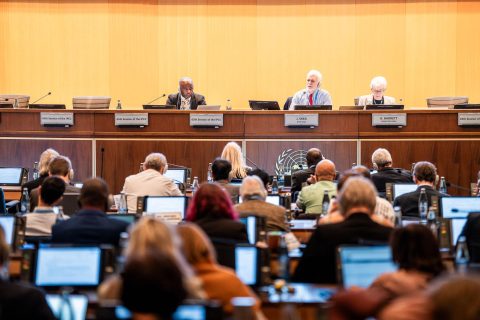
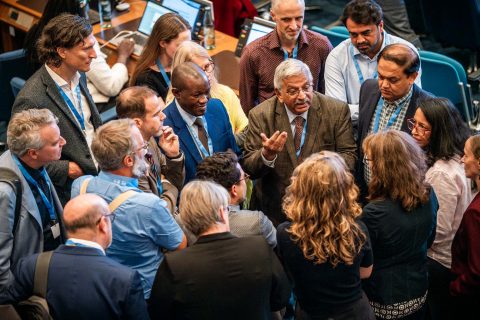
But the week-long meeting descended into fraught disagreements between governments, resulting in Skea “suspending” the talks on Friday evening with no decision made.
Countries were also unable to agree on the IPCC’s budget for the rest of the AR7 cycle, leaving the body with a “serious funding crisis”.
The IPCC has pledged to reconvene the meeting at the “earliest opportunity”; however, it has not yet given an indication of when this will be.
In his concluding remarks, Skea described the Addis Ababa summit as a “profound disappointment” and “among the most difficult IPCC meetings”, according to reporting from the Earth Negotiations Bulletin (ENB).
Some countries have reacted with dismay to the breakdown of negotiations, warning that a failure to have the IPCC’s latest assessments on climate adaptation and mitigation ready for the UN stocktaking exercise would undermine global climate action.
A climate envoy from a Pacific island state said it was a “travesty that a handful of countries continue to delay the IPCC’s reports – the science we need back home to help us save lives and livelihoods”.
Below, Carbon Brief explores the key developments, debates and disag