


Governments and businesses are investing heavily in carbon capture and storage (CCS) to meet climate goals and decarbonize heavy industries. With nearly $80 billion in investment expected to flow into the sector in the coming years, carbon capture is becoming a central part of global climate strategies. Reports say global CCS capacity might grow four times by 2030. This shows big advances in technology, funding, and teamwork across countries.
Why Is CCS Gaining So Much Attention?
Carbon capture and storage is a process that captures carbon dioxide (CO₂) from industrial and energy-related sources before it reaches the atmosphere. It then stores the carbon underground in geological formations.
CCS works well in sectors like cement, steel, and fossil fuel plants. These areas are tough to decarbonize with just renewable energy.
- According to DNV’s 2025 Energy Transition Outlook: CCS to 2050 report, cumulative global investment in CCS could reach $80 billion over the next five years, or by 2030. This represents 270 million tons of carbon dioxide captured (MtCO2) each year.

A notable example is a $500 million agreement between Occidental Petroleum and the Abu Dhabi National Oil Company (ADNOC). They will build a big direct air capture (DAC) facility in Texas.
The deal shows the growing global interest in CCS. It’s not just about cutting emissions; it’s also about creating carbon removal solutions that support other climate efforts.
Experts agree that CCS isn’t a complete solution. However, it plays a key role by tackling emissions that other technologies can’t remove. It is also one of the few methods available today for carbon dioxide removal, a crucial component for meeting long-term climate targets.
How Fast Is CCS Capacity Growing?
The global CCS capacity is expected to grow fourfold by 2030, according to the DNV report. From around 50 million tonnes of CO₂ captured annually today, capacity could rise to more than 550 million tonnes per year by the end of the decade. This would represent around 6% of today’s energy-related global emissions.

This growth requires major investment in infrastructure, including new carbon pipelines, storage hubs, and large-scale capture facilities. North America and Europe are expected to lead the expansion. They could make up more than 80% of the expected CCS capacity by 2030. This is due to helpful climate policies, funding incentives, and established infrastructure.

In the U.S., the Inflation Reduction Act drives CCS growth. It offers tax credits up to $85 for each metric ton of CO₂ captured and stored permanently. Similarly, the European Union supports CCS through its Innovation Fund, with countries like Norway and the Netherlands building cross-border carbon storage networks in the North Sea.
Emerging markets are also entering the CCS space. In Asia, Japan and South Korea have begun planning domestic CCS facilities and exploring regional carbon storage partnerships.
Smart Tech, Lower Costs: CCS Innovation Takes Off
Technology is central to making CCS more effective and affordable. Current advancements include improved solvents for carbon capture, modular DAC units, and more efficient CO₂ transport and storage systems. These innovations help lower energy use and cut costs.
A 2023 report from the Energy Futures Initiative (EFI) says CCS costs might drop by 40% by 2050. This could happen because of better technology and larger production. New digital tools, like AI monitoring systems, are being tested. They track carbon storage performance in real time and help ensure long-term safety.
Data centers in the U.S. are beginning to integrate CCS into their sustainability efforts. For example, Microsoft is partnering with firms like Heirloom and CarbonCapture to buy permanent carbon removal credits backed by CCS. These partnerships show how CCS is moving beyond industrial use and into corporate sustainability strategies.
Hybrid projects, combining renewable energy with CCS, are also on the rise. These include bioenergy with carbon capture and storage (BECCS), where biomass is used for power generation and the CO₂ is captured. This type of system can result in net-negative emissions—removing more carbon from the atmosphere than it emits.

How Do Policy and Carbon Markets Influence CCS Growth?
Strong policy support is driving CCS development. In the U.S., the Section 45Q tax credit offers financial incentives for both point-source carbon capture and DAC projects. The Department of Energy also provides funding for demonstration and early-stage CCS projects.
Globally, carbon markets are beginning to recognize the role of CCS. The voluntary carbon market (VCM) and compliance markets in California and the EU Emissions Trading System are considering or already using CCS-based credits.
In 2024, the global carbon market was valued at around $1.4 billion according to MSCI, with voluntary carbon credit transaction volumes declining but demand remaining steady. Projections suggest it could grow significantly, reaching between $7 billion and $35 billion by 2030.
Longer-term forecasts estimate the market could expand to as much as $250 billion by 2050. This is driven by increasing corporate climate commitments and demand for high-quality carbon removal credits.
High-quality carbon credits from CCS projects could play a major role in this growth. Projects that use strict measurement, reporting, and verification (MRV) protocols can attract higher prices. This applies in both voluntary and regulatory markets.
Wood Mackenzie estimates the U.S. CCUS (carbon capture, utilization, and storage) sector could offer a $196 billion investment opportunity over the next 10 years. This is especially true for the oil, gas, chemical, and power industries.
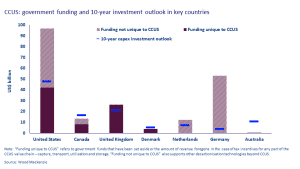
Meanwhile, countries like Canada, Australia, and the UK are developing shared CCS “hub” models—regional centers that link multiple emission sources to centralized storage facilities. These hubs lower costs and speed up development by pooling resources and infrastructure.
A Critical Piece of the Climate Puzzle
By 2030, global CCS projects could capture between 430 and 550 million tonnes of CO₂ each year. This is a big step forward, but it’s not enough. Experts say we need 1.3 billion tonnes per year by mid-century to meet the Paris Agreement goals.
Still, CCS plays a unique and necessary role in cutting emissions where alternatives are limited. The technology’s capture capacity will grow to 1,300 MtCO2/yr. It also supports the production of low-carbon hydrogen, decarbonized fuels, and sustainable building materials.

However, some environmental groups caution that CCS must be applied carefully. Using captured carbon for enhanced oil recovery (EOR) can hurt climate efforts. This happens if it isn’t combined with limits on fossil fuel use.
Clear governance, independent checks, and science-based standards are key to making sure CCS projects truly help climate goals. While it is not a silver bullet, CCS can buy time and cut emissions in sectors that are difficult to decarbonize with renewables alone.
As global capacity grows and costs drop, CCS will likely be key to climate strategies. This includes energy efficiency, clean fuels, and electrification. Continued collaboration among stakeholders, significant investment, and communities’ support will be key to making carbon capture and storage both scalable and sustainable.
The post Global Investment in CCS Surges Toward $80 Billion as Climate Goals Drive Demand appeared first on Carbon Credits.

The accounting differences that decide whether your nature investment shows up in inventory, in BVCM, or nowhere at all.
The question reaches a procurement team about three weeks before the next sustainability committee meeting. Someone has read about insetting. Someone else has just signed off on an offset purchase. The CSO wants to know if the two are interchangeable. The answer is no, and the GHG Protocol Land Sector and Removals Standard is the reason why.
This article walks through what each term means at audit-grade specificity, what the standards actually say about how each gets counted, and how to decide which tool fits which target. The insetting vs offsetting question is one of the most-searched in corporate climate strategy, and one of the most poorly answered. By the end of this piece, you should be able to brief a committee on the difference without notes.
The two definitions, in plain English
Offsetting means buying carbon credits generated outside your value chain and retiring them against your residual emissions. The reduction happens somewhere else, financed by you, and the credit is the receipt.
Insetting means investing in emission reductions or removals inside your own value chain, typically with suppliers, where the reduction is directly linked to the products and services you buy. The reduction happens inside the boundary of your Scope 3 inventory, and the accounting treatment is fundamentally different.
The shorthand from the University of Oxford’s Nature-based Insetting Initiative is useful: insetting is what you do with the supply chain you have; offsetting is what you do with the supply chain you do not have.
What the GHG Protocol Land Sector Standard actually says
The GHG Protocol Land Sector and Removals Standard, finalised in 2024 after a multi-year pilot, sets the rules for how land-based emission reductions and removals enter corporate inventories. The Standard distinguishes between inventory accounting (Scope 1, 2, and 3) and project or intervention accounting (a separate methodology for crediting).
For insetting, the practical implication is that supplier-level interventions, when properly measured and attributed, can reduce your Scope 3 category 1 (purchased goods and services) emissions in your inventory. The reduction is not a credit retired against the inventory; it is a lower inventory number, period.
For offsetting, the credit is retired separately. It can be reported as a contribution toward a net-zero claim under the SBTi Beyond Value Chain Mitigation framework or as part of a VCMI Carbon Integrity claim, but it does not lower the inventory number.
A practical consequence: if your Science Based Target requires a 50% absolute reduction in Scope 3 emissions by 2030, insetting moves you toward the target. Offsetting does not. This single point of difference reshapes the procurement decision.
When insetting counts toward Scope 3 (and when it does not)
Insetting counts toward Scope 3 only when several conditions are met:
- The intervention must occur with an entity in your value chain.
- The emissions reduction or removal must be measured against a defensible baseline.
- The reduction must be attributed to your share of that supplier’s output, not double-counted with other buyers.
- It must follow the inventory accounting rules in the GHG Protocol Land Sector Standard, not the project accounting rules used to generate credits.
The most common failure mode is double counting. If your supplier sells the same reduction as a credit on the voluntary market and also reports it to you as a Scope 3 reduction, the math breaks. The Standard requires you to address this risk, typically by purchasing and retiring the supplier-issued credit as part of your inventory or by contractual provisions that prevent the supplier from selling the reduction twice.
When insetting does not count toward Scope 3: when the intervention sits with a supplier you do not buy from, when the baseline is not defensible, when the attribution is unclear, or when the documentation does not survive audit. Those cases default to Beyond Value Chain Mitigation, which is still useful but operates on a different ledger.
The procurement and supplier engagement question
Insetting is harder than offsetting. That is the unfashionable truth most buyers eventually confront. Offsetting is a transaction; insetting is a relationship.
To run an insetting program, you need supplier mapping precise enough to know which farms or facilities sit at which Scope 3 boundary. You need an engagement model that gets suppliers to participate, which usually requires multi-year commitments and shared economics. You need an MRV architecture that measures the right things and produces audit-ready documentation. And you need a contractual structure that prevents double counting and protects both sides.
The trade-off you receive in return is significant. Reductions count against your inventory rather than your residual. Supplier relationships deepen, which protects sourcing continuity. Yield and quality improvements often follow regenerative interventions, which reduces your input cost over time. And the regulatory file, under CSRD, CSDDD, EUDR, and the SBTi FLAG Guidance, is materially stronger.
Choosing the right tool for the right target
A practical decision rule. If your target is a science-based Scope 3 reduction and you operate in a FLAG sector or source FLAG commodities, insetting is the structurally correct tool. If your target is a net-zero claim that includes neutralising hard-to-abate residual emissions outside your value chain, BVCM via high-integrity offsets is the structurally correct tool. Most companies with material Scope 3 exposure need both, in different proportions, sequenced over time.
The sequencing matters. Insetting takes longer to stand up but produces a permanent reduction in the inventory. Offsetting can be transacted faster but does not change the inventory and now sits under tighter claim restrictions. Treat them as complementary tools with different jobs, not as substitutes. The Accountability Framework Initiative and the IUCN Global Standard for Nature-based Solutions both provide useful guardrails for the insetting side, with biodiversity, human rights, and benefit-sharing requirements that go beyond carbon math.
If you are mapping a Scope 3 reduction roadmap and need to scope which interventions count toward your inventory versus which sit in Beyond Value Chain Mitigation, the carbon and sustainability experts at Carbon Credit Capital can help you structure a nature-based supply chain investment program that fits your FLAG exposure, your target architecture, and your audit horizon. Schedule a consultation.
Net zero is often described as a balancing act: cut what you can, account for the rest, and reach zero on the ledger. That framing is useful, but it leaves something out. It treats every tonne of carbon as interchangeable and every route to zero as equally sound, while the science tells a more specific story.

Malawi has lost a striking share of its forests over the past three decades. Woodlands that once covered well over a third of the country now cover less than a quarter, and the pressure on what remains is increasing. Behind those figures sit two practical questions: what is driving the loss, and what reverses it?




-
Climate Change1 year ago
Guest post: Why China is still building new coal – and when it might stop
-
Greenhouse Gases1 year ago
Guest post: Why China is still building new coal – and when it might stop
-

 Greenhouse Gases2 years ago
嘉宾来稿:满足中国增长的用电需求 光伏加储能“比新建煤电更实惠”
-

 Climate Change2 years ago
嘉宾来稿:满足中国增长的用电需求 光伏加储能“比新建煤电更实惠”
-
Climate Change2 years ago
Bill Discounting Climate Change in Florida’s Energy Policy Awaits DeSantis’ Approval
-

 Renewable Energy10 months ago
Sending Progressive Philanthropist George Soros to Prison?
-
Greenhouse Gases1 year ago
嘉宾来稿:探究火山喷发如何影响气候预测
-

 Carbon Footprint2 years ago
US SEC’s Climate Disclosure Rules Spur Renewed Interest in Carbon Credits