

Several years ago, at our annual family reunion, while tucking my seven-year-old granddaughter Hawith into bed, I laid down next to her for a goodnight grammy chat.
She leaned close to me and intently said, “Grammy, I want to do adventures with you!” Immediately I responded, “Hawith, you do not have to ask me twice.” That was it! The early seeds of “Get Outside with Grammy” were sown, and my responsibility as an elder to step up my game to care for the earth was heightened.
I am reminded of my elders who cared for the earth so that I and others can enjoy, share, and be good stewards of the earth’s bounty. I want to participate in a legacy of earth-honoring experiences that allow us to move our bodies vigorously as we were created to do in earth’s amazing places. I want wild places to be available to everybody, everywhere. To accomplish this, we have much work to do given the impending climate apocalypse we face.
What did my elders teach and show me about how to be a good ancestor? While they did not use the current language of climate justice, they practiced what we now call climate stewardship and environmentalism. Before it became the popular thing to do, my Mom practiced recycling of newspapers, cans, bottles and plastic. She also calculated the amount of water used in the dishwasher compared to washing dishes by hand so she could choose to have clean dishes while conserving water. Mom also cooked “just enough food” for our family of six to reduce food waste. My Dad, noticing the tree canopy in our small Indiana town was depleting, decided to plant maple trees across the town. (I do not think he asked for anyone’s permission to plant these trees; he simply just planted them.)
After the trees were planted, twice a week he filled a hard plastic kiddie swimming pool with water that was in the back of an old red Ford pick-up truck and he drove to every young tree and watered them. He nurtured each sapling until they could sustain themselves within their sphere of natural connection and influence. These trees thrived because of his participation in their care, connecting them to the earth’s supporting system for growth for the benefit of generations to come. His initiative eventually led to a town-wide tree board to grow trees to replenish the overstory.
Dad also planted trees on the land behind our family’s home. During the summer between my first and second years of college, one of my paid gigs was to water these saplings every morning. Every day at 6am (to avoid the summer heat and humidity), I carried water to each of 100 pine and red oak trees. I confess, at the time I did not see his grand scheme – that planting trees was for the health, beauty, and well-being of the earth and for generations of human creatures to come.
Mom and Dad purchased land in southern Michigan with the purpose of placing the land in a local land conservancy to ensure that it would never be developed, but rather remain wild forever. My Dad’s ashes are scattered on this land. When my 92-year-old Mom transitions to the next life, her ashes will join Dad’s on that land. Mom and Dad gifted this land to a church camp that had a history of practicing good land stewardship and environmental sustainability. They wanted this land to be a place that allowed all to breathe in and breathe out beauty to enjoy and share.
As a family physician, Dad launched a chapter of the American Lung Association in our small town to reduce the harmful effects of cigarette smoking. He asked friendly yet poignant questions of his local pharmacist colleagues, why they sold cigarettes in their stores that otherwise were there to promote health and healing. I still have a small metal button from Dad’s county-wide anti-smoking campaign that says, “Make Love, Not Smoke.” As a 7th grader, little did I know what I was naively promoting when I proudly wore this button to school and church.
Dad also instigated a smoking ban in public and private establishments. He did this in part by visiting local taverns and restaurants, talking to the owners about the desire to make our town free of second-hand smoke for the health of all. This undertaking was quite an adventure because he did not consume alcohol. Don’t get me wrong, not every owner liked what they heard from Dad. Still, he always felt good that he had at least made new acquaintances during his version of these bar-hopping excursions.
Several years later, because of his quiet and deliberate step-by-step relationship-building campaign to end the ravages of second-hand smoke, he presented his campaign’s mission to the county commissioners. One commissioner told him point blank, “what you are trying to do in your town will never be county-wide. So don’t get any ideas that this will happen in this county.” Dad graciously responded, “Well, I just want you to know what we’re doing in our town to make it a healthier place for everybody.” He thanked them for their time and attention and left the meeting. Several years after that, with the active support of many others in the community and county, the entire county became smoke-free in private and public establishments.
Dad’s anti-smoking campaign showed me first-hand that one person’s actions can make tangible, long-lasting change.
Dad and Mom always encouraged and supported me to get outside to enjoy and share nature’s gifts. They supported my desire to hike, wilderness backpack, and bikepack. For my 18th birthday, they bought me my first backpacking sleeping bag. They encouraged my choices to engage in service opportunities from: working at a homeless shelter and thrift shop in San Francisco, a drug rehabilitation center in England, and a wilderness school for troubled youth in Virginia; leading bicycling and backpacking trips with youth and adults; working as a psychologist with youth and adults entangled in our criminal legal system; and founding a peacebuilding institute to teach trauma awareness and resilience strategies within a racial and cultural justice collective framework.
These life experiences taught me how to care for myself, others, and the earth. I learned much along the way, and now at 66 years old I know that to enjoy and share outdoor adventures with Hawith, I need to engage with others and directly support those who are working for climate justice.
As a white, cis-gender, educated boomer woman, it’s incumbent upon me to use my privilege responsibly to work with others in the climate justice movement. In addition to giving money to organizations, I can be an ambassador within my spheres of influence by talking openly about climate change and justice. I can invite other people to give their time, energy, and money to climate justice organizations.
As a part of my “rewirement,” I said yes when I was invited to give my time and expertise to a racially and culturally diverse climate collaborative to develop a three-day {in-person or virtual} training entitled Climate STARR (Strategies for Trauma, Action, Resilience, and Regeneration). Climate STARR provides communities and climate action organizations who are facing climate trauma, angst, and fatigue, the time and space to strengthen their hope and build collective resilience and regenerative power for positive climate justice action within their spheres of influence. Climate STARR is for everyone who:
- cares deeply about our earth but wonders if anything they can do makes a difference toward healing the climate crisis,
- is burning out from guilt, concern, and/or activism,
- has lived with environmental injustice for generations,
- sometimes feels overwhelmed, or frozen by grief, despair, and angst about climate change,
- can talk about climate data but holds numbed emotions in their body,
- has gifts and energy to give to climate justice work but is not sure where to start, and/or
- wants to stay resilient as they address climate issues in their classroom, community, and the world.
The collaborative is committed to economic justice by ensuring that all people, regardless of their financial status, have access to the Climate STARR training.
Another exciting way I am working toward climate justice is by saying yes to my life-long dream to bicycle across America. In fall 2024, as I bike 3200 miles from San Diego, CA to Saint Augustine, FL, I’ll ask people I meet, “How has climate change impacted you personally?” With those who give their permission, I will video our conversations and post them on social media to share with others.
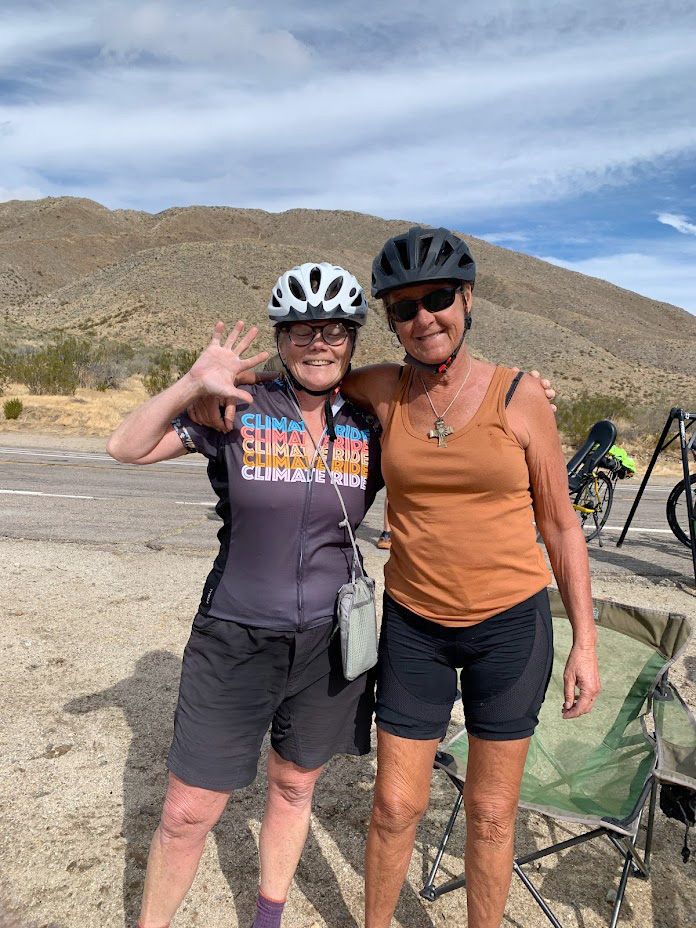
This 12-week, self-contained bicycle trip with my best biking pal Becky, will fulfill my BHAG – Big Hairy Audacious Goal – to raise $500,000 for five fiscally responsible climate justice organizations: Climate Generation, Minnesota Interfaith Power and Light, Third Act, Climate Ride, and Climate STARR. While I will graciously accept large donations, I believe that there are at least 50,000 people in Minnesota and the rest of the United States who will give $10 or more to achieve this BHAG. Many hands make light work. We can reach them together.
I am doing this because I love outdoor adventures, I love the earth. I love our creator, sustainer, and redeemer and building community with others. I love being a responsible, caring elder who wants to be a good ancestor for my grandchildren, your grandchildren, and everyone’s great grandchildren. As I age, I want to ensure that I never join the world’s largest club: “The Somebody Oughta Club.” Yes, I do this because I want to enjoy and share great outdoor adventures with Hawith, and I also want so much more with you as we care for the earth together.

Donna Minter resides on Dakota land in Minneapolis, Minnesota and she recognizes that because of hundreds of years of enslavement of people of African descent in this country, those of us who are not African descendants of those who were enslaved have benefited from the unpaid labor of these invisible founders, which she believes is the economic foundation of this nation. Donna is a Grammy to three precious grandchildren, a wife, and step/bonus mom, and an avid athlete, backpacker, bikepacker, and community builder who aspires to embrace the deeper meanings in life. She is a European American cisgender woman who is also a trainer, facilitator, and peacebuilding instigator. Donna is a licensed psychologist who practiced clinical neuropsychology for more than 25 years in outpatient and inpatient clinics and educational settings. For over 22 years she has conducted court-ordered mental health evaluations and provides expert court testimony. In 2010, Donna founded the Minnesota Peacebuilding Leadership Institute (i.e., MN Peacebuilding) to teach trauma-informed, resilience-oriented, and restorative justice-focused strategies to individuals, organizations, and communities for racial healing and equity toward the possibility of reconciliation. She administered, implemented, and conducted trainings and talking circles in Minnesota, the USA, and internationally. Before retiring from MN Peacebuilding in June 2023, she trained over 16,000 people from community organizations, local, state, tribal, and federal government agencies. In her rewirement, she is collaborating with others who are applying trauma awareness and resilience principles, models, and strategies to community and organizational climate action in a training called Climate STARR (Strategies for Trauma, Action, Resilience, and Regeneration). She is also biking the GRAMMY Climate Ride across America in fall 2024. Donna’s pronouns are she/her/hers. To contact Donna, please email her at graamyride@gmail.com.
The post Get Outside with Grammy appeared first on Climate Generation.

Rising temperatures and overfishing have seen the U.K.’s iconic cod decline for over a decade. Now, consumers are warned to “completely avoid” eating the fish.
The days of Britain’s fish and chip shops might be numbered.
Climate Change
DeBriefed 10 April 2026: Worst energy crisis ‘ever’ | India withdraws COP33 bid | Drag artists and climate change
Welcome to Carbon Brief’s DeBriefed.
An essential guide to the week’s key developments relating to climate change.
This week
Ceasefire causes oil price drop
CEASEFIRE SLUMP: Following the announcement on Tuesday of a two-week ceasefire agreement between Iran and the US and Israel, oil prices dropped below $96 per barrel, according to the Associated Press. However, price volatility resumed when a Saudi Arabian oil pipeline was hit just hours later, according to Reuters.
CRISIS COMBINED: Reuters and other outlets covered comments made by the International Energy Agency’s Fatih Birol to Le Figaro, where he said that the current energy crisis is worse than those of “1973, 1979 and 2022 combined”. It added that Birol said the “world has never experienced a disruption to energy supply of such magnitude”.
POLLUTERS PROFIT: The Guardian covered how the “worst polluters hold [the] world’s future in their hands as they benefit from higher fossil fuel prices”, but it added “global trends favour renewables”. The South China Morning Post reported that, according to experts, the diversification of energy sources is set to accelerate as the war continues to disrupt the world’s energy supplies.
Around the world
- CLIMATE GOALS PERIL: The UK opening new oil and gas fields in the North Sea “would imperil” international climate goals, experts told the Guardian. The warning came as the government pushed back against the speculation that it is set to approve new drilling projects, according to Sky News.
- COP33 CHANGES: The Indian government has withdrawn its offer to host the COP33 climate summit, “following a review of its commitments for the year 2028”, reported Climate Home News.
- ‘LONG-LASTING’ SHOCK: The Financial Times covered comments by EU energy commissioner Dan Jørgensen that the bloc was bracing for a “long-lasting” energy shock from the Iran war. Reuters reported that five EU countries have called for a windfall tax on energy companies’ profits in response to rising fuel prices.
- US BUDGET CUTS: US president Donald Trump’s 2027 budget proposal included targeting the “green new scam” with substantial cuts to energy and environment programmes, according to the Los Angeles Times.
- AFGHAN FLOODS: Since 26 March, at least 148 people have died and 216 have been injured due to heavy rains, floods, earthquakes and landslides in Afghanistan, reported Reuters.
- PENGUINS ENDANGERED: The “mass drowning” of emperor penguin chicks as sea ice melts due to climate change has led the International Union for Conservation of Nature to declare the species officially in danger of extinction, according to the Guardian.
86,120
The record number of battery electric vehicle sales registered in the UK in March, making up 22.6% of the total car market, according to the Society of Motor Manufacturers and Traders.
Latest climate research
- More than a quarter of the world’s population will face more frequent and severe hot-and-dry extreme events by 2100 under current climate policies | Geophysical Research Letters
- Climate change will increase wildfire exposure for nearly 10,000 species by the end of the century | Nature Climate Change
- A variety of climate hazards critically expose up to 30% of southern Africa to “environmental degradation” | PLOS One
(For more, see Carbon Brief’s in-depth daily summaries of the top climate news stories on Tuesday, Wednesday, Thursday and Friday.)
Captured
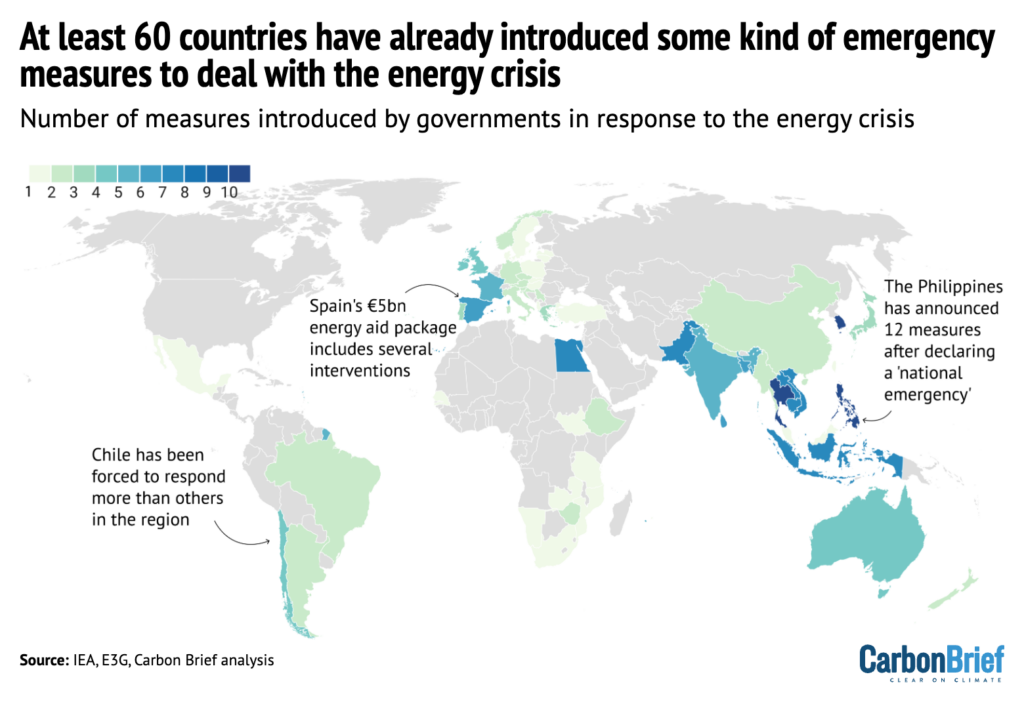
Carbon Brief analysis found that, since the beginning of the Iran war in late February, at least 60 countries have announced nearly 200 emergency energy-saving measures. Around 30 nations, from Norway to Zambia, have cut fuel taxes to help people struggling with rising costs, making this by far the most common domestic policy response to the crisis, said the analysis. Some countries have stressed the need to boost domestic renewable-energy construction, while others – including Japan, Italy and South Korea – have opted to lean more on coal, at least in the short term.
Spotlight
How drag is tackling climate change
This week, Carbon Brief looks at how some drag artists are using their performances to draw attention to climate change
Back in 2005, veteran climate journalist Bill McKibben wrote that “what the warming world needs now is art, sweet art” to help “build a general consciousness about climate change”.
Since then, the topic of climate change has spread to a host of art forms, from literature and music through to comedy and film.
One of the most recent art forms to take up the climate communication baton is drag, with performers using it as a “Trojan horse” to engage with audiences, according to Cheddar Gorgeous, a British drag performer.
‘Joy inspires momentum’
Drag artists around the world have begun to draw attention to the climate movement, using creativity, entertainment and their platforms to engage with their audiences.
In the UK, Cheddar Gorgeous declined a nomination for the British LGBT Awards due to its sponsorship by Shell and has made repeated calls for climate action.
Speaking on the “climate quickie” TEDx podcast, she argued:
“Drag can disrupt the master narratives that dictate our society. I love drag that makes you look at yourself and look at the world in a different way. And that can be deployed in all sorts of exciting ways.”
Drag has a proud history of disruption. As part of a TED talk titled, “Why joy is a serious way to take action”, US drag queen Pattie Gonia provided the audience with some “herstory” about the role of drag within protests. She said:
“Since the birth of the queer rights movement, drag performers and trans people have always been on the forefront of organising and protesting and community building.
“When we had the statistics and the facts on the millions of queer people dying of AIDS, yet no one was joining our fight, drag performers turned pain into joy and, in doing so, welcomed millions more people to fight with us.”

Pattie Gonia is arguably the best-known drag artist to engage with climate change. She is currently touring her environmental drag show “SAVE HER!” and has, according to her website, fundraised more than “$4.7m for LGBTQIA+, BIPOC and environmental non-profits”.
A key part of her message is the need for diversity and inclusion within the climate movement, adding that “our creativity is critical in this climate dilemma”. In her TED talk, she added:
“The problem in the climate movement isn’t just the abundance of carbon; it is the lack of joy. The scientific facts, the doom and gloom, they scare people, they wake them up. But joy is what will get people out of bed every day to take more action.”
Alongside Pattie Gonia, climate conversations are filtering into the wider drag movement, including being a topic repeatedly touched on in the highly successful TV drag contest, RuPaul’s Drag Race.
This ranges from drag artist Asia O’Hara explaining what global warming is in season 10 – telling her fellow contestants: “Bitch, the ice is melting!” – to queens dancing to “97% of scientists and four out of four Drag Race judges agree” that climate change “is real” during a challenge in season 11. (Drag Race host RuPaul Andre Charles has faced criticism for reportedly allowing fracking on his Wyoming ranch.)
Drag is opening up the climate movement to a wider audience, promoting diversity, inclusion and creativity in the space, according to its advocates. For Pattie Gonia, a key part of climate action has to be joy, she added:
“Joy provides an unbelievable opportunity to make the climate movement irresistible. Do not underestimate the power of joy. We deserve more than doom and gloom, because this is the only planet with a Beyoncé on it.”
Watch, read, listen
COOPERATION OVER CHAOS: In the Indian Express, Simon Stiell, the executive secretary of UN Climate Change, argued that “climate cooperation offers a way out of energy price chaos”.
ELECTRIC WORLD ORDER: On the Polycrisis podcast, Mark Blyth, a professor of international economics at Brown University, and Dr Naa Adjekai Adjei, a non-resident fellow, Africa, at the China Global South Project, discussed “what the US dollar has to do” with energy access in Africa.
‘THE RECKONING’: In the Equator, Mona Ali, associate professor of economics at the State University of New York, explored the closure of the Strait of Hormuz and the “end of American hegemony”.
Coming up
- 12 April: Hungarian elections
- 12 April: Peruvian elections
- 13-18 April: World Bank and International Monetary Fund Spring Meetings, Washington, DC, US
- 14 April: IEA Oil Market Report launch
Pick of the jobs
- Global Witness, several climate change jobs | Salary: Varied. Location: London
- London School of Economics, policy fellow – climate, gender and inclusivity | Salary: £53,949-£62,160. Location: London
- Climate Group, senior manager, international policy and advocacy | Salary: £47,160-£49,930. Location: London
- WWF, Nedbank green trust manager | Salary: Unknown. Location: Cape Town or Johannesburg, South Africa
- Greenpeace Australia Pacific, creative producer | Salary: AU$101,272. Location: Australia
- The Fairness Project, climate policy researcher | Salary: $96,000. Location: Remote (US)
DeBriefed is edited by Daisy Dunne. Please send any tips or feedback to debriefed@carbonbrief.org.
This is an online version of Carbon Brief’s weekly DeBriefed email newsletter. Subscribe for free here.


The post DeBriefed 10 April 2026: Worst energy crisis ‘ever’ | India withdraws COP33 bid | Drag artists and climate change appeared first on Carbon Brief.
The state Senate’s version of the bill offers more opportunities for utilities to profit, leading some observers to question whether the legislation will substantively lower costs for customers.
In its most recent energy affordability legislation, the Maryland Senate has reversed key utility accountability proposals passed by the state House and added new ways for utility companies to earn profit, including by reviving a billion-dollar gas subsidy that requires all ratepayers to cover the cost of running new gas pipelines to housing developments.
Utility Accountability Bills Divide Maryland’s Democratic Leadership


-
Climate Change8 months ago
Guest post: Why China is still building new coal – and when it might stop
-
Greenhouse Gases8 months ago
Guest post: Why China is still building new coal – and when it might stop
-

 Greenhouse Gases2 years ago
嘉宾来稿:满足中国增长的用电需求 光伏加储能“比新建煤电更实惠”
-
Climate Change2 years ago
Bill Discounting Climate Change in Florida’s Energy Policy Awaits DeSantis’ Approval
-

 Climate Change2 years ago
嘉宾来稿:满足中国增长的用电需求 光伏加储能“比新建煤电更实惠”
-
Climate Change Videos2 years ago
The toxic gas flares fuelling Nigeria’s climate change – BBC News
-

 Renewable Energy6 months ago
Sending Progressive Philanthropist George Soros to Prison?
-

 Carbon Footprint2 years ago
US SEC’s Climate Disclosure Rules Spur Renewed Interest in Carbon Credits