Connect with us

Published

on

Yes, Climate Change Will Affect Us Here

“Climate change will manifest as a series of disasters viewed through phones with footage that gets closer and closer to where you live until you’re the one filming it.” – unknown

This quote has been making the rounds on social media lately. I’ve found myself thinking about it a lot ever since Friday, September 27—the day Hurricane Helene ripped through my hometown of Asheville, North Carolina.

I’ve found myself thinking about it as I doomscroll through social media (now my go-to post-work activity), watching videos of neighborhoods I used to drive through completely swallowed by flood waters, photos of my go-to coffee shop and favorite quirky consignment store turned to rubble, clips of the roads I take to get to Target and Michaels destroyed.

I find myself thinking about it as I follow the nightly news, watching reporters interview locals who have lost loved ones, families who have lost their homes, artists who have lost their businesses—familiar communities and shops and restaurants now on the news for the world to see, my mind having trouble connecting familiar stomping grounds with the images on the screen.

And I’ve found myself thinking about it as I scroll through my own phone, rewatching my own footage of the road at the base of my mountain underwater, my own photos of trees and signs and power lines knocked to the ground, my own screenshots of Emergency Alerts warning of flash flood emergencies and dams at critical levels.

I’ve found myself thinking about it, because—even after all my time working in the clean energy space, all my years studying climate communication during graduate school, all my conversations with friends and family insisting that “yes, climate change will affect us here” and “yes, climate change will affect us now”—I was still shocked to see my hometown in the middle of a climate disaster.
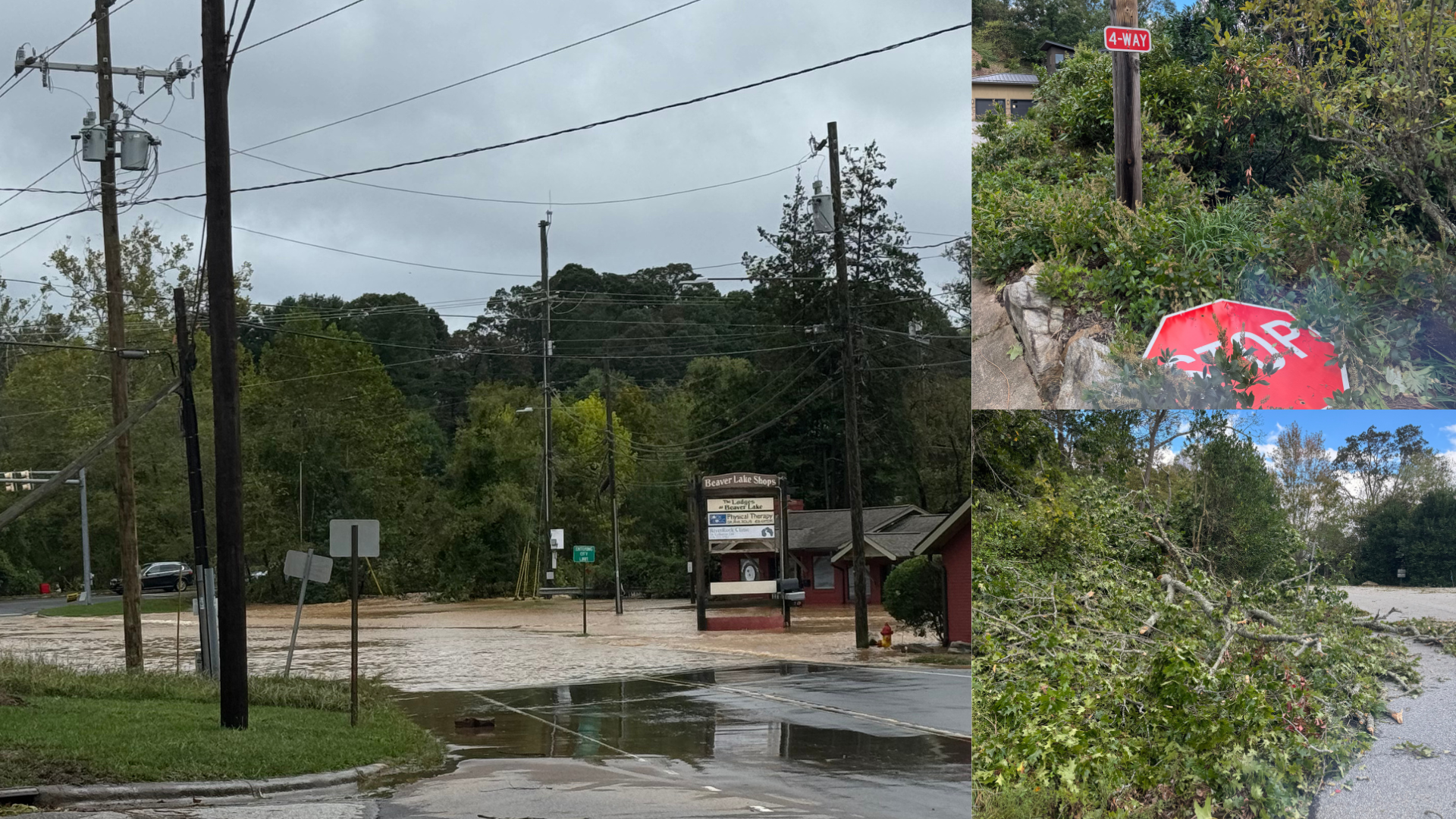
Signs of destruction around the apartment complex

Not the Last Unsuspecting Climate Casualty

I shouldn’t have been.

Climate change doesn’t discriminate. It will affect you (it probably already has), regardless of age, gender, socioeconomic status, or zip code. 3.6 billion people already live in areas highly susceptible to climate change, and that number is rapidly growing. The impacts are so widespread, in fact, that an online tool can show you just how vulnerable your community is. Asheville, now turned upside-down by a hurricane made 200-500 times more likely due to climate change, scores at only the 62nd percentile on the vulnerability scale.

Asheville, now turned upside-down by a hurricane made 200-500 times more likely due to climate change, scores at only the 62nd percentile on the vulnerability scale. Source: The U.S. Climate Vulnerability Index

But Asheville, 2,000 feet above sea level and 300 miles from the coast, isn’t the first unsuspecting climate casualty. And it won’t be the last. 2023 was the hottest year on record, with 2024 on track to take the unfortunate title. Tornado Alley is migrating eastward. Wildfires, once considered a cliché of the West, are posing a growing threat to the Southeast.

None of this is a surprise. Scientists have been warning us for years of hotter oceans leading to stronger hurricanes; of warmer air leading to heavier rainfalls; 0f increased temperatures setting the stage for larger wildfires. The Intergovernmental Panel on Climate Change has repeatedly warned of “widespread adverse impacts and related losses and damages to nature and people.”

Cut Off From The Outside World

But now these facts felt personal.

I woke up the morning of Friday, September 27 to the sound of wind and rain. My apartment’s electricity was already out. Our cell service would soon follow. Our water after that. By mid-afternoon, the sound of wind and rain had stopped, only to be replaced by the sounds of helicopters and sirens—sounds that wouldn’t stop for weeks.

Once I finally ventured out, I was able to find a weak cell signal standing in an empty Bojangles parking lot at the base of my flooded mountain. Just enough to let my family in Ohio know I was ok. While on the phone with them, I received yet another Emergency Alert. A dam was at critical levels. I was supposed to move to high ground now. I quickly said goodbye to my parents. I wouldn’t reach them again for almost 24 hours.

The next morning, I journeyed outside my neighborhood for the first time. I drove on sidewalks, under trees hanging over the road, over power lines in the street, past cars and homes that had been crushed, by hours-long lines of people waiting for water, past even longer lines of people waiting for gas. I’d only made it 4 miles.

The news came in slowly. Asheville had been cut off from the outside world, both literally and figuratively. Almost the entire city of 90,000-plus people had lost cell service and WiFi. Three of four major routes into Asheville had been blocked. On a call with my parents, standing in the driveway of a fire station, I learned for the first time of the destruction of neighborhoods like Asheville’s River Arts District and Biltmore Village, the leveling of towns like Lake Lure and Chimney Rock, the woman who watched her son and elderly parents get washed away.

Our apartment entrance soon turned into a community bulletin board, with neighbors sharing which roads were closed, where to find water, which stores were open, where to get cell signal. Neighbors began trekking to the apartment’s pool just to collect enough water to flush their toilets. Each time I ventured out, I’d come home wiping hunks of mud from my tennis shoes. Mud I’d later learn was toxic.

Left: A line for water wraps around Harris Teeter the day after the storm; Top Right: The apartment entrance turns into a community bulletin board; Bottom Right: Free “Wi-Fi Zones” pop up around town

Recovery Will Be Measured In Years

I’m one of the lucky ones.

As Helene ripped through Florida, Georgia, North Carolina, South Carolina, Tennessee, Virginia, and more, it left a trail of destruction. Of locals who have lost loved ones; families who have lost homes or businesses; children awaiting much-needed food, water, and supplies; relatives awaiting word from friends or family.

In North Carolina’s Buncombe County alone, 21 students are still missing, just some of the dozens of people —moms and dads and sons and daughters and brothers and sisters and friends — still unaccounted for. The county’s confirmed death toll of 42 is expected to rise as search and rescue efforts continue and, eventually, end.

Helene and Milton are both expected to surpass $50 billion in damages, joining only eight other hurricanes on a decreasingly rare list. Experts estimate that only 5% of homeowners impacted by Helene have the necessary insurance for the type of damage their home received. Recovery in many places will be measured not in months, but in years.

It doesn’t have to be this way.

The devastation wrought by Helene has been called ‘historic,’ ‘unimaginable,’ ‘unprecedented.’ It is also unnatural.

Fossil fuels are to blame. As SACE Executive Director Dr. Stephen A. Smith so aptly put it, “Record-breaking carbon emissions driving up record-breaking sea surface temperatures fueling record-breaking flooding all enabled by political denialism supported by corporate greed leading to a lack of political will to address the root cause of these catastrophic events.”

The good news? It doesn’t have to be this way.

As members of the Clean Energy Generation, we’re alive during a time of unprecedented climate disruption but also historic climate funding and opportunity. There are all kinds of ways to get involved in the movement — and the time is now, because later is too late. Each of us has the power to spark clean energy change in our lives, homes, or communities. Let us know you’re in by signing up below.

Join the Clean Energy Generation

The post From Abstract to Reality: When Your Hometown Becomes a Climate Casualty appeared first on SACE | Southern Alliance for Clean Energy.

From Abstract to Reality: When Your Hometown Becomes a Climate Casualty

Continue Reading

Renewable Energy

Raw Stupidity: Yet One More Reason that Trump Must Go

Published

on

From the Huffington Post:

A senior FBI officer struggled to answer basic questions about antifa, despite characterizing the organization as “the most immediate violent threat” the US faces.

At a House Committee on Homeland Security hearing on Thursday, Michael Glasheen, operations director of the national security branch of the FBI, said he agreed with President Donald Trump that antifa is one of the greatest national security threats to the country.

The answer, of course, is that “Antifa” is a concept, not an organization.  It refers to anyone who is against fascism. It has no headquarters, no leaders, and no members.

Now, it is true that people with these views can be violent.  When my father led a crew of his fellow anti-fascists, flying a B-17 bomber in World War 2, they completed 29 successful missions, destroying Nazi oil refineries.   Were Nazi soldiers killed in the process?  I never asked him that, and he probably didn’t know, as they were flying at 29,000 feet, but it seems extremely unlikely that no one died.

In peacetime, we antifa people are non-violent.  We may be marching for BLM, or encouraging the use of science in policymaking, or expressing our view that the United States should not have a king.

The FBI must understand this; they must be saying this purely to placate Trump.  No one can be that stupid.

Raw Stupidity: Yet One More Reason that Trump Must Go

Continue Reading

Renewable Energy

Hydrokinetics Gone Awry

Published

on

When I came across the meme at left, I was instantly reminded of a guy who called me from Baltimore, MD about 15 years ago, anxious for me to hunt up investors in an invention he had created.  I was having a hard time understanding the concept he was describing, and so he told me, “Think of it as a river in a box.”

“Ah! Now I get it. You have a box full of standing water. You add energy to it to get it moving, and then our extract energy from the moving water.  And you think that you can extract more energy than you put into it.”

“Yes!” he said excitedly.

I calmly told him that this violates the laws of physics, specifically the first and second laws of thermodynamics, but he wasn’t “having it.” I wished him a pleasant good night and asked him to let me know when he had built a working prototype.

I’m still hoping to hear from him again.

Hydrokinetics Gone Awry

Continue Reading

Renewable Energy

Benefits of Solar Power Solution in Manufacturing Facilities 

Published

on

In today’s dynamic manufacturing world, energy is more than just a utility; it’s the spark that keeps production running. Industrial facilities, powered by massive engines and heavy machinery, often operate 24/7, driving output but also consuming enormous amounts of electricity.

The issues? Soaring energy costs and a growing environmental footprint.

Sometimes it’s like a cycle that often feels impossible to break, but what if your facility could draw energy from a cleaner, more reliable, and cost-effective energy source?

Yes, you heard it right, and that’s where solar power comes in!

As electricity prices continue to rise and corporate sustainability goals become more pressing, manufacturers are rethinking how they power their commercial operations.

Therefore, solar energy is emerging as a game-changing solution, offering reliability, long-term savings, and a sustainable path forward for the Australian manufacturing industry.

In this blog, we’ll explore how manufacturers are successfully implementing solar power, featuring real-world case studies from Cyanergy that highlight both the business advantages and environmental impact.

So, let’s explore how solar energy can help your manufacturing facility reduce costs and enhance efficiency, achieving long-term sustainability.

Why Solar Energy Is Essential for Modern Manufacturing Facilities?

In Australia, manufacturing facilities typically have large roof or yard footprints, significant and relatively
stable electrical loads, including lighting, motors, HVAC, and other machinery. So, the energy used every day is
enormous.

By harnessing the sun’s energy, factories can significantly cut operating
costs
, reduce carbon emissions, and gain greater control over long-term energy stability.

Beyond the environmental benefits, solar power also strengthens a company’s competitive edge and brand reputation in
an increasingly eco-conscious market.

Here we’ve penned down the importance of solar power in the manufacturing industry:

  1. Energy cost mitigation 
  2. So, how solar energy reduces manufacturing costs in Australia?

    With electricity prices rising and energy market volatility increasing, incorporating solar energy offers a
    way to
    reduce grid dependency and lower utility costs in the long term.

  3. Ensure Operational Continuity & Resilience
  4. Solar panel systems, when paired
    with
    battery storage, can help smooth peak energy demand, reduce grid dependence, and improve functioning
    time.

  5. Promote Sustainability and Brand Value
  6. In larger industries, many manufacturers are under pressure from customers, regulators, investors, and
    internal
    stakeholders to reduce
    their carbon footprint
    .

    Solar helps them to achieve energy freedom, powering businesses with a sustainable energy source.

  7. Increase Asset value & ROI
  8. Solar systems, when sized appropriately and properly optimised, can deliver payback in a few years and
    continue to
    provide savings thereafter.

According to Cyanergy’s capability statement, we delivered a 490
kW system
that generated 752 MWh for a manufacturing client, with a 37-month payback period.

This shows that industrial-scale solar can deliver real, practical results for manufacturers.

Now, let’s examine solar power solutions for manufacturing facilities, case studies, and best practices to ensure a
clear understanding.

Case Studies from Cyanergy: Real-World Manufacturing Success in Australia!

In this part of the blog, we have selected three examples from Cyanergy to illustrate how manufacturing facilities are utilising solar energy.

These are not generic installations; these are production-oriented businesses taking real steps across different states of Australia.

1. Uniplas Mouldings International – Wetherill Park, NSW

Project Overview

  • System size: 490 kW solar system installed in staged phases
  • Investment: AUD $591,823.71.
  • Annual generation: 752 MWh
  • Yearly energy costs before solar: approximately $647,000.
  • After solar: $456K, which is approximately 55% of the previous
  • Payback period: 37 months

Why it matters

For Uniplas, a large industrial manufacturer, the solar system not only significantly reduces their operating energy
costs, but the payback of just over 3 years means that the return on investment is also attractive for the
business.

The staged approach also allowed them to access multiple subsidies and implement the project rapidly; for example,
the first stage of 200 kW was completed in four weeks.

This clearly shows how manufacturing operations can incorporate
solar
without any significant disruption.

2. AC Laser – Thomastown, VIC

Project Overview

  • System size: 99.45 kW
  • Annual generation: 141.75 MWh
  • Annual electricity cost before solar: $79,000.
  • After solar: $38,160, a reduction of more than 50%
  • Payback period: 26 months

Why it matters

This is a smaller-scale manufacturing facility compared to Uniplas, yet the results are impressive: a more than 50%
cost reduction and a shorter payback period.

This shows that not only large-scale commercial properties but also mid-sized manufacturing operations can benefit
from solar, not just large ones.

Insights Gained from the Case

  • Don’t wait until your business is huge, as size is scalable.
  • The solar system’s size aligned well with the manufacturing load, saving thousands of dollars.
  • Rapid ROI shows manufacturing facilities can justify solar as a capital investment for their business.

3. Specialised (Cycling-Industry manufacturer) – Port Melbourne, VIC

Project Overview

  • System size: 39.6 kW
  • Annual generation: 47.32 MWh
  • Electricity cost before solar: $26,720; after solar: $17,770
  • Payback period: 45 months

Why it matters

Although smaller, this project depicts that solar energy is a viable option for manufacturing across various sizes
and sectors, even in facilities with a relatively small carbon footprint.

The case emphasises sustainability as a business value and how solar can support brand positioning as well as cost
savings.

Major Takeaways

  • Solar supports both cost and branding sustainability
    goals
    .

  • Even medium-sized systems can provide meaningful savings.
  • The ROI
    generated
    must be viewed in terms of both financial and reputational benefits for any
    business, whether it’s large or small.

Is Now the Right Time for Manufacturers to Transition to Solar Energy?

After knowing the numerous benefits of solar solutions, you may be tempted to go solar. However, transitioning from
traditional energy sources to solar energy comes with a cost. 

From government
incentives
to long-term cost savings, the financial case for solar energy is compelling.

Still wondering, is it time for businesses to go solar? Here’s why you should act now:

  • Electricity prices continue to rise in many markets, strengthening the return on investment for solar
    energy.

  • Many governments and utilities offer incentives, favourable tariffs, or rebates
    for industrial solar projects.

  • Day by day, the pressure for sustainability reporting and corporate social responsibility (CSR) is
    intensifying. Manufacturing facilities with high energy loads are often subject to inspection.

  • Technology costs have fallen recently, making solar panels and inverters
    more affordable than ever and reducing payback time.

  • With the right sizing and execution, the solar system becomes a long-term asset that pays for itself,
    releasing capital for other manufacturing investments.

Best Practices for Manufacturing Facilities Considering Solar

Solar can be a powerful game-changer for manufacturing companies and large commercial buildings when implemented correctly.

But that doesn’t mean it’s as easy as flipping the switch.

Therefore, before investing in Solar power, ensure you understand every step that leads to real savings and sustainable success for your business.

1. Conduct a detailed energy assessment & align solar to load

Before installation, it is essential to understand your manufacturing facility’s energy usage patterns, including the peak usage limit, daily load curves, and seasonal variations.

The better the match between system size, orientation, and actual usage, the higher the yield and the quicker the payback.

At Cyanergy, we provide a customised design based on site analysis.

2. Use staging or modular deployment

If you have a large manufacturing site, you may benefit from staging the solar solution in phases.

For example, in Uniplas’s case, the installation was divided into three stages. This enables access to multiple subsidies, enhances cash flow, and mitigates the risk of disruption.

3. Optimise your system size & measure consumption rate

Over-sizing or under-sizing can both cause significant loss in a business. Therefore, the design should minimise waste and maximise the use of solar energy on-site.

As in AC Laser’s mid-sized facility, a 99 kW system fits their load and delivers huge savings.

4. Check your rooftop or plant infrastructure

Is your rooftop compatible with solar panel installation?

For manufacturing facilities, factors such as roof strength, shading, orientation, structural constraints, and maintenance access are crucial.

Ensure the facility can support panels, inverters, wiring, and monitoring systems without compromising building aesthetics.

5. Perform regular monitoring & performance tracking

Everything requires a certain amount of care and maintenance to function properly over time. The story is the same for a solar panel system.

Real-time monitoring allows you to spot performance issues, shading effects, degradation, and inverter downtime.

Cyanergy emphasises continuous monitoring post-installation.

6. Research on financial modelling & payback analysis

When going for solar, always calculate realistic payback periods, ensure system cost fits within capital budgets,

You should also check the available incentives, tax benefits, payback time, and how to stack several rebates for maximum savings.

For example, many Cyanergy projects offer a 2–4 year payback, with several solar rebates that can be combined with the VEU Rebate.

7. Align with sustainability and your brand strategy

In manufacturing factories, incorporating solar energy can be a substantial component of a broader sustainability strategy. Why?

Solar reduces your dependency on harmful fossil fuels, cutting greenhouse gas emissions.

It positions your brand and promotes your business, demonstrating corporate responsibility and improving stakeholder perception.

8. Maintenance & lifecycle planning

Solar systems require periodic maintenance, inverter replacements, cleaning, and monitoring.

So, manufacturing facilities should incorporate service arrangements into their design. Plan for system longevity, degradation, and eventual replacement or upgrade to ensure optimal performance.

9. Consider adding Battery storage

Even though optional, integrating battery storage or demand management can enhance value by enabling peak shaving, reducing demand charges, and storing excess energy for nighttime use or during grid outages.

10. Engage stakeholders and minimise disruption

In manufacturing, you can’t easily stop production. Plan your solar installation during low-production periods, coordinate with your team, and prioritise safety to minimise downtime.

Final Notes: Ready To Take The Next Step?

For manufacturing facilities, solar power isn’t just about being eco-friendly; it’s a smart business move for Australians. Cyanergy’s case studies showed that even large manufacturers can achieve paybacks of 2–4 years, reduce costs, lower emissions, and enhance brand value.

With proper planning, energy assessment, correct system sizing, phased installation, and active monitoring, solar can deliver lasting benefits.

So, if rising energy bills or sustainability goals are on your radar, it’s time to view solar energy as an innovative manufacturing solution, apart from just a renewable energy source.

Reach out to Cyanergy, conduct an energy audit, and engage a solar specialist with manufacturing experience today. Cyanergy is here to help!

Your Solution Is Just a Click Away

The post Benefits of Solar Power Solution in Manufacturing Facilities  appeared first on Cyanergy.

Benefits of Solar Power Solution in Manufacturing Facilities 

Continue Reading

Trending

Copyright © 2022 BreakingClimateChange.com