

The UK government’s “high-risk” research funding agency last week announced that it will invest £57m ($76m) in a new solar geoengineering research programme.
“Solar geoengineering” refers to methods that aim to address some of the impacts of a warming climate by reflecting away more sunlight from the Earth.
The programme, spearheaded by the Advanced Research and Invention Agency (Aria), will fund 21 projects globally.
This includes small-scale outdoor experiments, involving attempts to thicken Arctic sea ice and brighten clouds above Australia’s Great Barrier Reef to reflect away sunlight.
The news was reported breathlessly by the UK media, with some outlets conjuring images of the government one day “dimming the sun” or trying to modify the weather and others focusing on the “secretive” nature of Aria and its research.
The reaction was even more exaggerated on social media, where anonymous accounts seized upon the news to spread misinformation about existing “secret” government schemes to “control” the weather.
At the same time, the programme – first reported last year – has sparked legitimate debate among climate scientists, who have long held diverging views on whether more research funding should be channelled into solar geoengineering.
Below, Carbon Brief explains what the new solar geoengineering research programme consists of and explores the social and ethical concerns surrounding the technology.
- What is the UK’s new solar geoengineering research programme?
- How does this compare to past solar geoengineering efforts in the UK and globally?
- Why do some scientists say solar geoengineering research is needed?
- Why are there social and ethical concerns around solar geoengineering?
What is the UK’s new solar geoengineering research programme?
Solar geoengineering is a term used to describe a group of hypothetical technologies that could, in theory, counteract temperature rise by reflecting more sunlight away from the Earth’s surface. (It is also sometimes called “solar radiation modification”.)
The most commonly proposed idea is to introduce reflective aerosols high up into the stratosphere, which would lower global temperatures in a similar way to a volcanic eruption.
Other ideas include deliberately modifying clouds to make them more reflective or sending giant mirrors into space.
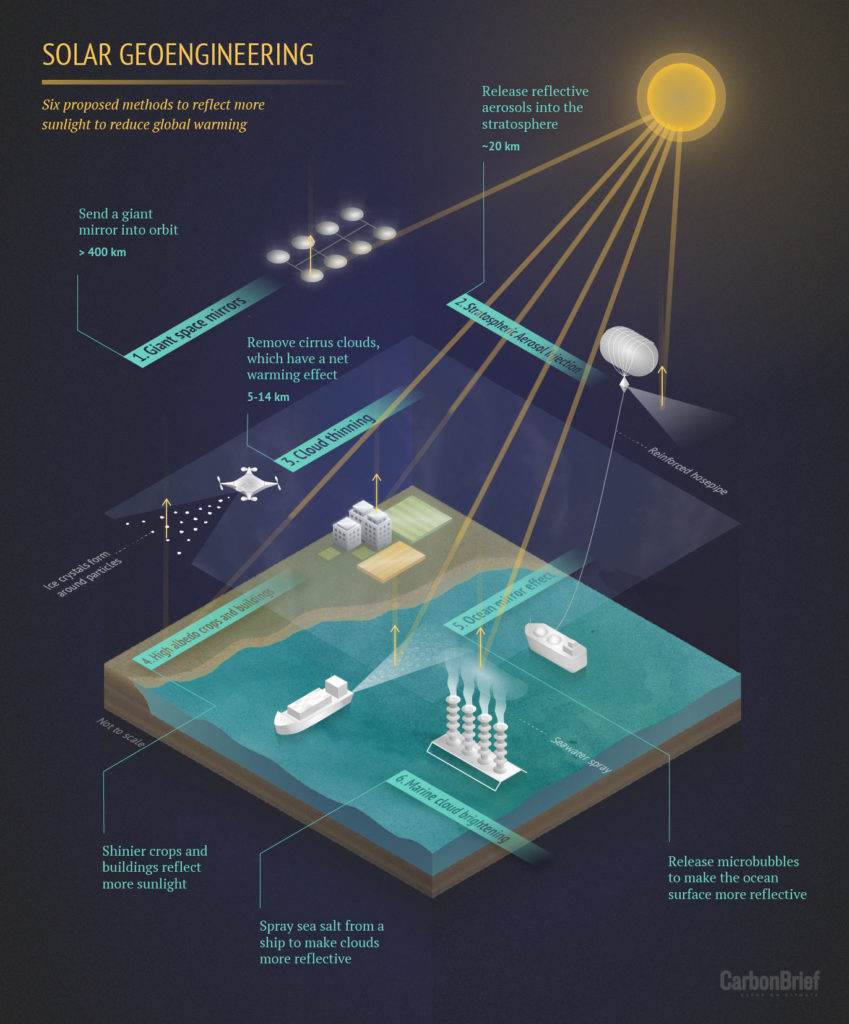
The proposals may sound futuristic, but the notion of engineering the climate in order to limit sunlight has been debated by scientists and politicians for more than 50 years.
However, these debates have always proved controversial, meaning – apart from studies based on computer simulations – little field research into solar geoengineering has been carried out. (See: How does this compare to past solar geoengineering efforts in the UK and globally?)
Aria’s new research programme aims to invest £57m in 21 solar geoengineering research projects globally.
This – along with a separate £10m scheme from the UK Research and Innovation body – means the UK is now one of the world’s biggest funders of solar geoengineering research.
Announcing the details of the scheme, Aria said its motivation for launching the research programme was “the possibility of encountering damaging climate tipping points”.
Out of the £57m, around £24.5m ($33m) will be spent on “controlled, small-scale outdoor experiments”, according to Aria.
These include attempts to thicken Arctic sea ice, brighten clouds above Australia’s Great Barrier Reef and to float weather balloons containing natural minerals high in the stratosphere, which will be retrieved after “hours or weeks”.
All outdoor experiments will be “scrutinised” by an oversight committee chaired by Prof Piers Forster, a leading climate scientist who is the founding director of the Priestley Centre for Climate Futures at the University of Leeds.
In a note released alongside news of the research funding, the oversight committee said it does “not exist to legitimise this programme”, adding:
“We advise Aria on the risks and benefits of supporting proposed creator projects and how best to work with and across creator teams to support learning and to help ensure that findings are contextualised and communicated appropriately alongside [climate] mitigation and adaptation options.”
Aria is a “high-risk, high-reward” government research agency that was formally established through an act of parliament in 2023.
It was originally conceptualised by Dominic Cummings, a controversial former adviser of then prime minister Boris Johnson.
According to Nature, Aria was modelled on the “famed US Defense Advanced Research Projects Agency, or DARPA, which helped to pioneer some of the world’s most consequential technologies, including the internet and personal computers”.
In its recent coverage, the Daily Telegraph described Aria as a “secretive government unit”.
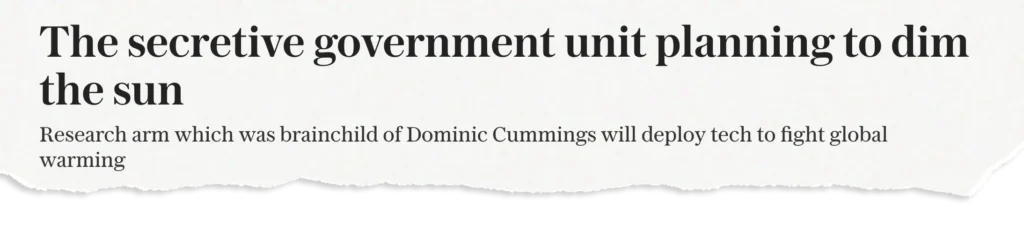
Aria itself has said that it aims to be fully transparent about its solar geoengineering programme, which was its motivation for publicly announcing its spending on the 21 projects involved.
How does this compare to past solar geoengineering efforts in the UK and globally?
As mentioned above, the idea of solar geoengineering has been debated for more than 50 years. However, its controversial nature has meant that, until now, very few field experiments have been carried out.
In 2010, there was an attempt to carry out field research in the UK by the Stratospheric Particle Injection for Climate Engineering (SPICE) project, which was headed by Dr Matthew Watson at the University of Bristol and involved scientists from the University of Oxford, the University of Cambridge and the University of Edinburgh.
The project aimed to “investigate the effectiveness” of solar geoengineering, in part by releasing the equivalent of a bathtub of water high into the atmosphere above Norfolk.
However, it was met with fierce opposition by some campaign groups. In 2012, the team ended the project, citing issues with intellectual property and discomfort with the current lack of regulation and governance of solar geoengineering research.
(Watson is one of the recipients of Aria’s new research programme. His team has been awarded £4.3m ($5.7m) to build specialised drones to study emissions from regularly erupting volcanoes in Guatemala, Montserrat and Chile.)
Outside of the UK, another high-profile solar geoengineering experiment headed by researchers at Harvard University, called the Stratospheric Controlled Perturbation Experiment (Scopex), was also forced to disband following public disapproval.
In the private sector, a US start-up called Make Sunsets has begun releasing high-altitude balloons containing sulphur dioxide into the stratosphere, in an attempt to geoengineer the planet. It funds its activities by selling “cooling credits”.
The company has been banned in Mexico, where it previously launched balloons, and is currently being investigated by the US Environmental Protection Agency.
According to the online publication SRM360, funding for solar geoengineering has increased from $34.9m in 2010-14 to $112.1m in 2020-24. The vast majority of funding is concentrated in global-north countries and about half of all funding comes from philanthropic sources.
This week, scientists and policymakers are meeting in Cape Town, South Africa for the largest summit to date on the scientific, social and political implications of solar geoengineering.
Countries have agreed to a de facto moratorium on large-scale solar geoengineering under the Convention on Biological Diversity, a UN treaty that aims to protect biodiversity. (However, it is not legally binding.)
Why do some scientists say solar geoengineering research is needed?
Scientists agree that cutting global greenhouse emissions as soon as possible is key to tackling climate change.
But global emissions are still rising – and the prospect of limiting global warming to 1.5C above pre-industrial levels, the ambition of the landmark Paris Agreement, without first “overshooting” the target is fast vanishing.
This has led some scientists to call for more research into solar geoengineering ideas, including through small-scale experiments and trials.
Research based on computer modelling indicates that artificially cooling the planet by releasing reflective aerosols into the stratosphere using specialised planes could be effective at offsetting a range of climate impacts, such as more intense heatwaves and flooding, melting sea ice and higher tropical storm risk.
(One solar geoengineering scientist has estimated that halving global warming with reflective aerosols would involve a specialised fleet of about 100 planes releasing 1m tonnes of sulfuric acid each year by 2070.)
However, this type of solar geoengineering would not address rising CO2 levels, which are causing oceans to become more acidic and crops to become less nutritious, among other issues.
Some scientists have raised concerns that, if aerosols were used to address global warming, the world could be left at risk of a “termination shock”. That is, if aerosols were released and then suddenly stopped – as a result of political disagreement or a terrorist attack, for example – global temperatures could rapidly rebound.
This sharp temperature change could be “catastrophic” for wildlife, modelling studies have suggested. However, other research argues that the likelihood of a termination shock has been “overplayed” and that measures could be put in place to ensure that the risk is minimised.
There is also a risk that deploying aerosols from just one spot on Earth could cause uneven impacts for people. One research paper based on modelling found that releasing aerosols in just the northern hemisphere could lead to a decrease in rainfall – and, therefore, an enhanced drought risk – in India and the African Sahel.
Ultimately, advocates of solar geoengineering research tend to argue that the only way to understand more about the efficacy and risks of the technology is to study it further, whereas opponents say more research could be a “slippery slope” towards deployment.
Why are there social and ethical concerns around solar geoengineering?
As well as scientific uncertainties, experts have long warned that solar geoengineering poses large social, ethical and governance challenges.
Some scientists and campaigners are fundamentally opposed to the idea of manipulating the climate further in order to try to repair some of the damage caused by fossil-fuel emissions.
Writing in the Guardian, climate scientists Prof Raymond Pierrehumbert and Dr Michael Mann described Aria’s research programme as “like using aspirin for cancer”.
Indigenous groups have strongly opposed the idea of solar geoengineering and its research, often arguing it goes against their beliefs about living in harmony with nature.
Some scientists and campaign groups also believe that solar geoengineering could be viewed by politicians and the public as a quick “technofix” to climate change. If more research and development is channelled into these techniques, they argue, people may start to backpedal on their promises to cut their emissions.
This is often referred to as the “moral hazard” dilemma.
But other researchers have urged caution on this idea. One reason for this is that social experiments conducted with members of the public have found little evidence of the moral hazard problem existing in practice.
Advocates of solar geoengineering research say it should be viewed as a “supplement” to climate mitigation efforts rather than a “substitute” or “quick fix”.
However, many experts and commentators have pointed out that the technology presents a very large global governance challenge.
A fair and just deployment of solar geoengineering would require agreement between countries, experts have reasoned. At present, it is difficult to picture a global forum that could garner such collaboration, they say.
Prof Alan Robock, a professor in the department of environmental sciences at Rutgers University, summarised this issue neatly in a conversation with Carbon Brief in 2018, when he said:
“You’re asking if the world can come together and agree on geoengineering without agreeing on mitigation. I think the answer is for us to agree on mitigation. Paris is the first step, the pledges made there aren’t enough but have got to increase.”
Another concern is the “free-driver problem”, an idea that refers to the potential for a single country, group or even individual to unilaterally deploy solar geoengineering, even if it might cause negative impacts for others. This concern arises from the fact that solar geoengineering would be relatively cheap to carry out.
It has been argued that the free-driver problem poses a larger concern than ever in today’s increasingly polarised world, where lone politicians and billionaires hold large amounts of power.
These serious social and governance issues prompt some experts to say solar geoengineering should not be researched at all, but others to say it should be researched to try to address concerns.
Out of Aria’s £57m for solar geoengineering research, around £2.8m ($3.7m) is earmarked for governance and ethics projects.
In its latest assessment for how the world can address climate change, the world’s authority on climate science, the Intergovernmental Panel on Climate Change (IPCC), notes that there is “high agreement” among research papers that solar geoengineering “cannot be the main policy response to climate change and is, at best, a supplement to achieving sustained net-zero”.
The assessment also notes that solar geoengineering “may introduce novel risks for international collaboration and peace”.



The post Factcheck: How the UK is – and is not – studying solar geoengineering appeared first on Carbon Brief.
Factcheck: How the UK is – and is not – studying solar geoengineering

The UN’s flagship climate fund has selected five locations for its new regional offices, a move aimed at bringing it physically closer to developing countries and making its finance easier to access.
After fraught discussions during a meeting last week, the board of the Green Climate Fund (GCF) decided in a secret vote on Saturday to open regional offices in Panama City, Amman in Jordan, Suva in Fiji, Nairobi in Kenya and Abidjan in Côte d’Ivoire. The African office will be split across two locations to better serve the continent with the largest number of countries and projects supported by the fund.
The decision marks a significant shift for the fund, which has operated from its headquarters in Songdo, South Korea, since its launch in 2013.
“This is a landmark moment for [the] GCF,” said the fund’s executive director Mafalda Duarte. “It has taken a lot of work, careful negotiation and persistent advocacy for a model that will bring us closer to the countries, to our partners and the communities we were created to serve”.
‘Less delay, more action’
The new offices are expected to act as the GCF’s front line, working more closely with governments, the private sector and civil society to improve access to climate finance and support the delivery of projects aimed at cutting emissions and strengthening resilience to climate impacts.
Welcoming the decision in a LinkedIn post, Fiji’s Permanent Secretary for the environment and climate change Sivendra Michael described it as “a win for the entire Pacific”, citing “long hours” and “tough negotiations” behind the outcome. “Less delay, more action — real support where it matters most,” he added.
-
Can new CEO steer Global Center on Adaptation back on course?
Madagascar’s Rindra Rabarinirinarison takes the helm of the troubled organisation promising to prioritise fundraising, rebuild trust with donors and hone its mission

A total of 43 countries applied to host the new offices, with 16 making a final shortlist after the GCF secretariat assessed bids on criteria including cost, connectivity and the ability to attract a “world-class workforce” through quality of life and access to international schools.
Panama emerged as the top-ranked location overall, according to a document seen by Climate Home News, while some selected hosts, including Amman and Abidjan, scored lower than rival candidates in their regions.
Establishing the new hubs is expected to cost an initial $6.5 million, but the fund anticipates these upfront expenses will be offset over time through operational savings, including lower staff and travel costs.
First Palestinian entity approved
The GCF board also accredited the first organisation in Palestine that will be able to directly apply for and access funding.
Created by the Palestinian Authority in the West Bank, the Municipal Development and Lending Fund supports local infrastructure projects and services. Working with partners, including the World Bank, it is developing projects to help communities cope with escalating climate risks such as drought and extreme heat.
In the West Bank, which is occupied by Israel, just under half of the population lives in areas classified as having high to very high climate exposure, according to a recent study.
The post Green Climate Fund picks locations for five developing country hubs appeared first on Climate Home News.
Green Climate Fund picks locations for five developing country hubs
Farmers and fishermen in the Maldives have long relied on an ancient calendar to guide their daily lives.
The Nakaiy system divides the year into 27 distinct periods, each named after a star or constellation in the night sky.
Any one period in the calendar tells you about expected weather and tidal patterns, navigational routes, and fishing conditions. The Nakaiy was created through centuries of careful observation and local knowledge, passed down through families as an essential tool for survival.
But things are now changing. The climate crisis is leading to more extreme weather events across the Indian Ocean island nation and upending the Nakaiy calendar.
“When you go and speak to communities and ask them what kind of impacts they are facing, a lot of elders will tell you that the weather, it doesn’t follow the calendar anymore,” explained Aishath Reesha Suhail, a programme officer in the Maldives’ Ministry of Tourism and Environment.
As the effects of climate change worsen, it is a real prospect that the Nakaiy may be abandoned by local people, representing a major cultural loss to the Maldives.
‘Systemic and growing threat’
With extreme weather becoming the norm, communities are observing a domino effect of consequences in their everyday lives. The slow onset of heritage loss is now being seen across continents, but notably among small islands in remote parts of the ocean.
“Climate change represents a systemic and growing threat to cultural heritage worldwide,” a UNESCO spokesperson told Climate Home, adding that the World Heritage Committee has identified climate change as “one of the most significant long-term risks affecting properties across all regions.”
UNESCO, the UN body for education, science and culture, defines the loss of cultural heritage as “the erosion of traditional knowledge systems, craftsmanship, social practices and identity, particularly where communities are displaced or livelihoods disrupted”. A clear example is historical sites and even entire islands washed into the ocean as a result of rising sea levels and coastal erosion.
The Maldives is dealing with such a situation now. The Koagannu Cemetery is a 900-year-old resting place, located on the country’s southernmost atoll, a mere 50 metres from the shoreline. The monument’s intricate coral gravestones are being actively threatened by the encroaching Indian Ocean.
The government and local community have responded to this challenge with emergency protection measures. Sandbags and concrete structures have been installed along the coastline, complemented by large numbers of palm trees to create a seawall. A wider solution is ‘beach nourishment’, a common practice in the Maldives where sand from elsewhere is brought in to replace what has been lost through erosion. Taken together, these solutions have so far protected the cemetery.
Among the many issues climate change creates, cultural heritage is not always front of mind. In the Maldives, one of the main barriers people face is awareness. “Most of what we are dealing with relates to the erosion of our islands along with areas such as fisheries… but we are quite limited in our capacity to do something about it,“ Suhail said.
“We don’t understand the full breadth of the issue at present because we haven’t been able to do extensive research on the matter,” she added. However, assessing the extent of the damage – and how to respond effectively – is a key priority for the government, outlined in its latest climate plan, known as a Nationally Determined Contribution, and as part of its National Adaptation Plan process.
Fishing is at the core of the country’s culture and identity, employing thousands of people. Most dishes include fish – “we have it for breakfast, lunch and dinner,” Suhail noted – but the climate crisis and overfishing are shifting how and when communities can fish. Tuna makes up 98% of all fish caught in the Maldives, but warmer ocean temperatures are changing migratory patterns, pushing the species into deeper, colder waters.
As a critical economic and cultural resource, the government has outlined a range of solutions to protect the fisheries sector in its first Biennial Transparency Report to the UN. These include using real-time tracking data to improve the efficiency of fishing operations; investing in canneries to increase fish storage; and diversifying away from tuna through marine farming.

Culture and nature go hand-in-hand
The same pattern is playing out elsewhere.
Palau and the Maldives are not close to one another. The two states are separated by around 4,000 miles and sit in different corners of the ocean. But both are experiencing very similar climate challenges, based on their position as a set of scattered, low-lying islands surrounded by an imposing body of blue water.
In the same way as the Maldives, Palau’s cultural heritage is closely tied to “land, coastlines and traditional food systems,” according to Toni Soalabla, at the Palau Office of Climate Change.
“Many of the places that hold stories, history and identity of our communities are located along the coast and are increasingly exposed to erosion and sea level rise,” she said.
One of these places is Ngerutechei village, reportedly the oldest in Palau, and home to ancient stone paths and carvings. The village provides a glimpse into the past social values and culture of the people in this western Pacific nation.
As part of the development of Palau’s National Adaptation Plan, the government has worked with local leaders to identify similar sites of cultural significance. The plan encourages communities to use their own knowledge to create protective measures for these sites.
Climate change is also prompting communities to take up traditional land and food practices again. These include cultivating taro, a stable food source that has historically supported water, soil and food security on the islands.
“These systems developed over generations in response to local environmental conditions, so strengthening them today is both a climate adaptation measure and a way of maintaining cultural knowledge that might otherwise fade,” said Soalabla.
Cultural practices in Palau have developed alongside the natural ecosystems that people rely on to survive. It is within this context that researchers believe adaptation policies should be created. Recognising this relationship “can strengthen both community identity and environmental resilience at the same time”, according to Soalabla.


Heritage on the global stage
The issue of cultural loss has not gone unnoticed in international climate negotiations.
Small island states such as the Maldives have used their role at the UN to push for greater awareness and action, with some key successes.
In 2015, the Paris Agreement established a Global Goal on Adaptation (GGA) which recognised that countries needed to do something about climate change now and not later. However, it took six years before a framework and a set of adaptation targets were agreed at the UN climate summit in Glasgow to pursue this goal.
From this came the establishment of seven overall themes – from poverty eradication to access to health – to guide adaptation action and a set of around 60 indicators to measure progress against the targets.
World leaders invited to see Pacific climate destruction before COP31
Emilie Beauchamp, an adaptation specialist at the International Institute for Sustainable Development (IISD), said that “cultural heritage was highlighted as one of the global priorities [of the GGA Framework] and is one of the seven themes, so it is considered very important by the international community.”
The much-debated set of indicators, only finalised in Belém at last year’s COP30, include five related to cultural heritage with a focus on preserving cultural practices and important sites that are “guided by traditional knowledge, Indigenous Peoples’ knowledge and local knowledge systems”. A spokesperson for UNESCO said the inclusion of heritage indicators “marks an important recognition that climate impacts extend beyond economic losses”.
While critics said the set of final indicators was rushed through by the Brazilian presidency, they now serve as guidance for national governments that wish to implement plans to protect their common heritage. The missing piece of the puzzle remains how to finance these plans – something notably absent from the Belém text, which made clear that the adaptation indicators “do not create new financial obligations or commitments, nor liability or compensation”.
The lack of financial commitments proved disappointing for many small states grappling with how to prevent their cultural history from being entirely forgotten, especially at a time when adaptation finance remains below requirements. A recent UNEP report found that developing nations would need an estimated US$310 billion per year in 2035 to adapt to climate change, while current public financing was around $26 billion.
At these low levels “only a small percentage of what the framework outlines could be implemented,” according to Beauchamp.

The challenge of cultural heritage
When looking at low-lying islands on a map, they can appear as specks of land amid a vast ocean. Many of the stories from these remote places go unnoticed. But the specks represent millennia of human culture that is slowly being lost to the ocean.
While the international community has now recognised the problem and solutions exist, the recurring issue of scarce finance may prevent governments from taking sustained action. Island communities have already been forced to move home as sea levels rise, leaving behind their cultural connections to a place.
The value of any cultural asset, or of human heritage, can be judged by how it is engaged with over generations. Without human intervention, many historical sites, language, cuisine and other local customs would become a forgotten part of history. The rapid onset of climate change brings the role of cultural heritage into sharp relief, challenging communities to decide in real time what they value, what deserves saving, and how to achieve that.
Stories of cultural loss are not confined to small islands but it is here where the challenge is presenting most acutely. The experiences of these vulnerable nations in protecting their heritage will provide the litmus test for effective adaptation responses elsewhere.
Adam Wentworth is a freelance writer based in Brighton, UK.
(Main image: The Isdhoo Havitha is an ancient Buddhist monastery in the Maldives, located moments from the shoreline. Photo: Ashwa Faheem)
The post Island nations fight to save cultural heritage from climate change appeared first on Climate Home News.
Island nations fight to save cultural heritage from climate change
The invasive emerald ash borer, native to northeast Asia, has spread to 37 states over the past quarter century, killing nearly all of the ash trees it infests. But in Maine, a coalition of basketmakers, scientists and government officials are plotting a future for their trees.
Each strip of wood in Richard Silliboy’s hands started as a year of an ash tree’s life.



-
Greenhouse Gases8 months ago
Guest post: Why China is still building new coal – and when it might stop
-
Climate Change8 months ago
Guest post: Why China is still building new coal – and when it might stop
-

 Greenhouse Gases2 years ago
嘉宾来稿:满足中国增长的用电需求 光伏加储能“比新建煤电更实惠”
-
Climate Change2 years ago
Bill Discounting Climate Change in Florida’s Energy Policy Awaits DeSantis’ Approval
-

 Climate Change2 years ago
嘉宾来稿:满足中国增长的用电需求 光伏加储能“比新建煤电更实惠”
-
Climate Change Videos2 years ago
The toxic gas flares fuelling Nigeria’s climate change – BBC News
-

 Renewable Energy5 months ago
Sending Progressive Philanthropist George Soros to Prison?
-

 Carbon Footprint2 years ago
US SEC’s Climate Disclosure Rules Spur Renewed Interest in Carbon Credits