

Shanxi province in northern China is the country’s largest coal producer, leaving its coal-reliant economy and workers particularly exposed to the nation’s pledge to transition away from fossil fuels.
A new survey of Shanxi residents, exploring attitudes to climate change and the “just transition”, offers a rare insight into the views of Chinese people on the frontline of this policy drive.
While the province has installed significant new clean energy capacity, coal-related industries contributed around 80% of the province’s tax revenues and 55% of its jobs in 2022.
Indeed, Shanxi could lose more than 240,000 coal jobs by 2050 as China’s energy transition continues, according to energy thinktank Global Energy Monitor (GEM).
In an April 2025 speech, Chinese president Xi Jinping said the energy transition needed to “strike a balance between multiple goals including environmental protection, economic growth, job creation and poverty alleviation”.
So far, however, provincial policies relating to the energy transition have not been translated into “something…tangible to peoples’ lives”, says Tom Wang, executive director of People of Asia for Climate Solutions, a climate advocacy group and one of the groups who designed, carried out and helped analyse the results of the recent survey.
The survey asked almost 10,000 people in Shanxi about their views on China’s climate policies, the impacts on their local economy and whether they felt prepared for the energy transition. A detailed methodology can be found at the end of the article.
In this interview, Wang discusses the motivations for carrying out the survey and outlines its key findings.
The interview has been edited for length and clarity.
- On the importance of coal to Shanxi’s economy: “Millions of people and their families rely on coal-related jobs, such as coal miners, coal-truck drivers, coal power plant workers or coal-washing workers.”
- On the lack of awareness of climate change in some communities: “The most vulnerable communities, by which I basically mean the coal community, don’t really know about climate change. They know about the energy transition, they know a little bit about big policies…but they don’t really understand them.”
- On media narratives: “Most state-owned media talk a lot about climate change, peaking carbon emissions, renewable energy, the energy transition and so on…However, the media does not explain what that means for people’s everyday lives.”
- On the interest in low-carbon industry jobs: “People are quite happy to move on, if they are provided with good training and strong support to help that transition go smoothly.”
- On the importance of fast action: “2025 and 2026 will be two critical years for this province. They will be when we make our next five-year plan, the 15th five-year plan, which will cover 2026-2030. This will also be the five years we start to physically see the job losses in the coal mining industry, because of China’s overall climate policies.”
- On why young people were concerned about coal mines and power plants closing: “We have spent so much energy and resources on educating and preparing our young people for the coal industry, instead of preparing them for the transition.”
- On what needs to be done next: “We need to prepare our two communities – the coal community and the young generation – today. We cannot afford to wait any longer. We need to tangibly start to train people and raise new sectors, or at least raise incomes.”
- On the need for inter-provincial support: “The [richer] provinces should step up and say: ‘Look, brothers, you have supported our economies and now it’s time for us to help you.’”
Carbon Brief: Why did you want to conduct this survey? Why did you want to focus on Shanxi?
Tom Wang: I always say working on coal is my job, but, at the same time, it’s a personal issue for me, because I’m from Shanxi province. I grew up with coal, thinking that it was a necessary part of life. We burned coal for cooking, heating and even festival celebrations. But I also lost quite a lot of people in my family – my cousins and uncles, who were coal miners or working for coal-fired power plants – either because of coal-mine accidents or air pollution.
Shanxi province is the world’s largest coal producer. [Note: The province’s coal output reached 1.3bn tonnes in 2024.]…Every year, whether China’s economy is performing well or badly, we contribute around one-third of its coal. Millions of people and their families rely on coal-related jobs, such as coal miners, coal-truck drivers, coal power plant workers or coal-washing workers. Around you, your cousins, classmates or friends [are working in the coal industry].
Even in my first job as a teacher, part of my pay would come from money made from coal. So it was a big part of my life. That’s why we have to address coal in China, including – or even starting with – Shanxi.
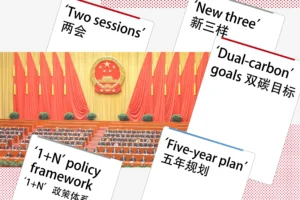
And then there is the bigger context. Internationally, after COP28 and COP29, we talk about a coal phase-down, if not a coal phase-out. Then, domestically, China is working towards its dual-carbon goals – targeting a carbon emissions peak before 2030 and carbon neutrality by 2060…This means we have five years to achieve a carbon emission peak and it also means that coal consumption should start to decline next year.
Therefore, Shanxi cannot depend on the coal economy. We have been relying so heavily on coal mining, coal sales and coal exports to other provinces. That income-generating industry is going to disappear very soon…which means millions of people’s jobs and livelihoods will undergo dramatic changes.
For more than a decade, Shanxi province’s own policies have also covered the energy transition. It’s worrisome that these policies have remained [high-level], without being translated into something more tangible to people’s lives.
People are not prepared. Coal miners are not prepared. Their wives are not prepared. The coal-truck drivers are not prepared. The metallurgical coal industry is not prepared. That’s why we wanted to do this survey and interview as many people as possible. We ask two simple questions: do you know about and support the energy transition – and are you prepared?
CB: What do people in Shanxi think about the energy transition, climate change and climate policy?
When it comes to climate change, awareness levels are very different between different demographic groups. For example, government workers and people with higher income or education levels know about climate change.
Some people [in the survey] could identify things happening around them, such as temperatures getting warmer every year, drought periods getting longer, how last winter we didn’t have any snow – and they found these worrisome, based on their own experiences of how the province should be.
Some people even mentioned extreme weather events, including heatwaves and a week-long rainstorm that ruined a lot of Shanxi province’s ancient temples – the most valuable thing that we have.
However, the most vulnerable communities, by which I basically mean the coal community, don’t really know about climate change. They know about the energy transition, they know a little bit about big policies, such as the dual-carbon goals – they say they know about these buzzwords, but they don’t really understand them.
CB: In the survey, people would say they supported the ‘dual-carbon goals’ when asked about them specifically, but then were not as supportive of implementation measures, such as closing coal mines or coal-fired power plants. Why is that?
TW: This is uniquely Chinese, because most state-owned media talk a lot about climate change, peaking carbon emissions, renewable energy, the energy transition and so on. The visibility of all these ‘big words’ is really high.
However, the media does not explain what that means for people’s everyday lives. They are just copy-pasting [readouts of] policies from the State Council into their newspaper. For them, that’s ‘job done’, but it doesn’t really make sense to ordinary people. That’s how Chinese media works.
That is why the survey finds that, although more than 70% of people are aware of words like carbon emissions peak, or that they’re aware of the energy transition, it doesn’t mean they know what these words mean or how to interpret them.
But when we interpret these policies for them and explain that the energy transition means we are going to use less coal, they can understand…and feel the impact on their lives quite sharply.
That’s why there’s such a gap. [People say they] support everything the government does, whether or not they understand what that means. However, when you ask if they support something that would change their life completely – for the better or for the worse – they have to think twice.
CB: The survey also asked people what they would like to see prioritised in a just transition away from coal. What did respondents say was important to them?
TW: Two things stood out to me. First, I often talk about a mechanism called JET-B. We all know JET-P, the Just Energy Transition Partnership. However, in Shanxi province, what we really need is the JET-B, a Just Energy Transition Brotherhood.
The rich provinces in China, which are mostly along the east coastline – for example, Jiangsu, Guangdong, Shanghai, Zhejiang, Fujian, Shandong – relied heavily on Shanxi’s coal in the past decades to develop their economies. [The JET-B calls on them to] support Shanxi with its energy transition.
Many [respondents] agreed with this! They expect other richer provinces to support us, because the whole province knows that we have been providing so much coal to other provinces, instead of using it ourselves.
Also, the people of Shanxi are actually willing to change or improve their own skill-sets. They know how dangerous it is to work in the coal industry, both because of accidents and because of pollution. There is a high awareness of the lack of a future for the coal industry among respondents. People are quite happy to move on, if they are provided with good training and strong support to help that transition go smoothly.
CB: In the report, you chose to pull out the responses from coal sector workers and young people as special focus areas. Why?
TW: Almost a half of [Shanxi’s] population works one way or another in or for the coal industry – they would have been a huge part of the survey whether we focused on them or not. But we did want to find out particularly how the coal community feels, because they will be the community who are most directly and immediately impacted by the energy transition.
Their responses are very important as an indicator to policymakers. They will have to be the very first group of people to be retrained and they should be supported in the transition into a cleaner and healthier future.
Prospects for the young generation are also a huge concern in Shanxi. We are losing many young people to other provinces – like a talent drain. Also, the energy transition and climate change are always about the future generations. I wanted young people to feel ownership over this topic and I wanted to hear about their [feelings towards their] own province. Do they want to stay here? Do they want to leave? What is keeping them here, or what is pushing them away?
These answers are valuable for policymakers because young people are leaving and trying to make a living [in other provinces]. Ironically, historically, we have a reputation of being the “stubborn province” – a community of people who refuse to leave their hometowns, because we are so attached to this place.
I don’t know why this is! I guess [the community feels] we have such a beautiful history, beautiful nature and lovely people. There are many reasons to be proud of being from Shanxi, but we are losing so many young people.
2025 and 2026 will be two critical years for this province. They will be when we make our next five-year plan, the 15th five-year plan, which will cover 2026-2030. This will also be the five years we start to physically see the job losses in the coal mining industry, because of China’s overall climate policies.
At the same time, in late 2024 and early 2025, Shanxi was put into the spotlight for its rich tourism opportunities. I’m not sure how familiar you are with the area?
CB: I have been to Shanxi before – to Datong, Pingyao and a couple of other areas…
TW: …so you saw the beautiful grottos in Datong and the ancient temples? When I was talking about [the week-long] rainstorm in 2021 that damaged our ancient cities and towns, I was talking about Pingyao!
I would feel so guilty if we weren’t able to hand down a beautiful Shanxi province to future generations. That is why the voice of the young generation is so interesting to me.
CB: It struck me how young people in Shanxi responded to the questions. Just over a quarter felt they did not have the skills they needed for a clean-energy economy and around half were worried about the closure of coal mines and coal-power plants. What can be done to address their concerns?
TW: In Shanxi province we have universities that are dedicated to the coal industry. These young people are trained to become engineers, coal miners, metallurgical coal factory technicians or steel factory workers. We have spent so much energy and resources on educating and preparing our young people for the coal industry, instead of preparing them for the transition away from coal.
Young people don’t know how to prepare for the energy transition. And then there’s the current job market. Shanxi’s economy is so weak – in 2024, our province had the lowest economic growth rate in China.
Shanxi is not supposed to have the weakest growth, theoretically speaking – we have both heavy industry and a services industry. But we didn’t do very well last year because coal prices were rising and falling and China was importing a lot of coal from other countries, which meant Shanxi lost market share for coal in 2024.
At the same time, Shanxi is not very good at setting up new industries. For example, China’s AI industry is getting stronger. Shanxi province is full of mountainous regions that could provide natural cooling environments for big data centres.
Data centres require two things: cooling and energy. Shanxi has both: natural cooling and energy, including a lot of renewable energy – curtailment is a big problem for us.
We have all of this potential but we’re not translating it into good, decent, healthy, strong, futuristic, sustainable jobs. That’s why the young generation doesn’t feel confident.
CB: What lessons should be taken away from the survey?
TW: We need to prepare our two communities – the coal community and the young generation – today. We cannot afford to wait any longer. We need to tangibly start to train people and raise new sectors, or at least raise incomes.
Communications are also critical. We, as communicators, know the importance of communications, but policymakers – and sometimes even China’s journalists – do not know that yet. I want to see more opinion leaders or TikTok influencers from my province [talking about Shanxi’s transition away from coal].
Wouldn’t it be beautiful to see a coal miner from Datong [which was once China’s largest coal production and export base] become a tour guide on TikTok and show that he can still make decent money without coal?
We need to inspire people. Young people and the coal community are feeling lost and sad, they don’t know what to do. We need to find the different seeds of possibilities and highlight that all these doors are out there. They might look as if they’re closed, but with a little pushing they will open.
That’s what I would like our policymakers and investors, as well as NGOs – although we don’t have many of them! – to say. And the [richer] provinces should step up and say: “Look, brothers, you have supported our economies and now it’s time for us to help you.” Not necessarily even with money, it could be with technology.
For example, once, I almost cried when I was visiting a museum in another province, because it was so well set-up and curated. As a tourist, I really appreciated its beauty.
The subject the exhibition was focused on was only 300 years old, whereas in Shanxi province so many of our artifacts are more than 500 years old. But we don’t have the investors and technologies, or even the awareness, to make our museums that attractive.
Having artists, professors, historians or curators come from these rich provinces and make our heritage stay here and shine [would be helpful] – it doesn’t have to be financial support that they send! We have this piece of gold but it isn’t shining because our policymakers aren’t doing their jobs and our people aren’t aware of its value.
As a final thought, a speaker at one of our recent conferences was a coal miner who was also a poet. One of his collections was called “Seeking starlight in the coal pit”.
That metaphor reminded me about an English poem I had read. The UK was probably the world’s very first coal-mining country and there’s a lot of poetry and poets that came out of the UK’s coal community as well. And it just so happened that a UK coal-miner poet also wrote a very similar poem. [The poem is titled “The stars are twinkling”.]
It is beautiful that two coal miners from two different centuries, countries and language groups both became poets who wrote about standing in a coal mine and seeing the stars.
Note on the survey methodology: According to the survey report, the findings of the report were primarily sourced from a survey, supplemented by in-depth interviews with 30 individuals representing a range of industries.
The survey was hosted on Credamo, an online survey website, and was open from 17 July 2024 to 18 August 2024. The survey organisers recruited 201 students from universities in Shanxi province as volunteers to promote the survey and gather responses. Volunteers were asked to ensure that at least one of every three responses they gathered was collected in-person.
In total, 9,776 complete responses were gathered. Respondents who responded to control questions incorrectly, or took less than seven minutes to complete the survey, had their responses removed, leaving 6,035 valid responses.
Among the respondents with valid responses, 44% were men, 54% were women, with 2% selecting ‘other’. Respondents were located in 11 towns or cities across Shanxi province: Changzhi (25%), Taiyuan (15%), Linfen (10%), Yuncheng (9%), Datong (7%), Jincheng (7%), Shuozhou (6%), Lüliang (6%), Xinzhou (5%), Jinzhong (5%) and Yangquan (3%). The survey respondents skewed young, with 55% aged 24 years old or younger. 57% of respondents completed a university degree.
The interview was conducted by Anika Patel on 2 April 2025 via Zoom.



The post Interview: What the people of China’s coal-rich Shanxi think about climate change appeared first on Carbon Brief.
Interview: What the people of China’s coal-rich Shanxi think about climate change

The launch of the Africa Energy Bank (AEB) has been put back yet again, raising doubts about the institution’s future ability to finance fossil fuel projects – its main objective – as global lenders retreat from such investments over climate concerns, experts told Climate Home News.
The bank, which had been billed to launch in September after a series of delays, is now scheduled to begin operations in November, according to the head of the African Energy Chamber, an advocacy body for the continent’s oil and gas sector.
Even as the world aims to transition away from fossil fuels, many African leaders have made clear they want to continue exploring and extracting the continent’s large oil and gas deposits – estimated at around 125 billion barrels of crude and over 600 trillion cubic feet of gas – to boost economic development.
As a group, Africa sided with a number of powerful oil-and-gas producing nations in blocking progress on negotiations to craft a global roadmap to transition away from fossil fuels at last year’s UN COP30 climate talks, although some countries did individually support the proposal.
-
Campaigners oppose Dangote’s planned Kenya refinery over climate and ecological risks
Plans to build Africa’s second largest oil refinery in ecologically sensitive region criticised as “environmental recklessness” -
Tanzania pushed African nations to oppose fossil fuel transition at COP30
While chairing the African group at the summit, the gas-dependent nation advised the continent’s ministers to block language on transitioning away from fossil fuels


Meanwhile, major projects under development across the continent – including the 1,443-km East African Crude Oil Pipeline (EACOP) and Dangote’s 700,000-barrel-per-day Kenyan refinery – show that African governments see oil and gas as playing a significant role in meeting their energy and economic needs for many years to come.
In 2022, at a gathering of the African Petroleum Producers’ Organization (APPO) in oil-rich Angola, ministers from its member states adopted a resolution to create the Africa Energy Bank to finance projects for the production, use and trade of oil, gas and broader energy sources.
African control over energy resources
An article on the APPO website explains that the bank was conceived as a way to overcome “disenchantment” with fossil fuels among “the international community” which it said had crystallised around the “energy transition” concept.
“If Western countries, after having long taken advantage of the energy sources they now revile to develop, can afford the luxury of abandoning them, this is not the case in Africa,” it adds, noting that many of the continent’s economies are still largely dependent on oil and gas revenues.
A separate web page about the bank, also hosted on APPO’s website, says its objectives include financing the exploration, production and refining of oil and gas, as well as supporting member states in transitioning from fossil fuels to cleaner energy sources “while ensuring energy security”.
Said Addi, a former executive with Shell and energy commodities trading house Gunvor, said the new bank was judged necessary because financing for hydrocarbons from many traditional international lenders has become constrained.
In trying to fill this financing gap, Africa is not simply setting up another fund to support oil and gas, he added. “It is also an attempt to give African countries greater control over how their energy resources and infrastructure are financed,” he explained.
Nigeria to host the AEB
The energy bank – a joint initiative of APPO and the African Export–Import Bank (Afreximbank) – has so far suffered several delays and is almost two years behind schedule. The initial plan was to start operations in January 2025, with Nigeria as the host country, but the bank’s opening was delayed to June of that year to allow Nigeria time to finalise the construction of the bank’s headquarters in Abuja.
After the government announced the completion of the offices in late November 2025, a new launch date was set for January 2026, which was moved back to April, June and then September. Now it has shifted again to November, raising concerns that the institution may be losing momentum.
Former Shell executive Addi said that if the capital is eventually paid in, the bank becomes operational and its first projects are commercially credible, then the delays will be regarded as normal teething troubles in setting up a multilateral institution. But, he added, scepticism will be justified if it continues to stall.
Uganda may see lower oil revenues than expected as costs rise and demand falls
Baron Lamarré, an oil and gas expert and former Petronas oil trader, said that missing “three deadlines in a row is not normal”, and warned that if the timeline slips again, “the story flips from ‘ambitious institution finding its footing’ to ‘good idea that lost momentum before it found any’.”
The Nigerian government, APPO and Afreximbank did not respond to requests for comment by the time of publication.
The funding challenge
The Africa Energy Bank is targeting base capital of $5 billion, with plans to scale up to $120 billion within five years by mobilising private-sector funds. However, it is expected to start operations with initial seed capital of $500 million.
The funding plan is to have the 18 member countries of the APPO contribute $83 million each to the bank as equity for a combined $1.5 billion. Afreximbank, other non-APPO African countries and investors outside the continent are expected to provide the remaining $3.5 billion.
But even the initial $500 million has not been easy to mobilise. In May, APPO Secretary-General Farid Ghezali called on members to deliver on their pledges towards the startup goal before the end of June. But the delays suggest this may not have been met, with experts saying Africa may be finding it difficult to self-fund its oil and gas projects in the absence of international capital.
Lamarré said every extension of the deadline points to the fact that “raising fossil fuel capital in Africa without the majors and their financing networks is brutally hard”.
Why the global electrification agenda misses the point on Africa’s energy crisis
Since 2020, Western lenders, export credit agencies and insurers have been in steady retreat from African hydrocarbons, he said, while oil majors are divesting their African assets, handing over fields to smaller local operators whose credit ratings are not high enough to borrow cheaply.
Even capital from China and the Gulf, which has partially filled the gap, cannot match the volume, tenor or pricing that Western investors once offered, Lamarré argued.
“If mobilising the first $500 million of seed capital [for the AEB] has taken this long, that’s the clearest signal yet of how steep the climb to $120 billion looks,” he said, noting that the continent’s energy financing gap is as large as $30 billion-$45 billion per year.
Africa’s investment landscape, meanwhile, has been shifting. While foreign direct investment dropped from a 2024 peak, inflows remained roughly one-third above the continent’s long-term average in 2025, according to the 2026 World Investment Report from UN Trade and Development (UNCTAD). They are concentrated in a few sectors including critical minerals needed for renewable energy technologies, battery manufacturing and advanced industrial production.
At the same time, data on global energy investment from the International Energy Agency (IEA) shows that fossil fuel investment in Africa has declined over the last decade.

“Trojan horse” for fossil fuels
While the Africa Energy Bank struggles to get off the ground, climate campaigners have criticised its primary aim of financing oil and gas on the continent at a time when the world is starting to move away from high-carbon fuels to cleaner alternatives.
Bhekumuzi Dean Bhebhe, founder of Africa Change Lab, described the bank as a “Trojan horse”, arguing that its focus on fossil fuel financing runs counter to the global energy transition and the African Union’s Agenda 2063 goals of sustainable development and inclusive growth.
The energy bank, he warned, “risks locking Africa into a new cycle of debt, dependency and fossil fuel entrenchment”, adding that its financing blueprint does not pave the way for a climate-resilient future. “In truth, it is to deepen the same extractive, carbon-heavy pathways that the continent should be moving away from,” he added.
Ugandan farmers use British court to try to stop East Africa oil pipeline
Kenya-based climate and energy expert Joab Okanda said the AEB’s plan to finance oil and gas is “a misplaced priority” and it should instead back clean energy in line with the policies of some of Africa’s major export markets like Europe.
In addition, the new bank could struggle to mobilise enough resources to advance large-scale oil and gas projects, he added, noting that its proposed $5-billion initial capital is equivalent to the cost of the East African Crude Oil Pipeline alone.
The AEB’s aim of backing more fossil fuels should be flipped “to support countries that are oil-dependent to start working on their transition plans”, Okanda said.
The post Launch of Africa Energy Bank delayed again in blow to oil and gas hopes appeared first on Climate Home News.
Launch of Africa Energy Bank delayed again in blow to oil and gas hopes