

The Republican candidate Donald Trump has been elected as the 47th US president, beating his Democratic opponent Kamala Harris in a “historic comeback”.
In response, climate scientists, researchers and experts have expressed concern about his election’s impact on efforts to tackle climate change.
During his first term in 2017-2021, Trump – a climate sceptic – rolled back climate regulations and pulled the US out of the Paris Agreement, a move he has promised to repeat.
He continued to attack climate action and science throughout his campaign in the run-up to the 5 November election. He lent heavily on his mantra of “drill, baby, drill”, as well as announcing he wanted to “terminate” spending on what he calls the “green new deal” – understood to be a reference to 2023’s landmark Inflation Reduction Act.
Trump’s election could lead to an additional 4bn tonnes of carbon dioxide equivalent (GtCO2e) of US emissions by 2030, compared to continuing current-president Joe Biden’s plans, Carbon Brief analysis found earlier this year.
Carbon Brief has asked a range of scientists, policy experts and campaigners from around the world what they think a Trump presidency could mean for climate action.
These are their responses, first as sample quotes, then, below, in full:
- Katharine Hayhoe: “‘Every action matters’…[so] despite the coming headwind, it’s more vital than ever to continue striving.”
- Jason Bordoff: “Among the most consequential impacts of a second Trump term on climate action will be regarding the Inflation Reduction Act.”
- Joeri Rogelj: “Political decisions that disregard evidence…will be harshly course-corrected by the hard physical reality of climate change.”
- Li Shuo: “Trump’s win is no doubt bad news for US climate action…Other countries will need to step up.”
- Mo Adow: “Ultimately no one can run from the climate crisis, not even Donald Trump.”
- Alden Meyer: “Both domestic climate policy and multilateral cooperation are facing a time of extreme uncertainty and stress.”
- Navroz K Dubash: “It is critical that the world not bend backwards to try and mould the climate regime around the vagaries of US political currents.”
- Camilla Born MBE: “There is now a significant vacuum to fill to inspire confidence, shape markets and maximise the opportunities the transition brings.”
- Tasneem Essop: “The climate movement will be defiant and continue fighting.”
 Katharine Hayhoe
Chief scientist of the Nature Conservancy and distinguished professor
Texas Tech University
As a lead author for the National Climate Assessment during the previous Trump administration, I’ve personally witnessed how federal decisions can impact climate action.
Some decisions are highly visible, like rolling back legislation, removing environmental protections and pulling out of global treaties. However, quieter and more behind-the-scenes decisions that restrict scientists’ access to data, limit research and funding and discourage public communication of critical findings can be equally chilling.
It’s essential to remember that action doesn’t rely solely on federal action. While policies such as the Inflation Reduction Act provide critical momentum, progress can and must happen at all levels: cities, states, businesses, organisations and more.
This election, for example, climate- and nature-positive ballot initiatives were passed in more than a dozen states. Groups such as the US Climate Alliance, Climate Mayors and America Is All In represent nearly two-thirds of the US. And organisations like the Nature Conservancy remain dedicated to implementing effective solutions for a safer, healthier and more just future.
Science is clear that “every action matters”. That’s why, despite the coming headwind, it’s more vital than ever to continue striving for a resilient future for people and nature. It’s not about saving the planet: it’s about saving us.

 Jason Bordoff
Founding director
Center on Global Energy Policy at Columbia University’s School of International and Public Affairs
Domestically, among the most consequential impacts of a second Trump term on climate action will be regarding the Inflation Reduction Act (IRA). President Trump has been critical of the IRA, vowing to rescind unspent IRA funds and end EV tax credits. Particularly with the possibility of Republican control of Congress, there may be more legislative ability to roll back parts of the IRA. At the same time, given that we have seen bipartisan support for parts of the IRA in Republican-leaning states because of the investments being generated, I could see a scenario where some of the IRA’s domestic manufacturing provisions remain in place.
Additionally, we could see some expansion of clean-energy generation capacity in the Trump administration, particularly nuclear energy, for which Trump has voiced support. This would come at a time when some of America’s largest tech companies are actively looking to invest in nuclear and other forms of clean, firm power generation to meet the rapidly growing energy needs of artificial intelligence. Given growing tensions between the US and China, Republicans and Democrats should both be able to agree that it is in America’s economic and security interests to maintain our leadership position in AI.
Internationally, Trump quite notably withdrew the US from the Paris Agreement in the first days of his first term in office and has pledged to do so again if re-elected. On top of that, he has also said he plans to withdraw the US from the UN Framework Convention on Climate Change, a potentially more impactful move that, if successful, would remove the US from participating in COP negotiations and global climate cooperation more broadly.
 Joeri Rogelj
Director of research at the Grantham Institute
Imperial College London
Irrespective of how one aligns politically, the case for pursuing a thriving low-carbon economy has never been stronger, both scientifically and economically. Scientifically, we understand how the extreme weather we have seen over the past years is of our own making, a result of the world’s greenhouse gas emissions.
We also understand that these impacts will become unacceptable and unmanageable with unchecked climate change. Meanwhile, clean renewable energy that generates high-quality jobs has become the economically sane choice in many countries. Political decisions that disregard evidence are putting us on societal dead-end streets that will be harshly course-corrected by the hard physical reality of climate change catching up.
 Li Shuo
Director of China Climate Hub
Asia Society Policy Institute
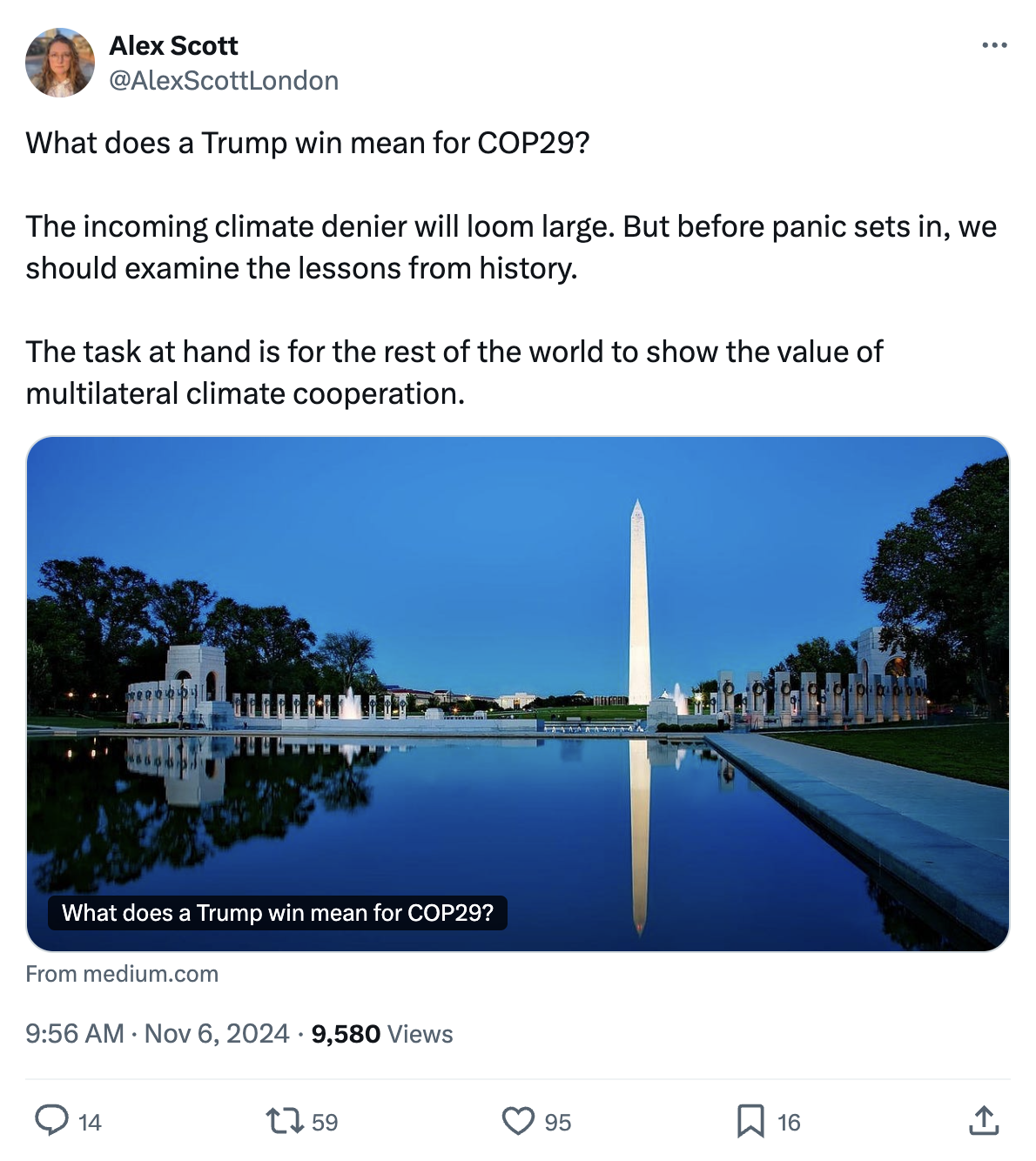
Trump’s win is no doubt bad news for US climate action. It will also have a spillover effect for global climate politics, casting a shadow over COP29. Other countries will need to step up to fill the leadership gap. The EU and China will need to be critical partners in this endeavour.
Trump’s win will not change the global green transition. Green energy is becoming cheaper and more competitive. This economic trend, not politics, will lead action from now on.
I expect countries, including China, to reaffirm their commitments to the Paris Agreement at the start of COP29. Their resolve to manage the climate finance debate in Baku will be the earliest test of the resilience of the climate regime. Unlike 2016, the global community is prepared.
I am confident we will weather the immediate impact, but I am worried about the long-term implications of this election.
 Mo Adow
Founding director
Power Shift Africa
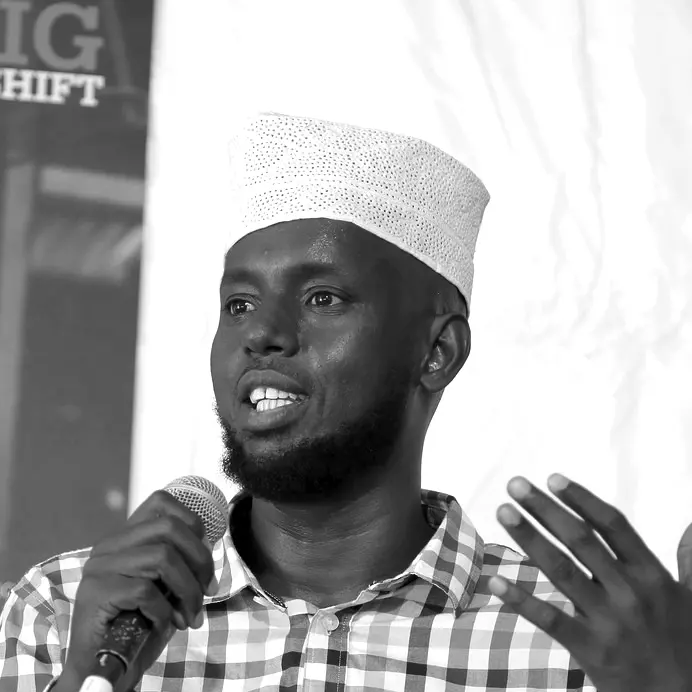
Ultimately, no one can run from the climate crisis, not even Donald Trump. Extreme weather is killing people, economies and livelihoods are being wrecked, the science is clear, and the solutions are known. The rest of the world won’t just stand by and let one man’s ignorance ruin the home we all share.
Climate action is not a wall where if you remove one brick it falls down. It is like a trampoline with many springs. If you take one out, others can bear the load. The impetus for climate action over the next four years will not come from the politics of the White House, it will come from the economics of clean energy, from Europe, emerging markets and sub-national actors in the US and around the world.
For Africa, this is an opportunity to step up and fill the void left by the US presidency. Africa has vast renewable energy potential combined with the moral authority of being victims of climate harm but not perpetrators. With the right investment from other countries, African nations can demonstrate how it’s possible to break the link between development and fossil fuels and raise up a continent of climate champions to showcase the power of clean energy.

 Alden Meyer
US lead for the International Climate Politics Hub and senior associate
E3G
While we don’t know exactly what policies President-elect Trump will pursue on the domestic or global stage, both domestic climate policy and multilateral cooperation are facing a time of extreme uncertainty and stress, given his statements on expanding oil and gas production, withdrawing from the Paris Agreement and rolling back key climate and clean energy measures.
Any retreat from progress would be a significant mistake. As the mounting impacts of climate-related disasters make abundantly clear, the world needs to accelerate climate action. And such action is advantageous for the US – for our economy, our energy security and for our foreign policy interests.
In a few days, representatives from 197 countries as well as a delegation of US governors, mayors, corporate CEOs and civil society leaders will travel to Baku to advance the crucial work of climate cooperation. COP29 has both the opportunity and obligation to drive forward progress on scaling up climate finance, transitioning from polluting fossil fuels to cleaner, more secure energy sources and building greater resilience to mounting climate impacts.
 Navroz K Dubash
Professor of public and international affairs
Princeton University
Trump has called climate change a “hoax” and supports fossil fuel expansion. His election as president of the richest and most technologically capable country with the greatest responsibility for cumulative emissions cannot but set back the fight against climate change.
But it is also true that the problem goes deeper than an individual president. For example, because of the divided polity in the US and its political system of multiple “veto points”, the world’s largest historical emitter finds it impossible to appropriate essential public funds for climate finance, under any president. This contributes to simmering feelings of global climate injustice.
Which is why, at climate negotiations, it is critical that the world not bend backwards to try and mould the climate regime around the vagaries of US political currents, nor press pause on building out critical elements of the climate regime.
Meanwhile, our friends in the US will need to take defensive measures at home by, for example, doubling down on action in US states (again!). And by mobilising political support from beneficiary Republican states to maintain clean energy technology subsidies.
Failing this, the US public may well find that a Trump-induced sabbatical from the clean-energy race (which they are by no means winning even now) may cost them dearly in foregone jobs and competitiveness in technologies of the future.
 Camilla Born MBE
Independent climate advisor and former UK senior official at COP26
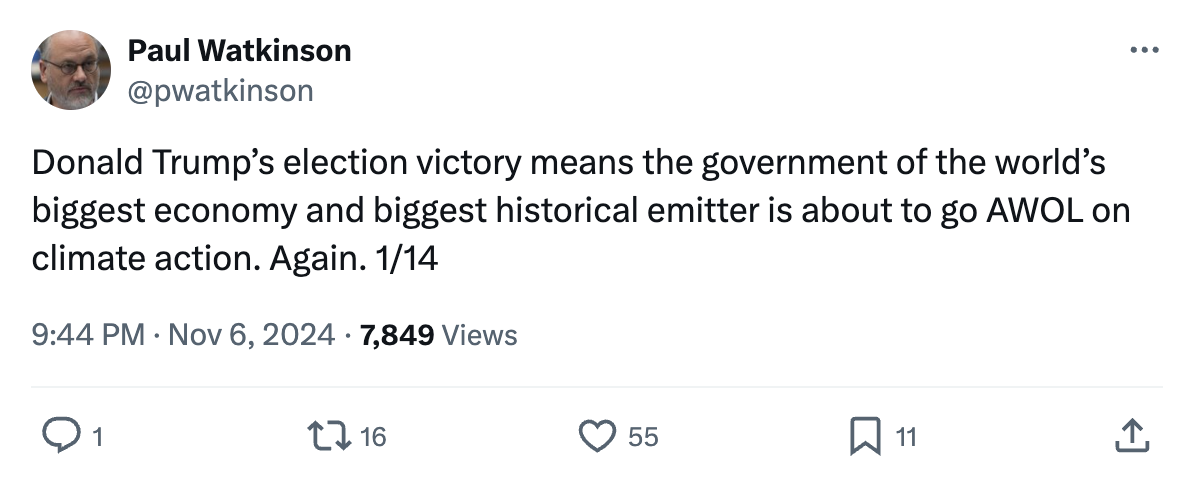
In a word, the biggest impact Trump’s election has on climate action is on “confidence”.
We are in a different world than we were the first time around and there are many more equities invested in the transition. People are making money, doing jobs and cutting their bills because of clean energy and technology. And after Russia’s invasion of Ukraine, there is a growing recognition that fossil fuel dependency is risky and not consistent with security.
But for those on the fence, still making choices, the confidence dent could slow or knock their transition off course. This is potentially particularly true in emerging and developing economies where the transition is less mature.
Having said that, the other major difference this time is that China is so heavily politically and economically invested in the transition and they will want to maintain and grow export markets for their low-carbon tech.
There’s no doubt a strong and climate-positive US voice on the international stage helps immensely, there is now a significant vacuum to fill to inspire confidence, shape markets and maximise the opportunities the transition brings.
 Tasneem Essop
Executive director
Climate Action Network-International
The climate crisis doesn’t care who is in the White House. If President Trump’s last time in office was anything to go by, there will be chaos and mayhem, but the climate movement will be defiant and continue fighting. The rest of the world will continue working.
Working together to address the climate crisis is in every nation’s self-interest. The impacts of climate know no boundaries and are felt across the world, including in the US. Nearly 200 countries carried on working on climate during the first Trump presidency – collaborating with many US states and cities – and we fully expect that to carry on.
The US is still in the climate battle. The energy transition is inevitable and accelerating in many countries and across the US, regardless of who is in power. If Trump steps out of the global clean energy race, they will be the losers. First-mover countries will be the winners. Trump can withdraw from the Paris Agreement, or the UNFCCC as a whole, at his own peril. The US will lose its ability to influence the decisions that will change the trajectory of the world’s economic development.
While the news that Trump plans to leave the Paris Agreement could cause initial anxiety at COP29, the world’s majority recognises that climate action does not hinge on who is in power in the US, and as we saw before and will see again, other countries will step up if the US reneges on their responsibilities and stands back. But the US will still be held accountable, by their own citizens as well as by governments and people across the world.
The Trump administration also cannot think that it can leave the Paris Agreement, and still come to climate meetings and obstruct progress. We will not allow this obstruction even if the US stays in the Paris Agreement.



The post Experts: What does a Trump presidency mean for climate action? appeared first on Carbon Brief.
Experts: What does a Trump presidency mean for climate action?

When José Antonio Kast took office as Chile’s new president in March, one of his first moves was to put the brakes on plans to expand two protected marine parks – raising doubts about the country’s high-profile bid to host the headquarters of the High Seas Treaty.
But during the UN General Assembly last month, the right-wing leader reaffirmed his leftist predecessor’s ambition for Chile to host the landmark global pact, which came into effect in January and provides a legal framework to protect the waters of the high seas beyond national jurisdiction that cover about two-thirds of the world’s oceans.
Hailing the country’s “maritime vocation”, Kast’s government said the bid to host the treaty’s secretariat in the port city of Valparaíso was state policy and testament to its commitment to multilateralism.
“For the government of Chile, it is of high interest to achieve this recognition, and we will carry out all the efforts to obtain the necessary support,” Foreign Minister Francisco Pérez Mackenna was quoted as saying by local media.
-
At pre-COP, UN climate chief warns of heat threat to mothers and babies
The spotlight on maternal health came on the first day of the pre-COP31 meeting in Fiji, where Pacific concerns are set to top the agenda as ministers gather for talks -
Big banks behind “net zero” alliance continued lending to coal firms
New data shows coal finance has stayed steady at the global level since 2022, as international efforts to cut the ties between lending and emissions faded -
Jordan’s mega-plan for water security risks locking in fossil gas demand
A giant desalination plant will help Jordan confront water scarcity, but solar power’s limited role in the energy-hungry project has raised questions about how climate adaptation finance is being spent



Tough competition from Chinese, Belgian bids
But to garner the votes it needs, Chile must fend off competing bids by Belgium – which has proposed its well-connected capital, Brussels – and China, whose well-funded bid includes the provision of free premises in the coastal city of Xiamen and five years of free utility costs.
Parties to the treaty, formally called the Agreement on Marine Biological Diversity of Areas Beyond National Jurisdiction (BBNJ), will choose the headquarters at their first summit (COP1), in New York from January 11 to January 22, 2027. They will seek consensus, falling back on a two-thirds majority in successive secret ballots.
Chile has offered to provide a restored waterside warehouse “at its own expense” as office space, pitching itself to developing countries as a Global South alternative to Europe-centred Brussels. Among richer countries, it is promoting its democratic credentials and greater transparency as an alternative to China.
Rolling back environmental safeguards at home?
While the South American country remains the top pick among environmental campaigners and other civil society groups, critics of Kast’s government say recent policy moves may make it harder for the country to garner the support it needs.
On March 12, the day after Kast took office, the Environment Ministry withdrew 43 decrees awaiting legal approval, including a push to expand the Mar de Juan Fernández and Nazca-Desventuradas marine parks – vast protected areas in Chile’s Pacific Ocean waters. Both remain under review, the ministry told Climate Home News.
The decrees also included an emission standard for coal power plants and regulations for Chile’s new biodiversity and protected areas service.
A month after holding up the decrees, Kast questioned aspects of Chile’s urban wetlands protection law, suggesting it was sometimes an unjustified obstacle to much-needed housing development, and his administration has also sought to ease the rules on salmon farming in the world’s second-largest producer.
In August, the Constitutional Court struck down the salmon farming reform after a challenge by opposition lawmakers and warnings from green groups including Greenpeace, which said it could help farms relocate into protected areas such as the Kawésqar National Reserve.
Valparaíso mayor Camila Nieto, from former leftist President Gabriel Boric’s party, backs the bid to host the High Seas Treaty, but said she hoped “the government’s support also translates into public policies consistent with the goals of protecting and conserving the oceans”.
“The decisions a country makes on environmental matters can influence international perceptions of its commitment to protecting the oceans. That is something we cannot ignore,” Nieto told Climate Home News.

China’s bid stirs concerns over data access, fishing
Chile’s past record on marine protection – it has protected 43% of its jurisdictional waters – could yet give it an edge.
“Chile deserves it for its conservation record as a state. For more than 15 years Chile has been following this path,” Liesbeth van der Meer, executive director at conservation group Oceana in Chile, told Climate Home News.
Concerns in some quarters about the rival bid by China – for example, over a potential conflict of interest due to the vast Chinese fishing industry – may also weigh in Chile’s favour, experts say.
Chinese-flagged vessels did about 30% of detected high seas fishing between 2022 and 2024, according to an Oceana analysis of Global Fishing Watch data. China also sponsors five of the International Seabed Authority’s 31 deep-sea mining exploration contracts, more than any other country.
The secretariat would host sensitive marine data, making transparency paramount, experts say.
China says hosting the secretariat in Xiamen would help make the treaty more globally representative, fostering cooperation between rich and dev