A Dutch startup thinks it has the answer to two of Europe’s biggest energy transition conundrums – long-duration storage batteries that are free from critical minerals and powered by rust.
In a pilot project in February, Amsterdam-based Ore Energy supplied four days of uninterrupted power to a research facility operated by France’s EDF electricity utility using a battery made of little more than iron pellets, water and air. That followed a grid installation in the Netherlands last year.
“These are the first instances of grid-connected iron-air batteries in Europe,” Yakup Koç, Ore Energy’s chief operating officer, told Climate Home News. “With these deployments, we’ve proven that the technology really works.”
Using abundant, cheap materials that can be sourced locally across Europe, iron-air batteries store and release electricity through a simple, chemical process: rusting and de-rusting.
“Rusting refers to discharging, and de-rusting refers to charging,” Koç said. “When discharging, air is drawn in and reacts with the iron, forming rust and releasing electricity in the process. To recharge, the oxygen is removed, and the rust reverts to iron, ready to go again.”
Energy transition’s “missing link”
Batteries able to store solar and wind power over longer periods of time than conventional lithium-ion batteries are often described as the “missing link” in the energy transition.
Technology such as Ore Energy’s could hold particular appeal for Europe as it strives to reduce its exposure to volatile critical mineral supply chains and boost its production of batteries for power storage and electric vehicles (EVs) instead of relying so heavily on imports from China.
“There are no critical raw materials in our batteries … which means we are truly independent of supply chain issues in that sense,” Koç said.
It also makes them cheaper than established batteries, which mostly use either lithium iron phosphate (LFP) or lithium nickel cobalt manganese oxide (NMC) chemistries.
“Critical raw materials are expensive,” Koç adds. “Because we’re using abundant resources, our cost price can be as much as 10 times lower than lithium.”
-
Battery passport plan aims to clean up the industry powering clean energy
Some of the world’s largest battery makers are piloting a scheme led by the Global Battery Alliance to reward manufacturers that meet social and environmental standards -
South African rare earths project aims to rival Chinese with low-cost model
The EU-backed Zandkopsdrift project plans to offset the high cost of rare earths production with another mineral in hot demand for use in batteries -
Self-taught mechanics give second life to Jordan’s glut of spent EV batteries
As EV sales boom in Jordan, a lack of formal infrastructure for dealing with end-of-life batteries is leading to some innovative solutions


Europe sprints for storage capacity
Wind and solar make up the fastest-growing energy sources globally, but bridging inherent supply fluctuations requires batteries capable of storing energy for far longer than currently possible with a typical lithium-ion battery.
Demand for battery energy storage systems has surged and it currently accounts for 15% of global battery demand, according to the International Energy Agency (IEA).
Multi-day storage capabilities will become increasingly important as renewable integration booms, said Zeenat Hameed, principal analyst for energy storage at Wood Mackenzie.
“Under net-zero scenarios, the average duration of newly installed storage assets may need to increase from around 2.5 hours today to roughly 20 hours to manage multi-day variability in wind and solar generation,” she told Climate Home News.
Europe added a record 27.1 GWh of new batteries in 2025, bringing total capacity to 77.3 GWh, according to a recent report by industry group SolarPower Europe, adding that capacity must increase 10-fold by 2030 to meet its needs.
With about 90% of battery-storage applications relying on Chinese lithium batteries, steps to diversify suppliers are also seen as vital to shore up energy security.
Innovation that can help reduce or diversify battery mineral supplies and demand – for example, technologies that do not require critical minerals – could play a key role in shoring up energy security, the IEA says.
Uncomplicated alternative?
This is where iron-air comes in.
Koç said Ore’s system can be configured to store energy anywhere between 24 and 100 hours, and is capable of being reused over a lifespan of as much as 20 years.
Each battery storage unit ships in standard 40-foot containers, a similar size as lithium-ion systems, and can be connected and operational within days of arriving on site.
Ore Energy is not the only company in the race to bring iron-air to the market.
US-based Form Energy, which has also developed an iron-air battery system, has partnered with Xcel Energy on a 10-megawatt (MW) iron-air system in Minnesota at a retiring coal plant. They have also announced plans to provide a 300-MW iron-air system to power a new Google data centre.
-
To break its coal habit, China should look to California’s progress on batteries
Big strides on battery storage are helping the state and other parts of the US cut their reliance on “peakers” – fossil fuel power plants that crank up at times of high demand -
China maximises battery recycling to shore up critical mineral supplies
Beijing is bracing for a tsunami of spent EV batteries by taking steps to boost recycling – a strategy that could also cut its reliance on imports of clean energy minerals -
Cobalt and nickel-free electric car batteries boom in “good news” for rainforests
Lithium iron phosphate batteries do not contain cobalt and nickel, which are mostly found in rainforest nations like the DR Congo and Indonesia


Beyond iron-air, a broader range of long-duration energy storage (LDES) technologies is taking shape. US-based Noon Energy is developing a carbon-oxygen battery based on solid-oxide fuel cell technology which it says avoids “scarce metals and minerals” and targets storage durations of 100 hours and above, while E-Zinc’s zinc-air systems are another player in the ultra-long-duration bracket.
Mahika Sri Krishna from the LDES Council, a global organisation focused on accelerating long duration energy storage solutions, told Climate Home News a mix of different technologies would be necessary to support grid reliability as renewables gain ground.
“Medium-duration storage solutions can help manage daily variability in renewable generation, while very long-duration systems may help address less frequent but more challenging reliability events,” said Sri Krishna, a senior manager for research and analysis at the group.
Last longer, scale up faster
Iron-air faces numerous challenges to scale-up and challenge established battery technologies, however, energy experts say.
Demand for multi-day storage is not yet high enough to drive commercialisation, Hameed said, estimating that lithium-ion is expected to retain about 85% of the global storage market through 2034 as economies of scale and manufacturing innovations reduce its costs.
While iron-air’s raw materials are cheap, the overall system cost still needs to prove itself at scale, Hameed added.
At Ore Energy, the next step is moving from single- to multi-container configurations, building what Koç describes as an “energy reservoir” that can be deployed across different use cases.
The scale-up itself, he said, is less the challenge than gaining industry acceptance by building a commercial track record.
“It’s not only about customers seeing the data and knowing it works,” he said. “The whole ecosystem around a new technology has to be brought along.”
When that happens, the technology could have transformative effects on Europe’s energy transition, he said.
“Europe will not decarbonise its power system on renewables alone,” Koç said. “Without long-duration storage, Europe risks replacing dependence on fossil fuels with dependence on overbuilding, curtailment and backup generation.”
The post Dutch startup’s rust-powered batteries could help crack Europe’s energy storage gap appeared first on Climate Home News.
Dutch startup’s rust-powered batteries could help crack Europe’s energy storage gap

Climate Change
Large flotilla brings Pacific voices and message to leaders at Pre-COP meeting: Keep 1.5C Alive
NADI, FIJI Wednesday 7 October 2026 — Around 80 people including Pacific and Torres Strait community members, Elders and youth activists travelled as part of a colourful flotilla past the Pre-COP venues with a message for leaders: ‘Keep 1.5°C Alive’.
High res footage and images available here
The large flotilla included traditional Fijian voyaging vessel the Uto Ni Yalo, six 6-person outrigger canoes, and Greenpeace campaigning vessel the Oceania which sailed from Sydney to the Pre-COP in Nadi. On board were Elders, climate-vulnerable communities members from across the Pacific and Torres Strait, youth activists and poets, and campaigners and climate experts from across the region.
Messaging on canoes and banners said ‘Hold the Line at 1.5°C’ and ‘Keep 1.5°C Alive’ — a reminder to leaders that the climate limit established under the Paris Agreement is a non-negotiable survival line.
Shiva Gounden, Head of Pacific at Greenpeace Australia Pacific, said: “People from across the Pacific and Australia have come together today to make sure the voices of our communities are heard by leaders meeting here in Nadi for the Pre-COP climate talks. The Taku Pakasoa Declaration adopted here at Pre-COP means ‘Strength in Unity’, and that’s how we’re coming together today.
“Our message is clear: Hold the Line on 1.5°C and centre those most impacted by the climate crisis in your decision-making. Our children’s futures must not be stolen away so that polluting nations can continue down the fossil-fuel path.
“Limiting global heating to 1.5°C is a non-negotiable survival line for Pacific communities and for humanity. Every cyclone, every storm now blows with the deadly force of accumulated emissions and gives a warning of what is to come as we face a dangerous summer of climate-fuelled extreme weather. Do not ignore our voices.”
On board, Aigagalefili Fepulea’i-Tapua’i, Pacific youth climate advocate and poet from Aotearoa Climate Action Network, said: “To hold the line on 1.5C for our Pacific family, New Zealand, as the only country where the connection between environmental protection and indigenous rights is legally validated by our constitutional document, must protect the rights of Māori.”
ENDS
Media contact: Kate O’Callaghan in Nadi on +61 406 231 892 (Whatsapp/Signal)
Large flotilla brings Pacific voices and message to leaders at Pre-COP meeting: Keep 1.5C Alive
Climate Change
A ‘victory’ for communities as High Court rules climate impacts from coal and gas must be considered even where fossil fuels are exported
SYDNEY, Wednesday 7 October 2026 — In response to the landmark High Court ruling that climate impacts of fossil fuel projects must be considered by NSW planning authorities, the following lines can be attributed to Joe Rafalowicz, Head of Climate and Energy at Greenpeace Australia Pacific
“The High Court decision today is a victory for communities that bear the brunt of the storms, bushfires and extreme weather fuelled by Australian fossil fuel corporations.
“Coal and gas companies have claimed they are not responsible for their pollution because it happens overseas, but today Australia’s highest court sided with common sense and scientific evidence to find that every new coal and gas approval in this country could put us at risk, no matter where it is sold or burnt.
“As leaders meet at the Pre-COP talks in Fiji this week, Pacific communities are reaffirming the importance of the 1.5C temperature limit as a survival line for humanity, and is a scientific, moral and legal obligation as affirmed by the landmark Pacific-led ICJ Advisory Opinion. The highest court in the world, and now in Australia, have been clear: it is legally imperative that all of the pollution from fossil fuel projects be considered before approving a new project.
“Now is the moment for the Australian Government, as COP31 President of Negotiations, to find the courage, leadership and grit our country is known for to chart a new course away from fossil fuels. This begins with showing leadership at home by ending new coal and gas approvals.”
-ENDS-
After witnessing the effects of sea-level rise in the low-lying island nation of Tuvalu, Pacific leaders on Tuesday used the pre-COP31 summit in Fiji to voice their frustration at the difficulties they have experienced in tapping the global climate finance system.
A small group of government leaders, climate negotiators and heads of development banks and climate funds took a trip to Tuvalu’s Funafuti atoll on Tuesday morning, travelling by road over land just 10-20 metres wide to visit a project that is building barriers to keep the sea from the land.
They then flew to Fiji for the pre-COP summit, where several Pacific leaders said they had been let down by the insufficient quantity, bad terms and slow speed of international finance to help them adapt to a warming climate that is bringing higher oceans, drought and more powerful storms to their shores.
“Right now, our islands are like a canoe that has been rammed by a massive foreign ship. Our canoe is taking on water, we are sinking, and what is the world’s response?” asked Palau’s President Surangel Whipps Jr.
“They hand us a tiny patch to cover a gaping hole,” he continued, “but the bureaucratic process just to receive that patch is so slow that the water fills the hole while we wait. Then to rebuild the vessel so that we can survive the next storm, we are offered loans, debt that adds weight to a sinking boat packaged in red tape so thick we can barely access it. And while we wait, the water continues to fill.”
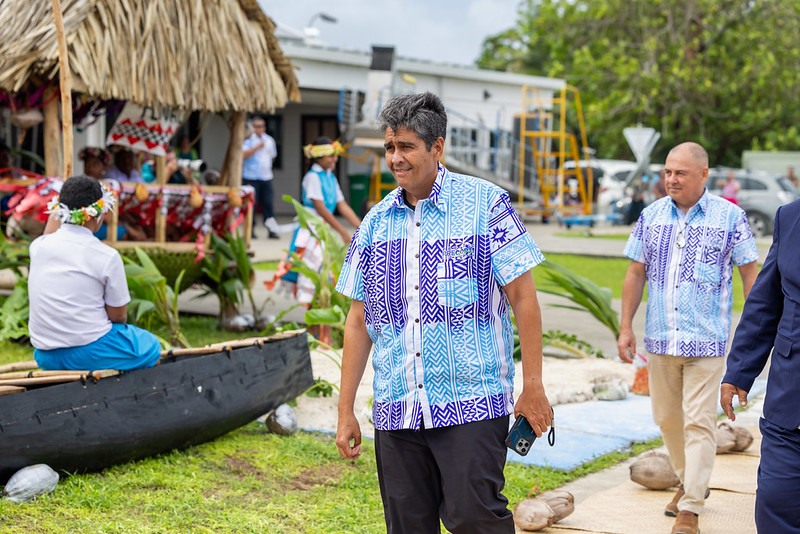
Pacific leaders and Australia called again on governments to invest in the new Pacific Resilience Facility (PRF), which has been designed by the Pacific Islands Forum and is seeking $500 million in investments by COP31 in November.
It has around $180 million so far, but did not receive additional pledges during the UN General Assembly in New York. The PRF aims to invest to generate annual returns which it can give to projects like water tanks for drought-hit communities.
Witnessing sea level rise
The annual pre-COP gathering is usually a low-profile technical meeting of climate negotiators. But this year, Australia – which is the president of negotiations at COP31 – partnered with the Pacific to introduce a “leaders segment” in an attempt to shine a spotlight on climate issues affecting the region.
Fourteen government leaders – from Australia, Timor-Leste, Mauritius and the Pacific – made the trip. They were joined by the European Union’s climate commissioner Wopke Hoekstra, the heads of the Green Climate Fund and the Asian Development Bank and former Australian prime minister Julia Gillard.
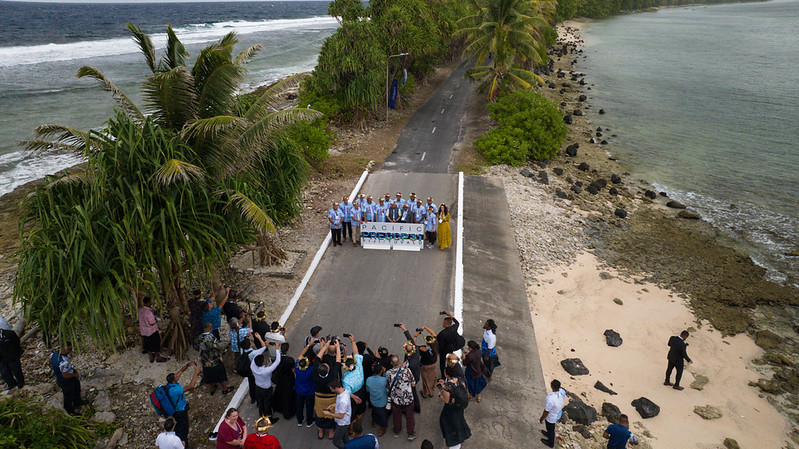
On their return to Fiji, Solomon Islands Prime Minister Matthew Wale told the pre-COP leaders roundtable that the sea level rise they had witnessed was personal for him.
“Tuvalu was not just a site visit for me. I saw the story of my own saltwater people,” he said, adding that he, his daughter and his grandfather had lost their houses to sea level rise and that three-quarters of his electorate live on land that will be underwater in the next 30 years.
From the other side of the world, Antigua and Barbuda’s environment minister Michael Joseph said Tuvalu’s problems felt similar to those of his own Caribbean islands. “I saw vulnerable communities… just metres from the sea and people determined to remain on their land, preserve their culture and way of life,” he said.

A group of Fijian schoolchildren told the leaders it was not just sea level rise the Pacific struggles with but also heatwaves, droughts and storms, which worry their families and prevent them from learning.
Climate finance red-tape
Several Pacific leaders criticised the world’s leaders for not doing enough to combat climate change. Cook Islands Prime Minister Mark Brown expressed disappointment that only two non-Pacific leaders had come to the pre-COP, a fact Australian media widely picked up on to label the event a flop and question its A$20 million (US$14m) price tag.
“We’ve heard a lot of numbers these last two days,” Brown said. “Let me share one of my own. More than 50 invitations extended to world leaders… to see for themselves what high emissions are doing to our nations and our ocean – an ocean that covers nearly one-third of the Earth’s surface.”
-
Pacific islands seek backing for new regional fund ahead of COP31
Pacific leaders will appeal for pledges to a new regional fund designed to swiftly channel climate finance to local communities