

Mukhtar Babayev is COP29 President and Special Representative of the President of Azerbaijan for Climate Issues.
We face an historic irony this year. 2025 was supposed to start a new decade in climate finance.
When countries signed the Paris Agreement in 2015, they set this year as the date from which donor countries would support the developing world under a new climate finance deal. The Baku Finance Goal agreed at COP29 in Azerbaijan did indeed set a target of $300 billion a year by 2035, a three-fold increase on the current funding.
But instead of stepping up, donors are stepping back. Governments are diverting funds from communities on the frontlines of the climate crisis. Military spending is being raised at the expense of climate finance and aid budgets are being slashed.
This is not how the new decade of solidarity and action was supposed to begin. Developed countries were supposed to take the lead. It is a bitter pill for the world’s poorest to swallow.
No enforcement mechanism for promises
Worryingly, this comes as countries prepare their next generation of climate plans for submission. This round of emission cuts is our last best chance to keep the 1.5 degree Celsius target within reach without a sustained overshoot. But how can developing countries cut emissions if they can’t count on support?
COP Presidents face the same question – how do you ensure the deals you gavelled are actually delivered? The awkward truth is that, technically, we cannot. There are proposals to reform climate governance, but we currently have no formal power to hold countries to account.
There is no international enforcement mechanism. Some countries should be commended for embedding commitments into domestic law. Most, however, exploit every loophole to avoid legally binding requirements.
COP30 president: Transition from fossil fuels can start without climate talks
Instead, we rely on norms, values and standards. We place our hope in enlightened leaders who can see their own interest in collective climate action. We hope they understand that promises made are promises. Or we are forced to invoke their sense of duty.
When governments break promises to each other, it breeds distrust and anger. We can see this in the hallways of climate negotiations already. There is little point investing in soft power if leaders go soft on their words.
Many donor countries seem oblivious to the promises made. At ministerial meetings on climate change, few can recount the pledges of past years. Ministers gathered in Spain last week for the Fourth International Financing for Development conference. For all the talk of implementation, how many governments have kept the promises they made last time?
The early milestones for 2025 are barely on the agenda for this year’s UN climate summit. Small island states have said that, if need be, they will fight to get climate finance on the agenda. Why are their voices alone?
Adaptation finance goal expires this year
The earliest invoice due is a pledge made when the UK hosted COP26 in 2021. Under the “Glasgow Pact”, developed countries would at least double their collective support to help communities adapt to the consequences of climate change by 2025. Put simply, that’s at least $40 billion a year.
This is a critical early test of whether the will is there to hit the $300 billion by 2035. Falling short of a commitment due now augurs ill for a much larger commitment due ten years hence.
The conventional excuse is that the world has changed, making old plans and pledges redundant. To that, we say the world was always going to change. These targets were supposed to provide certainty in uncertain times. They were collective goals, so collectively they must be delivered.
Green Climate Fund reforms aim to fix “slow, cumbersome” accreditation process
When we negotiated the Baku Finance Goal in November following the US election, donors insisted they couldn’t be expected to pay more than $300 billion when some of the biggest players were stepping away. They cannot use the same excuse again to explain why they can’t meet the goal.
To lead is to choose, and in a world of tight finances, the burden of leadership is heavy. Nobody should envy the trade-offs governments must make: which causes to support, which sectors to prioritise, which issues to address. There are no free choices.
But there are shortsighted choices. And there are choices that can corrode the system. Breaking your word is not an acceptable choice. It would be a matter of deep regret. Developed countries need to take the lead on climate finance. Donors must send a clear and strong signal that a promise made is a promise kept.
The post Donors were supposed to step up, not step back on climate finance appeared first on Climate Home News.
Donors were supposed to step up, not step back on climate finance

Climate Change
DeBriefed 20 March 2026: Energy crisis deepens | Brazil’s new climate plan | New Zealand climate case
Welcome to Carbon Brief’s DeBriefed.
An essential guide to the week’s key developments relating to climate change.
This week
Iran war fallout continues
WORK FROM HOME: The International Energy Agency has advised its member countries to take 10 steps in response to the ongoing energy crisis fuelled by the Iran war, including reducing highway speeds and encouraging people to work from home, said the Guardian. It came after retaliatory attacks between Israel and Iran continued to destroy energy infrastructure in the Middle East, causing energy prices to soar further, said Reuters.
SUPPLY DISRUPTED: The IEA also said it is prepared to make more of its member nations’ 1.4bn-barrel oil reserves available to help ease the impacts of what it called the “biggest supply disruption in the history of the oil market”, reported Bloomberg. The outlet noted that Asian countries have been hit hardest by the shortages, caused by a “near-halt” of shipping through the Strait of Hormuz.
EU SUMMIT: The energy crisis dominated talks at an EU leaders summit on Thursday, said Politico. Arriving at the summit, Spain’s prime minister Pedro Sánchez attacked other European leaders for using the energy crisis as an excuse to “gut climate policies”, according to the EU Observer. The Financial Times said that some European leaders have asked the European Commission to overhaul its flagship emissions trading system (ETS) by summer in response to the energy crisis.
COAL BOOST: In response to the conflict, utility companies in Asia are “boosting coal-fired power generation to cut costs and safeguard energy supply”, said Reuters. UN climate change executive secretary Simon Stiell told Reuters: “If there was ever a moment to accelerate that energy transition, breaking dependencies which have shackled economies, this is the time.”
Around the world
- WINDFARM WINDFALL: The Trump administration in the US is considering a nearly $1bn settlement with TotalEnergies to cancel the French energy company’s two planned windfarms off the US east coast and have it instead invest in fossil-gas infrastructure in Texas, according to documents seen by the New York Times.
- BUSINESS CLASH: Following “clashes” with the agribusiness sector, Brazil launched its new climate plan, which calls for a 49-58% reduction in greenhouse gas emissions from 2022 levels by 2025 and includes “specific guidelines for different sectors”, reported Folha de Sao Paolo.
- SALES SLUMP: Sales of liquified petroleum gas from India’s state-run oil companies have fallen by 17% this month due to cuts in deliveries to commercial and industrial consumers “amid the widespread logistical bottlenecks triggered by the Iran war”, said the Economic Times.
- CUBAN ENERGY CRISIS: The US imposed an “effective oil blockade” on Cuba, leaving the country facing its “worst energy crisis in decades”, reported the Washington Post. Meanwhile, Chinese exports of solar panels to the island have “skyrocketed” since 2023, it added.
- RECORD HIGHS: An “unprecedented” heatwave in the western and south-western US is “shattering dozens of temperature records” and could lead to drought in California in the coming months, reported the Los Angeles Times.
- VULNERABILITY CONCERNS: Landslides that killed more than 100 people in southern Ethiopia have “renewed concerns about Ethiopia’s vulnerability to climate-related disasters”, said the Addis Standard.
1%
The percentage of England’s land surface that could be devoted to renewables by 2050, according to the long-awaited “land-use framework” released by the UK government this week and covered by Carbon Brief.
Latest climate research
- Approaching international climate action by shifting the burden of mitigation onto higher-income countries could avoid 13.5 million premature deaths from air pollution in middle- and lower-income countries by 2050 | The Lancet Global Health
- Beavers can turn the ecosystems surrounding streams into “persistent” sinks of carbon that can sequester an order of magnitude more than non-beaver-modified ecosystems can store | Communications Earth & Environment
- Mobile-phone data from seven diverse countries during the summer heatwaves of 2022-23 showed a “widespread tendency to withdraw into homes” and an increase in out-of-home activities that can offer cooling, such as indoor retail | Environmental Research: Climate
(For more, see Carbon Brief’s in-depth daily summaries of the top climate news stories on Monday, Tuesday, Wednesday, Thursday and Friday.)
Captured

Carbon Brief this week published a significant update to its map of how climate change is affecting extreme weather events around the world. The map now includes 232 new extreme weather events from studies published in 2024 and 2025. Of these events, 196 were made more severe or more likely to occur by human-driven climate change, 12 were made less severe or less likely to occur and 10 had no discernible human influence. (The remaining 14 studies were inconclusive.)
Spotlight
New Zealand breaks new ground on climate litigation
This week, Carbon Brief speaks to experts about a first-of-its-kind climate lawsuit in New Zealand.
Earlier this week, representatives from two environmentally focused legal advocacy groups challenged the New Zealand government’s climate-action plan in court.
The plaintiffs argued that the measures laid out in the plan are insufficient to achieve the country’s legal obligation to hold global warming to 1.5C above pre-industrial temperatures.
The case could be “influential” in shaping lawsuits and rulings around the world, one legal expert not involved in the case told Carbon Brief.
Reductions vs removals
The new case contends that there are several issues regarding the New Zealand government’s response to climate change.
One of the key arguments the plaintiffs make is that New Zealand’s second emissions reduction plan, which covers the period from 2026-30, is overreliant on the use of tree-planting to achieve its targets.
When the plan was released in December 2024, it was “immediately clear that it was a pretty lacklustre plan”, Eliza Prestidge Oldfield, senior legal researcher at the Environmental Law Initiative, one of the groups behind the legal case, told Carbon Brief.
The plan called for large-scale planting of pine tree plantations, which are not native to New Zealand and have a high risk of burning. Because of this, there are concerns about how permanent any carbon removal provided by these plantations actually can be, experts told Carbon Brief.
Catherine Higham, senior policy fellow at the Grantham Research Institute on Climate Change and the Environment who was not involved in the case, said:
“The lawyers are arguing that there are real challenges with equating the emissions that you may be able to remove from the atmosphere through afforestation with actual emissions reductions, which are much more certain.”
‘Global dialogue’
While other climate lawsuits elsewhere in the world have also focused on the inadequacy of a government’s plan to meet its stated emissions-reduction targets, this is the first such case that addresses the role of removals head-on.
Lucy Maxwell, co-director of the Climate Litigation Network, told Carbon Brief that the lawsuit “builds on a decade of climate litigation” in national, regional and international courts.
Maxwell, who was not involved in the New Zealand case, added that there is a “real global dialogue” between, not just plaintiffs, but national courts as well. She said:
“[National courts] look to common issues that have been decided in other countries. They’re not binding on that court if it’s at the national level, but they are influential.”
Given that many other countries have legal frameworks requiring their governments to create plans outlining the pathway to their long-term climate targets, Prestidge Oldfield told Carbon Brief that other jurisdictions “should be interested in these questions around the level of certainty”.
Higham noted that, even if the case is successful, addressing the plan’s shortfalls will face its own set of challenges. She told Carbon Brief:
“A lot of these decisions are political and they can be politically contentious…Those [measures] have to be put into action through legislation and that is then subject to the usual political process. So that’s where the challenge comes in.”
While she could not speculate on the outcome of the case, Prestidge Oldfield said it was “very heartening” to see that both the judge and the opposing counsel “appreciated how much of a concern climate change is globally”.
She added:
“It’s not a given that the judge would even be interested in climate change.”
Watch, read, listen
COMMON APPROACH: The Heated podcast analysed fossil-fuel advertisements and highlighted the most common deception tactics they employed.
THREAT ASSESSMENT: Mongabay mapped the potential threat that oil extraction poses to Venezuela’s ecosystems, including the Amazon rainforest and its coral reefs.
SALT LAKES? GREAT!: High Country News interviewed journalist Dr Caroline Tracey about her new book on saline lakes – such as Utah’s Great Salt Lake – the threats that face them and what they can teach us.
Coming up
- 23 March-2 April: Third meeting of the preparatory commission for the High Seas Treaty, New York
- 24-27 March: 64th session of the Intergovernmental Panel on Climate Change, Bangkok
- 26-29 March: 14th ministerial conference of the World Trade Organization, Yaoundé, Cameroon
Pick of the jobs
- International Centre of Research for the Environment and Development (CIRAD), IPCC chapter scientist | Salary: €3,200-3,750 per month. Location: Nogent-sur-Marne, France
- Avaaz, chief of staff | Salary: Dependent on location. Location: Remote, with preferred time zones
- Green Party, social media officer | Salary: £31,592-£32,192. Location: Remote or Westminster, UK
DeBriefed is edited by Daisy Dunne. Please send any tips or feedback to debriefed@carbonbrief.org.
This is an online version of Carbon Brief’s weekly DeBriefed email newsletter. Subscribe for free here.


The post DeBriefed 20 March 2026: Energy crisis deepens | Brazil’s new climate plan | New Zealand climate case appeared first on Carbon Brief.
Around 300 scientists, civil servants, journalists and climate experts took part in the 11th annual Carbon Brief quiz on Wednesday 18 March 2026.
For the second time, this year’s quiz was hosted by Octopus Energy at its headquarters in central London.
In total, 39 teams participated – 25 teams in person and 14 teams joining via Zoom.
Competing teams reflected a wide range of climate change and energy professionals. The list included journalists, civil servants, climate campaigners, policy advisers, energy experts and scientists.
Organisations represented included: Council on Energy, Environment and Water (CEEW) in India; New Scientist; the Times; Business Green; the Bartlett School of Environment, Energy and Resources (BSEER), UCL; Verisk Maplecroft; BBC; World Weather Attribution; Grantham Institute at Imperial; DESNZ; WWF; European Climate Foundation (ECF); the ENDS Report; C40 Cities; Ricardo; Met Office; Meliore; E3G; Danish Meteorological Institute (DMI); Energy Transitions Commission; Carbon Tracker; Ember; Royal Meteorological Society; Civil Service Climate and Environment Network (CSCEN); Changing Markets Foundation; Cerulogy; Oxford Sustainable Law Programme; Université de Lausanne; University of Exeter; Centre for Environment and Sustainability, University of Surrey; UK Parliament; Skeptical Science; ECIU (Energy and Climate Intelligence Unit); Octopus Energy; DeSmog; Department for Transport and Royal School of Mines.
Teams were tested with five rounds of questions – general knowledge, policy, science and two picture rounds. (See the slideshow of the questions and answers below).
After two hours of playing, this year’s winners were announced.
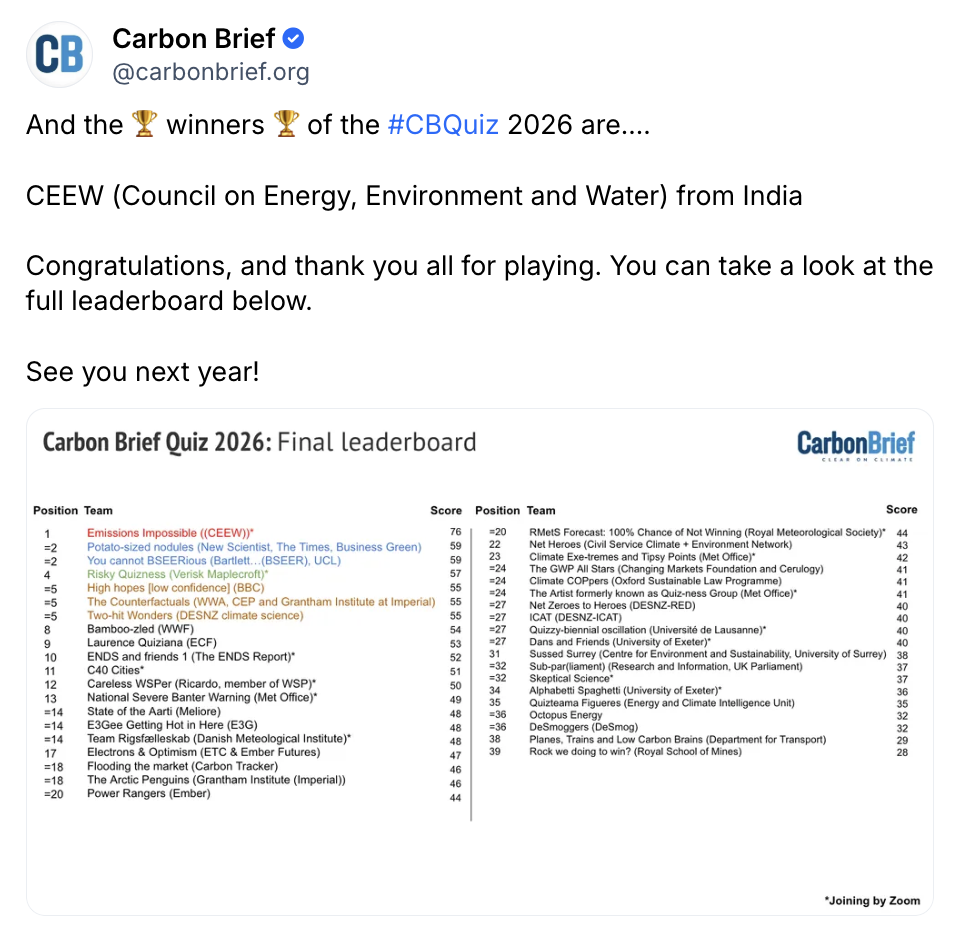
Comprised of players from the Council on Energy, Environment and Water (CEEW) in India, last time’s second place team, “Emissions Impossible” won the coveted Carbon Brief trophy with a total score of 76 out of 100 available points.

In joint second place, with 59 points, were the “Potato-sized nodules”, a mixed team of journalists from New Scientist, the Times and Business Green.
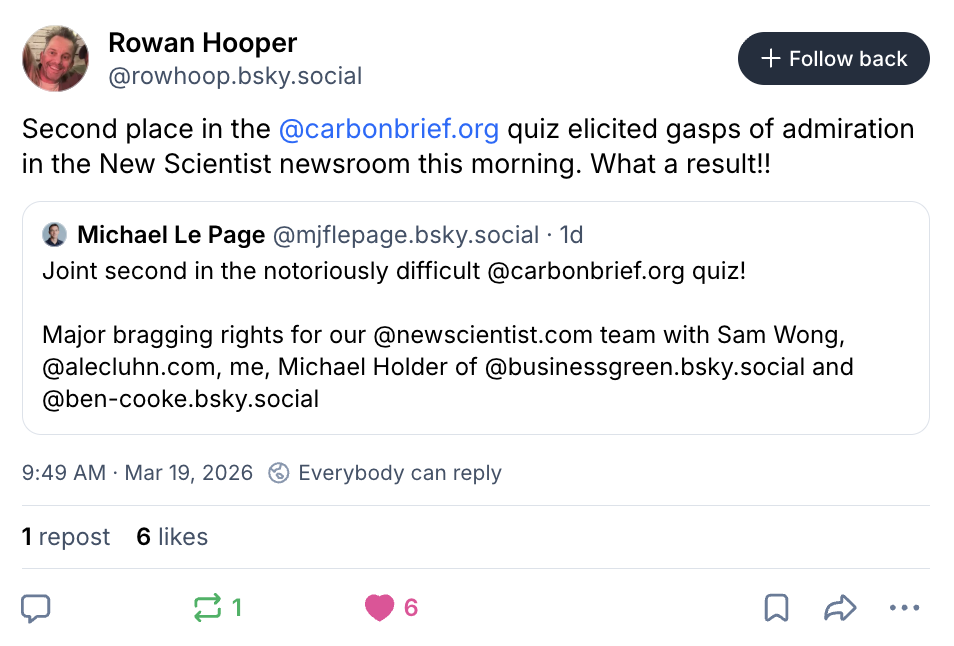
Sharing second place, after leading at the half-way point, were “You cannot BSEERious” from the Bartlett School of Environment, Energy and Resources at UCL.
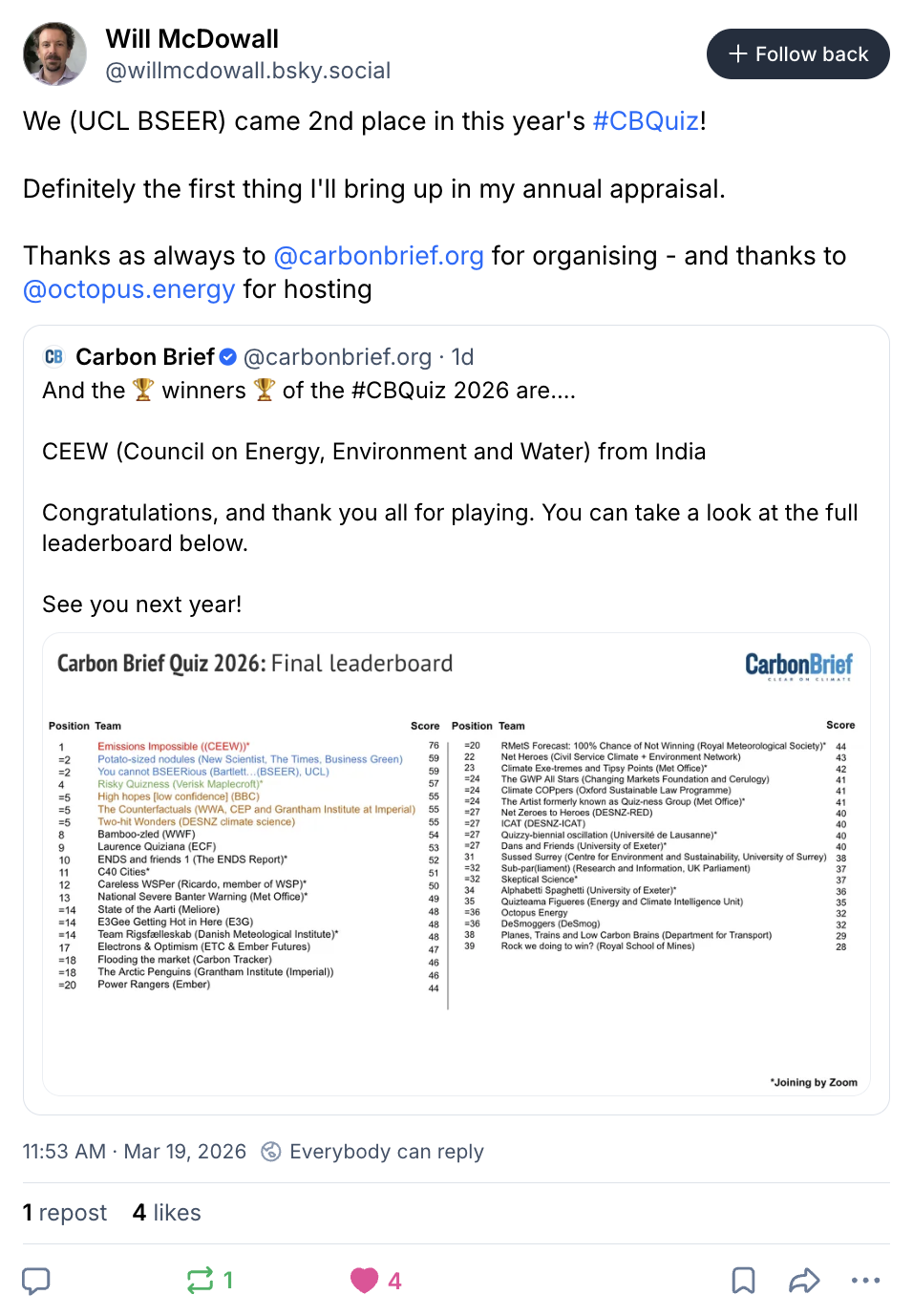
In fourth place, with 57 points, were “Risky Quizness”, from Verisk Maplecroft.
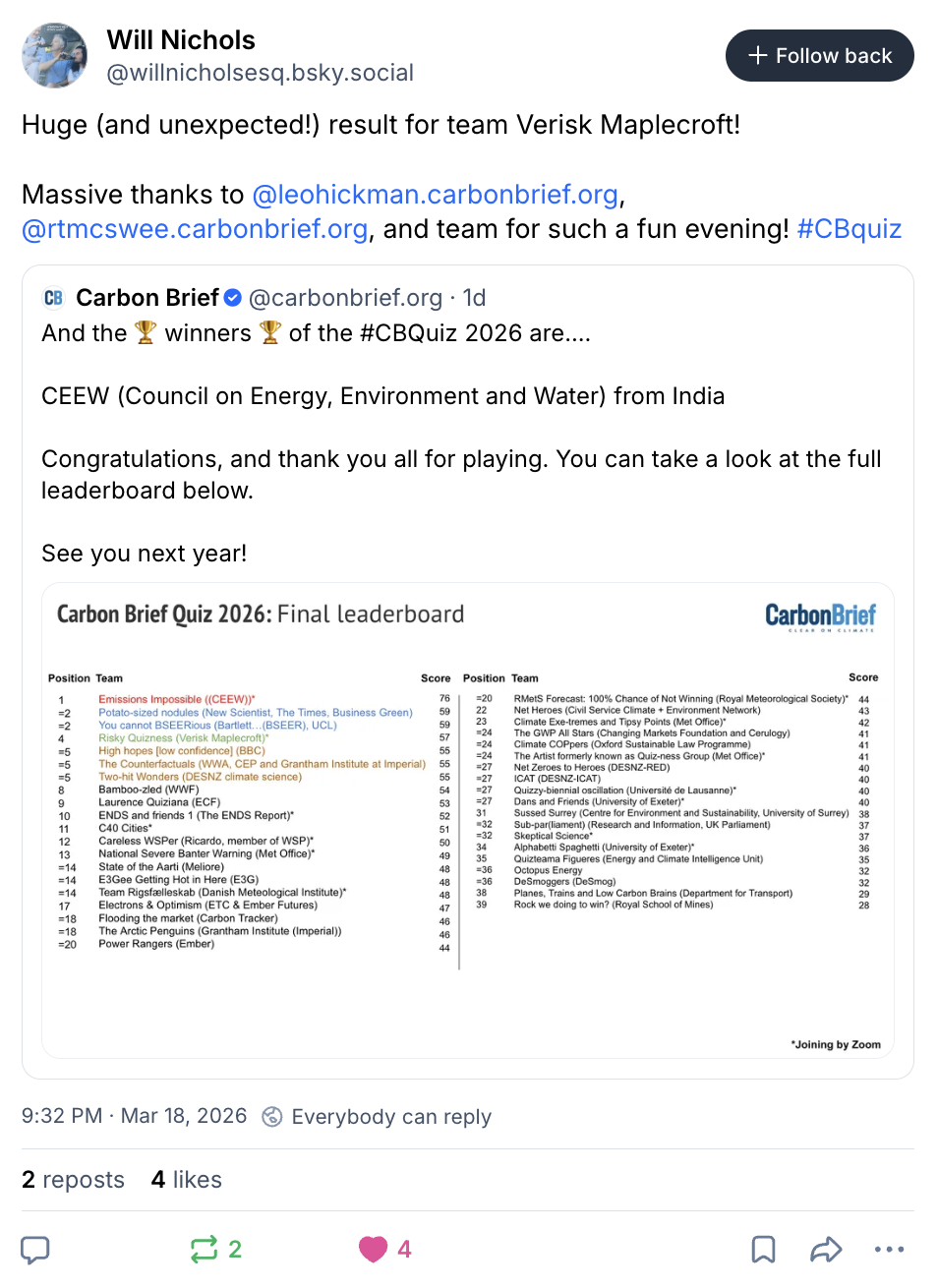
A certificate was awarded to the BBC for the best team name, as voted for by Carbon Brief staff: “High hopes [low confidence]”.
See the full leaderboard:
All the questions and answers from this year’s quiz can be found in this PDF document.
This year’s trickiest round was picture round two, which asked teams to match the quote to the author, with an average score of 5.9 out of 20 available points.
No team correctly guessed that “Chris Funk: Drought, Flood, Fire” was the source of the quote: “How greenhouse gases warm the atmosphere is pretty straightforward. It is really important that we understand this. But almost nobody does, because it is not something that we are taught in school.”
Science was the second hardest round, earning an average score of 6.1 points out of 20.
No team correctly guessed “religious leaders” as the least trustworthy source of climate information, according to a 2025 study using public polling from seven global south countries.
The highest-scoring round was general knowledge, with an average of 13.8 out of 20 questions answered correctly.
Carbon Brief would like to thank all the teams who took part and we look forward to hosting the quiz again in the spring of 2027.
If you would like to participate in next year’s quiz, please contact us in advance at quiz AT carbonbrief DOT org.
Photos by Kerry Cleaver


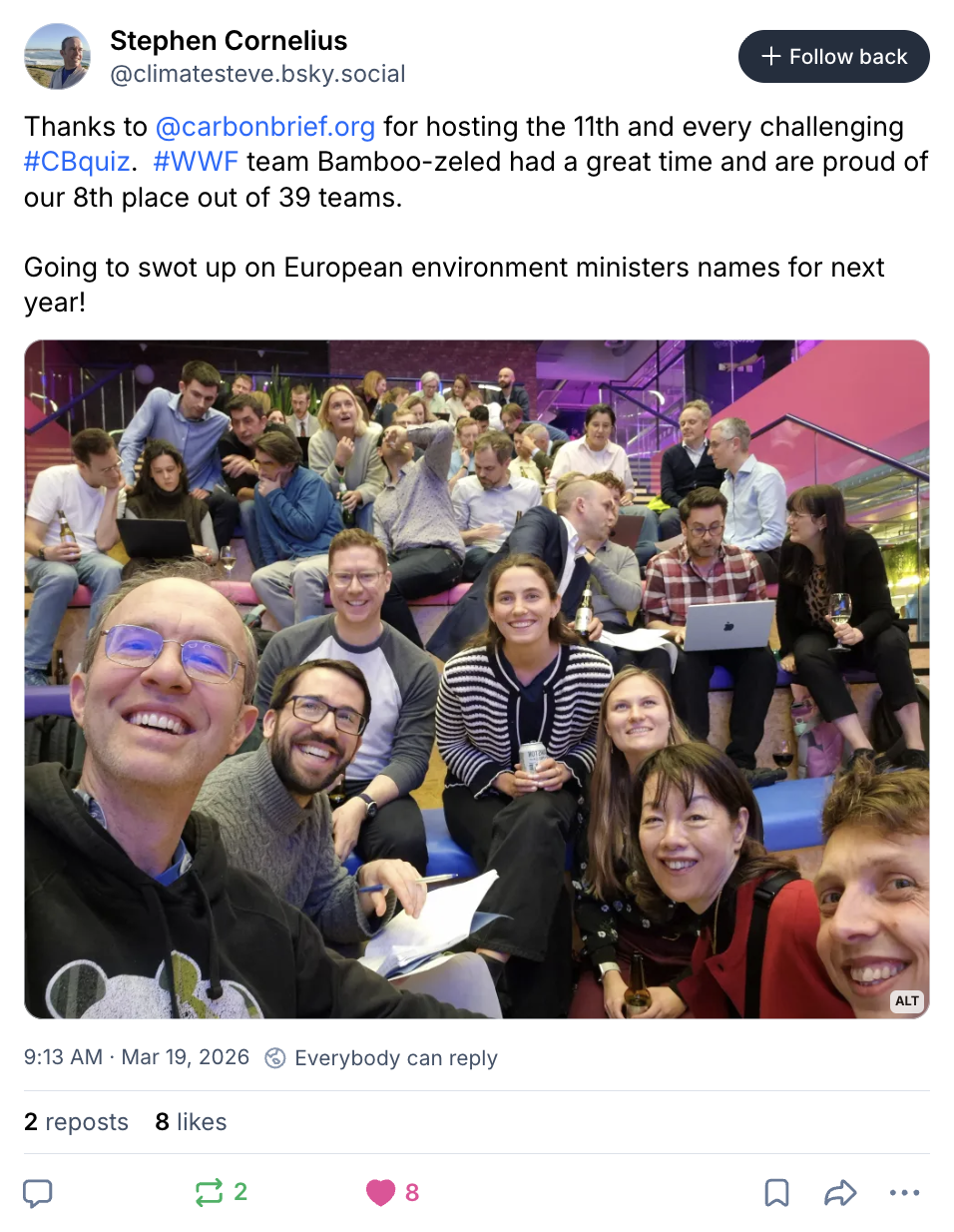

The post The Carbon Brief Quiz 2026 appeared first on Carbon Brief.
Just 1% of England’s land will be needed for renewables to help meet the UK’s climate goals by 2050, according to a first-of-its-kind framework.
There is enough land in England to meet climate and nature goals, while also producing more food and building new homes, according to the UK government’s new “land-use framework”.
Speaking at the framework’s launch on Wednesday, environment secretary Emma Reynolds said she hoped it would put an end to the idea that England faces “false choices” over “solar panels versus farmland”, or “growth versus environment”.
The policy was first planned by the Conservative government in 2022, but has been delayed many times.
It has been broadly welcomed by environmental groups, with Tony Juniper, the chair of Natural England, calling it a “vital step forward” towards “more joined-up approaches” to land use.
Below, Carbon Brief outlines the main points of the framework relating to climate change, nature restoration, food production, renewable energy and housing.
- What is the land-use framework?
- What does the plan say about how land in England should be used?
- What does the framework mean for different sectors?
What is the land-use framework?
The government’s land-use framework for England aims to set out a “coherent national vision” for using land.
The 56-page report is the first of its kind in England.
It focuses solely on England, but notes that the government will “work closely” with the devolved governments in Scotland, Wales and Northern Ireland to share best practice and “collaborate on cross-border issues”.
It is a “blueprint” to inform better decisions on optimising land use to produce food, host renewable energy, restore nature and build more homes, says environment secretary Emma Reynolds in the foreword of the framework.
The plan hopes to end the “fragmented approach” to tackling these issues, which has led to a “confused picture and missed opportunities for land to deliver multiple benefits”, Reynolds says in the foreword. She adds:
“We can plant trees to reduce flood risk to homes and farmland, locate energy infrastructure alongside nature-rich food production and ensure nature recovery is at the heart of resilient growth and development.”
The report says it will play a “critical role” in helping to deliver national and global commitments, such as carbon budgets and national biodiversity and climate plans.
The framework commits to creating a long-term assessment of climate change impacts on land use at 2C and 4C of global warming.
It also commits to setting up a “land-use unit” in the Department for Environment, Food & Rural Affairs to produce a map of “national spatial priorities” in England for, among other things, food production, nature and housing.
The government says it will update the framework every five years, outlining progress and next steps on implementation.
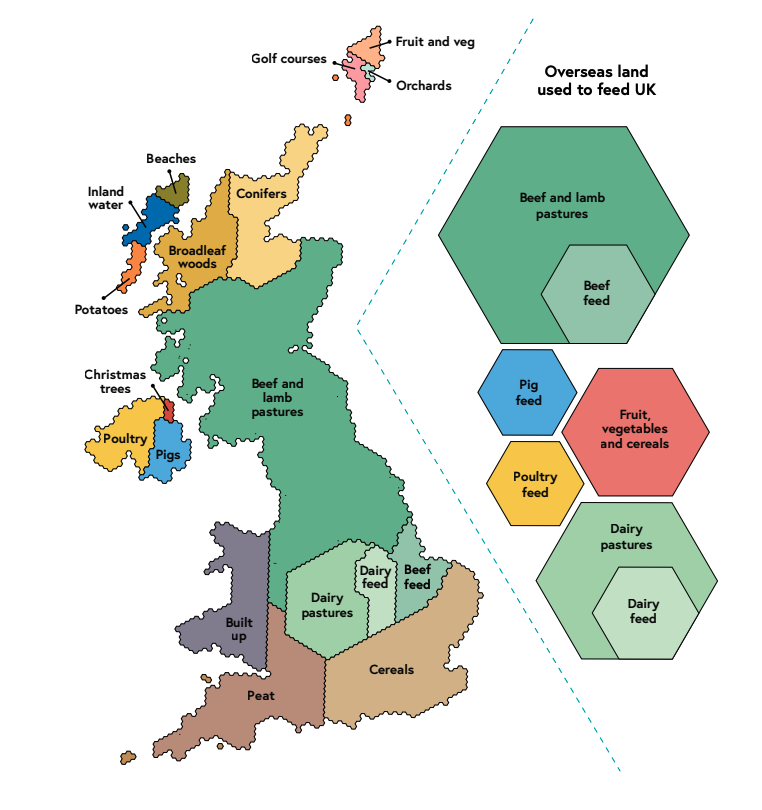
Currently, about 70% of land in the UK is used for agriculture – primarily livestock.
The chart below highlights how land is currently allocated in the UK (left) and how much overseas land is used to produce food for the UK (right).
The government’s land-use framework for England has been long-awaited and much-delayed.
The recommendation for the report first came in the 2021 National Food Strategy, an independent report led by businessman Henry Dimbleby.
It recommended creating a rural land-use framework to give “detailed assessments” of the best ways to use land in England.
The former Conservative government committed to produce such a report in a June 2022 food strategy.
This strategy said that a land-use framework for England would be released in 2023 “to ensure we meet our net-zero and biodiversity targets”, among other aims.
The publication was, however, delayed many times.
The Labour government launched a consultation on the framework in January 2025 and the final report was eventually released on 18 March 2026.
The framework is a “long-awaited opportunity for real change”, says Roger Mortlock, chief executive of the environmental charity Campaign to Protect Rural England (CPRE), in a statement.
Mortlock welcomes its “ambition”, but says that the way in which land tradeoffs are considered locally and nationally “will be key to its success”.
A report released by CPRE earlier this week, however, said that the framework is “unlikely to be the silver bullet many are hoping for”.
What does the plan say about how land in England should be used?
The framework uses high-resolution modelling – what it calls the “most sophisticated analysis” of its kind – to examine how England can use land to meet climate, nature, food and housing needs.
One key finding is that England has enough land to meet all of its objectives, if land is used efficiently.
This means that England has “enough land to deliver our objectives for nature restoration and development without reducing domestic food production or compromising on these objectives”, according to the framework.
It adds that efficient land use means “playing to the strengths” of England’s varied landscape. This involves, for example, prioritising the restoration of peatlands in north-west England and temperate rainforests in the south-west.
The chart below shows the percentage of land in England currently used for different purposes, as well as how this distribution will need to change by 2030 and 2050, if the UK is to meet its goals, according to the framework.
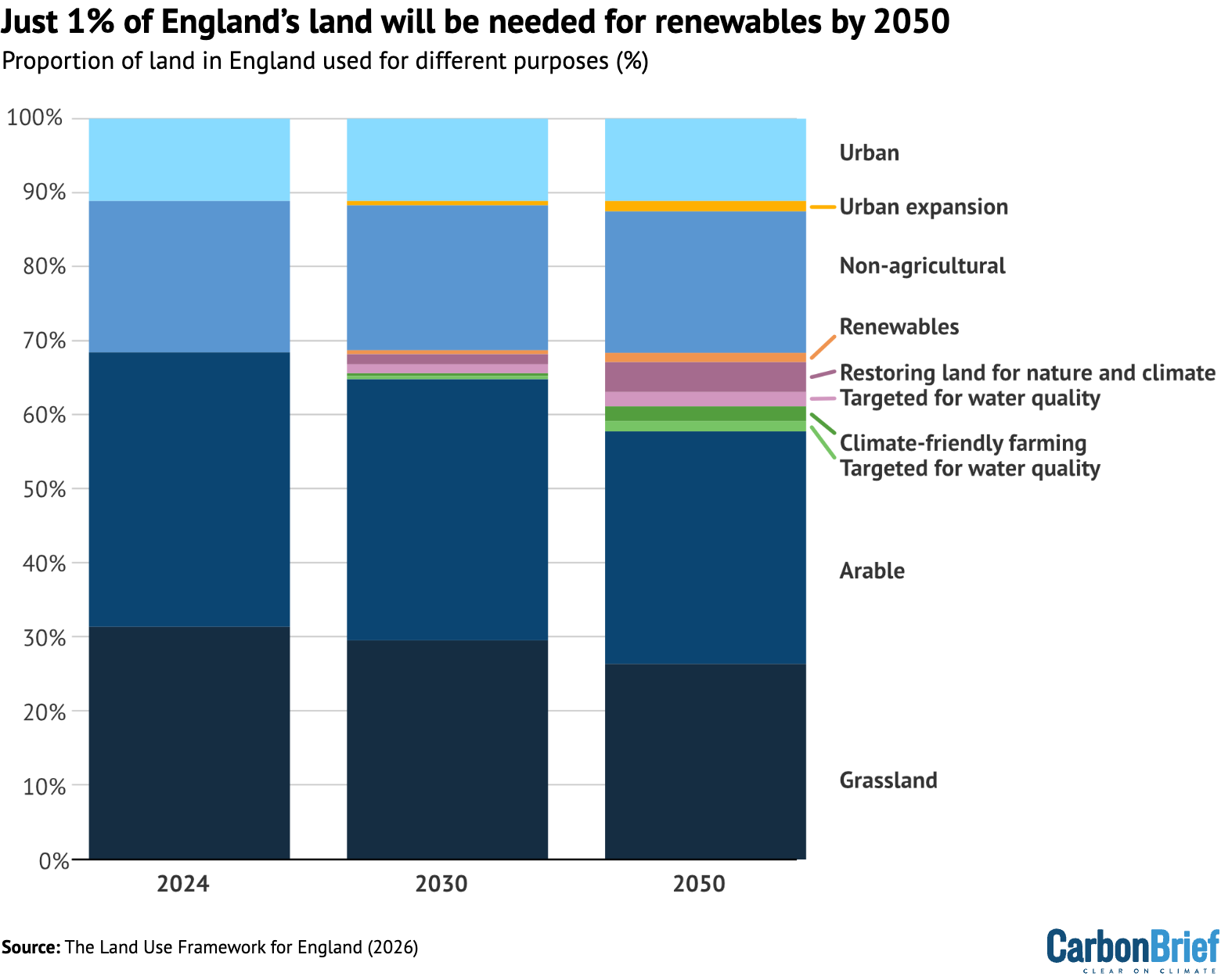
According to the framework, just 1% of England’s land will need to be taken up by renewables, such as solar and onshore wind, by 2050.
However, the framework does note that there is “inherent uncertainty” in projecting energy use by 2050 and says that the amount of land required for renewables may be nearer to “more than 2%”, depending on how quickly solar and wind is deployed in the future.
A further 6% of England’s land should be used for achieving climate and nature goals, according to the framework.
(A Defra official tells Carbon Brief that the framework’s projections for renewable energy and tree-planting were not as ambitious as those in the Climate Change Committee’s central pathway to net-zero, but are in line with the government’s carbon budget delivery plan for 2035.)
Speaking at the launch of the framework, environment secretary Emma Reynolds said that the framework shows that there are no “false choices” between “solar panels versus farmland” or “growth versus environment”, adding:
“The problem has never been scarcity of land. It has been a shortage of clarity.”
What does the framework mean for different sectors?
The framework sets out a “vision” for land use in several areas, such as housing, energy, food and nature by 2030 and 2050.
It also details what the government is currently doing to achieve these aims and makes pledges for more action down the line.
Below, Carbon Brief has detailed the key points around renewable energy, tree-planting and nature restoration, food production and housing.
Renewable energy
The report notes that the need to produce extra electricity to meet growing demand from, among other things, electric vehicles, heat pumps and data centres is “changing the way land is used across England”.
The UK plans to produce at least 95% of electricity from low-carbon sources, such as wind, solar and nuclear, by 2030.
Despite this, the report says that solar and wind will continue to make up a “small proportion of land use”. It says that, by 2030, much of this land will be “managed sustainably” for dual purposes, such as placing solar panels on the same land as growing crops.
Currently, around 21,000 hectares of land in the UK is covered by solar panels – which, as Carbon Brief has previously noted, is much less than the land used for golf courses.
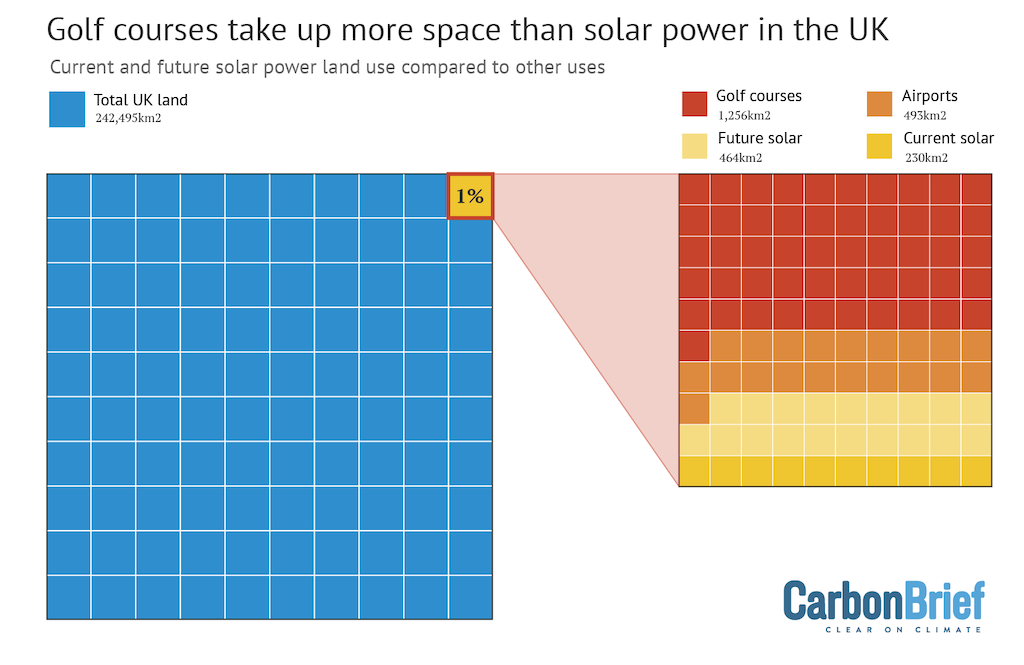
By 2035, an additional 129,000 hectares of land is estimated to be used for solar and wind energy in England, with some of this land also used to produce food at the same time.
If achieved, this will account for 1% of land in England and 2% of the UK’s agricultural area.
This estimate is based on the assumption that all extra solar will be installed on the ground, which the report says is a “highly conservative and unlikely scenario” given that many panels are anticipated to be placed on rooftops.
This makes the 2035 figure an “upper-bound” estimate, says the report.
By 2050, around 155,000 hectares – roughly equal to the size of Greater London – will be used for renewables, the report estimates, adding that this is based on trends from historical data and not future scenarios.
The report adds that it is possible that more land than this will be needed to meet energy goals past 2035, however, citing the “inherent uncertainty” in figuring out what the mix of electricity sources will look like by 2050.
By 2030, coordinated planning of electricity networks will encourage rural investment, “such as through new data centres”, the report claims.
By 2050, the report says that better land-use planning will lead to a “fairer and more efficient distribution of solar and wind infrastructure across England”.
There will also be better electricity connections to renewables, much of which will be delivered alongside “productive agriculture”, such as by installing solar panels above crops – known as agrivoltaic farming.
The report says that any land-use change decisions should be made based on a number of factors, drawing from “local knowledge, values, data and priorities”.
It notes that development of wind and solar infrastructure in rural areas should give local communities the “opportunity to benefit from local clean energy”.
Tree-planting and nature restoration
According to the framework, 6% of England’s land will need to be used for achieving climate and nature goals by 2050.
This kind of land use includes restoring England’s carbon-dense peatlands, planting new woodlands and restoring heathland habitats.
As part of the analysis, the framework takes a detailed look at what parts of England would be best suited for nature restoration. It says:
“Habitat creation and restoration should be directed to the places where it can have the greatest ecological impact, help to reconnect fragmented landscapes, support priority species and deliver the greatest contribution to nature recovery.”
The chart below, taken from the framework, shows where in England has the greatest potential for nature restoration in dark green.
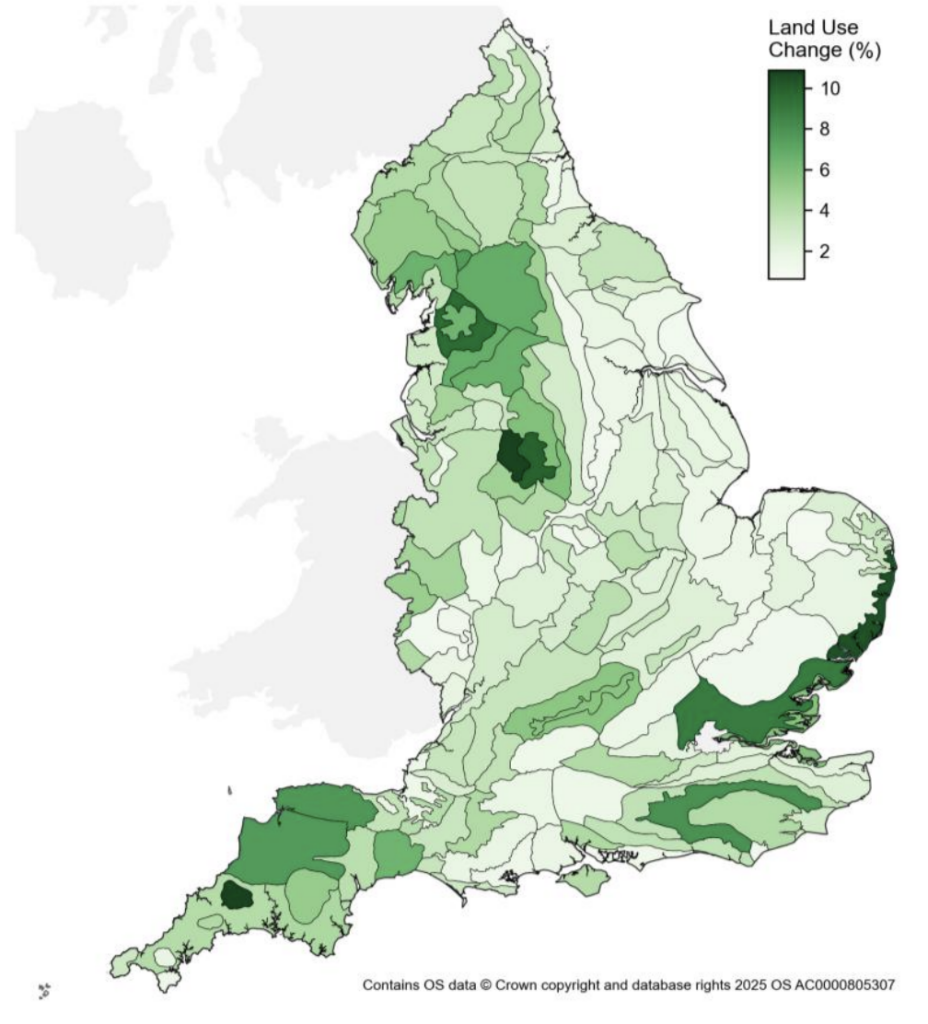
The analysis finds that north-west England has high potential for nature restoration, largely because it is home to the vast majority of the country’s carbon-rich, but degraded, peatlands.
Other areas identified include the south-west, which could be suitable for “grassland restoration and broadleaf woodland creation” and the south-east, where new grasslands could be planted, according to the framework.
The framework adds that the UK government remains committed to protecting 30% of land for nature by 2030, an international goal set under the Kunming-Montreal Global Biodiversity Framework.
However, it notes that, at present, just 7% of England’s land is protected for nature – with just four years to go until the deadline.
Speaking at the launch of the framework, nature minister Mary Creagh acknowledged that meeting the target remains a large challenge.
She added that her department was currently on a “data sprint” to try to account for all kinds of land that may not currently be classified as being protected for nature, despite serving this purpose.
Food production
The new framework extensively discusses how to balance food production with other uses for land, such as producing renewable energy and building homes.
The government says it is generally not suggesting land-use change on the country’s “best agricultural land”.
The framework focuses instead on using farmland to fulfil dual purposes, “rather than taking land out of production entirely”.
The goals outlined in the framework include increasing domestic food production in England, which the report says is “feasible according to our projections”.
Currently, the UK produces around 60% of its own food, importing the rest from abroad.
By 2030, the “vision” outlined in the framework says that farmers and other land managers will have better long-term clarity and more information on improved ways to use their land.
By 2050, meanwhile, farmlands will be managed to prioritise “sustainable food production and environmental benefits”, it says.
At this stage, the framework estimates that 480,000 hectares of farmland could be used primarily for food production, while also bringing environmental and climate benefits such as planting trees or restoring grassland habitats.
Agricultural land will be used to balance food production and other outcomes. A footnote in the report says that this will broadly lead to a “mosaic of different landscapes” – semi-natural land, low-intensity farmland and higher-intensity farmland.
It also says that, by 2050, farmland will be more resilient to climate change impacts through actions such as planting trees for flood and drought resilience.
All projected scenarios in the analysis behind the framework focus on producing food “more sustainably from less land”, the report notes.
The agricultural land-use change recommendations in the framework differ across the country. If focusing on improvements to water quality and biodiversity, for example, it recommends looking at areas with intensive agricultural production in the east of England.
This is due to these areas using high quantities of fertilisers, which can wash off fields and run into rivers and other waterways. This lowers water quality and harms plants and animals.
The government commits to developing sectoral growth plans, starting with horticulture and poultry, to provide a framework to boost production and “maintain food security”.
The government also promises to support making “under-used land” available for communities to grow food and recover nature, “where appropriate”. This refers to inactive land that is not suitable for other developments.
The report is a “step in the right direction”, says Tom Bradshaw, president of the National Farmers’ Union. He adds that it is “positive” to have “explicit recognition” of using land for multiple purposes and a government commitment to maintain food production.
Bradshaw notes that “challenges remain about delivering against the ambitious objectives as the first 2030 milestone approaches”.
Housing
Reynolds says that this framework can help to “speed up house-building and infrastructure delivery”.
The report says that, by 2030, improved planning will enable areas to facilitate housing and development “whilst protecting and enhancing the environment”.
It adds that, where appropriate, developments will be higher-density to “make the best use of land within our towns and cities”.
By 2030, biodiversity net gain – a planning requirement to improve habitats while building developments – and nature-based solutions will also be used to ensure development “leaves the natural environment in a measurably better state than it was in beforehand”, the report says.
It adds that timber production will be expanded to provide “low-carbon building materials”.
By 2050, meanwhile, the framework says planners will be able to more easily assess how suitable areas are for development “using a streamlined digital planning service and decision support tools”.
These tools – built on a range of data sources – are intended to reduce the number of homes built in areas at risk of flooding, the report says.
One in four homes in England are projected to be at risk of flooding by 2050, under a high-emissions scenario, the report outlines.
The report notes that the government is proposing a “default yes” to some planning applications for developments near well-connected transport stations.
High-demand areas “need to be powered locally and sustainably”, it notes, and using technologies such as rooftop solar to “make use of existing built land for electricity generation” can reduce land pressures elsewhere.




The post Q&A: What England’s new ‘land-use framework’ means for climate, nature and food appeared first on Carbon Brief.
Q&A: What England’s new ‘land-use framework’ means for climate, nature and food



-
Greenhouse Gases7 months ago
Guest post: Why China is still building new coal – and when it might stop
-
Climate Change7 months ago
Guest post: Why China is still building new coal – and when it might stop
-

 Greenhouse Gases2 years ago
嘉宾来稿:满足中国增长的用电需求 光伏加储能“比新建煤电更实惠”
-
Climate Change2 years ago
Bill Discounting Climate Change in Florida’s Energy Policy Awaits DeSantis’ Approval
-

 Climate Change2 years ago
嘉宾来稿:满足中国增长的用电需求 光伏加储能“比新建煤电更实惠”
-
Climate Change Videos2 years ago
The toxic gas flares fuelling Nigeria’s climate change – BBC News
-

 Carbon Footprint2 years ago
US SEC’s Climate Disclosure Rules Spur Renewed Interest in Carbon Credits
-
Renewable Energy2 years ago
GAF Energy Completes Construction of Second Manufacturing Facility