

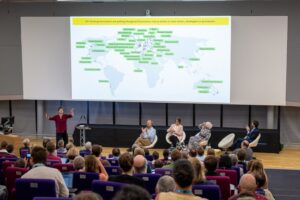
Last week, hundreds of scientists, policymakers and journalists flocked to the University of Exeter to attend an international conference on “tipping points”.
The conference saw experts discussing the dangers of a range of Earth system tipping points, including the dieback of the Amazon, the melting of the Greenland ice sheet and the shutdown of the Atlantic Meridional Overturning Circulation (AMOC).
Attendees also explored “positive tipping points” – large-scale, self-propelling social changes that would reduce the impact of humans on the climate.
(For more on the key talking points, new research and ideas that emerged from the four-day event, see Carbon Brief’s full write-up of the event.)
On the sidelines of the conference, Carbon Brief asked a wide range of delegates which tipping point concerns them the most.
These are their responses, first as sample quotes, then, below, in full:
- Prof Gabi Hegerl: “I am particularly worried about tipping points that involve the biosphere and humans due to breaching thresholds for heat or drought that then ripple into food availability, livelihood and ecosystems.”
- Prof Carlos Nobre: “The Amazon is a very serious tipping point, because [dieback] could release around 250bn tonnes of CO2 by 2100 – which will make it impossible to [limit global warming] at 1.5C.”
- Gaia Vince: “I would say that we have already passed the tipping point for coral reef ecosystems…As a scuba diver, I find it a tragedy because I love coral reef ecosystems, but it’s also a tragedy for human systems.”
- Dr Andrew Hartley: “The tipping point I’m most concerned about is Amazon forest dieback…because of the significance of the carbon cycle and the feedback to the global climate. Also [due to] the effects that Amazon tipping has on food security, both locally and globally.”
- Prof Tim Lenton: “The Atlantic Meridional Overturning Circulation, or AMOC, for sure. The consequences of crashing that would be devastating globally – and also for where I live in the UK.”
- Prof Peter Cox: “The one that I’ve worked on most and worries me most at the moment is Amazon dieback. And that’s because we’ve got two things, two stressors, going on at once that push it in the wrong direction. Climate change is one, deforestation is another.”
- Prof Johan Rockström: “The tipping element that worries me most is coral reef systems, for the simple reason that the scientific uncertainty range is very limited.”
- Dr Patricia Pinho: “For me, it is the Amazon…I think it’s going to be a really profound, irreversible change that will affect the global population in the most dramatic way.”
- Prof Ricarda Winkelmann: “I’m mostly concerned about the Greenland and West Antarctic ice sheets. This is because we know that, even at lower warming levels, they are already at risk of transgressing tipping points in certain regions.”
- Dr Nico Wunderling: “The tipping element that worries me most is the Amazon rainforest. This is because the Amazon rainforest is not only threatened by climate change, but also by deforestation at the same time.”
- Dr Rebecca Shaw: “The coral reef tipping point…It signals the end of the most colourful and biodiverse ecosystem which supports the nutrition and livelihoods of over one billion people.”
- Dr David Obura: “The ice [tipping elements] – because they are the first ones to go that have cascading impacts on other tipping elements.”
- Dr David Armstrong McKay: “The Amazon is actually probably closer to a deforestation-induced tipping point than to a climate change-induced tipping point. So, I actually think that could be potentially in the offing sooner than we would like.”
- Kate Raworth: “The tipping point that I fear we will fail to cross is [the social tipping point] around transforming our mindsets.”

Chair in climate system science in the school of geosciences at the University of Edinburgh
I am worried about all of them, but for the immediate future, I am particularly worried about tipping points that involve the biosphere and humans due to breaching thresholds for heat or drought that then ripple into food availability, livelihood and ecosystems. The Earth system tipping points will do that too, but maybe a little bit later. Examples [of this] are the coral diebacks triggered by marine heatwaves, forest change and fires, and droughts threatening livelihoods and putting people on the move.
I did a research project on the US Dust Bowl and the trigger [for that event] was drought causing vegetation and crop dieback, [which led to] extreme heat and dust storms in response – and migration, as memorialised in [the 1939 John Steinbeck novel] The Grapes of Wrath. And, now with warming, all droughts get supercharged.

Prof Carlos Nobre
Scientist and meteorologist who spearheaded the multi-disciplinary, multinational large-scale biosphere-atmosphere experiment in Amazonia
The Amazon is a very serious tipping point, because [dieback] could release around 250bn tonnes of CO2 by 2100 – which will make it impossible to [limit global warming] at 1.5C. We could also lose the largest [host to] biodiversity on the planet, which would induce a tremendous, large number of epidemics and several pandemics. Also, of course, the Amazon forest controls aspects of the global climate. In South America, the climate is entirely controlled by the Amazon forest.
I’m most worried about Amazon [dieback] because I have worked on it for 40 years. But the other tipping points deeply concern me. The melting of the permafrost will release more than 200bn tonnes [of greenhouse gases], mostly methane. Ice sheet melt in Greenland is a very serious tipping point because it could raise sea level rise by three metres in 200 years. The melting of Greenland has already started. Species extinction is also very serious.
One thing that was not much talked about [at this conference] is that when the ocean heats up, particularly the Arctic Ocean, then a tremendous amount of methane is released. And if that happens – if the Arctic Ocean warms up by 3-4C – the amount of methane that would be released could see [air] temperatures reach 8-10C [above pre-industrial levels]. At 8-10C, the only inhabitable places for us humans will be the top of the Alps, the Andes and the north and south poles. The rest of the planet would be uninhabitable.
 Gaia Vince
Science writer and broadcaster
I would say that we have already passed the tipping point for coral reef ecosystems, for example. That really is a tragedy. As a scuba diver, I find it a tragedy because I love coral reef ecosystems, but it’s also a tragedy for human systems. They are the nursery for our fisheries. And, of course, they’re not just fisheries – they are a valid ecosystem and a biodiversity hotspot. This will have untold consequences and cascading impacts for other parts of the ecosystem, for example, the cycling of nutrients and coral reefs are really important to stop coastal erosion. And they actually provide sand, the lovely white sand that people go on holiday for Bucha.
 Dr Andrew Hartley
Climate impacts scientist at the Met Office Hadley Centre
The tipping point I’m most concerned about is Amazon forest dieback and reduction in the function of the Amazon forest, because of the significance of the carbon cycle and the feedback to the global climate. Also [due to] the effects that Amazon tipping has on food security, both locally and globally, because of [the Amazon’s] contribution to major commodity markets, such as soybean and maize.
This might interact with climate change in the future to lead to more severe events, particularly in populated areas of Brazil. If an Amazon tipping point were to occur, it might lead to more severe events on the coast of Brazil which would affect a much larger population. There are negative impacts across the forest from the drying of the forest, for example for the Indigenous communities, but also globally.
 Prof Tim Lenton
Founding director of the Global Systems Institute and chair in climate change and Earth system science at the University of Exeter
The Atlantic Meridional Overtoning Circulation, or AMOC, for sure. The consequences of crashing that would be devastating globally – and also for where I live in the UK. By our own calculation, we could have less than half the viable area for growing a couple of major staple crops, wheat and maize worldwide. We would have a widespread water crisis. We could have collapses of the monsoons in West Africa and India that would displace hundreds of millions of people. It is hard to see that as anything other than a catastrophe.
 Prof Peter Cox
Professor of climate system dynamics in mathematics and director of the Global Systems Institute at the University of Exeter
The one that I have worked on most and worries me most at the moment is Amazon dieback. And that’s because we’ve got two things, two stressors going on at once that push it in the wrong direction. Climate change is one, deforestation is another. You can imagine crossing the boundary in various ways – but, if you push diagonally, you get there quicker.
If I had spoken to you 25 years ago, I would have said I’m really worried about [Amazon dieback]. Then I went through a phase of thinking that the models have overdone it. And now I’m thinking the models that don’t include land-use change are underdoing it. So, I’m more concerned about that one.
There are others as well, but that is the one that is also quite fast. The other [tipping points] we worry about, we’re worried about a long-term commitment. It takes a while for the AMOC to shut down, it really does. It takes a while for the Greenland ice sheet to melt. We’ve done work that suggests you can overshoot even a little bit for these slow systems. The Amazon forest is a decadal dieback, especially if it is fire driven.
 Prof Johan Rockström
Director of the Potsdam Institute for Climate Impact Research (PIK) and professor in Earth system science at the University of Potsdam
There is not a simple answer to this – there is a two-part answer.
The tipping element that worries me most is coral reef systems, for the simple reason that the scientific uncertainty range is very limited. We have, unfortunately, ample evidence that at 1.5C we’re very likely to knock over, potentially, the entire tropical coral reef system on Earth. [This threatens] the livelihoods of 400 million people and a fundamental nursing ground for the whole ocean food web. So that is one deep concern. It is the canary in the coal mine – the first kid on the block to fall over. We’re so close.
The second one is AMOC – the whole overturning of heat in the Atlantic, which connects the entire ocean system. Not only is the latest science showing that we are going from low likelihood to uncomfortably high likelihood, but we also know – with very little uncertainty – that this would cause a catastrophic impact across the entire world, and it would go fast. So the AMOC, I would argue, is today the most important scientific message to the world. If you want a really hard-hitting reason to act at a level of planetary emergency, it is the AMOC. That is the second one.
From a planetary boundary perspective, it is important to recognise that – on climate science grounds – the Amazon basin is not at risk of tipping until 3-5C of warming. But as soon as you factor in loss of biodiversity, deforestation and changes in hydrology – then the temperature risk goes down to between 1.5-2C. So suddenly – when taking a more integrated [assessment] approach – the conclusion is that it is also very close to a tipping point.
 Dr Patricia Pinho
Deputy science director at the Amazon Environmental Research Institute (IPAM)
For me, it is the Amazon. When we think of the planetary crisis, we think about the Amazon and all the regulating climate services it provides. This is not only regionally, but we know it’s a global “climate good”, if you will. But it is highly sensitive to land-use change and increasing temperature. So, if we transition to a point of no return – Amazon dieback – and transforming or transitioning to another ecosystem, the function of the forest will not be doing what it has been doing for the past millennium and so on. And then we cannot revert this loss. I think it is going to be a really profound, irreversible change that will affect the global population in the most dramatic way.
Of course, we have the people on the front line that I’m working with – Indigenous people, traditional population – that are safeguarding this resource, but they are also at the front line of climate risks and the impacts that we already observe. If we miss this opportunity of really reverting from increasing greenhouse emissions and increasing temperature, we’re going to miss the window of opportunity to really protect the region, protect the ecosystem and the forest for the global society.
 Prof Ricarda Winkelmann
Founding director of the Max Planck Institute of Geoanthropology and professor of climate system analysis at PIK and the University of Potsdam
So I am thinking about this from a risk perspective – so both the likelihood as well as the impacts – and I think the answer depends on that. Because when it comes to the likelihood and the particular threshold – and we know about those – I’m mostly concerned about the Greenland and the West Antarctic ice sheets. This is because we know that, even at lower warming levels, they’re already at risk of transgressing tipping points in certain regions.
But when it comes to the impacts and also the timescales over which those play out, there are other tipping elements that worry me most. In particular, regional tipping elements. So if we think of the mountain glaciers, for instance, these impacts are already experienced right now and several mountain glaciers are undergoing these accelerated changes. And so thinking about the timescales when it comes to the impacts is also incredibly important.
 Dr Nico Wunderling
Junior professor at the Center for Critical Computational Studies at Goethe University Frankfurt and researcher at the Potsdam Institute for Climate Impact Research.
The tipping element that worries me most is the Amazon rainforest. This is because the Amazon rainforest is not only threatened by climate change, but also by deforestation at the same time. So that means that the critical threshold from climate change alone, at around 3-4C of global warming, can come down to 1.5-2C. Climate change and deforestation basically go hand-in-hand to lower the [Amazon’s tipping] threshold because of this double threat.
 Dr Rebecca Shaw
Chief scientist and senior vice-president at WWF
The coral reef tipping point – it comes first because of warming surface waters, and then the outcome is sealed by ocean acidification. It signals the end of the most colourful and biodiverse ecosystem which supports the nutrition and livelihoods of over one billion people and has captured the imagination of more people than any other through the characters like Nemo the clownfish, SpongeBob SquarePants, and, of course, Frank the coral [a character from an educational YouTube video].
If humanity is not motivated to act in the face of the loss of coral reefs, is there hope that we will act in time to prevent the Amazon and glacier tipping points?
 Dr David Obura
Chair of the Intergovernmental Science-Policy Platform on Biodiversity and Ecosystem Services and founding director of CORDIO East Africa
The ice [tipping elements] – because they are the first ones to go that have cascading impacts on other tipping elements. When [ice masses] reduce, we lose their albedo, waters heat up more [and] the AMOC can collapse. That has the biggest impact across the planetary system, including the Amazon.
My own [research], of course, is coral reefs. So, in a way, the coral reef tipping point does concern me the most. [But] it doesn’t have cascading impacts on other tipping elements. It does on people, in socioeconomic terms – but not on other system elements. So, in a sense, it is the least worrying one.
 Dr David Armstrong McKay
Lecturer in geography, climate change and society in the school of global studies at the University of Sussex and lead author on an influential tipping points assessment, published in Science in 2022
One of the tipping systems that concerns me the most is Amazon rainforest dieback. Because even though we assessed it a few years ago as having a warming threshold that’s a bit higher than what we might be seeing – we’ve thought it is maybe at a best estimate of 3.5C – there’s also deforestation as well. The Amazon is actually probably closer to a deforestation-induced tipping point than to a climate change-induced tipping point. So I actually think that could be potentially in the offing sooner than we would like. That would have huge impacts for biodiversity, for South America as a whole, by shifting rainfall patterns, which would really affect a lot of people for agriculture or ecosystems. Also, the Amazon as an ecosystem is so incredibly biodiverse and amazing in itself, it would be a tragedy to lose it.
 Kate Raworth
Senior visiting research associate and lecturer at the University of Oxford’s Environmental Change Institute and co-founder and conceptual lead of Doughnut Economics Action Lab
The tipping point that I fear we will fail to cross is [the social tipping point] around transforming our mindsets. We need to move from the extractive, degenerative economy towards a regenerative one. This all starts within our head and it underlies everything.
[A failure to do this] is what is driving us towards all these [Earth system tipping points].
The post Experts: Which climate tipping point is the most concerning? appeared first on Carbon Brief.
Experts: Which climate tipping point is the most concerning?

Three countries have been named by the Paris Agreement’s compliance committee for failing to submit a nationally determined contribution (NDC) and repeatedly snubbing offers of help with their climate plans.
After months of internal debate over whether to identify serial non-responders, the Paris Agreement’s Implementation and Compliance Committee (PAICC) named the three countries which have failed to engage with it over their NDCs on Friday.
It named Democratic Republic of Congo, Senegal and North Korea in a footnote of its annual report, adding that it decided to name them “with a view to facilitating engagement”, adding that representatives of the three nations had been invited to its meeting in early 2027 “with the purpose of identifying any challenges and constraints”.
“The Committee noted the importance of Parties engaging with the Committee in a timely manner, while noting that some delays may be due to the national capabilities and circumstances of the Parties”, the report said.
-
Under US pressure, World Bank says it will back gas “where appropriate”
The US wants the World Bank to expand its gas support while climate campaigners are pushing for it to end – its head spoke this week of limited backing for the fossil fuel -
IPCC scientists vow to press on with climate reports despite political deadlock
After governments again failed to agree a timeline, nearly 120 IPCC authors pledged to complete their assessment on time and with full scientific rigour -
Paris Agreement committee snubbed over missing NDC climate plans
Many governments have still not submitted a nationally determined contribution to the UN, breaching a key requirement of the Paris Agreement

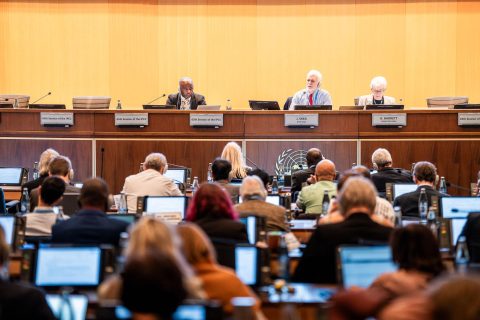

In July, PAICC said 12 countries had ignored its repeated attempts to discuss why they had not published an NDC as required every five years under the 2015 Paris accord.
Members of the committee had been divided over whether to name them, but at a September meeting decided to do so in their annual report to the annual climate COP summit.
By the time the report was published on Friday, only Congo, Senegal and North Korea “had not communicated an NDC or submitted a [Biennial Transparency Report] and had not yet responded to any of the Committee’s notifications, despite several reminders issued by the Committee in this regard”.
Rainforest and renewable energy ambitions
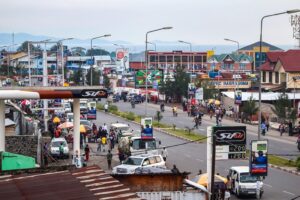
The silence from Congo and Senegal is notable because the former is home to much of the Congo Basin rainforest while the latter has sought billions of dollars in climate finance to support its renewable energy ambitions.
After Brazil, Congo has more rainforest than any country in the world. This forest, and the country’s peatlands, absorb huge amounts of greenhouse gas but are fast being lost to expanding farmland, charcoal production, logging and mining.
Senegal signed a Just Energy Transition Partnership with Canada and wealthy European nations in 2023, to help it meet its renewable energy targets under the-then government of Macky Sall. It was chair of the Least Developed Countries group between January 2022 and December 2023.

Tejas Rao, who is researching the PAICC as part of a doctoral thesis at Cambridge University, said the governments of the three countries should engage with the committee.
“Engagement costs these governments very little and the committee has shown it will listen,” he said.
“Silence leaves the committee with no basis to help, and it leaves the [governments] exposed to the narrative that they are simply disengaged,” he told Climate Home News.
Paris Agreement requirement
The 2015 Paris Agreement requires all parties to