

The Tropical Forest Forever Facility (TFFF) – a major new rainforest protection fund launched by Brazil at COP30 – is unlikely to make payments to rainforest countries until at least 2028, experts said, while it raises funds in financial markets.
The proposed new mechanism aims to pay rainforest countries for achieving low deforestation rates. Rather than depending on grants, the TFFF would seek to raise public and private capital to make investments in financial markets, and then use part of the returns to reward countries which protect their rainforests.
But raising the US$125 billion of public and private investment needed to make meaningful payments could take years, according to Andrew Deutz, managing director of Global Policy and Partnerships at WWF, one of the organisations involved in the fund’s design.
He said it will likely take two or three years for the fund to raise private capital by issuing bonds, invest the money and generate enough returns to make significant payments. “So I don’t think we’re going to see payments to rainforest countries until 2028 or 2029,” Deutz said.
-
UK cuts support for climate action abroad to fund military instead
The UK’s foreign minister said the cuts to the aid budget would “deliver the biggest increase in defence spending since the Cold War” -
Roadmap launched to restart deadlocked UN plastics treaty talks
The chair of the negotiations proposes informal meetings through 2026 to bridge deep divisions among countries, following the collapse of talks in Geneva last year


Norway’s climate minister Andreas Bjelland Eriksen, another of the fund’s early backers, told Climate Home News that “the TFFF requires scale, which will take some time”, but added that it “is a historic opportunity” to finance the protection of tropical forests “for generations”.
The delay is not necessarily bad, according to Deutz, as it will allow communities to build capabilities and legal structures to handle the new flow of funds. “There needs to be a capacity-building process over the next couple of years with Indigenous organisations and local communities to be able to manage the flow of funds at that level,” he added.
At the COP26 climate summit in 2021, over 140 countries – covering 85% of the world’s forests – pledged to end deforestation by 2030. At last year’s COP30, the Brazilian government promised to create a roadmap towards ending deforestation by that same date.
But governments are far off track, with a yearly review showing that deforestation rates are currently 63% higher than what they should be to reach this goal. An estimated $570 billion funding gap for nature protection has contributed to the deficient results.
First step: raising $10 billion
While the TFFF has a long-term goal of raising $125bn in public and private capital, its proponents say the key goal for the fund in 2026 will be to raise the total amount of public investment to $10bn so that it can start to scale up.
The fund has already raised $6.7bn, but Norway’s $3bn pledge requires that the TFFF raises about $10bn mostly from other funders by the end of 2026 or they will not invest.
Before scaling up to the long-term $125bn goal – of which $25bn is public and $100bn private – the TFFF will have to prove that it can be successful in paying back investors and channeling funds for rainforest protection. The whole process can take years, Deutz said.
If this $10bn target is reached, the fund could begin raising private finance – up to an estimated $40bn, Deutz said. This initial $50bn tranche would serve to start making investments and show that the model works and can generate returns.
Bjelland Eriksen also said that reaching the $10bn target will be “an important priority” this year. “Only a handful of countries had the opportunities to assess it in detail before the [COP30] Belém summit – now is the time for more countries to do so,” the Norwegian minister said.
Public finance from governments is key for the TFFF model because it would act as a guarantee to lower risk for private investors, something very common in the financial sector, said Charlotte Hamill, partner at hedge fund Bracebridge Capital and one of the fund’s financial advisors, at an event earlier in January in Davos.
“Being able to do this at scale is actually really important, not only to be able to make the payments that are necessary for rainforest preservation but also, in a funny way, it allows you to buy slightly less risky assets because you’re gonna have a much larger pool to buy them off of,” she added.
New contributions?
João Paulo de Resende, TFFF Leader at Brazil’s Ministry of Finance, told Climate Home News that the country will continue fundraising efforts throughout this year, and said he has recently concluded a tour in East Asia speaking with government officials from Japan, South Korea and China.
Conversations with the Chinese government have become “a lot more serious”, said Felix Finkbeiner, founder of the non-profit Plant-for-the-Planet, which operates the online tracking platform TFFF Watch. He added that a Chinese investment would likely be similar in size to the French or German contributions, which would grant the country a seat on the TFFF board. France has pledged a €500m ($578m) investment while Germany has promised €1bn ($1.17bn).
While China is categorised as a developing country at UN climate talks, and thus has no legal responsibility to grant climate finance, the TFFF has been seen as an opportunity for the Asian country to contribute because it’s not an official mechanism within the UN. Deutz said that, for the Chinese government to contribute, they will need reassurance that the funds will not be counted as formal climate finance.
The UK is another of the countries expected to announce a contribution in the coming months, both Finkbeiner and Deutz said. The country announced cuts to climate finance this week as it ramps up defense spending, but Deutz noted that it could still contribute with funds to the TFFF.
“I’m still somewhat optimistic that [the $10bn goal] can happen despite the geopolitical turmoil because the TFFF does not require grant money. We’re not competing with humanitarian assistance,” Deutz explained. “Because governments are being asked to make a loan that would be paid back with interest, this comes out of a different pile of money”.
Multilateral banks such as the European Bank for Reconstruction and Development (EBRD) and the Asian Infrastructure Investment Bank (AIIB) also reportedly considered contributions.
Brazil sharing leadership
Despite having led the official launch of the fund and spearheading its fundraising efforts, Brazil is now aiming to “share leadership” as other countries join the TFFF’s steering committee and establish a new board.
De Resende told Climate Home News that “the project no longer belongs solely to Brazil”, and added that the group of countries that have pledged contributions to the TFFF are also now playing a larger role in “finding ways to jointly promote sponsor outreach”.
Deutz said that Brazil wants to move towards a “shared leadership model”. “They are now asking the European countries to have one of them set up to be the co-chairs so that this is not seen as a Brazilian initiative but is rather seen as owned by all of them,” he added.
The fund will now have to form a steering committee, likely chaired by Brazil and one European country, which will instruct the World Bank on setting up the formal structures of the fund.
Bjelland Eriksen said there is “important work” ongoing to formally establish the fund’s investment arm (known as the TFIF), while de Resende said he expects to “have the fund incorporated in some European jurisdiction by the beginning of the second semester.”
The post COP30 rainforest fund unlikely to make first payments until 2028 appeared first on Climate Home News.
COP30 rainforest fund unlikely to make first payments until 2028

Three countries have been named by the Paris Agreement’s compliance committee for failing to submit a nationally determined contribution (NDC) and repeatedly snubbing offers of help with their climate plans.
After months of internal debate over whether to identify serial non-responders, the Paris Agreement’s Implementation and Compliance Committee (PAICC) named the three countries which have failed to engage with it over their NDCs on Friday.
It named Democratic Republic of Congo, Senegal and North Korea in a footnote of its annual report, adding that it decided to name them “with a view to facilitating engagement”, adding that representatives of the three nations had been invited to its meeting in early 2027 “with the purpose of identifying any challenges and constraints”.
“The Committee noted the importance of Parties engaging with the Committee in a timely manner, while noting that some delays may be due to the national capabilities and circumstances of the Parties”, the report said.
-
Under US pressure, World Bank says it will back gas “where appropriate”
The US wants the World Bank to expand its gas support while climate campaigners are pushing for it to end – its head spoke this week of limited backing for the fossil fuel -
IPCC scientists vow to press on with climate reports despite political deadlock
After governments again failed to agree a timeline, nearly 120 IPCC authors pledged to complete their assessment on time and with full scientific rigour -
Paris Agreement committee snubbed over missing NDC climate plans
Many governments have still not submitted a nationally determined contribution to the UN, breaching a key requirement of the Paris Agreement

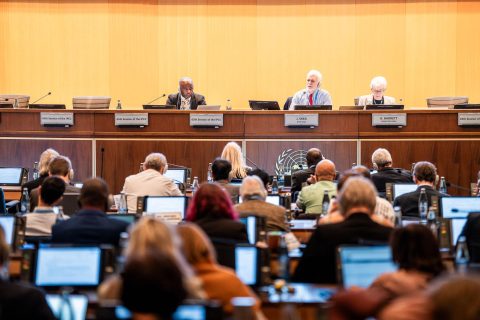

In July, PAICC said 12 countries had ignored its repeated attempts to discuss why they had not published an NDC as required every five years under the 2015 Paris accord.
Members of the committee had been divided over whether to name them, but at a September meeting decided to do so in their annual report to the annual climate COP summit.
By the time the report was published on Friday, only Congo, Senegal and North Korea “had not communicated an NDC or submitted a [Biennial Transparency Report] and had not yet responded to any of the Committee’s notifications, despite several reminders issued by the Committee in this regard”.
Rainforest and renewable energy ambitions
The silence from Congo and Senegal is notable because the former is home to much of the Congo Basin rainforest while the latter has sought billions of dollars in climate finance to support its renewable energy ambitions.
After Brazil, Congo has more rainforest than any country in the world. This forest, and the country’s peatlands, absorb huge amounts of greenhouse gas but are fast being lost to expanding farmland, charcoal production, logging and mining.
Senegal signed a Just Energy Transition Partnership with Canada and wealthy European nations in 2023, to help it meet its renewable energy targets under the-then government of Macky Sall. It was chair of the Least Developed Countries group between January 2022 and December 2023.

Tejas Rao, who is researching the PAICC as part of a doctoral thesis at Cambridge University, said the governments of the three countries should engage with the committee.
“Engagement costs these governments very little and the committee has shown it will listen,” he said.
“Silence leaves the committee with no basis to help, and it leaves the [governments] exposed to the narrative that they are simply disengaged,” he told Climate Home News.
Paris Agreement requirement
The 2015 Paris Agreement requires all parties to publish an NDC every five years outlining their emissions reduction targets, with each plan meant to be more ambitious than the country’s last NDC.
The latest set – the third round of plans, with new targets for 2035 – was due in February 2025. While most countries missed this deadline, all but around 30 – mostly small emitters but including Egypt, Vietnam and Argentina – have now submitted them.
Over the year, the PAICC – which is made up of government climate officials from developed and developing countries – has been communicating with governments that have not submitted NDCs and trying to overcome barriers to them doing so.
Some nations have cited exceptional circumstances as the reason for not submitting an NDC, a process that requires a significant amount of work in tracking emissions and consulting on how to curb them across the economy. For example, a letter from a Sudanese official to the PAICC, seen by Climate Home News, said that the country’s civil war had led to the suspension of its NDC preparation.
-
IPCC scientists vow to press on with climate reports despite political deadlock
After governments again failed to agree a timeline, nearly 120 IPCC authors pledged to complete their assessment on time and with full scientific rigour -
Under US pressure, World Bank says it will back gas “where appropriate”
The US wants the World Bank to expand its gas support while climate campaigners are pushing for it to end – its head spoke this week of limited backing for the fossil fuel -
Who shapes climate science? The equity question facing the IPCC
Early completion of the next global climate science assessment reports risks excluding research from the Global South, which is key to ensuring the findings are fair
The US and Iran are not signed up to the Paris Agreement and so do not have active NDCs, nor does Taiwan, which is not a UN member state.
Rao said that because the PAICC is “facilitative and non-punitive”, naming the countries “is meant to open a door, not close one – the invited consultation is the point”.
“In recent months, governments that explained their constraints, whether capacity, finance or domestic process, have been met with follow-up and support rather than sanction, and the number of silent governments has fallen sharply,” Rao said.
The post Paris Agreement committee names three countries snubbing it over NDCs appeared first on Climate Home News.
Paris Agreement committee names three countries snubbing it over NDCs