


History of The Hubble
The Hubble Space Telescope, a cornerstone of modern astronomy, boasts a rich history filled with collaboration, innovation, and overcoming challenges.
Here’s a glimpse into its fascinating journey:
Seeds of an Idea (1940s):
The concept of a space-based telescope first emerged in the 1940s. Astronomers envisioned an instrument free from the interference of Earth’s atmosphere, allowing for clearer observations of the cosmos.
Planning and Development (1960s-1980s):
Throughout the 1960s and 1970s, the project gained momentum. NASA and the European Space Agency (ESA) collaborated, proposing a 3-meter telescope. In 1977, the U.S. Congress approved funding, and the project was officially named the Hubble Space Telescope after Edwin Hubble, the astronomer who made groundbreaking discoveries about galaxies.
A Flaw and a Fix (1980s):
Unfortunately, a critical error was discovered during construction. The primary mirror, the telescope’s “eye,” was flawed, causing blurry images. This led to the development of corrective optics, ingenious instruments installed during the first servicing mission in 1993, which ultimately saved the mission.
Launch and Early Challenges (1990):
Hubble was launched aboard the Space Shuttle Discovery in 1990. Initially, astronomers were met with blurry images due to the mirror flaw. The successful servicing mission in 1993, however, transformed Hubble into the powerful instrument we know today.
A Legacy of Discovery (1990s-Present):
Since its “fix,” Hubble has become an invaluable tool for astronomers. It has captured iconic images of distant galaxies, nebulae, and stellar nurseries. It has provided crucial data on the expansion of the universe, the formation of stars and planets, and even the existence of exoplanets (planets outside our solar system).
Hubble continues to operate today, undergoing multiple servicing missions throughout its lifetime. It remains a testament to international collaboration, scientific innovation, and the ongoing quest to understand the universe we inhabit.

Discovered Hubble: Eyes of the Earth
The Hubble Space Telescope, aptly nicknamed “Eyes of the Earth,” is a marvel of modern science and engineering. Launched in 1990, it revolutionized our understanding of the universe by offering an unprecedented view from beyond Earth’s atmosphere.
A New Perspective:
Unlike ground-based telescopes hindered by the distortions of our atmosphere, Hubble orbits Earth at a distance of roughly 340 miles. This allows it to capture images with exceptional clarity, revealing details invisible to the naked eye or even the most powerful Earth-bound telescopes.
A Universe Unveiled:
Hubble’s discoveries have been nothing short of spectacular. It has provided crucial evidence for the accelerating expansion of the universe, a phenomenon attributed to the mysterious force known as dark energy. It has also captured stunning images of distant galaxies, revealing their diverse shapes and sizes, and offering glimpses into the early stages of the universe’s formation.
Beyond the Galaxies:
Hubble’s reach extends beyond the vast expanse of galaxies. It has peered into the heart of our own solar system, studying the intricate details of planets, moons, and other celestial bodies. It has even played a key role in the discovery of exoplanets, planets orbiting stars beyond our solar system.
A Legacy of Discovery:
Over its three decades in operation, Hubble has generated a treasure trove of data, fueling countless scientific breakthroughs and inspiring generations of scientists and astronomers. It continues to operate today, serving as a testament to human ingenuity and our relentless pursuit of knowledge about the universe we inhabit.
Hubble is a powerful reminder that there is so much more to discover beyond our planet. It serves as a constant source of wonder and a symbol of our collective human journey to unravel the mysteries of the cosmos.

The Hubble Telescope Technology
The Hubble Space Telescope, launched in 1990, revolutionized astronomy by offering an unprecedented view of the universe. This marvel of engineering relies on various cutting-edge technologies to capture stunning images and gather valuable data.
1. Mirrors:
- Primary Mirror: The heart of Hubble is its 2.4-meter diameter primary mirror, the largest ever flown in space at its launch. This mirror collects and focuses light from distant celestial objects. However, a grinding error initially produced blurry images, which were later corrected during the first servicing mission with the installation of COSTAR (COmpensating Optical Support System Aberrations Recorder).
- Secondary and Tertiary Mirrors: These smaller mirrors work in conjunction with the primary mirror to direct the light path within the telescope, ultimately focusing it onto the scientific instruments.
2. Imaging Systems:
Hubble utilizes a suite of specialized instruments, each designed to capture specific wavelengths of light:
- Wide Field Camera 3 (WFC3): This versatile camera captures high-resolution, detailed images across various wavelengths, offering data from ultraviolet to near-infrared. It has captured iconic images like the “Pillars of Creation” and the “Deep Field” views.
- Cosmic Origins Spectrograph (COS): This instrument acts like a light prism, splitting light into its constituent colors to reveal the chemical composition of celestial objects.
- Other Instruments: Hubble boasts additional specialized instruments like the Advanced Camera for Surveys (ACS), the Space Telescope Imaging Spectrograph (STIS), and the Faint Object Spectrograph (FOS), each contributing significantly to our understanding of the universe.
3. Guidance and Control Systems:
Maintaining precise pointing is crucial for capturing clear images of faint objects. A complex system of gyroscopes, star trackers, and reaction wheels keeps Hubble pointed with incredible accuracy, even as it orbits Earth at high speeds.
4. Data Transmission:
The vast amount of scientific data collected by Hubble’s instruments needs to be transmitted back to Earth. High-speed telemetry systems send this data down to ground stations for processing and analysis by scientists worldwide.
These key technologies have made the Hubble Space Telescope a cornerstone of modern astronomy, paving the way for groundbreaking discoveries and inspiring generations of scientists and astronomers.

The Hubble Space Telescope, launched in 1990, revolutionized astronomy by offering an unprecedented view of the universe. This marvel of engineering relies on various cutting-edge technologies to capture stunning images and gather valuable data.
1. Mirrors:
- Primary Mirror: The heart of Hubble is its 2.4-meter diameter primary mirror, the largest ever flown in space at its launch. This mirror collects and focuses light from distant celestial objects. However, a grinding error initially produced blurry images, which were later corrected during the first servicing mission with the installation of COSTAR (COmpensating Optical Support System Aberrations Recorder).
- Secondary and Tertiary Mirrors: These smaller mirrors work in conjunction with the primary mirror to direct the light path within the telescope, ultimately focusing it onto the scientific instruments.
2. Imaging Systems:
Hubble utilizes a suite of specialized instruments, each designed to capture specific wavelengths of light:
- Wide Field Camera 3 (WFC3): This versatile camera captures high-resolution, detailed images across various wavelengths, offering data from ultraviolet to near-infrared. It has captured iconic images like the “Pillars of Creation” and the “Deep Field” views.
- Cosmic Origins Spectrograph (COS): This instrument acts like a light prism, splitting light into its constituent colors to reveal the chemical composition of celestial objects.
- Other Instruments: Hubble boasts additional specialized instruments like the Advanced Camera for Surveys (ACS), the Space Telescope Imaging Spectrograph (STIS), and the Faint Object Spectrograph (FOS), each contributing significantly to our understanding of the universe.
3. Guidance and Control Systems:
Maintaining precise pointing is crucial for capturing clear images of faint objects. A complex system of gyroscopes, star trackers, and reaction wheels keeps Hubble pointed with incredible accuracy, even as it orbits Earth at high speeds.
4. Data Transmission:
The vast amount of scientific data collected by Hubble’s instruments needs to be transmitted back to Earth. High-speed telemetry systems send this data down to ground stations for processing and analysis by scientists worldwide.
These key technologies have made the Hubble Space Telescope a cornerstone of modern astronomy, paving the way for groundbreaking discoveries and inspiring generations of scientists and astronomers.

The Hubble Telescope: Research and Exploration
The Hubble Space Telescope, launched in 1990, has revolutionized our understanding of the universe through its groundbreaking research and exploration capabilities. Here’s how:
1. Unveiling the Early Universe:
Hubble has peered deep into space and time, capturing images of galaxies billions of light-years away, allowing us to see the universe as it was in its early stages. These observations have provided vital clues about the origin, evolution, and structure of the cosmos.
2. Understanding the Expansion of the Universe:
Hubble’s observations of distant supernovae, exploding stars, provided strong evidence for the accelerating expansion of the universe. This discovery led to the theory of dark energy, a mysterious force believed to be responsible for this phenomenon.
3. Mapping the Distribution of Matter:
Hubble’s observations help map the distribution of dark matter, an invisible form of matter that makes up a significant portion of the universe’s mass. By studying the gravitational lensing effect of dark matter on light, scientists can map its presence and understand its impact on the evolution of galaxies and the universe.
4. Studying the Formation of Stars and Planets:
Hubble has captured stunning images of star-forming nebulae and protoplanetary disks, offering valuable insights into the birth of stars and planetary systems. These observations allow scientists to study the early stages of star and planet formation and the factors influencing these processes.
5. Searching for Exoplanets:
While not its primary mission, Hubble has also contributed to the search for exoplanets, planets outside our solar system. It has detected atmospheric signatures of some exoplanets, providing crucial information about their composition and potential habitability.
6. Investigating Black Holes:
Hubble has studied supermassive black holes, objects with immense gravitational pull, residing at the centers of most galaxies. These observations provide insights into the growth and behavior of black holes and their influence on the surrounding galaxies.
Beyond these specific areas, Hubble has contributed to countless other research endeavors, making it an invaluable tool for astronomers worldwide. Its legacy continues to inspire and shape our understanding of the universe, paving the way for future exploration and discovery.
The Hubble Space Telescope, launched in 1990, has revolutionized our understanding of the universe through its groundbreaking research and exploration capabilities. Here’s how:
1. Unveiling the Early Universe:
Hubble has peered deep into space and time, capturing images of galaxies billions of light-years away, allowing us to see the universe as it was in its early stages. These observations have provided vital clues about the origin, evolution, and structure of the cosmos.
2. Understanding the Expansion of the Universe:
Hubble’s observations of distant supernovae, exploding stars, provided strong evidence for the accelerating expansion of the universe. This discovery led to the theory of dark energy, a mysterious force believed to be responsible for this phenomenon.
3. Mapping the Distribution of Matter:
Hubble’s observations help map the distribution of dark matter, an invisible form of matter that makes up a significant portion of the universe’s mass. By studying the gravitational lensing effect of dark matter on light, scientists can map its presence and understand its impact on the evolution of galaxies and the universe.
4. Studying the Formation of Stars and Planets:
Hubble has captured stunning images of star-forming nebulae and protoplanetary disks, offering valuable insights into the birth of stars and planetary systems. These observations allow scientists to study the early stages of star and planet formation and the factors influencing these processes.
5. Searching for Exoplanets:
While not its primary mission, Hubble has also contributed to the search for exoplanets, planets outside our solar system. It has detected atmospheric signatures of some exoplanets, providing crucial information about their composition and potential habitability.
6. Investigating Black Holes:
Hubble has studied supermassive black holes, objects with immense gravitational pull, residing at the centers of most galaxies. These observations provide insights into the growth and behavior of black holes and their influence on the surrounding galaxies.
Beyond these specific areas, Hubble has contributed to countless other research endeavors, making it an invaluable tool for astronomers worldwide. Its legacy continues to inspire and shape our understanding of the universe, paving the way for future exploration and discovery.
https://www.exaputra.com/2024/02/discovered-hubble-eyes-of-earth.html

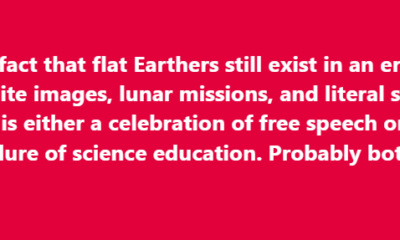




 To the author of the meme here, I say: It’s safe to say that most folks in Trump’s MAGA base are stupid, though one needs more than a low IQ to fit into this segment.
In particular, we mustn’t omit mean-spiritedness. People who are kind, compassionate, decent and tolerant of others are grossly unqualified to be rank-and-file Trumpers.
 Trump appeals to two groups of constituents: a) a small group of billionaires who lavish him with campaign contributions in exchange for huge financial favors, and b) a large number of poorly educated white people who call themselves Christians–the so-called MAGA base.
Trump has little if any appeal to everybody else: honest, fairly well-educated people of a variety of ethnicities and religious affiliations.
For Trump, staying in power means making sure that there is a minimum of leakage away from the MAGA base. That requires barraging these people with messaging to the effect that the president is the only thing standing in the way of communism/socialism, open borders, the invasion of Muslims, godlessness, teaching our little children about LGBTQs, critical race theory, choking environmental regulation, and whatever else may be on the radical left’s agenda.
Maintain this chasm means not letting up on the propaganda for a single minute. No nuance, no critical thinking, no considering what we’ve learned from history–just constant bombardment.
The mural here reminds us of what Tom Joad famously tells his mother at the end of in John Steinbeck’s The Grapes of Wrath, in response to her asking Tom where he’s going:
Wherever people are fighting for their rights, where kids are hungry and crying, and where folks are struggling to be free. Everywhere in the dark, wherever there is a fight so hungry people can eat or a cop beating up a guy.



-
Climate Change1 year ago
Guest post: Why China is still building new coal – and when it might stop
-
Greenhouse Gases1 year ago
Guest post: Why China is still building new coal – and when it might stop
-

 Greenhouse Gases2 years ago
嘉宾来稿:满足中国增长的用电需求 光伏加储能“比新建煤电更实惠”
-

 Climate Change2 years ago
嘉宾来稿:满足中国增长的用电需求 光伏加储能“比新建煤电更实惠”
-
Climate Change2 years ago
Bill Discounting Climate Change in Florida’s Energy Policy Awaits DeSantis’ Approval
-

 Renewable Energy10 months ago
Sending Progressive Philanthropist George Soros to Prison?
-
Greenhouse Gases1 year ago
嘉宾来稿:探究火山喷发如何影响气候预测
-

 Carbon Footprint2 years ago
US SEC’s Climate Disclosure Rules Spur Renewed Interest in Carbon Credits