

Welcome to Carbon Brief’s DeBriefed.
An essential guide to the week’s key developments relating to climate change.
This week
Iran war fallout continues
WORK FROM HOME: The International Energy Agency has advised its member countries to take 10 steps in response to the ongoing energy crisis fuelled by the Iran war, including reducing highway speeds and encouraging people to work from home, said the Guardian. It came after retaliatory attacks between Israel and Iran continued to destroy energy infrastructure in the Middle East, causing energy prices to soar further, said Reuters.
SUPPLY DISRUPTED: The IEA also said it is prepared to make more of its member nations’ 1.4bn-barrel oil reserves available to help ease the impacts of what it called the “biggest supply disruption in the history of the oil market”, reported Bloomberg. The outlet noted that Asian countries have been hit hardest by the shortages, caused by a “near-halt” of shipping through the Strait of Hormuz.
EU SUMMIT: The energy crisis dominated talks at an EU leaders summit on Thursday, said Politico. Arriving at the summit, Spain’s prime minister Pedro Sánchez attacked other European leaders for using the energy crisis as an excuse to “gut climate policies”, according to the EU Observer. The Financial Times said that some European leaders have asked the European Commission to overhaul its flagship emissions trading system (ETS) by summer in response to the energy crisis.
COAL BOOST: In response to the conflict, utility companies in Asia are “boosting coal-fired power generation to cut costs and safeguard energy supply”, said Reuters. UN climate change executive secretary Simon Stiell told Reuters: “If there was ever a moment to accelerate that energy transition, breaking dependencies which have shackled economies, this is the time.”
Around the world
- WINDFARM WINDFALL: The Trump administration in the US is considering a nearly $1bn settlement with TotalEnergies to cancel the French energy company’s two planned windfarms off the US east coast and have it instead invest in fossil-gas infrastructure in Texas, according to documents seen by the New York Times.
- BUSINESS CLASH: Following “clashes” with the agribusiness sector, Brazil launched its new climate plan, which calls for a 49-58% reduction in greenhouse gas emissions from 2022 levels by 2025 and includes “specific guidelines for different sectors”, reported Folha de Sao Paolo.
- SALES SLUMP: Sales of liquified petroleum gas from India’s state-run oil companies have fallen by 17% this month due to cuts in deliveries to commercial and industrial consumers “amid the widespread logistical bottlenecks triggered by the Iran war”, said the Economic Times.
- CUBAN ENERGY CRISIS: The US imposed an “effective oil blockade” on Cuba, leaving the country facing its “worst energy crisis in decades”, reported the Washington Post. Meanwhile, Chinese exports of solar panels to the island have “skyrocketed” since 2023, it added.
- RECORD HIGHS: An “unprecedented” heatwave in the western and south-western US is “shattering dozens of temperature records” and could lead to drought in California in the coming months, reported the Los Angeles Times.
- VULNERABILITY CONCERNS: Landslides that killed more than 100 people in southern Ethiopia have “renewed concerns about Ethiopia’s vulnerability to climate-related disasters”, said the Addis Standard.
1%
The percentage of England’s land surface that could be devoted to renewables by 2050, according to the long-awaited “land-use framework” released by the UK government this week and covered by Carbon Brief.
Latest climate research
- Approaching international climate action by shifting the burden of mitigation onto higher-income countries could avoid 13.5 million premature deaths from air pollution in middle- and lower-income countries by 2050 | The Lancet Global Health
- Beavers can turn the ecosystems surrounding streams into “persistent” sinks of carbon that can sequester an order of magnitude more than non-beaver-modified ecosystems can store | Communications Earth & Environment
- Mobile-phone data from seven diverse countries during the summer heatwaves of 2022-23 showed a “widespread tendency to withdraw into homes” and an increase in out-of-home activities that can offer cooling, such as indoor retail | Environmental Research: Climate
(For more, see Carbon Brief’s in-depth daily summaries of the top climate news stories on Monday, Tuesday, Wednesday, Thursday and Friday.)
Captured

Carbon Brief this week published a significant update to its map of how climate change is affecting extreme weather events around the world. The map now includes 232 new extreme weather events from studies published in 2024 and 2025. Of these events, 196 were made more severe or more likely to occur by human-driven climate change, 12 were made less severe or less likely to occur and 10 had no discernible human influence. (The remaining 14 studies were inconclusive.)
Spotlight
New Zealand breaks new ground on climate litigation
This week, Carbon Brief speaks to experts about a first-of-its-kind climate lawsuit in New Zealand.
Earlier this week, representatives from two environmentally focused legal advocacy groups challenged the New Zealand government’s climate-action plan in court.
The plaintiffs argued that the measures laid out in the plan are insufficient to achieve the country’s legal obligation to hold global warming to 1.5C above pre-industrial temperatures.
The case could be “influential” in shaping lawsuits and rulings around the world, one legal expert not involved in the case told Carbon Brief.
Reductions vs removals
The new case contends that there are several issues regarding the New Zealand government’s response to climate change.
One of the key arguments the plaintiffs make is that New Zealand’s second emissions reduction plan, which covers the period from 2026-30, is overreliant on the use of tree-planting to achieve its targets.
When the plan was released in December 2024, it was “immediately clear that it was a pretty lacklustre plan”, Eliza Prestidge Oldfield, senior legal researcher at the Environmental Law Initiative, one of the groups behind the legal case, told Carbon Brief.
The plan called for large-scale planting of pine tree plantations, which are not native to New Zealand and have a high risk of burning. Because of this, there are concerns about how permanent any carbon removal provided by these plantations actually can be, experts told Carbon Brief.
Catherine Higham, senior policy fellow at the Grantham Research Institute on Climate Change and the Environment who was not involved in the case, said:
“The lawyers are arguing that there are real challenges with equating the emissions that you may be able to remove from the atmosphere through afforestation with actual emissions reductions, which are much more certain.”
‘Global dialogue’
While other climate lawsuits elsewhere in the world have also focused on the inadequacy of a government’s plan to meet its stated emissions-reduction targets, this is the first such case that addresses the role of removals head-on.
Lucy Maxwell, co-director of the Climate Litigation Network, told Carbon Brief that the lawsuit “builds on a decade of climate litigation” in national, regional and international courts.
Maxwell, who was not involved in the New Zealand case, added that there is a “real global dialogue” between, not just plaintiffs, but national courts as well. She said:
“[National courts] look to common issues that have been decided in other countries. They’re not binding on that court if it’s at the national level, but they are influential.”
Given that many other countries have legal frameworks requiring their governments to create plans outlining the pathway to their long-term climate targets, Prestidge Oldfield told Carbon Brief that other jurisdictions “should be interested in these questions around the level of certainty”.
Higham noted that, even if the case is successful, addressing the plan’s shortfalls will face its own set of challenges. She told Carbon Brief:
“A lot of these decisions are political and they can be politically contentious…Those [measures] have to be put into action through legislation and that is then subject to the usual political process. So that’s where the challenge comes in.”
While she could not speculate on the outcome of the case, Prestidge Oldfield said it was “very heartening” to see that both the judge and the opposing counsel “appreciated how much of a concern climate change is globally”.
She added:
“It’s not a given that the judge would even be interested in climate change.”
Watch, read, listen
COMMON APPROACH: The Heated podcast analysed fossil-fuel advertisements and highlighted the most common deception tactics they employed.
THREAT ASSESSMENT: Mongabay mapped the potential threat that oil extraction poses to Venezuela’s ecosystems, including the Amazon rainforest and its coral reefs.
SALT LAKES? GREAT!: High Country News interviewed journalist Dr Caroline Tracey about her new book on saline lakes – such as Utah’s Great Salt Lake – the threats that face them and what they can teach us.
Coming up
- 23 March-2 April: Third meeting of the preparatory commission for the High Seas Treaty, New York
- 24-27 March: 64th session of the Intergovernmental Panel on Climate Change, Bangkok
- 26-29 March: 14th ministerial conference of the World Trade Organization, Yaoundé, Cameroon
Pick of the jobs
- International Centre of Research for the Environment and Development (CIRAD), IPCC chapter scientist | Salary: €3,200-3,750 per month. Location: Nogent-sur-Marne, France
- Avaaz, chief of staff | Salary: Dependent on location. Location: Remote, with preferred time zones
- Green Party, social media officer | Salary: £31,592-£32,192. Location: Remote or Westminster, UK
DeBriefed is edited by Daisy Dunne. Please send any tips or feedback to debriefed@carbonbrief.org.
This is an online version of Carbon Brief’s weekly DeBriefed email newsletter. Subscribe for free here.


The post DeBriefed 20 March 2026: Energy crisis deepens | Brazil’s new climate plan | New Zealand climate case appeared first on Carbon Brief.

Tropical cyclones that rapidly intensify when passing over marine heatwaves can become “supercharged”, increasing the likelihood of high economic losses, a new study finds.
Such storms also have higher rates of rainfall and higher maximum windspeeds, according to the research.
The study, published in Science Advances, looks at the economic damages caused by nearly 800 tropical cyclones that occurred around the world between 1981 and 2023.
It finds that rapidly intensifying tropical cyclones that pass near abnormally warm parts of the ocean produce nearly double – 93% – the economic damages as storms that do not, even when levels of coastal development are taken into account.
One researcher, who was not involved in the study, tells Carbon Brief that the new analysis is a “step forward in understanding how we can better refine our predictions of what might happen in the future” in an increasingly warm world.
As marine heatwaves are projected to become more frequent under future climate change, the authors say that the interactions between storms and these heatwaves “should be given greater consideration in future strategies for climate adaptation and climate preparedness”.
‘Rapid intensification’
Tropical cyclones are rapidly rotating storm systems that form over warm ocean waters, characterised by low pressure at their cores and sustained winds that can reach more than 120 kilometres per hour.
The term “tropical cyclones” encompasses hurricanes, cyclones and typhoons, which are named as such depending on which ocean basin they occur in.
When they make landfall, these storms can cause major damage. They accounted for six of the top 10 disasters between 1900 and 2024 in terms of economic loss, according to the insurance company Aon’s 2025 climate catastrophe insight report.
These economic losses are largely caused by high wind speeds, large amounts of rainfall and damaging storm surges.
Storms can become particularly dangerous through a process called “rapid intensification”.
Rapid intensification is when a storm strengthens considerably in a short period of time. It is defined as an increase in sustained wind speed of at least 30 knots (around 55 kilometres per hour) in a 24-hour period.
There are several factors that can lead to rapid intensification, including warm ocean temperatures, high humidity and low vertical “wind shear” – meaning that the wind speeds higher up in the atmosphere are very similar to the wind speeds near the surface.
Rapid intensification has become more common since the 1980s and is projected to become even more frequent in the future with continued warming. (Although there is uncertainty as to how climate change will impact the frequency of tropical cyclones, the increase in strength and intensification is more clear.)
Marine heatwaves are another type of extreme event that are becoming more frequent due to recent warming. Like their atmospheric counterparts, marine heatwaves are periods of abnormally high ocean temperatures.
Previous research has shown that these marine heatwaves can contribute to a cyclone undergoing rapid intensification. This is because the warm ocean water acts as a “fuel” for a storm, says Dr Hamed Moftakhari, an associate professor of civil engineering at the University of Alabama who was one of the authors of the new study. He explains:
“The entire strength of the tropical cyclone [depends on] how hot the [ocean] surface is. Marine heatwave means we have an abundance of hot water that is like a gas [petrol] station. As you move over that, it’s going to supercharge you.”
However, the authors say, there is no global assessment of how rapid intensification and marine heatwaves interact – or how they contribute to economic damages.
Using the International Best Track Archive for Climate Stewardship (IBTrACS) – a database of tropical cyclone paths and intensities – the researchers identify 1,600 storms that made landfall during the 1981-2023 period, out of a total of 3,464 events.
Of these 1,600 storms, they were able to match 789 individual, land-falling cyclones with economic loss data from the Emergency Events Database (EM-DAT) and other official sources.
Then, using the IBTrACS storm data and ocean-temperature data from the European Centre for Medium-Range Weather Forecasts, the researchers classify each cyclone by whether or not it underwent rapid intensification and if it passed near a recent marine heatwave event before making landfall.
The researchers find that there is a “modest” rise in the number of marine heatwave-influenced tropical cyclones globally since 1981, but with significant regional variations. In particular, they say, there are “clear” upward trends in the north Atlantic Ocean, the north Indian Ocean and the northern hemisphere basin of the eastern Pacific Ocean.
‘Storm characteristics’
The researchers find substantial differences in the characteristics of tropical cyclones that experience rapid intensification and those that do not, as well as between rapidly intensifying storms that occur with marine heatwaves and those that occur without them.
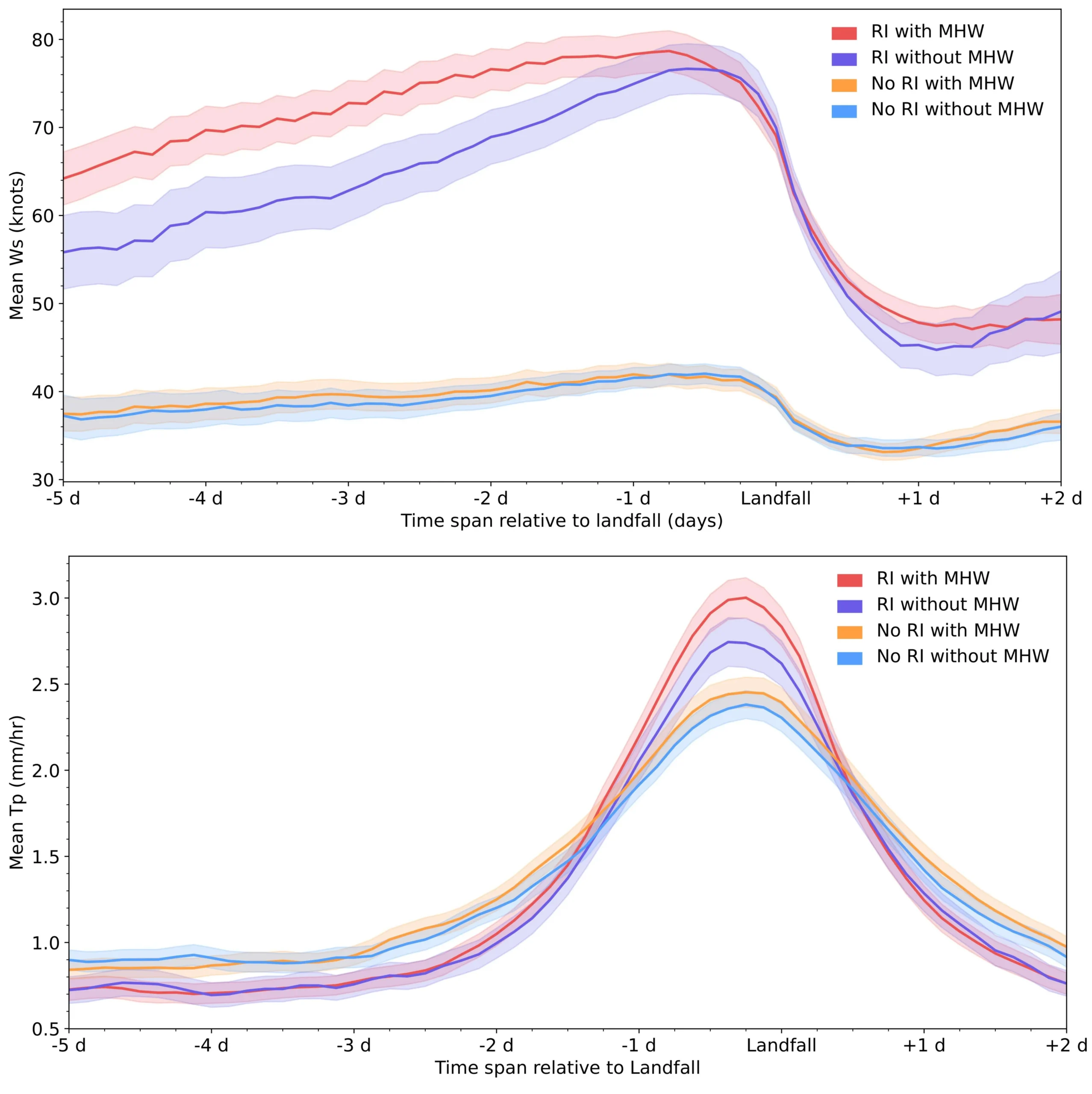
For example, tropical cyclones that do not experience rapid intensification have, on average, maximum wind speeds of around 40 knots (74km/hr), whereas storms that rapidly intensify have an average maximum wind speed of nearly 80 knots (148km/hr).
Of the rapidly intensifying storms, those that are influenced by marine heatwaves maintain higher wind speeds during the days leading up to landfall.
Although the wind speeds are very similar between the two groups once the storms make landfall, the pre-landfall difference still has an impact on a storm’s destructiveness, says Dr Soheil Radfar, a hurricane-hazard modeller at Princeton University. Radfar, who is the lead author of the new study, tells Carbon Brief:
“Hurricane damage starts days before the landfall…Four or five days before a hurricane making landfall, we expect to have high wind speeds and, because of that high wind speed, we expect to have storm surges that impact coastal communities.”
They also find that rapidly intensifying storms have higher peak rainfall than non-rapidly intensifying storms, with marine heatwave-influenced, rapidly intensifying storms exhibiting the highest average rainfall at landfall.
The charts below show the mean sustained wind speed in knots (top) and the mean rainfall in millimetres per hour (bottom) for the tropical cyclones analysed in the study in the five days leading up to and two days following a storm making landfall.
The four lines show storms that: rapidly intensified with the influence of marine heatwaves (red); those that rapidly intensified without marine heatwaves (purple); those that experienced marine heatwaves, but did not rapidly intensify (orange); and those that neither rapidly intensified nor experienced a marine heatwave (blue).
Dr Daneeja Mawren, an ocean and climate consultant at the Mauritius-based Mascarene Environmental Consulting who was not involved in the study, tells Carbon Brief that the new study “helps clarify how marine heatwaves amplify storm characteristics”, such as stronger winds and heavier rainfall. She notes that this “has not been done on a global scale before”.
However, Mawren adds that other factors not considered in the analysis can “make a huge difference” in the rapid intensification of tropical cyclones, including subsurface marine heatwaves and eddies – circular, spinning ocean currents that can trap warm water.
Dr Jonathan Lin, an atmospheric scientist at Cornell University who was also not involved in the study, tells Carbon Brief that, while the intensification found by the study “makes physical sense”, it is inherently limited by the relatively small number of storms that occur. He adds:
“There’s not that many storms, to tease out the physical mechanisms and observational data. So being able to reproduce this kind of work in a physical model would be really important.”
Economic costs
Storm intensity is not the only factor that determines how destructive a given cyclone can be – the economic damages also depend strongly on the population density and the amount of infrastructure development where a storm hits. The study explains:
“A high storm surge in a sparsely populated area may cause less economic damage than a smaller surge in a densely populated, economically important region.”
To account for the differences in development, the researchers use a type of data called “built-up volume”, from the Global Human Settlement Layer. Built-up volume is a quantity derived from satellite data and other high-resolution imagery that combines measurements of building area and average building height in a given area. This can be used as a proxy for the level of development, the authors explain.
By comparing different cyclones that impacted areas with similar built-up volumes, the researchers can analyse how rapid intensification and marine heatwaves contribute to the overall economic damages of a storm.
They find that, even when controlling for levels of coastal development, storms that pass through a marine heatwave during their rapid intensification cause 93% higher economic damages than storms that do not.
They identify 71 marine heatwave-influenced storms that cause more than $1bn (inflation-adjusted across the dataset) in damages, compared to 45 storms that cause those levels of damage without the influence of marine heatwaves.
This quantification of the cyclones’ economic impact is one of the study’s most “important contributions”, says Mawren.
The authors also note that the continued development in coastal regions may increase the likelihood of tropical cyclone damages over time.
Towards forecasting
The study notes that the increased damages caused by marine heatwave-influenced tropical cyclones, along with the projected increases in marine heatwaves, means such storms “should be given greater consideration” in planning for future climate change.
For Radfar and Moftakhari, the new study emphasises the importance of understanding the interactions between extreme events, such as tropical cyclones and marine heatwaves.
Moftakhari notes that extreme events in the future are expected to become both more intense and more complex. This becomes a problem for climate resilience because “we basically design in the future based on what we’ve observed in the past”, he says. This may lead to underestimating potential hazards, he adds.
Mawren agrees, telling Carbon Brief that, in order to “fully capture the intensification potential”, future forecasts and risk assessments must account for marine heatwaves and other ocean phenomena, such as subsurface heat.
Lin adds that the actions needed to reduce storm damages “take on the order of decades to do right”. He tells Carbon Brief:
“All these [planning] decisions have to come by understanding the future uncertainty and so this research is a step forward in understanding how we can better refine our predictions of what might happen in the future.”


The post Marine heatwaves ‘nearly double’ the economic damage caused by tropical cyclones appeared first on Carbon Brief.
Marine heatwaves ‘nearly double’ the economic damage caused by tropical cyclones
Rising temperatures and overfishing have seen the U.K.’s iconic cod decline for over a decade. Now, consumers are warned to “completely avoid” eating the fish.
The days of Britain’s fish and chip shops might be numbered.
Climate Change
DeBriefed 10 April 2026: Worst energy crisis ‘ever’ | India withdraws COP33 bid | Drag artists and climate change
Welcome to Carbon Brief’s DeBriefed.
An essential guide to the week’s key developments relating to climate change.
This week
Ceasefire causes oil price drop
CEASEFIRE SLUMP: Following the announcement on Tuesday of a two-week ceasefire agreement between Iran and the US and Israel, oil prices dropped below $96 per barrel, according to the Associated Press. However, price volatility resumed when a Saudi Arabian oil pipeline was hit just hours later, according to Reuters.
CRISIS COMBINED: Reuters and other outlets covered comments made by the International Energy Agency’s Fatih Birol to Le Figaro, where he said that the current energy crisis is worse than those of “1973, 1979 and 2022 combined”. It added that Birol said the “world has never experienced a disruption to energy supply of such magnitude”.
POLLUTERS PROFIT: The Guardian covered how the “worst polluters hold [the] world’s future in their hands as they benefit from higher fossil fuel prices”, but it added “global trends favour renewables”. The South China Morning Post reported that, according to experts, the diversification of energy sources is set to accelerate as the war continues to disrupt the world’s energy supplies.
Around the world
- CLIMATE GOALS PERIL: The UK opening new oil and gas fields in the North Sea “would imperil” international climate goals, experts told the Guardian. The warning came as the government pushed back against the speculation that it is set to approve new drilling projects, according to Sky News.
- COP33 CHANGES: The Indian government has withdrawn its offer to host the COP33 climate summit, “following a review of its commitments for the year 2028”, reported Climate Home News.
- ‘LONG-LASTING’ SHOCK: The Financial Times covered comments by EU energy commissioner Dan Jørgensen that the bloc was bracing for a “long-lasting” energy shock from the Iran war. Reuters reported that five EU countries have called for a windfall tax on energy companies’ profits in response to rising fuel prices.
- US BUDGET CUTS: US president Donald Trump’s 2027 budget proposal included targeting the “green new scam” with substantial cuts to energy and environment programmes, according to the Los Angeles Times.
- AFGHAN FLOODS: Since 26 March, at least 148 people have died and 216 have been injured due to heavy rains, floods, earthquakes and landslides in Afghanistan, reported Reuters.
- PENGUINS ENDANGERED: The “mass drowning” of emperor penguin chicks as sea ice melts due to climate change has led the International Union for Conservation of Nature to declare the species officially in danger of extinction, according to the Guardian.
86,120
The record number of battery electric vehicle sales registered in the UK in March, making up 22.6% of the total car market, according to the Society of Motor Manufacturers and Traders.
Latest climate research
- More than a quarter of the world’s population will face more frequent and severe hot-and-dry extreme events by 2100 under current climate policies | Geophysical Research Letters
- Climate change will increase wildfire exposure for nearly 10,000 species by the end of the century | Nature Climate Change
- A variety of climate hazards critically expose up to 30% of southern Africa to “environmental degradation” | PLOS One
(For more, see Carbon Brief’s in-depth daily summaries of the top climate news stories on Tuesday, Wednesday, Thursday and Friday.)
Captured
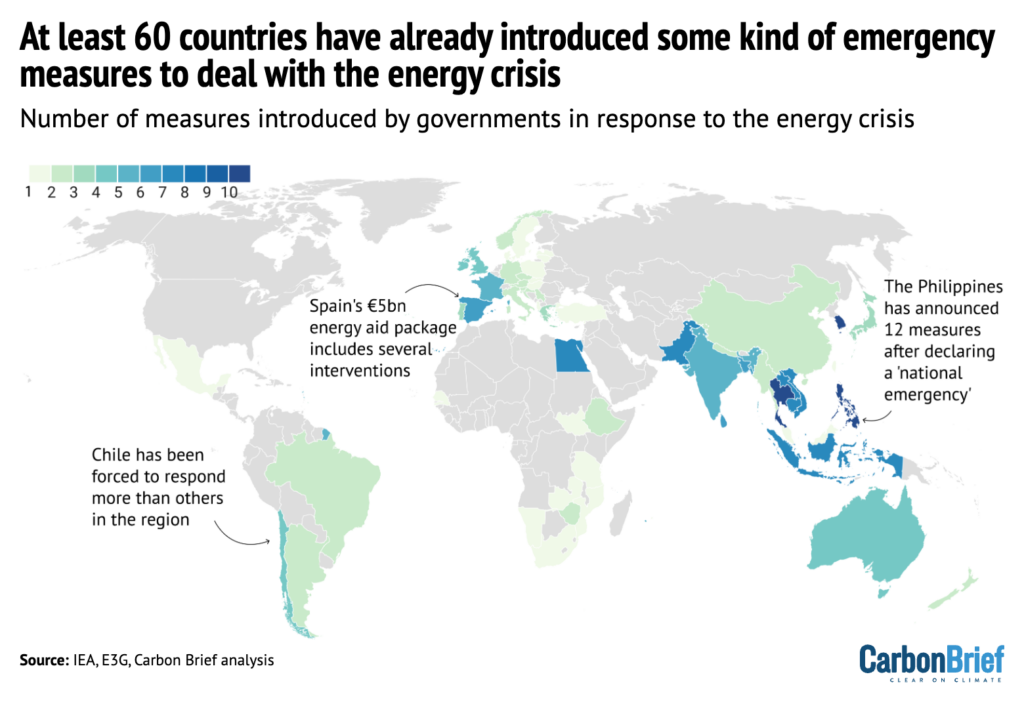
Carbon Brief analysis found that, since the beginning of the Iran war in late February, at least 60 countries have announced nearly 200 emergency energy-saving measures. Around 30 nations, from Norway to Zambia, have cut fuel taxes to help people struggling with rising costs, making this by far the most common domestic policy response to the crisis, said the analysis. Some countries have stressed the need to boost domestic renewable-energy construction, while others – including Japan, Italy and South Korea – have opted to lean more on coal, at least in the short term.
Spotlight
How drag is tackling climate change
This week, Carbon Brief looks at how some drag artists are using their performances to draw attention to climate change
Back in 2005, veteran climate journalist Bill McKibben wrote that “what the warming world needs now is art, sweet art” to help “build a general consciousness about climate change”.
Since then, the topic of climate change has spread to a host of art forms, from literature and music through to comedy and film.
One of the most recent art forms to take up the climate communication baton is drag, with performers using it as a “Trojan horse” to engage with audiences, according to Cheddar Gorgeous, a British drag performer.
‘Joy inspires momentum’
Drag artists around the world have begun to draw attention to the climate movement, using creativity, entertainment and their platforms to engage with their audiences.
In the UK, Cheddar Gorgeous declined a nomination for the British LGBT Awards due to its sponsorship by Shell and has made repeated calls for climate action.
Speaking on the “climate quickie” TEDx podcast, she argued:
“Drag can disrupt the master narratives that dictate our society. I love drag that makes you look at yourself and look at the world in a different way. And that can be deployed in all sorts of exciting ways.”
Drag has a proud history of disruption. As part of a TED talk titled, “Why joy is a serious way to take action”, US drag queen Pattie Gonia provided the audience with some “herstory” about the role of drag within protests. She said:
“Since the birth of the queer rights movement, drag performers and trans people have always been on the forefront of organising and protesting and community building.
“When we had the statistics and the facts on the millions of queer people dying of AIDS, yet no one was joining our fight, drag performers turned pain into joy and, in doing so, welcomed millions more people to fight with us.”

Pattie Gonia is arguably the best-known drag artist to engage with climate change. She is currently touring her environmental drag show “SAVE HER!” and has, according to her website, fundraised more than “$4.7m for LGBTQIA+, BIPOC and environmental non-profits”.
A key part of her message is the need for diversity and inclusion within the climate movement, adding that “our creativity is critical in this climate dilemma”. In her TED talk, she added:
“The problem in the climate movement isn’t just the abundance of carbon; it is the lack of joy. The scientific facts, the doom and gloom, they scare people, they wake them up. But joy is what will get people out of bed every day to take more action.”
Alongside Pattie Gonia, climate conversations are filtering into the wider drag movement, including being a topic repeatedly touched on in the highly successful TV drag contest, RuPaul’s Drag Race.
This ranges from drag artist Asia O’Hara explaining what global warming is in season 10 – telling her fellow contestants: “Bitch, the ice is melting!” – to queens dancing to “97% of scientists and four out of four Drag Race judges agree” that climate change “is real” during a challenge in season 11. (Drag Race host RuPaul Andre Charles has faced criticism for reportedly allowing fracking on his Wyoming ranch.)
Drag is opening up the climate movement to a wider audience, promoting diversity, inclusion and creativity in the space, according to its advocates. For Pattie Gonia, a key part of climate action has to be joy, she added:
“Joy provides an unbelievable opportunity to make the climate movement irresistible. Do not underestimate the power of joy. We deserve more than doom and gloom, because this is the only planet with a Beyoncé on it.”
Watch, read, listen
COOPERATION OVER CHAOS: In the Indian Express, Simon Stiell, the executive secretary of UN Climate Change, argued that “climate cooperation offers a way out of energy price chaos”.
ELECTRIC WORLD ORDER: On the Polycrisis podcast, Mark Blyth, a professor of international economics at Brown University, and Dr Naa Adjekai Adjei, a non-resident fellow, Africa, at the China Global South Project, discussed “what the US dollar has to do” with energy access in Africa.
‘THE RECKONING’: In the Equator, Mona Ali, associate professor of economics at the State University of New York, explored the closure of the Strait of Hormuz and the “end of American hegemony”.
Coming up
- 12 April: Hungarian elections
- 12 April: Peruvian elections
- 13-18 April: World Bank and International Monetary Fund Spring Meetings, Washington, DC, US
- 14 April: IEA Oil Market Report launch
Pick of the jobs
- Global Witness, several climate change jobs | Salary: Varied. Location: London
- London School of Economics, policy fellow – climate, gender and inclusivity | Salary: £53,949-£62,160. Location: London
- Climate Group, senior manager, international policy and advocacy | Salary: £47,160-£49,930. Location: London
- WWF, Nedbank green trust manager | Salary: Unknown. Location: Cape Town or Johannesburg, South Africa
- Greenpeace Australia Pacific, creative producer | Salary: AU$101,272. Location: Australia
- The Fairness Project, climate policy researcher | Salary: $96,000. Location: Remote (US)
DeBriefed is edited by Daisy Dunne. Please send any tips or feedback to debriefed@carbonbrief.org.
This is an online version of Carbon Brief’s weekly DeBriefed email newsletter. Subscribe for free here.


The post DeBriefed 10 April 2026: Worst energy crisis ‘ever’ | India withdraws COP33 bid | Drag artists and climate change appeared first on Carbon Brief.


-
Climate Change8 months ago
Guest post: Why China is still building new coal – and when it might stop
-
Greenhouse Gases8 months ago
Guest post: Why China is still building new coal – and when it might stop
-

 Greenhouse Gases2 years ago
嘉宾来稿:满足中国增长的用电需求 光伏加储能“比新建煤电更实惠”
-
Climate Change2 years ago
Bill Discounting Climate Change in Florida’s Energy Policy Awaits DeSantis’ Approval
-

 Climate Change2 years ago
嘉宾来稿:满足中国增长的用电需求 光伏加储能“比新建煤电更实惠”
-
Climate Change Videos2 years ago
The toxic gas flares fuelling Nigeria’s climate change – BBC News
-

 Renewable Energy6 months ago
Sending Progressive Philanthropist George Soros to Prison?
-

 Carbon Footprint2 years ago
US SEC’s Climate Disclosure Rules Spur Renewed Interest in Carbon Credits