

Welcome to Carbon Brief’s DeBriefed.
An essential guide to the week’s key developments relating to climate change.
This week
EU easing up
HITTING THE BREAKS: The EU “walked back” its target to ban the sale of petrol and diesel cars by 2035, “permitting some new combustion engine cars”, reported Agence-France Presse. Under the original plan, the bloc would have had to cut emissions entirely by 2035 on new vehicles, but will now only have to cut emissions by 90% by that date, compared to 2021 levels. However, according to the Financial Times, some car manufacturers have “soured” on the reversal.
ADJUSTING CBAM: Meanwhile, the Financial Times reported that the EU is making plans to “close loopholes” in the bloc’s carbon border adjustment mechanism (CBAM) before it goes into effect in January. CBAM is set to be the world’s first carbon border tax and has drawn ire from key trading partners. The EU has also finalised a plan to delay its anti-deforestation legislation for another year, according to Carbon Pulse.
Around the world
- NCAR NO MORE: The Trump administration is moving to “dismantle” the National Center for Atmospheric Research in Colorado, said USA Today, describing it as “one of the world’s leading climate research labs”.
- DEADLY FLOODS: The deadliest flash flooding in Morocco in a decade killed “at least” 37 people, while residents accused the government of “ignoring known flood risks and failing to maintain basic infrastructure”, reported Radio France Internationale.
- FAILING GRADE: The past year was the “warmest and wettest” ever recorded in the Arctic, with implications for “global sea level rise, weather patterns and commercial fisheries”, according to the US National Oceanic and Atmospheric Administration’s 2025 Arctic report card, covered by NPR.
- POWER TO THE PEOPLE: Reuters reported that Kenya signed a $311m agreement with an African infrastructure fund and India’s Power Grid Corporation for the “construction of two high-voltage electricity transmission lines” that could provide power for millions of people.
- BP’S NEW EXEC: BP has appointed Woodside Energy Group’s Meg O’Neill as its new chief executive amid a “renewed push to…double down on oil and gas after retreating from an ambitious renewables strategy”, said Reuters.
29
The number of consecutive years in which the Greenland ice sheet has experienced “continuous annual ice loss”, according to a Carbon Brief guest post.
Latest climate research
- Up to 4,000 glaciers could “disappear” per year during “peak glacier extinction”, projected to occur sometime between 2041 and 2055 | Nature Climate Change
- The rate of sea level rise across the coastal US doubled over the past century | AGU Advances
- Repression and criminalisation of climate and environmentally focused protests are a “global phenomena”, according to an analysis of 14 countries | Environmental Politics
(For more, see Carbon Brief’s in-depth daily summaries of the top climate news stories on Monday, Tuesday, Wednesday, Thursday and Friday.)
Captured
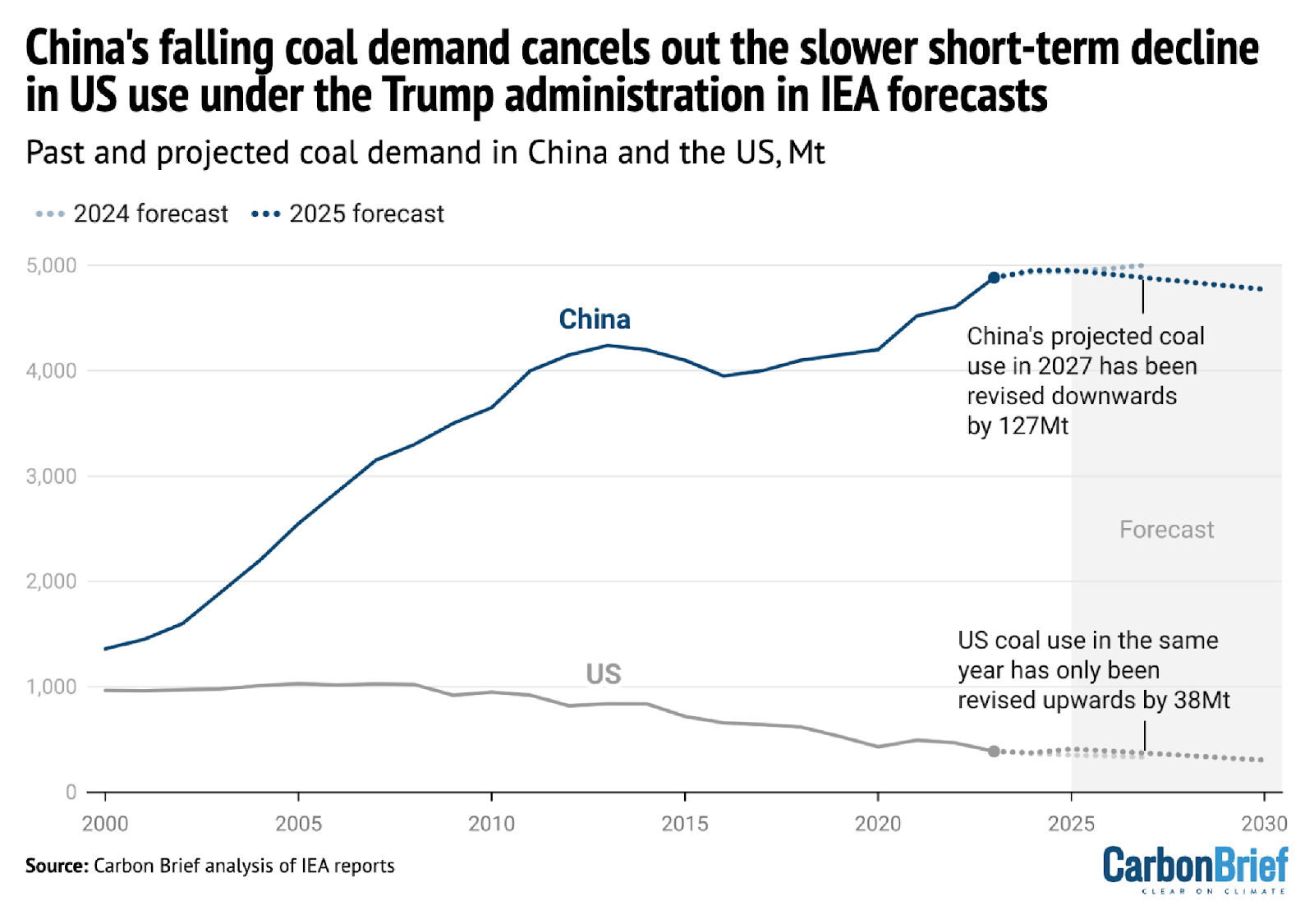
The latest coal market report from the International Energy Agency said that global coal use will reach record levels in 2025, but will decline by the end of the decade. Carbon Brief analysis of the report found that projected coal use in China for 2027 has been revised downwards by 127m tonnes, compared to the projection from the 2024 report – “more than cancelling out the effects of the Trump administration’s coal-friendly policies in the US”.
Spotlight
What climate scientists are curious about
This week, Carbon Brief spoke to climate scientists attending the annual meeting of the American Geophysical Union in New Orleans, Louisiana, about the most interesting research papers they read this year.
Their answers have been lightly edited for length and clarity.
Dr Christopher Callahan, assistant professor at Indiana University Bloomington
The most interesting research paper I read was a simple thought experiment asking when we would have known humans were changing the climate if we had always had perfect observations. The authors show that we could have detected a human influence on the climate as early as the 1880s, since we have a strong physical understanding of how those changes should look. This paper both highlights that we have been discernibly changing the climate for centuries and emphasises the importance of the modern climate observing network – a network that is currently threatened by budget cuts and staff shortages.
Prof Lucy Hutyra, distinguished professor at Boston University
The most interesting paper I read was in Nature Climate Change, where the researchers looked at how much mortality was associated with cold weather versus hot weather events and found that many more people died during cold weather events. Then, they estimated how much of a protective factor in the urban heat island is on those winter deaths and suggested that the winter benefits exceed the summer risks of mitigating extreme heat, so perhaps we shouldn’t mitigate extreme heat in cities.
This paper got me in a tizzy…It spurred an exciting new line of research. We’ll be publishing a response to this paper in 2026. I’m not sure their conclusion was correct, but it raised really excellent questions.
Dr Kristina Dahl, vice president for science at Climate Central
This year was when we saw source attribution studies, such as Chris Callahan‘s, really start to break through and be able to connect the emissions of specific emitters…to the impact of those emissions through heat or some other sort of damage function. [This] is really game-changing.
What [Callahan’s] paper showed is that the emissions of individual companies have an impact on extreme heat, which then has an impact on the GDP of the countries experiencing that extreme heat. And so, for the first time, you can really say: “Company X caused this condition which then led to this economic damage.”
Dr Antonia Hadjimichael, assistant professor at Pennsylvania State University
It was about interdisciplinary work – not that anything in it is ground-shakingly new, but it was a good conversation around interdisciplinary teams and what makes them work and what doesn’t make them work. And what I really liked about it is that they really emphasise the role of a connector – the scientist that navigates this space in between and makes sure that the things kind of glue together…The reason I really like this paper is that we don’t value those scientists in academia, in traditional metrics that we have.
Dr Santiago Botía, researcher at Max Planck Institute for Biogeochemistry
The most interesting paper I’ve read this year was about how soil fertility and water table depth control the response to drought in the Amazon. They found very nicely how the proximity to soil water controls the anomalies in gross primary productivity in the Amazon. And, with that methodology, they could explain the response of recent droughts and the “greening” of the forest during drought, which is kind of a counterintuitive [phenomenon], but it was very interesting.
Dr Gregory Johnson, affiliate professor at the University of Washington
This article explores the response of a fairly coarse spatial resolution climate model…to a scenario in which atmospheric CO2 is increased at 1% a year to doubling and then CO2 is more gradually removed from the atmosphere…[It finds] a large release of heat from the Southern Ocean, with substantial regional – and even global – climate impacts. I find this work interesting because it reminds us of the important – and potentially nonlinear – roles that changing ocean circulation and water properties play in modulating our climate.
Cecilia Keating also contributed to this spotlight.
Watch, read, listen
METHANE MATTERS: In the Guardian, Barbados prime minister Mia Mottley wrote that the world must “urgently target methane” to avoid the worst impacts of climate change.
CLIMATE WRAPPED: Grist summarised the major stories for Earth’s climate in 2025 – “the good, the bad and the ugly”.
COASTING: On the Coastal Call podcast, a biogeochemist spoke about “coastal change and community resilience” in the eastern US’s Long Island Sound.
Coming up
- 27 December: Cote D’Ivoire parliamentary elections
- 28 December: Central African Republic presidential and parliamentary elections
- 28 December: Guinean presidential election
Pick of the jobs
- BirdLife International, forest programme administrator | Salary: £28,000-£30,000. Location: Cambridge, UK
- World Resources Institute, power-sector transition senior manager | Salary: $116,000-$139,000. Location: Washington DC
- Fauna & Flora, operations lead for Liberia | Salary: $61,910. Location: Monrovia, Liberia
DeBriefed is edited by Daisy Dunne. Please send any tips or feedback to debriefed@carbonbrief.org.
This is an online version of Carbon Brief’s weekly DeBriefed email newsletter. Subscribe for free here.


The post DeBriefed 19 December 2025: EU’s petrol car U-turn; Trump to axe ‘leading’ research lab; What climate scientists are reading appeared first on Carbon Brief.

Forty-six countries, including major oil, coal and gas producers such as Canada, Australia, Brazil and Norway, have confirmed they will attend next month’s first conference on speeding up the global shift from fossil fuels, the Colombian government said on Tuesday.
The summit, being held in the Colombian port city of Santa Marta from April 24-29, aims to cement an international coalition of nations committed to ending the world’s reliance on planet-heating oil, coal and natural gas.
The conference represents an “unprecedented opportunity” for the energy transition as it brings hydrocarbon-producing nations together with fossil fuel consumers and countries at the forefront of the climate crisis, Colombia’s acting environment minister, Irene Vélez Torres, said in a statement.
“Despite our differences, all participants agree on the need to prioritize science and to move forward, urgently and in a coordinated manner, toward phasing out the production and consumption of natural gas, coal, and oil,” she added.
-
Iran war could boost fossil fuel phase-out push, says Colombian minister
Colombia’s environment minister Irene Vélez Torres said she hopes that a new fossil fuel phase out summit in Santa Marta can cement a coalition of countries -
Pressure builds for fossil fuel transition plan at COP30
More than 80 countries issue a call for the summit outcome to include a commitment to develop a roadmap for the world to shift away from oil, gas and coal -
Colombia aims to launch fossil fuel transition platform at first global conference
The landmark summit aims to build the political and economic foundations to fast-track the shift away from coal, oil and gas, one of its organisers said


Who is going to Santa Marta?
Canada is the largest fossil fuel producer confirmed to attend. The country accounts for roughly 6% of global oil output and 5% of gas production, with both sectors expanding over the past decade, according to the Energy Institute.
Its powerful fossil fuel industry continues to push for increased production and new export markets, particularly in Asia. However, further investment risks creating stranded assets, according to a recent report by Carbon Tracker. Canada’s latest national climate plan did not include any concrete measures to curb its fossil fuel production.
Australia will also be represented in Santa Marta as co-host of the COP31 climate summit. One of the world’s largest exporters of coal and liquefied natural gas, Australia supplies energy-hungry markets across Asia. The centre-left government led by Anthony Albanese has approved 36 new or extended fossil fuel projects since taking office in 2022, according to the Climate Council.
Fellow COP31 co-host Turkey is also set to attend. Despite growing investment in renewables, the country remains heavily reliant on coal power. Murat Kurum, the incoming COP31 president, said last month that emissions cuts should not come at the expense of economic growth. “We cannot simplify things down to only fossil fuels,” he said.
Norway, another participant, has built its wealth on oil and gas exports and has become a key supplier to Europe following Russia’s invasion of Ukraine. While positioning itself as a climate leader, Norway argues its relatively low-emissions production can help meet demand during the transition, a stance critics say undermines global efforts to phase out fossil fuels.
The list of participants also includes Brazil and Mexico, both among the world’s top oil producers; Angola, one of Africa’s leading oil exporters; Senegal, which only began producing oil two years ago; and Trinidad and Tobago, where hydrocarbons generate around half of government revenue. Vietnam remains heavily dependent on coal for power generation but is working with wealthy nations to accelerate a shift to renewables.
Notably absent are the world’s largest fossil fuel producers and consumers, including the United States, Saudi Arabia and Russia, which together account for nearly half of global oil production. The biggest coal producers, China and India, are also not on the current list of participants.
Attendees also include nations that are highly vulnerable to the climate crisis primarily caused by burning fossil fuels, including island nations Palau, Fiji and Vanuatu, and Sierra Leone.
More momentum than commitments
The Santa Marta conference is expected to deliver political momentum rather than binding commitments, with organisers aiming to launch a “coalition of the willing” to advance a fossil fuel phase-out outside the constraints of UN consensus negotiations.
The outcomes of the summit are also expected to inform discussions at COP31, where an informal roadmap to transition away from fossil fuels drafted by the Brazilian COP30 team is expected to be delivered.
Ugandan farmers use British court to try to stop East Africa oil pipeline
Andreas Sieber, head of political strategy at campaign group 350.org, told Climate Home News that “starting with a coalition of doers creates momentum”.
“This also comes at a critical point in time, when ordinary people bear the cost of fossil fuel volatility and geopolitical shocks,” he added. “These countries can demonstrate what credible transition looks like and compel others to follow”.
Colombia’s Vélez Torres said last week that the global energy shock triggered by the U.S.-Israeli war on Iran could give countries the chance to build a “new geopolitical balance” by boosting the transition away from fossil fuels.
The post Major oil producers among 46 nations joining fossil fuel phase-out summit appeared first on Climate Home News.
Major oil producers among 46 nations joining fossil fuel phase-out summit
CANBERRA, Tuesday 31 March 2026 — Greenpeace Australia Pacific has welcomed the Parliament’s ratification of the Global Ocean Treaty, creating the opportunity for world-first high seas ocean sanctuaries.
Environment Minister Murray Watt today announced the treaty, the most significant global nature protection agreement in a decade, will be ratified by the Australian parliament. The bill has now passed the Senate and House of Representatives with support from the major parties, clearing the final hurdle towards ratification.
David Ritter, CEO at Greenpeace Australia Pacific, said: “Ratifying the Global Ocean Treaty is genuinely historic. At a time of unprecedented pressure from destructive industrial fishing, severe climate impacts, plastic pollution and mining, Australia has chosen to join the global effort to protect our magnificent oceans.”
Australia was one of the first countries to sign its intent to ratify the treaty in 2023, and we have a long and distinguished history of leadership on global ocean protection. Under the new treaty Australia has the necessary legal tools to drive the creation of high seas ocean sanctuaries.
“The Global Ocean Treaty is the most significant global nature agreement for many years, and has the power to protect the world’s high seas and safeguard precious and endangered wildlife,” Ritter added.
“With the Treaty now in force, Australia has an important opportunity to drive the creation of ocean sanctuaries on the high seas that are fully protected, no-take zones, which will allow wildlife populations to recover and thrive.
“We thrill at the whales and albatross, and all of the animals of the deep wild oceans, great and small–and now the world has the legal ability to protect them by creating high seas sanctuaries; massive parks at sea where nature can thrive.
“We are an island nation of ocean lovers, and all Australians are entitled to expect that our government will take this incredible new opportunity to protect the ocean.”
Greenpeace is calling on the Australian government to build on our national legacy by ensuring that this landmark agreement delivers lasting protection for our precious oceans.
“We’re calling on Minister Watt to create five high seas sanctuaries in our region, starting with a large ocean sanctuary in the Tasman Sea, between Australia and Aotearoa-New Zealand.”
Currently, less than 1 per cent of the global ocean is highly or fully protected. Closing the High Seas protection gap from under 1 per cent to 30 per cent in four years, to meet the globally-agreed 30×30 target, will require governments to protect ocean areas larger than entire continents and to do so faster than any conservation effort in history. Australia will now have a seat at the table for the very first Oceans COP, due before February 2027, where nations will discuss the design and implementation of the treaty.
—ENDS—
For more information or to arrange an interview, please contact Vai Shah on +61 452 290 082 or vai.shah@greenpeace.org
High res images and footage of Australia’s oceans can be found here
Ocean Treaty passes Australian Parliament, a “historic moment” for nature protection
Climate Change
Looking to Jesus and Buddha, a Kentucky Passionist Priest Finds Hope Amid an Enveloping Global Environmental Crisis
Father Joe Mitchell works to create a “new story” that recognizes the interconnectedness of people and nature.
LOUISVILLE, Ky.—Father Joe Mitchell, a Passionist priest, returned home here in 2004 to create a nonprofit center that focuses on what he saw as two major disconnects.



-
Climate Change8 months ago
Guest post: Why China is still building new coal – and when it might stop
-
Greenhouse Gases8 months ago
Guest post: Why China is still building new coal – and when it might stop
-

 Greenhouse Gases2 years ago
嘉宾来稿:满足中国增长的用电需求 光伏加储能“比新建煤电更实惠”
-
Climate Change2 years ago
Bill Discounting Climate Change in Florida’s Energy Policy Awaits DeSantis’ Approval
-

 Climate Change2 years ago
嘉宾来稿:满足中国增长的用电需求 光伏加储能“比新建煤电更实惠”
-
Climate Change Videos2 years ago
The toxic gas flares fuelling Nigeria’s climate change – BBC News
-

 Renewable Energy5 months ago
Sending Progressive Philanthropist George Soros to Prison?
-

 Carbon Footprint2 years ago
US SEC’s Climate Disclosure Rules Spur Renewed Interest in Carbon Credits