

Welcome to Carbon Brief’s DeBriefed.
An essential guide to the week’s key developments relating to climate change.
This week
US targets Chinese clean tech
100% TARIFFS: US president Joe Biden on Tuesday announced tariffs on “$18bn” in Chinese clean technologies and critical minerals, Reuters reported. According to the newswire, tariffs on Chinese electric vehicles (EVs) will quadruple to 100% (plus a separate 2.5% tariff), while solar cell tariffs will double to 50%, lithium-ion EV battery tariffs will increase from 7.5% to 25% and tariffs on critical minerals rise from nothing to 25% this year.
SOLAR PANELS: On Friday, the Biden administration announced further tariffs on double-sided solar panel imports, which largely come from southeast Asia, the Financial Times reported. Economist Joe Brusuelas told CNN that the changes “foreshadow what is going to be a long, cold winter of economic conflict between the US and China”.
CALL AND RESPONSE: In the New York Times, economist Paul Krugman said the tariffs were all about “political economy”. He explained: “If those subsidies [under Biden’s Inflation Reduction Act] are seen as creating jobs in China instead, our last, best hope of avoiding climate catastrophe will be lost.” State-run newspaper China Daily quoted foreign ministry spokesperson Wang Wenbin saying that the US is “making double standards by justifying its own subsidies and exports, while accusing other countries’ subsidies and exports as ‘unfair’ and ‘overcapacity’”.
Afghanistan flooding
‘CATASTROPHIC’ FLOODING: Flash flooding hit Baghlan province in north Afghanistan last Friday, leaving more than 300 people dead and villages cut off, Fox Weather reported. The outlet said that the flooding washed away “vast landscapes” of communities and farms. It added that the World Health Organization described the floods as “catastrophic” and stated the country “lacks the necessary resources to manage a disaster of this magnitude”, including health facilities, especially as waterborne diseases emerge.
AID CALL: A survivor of the floods in a district of Baghlan told Xinhua that victims fled to the mountain in search of refuge and scores of them are still stranded in the hilltops. The newswire spoke to another survivor who said: “No one has assisted us, the women are living in the open ground, there is no tent and no one has provided assistance.
Around the world
- WEAKENING UK TARGETS?: Ministers are “considering” weakening the UK’s emissions targets by carrying over the “unused” portion of the last carbon budget to the next period, the Guardian reported. A decision is due this month.
- VATICAN CLIMATE SUMMIT: Experts and leaders from the Americas, Asia and Africa met at a Vatican summit on how to “effectively manage” climate change and boost climate resilience from 15-17 May, Vatican News reported. The summit is expected to deliver a “Planetary Climate Resilience protocol”, which will be submitted to the UN climate change body.
- AFRICAN CLEAN COOKING: Carbon Brief covered a summit held in Paris which saw leaders pledge $2.2bn to help to achieve universal clean cooking access by 2030, examining what this could mean for climate, energy, nature and gender goals.
- BRAZIL CLIMATE REFUGEES: Nearly 80,000 people remain in shelters in Rio Grande do Sul, following flooding in the Brazilian state, according to El País. The outlet noted that people are in a “dramatic and uncertain situation as rains persist and water rises again”.
- ‘HISTORIC’ TREATY: Le Monde reported that Australia and Tuvalu have agreed on a “historic” treaty to welcome climate refugees from Tuvalu, an island in the South Pacific threatened by rising sea levels. The treaty will come into force by the end of the year.
- ‘GREEN’ MINING: At a press briefing attended by Carbon Brief, Indigenous leaders called for an upcoming OECD forum on responsible mineral supply chains to consider their rights to consent on mining projects.
€48 billion
The amount spent each year by the EU on nature-harming activities, according to a new report covered by Carbon Brief.
Latest climate research
- New research published in Nature Communications found that chronic exposure of older adults to heat is projected to double in “all warming scenarios” by mid-century, with Asia and Africa being the most affected continents.
- Global investors and owners, mainly from Europe, were involved in 78% of wind and 96% of solar parks in Brazil from 2000 to 2021. These parks occupy 2,148 and 102 square km, respectively, and could “exacerbate land struggles,” according to a study in Nature Sustainability.
- A World Weather Attribution study found that the “deadly heatwaves” that hit Asia throughout April and May this year and brought temperatures above 40C, were more frequent and extreme due to climate change.
(For more, see Carbon Brief’s in-depth daily summaries of the top climate news stories on Monday, Tuesday, Wednesday, Thursday and Friday.)
Captured

The administration of Indian prime minister Narendra Modi has boosted coal mining and coal power since 2014. Carbon Brief published an interactive piece analysing the impact on Indian communities and climate change, as well how this year’s general election could change things. The map above shows that India’s coal reserves are concentrated in seven south-central and eastern states, regions that have significant Indigenous populations. Indigenous peoples and local communities told Carbon Brief that they have been displaced and suffered environmental impacts as a result of coal mining projects.
Spotlight
Intense heatwave hits Mexico
This week, Carbon Brief speaks to experts about why recent heat in Mexico was so deadly.
Mexico recently experienced a heatwave from 3 to 13 May, leaving 14 dead and driving temperatures above 40C in several states, Forbes Mexico reported. The health services in the state of San Luis Potosí, in eastern and central Mexico, reported 10 deaths from heat stroke and other similar deaths in southern and northern states.
Milenio reported that the heatwave also killed birds, such as parrots and toucans, in San Luis Potosí. N+ news added that owls, parrots, stake birds and bats also died because of the heat, and other species, such as squirrels and turkeys, were also affected.
The heatwave is the second major deadly event in Mexico’s heat season, which began in March, Reuters reported.
Mexico is no exception. A recent report by the World Meteorological Organization stated that 2023 was the hottest year in Latin America and the Caribbean, with temperatures 1.39C above the 1961-1990 period.
There were 3,405 heatwave-associated deaths annually in the region between 1990 and 2019, according to a new study published in PLOS Medicine.
Deadly impacts
Dr Lucía Gabriela Rosales, director of public health at the Health Services of San Luis Potosí, told Carbon Brief that this second heatwave was very “atypical” and caused four confirmed deaths from heat stroke – mostly in adults over the age of 60 – as well as cases of dehydration and heat stroke.
Rosales pointed out that there was no specific alert for this heatwave, but there was a warning about the heat season from the Civil Protection authorities.
She added that the health sector has carried out some actions to deal with the high temperatures in the state, such as community campaigns and hydration points. She called on the population to take care of their health.

Dr José Antonio Ávalos, head of the Laboratory of Climate Variability, Remote Sensing and Assessment of Risks at the Autonomous University of San Luis Potosí, told Carbon Brief that May is the hottest month of the year in the state. Since 2023, the country as a whole has been experiencing levels of drought not seen since 1941, he added.
Ávalos pointed out that the authorities were aware of the municipalities most at risk from heatwaves, yet failed to effectively alert the population. He recommended the creation of a heatwave surveillance mechanism, the implementation of heat indices and increased investment in climate science.
The experts explained that heat stroke causes, among other things, body temperature above 42C, headache and tachycardia. Deaths from heat stroke are caused by an increase in the atmospheric temperature and humidity, which prevents the body’s sweat from evaporating, causing it to accumulate heat, they added.
Watch, read, listen
THREATENED PARKS: An Agence France-Presse video looked at how climate change is threatening many features of US national parks.
CHOCOLATE DILEMMA: A National Public Radio podcast explored how climate change is decreasing cocoa production worldwide and what solutions are available.
STELLAR CHANGE: The New York Times covered the challenges climate change poses to astronomers, who are considering “using their expertise” to address it.
Coming up
- 19 May: Dominican Republic presidential election
- 20 May: Fifth phase of India’s general election
- 21 May: International Energy Agency (IEA) ninth annual conference on energy efficiency, Nairobi, Kenya
- 21-24 May: Organisation for Economic Co-operation and Development (OECD) forum on responsible mineral supply chains, Paris, France
- 22 May: Allied for Climate Transformation by 2025 (ACT2025) consortium high-level webinar on unlocking finance for climate-vulnerable nations at COP29 and beyond, virtual
Pick of the jobs
- Global Alliance for the Future of Food, climate and nature director | Salary: $125,000. Location: Global (remote)
- Intergovernmental Panel on Climate Change, climate mitigation staff scientist (working group III) | Salary: $76,848-$130,642. Location: Washington DC (hybrid)
- The Washington Post, climate and environment photo assignment editor | Salary: Unknown. Location: Washington DC
- UK Antarctic Heritage Trust, filmmaker, Antarctica 2024-2025 | Salary: Travel and expenses plus a fee. Location: Cambridge, UK and Blaiklock, Antarctica
DeBriefed is edited by Daisy Dunne. Please send any tips or feedback to debriefed@carbonbrief.org.
This is an online version of Carbon Brief’s weekly DeBriefed email newsletter. Subscribe for free here.


The post DeBriefed 17 May 2024: Biden’s clean-energy tariff blitz; Modi’s coal plans examined; Deadly heat in Mexico appeared first on Carbon Brief.

Three countries have been named by the Paris Agreement’s compliance committee for failing to submit a nationally determined contribution (NDC) and repeatedly snubbing offers of help with their climate plans.
After months of internal debate over whether to identify serial non-responders, the Paris Agreement’s Implementation and Compliance Committee (PAICC) named the three countries which have failed to engage with it over their NDCs on Friday.
It named Democratic Republic of Congo, Senegal and North Korea in a footnote of its annual report, adding that it decided to name them “with a view to facilitating engagement”, adding that representatives of the three nations had been invited to its meeting in early 2027 “with the purpose of identifying any challenges and constraints”.
“The Committee noted the importance of Parties engaging with the Committee in a timely manner, while noting that some delays may be due to the national capabilities and circumstances of the Parties”, the report said.
-
Under US pressure, World Bank says it will back gas “where appropriate”
The US wants the World Bank to expand its gas support while climate campaigners are pushing for it to end – its head spoke this week of limited backing for the fossil fuel -
IPCC scientists vow to press on with climate reports despite political deadlock
After governments again failed to agree a timeline, nearly 120 IPCC authors pledged to complete their assessment on time and with full scientific rigour -
Paris Agreement committee snubbed over missing NDC climate plans
Many governments have still not submitted a nationally determined contribution to the UN, breaching a key requirement of the Paris Agreement

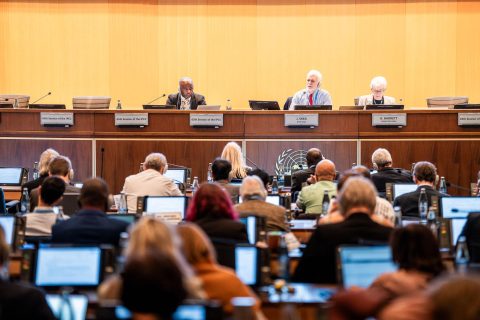

In July, PAICC said 12 countries had ignored its repeated attempts to discuss why they had not published an NDC as required every five years under the 2015 Paris accord.
Members of the committee had been divided over whether to name them, but at a September meeting decided to do so in their annual report to the annual climate COP summit.
By the time the report was published on Friday, only Congo, Senegal and North Korea “had not communicated an NDC or submitted a [Biennial Transparency Report] and had not yet responded to any of the Committee’s notifications, despite several reminders issued by the Committee in this regard”.
Rainforest and renewable energy ambitions
The silence from Congo and Senegal is notable because the former is home to much of the Congo Basin rainforest while the latter has sought billions of dollars in climate finance to support its renewable energy ambitions.
After Brazil, Congo has more rainforest than any country in the world. This forest, and the country’s peatlands, absorb huge amounts of greenhouse gas but are fast being lost to expanding farmland, charcoal production, logging and mining.
Senegal signed a Just Energy Transition Partnership with Canada and wealthy European nations in 2023, to help it meet its renewable energy targets under the-then government of Macky Sall. It was chair of the Least Developed Countries group between January 2022 and December 2023.

Tejas Rao, who is researching the PAICC as part of a doctoral thesis at Cambridge University, said the governments of the three countries should engage with the committee.
“Engagement costs these governments very little and the committee has shown it will listen,” he said.
“Silence leaves the committee with no basis to help, and it leaves the [governments] exposed to the narrative that they are simply disengaged,” he told Climate Home News.
Paris Agreement requirement
The 2015 Paris Agreement requires all parties to publish an NDC every five years outlining their emissions reduction targets, with each plan meant to be more ambitious than the country’s last NDC.
The latest set – the third round of plans, with new targets for 2035 – was due in February 2025. While most countries missed this deadline, all but around 30 – mostly small emitters but including Egypt, Vietnam and Argentina – have now submitted them.
Over the year, the PAICC – which is made up of government climate officials from developed and developing countries – has been communicating with governments that have not submitted NDCs and trying to overcome barriers to them doing so.
Some nations have cited exceptional circumstances as the reason for not submitting an NDC, a process that requires a significant amount of work in tracking emissions and consulting on how to curb them across the economy. For example, a letter from a Sudanese official to the PAICC, seen by Climate Home News, said that the country’s civil war had led to the suspension of its NDC preparation.
-
IPCC scientists vow to press on with climate reports despite political deadlock
After governments again failed to agree a timeline, nearly 120 IPCC authors pledged to complete their assessment on time and with full scientific rigour -
Under US pressure, World Bank says it will back gas “where appropriate”
The US wants the World Bank to expand its gas support while climate campaigners are pushing for it to end – its head spoke this week of limited backing for the fossil fuel -
Who shapes climate science? The equity question facing the IPCC
Early completion of the next global climate science assessment reports risks excluding research from the Global South, which is key to ensuring the findings are fair
The US and