

An ocean of 570,000 solar panels stretches out as far as the eye can see across an arid landscape an hour’s drive from Azerbaijan’s capital Baku. In the sun-baked hills of Garadagh, a country built on oil and gas is taking its first steps towards what it bills as a “green” future.
This is Azerbaijan’s first large-scale solar power plant. It opened last October and the Emirati company developing it, Masdar, says it can power 110,000 homes.
Climate Home visited the solar park as part of a media tour organised and sponsored by the Azerbaijan COP29 Presidency, which is arranging the UN climate summit in Baku this November.
At the park’s opening ceremony, in front of Sultan Al-Jaber – Masdar’s CEO who led the COP28 climate summit in Dubai – Azerbaijan’s President Ilham Aliyev boasted about his country’s determination in “moving towards a green agenda”.
“This is our contribution not only to the future development of Azerbaijan but to the issues related to climate change,” he told the assembled dignitaries.
But despite this rhetoric, climate scientists have questioned Azerbaijan’s climate credentials as it prepares to host the COP29 summit.
An increase in renewable energy production does not mean Azerbaijan is planning to leave its vast oil and gas reserves in the ground. Aliyev said last month that Azerbaijan will try to sell abroad the gas it saves by not using it in power stations at home. Europe is the main target customer, as it shifts away from Russian gas supplies.
In Nagorno-Karabakh, Azerbaijan’s net zero vision clashes with legacy of war
On top of selling its surplus, Azerbaijan is planning to extract more gas thanks, in part, to fresh investments from foreign fossil fuel giants like Britain’s BP, France’s TotalEnergies and Emirati oil giant ADNOC, which Al-Jaber also heads.
Bill Hare, CEO of climate science non-profit group Climate Analytics, called Azerbaijan’s plans “a fantasy”. “Ramping up renewables won’t make a dent in emissions unless they displace fossil fuels in the system,” he told Climate Home. “You can’t tackle climate change without getting rid of fossil fuels.”
A spokesperson for COP29 said gas is “an ideal transition fuel in the production of electricity”. In emailed comments, they added that gas exported to Europe can replace coal power – which currently provides around 15% of the EU’s electricity – in the short to medium-term, thereby reducing greenhouse gas emissions.
Azerbaijan is not alone in pursuing both renewable energy and fossil fuel production. Most fossil fuel producers – including wealthy nations like the US, UK and Canada – have no plans to stop producing oil and gas. That’s despite the International Energy Agency (IEA) warning that new fossil fuel extraction projects are not compatible with limiting global warming to 1.5C.
The COP29 spokesperson said Azerbaijan’s strategy does not contradict IEA scenarios, which do not exclude continued investment in existing oil and gas assets and approved projects.
A fossil fuel economy
Azerbaijan’s fossil fuel industry is steeped in history. As early as the 13th century, Italian explorer Marco Polo wrote of Baku’s “stream of oil in such abundance that a hundred ships may load there at once”.
In the 19th century, Azerbaijan gave birth to modern crude refining, and by the 20th century it accounted for around half of the world’s oil production, helping fuel the Soviet Union’s victory in World War Two.
Oil and gas remain omnipresent today. The Flame Towers, Baku’s iconic skyscrapers, are a symbol of fossil fuel wealth. At night, their facades light up to display flickering flames in a reference to the naturally-occurring fires produced by gas leaks that earned Azerbaijan its name, “The Land of Fire”.
The logo of SOCAR, the state-owned oil and gas firm, emblazons the national football team shirts, while one of the country’s oldest oil fields sits just behind Baku’s Olympic Stadium, the venue for the COP29 climate summit.

Oil fields in the outskirts of Baku, Azerbaijan. Photo: Matteo Civillini
By global standards, Azerbaijan is no longer a major fossil fuel producer, pumping less than 1% of the world’s oil and gas. But its economy remains heavily dependent on the income they generate. Fossil fuels make up over 90% of all exports and 64% of government revenue.
At the Petersberg Climate Dialogue in Berlin last month, Aliyev said that “having oil and gas deposits is not our fault. It’s a gift from God. We must not be judged by that. He added that “our oil and gas will be needed for many more years, including in European markets”.
A shrinking market?
European countries have historically been the main destination market for Azerbaijani oil and gas, and flows have been rising in the wake of Russia’s invasion of Ukraine.
As Europe tried to wean itself off Moscow’s supplies, the European Commission went looking around the world for alternative sources of gas to keep the lights on and curb skyrocketing prices. In Azerbaijan, it struck a new deal to double gas exports by 2027.
Baku is now scrambling to make good on that pact, while using it as a lever to expand its lucrative gas industry. The country could boost its gas production by more than a third over the next decade, according to data analysis by campaigning group Global Witness.
“We are largely investing in increasing our gas production,” said Aliyev in Berlin, “because Europe needs more gas from new sources.”
But energy experts question that reasoning. While looking for new gas supplies in the short term, the war in Ukraine also prompted the EU to fast-track its transition towards renewable sources of energy. Its strategic energy plan, laid out in 2022, would see overall gas demand in the bloc halve by 2030.
“There will be a lot of supply globally and not that much demand on the European side,” said E3G analyst Maria Pastukhova. “Looking at the amounts alone, the EU will not need any additional gas from Azerbaijan if it delivers on its energy transition policies.”
Clean, cheap or fair – which countries should pump the last oil and gas?
But much will also depend on what kind of gas the block will continue to rely on. Norway, Europe’s top supplier, Algeria and Azerbaijan provide it through pipelines, while the United States and Qatar ship liquefied natural gas (LNG) to the continent.
“It’s hard to say at the moment [which supplies will remain],” added Pastukhova. “But it isn’t very likely that Azerbaijan can continue to bank on crazy gas revenues from the EU. We don’t see readiness from European buyers to sign long-term contracts beyond 2035.”
Sell, don’t burn
Meanwhile, Baku also wants to ensure that its gas is channelled towards the lucrative export market not burned at home.
Central to this strategy is the rollout of renewable energy. With strong winds blowing from the Caspian Sea and sun shining for a large part of the year, Azerbaijan boasts significant clean energy prospects.
But that potential has so far been largely untapped. Renewable sources, mainly from three hydro power stations, produced only 7% of Azerbaijan’s electricity in 2023. The government wants to increase that to 30% by 2030.
If that target is met, Aliyev says that solar and wind will pump 5 gigawatts of clean electricity into the national grid, freeing up “at least” 5 billion cubic metres of gas for the European market.
At Masdar’s sprawling solar park in Garadagh, this plan is being rolled out. The park spans the equivalent of 770 football pitches, but was built in just under two years. It cost $262 million, with multilateral development banks stumping up just under half of that.
Speaking to journalists inside the plant’s control room, Kamran Huseynov, deputy director of the Azerbaijan Renewable Energy Agency, said eight more solar and wind projects are being developed for the coming years. “We are quite sure we can reach the target [of 30% renewables capacity] by 2028,” he added.
As in Garadagh, foreign energy companies will be at the helm of those eight projects. Masdar will build two more solar parks and one onshore wind farm. Saudi Arabia’s ACWA Power is erecting a wind farm just north of Baku by the Caspian Sea.
Renewables-processed fossil fuels?
Later this year, BP is expected to start building a solar farm in the district of Jabrayil. This is one of the territories Azerbaijan captured after a long-running dispute with Armenia centred on the Nagorno-Karabakh region.
Baku seized control of these areas in a two-part military offensive that started in 2020 and ended last autumn. As a result, some 136,000 ethnic Armenians who had lived in Nagorno-Karabakh fled in a mass exodus which, according to Armenia and the EU Parliament, amounted to “ethnic cleansing”. Azerbaijan has rejected those accusations.
In Nagorno-Karabakh, Azerbaijan’s net zero vision clashes with legacy of war
The Azeri government is now promoting a green vision for Nagorno-Karabakh which involves the construction of government-branded “net zero” villages. It has also designated the region as a “green energy zone”, aiming to attract investment in renewable energy.
BP was the first major international energy firm to jump at that opportunity. In 2022, the company’s regional president for Azerbaijan, Georgia and Turkey, praised Baku’s efforts to turn Karabakh into “the heart of sustainable development”.
BP wants electricity produced from Jabrayil’s solar power plant to make some of its vast oil and gas operations in Azerbaijan less dirty.
The British energy giant runs the Sangachal terminal, one of the world’s largest oil and gas processing facilities and the starting point for the pipelines transporting gas to Europe. Processing all of this oil and gas requires power, which BP currently gets from burning gas in generators.

The Sangachal oil and gas terminal in Azerbaijan. Photo: Azerbaijan Presidency
According to Elnur Soltanov, Azerbaijan’s deputy energy minister and the COP29 CEO, these are “very inefficient” and produce “some of the dirtiest electricity” in the country. After being electrified, the fossil fuel processing plant will receive the same amount of electricity from the grid as the solar park generates, according to Azernenerji, the country’s grid operator.
The process will also free up “more gas to export to world markets”, BP says.
BP’s project is being developed in partnership with SOCAR, Azerbaijan’s state-owned oil and gas giant. After setting up a “green energy” unit last year, SOCAR says it is working with international companies, like BP, “in order to get the know-how” and “learn in the process” with the goal of transforming into a “comprehensive energy company”.
“Sooner or later, hydrocarbons will slowly die out – not right away,” Teymur Guliyev, deputy vice president for the energy transition at SOCAR, told reporters including Climate Home. “But we have to start our transformation process when we still have plenty of time to plan accordingly, go through trial and error.”
The COP29 spokesperson said Azerbaijan “is making significant progress” towards reducing its greenhouse gas emissions. Currently, Azerbaijan has a goal to reduce emissions 40% by 2050 as outlined in its national climate plan (NDC). It has promised to submit a new NDC that is aligned with limiting global warming to 1.5C, which is due by early 2025.
How to move it
While the current priority for Azerbaijan’s renewables push appears to be maximising its gas exports, the government is also wrangling over how to sell its clean energy to Europe, when gas demand falls.
COP29’s Soltanov told Climate Home and other international journalists that he is “very optimistic” about Azerbaijan’s green transition. “Azerbaijan has been at the forefront of the oil revolution, it has been at the forefront of the gas revolution, and it has all the conditions to be at the forefront of the clean energy revolution as well,” he added.
But the transportation of green electricity remains an obstacle.
The main option being explored is laying an electric cable under the Black Sea, stretching over 1,155 kilometres between Georgia and Romania. Originally the project, under discussion for several years, had the stated intention of linking Georgia to the European transmission network and boosting its energy security.
But it was recently revamped as a possible route to carry Azerbaijan’s clean energy to the European market. In December 2022, the leaders of Azerbaijan, Georgia, Romania and Hungary formed a partnership to push the project forward, indicating it could be completed by 2029 at a cost of €2.3bn ($2.5bn). A two-year long feasibility study is currently in its final stage, according to President Aliyev.

The leaders of Azerbaijan, Romania, Hungary and Georgia, and the European Commission President, at the signing of a green energy partnership in December 2022. (Photo: Inquam Photos/Octav Ganea via Reuters)
Implementing the project could be challenging given the fragile geopolitical situation in the region. The cable would run just south of the Crimean Peninsula, under Russian control, and near a theatre of war in Ukraine with the strong presence of military vessels.
For Climate Analytics’ Bill Hare, “it’s a tricky location to attract investment and get built at the moment, but it would provide a lot of benefits in the long-term”.
There are also questions over whether Azerbaijan’s current plans to export green energy via the Black Sea cable will yield a high-enough return to compensate for selling less fossil fuel.
“Electricity trade is a stable source of revenue, but it is also capital-intensive and not very high margin,” explained E3G’s Pastukhova. “It will not replace the same amount of export revenue that gas and oil have been contributing.”
“What Azerbaijan is doing right now [on renewables] is not enough and quite alarming because this country is so dependent on oil and gas revenue,” she said.
(Reporting by Matteo Civillini in Azerbaijan; editing by Megan Rowling and Joe Lo)
Matteo Civillini visited Azerbaijan as part of an “energy media tour” organised and sponsored by the COP29 Presidency.
The article was updated on 17 May to include comments from a COP29 spokesperson received after publication.
The post Azerbaijan pursues clean energy to export more ‘god-given’ gas to Europe appeared first on Climate Home News.
Azerbaijan pursues clean energy to export more ‘god-given’ gas to Europe

Three countries have been named by the Paris Agreement’s compliance committee for failing to submit a nationally determined contribution (NDC) and repeatedly snubbing offers of help with their climate plans.
After months of internal debate over whether to identify serial non-responders, the Paris Agreement’s Implementation and Compliance Committee (PAICC) named the three countries which have failed to engage with it over their NDCs on Friday.
It named Democratic Republic of Congo, Senegal and North Korea in a footnote of its annual report, adding that it decided to name them “with a view to facilitating engagement”, adding that representatives of the three nations had been invited to its meeting in early 2027 “with the purpose of identifying any challenges and constraints”.
“The Committee noted the importance of Parties engaging with the Committee in a timely manner, while noting that some delays may be due to the national capabilities and circumstances of the Parties”, the report said.
-
Under US pressure, World Bank says it will back gas “where appropriate”
The US wants the World Bank to expand its gas support while climate campaigners are pushing for it to end – its head spoke this week of limited backing for the fossil fuel -
IPCC scientists vow to press on with climate reports despite political deadlock
After governments again failed to agree a timeline, nearly 120 IPCC authors pledged to complete their assessment on time and with full scientific rigour -
Paris Agreement committee snubbed over missing NDC climate plans
Many governments have still not submitted a nationally determined contribution to the UN, breaching a key requirement of the Paris Agreement

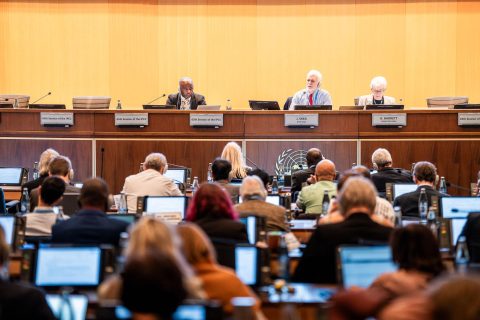

In July, PAICC said 12 countries had ignored its repeated attempts to discuss why they had not published an NDC as required every five years under the 2015 Paris accord.
Members of the committee had been divided over whether to name them, but at a September meeting decided to do so in their annual report to the annual climate COP summit.
By the time the report was published on Friday, only Congo, Senegal and North Korea “had not communicated an NDC or submitted a [Biennial Transparency Report] and had not yet responded to any of the Committee’s notifications, despite several reminders issued by the Committee in this regard”.
Rainforest and renewable energy ambitions
The silence from Congo and Senegal is notable because the former is home to much of the Congo Basin rainforest while the latter has sought billions of dollars in climate finance to support its renewable energy ambitions.
After Brazil, Congo has more rainforest than any country in the world. This forest, and the country’s peatlands, absorb huge amounts of greenhouse gas but are fast being lost to expanding farmland, charcoal production, logging and mining.
Senegal signed a Just Energy Transition Partnership with Canada and wealthy European nations in 2023, to help it meet its renewable energy targets under the-then government of Macky Sall. It was chair of the Least Developed Countries group between January 2022 and December 2023.

Tejas Rao, who is researching the PAICC as part of a doctoral thesis at Cambridge University, said the governments of the three countries should engage with the committee.
“Engagement costs these governments very little and the committee has shown it will listen,” he said.
“Silence leaves the committee with no basis to help, and it leaves the [governments] exposed to the narrative that they are simply disengaged,” he told Climate Home News.
Paris Agreement requirement
The 2015 Paris Agreement requires all parties to publish an NDC every five years outlining their emissions reduction targets, with each plan meant to be more ambitious than the country’s last NDC.
The latest set – the third round of plans, with new targets for 2035 – was due in February 2025. While most countries missed this deadline, all but around 30 – mostly small emitters but including Egypt, Vietnam and Argentina – have now submitted them.
Over the year, the PAICC – which is made up of government climate officials from developed and developing countries – has been communicating with governments that have not submitted NDCs and trying to overcome barriers to them doing so.
Some nations have cited exceptional circumstances as the reason for not submitting an NDC, a process that requires a significant amount of work in tracking emissions and consulting on how to curb them across the economy. For example, a letter from a Sudanese official to the PAICC, seen by Climate Home News, said that the country’s civil war had led to the suspension of its NDC preparation.
-
IPCC scientists vow to press on with climate reports despite political deadlock
After governments again failed to agree a timeline, nearly 120 IPCC authors pledged to complete their assessment on time and with full scientific rigour -
Under US pressure, World Bank says it will back gas “where appropriate”
The US wants the World Bank to expand its gas support while climate campaigners are pushing for it to end – its head spoke this week of limited backing for the fossil fuel -
Who shapes climate science? The equity question facing the IPCC
Early completion of the next global climate science assessment reports risks excluding research from the Global South, which is key to ensuring the findings are fair
The US and Iran are not signed up to the Paris Agreement and so do not have active NDCs, nor does Taiwan, which is not a UN member state.
Rao said that because the PAICC is “facilitative and non-punitive”, naming the countries “is meant to open a door, not close one – the invited consultation is the point”.
“In recent months, governments that explained their constraints, whether capacity, finance or domestic process, have been met with follow-up and support rather than sanction, and the number of silent governments has fallen sharply,” Rao said.
The post Paris Agreement committee names three countries snubbing it over NDCs appeared first on Climate Home N