

Welcome to Carbon Brief’s DeBriefed.
An essential guide to the week’s key developments relating to climate change.
This week
Heat and firewaves
‘FIREWAVE’: Wildfires ravaged Europe and North America this week. France utilised water-dumping planes collecting from the Seine to contain a fire in the Fontainebleau forest near Paris, according to the Associated Press. The Financial Times reported that the UK has had “25 non-consecutive days with temperatures of 30C or more, including nine days above 34C”, creating a “firewave” and putting pressure on emergency services. Meanwhile, an “orange haze from Canada wildfires” could be “seen in Ontario and northern US”, said BBC News.
‘NEW NORMAL’: Climate events previously seen as extreme are becoming the “new ‘normal’”, said the Met Office, in a report on the UK’s climate. While last year was the UK’s hottest on record, rising temperatures mean it is expected to be surpassed in the next few years, reported Reuters. Liz Bentley, head of the Royal Meteorological Society, told the Guardian that “climate change has been described by scientists for many years but is now increasingly being felt by the UK population in their own homes and communities”.
Around the world
- ELECTRIFYING PUSH: The European Commission has announced a target for electricity to account for 46% of energy consumption across the bloc by 2040, reported Carbon Pulse. The commission has also made plans to adapt its emissions trading system to “bring relief to industry”, it said.
- FALLING OIL: The International Energy Agency said that global oil demand is expected to decline this year for the first time since 2020, reported the Associated Press.
- US ROLLBACKS: Trump cuts to clean energy support “led to the cancellation or delay of $83bn in investment across hundreds of projects”, reported Reuters. The Trump administration has also changed environmental law to allow development in the habitats of endangered species, according to CNN.
- BURNHAM BEGINS: Incoming UK prime minister Andy Burnham is preparing to announce new North Sea drilling “within days of taking office”, said Bloomberg. Carbon Brief looked at 28 statements that Burnham has made about climate change and fossil fuels.
- DRY JULY: Drought in Uganda led to significant crop losses and at least 16 deaths from starvation, said BBC News.
- ON AI: Australia planned to implement restrictions on energy and water usage for datacentres “amid [an] AI boom”, said the New York Times.
38%
The drop in Brazilian Amazon deforestation in the first half of 2026, compared to last year, reported Al Jazeera.
Latest climate research
- The area of land burned by wildfires in Africa each year has reduced due to a shrinking dry season | Geophysical Research Letters
- Most people do not distinguish between climate adaptation and mitigation when thinking about tackling climate change | Climate Outreach
- An “effort-sharing framework” has been developed to support progress towards the Paris Agreement | npj Climate Action
(For more, see Carbon Brief’s in-depth daily summaries of the top climate news stories on Monday, Tuesday, Wednesday, Thursday and Friday.)
Captured
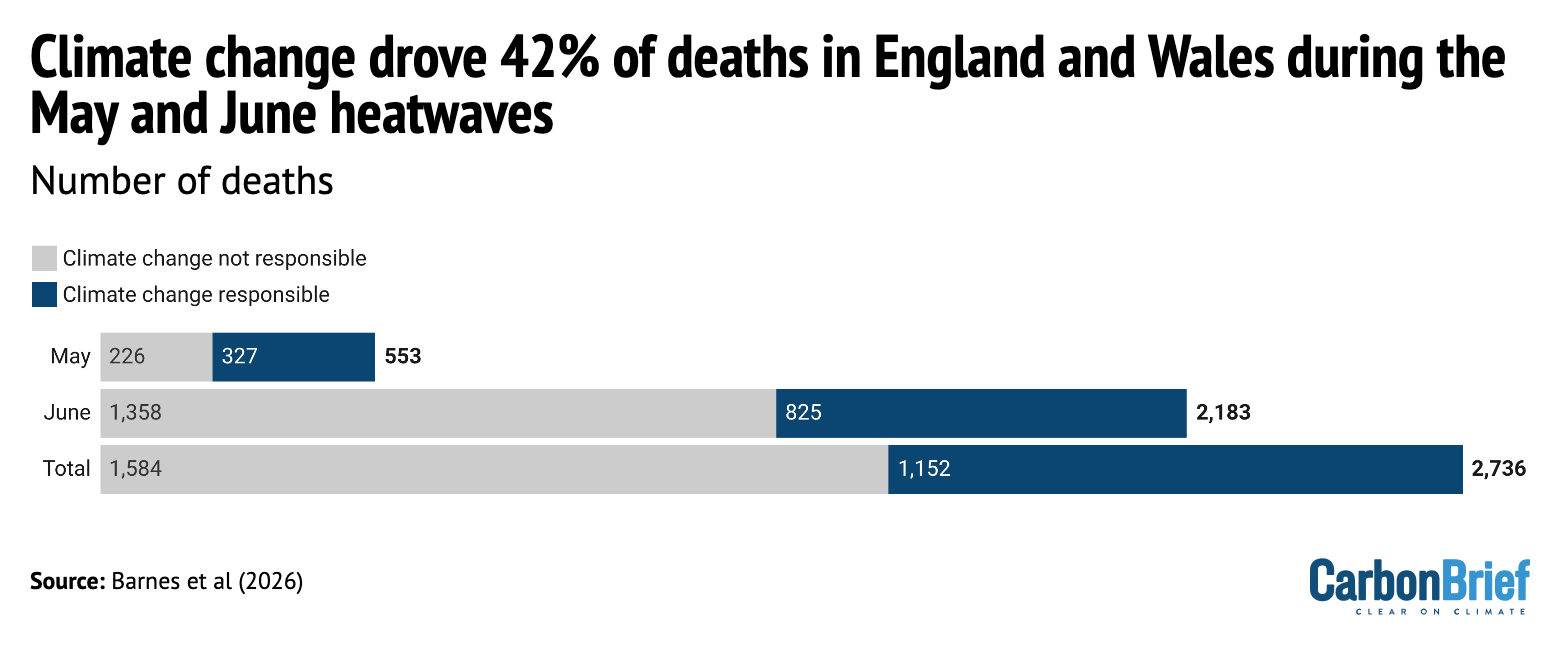
Carbon Brief explained how more than 1,000 heat-related deaths in England and Wales during May and June were attributed to climate change, accounting for almost half of all heat-related deaths experienced during those months. The article also unpacked the different methods for estimating heat deaths around the world.
Spotlight
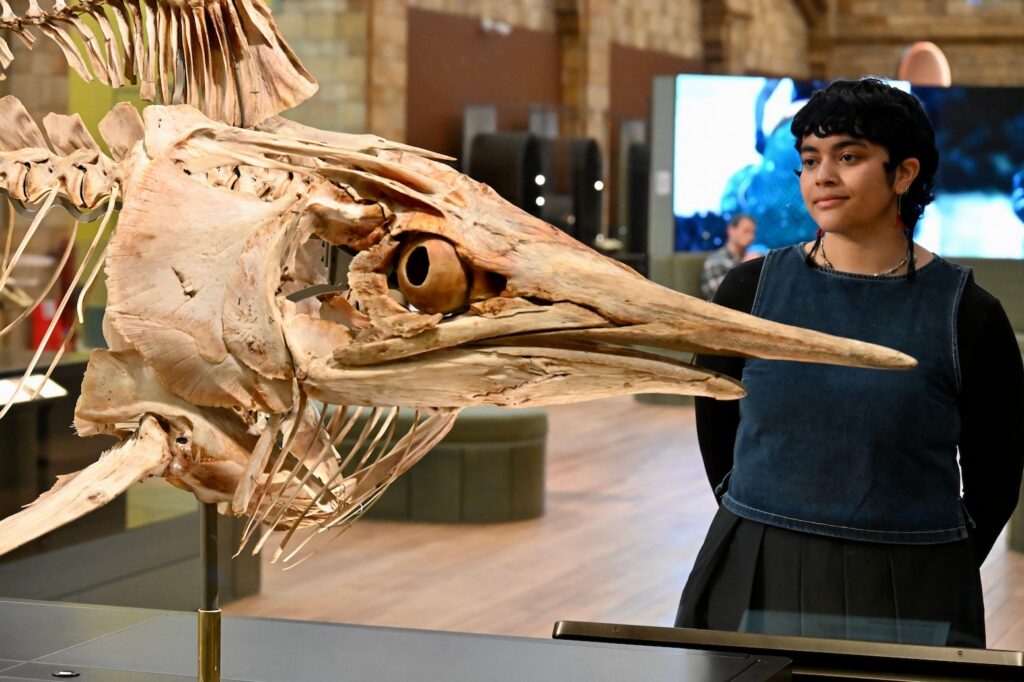
Natural History Museum exhibits climate change
This week, Carbon Brief interviews Meaghan Macdonald, senior project and programme manager for London’s Natural History Museum, about their first permanent climate-themed exhibition, Fixing Our Broken Planet.
Carbon Brief: Why are programmes such as Fixing Our Broken Planet so important?
Meaghan Macdonald: One of the main things we’re trying to achieve with Fixing Our Broken Planet is to place the museum as a convener of conversations around the planetary emergency…trying to bring together the different groups of people who need to be involved in this conversation in order to work together to find a solution.
And we find that a lot of the people who come into the gallery weren’t necessarily coming here to see it; they come across it, which is a really great way to engage people who may not have been engaged in that discussion previously.
CB: How does the exhibition engage and inspire visitors?
MM: A driving force for this exhibition is that you are dealing with a subject matter that can be quite disheartening, and one of the things that we were very careful about is to try to make sure that woven throughout the scientific data… is a sense of hope… to enable people to feel empowered to make a difference.
We were able to do things like our “what you can do” labels, which give an example that people can take away with them. We also have “conversation starters”, which is a digital screen that asks people a series of questions related to the planetary emergency. Things like: “Should we mine the deep sea to power the green economy?”…And there’s no right or wrong answer.
We [also] set out very specifically to…forefront the science that’s happening here. We know from multiple studies from thinktanks and organisations that people actually trust our scientists the most.
CB: The museum has set out a goal to “create advocates for the planet”. What does this mean? How does it relate to the exhibition and the museum’s wider climate action?
MM: The aim of the museum is to get to a place where both people and the planet thrive. Being a library of the natural world, it is our duty to be standing up for it and to help people find their way, fighting for nature’s side.
In order to create those advocates, the aim of the [exhibition] and the wider advocacy programmes at the museum is to try to find ways to bring all these people [individuals, policymakers, industry, scientists] together.
We have the wider programme with Fixing Our Broken Planet. We have Generation Hope…a free graphic panel version of our display in the gallery that we have been able to get into a number of venues in Bangalore…the very long-standing and beloved wildlife photographer of the year [exhibition]…our urban nature movement…[and] an initiative that we are doing with the Department for Education called the National Education Nature Park.
Watch, read, listen
STUBBORN HOPE: For the Conversation, climate scientist Prof Peter Stott argued that researchers need to “talk more about the very worst-case scenarios” and the possibility for action.
EXTREME: Vox’s the Gray Area podcast spoke to New York Times journalist David Wallace-Wells about the possibility of a “Godzilla” El Niño.
RESPONSIBILITY: For Climate Home News, two researchers from the Center for International Environmental Law explored how “major emitting countries knew of climate risks decades earlier than claimed”.
Coming up
- 13-31 July: Meeting of the International Seabed Authority assembly and council, Kingston, Jamaica
- 17-19 July: 3rd International Conference on Environment and Sustainable Development, London
- 19 July: Presidential election, São Tomé and Príncipe
Pick of the jobs
- Zero Carbon Analytics, research lead | Salary: Unknown. Location: Remote
- Met Office, ocean climate scientific manager | Salary: £54,515-£58,582. Location: Exeter
- National Trust, land use and nature delivery partner | Salary: £44,499. Location: Newcastle or York
DeBriefed is edited by Daisy Dunne. Please send any tips or feedback to debriefed@carbonbrief.org.
This is an online version of Carbon Brief’s weekly DeBriefed email newsletter. Subscribe for free here.


The post Debriefed 17 July 2026: UK ‘firewave’ | Fossil-fuelled heat deaths | London’s Natural History Museum spotlights climate appeared first on Carbon Brief.

Three countries have been named by the Paris Agreement’s compliance committee for failing to submit a nationally determined contribution (NDC) and repeatedly snubbing offers of help with their climate plans.
After months of internal debate over whether to identify serial non-responders, the Paris Agreement’s Implementation and Compliance Committee (PAICC) named the three countries which have failed to engage with it over their NDCs on Friday.
It named Democratic Republic of Congo, Senegal and North Korea in a footnote of its annual report, adding that it decided to name them “with a view to facilitating engagement”, adding that representatives of the three nations had been invited to its meeting in early 2027 “with the purpose of identifying any challenges and constraints”.
“The Committee noted the importance of Parties engaging with the Committee in a timely manner, while noting that some delays may be due to the national capabilities and circumstances of the Parties”, the report said.
-
Under US pressure, World Bank says it will back gas “where appropriate”
The US wants the World Bank to expand its gas support while climate campaigners are pushing for it to end – its head spoke this week of limited backing for the fossil fuel -
IPCC scientists vow to press on with climate reports despite political deadlock
After governments again failed to agree a timeline, nearly 120 IPCC authors pledged to complete their assessment on time and with full scientific rigour -
Paris Agreement committee snubbed over missing NDC climate plans
Many governments have still not submitted a nationally determined contribution to the UN, breaching a key requirement of the Paris Agreement

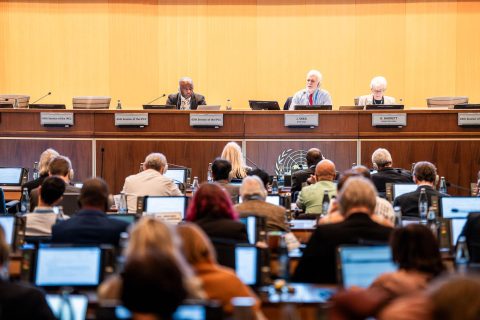

In July, PAICC said 12 countries had ignored its repeated attempts to discuss why they had not published an NDC as required every five years under the 2015 Paris accord.
Members of the committee had been divided over whether to name them, but at a September meeting decided to do so in their annual report to the annual climate COP summit.
By the time the report was published on Friday, only Congo, Senegal and North Korea “had not communicated an NDC or submitted a [Biennial Transparency Report] and had not yet responded to any of the Committee’s notifications, despite several reminders issued by the Committee in this regard”.
Rainforest and renewable energy ambitions
The silence from Congo and Senegal is notable because the former is home to much of the Congo Basin rainforest while the latter has sought billions of dollars in climate finance to support its renewable energy ambitions.
After Brazil, Congo has more rainforest than any country in the world. This forest, and the country’s peatlands, absorb huge amounts of greenhouse gas but are fast being lost to expanding farmland, charcoal production, logging and mining.
Senegal signed a Just Energy Transition Partnership with Canada and wealthy European nations in 2023, to help it meet its renewable energy targets under the-then government of Macky Sall. It was chair of the Least Developed Countries group between January 2022 and December 2023.

Tejas Rao, who is researching the PAICC as part of a doctoral thesis at Cambridge University, said the governments of the three countries should engage with the committee.
“Engagement costs these governments very little and the committee has shown it will listen,” he said.
“Silence leaves the committee with no basis to help, and it leaves the [governments] exposed to the narrative that they are simply disengaged,” he told Climate Home News.
Paris Agreement requirement
The 2015 Paris Agreement requires all parties to publish an NDC every five years outlining their emissions reduction targets, with each plan meant to be more ambitious than the country’s last NDC.
The latest set – the third round of plans, with new targets for 2035 – was due in February 2025. While most countries missed this deadline, all but around 30 – mostly small emitters but including Egypt, Vietnam and Argentina – have now submitted them.
Over the year, the PAICC – which is made up of government climate officials from developed and developing countries – has been communicating with governments that have not submitted NDCs and trying to overcome barriers to them doing so.
Some nations have cited exceptional circumstances as the reason for not submitting an NDC, a process that requires a significant amount of work in tracking emissions and consulting on how to curb them across the economy. For example, a letter from a Sudanese official to the PAICC, seen by Climate Home News, said that the country’s civil war had led to the suspension of its NDC preparation.
-
IPCC scientists vow to press on with climate reports despite political deadlock
After governments again failed to agree a timeline, nearly 120 IPCC authors pledged to complete their assessment on time and with full scientific rigour -
Under US pressure, World Bank says it will back gas “where appropriate”
The US wants the World Bank to expand its gas support while climate campaigners are pushing for it to end – its head spoke this week of limited backing for the fossil fuel -
Who shapes climate science? The equity question facing the IPCC
Early completion of the next global climate science assessment reports risks excluding research from the Global South, which is key to ensuring the findings are fair
The US and Iran are not signed up to the Paris Agreement and so do not have active NDCs, nor does Taiwan, which is not a UN member state.
Rao said that because the PAICC is “facilitative and non-punitive”, naming the countries “is meant to open a door, not close one – the invited consultation is the point”.
“In recent months, governments that explained their constraints, whether capacity, finance or domestic process, have been met with follow-up and support rather than sanction, and the number of silent governments has fallen sharply,” Rao said.
The post Paris Agreement committee names three countries snubbing it over NDCs appeared first on Climate Home News.
Paris Agreement committee names three countries snubbing it over NDCs