

And the truth is that, sometimes – for all sorts of reasons – you get told ‘no’.
But the wonderful thing is just how often people not only say ‘yes’; they also tell you that they are grateful to have been asked.
My colleague Hannah has been doing a lot of asking lately. She’s one of the Greenpeace team at the centre of the massive campaign effort to protect magnificent Scott Reef from Woodside. Hannah hasn’t been with Greenpeace for all that long, but she’s a terrific campaigner with a wonderful sense of humour, so naturally it’s fantastic to have her on board.
I was talking with Hannah the other day about all the asking she’s been doing. She shared how much she’d noticed the special enthusiasm which surfaces when someone’s unique way of being and self-expression finds resonance with the needs of a cause.
Actually, Hannah put it much more poetically and succinctly, coming out with something like:
“Each of us has our own language of love and power, and if we are invited to use it for what we believe in, joining a campaign becomes easy.”
Hannah had elegantly expressed something which I believe in very deeply.
Great public campaigns are like mighty rivers with many tributaries, deriving their force and scale by welcoming a multitude of perspectives and contributions. The destination becomes an obvious good – ending a wrong, protecting something important, or establishing some new liberty – but the metaphorical and literal march of the crowd necessarily reflects a true diversity of values, motivations and ways of contributing.
The campaign to save Scott Reef now feels as though it has gathered this kind of momentum.
In recent days, Hugh Jackman and 150 other leading Australian celebrities and artists have called for the protection of “a famous reef” in Rolling Stone magazine. At the other end of the spectrum, a group of primary school children in Sydney self-organised to send a huge pictorial petition to federal environment minister Murray Watt. These are signs that the big river is rising.
A big part of the work of Hannah, alongside the wider team, has been inviting musicians, writers, artists, actors and other creatives to bring their own languages of love and power to the campaign to save Scott Reef.
The response has been extraordinary. Across generations, genres and art forms, an incredible roll call of some of Australia’s most accomplished and celebrated creatives have not only signed letters but collaborated on songs, contributed poems and essays, made films, worn Save Scott Reef pins on the ARIA Awards red carpet, and even created a music video at Scott Reef itself.
The reality of course is that most of us aren’t film stars, rock stars or Nobel Laureates. But as Hannah noticed, every one of us has our individual language of love and power which is ours to contribute. It might be volunteering, or donating vital money; or writing in, calling up or speaking out to decision makers. All are crucial contributions.
And sometimes the greatest gift is simply to be there: to show up with our bodily presence, alongside others of like mind and heart. To become one of the crowd who turns out, committing that most precious offering of our participation, and our time.
Never be in any doubt. Turning up always matters.
And earlier this month, ten thousand people turned up for the Scott Reef Rising Festival in Perth on a late Sunday afternoon.
There was one particular moment during the festival, when the light of the golden hour was caressing a rumpled doona of cloud to the east, and a tender rain began to fall, that the gentlest of shimmering rainbows could be seen against the trees.
Underneath this gilded reminder of the beauty of the earth, Tim Winton was among those who took to the stage to address the crowd. Speaking gently, Tim’s words were characteristically emotive, evocative and direct. Someone who has been using his language of love and power as an advocate for the oceans for many years, Tim made another intervention, imploring our politicians once again to save Scott Reef, and reject Woodside’s plans. His closing words offered a secular benediction.
“To all of you here today, dancing and singing in the rain, you comrades and friends, you ordinary defenders of life, you patriots, I say this:
Take heart. Stay strong. Lift each other up. Be loud. Expect better leadership. Demand it. And fight on. For each other. For our home. Our beautiful home. Our only home. And for those who come after.”
It is a moment to not forget. Tim’s words warmed, held and lifted the crowd — this rising of Australians for Scott Reef and our oceans.
And there, in the soft drizzle under the late-day sky, was the living truth of what Hannah had expressed. Each of us there, doing what we can, offering what we do best, sometimes our very biggest thing, in this time of monsters. Speaking our unique dialect of love and power, in rhythm with and in awe of, life on Earth. For the good of ourselves and for the benefit of all.
Q & A
I wasn’t at COP31 in Anatalya and am grateful to my Greenpeace colleagues who did the hard yards at this year’s conference–especially the team from Greenpeace Türkiye – but various folks have asked me in the course of the last week what I think about the outcome. I’ve put down a few thoughts on COP31 here, and strongly recommend the concise comments of my colleague Dr Simon Bradshaw who was part of the Greenpeace team in Anatalya. Greenpeace Australia Pacific’s formal statement is here.

Sinking land and rising seas could expose more than seven million people living in Africa’s coastal “megacities” to flooding by the middle of the century, according to new research.
The analysis, published in Science Advances, combines satellite data with projections of sea level rise to assess the risk of flooding in 20 of Africa’s most populous coastal cities.
The study finds that, under a moderate warming scenario, an “extreme sea level event” – when sea levels are unusually high due to short-term changes in weather and ocean conditions – could expose a million buildings and $180bn of assets to flooding.
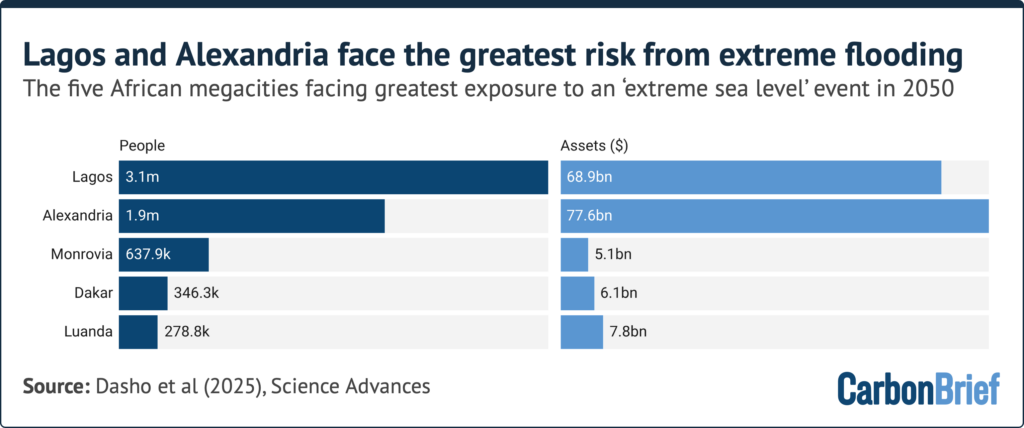
Lagos, the capital of Nigeria, and Alexandria in Egypt are the most vulnerable cities in the analysis.
In these two cities alone, five million people and $150bn in assets could be exposed to flooding and the cities by mid-century.
Human activity, such as pumping groundwater or drilling for fossil fuels, can cause the ground to sink, in a process called “subsidence”.
Seismic or volcanic activity can also drive changes in the height of the land, causing it to either rise or fall. This “vertical land movement” can either alleviate or exacerbate the effects of sea level rise.
The researchers combined more than 4,000 satellite images of Africa’s coastline to determine how quickly different regions are rising or sinking.

They identified Lagos and Alexandria as “subsidence hotspots”, finding that the two cities are sinking at rates of 5.2mm and 6.3mm per year, respectively.
This is “comparable to rates reported for south-east Asian megacities such as Jakarta, Manila and Ho Chi Minh City”, which have recorded “some of the highest subsidence rates yet observed”, according to the study.
The authors combined these estimates with sea level rise projections from the Intergovernmental Panel on Climate Change’s sixth assessment report under three different emissions scenarios, to assess the regional sea level rise across the African coastline.
They used 2020 population data, building footprints and GDP per capita to estimate how much of each city would be exposed to these flooding events over the 21st century, if the city itself stays the same.
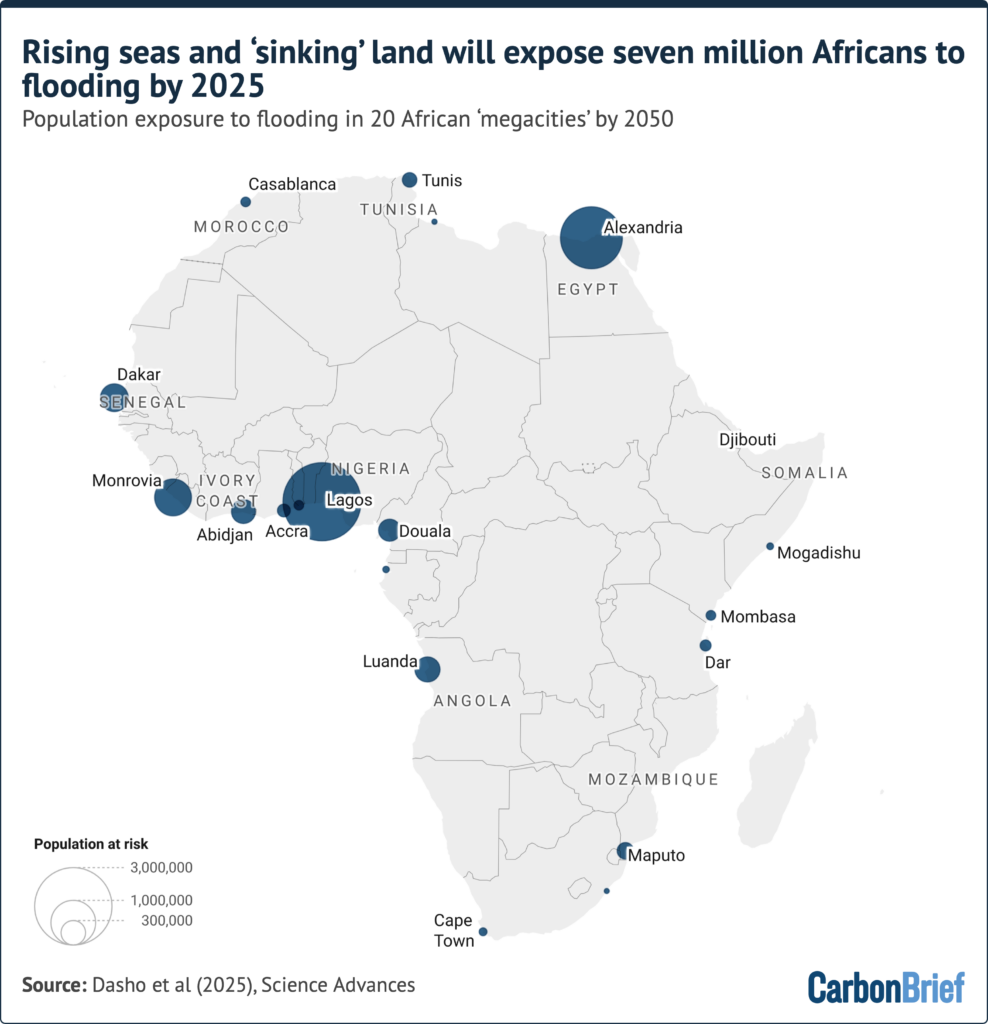
While Lagos and Alexandria are the most vulnerable cities, the research finds that Djibouti City in Djibouti, Mogadishu in Somalia and Tripoli in Libya will face “minimal economic exposure due to their smaller populations and infrastructure bases”.
Lead author Oluwaseyi Dasho, a PhD student at Virginia Tech, tells Carbon Brief that the analysis holds population and city data constant at 2020 levels, so that the authors can isolate the effects of sea level rise and vertical land movement on changing flood exposure.
He notes that if people move away from “threatened areas” over the coming decades, then estimates could be too high. However, if “continued urban growth” causes city populations to increase, the estimates could be too low.
Africa is the world’s fastest-urbanising region, with cities growing at an average rate of 3.5% every year. By 2050, Africa’s urban population is expected to double from 7m to 1.4bn.
He also notes that “the flood model assumes no coastal defenses, so the estimates are a worst-case physical picture”.
Subsidence in African coastal cities has not been consistently monitored in the past, largely due to a lack of local data, the study explains.
The authors say their method of using satellites to assess subsidence and uplift could be used in other “data-scarce coastal regions across the global south”.
Dasho, O., et al (2026), Sinking cities: Latent flood risk in Africa’s coastal megacities, Science Advances, doi:10.1126/sciadv.aeh6538
Related
Q&A: What can – and cannot – be said about global warming’s role in the 2026 Himalayan floods
Revealed: Floods have forced at least 67 closures at NHS hospitals since 2021
Mapped: How climate change affects extreme weather around the world
Analysis: Constituency of Reform’s climate-sceptic Richard Tice gets £55m flood funding
The post ‘Sinking’ African megacities will expose seven million people to flooding by 2050 appeared first on Carbon Brief.
‘Sinking’ African megacities will expose seven million people to flooding by 2050