

Sinking land and rising seas could expose more than seven million people living in Africa’s coastal “megacities” to flooding by the middle of the century, according to new research.
The analysis, published in Science Advances, combines satellite data with projections of sea level rise to assess the risk of flooding in 20 of Africa’s most populous coastal cities.
The study finds that, under a moderate warming scenario, an “extreme sea level event” – when sea levels are unusually high due to short-term changes in weather and ocean conditions – could expose a million buildings and $180bn of assets to flooding.
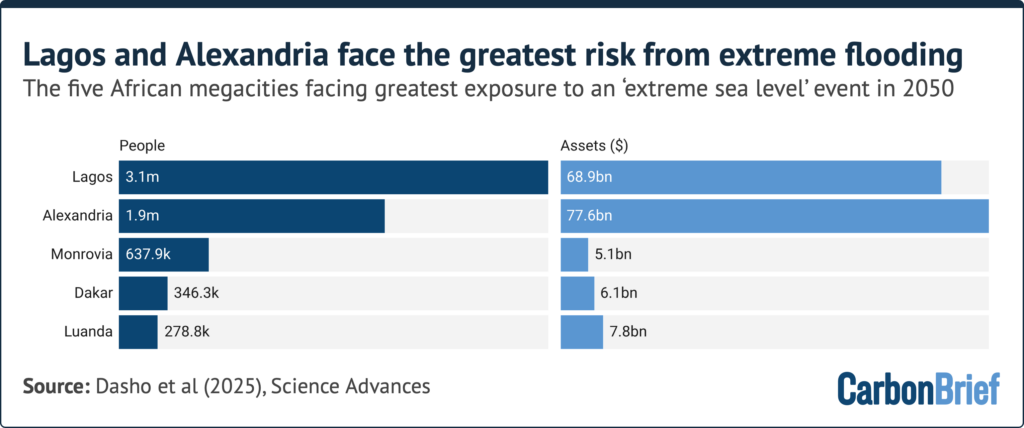
Lagos, the capital of Nigeria, and Alexandria in Egypt are the most vulnerable cities in the analysis.
In these two cities alone, five million people and $150bn in assets could be exposed to flooding and the cities by mid-century.
Human activity, such as pumping groundwater or drilling for fossil fuels, can cause the ground to sink, in a process called “subsidence”.
Seismic or volcanic activity can also drive changes in the height of the land, causing it to either rise or fall. This “vertical land movement” can either alleviate or exacerbate the effects of sea level rise.
The researchers combined more than 4,000 satellite images of Africa’s coastline to determine how quickly different regions are rising or sinking.

They identified Lagos and Alexandria as “subsidence hotspots”, finding that the two cities are sinking at rates of 5.2mm and 6.3mm per year, respectively.
This is “comparable to rates reported for south-east Asian megacities such as Jakarta, Manila and Ho Chi Minh City”, which have recorded “some of the highest subsidence rates yet observed”, according to the study.
The authors combined these estimates with sea level rise projections from the Intergovernmental Panel on Climate Change’s sixth assessment report under three different emissions scenarios, to assess the regional sea level rise across the African coastline.
They used 2020 population data, building footprints and GDP per capita to estimate how much of each city would be exposed to these flooding events over the 21st century, if the city itself stays the same.
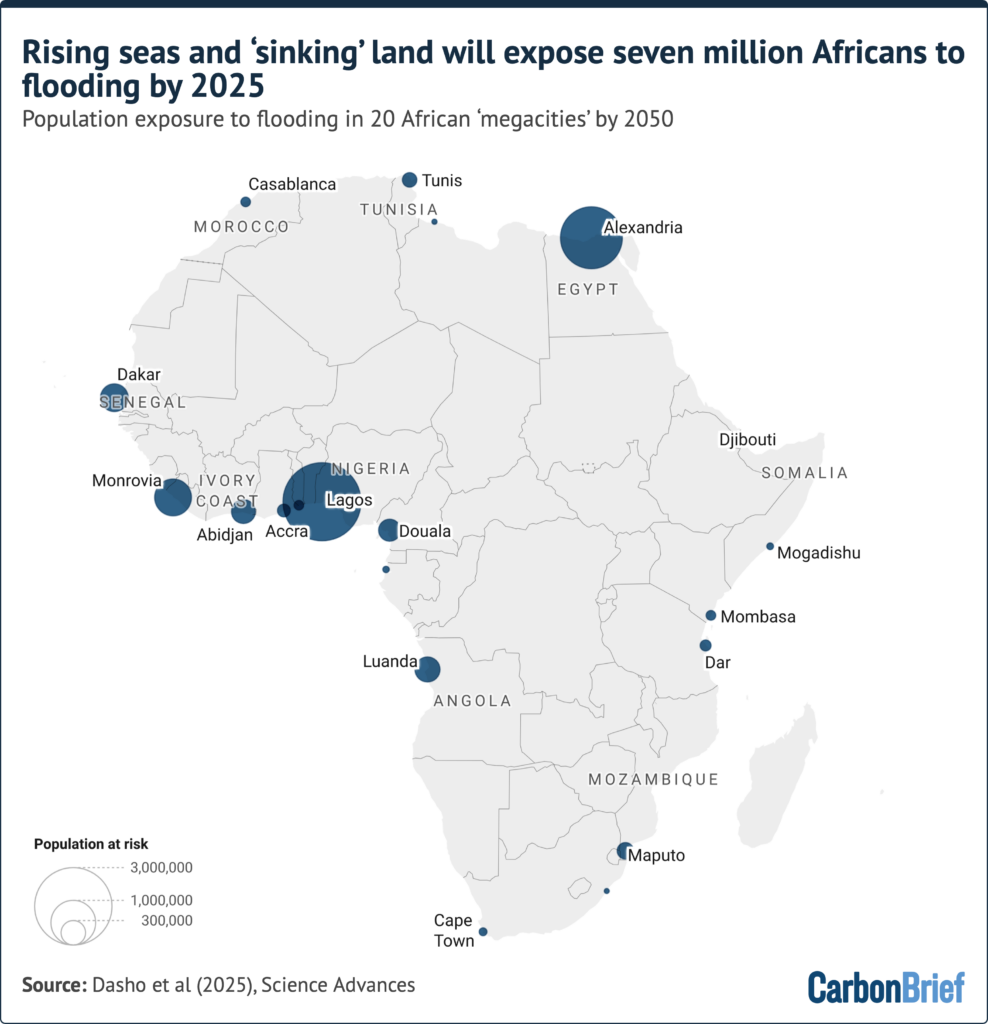
While Lagos and Alexandria are the most vulnerable cities, the research finds that Djibouti City in Djibouti, Mogadishu in Somalia and Tripoli in Libya will face “minimal economic exposure due to their smaller populations and infrastructure bases”.
Lead author Oluwaseyi Dasho, a PhD student at Virginia Tech, tells Carbon Brief that the analysis holds population and city data constant at 2020 levels, so that the authors can isolate the effects of sea level rise and vertical land movement on changing flood exposure.
He notes that if people move away from “threatened areas” over the coming decades, then estimates could be too high. However, if “continued urban growth” causes city populations to increase, the estimates could be too low.
Africa is the world’s fastest-urbanising region, with cities growing at an average rate of 3.5% every year. By 2050, Africa’s urban population is expected to double from 7m to 1.4bn.
He also notes that “the flood model assumes no coastal defenses, so the estimates are a worst-case physical picture”.
Subsidence in African coastal cities has not been consistently monitored in the past, largely due to a lack of local data, the study explains.
The authors say their method of using satellites to assess subsidence and uplift could be used in other “data-scarce coastal regions across the global south”.
Dasho, O., et al (2026), Sinking cities: Latent flood risk in Africa’s coastal megacities, Science Advances, doi:10.1126/sciadv.aeh6538
Related
Q&A: What can – and cannot – be said about global warming’s role in the 2026 Himalayan floods

Revealed: Floods have forced at least 67 closures at NHS hospitals since 2021
Mapped: How climate change affects extreme weather around the world
Analysis: Constituency of Reform’s climate-sceptic Richard Tice gets £55m flood funding
The post ‘Sinking’ African megacities will expose seven million people to flooding by 2050 appeared first on Carbon Brief.
‘Sinking’ African megacities will expose seven million people to flooding by 2050

SYDNEY, Friday 27 November 2026 — In response to the Federal Government today announcing public consultation on a proposed bilateral agreement for approval of native forest logging with the Tasmanian Government, the following statement can be attributed to Adele Chasson, Nature Policy Lead at Greenpeace Australia Pacific:
“The Tasmanian Government has a proven track-record of reckless disregard for the state’s precious native forests, and for decades have given the logging industry the green light to tear through critical habitat of threatened species like swift parrots and Tasmanian devils, threaten water sources, damage cultural heritage and deplete carbon stores.
“The Federal Government has the extraordinary opportunity to implement our new national nature laws to finally protect the incredible Tasmanian wilderness, but that would be undermined by allowing native logging to continue unchecked. The Tasmanian government cannot be trusted to do it themselves.
“The Federal Government must address deep-rooted problems with the Tasmanian system governing forestry, particularly its governance failures and mismanagement of species habitat, and step up protection for forests as it looks to bring forestry under the new nature laws.
“Native forest logging is a national shame and it must end across Australia. Governments need to get on with the urgent job of protecting Australia’s extraordinary forests and wildlife for good.”
-ENDS-
Tas govt ‘cannot be trusted’ in new proposed native forest logging sign-off
Climate Change
“Absurd” environmental green light for Australia’s most polluting AI data centre proposal shows urgent need for moratorium
SYDNEY, Friday 27 November 2026 — In response to an Anthropic-backed $32 billion AI data centre proposal in Queensland being given the environmental green light by the National EPA, Greenpeace Australia Pacific has renewed calls for an urgent moratorium on AI data centre approvals and construction.
The Zerra-DC Western Downs Digital Park proposal in Queensland has been ranked as the most polluting data centre proposal in the country by the Climate Council. The AI data centre would have a maximum power demand of 3.24 gigawatts (GW) and Zerra-DC has not ruled out building dedicated on-site gas generation for power.
Joe Rafalowicz, Head of Climate and Energy at Greenpeace Australia Pacific said: “For the most polluting AI data centre proposal in the country to be given the environmental green light shows the desperate need for a moratorium on the construction of these monstrosities until appropriate safeguards are put in place.
“It is frankly absurd that this proposal has been waved through when this data centre alone would use more energy than six million homes. That energy has to come from somewhere, and because the Federal Government has given a free pass to Queensland to use coal and gas to power data centres, it will increase the cost of electricity for everyone else and the pollution it creates will turbocharge climate disasters like floods and extreme heat.
“Australia desperately needs national legislation to manage the frenzied build-out of AI data centres, and until then we need a moratorium on new approvals. Right now it is a free-for-all with these resource-hungry mega data centres locking in access to water, power and land with minimal safeguards and input from local communities.
“As the Federal Government prepares to introduce new legislation for the regulation of AI data centres in the new year, they need to remember they serve the Australian people, not Big Tech. They must introduce a strong national framework that at a minimum forces AI data centres to build their own renewable energy, excludes projects which impact water resources, and makes operators genuinely consult with local communities.
“Australians should not be forced to absorb the economic, environmental and social costs of data centre expansion.”
-ENDS-
Media contact
Lucy Keller on +61 491 135 308 or lucy.keller@greenpeace.org
Dan Ioschpe is the Climate High-Level Champion for COP30.
A year ago at COP30 in Belém, we said this would be the decade of implementation for climate action. Simply put, implementation is the fastest way to promote sustainable socio-economic development. But implementation is not about words. It is about action, on the ground, at speed and scale.
COP31 in Antalya demonstrated why the implementation of the Paris Agreement must extend well beyond the two weeks of a climate conference. Despite political divisions, businesses, investors, governments, cities and communities came with results and remained committed to scaling climate action, showing that the real economy does not wait.
That is why continuity matters. In Belém, the Global Climate Action Agenda was given a new structure, with six thematic axes, and Plans to Accelerate Solutions (PAS). Because that structure carries work from one COP to the next, progress can compound. And progress is now something we can measure.
This year’s Yearbook of Global Climate Action shows that 87% of PAS reported progress, while 38% of the 40 with quantitative targets are on track or ahead of their goals. It highlights where the gaps remain.
Grids stretching halfway around the world
The strongest signal from Antalya came from electrification. The Electrification Delivery Package brings together more than 200 actions from over 180 organisations, involving over 150 countries plus the European Union – together over two-thirds of global GDP – and more than 260 businesses with over $4 trillion in annual revenue.
The results are already visible on the ground. Members of the Utilities for Net Zero Alliance built more than 21,000 kilometres of grid in 2025, up from 14,000 km the year before – enough to stretch halfway around the world. From grids, storage and renewable power to energy access, the foundations of a modern, interconnected system are coming together at speed and scale.
-
Australia and South Korea’s clean energy deal could boost low-carbon trade
The deal aims to connect Australia’s renewable resources with Korean industries’ clean energy demand, potentially transforming a relationship built on coal and gas -
After COP31, our chance to save climate diplomacy lies in global shipping
If COP31’s high ambition countries can show the same resolve at London shipping talks, a climate breakthrough is possible next week

The Global Climate Action Agenda is helping connect these investments and shift from individual solutions to economy-wide transformation. Electrification is simply the fastest way to foster sustainable socioeconomic development – efficiently, affordably, and securely.
On transport, 13 zero-emission freight corridors are now in development across six continents, covering more than 29,000 km of roads. That is already ahead of the Global Green Road Corridors Initiative’s goal of ten corridors by 2026.
Sustainable aviation fuel starts to take off
Progress is also visible on sustainable aviation fuel (SAF), a solution approaching a positive tipping point. One in three new sustainable industry investment decisions this year was for SAF, a sign of how quickly the market is developing, including through an Action Agenda plan to decarbonise aviation.
Projects that have reached final investment decision represent around 7 million tonnes of SAF a year, or 3% of today’s jet fuel use. But the wider pipeline stands at 31 million tonnes – around 11% of the existing market. Once sustainable solutions capture 5-10% of an established market, growth can become self-reinforcing as costs fall, supply chains mature and investors gain confidence. Across heavy industry more broadly, 36 deep decarbonisation projects reached final investment decision this year – a record.

On nature, the Tropical Forest Forever Facility has reached $8.3 billion in commitments towards its $10-billion initial target, and the Global Fund for Coral Reefs announced $30 million in new reef financing across 22 developing countries.
With the launch of the Rio Synergies Group for Action, implementation will be at the centre of the three Rio Conventions on climate, biodiversity and land, and 17 governments are now backing the Intergovernmental Land Tenure Commitment to strengthen the rights of Indigenous Peoples and local communities.
On food and agriculture, solutions range from methane-reducing practices reaching more than 5,000 smallholders to food recovery initiatives now reaching 40.5 million people, cutting food waste and emissions at the same time. Some 66 million hectares are now under regenerative landscape projects.
Accelerator to support two solutions per year
Antalya also laid the groundwork for progress. Mandated by the Mutirão Decision in Belém, the Global Implementation Accelerator established its governance and operational framework at COP31. Each year, two solutions – one on mitigation and one on adaptation – will be selected for coordinated support, informed by independent expert assessment and mobilising the capabilities of a dedicated partner network.
The Accelerator builds on the Action Agenda, bringing governments, businesses, finance and technical expertise together to accelerate solutions with the potential to reach positive tipping points.
None of this happened by accident. It was possible because a structure is in place that allows progress to compound – connecting political guidelines with investments, infrastructure and sustainable socio-economic development.
This is the Global Climate Action Agenda at work: a multi-year engine for the implementation of the Paris Agreement, guided by a shared vision towards 2030. And I am optimistic about what comes next.
In Belém, we collectively revamped its structure and strengthened its foundations. In Antalya, we demonstrated the value of continuity. The opportunity now is to deepen its reach across regions, strengthening implementation on the ground with speed and scale.
From Antalya to Addis Ababa and beyond, the work continues 365 days a year, 24 hours a day.
The post Despite political divisions, COP31 showed the real economy does not wait appeared first on Climate Home News.
https://www.climatechangenews.com/2026/11/26/despite-political-divisions-cop31-showed-the-real-economy-does-not-wait/


‘Sinking’ African megacities will expose seven million people to flooding by 2050
Tas govt ‘cannot be trusted’ in new proposed native forest logging sign-off
“Absurd” environmental green light for Australia’s most polluting AI data centre proposal shows urgent need for moratorium

-
Climate Change1 year ago
Guest post: Why China is still building new coal – and when it might stop
-
Greenhouse Gases1 year ago
Guest post: Why China is still building new coal – and when it might stop
-

 Renewable Energy1 year ago
Sending Progressive Philanthropist George Soros to Prison?
-
Greenhouse Gases1 year ago
嘉宾来稿:探究火山喷发如何影响气候预测
-

 Climate Change2 years ago
Analysis: China’s CO2 falls 1% in Q2 2024 in first quarterly drop since Covid-19
-

 Climate Change1 year ago
嘉宾来稿:探究火山喷发如何影响气候预测
-

 Renewable Energy5 months ago
Send a Bible to a Starving Child
-

 Green Living2 years ago
Our Picks for the Top 2024 Black Friday and Cyber Week Sales From Sustainable Brands