

Welcome to Carbon Brief’s DeBriefed.
An essential guide to the week’s key developments relating to climate change.
This week
Deadly Texas floods
EXTREME FLOODING: At least 120 people died and 173 remain missing one week after flash floods in Texas, NBC News reported. The floods were “one of the deadliest weather events in recent American history”, the New York Times said. The newspaper said it is “too early to say with certainty” the role of climate change, but this type of extreme rainfall is “precisely the kind of phenomenon that scientists say is becoming more common because of global warming”.
STORM CONDITIONS: Bloomberg noted that drought, the “abnormally hot Gulf of Mexico” and other factors fuelled the “storm that spawned the floods” in Kerr county. Climate scientists told Inside Climate News that the “torrential downpours on 4 July exemplify the devastating outcomes of weather intensified by a warming atmosphere”.
CUTS QUESTIONED: The Guardian reported on a warning from experts that such floods could become the “new normal” as “Donald Trump and his allies dismantle crucial federal agencies that help states prepare and respond to extreme weather and other hazards”. E&E News reported that “forecasts and warnings largely worked during the catastrophe in Texas”, but that “those systems are expected to degrade as Trump’s cuts take hold”.
HIMALAYAN FLOODS: Elsewhere, heavy rainfall “battered” two Himalayan states in India, “leading to widespread damage, disruption and loss of life”, India Today reported. Pakistan’s Dawn newspaper reported that “record high summer temperatures” have “accelerated the melting of glaciers”, leading to deadly flooding in some parts of the country.
Europe heat deaths
RAGING HEAT: Around 1,500 of the 2,300 heat deaths during the heatwave that “seared Europe at the end of June” can be attributed to climate change, according to World Weather Attribution analysis covered by the Guardian. The newspaper said that Milan was the “hardest-hit city” and that 88% of the “climate-driven deaths” were in people aged over 65.
MORE EXTREMES: Extreme heat continued to affect much of Europe this week. In Catalonia, Spain, more than 18,000 people were ordered to remain indoors as a “wildfire raged out of control, consuming almost 3,000 hectares of vegetation”, Reuters said. Marseille airport closed as a major wildfire encroached on the southern French city, Le Monde reported.
‘CLIMATE DELAYERS’: Meanwhile, a “far-right” political group successfully outbid other groups to lead negotiations for the EU’s next climate target on behalf of the European parliament, according to Politico. This role for the Patriots for Europe group “give[s] the far right unprecedented influence” over the 2040 target, the outlet said, adding that it “strongly opposes the EU’s climate policies”. An early attempt to curb the bloc’s influence failed, Reuters said.
Around the world
- LIBYAN OIL: BP and Shell have “signed agreements to assess new opportunities in Libya”, the Financial Times reported, joining several oil majors resuming exploration following the country’s civil war.
- SOLAR POWER: Trump issued an executive order targeting “unaffordable and unreliable ‘green’ energy sources”, reported Inside Climate News. But the outlet said it is unclear whether this will “have much of an effect”.
- CLIMATE MOTION: The UN Human Rights Council passed a motion on climate change and human rights – but only after the Marshall Islands withdrew a “divisive amendment” calling on states to recommit to a fossil fuel phase-out, Reuters said.
- BELÉM INCOMING: Meanwhile, the president of COP30 told Climate Home News that countries “already decided” to transition away from fossil fuels and climate negotiations can now focus on a “timeline or rules for how this transition will be made”.
- LAW: The International Court of Justice will issue a major opinion on the legal obligation of countries to address climate change on 23 July, reported Reuters. Although it is nonbinding, experts told the newswire that it “could set a precedent in climate change-driven lawsuits” around the world.
74%
The percentage of global wind and solar projects under construction that are located in China, according to a Global Energy Monitor report.
Latest climate research
- Annual meltwater from the Greenland ice sheet “significantly increased” in the past three decades | Nature Climate Change
- The wealthier and more democratic a nation, the less their citizens engage in climate activism | Journal of Environmental Psychology
- Climate change has “played an important role” in genetic and demographic changes in Tibetan macaques | Science Advances
(For more, see Carbon Brief’s in-depth daily summaries of the top climate news stories on Monday, Tuesday, Wednesday, Thursday and Friday.)
Captured
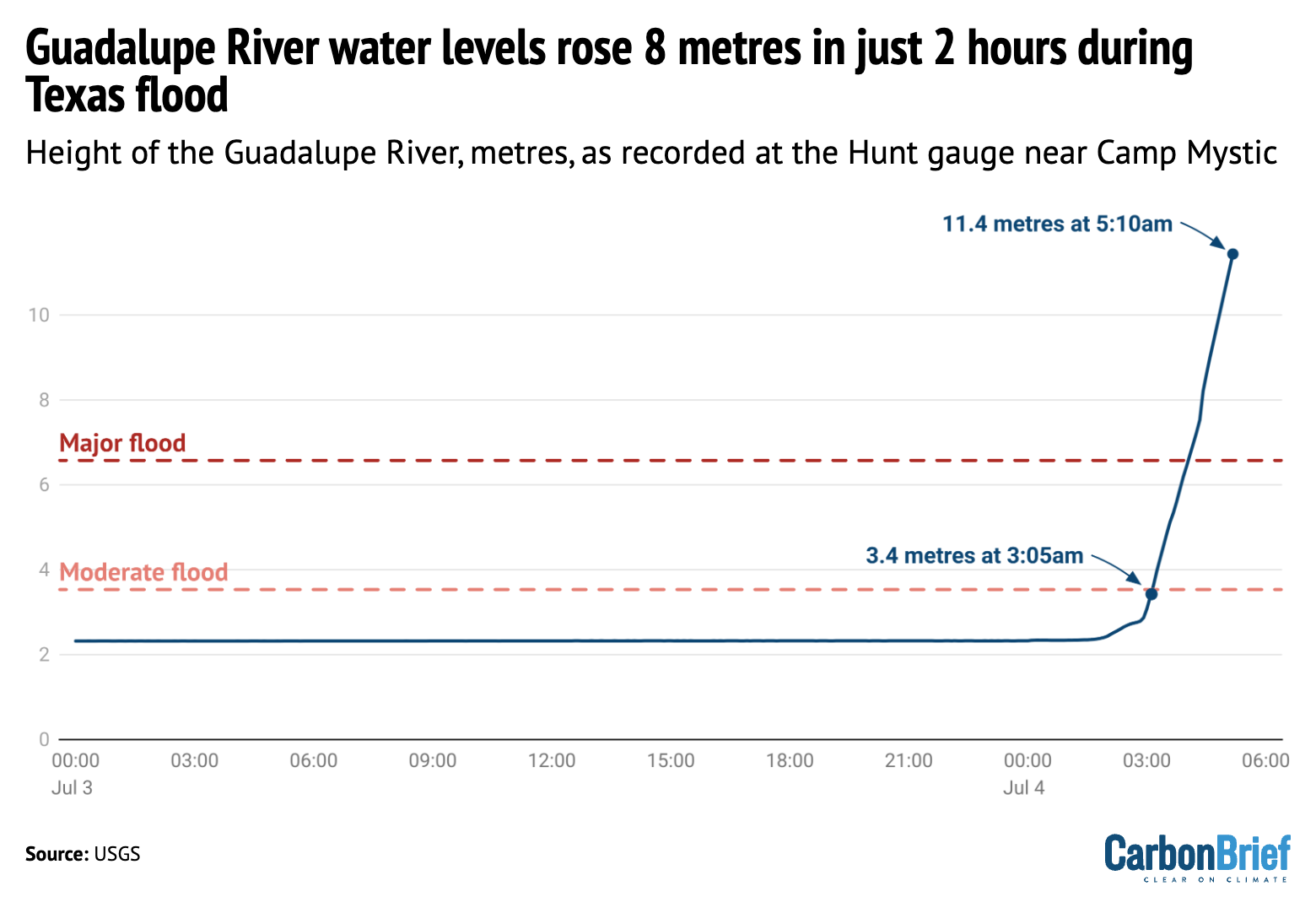
Water levels soared by more than eight metres in just over two hours on the Guadalupe River within an area known as “flash flood alley” in Texas on 4 July. The resulting floods caused devastation for people in nearby homes and summer camps. Satellite imagery in NBC News showed the scale of the impact. Carbon Brief examined the potential role of climate change in the flood and how it was covered by global media.
Spotlight
Ireland exits coal
This week, Carbon Brief looks at the significance of Ireland becoming the latest European country to end coal-powered electricity.
Ireland has joined the UK and a slew of other nations in burning its last lump of coal – the most polluting fossil fuel – to generate electricity.
Coal use ceased on 20 June at Moneypoint, the country’s last coal-burning power station, in line with a 2019 government pledge.
Spain and Italy are expected to become the next European countries to leave behind coal power, according to Beyond Fossil Fuels.
Ireland’s move offers an important “signal” for the country’s energy transition, said Margie McCarthy, the director of research and policy insights at the Sustainable Energy Authority of Ireland (SEAI). She told Carbon Brief:
“We’ve put in place a lot of really ambitious legislation and climate action plans, but we are still more than 80% reliant on fossil fuels across all of our energy demands…Coal is a particularly carbon-intensive fossil fuel, so any movement away from that is a good step forward.”
Coal controversies
Gas (42.1% in 2024) and renewables (39.6%) generate the vast majority of Ireland’s electricity. Coal, despite its overall decline, experienced a mini-comeback in 2021 and 2022 – broadly in line with EU trends when gas prices soared as Russia restricted supplies and countries later dropped Russian fossil fuels following the country’s invasion of Ukraine.
The share of Ireland’s electricity coming from coal increased from 4% in 2020 to 14% in 2021. This fluctuated again in recent years, dropping to 4.6% in May 2025.
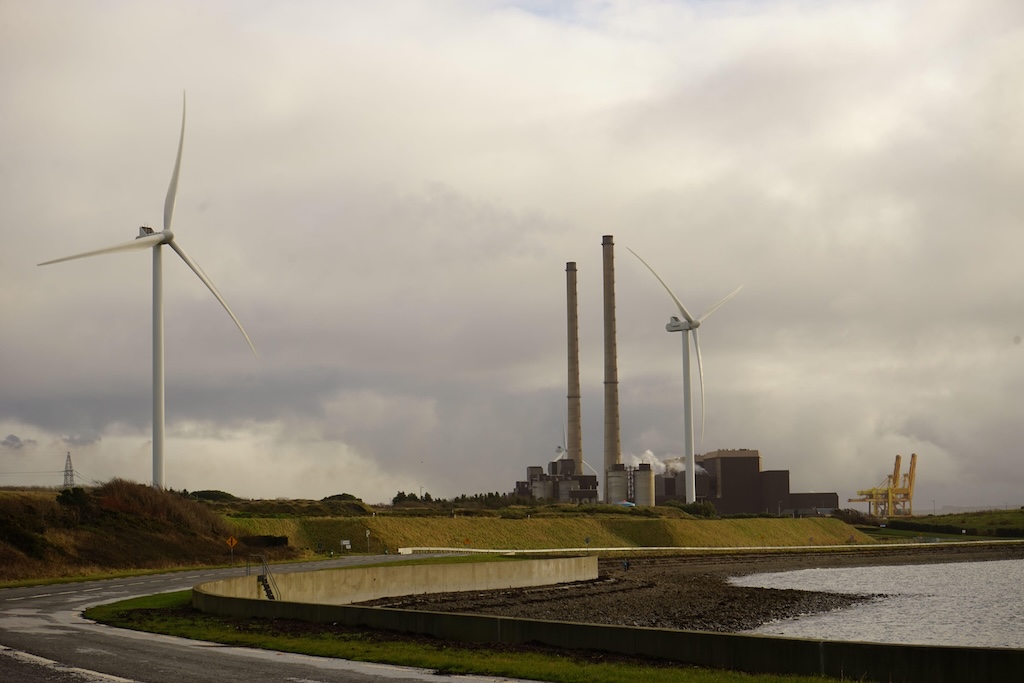
The ESB, the state-owned energy company that runs Moneypoint, was criticised in 2022 for resuming shipments from a controversial Colombian mine as an alternative to Russian coal. The company had stopped buying coal from the Cerrejón mine in 2018.
Cerrejón is “Latin America’s largest open-pit coal mine” – six times the size of Manchester, a recent article from the Bureau of Investigative Journalism said. Ireland’s national broadcaster RTÉ reported in 2024:
“According to local communities, lawyers’ organisations and court rulings, in its four decades of operation it has driven an environmental crisis that has destroyed the health, lives and culture of many thousands of Indigenous people.”
An ESB spokesperson told Carbon Brief that it sourced a “limited amount of coal from Cerrejón between April 2022 and August 2023”.
Next steps
Now that coal use has wound down, Moneypoint will remain available to generate electricity using oil on a back-up basis until 2029.
The ESB “expects low levels of running of the plant going forward”, a spokesperson said.
The company plans to turn Moneypoint into a “green energy hub”, with a major offshore windfarm, a wind turbine construction hub and a green hydrogen facility on site.
Looking at Ireland’s ongoing energy transition, McCarthy said that, although gas still plays a “significant” role, increases in wind, solar and electricity interconnection are “good signals to move in the right direction”. She added:
“We just need to keep the pace going. We need to accelerate quicker…and that we make sure we’re managing demand while we are trying to accelerate that pace.”
Data centre dilemma
A major cause of Ireland’s growing electricity demand is data centres, which consumed more than one-fifth of the country’s electricity supplies in 2024 – more than all urban households.
Ireland has become an “EU pioneer of data centres” thanks to “its low taxes, temperate climate and fibre cable access to the US and Europe”, according to the Financial Times.
McCarthy highlighted the importance of ensuring that “data centre demand is not undoing the renewable energy share, or the final energy consumption reductions that are required as part of our targets and obligations”. She added:
“It’s very fair to say that the efficiency measures in data centres have been significant…But the issue is that the demand is outpacing any efficiency measures that are being introduced.”
Watch, read, listen
OIL TO LITHIUM: A Climate Home News article looked at the challenges facing Nigeria’s efforts to “supply refined lithium to the electric vehicle battery industry”.
PODCAST CHAT: The Rest is Politics podcast spoke to the UK Climate Change Committee chief executive, Emma Pinchbeck, about net-zero and the energy transition.
BRRR: A BBC News “in depth” article explored the growing “battle” for control over the Arctic, along with the security challenges from climate change and other issues in “one of the world’s coldest places”.
Coming up
- 7-25 July: 30th session of the International Seabed Authority (part II), Kingston, Jamaica
- 14-23 July: UN high-level political forum on sustainable development, New York
- 17 July: UN General Assembly third informal dialogue on the Pact for the Future, New York
- 14-18 July:20th ordinary session of the African ministerial conference on the environment, Nairobi, Kenya
Pick of the jobs
- New Scientist, environment news reporter | Salary: £40,000-£50,000 (pro rata). Location: London
- Environmental Defense Fund, senior analyst, mission finance | Salary: €56,000-£61,000. Location: Belgium, the Netherlands or UK
- Daily Telegraph, environment editor | Salary: Unknown. Location: London
- United Nations Human Settlements Programme, junior nature-based solutions and climate consultant | Salary: Unknown. Location: Kenya
- Brookline.News, freelance environmental reporter | Salary: Unknown. Location: Massachusetts, US
DeBriefed is edited by Daisy Dunne. Please send any tips or feedback to debriefed@carbonbrief.org.
This is an online version of Carbon Brief’s weekly DeBriefed email newsletter. Subscribe for free here.


The post DeBriefed 11 July 2025: Texas floods; Global warming ‘tripled’ Europe heat deaths; Ireland exits coal appeared first on Carbon Brief.

Countries will meet in Armenia this month to carry out the first global review of progress towards meeting key nature targets by 2030.
These targets – and the wider ambition to halt and reverse biodiversity loss around the world – were agreed in the landmark Kunming-Montreal Global Biodiversity Framework in 2022.
But the ambitions will not be achieved in time for the 2030 deadline unless action “accelerates rapidly”, a key UN report found.
It noted that nations are falling short on 22 of 23 nature targets, which focus on restoring ecosystems, increasing nature finance and reducing harmful subsidies.
This report and other findings will inform the global progress review taking place at the COP17 biodiversity summit in Armenia over 19-30 October.
The sections below summarise the report’s findings on where progress has – and has not – been made on each of the 23 targets.
They also rank the extent to which countries have addressed elements of each target on a national basis. Click on each target for more information. Key terms are defined throughout each section and in a glossary below.
The post COP17: Tracking progress towards the UN’s 2030 nature targets appeared first on Carbon Brief.
https://interactive.carbonbrief.org/nature-targets-2030-progress/
The amount of finance for nature delivered to date “falls far short” of what is needed to meet the UN’s global goals, according to a report released ahead of the COP17 biodiversity summit.
The global stocktaking report, prepared by the UN Convention on Biological Diversity (UN CBD) ahead of this month’s summit in Armenia, finds that developed nations are failing to close the $200bn “biodiversity finance gap”.
Initiatives designed to support this goal are also stumbling, with a special “framework” fund for biodiversity receiving less than $140m from developed countries in the past two years and the “landmark” Cali Fund receiving only $6,000 from private companies.
The availability of finance – or lack thereof – is likely to be a key point of contention in negotiations at COP17 in Yerevan, Armenia, which begin on 19 October.
Target for 2025 ‘not achieved’
At COP15 in 2022, 196 countries agreed to an ambitious global deal to reverse biodiversity loss by 2030, dubbed the Kunming-Montreal Global Biodiversity Framework (GBF).
Goal D of the agreement, shown below, states that countries must “close” a $700bn “biodiversity finance gap” by 2030.
This overall $700bn is made up of two parts: changes to nature-harming subsidies; and raising financial resources to support biodiversity.
Target 18 within the text calls for countries to “identify by 2025, and eliminate, phase out or reform incentives, including subsidies, harmful for biodiversity…progressively reducing them by at least $500bn per year by 2030”.
The remaining $200bn should be met by “mobilising” resources, according to target 19 of the GBF. It states that countries should “substantially and progressively increase the level of financial resources from all sources” to “at least” $200bn per year by 2030.
The overarching $200bn can be from national budgets, multilateral development banks or money “mobilised” from the private sector.
However, the target also specifically states that “at least $20bn per year by 2025 and…at least $30bn per year by 2030” should be public biodiversity funding provided to developing countries by developed countries – or others that “voluntarily assume” their obligations.
According to the global stocktaking report prepared by the CBD, between 2020 and 2023, countries mobilised a cumulative total of just $186.4bn. This is equivalent to an average of less than $50bn per year.
While the report – published on 10 September 2026 – cautions that it is “still too early to draw any conclusions”, it adds that this total “falls far short” of what is needed to close the $200bn-per-year biodiversity finance gap.
It continues to specify that the milestone of raising “at least $20bn per year by 2025” in public finance was also “likely not achieved”.
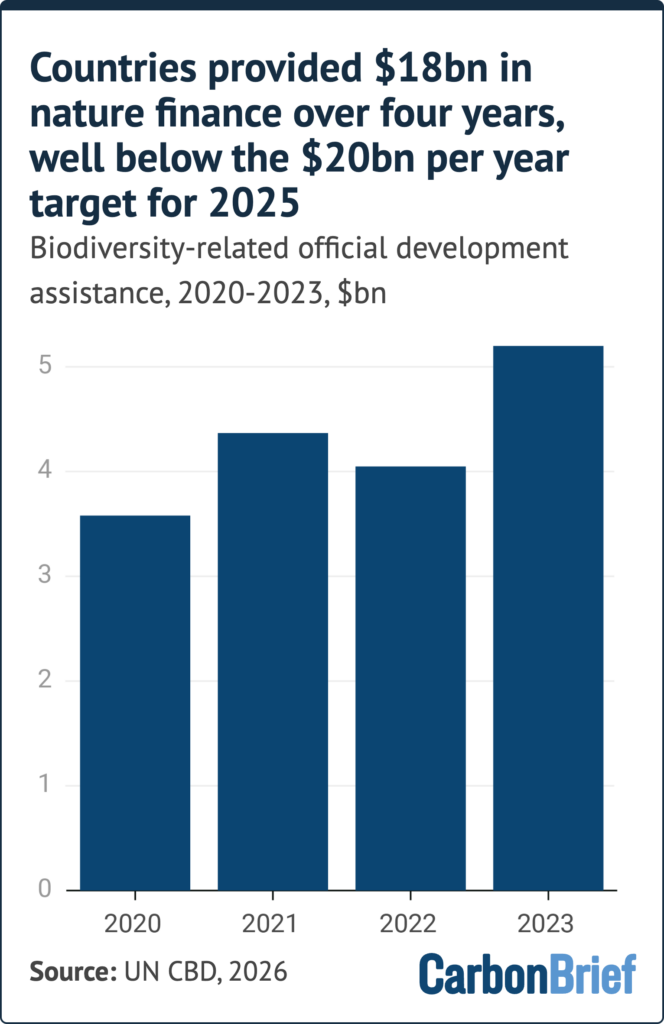
The report states that reporting countries raised a cumulative total of just $17.7bn in international public funding for biodiversity, across four years from 2020-23, as shown in the figure below. This amounts to an average of just $4.4bn per year.
These figures are supported by a report from the Organisation for Economic Co-operation and Development (OECD), which suggests that global biodiversity finance reached $74.9-92.4bn per year between 2023 and 2025.
It adds that, of this, international public finance contributed around $16.1bn per year on average – nearly $4bn below the 2025 goal.
Moreover, the OECD report says that only $7.9bn in 2023 to $8.5bn in 2024 was “biodiversity-specific” funding, with another $5.7bn and $6.5bn, respectively, coming in the form of funds for other priorities, in which support for biodiversity was a secondary aim.
While the GBF sets targets for nature finance in 2025 and 2030, developed countries should be making similar contributions every year, according to thinktank Third World Network.
Faltering initiatives
There are two main channels of international public finance that developed countries can use to meet their biodiversity finance commitments under the GBF. These are official development finance (ODF) and the Global Biodiversity Framework Fund (GBFF).
Separate figures for these channels also show financing falling behind the subtargets set out in the GBF.
This includes the Global Biodiversity Framework Fund (GBFF), which was established at COP15 in 2022.
It is currently housed under the Global Environment Facility (GEF) and reports directly to the biodiversity COP.
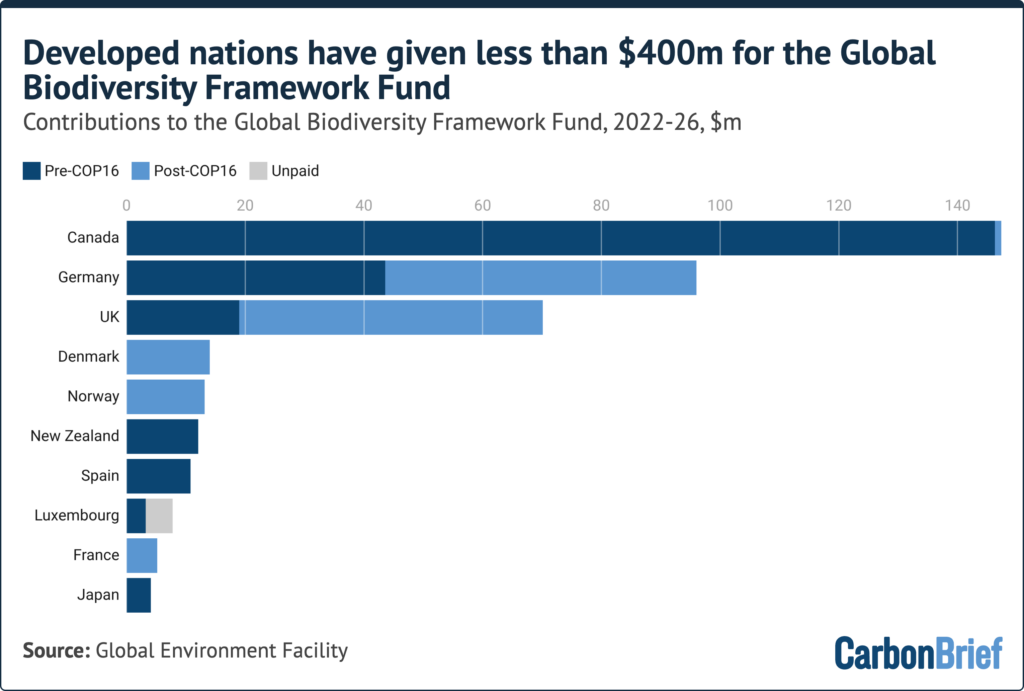
Despite an initial flurry of pledges for the initiative, developed nations had contributed less than $400m to the fund, as of July this year, according to data shared with Carbon Brief by the GEF.
Between August 2023 and 30 June 2026, the GBFF has received only $387.2m in signed commitments from 11 countries and one subnational government (Quebec in Canada).
The figure below shows that, after the initial pledges ahead of COP16 in 2024, there have only been a handful of new contributions to the fund.
Elsewhere, the Cali fund was created at the COP16 nature negotiations in Colombia in 2024.
It is the first-ever global fund for companies profi