

Welcome to Carbon Brief’s DeBriefed.
An essential guide to the week’s key developments relating to climate change.
This week
Trump to overturn ‘endangerment finding’
EPA OVERTURNING: The Trump administration announced its plan to overturn the 2009 finding that has been the “central basis” for US action to regulate greenhouse gas emissions, the Associated Press reported. A new Environmental Protection Agency proposal would rescind the “endangerment finding”, which determined that carbon dioxide and other greenhouse gases endanger public health and welfare, according to the newswire. If the finding is repealed, it would “erase current limits” on greenhouse gas pollution from cars, factories and power plants, AP said.
‘MISLEADING’ REPORT: The proposal is supported by a new Department of Energy report that uses “misleading and inaccurate” statements to argue that climate science has “overstated” the risks of a warming planet, Politico reported. The report, which also argues that climate science is “underestimating” the societal benefits of burning fossil fuels, was written by five scientists who “are known” for “denying accepted climate science”, the outlet added.
‘WINDMILL DISGRACE’: Wind development on federal lands and waters may be halted by the Trump administration, Bloomberg reported. Interior secretary Doug Burgum ordered a comprehensive review of the agency’s approval process, it said. According to Renewable Energy News, the department said more than 3.5m acres offshore were designated as “wind energy areas” by the last administration and that “terminating” these areas is “safeguarding” local environments and economies from “unchecked development”. This followed from Trump’s recent comment that “windmills are a disgrace”, the publication added.
Floods and heatwaves
SEVERE FLOODING: Torrential rains triggered a devastating flood in northern Nigeria, leaving at least 23 people dead, Deutsche Welle reported. The flooding has displaced 5,560 people and left dozens injured, according to the National Emergency Management Agency. More than 200 people have been killed in floods in Nigeria since the start of the rainy season in May this year, according to DW. The outlet reported that scientists have said climate change is fuelling many of these extreme weather occurrences.
BEIJING RAINS: China faced “another deadly rainy season” after 60 people were killed following days of torrential rain in Northern Beijing, reported Reuters. The outlet said climate change has made extreme weather “more frequent and intense”. Elsewhere, floodwaters from the Indus and Chenab rivers have “inundated” more than a dozen villages across Pakistan’s Punjab province, said India’s Tribune.
RECORD TEMPERATURE: Japan recorded its hottest day on record as temperatures reached 41.2C in southwest Tokyo, Al Jazeera reported. There were 16 heat-related deaths and more than 10,800 people were hospitalised with heatstroke last week, the outlet said. Meanwhile, the Iraqi government issued an official holiday in seven of its provinces as temperatures topped 50C, said Gulf News.
‘MILLIONS’ INSIDE: Temperatures soaring in the US have led to “millions” of Americans being warned to stay inside as some areas reach 48.8C, noted Newsweek. Heat warnings and advisories have been issued by the National Weather Service, according to the outlet.
Around the world
- ENERGY PLEDGE: The European Union has pledged to buy $750bn of energy from the US in exchange for a lower tariff rate under its trade deal with Trump. “Significant purchases” of US oil, liquified natural gas and nuclear fuel to replace Russian fossil fuels are included in the deal, CNBC reported. The Financial Times quoted energy experts saying the deal is a “pie in the sky” given that “US fossil fuel supplies [in 2024] to the bloc accounted for just $75bn”.
- COP30 COSTS: The UN held an “urgent meeting” over “sky-high” accommodation costs ahead of the COP30 climate summit in Brazil, Reuters reported. Meanwhile, the last US climate negotiators have been fired by the Trump administration, leaving the nation with “no official presence” at the summit, said CNN.
- ‘MELTING RAPIDLY’: Glaciers in Turkey’s southeast are melting rapidly due to rising global temperatures “amid human-caused climate change”, Al Jazeera reported.
- ‘SEWAGE CRISIS’: The US and Mexico have signed a deal to end the Tijuana “sewage crisis”, committing to update outdated wastewater infrastructure to handle higher flows triggered by worse flooding, said Inside Climate News.
- RENEWABLE ENERGY: Australia’s government has pledged to “substantially increase” its renewable energy underwriting scheme following concerns the nation will struggle to meet its 2030 power target, noted the Guardian. Meanwhile, New Zealand’s government has voted to resume gas and oil drilling despite an “outcry” from the opposition and environmental groups, reported the New Zealand Herald.
- ‘UNHELPFUL TUSSEL’: UN climate chief Simon Stiell paid a visit to Australia and urged the nation and Turkey to resolve their “long-running tussle” over who will host the COP31 summit, calling the delay “unhelpful and unnecessary”, Reuters reported.
66.8 million
The hectares of intact tropical forest that overlaps with oil blocks in the Democratic Republic of Congo, according to Earth Insight.
Latest climate research
- Climate change could make ‘droughts’ for wind power 15% longer | Carbon Brief
- A study of urban construction workers in Taiwan found that heat stress imposes “substantial economic burden” and results in productivity losses in the range of 29-41% | Nature Cities
- Drought will increasingly contribute to the collapse of many bird species that live in highly arid regions of the US | Biological Conservation
(For more, see Carbon Brief’s in-depth daily summaries of the top climate news stories on Monday, Tuesday, Wednesday, Thursday and Friday.)
Captured
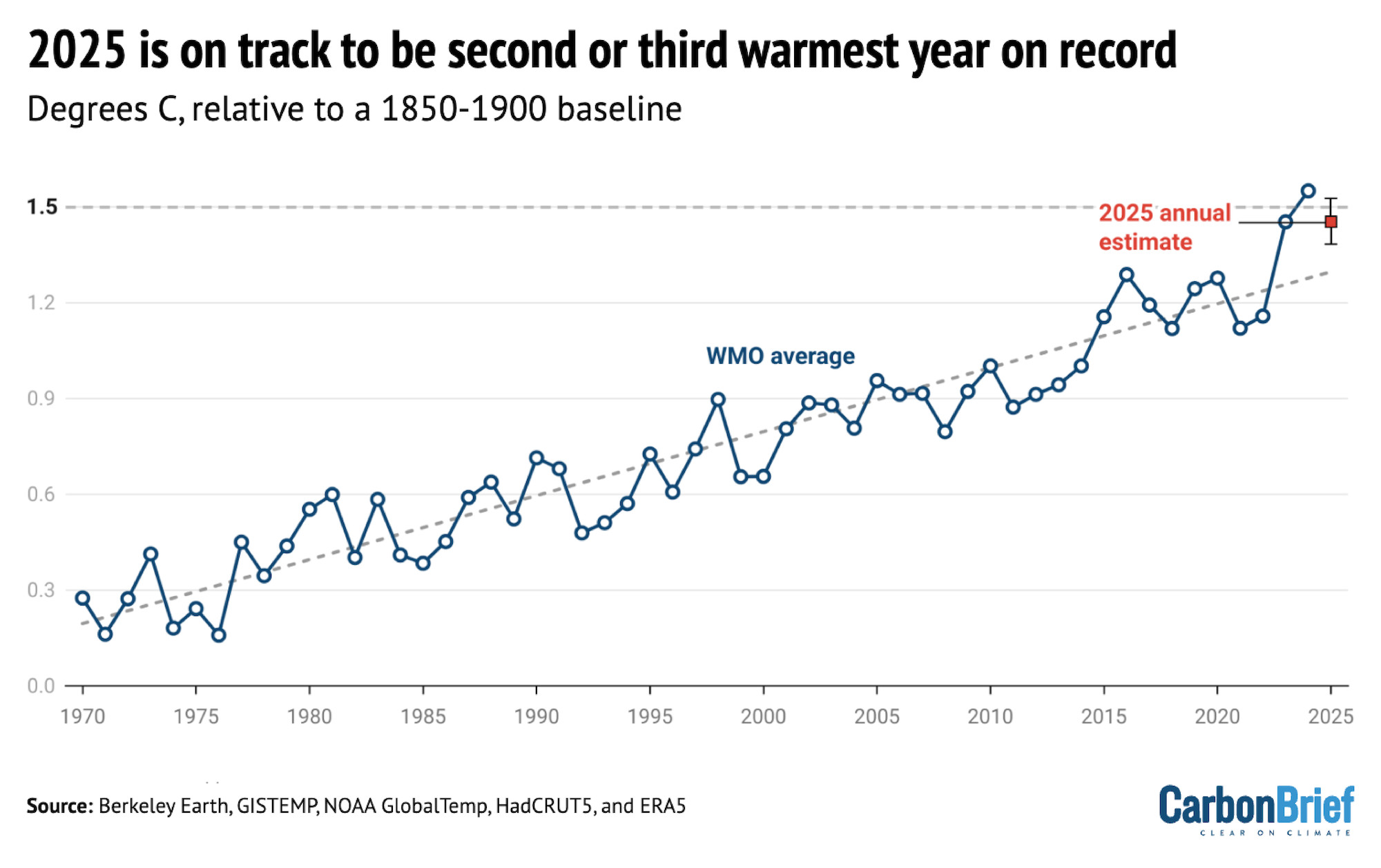
New analysis by Carbon Brief this week revealed that 2025 is on track to be the second or third hottest year on record. The chart above draws on data from five different research groups that report global surface temperature records to illustrate how 2025 saw the second-hottest first half of the year on record.
Spotlight
‘Thirst’ exhibition maps the water crisis
This week, Carbon Brief visits a London exhibition exploring the world’s worsening water crisis.
Intricate ink drawings on cotton paper explore interconnected issues in Nepal.
Global warming has melted glaciers in the region, causing flooding and infectious diseases, displacing human and non-human life.
Yet, through his drawings, Nepalese artist Karan Shrestha has created a mosaic of the Himalayan region that shows water as a signifier of extreme weather and a life-giving source to be shared.

His piece, “Water-giver, memory-keeper and the shifting forces”, is displayed at the Wellcome Collection for its “Thirst: In Search of Freshwater” exhibition.
Brought together by Wellcome curator and lecturer Janice Li, it features 125 objects that showcase the impact of climate change on water and its role in shaping health and ecosystems.
Li’s research into the etymology of “thirst” unravelled a global interpretation of water, reflecting the exhibition’s geographical breadth. She told Carbon Brief:
“Humans have faced really brutal and critical environmental crises and have, through a really deep innate knowledge of their own specific land, been able to devise monumental infrastructure to combat the crises they face.”
Just before Shrestha’s art in the exhibition are photographs taken by M’hammed Kilito.
In one picture, Kilito’s guide, Mustapha, looks into a dried-up well in a Moroccan oasis.
Climate change and human activities have resulted in the loss of two-thirds of oases in the country, according to information displayed at the exhibition.
Speaking about the photograph, Kilito told the Guardian that it looked like Mustapha was “praying for the return of something essential: water”.
Water adopts multiple faces in the exhibition: a vital yet scarce resource in certain pieces, a spiritual entity in others – and a destructive force.
Nothing makes the latter as clear as “Deluge” by photojournalist Gideon Mendel. Five screens display footage of the aftermath of severe floods around the world, captured by Mendel over 17 years.
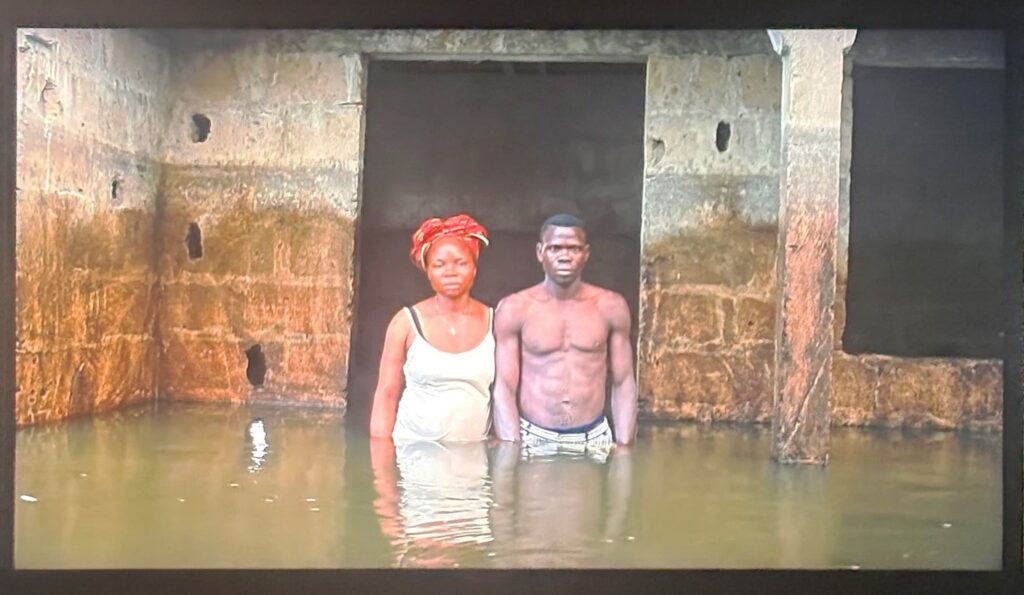
Li told Carbon Brief:
“[Gideon] told me that, in the last two years, there’s always been a flood of that magnitude happening somewhere. He didn’t imagine that one day it would get to a point where he would have to choose which one to go to.”
Next to “Deluge” is a dome-like space where visitors can sit on bean bags and listen to glaciers melting in the Himalayas.
Though the exhibition confronts global water challenges, Li hopes it also reminds visitors of the resource’s beauty:
“Quite a few people told me they sit in the listening room for half an hour, really enjoying themselves and then guilt hits them because they’ve forgotten they’re listening to melting ice. But, this is the beauty of art, and a lot of beauty has come out of decay, destruction and deterioration because it also, sometimes, signals rebirth.”
Watch, read, listen
YAK HERDERS STRUGGLE: The Associated Press featured the stories of yak herders in India’s Himalayan mountains as climate change threatens their way of life.
PILOT ANXIETY: A Guardian documentary followed two airline pilots grappling with the climate impacts of their jobs.
‘IS DECARBONISATION DEAD?’: New York Times columnist Ezra Klein invited climate experts onto his podcast to discuss the future of renewable energy in the US.
Coming up
- 5-14 August: Second part of the fifth session of the Intergovernmental Negotiating Committee to Develop an International Legally Binding Instrument on Plastic Pollution, Geneva, Switzerland
- 9 August: UN international day of the world’s Indigenous peoples
- 11-15 August:UN Environment Programme’s International Methane Earth Observatory at AmeriGeo Week 2015: Earth Observations for the Americas, Bogotá, Colombia
Pick of the jobs
- Climate Justice Standard Lab, research associate in forest carbon and climate justice | Salary: $25-35 an hour. Location: Remote
- The Church of England, net-zero carbon programme decarbonising churches lead | £59,248. Location: Remote
- UN Office for Project Services, country engagement specialist and regional coordinator for eastern europe, Santiago network | Salary: Unknown. Location: Geneva, Switzerland
DeBriefed is edited by Daisy Dunne. Please send any tips or feedback to debriefed@carbonbrief.org.
This is an online version of Carbon Brief’s weekly DeBriefed email newsletter. Subscribe for free here.
The post DeBriefed 1 August 2025: Trump targets ‘endangerment finding’; Floods and heatwaves; ‘Thirst’ exhibition appeared first on Carbon Brief.

Meena Raman is deputy director at Third World Network (TWN), a public interest lawyer and an expert on international climate negotiations. Leon Sealey-Huggins is senior campaigner in global climate justice and just transition at War on Want. Both organisations are members of the Global Campaign to Demand Climate Justice (DCJ).
The world urgently needs the next assessment of climate science. But speed cannot be the only consideration. Equally important is whose research informs it, whether scientists from developing countries can participate meaningfully, and how its findings shape global climate policy.
The timeline of the IPCC’s Seventh Assessment Report (AR7) is a major point of contention at its sixty-fifth meeting in Addis Ababa this week. Since early 2024, it has been contested principally between developed countries and Small Island Developing States (SIDS) seeking earlier completion, and many developing countries calling for more time.
-
Global deforestation slowed in 2025 but Brazil’s election could undo “fragile” gains
Countries remain 70% off track to meet a goal to end deforestation by 2030, as progress in Latin America offset by failures in Africa

Many developed countries, SIDS and some Least Developed Countries (LDCs) want the AR7 Working Group reports completed by 2028, to inform the second Global Stocktake (GST2) of the Paris Agreement. IPCC assessment cycles have generally taken five to seven years.
But the IPCC’s findings would remain relevant after 2028. Reports completed in 2029 could inform countries’ next nationally determined contributions (NDCs) in 2030. The stocktake assesses collective progress, rather than prescribing individual emissions targets.
More time needed for input from developing countries
Between IPCC60 and IPCC65, developing countries – including Algeria, Burundi, Burkina Faso, Bolivia, China, Egypt, Ghana, Guinea, India, Iran, Iraq, Indonesia, Jordan, Kenya, Libya, Malaysia, Morocco, Mozambique, Saudi Arabia, South Africa, Syria, Tanzania, Tunisia, Turkmenistan, Venezuela, Yemen and Zimbabwe – have raised concerns over an earlier AR7 timetable and its impact on inclusivity. Russia and Belarus have expressed similar concerns. An earlier completion date could also affect the scientific integrity and robustness of the AR7 assessments, they argue.
Developing countries have emphasised equity in the IPCC’s work, both in process and substance. Their emphasis on a six-to-seven-year assessment cycle is linked to ensuring that the reports reflect scientific literature from the Global South, including research led and funded by institutions in developing countries.
Who funds research, where institutions are based, which questions receive attention and whose work is assessed shape the IPCC’s evidence base. Scientists in developing countries face unequal access to funding, institutional support and international collaboration.
Extending a deadline alone cannot resolve these inequalities. The timetable must be designed alongside measures to strengthen research capacity and enable meaningful participation, otherwise existing inequalities risk being reproduced in successive assessments.
Timeliness doesn’t guarantee political action
Equity is not only about who participates. It also concerns the assumptions behind scientific models, the development pathways they describe and how their findings are subsequently used. Consider mitigation scenarios assessed in the IPCC’s Sixth Assessment Report (AR6). The IPCC itself acknowledges that most do not explicitly incorporate assumptions about global equity, environmental justice or income distribution within regions.
These scenarios draw on assumptions about development, technology and mitigation, and can shape climate policies. The IPCC calls them projections, not predictions or forecasts. Yet when global emissions pathways become reference points in UN climate decisions, the distinction between projected outcomes and an equitable distribution of responsibilities can blur.
Timely science does not guarantee political action. The IPCC’s Fourth Assessment Report in 2007 identified emissions reductions of 25–40% below 1990 levels by 2020 for developed countries as a group, under a particular scenario. Yet Canada withdrew from the Kyoto Protocol, while Japan and Russia declined new commitments under its second period.
Comment: Governments that support climate science must stand firm against naysayers
The first Global Stocktake in 2023 recognised the need to reduce global greenhouse gas emissions by 43% by 2030 and 60% by 2035 relative to 2019, and reach net-zero carbon dioxide emissions around 2050 to limit warming to 1.5°C with no or limited overshoot.
These benchmarks were highlighted in AR6’s mitigation report. However, the report had an important caveat, that most modelled pathways do not explicitly account for global equity and are projections, not forecasts. But when the 43% figure entered the Global Stocktake decision, it did so without this caveat. This was a fatal omission, given that Article 14 of the Paris Agreement requires Global Stocktake be conducted in the light of equity and the best available science.
Including findings from such models in international climate decisions without their caveats is problematic. Such assumptions affect how future energy use, emissions reductions and development opportunities are distributed across regions.
Emissions-cutting pathways put burden on Global South
A 2024 peer-reviewed study by Indian scientists, published in Climate Policy, examined 556 mitigation scenarios. The researchers found that global inequalities in income, energy use and emissions were projected to persist until 2050, raising questions about whether these pathways reflect equity.
In the scenarios underlying the 43% global reduction figure, sub-Saharan Africa is projected to reduce emissions by 80% by 2030, against 50% in North America and Europe. Developed countries are projected to retain higher per-capita fossil fuel consumption in 2050, while developing countries reduce consumption from already low levels. These pathways place a disproportionate mitigation burden on developing countries, despite developed countries’ historical responsibility.
As science comes under attack at UN talks, climate movement splits over how to respond
Some of the severest projected restrictions on energy use are in sub-Saharan Africa and South Asia, home to many Least Developed Countries (LDCs), where essential infrastructure is yet to be built, even as climate impacts worsen. Yet these scenarios constrain energy consumption and development prospects.
The scenarios also rely on large amounts of land-based carbon dioxide removal, with more than 70% projected in Latin America and the Caribbean, Asia and Africa. This has implications for food security, livelihoods and biodiversity, placing burdens on communities most vulnerable to climate change and least responsible for it.
The IPCC’s findings carry considerable scientific and political weight. Its assessments must uphold the highest standards of scientific integrity, inclusiveness and equity, both in process and substance. There must be no shortcuts for political expediency.
The post Who shapes climate science? The equity question facing the IPCC appeared first on Climate Home News.
Who shapes climate science? The equity question facing the IPCC
A first set of biodiversity plans filed by countries to reverse nature loss are “insufficient” to meet this decade’s global targets, including a landmark goal to protect at least 30% of the world’s land and marine ecosystems by 2030, a landmark UN report warned on Thursday.
The State of Biodiversity Action, put together by a panel of technical experts for the UN Convention on Biological Diversity (CBD), was released in Yerevan, ahead of the COP17 nature talks starting on Monday in the Armenian capital.
Over the next two weeks, governments will for the first time take stock of progress towards the Global Biodiversity Framework (GBF) agreed in 2022 – a set of 23 targets also known as the “Paris Agreement for nature” – and will decide on policy guidelines for ramping up ambition before the 2030 deadline. The UN report will be the main basis for these negotiations.
At a press conference in Armenia, UN Secretary-General António Guterres highlighted that, while there has been some progress on the GBF, the “bad news” is that less than half of country plans are on track to meet its targets.
If current commitments are met by the end of the decade, only 26% of land ecosystems and 12% of marine ecosystems will be protected – falling “real short” of the 30% target agreed in Montreal in 2022, Guterres said. “The war on nature has not yet ended,” he added.
UN Environment chief Inger Andersen said the report “sets the tone for the focus, ambition and urgent action we need to deliver” in Armenia, including by reducing subsidies that harm nature and mobilising new finance for biodiversity. “All leaders and all negotiators must respond to these findings,” she emphasised.
Andersen added that climate change amplifies threats to biodiversity, which makes protection all the more important as global warming is now almost certain to rise above a key threshold. “Exceedence of 1.5C increases the likelihood of forest diebacks, phenological shifts, warming oceans that become more inhospitable to species, irreversible tipping points and so much more,” she said.