

We handpick and explain the most important stories at the intersection of climate, land, food and nature over the past fortnight.
This is an online version of Carbon Brief’s fortnightly Cropped email newsletter. Subscribe for free here.
Key developments
COP16 resumes in Rome
CALI CARRIES ON: The UN biodiversity summit, COP16, resumed in Rome yesterday after the countries failed to reach agreement on several key issues in Cali, Colombia last year. The latest round of talks “will focus on securing financial resources and developing a robust system to track biodiversity commitments”, DownToEarth said. Devex noted that the Rome meeting “won’t have the same pomp and circumstance” as the Colombia talks. On the first day of the resumed talks, the Cali fund for sharing the benefits derived from genetic data – seen as one of the big “wins” from the Colombia talks – was launched.
DEFORESTATION IS UP: Last week, COP16 president (and former environment minister of Colombia) Susana Muhamad announced that deforestation in the country was 35% higher in 2024 than 2023. According to Climate Home News, the increase was “fuelled by an uptick in the Amazon region”, which Muhamad attributed primarily to “the involvement of organised crime more than rural communities”. Despite the uptick, the deforestation rate in 2024 was still the second lowest in the last 23 years, after last year’s record low.
NATURE PLANS LACKING: Meanwhile, a joint investigation by Carbon Brief and the Guardian found that of the 137 countries that had submitted updated biodiversity plans to the UN by 21 February, fewer than half were committing to protecting 30% of their land and sea by 2030. The so-called “30 by 30” target was a key goal of the Kunming-Montreal Global Biodiversity Framework, agreed at COP15 in Montreal. Responding to Carbon Brief and the Guardian, several countries said that they are still finalising their targets. Indonesia pointed out that the target is meant to be a global one, with no contributions specified for each country. Brian O’Donnell, director of Campaign for Nature, said: “This is troubling and action must be taken to put the world on track.”
Extreme weather driving up food prices
MAPPING DAMAGES: Carbon Brief published a new interactive map showing some of the impacts of extreme weather on global crops during 2023 and 2024. Using news reports in global media and other sources, the analysis identified 100 cases around the world where crops were damaged or destroyed by heat, drought, wildfires or other extreme events. According to the findings, Europe, the Middle East and sub-Saharan Africa were the regions most impacted by flooding, while Asia, Europe and Latin America were the most frequently hit by droughts.
HUGE IMPACT: Extreme weather is “expected to” drive up food prices throughout 2025, according to analysis covered by the Guardian. The research showed a “long-term trend towards more extreme weather events would continue to hit regional crop yields, causing price spikes”. Of the studied crops, coffee and cocoa had the highest price spikes last year due to surging rainfall and temperatures. Elsewhere, Mongabay covered a new report from the UN Food and Agriculture Organization pointing out that increasing droughts and floods, as well as rising temperatures in Latin America and the Caribbean, are leading to crop and livestock losses, interruption of supply chains and impoverishment among farmers. Those events are “highly frequent” in 74% of the countries in the region, the report said.
TOWARDS COP30: Warmer temperatures threaten wheat production in India, which has declined over the past three years, the New Indian Express reported. According to India’s Meteorological Department, north-western areas have seen temperatures fluctuate 2-6C above normal during that time. In Brazil, the inflation rate for food and beverage reached nearly 7.7% last year due to the impacts of climate change, according to COP30’s official webpage. The website quoted Guilherme Mello, secretary of economic policy at Brazil’s ministry of finance, who stressed the need to “adapt and create adequate instruments to guarantee food and water security”.
Spotlight
Biodiversity banking on a breakthrough
This week, Carbon Brief traces the history and future of the fight for a new biodiversity fund as COP16 restarts in Rome.
The fight for a new biodiversity fund – dominating the agenda at the resumed nature talks in Rome and led by “megadiverse” countries – is a fight that has come a long way in the last four years.
From a proposal in Nairobi to an overlooked objection that soured nature’s “Paris” moment in Montreal, the call for a COP-governed biodiversity fund that could match climate’s $100bn-promise failed to materialise at COP15.
Instead, the final nature deal for this decade – gavelled through in a hurry – gave the world an interim fund with a mandate to operate only until 2030. It gave rich countries a scaled-down, collective bottom line of paying $20bn per year by 2025 and $30bn per year by 2030 in biodiversity finance, against a $700bn-a-year nature funding “gap” that is widening every year.
With only $250m collected in the interim fund and developed countries accused of failing to pay their “fair share” by the start of COP16, Zimbabwe revived the fight for the fund on the very first day in Cali.
The decision “to establish a dedicated global financing instrument” eventually made it to a 3:30am draft issued by Colombia’s Susana Muhamad. That “L document” published well into overtime and an inability to gather a quorum put the brakes on COP16. It is now at the heart of what brings countries again to Rome.
To Muhamad, the “polarisation” around resource mobilisation has a lot to do with the “changing landscape of power in geopolitics”, the economic cost of conflict and the need to “substantially address” biodiversity loss and climate change.
The Rome session follows what has been described as a “betrayal” of climate finance talks at COP29 in Baku. It also comes as a re-elected Donald Trump dismantles US climate policy and many European countries cut their aid budgets.
Although the US is not a party to the UN Biodiversity Convention (CBD), Trump’s withdrawal from the Paris Agreement and geopolitical trade wars have cast a cloud over global environmental cooperation and tempered hopes for more public funding for nature and climate.
At the opening of the resumed talks, UN secretary general Antonio Guterres warned in a statement that “[w]ith the world approaching dangerous tipping points, it is imperative that [countries] reach agreement here in Rome” on how biodiversity finance commitments will be honoured. He added:
“We share nature and we depend on nature. Multilateralism is our only hope.”
The Rome talks are already seeing countries bringing the same arguments to the table, even though $30bn is a 10th of the $300bn climate-finance goal.
In general, developed countries want to broaden and review the list of donor states contributing biodiversity finance to include other countries, such as China and Russia, as well as private sources, such as biodiversity credits. They also typically do not see the need for a new fund after 2030. In contrast, developing countries do not want to leave Rome without a new fund or to let countries escape their historical obligations to pay.
Muhamad, meanwhile, is hoping nations will agree on a roadmap somewhere in between and make progress towards reforming the complex, but shallow, pool of biodiversity finance.
After back-to-back regional consultations and bilateral meetings, her ambitious after-midnight draft has since been reformed into a “reflection note” attempting compromise. But, as she notes, “nothing is agreed until everything is agreed”, including a monitoring framework that countries say is contingent on a strong finance outcome.
As a delegate from Panama pointed out on the first day of the Rome talks:
“Biodiversity financing beyond 2030 must reflect the urgency of the biodiversity crisis and align with the commitments under the framework. This is a matter of survival for ecosystems, economy and humanity. We cannot repeat the failures of climate finance. [The Rome talks] must deliver more than words. It must deliver funding.”
News and views
US AG DEPARTMENT CHAOS: Organic farmers have sued the US agriculture department over its deletion of climate-related information from its website, the New York Times reported. The now-missing pages contained “datasets, interactive tools and funding information that farmers and researchers relied on for planning and adaptation projects”, the newspaper wrote. The department also implemented a funding freeze on climate- and conservation-related programmes, although some freezes on the latter have been lifted, according to Civil Eats. Meanwhile, the department is “scrambling to rehire several workers who were involved in the government’s response to the ongoing bird flu outbreak” and had been fired on Elon Musk’s recommendation, according to the Associated Press.
RIVER RESTRICTIONS: Norway’s parliament has approved a bill that would “open up protected rivers to hydropower plants”, the Guardian reported. Nearly 400 of the country’s waterways are currently protected from such development. The Guardian noted that “companies seeking to build hydropower dams would still face strict assessments before being granted a permit”. However, one member of the Norwegian parliament said the bill was “a historic attack on Norwegian nature”. The newspaper added that as a result of Norway’s network of hydropower dams, “the Norwegian electricity grid is among the cleanest on the planet”.
CONGO CORRIDOR: A plan to create the “world’s largest protected area” in the Democratic Republic of Congo does not have the approval of Indigenous peoples and local communities, Climate Home News reported. In January, DRC president Felix Tshisekedi announced the creation of a 2,600km-long “green corridor” in the Congo basin forest, which he said would “strengthen agricultural value chains and sustainable development”. However, the outlet noted that Indigenous and local groups have not been consulted about the project and “fear it could impinge on their land”. Groups that oppose the project, including Greenpeace Africa, fear it could “perpetuate neo-colonialism”.
ET TU, EU?: The European Commission plans to pare back the number of companies facing the EU’s sustainability reporting requirements and delay a key due diligence law that would require companies to address environmental and human-rights issues in their supply chains, according to a draft seen by Reuters. Politico published a set of five takeaways on the EU’s long-term “vision” for agriculture, which includes “stronger support for carbon farming [and] bioenergy production”. Environmental campaigners told the Guardian that the new farming strategy “ignores vital green proposals” including a just transition fund, a “necessary increase in environmental payments” and “the case for eating less meat”. Separately, Scandinavia’s largest dairy producer told the Financial Times that uncertainty about the EU’s rules “is deterring investment in food production and pushing up prices”.
TENSION OVER CORN: Mexico lifted its ban on genetically modified corn imports from the US, after a ruling made under the US, Mexico, Canada Agreement (USMCA), SciDevNet reported. In 2020, former Mexico’s former president, Andrés Manuel López Obrador, had issued a decree to ban GM corn. After a recent ruling against such a ban, filed by a dispute settlement panel, current president Claudia Sheinbaum’s administration released a new decision on 5 February approving the use of GM corn for human consumption and calling off the plan to halt its use for animal feeding.
Watch, read, listen
PAYBACK TIME: The Straits Times’s Green Pulse podcast spoke to Dr Siva Thambisetty, who was closely involved in negotiations for the landmark Cali Fund that launched this week.
SEA TREASURES: A BBC Earth video showed the “top five whale scenes”, including everything from feeding techniques to the ongoing challenges they face.
BANANA BOOM: Mekong Eye explored how booming demand for bananas has driven large-scale soil depletion in Laos.
KEEPING CHAPARRAL ALIVE: NPR explained the importance of California’s native chaparral brush and how clearing it will not reduce the risk of wildfires.
New science
- Research published in Bird Study found that solar farms contained greater numbers and diversity of birds, as compared to arable farmland. Researchers studied six solar farms in the UK, finding that these benefits could be magnified by managing the farms with biodiversity in mind.
- UK peatland fires emitted around 800,000 tonnes of carbon between 2001 and 2021, according to a study published recently in Environmental Research Letters. By looking at climate projections, the researchers found that 2C of warming could increase peatland-fire emissions by more than 60%.
- A new study, published in Nature Food, finds that 1.2 billion people globally are dependent on imported nitrogen fertilisers for food production. The authors suggest that shifting towards smaller-scale ammonia production could increase both food security and agricultural sustainability.
In the diary
- 24-28 February: 62nd session of the Intergovernmental Panel on Climate Change | Hangzhou, China
- 25-27 February: Resumed session of COP16 | Rome
- 26 February: UK Climate Change Committee seventh carbon budget advice published | London
- 26-28 February: Finance in common summit | Cape Town, South Africa
- 3 March: World Wildlife Day
- 5-7 March: World Sustainable Development Summit 2025 | New Delhi
Cropped is researched and written by Dr Giuliana Viglione, Aruna Chandrasekhar, Daisy Dunne, Orla Dwyer and Yanine Quiroz. Please send tips and feedback to cropped@carbonbrief.org

The post Cropped 26 February 2025: COP16 biodiversity talks resume; Farmers sue Trump; Mapping extreme weather’s ag impacts appeared first on Carbon Brief.

Three countries have been named by the Paris Agreement’s compliance committee for failing to submit a nationally determined contribution (NDC) and repeatedly snubbing offers of help with their climate plans.
After months of internal debate over whether to identify serial non-responders, the Paris Agreement’s Implementation and Compliance Committee (PAICC) named the three countries which have failed to engage with it over their NDCs on Friday.
It named Democratic Republic of Congo, Senegal and North Korea in a footnote of its annual report, adding that it decided to name them “with a view to facilitating engagement”, adding that representatives of the three nations had been invited to its meeting in early 2027 “with the purpose of identifying any challenges and constraints”.
“The Committee noted the importance of Parties engaging with the Committee in a timely manner, while noting that some delays may be due to the national capabilities and circumstances of the Parties”, the report said.
-
Under US pressure, World Bank says it will back gas “where appropriate”
The US wants the World Bank to expand its gas support while climate campaigners are pushing for it to end – its head spoke this week of limited backing for the fossil fuel -
IPCC scientists vow to press on with climate reports despite political deadlock
After governments again failed to agree a timeline, nearly 120 IPCC authors pledged to complete their assessment on time and with full scientific rigour -
Paris Agreement committee snubbed over missing NDC climate plans
Many governments have still not submitted a nationally determined contribution to the UN, breaching a key requirement of the Paris Agreement

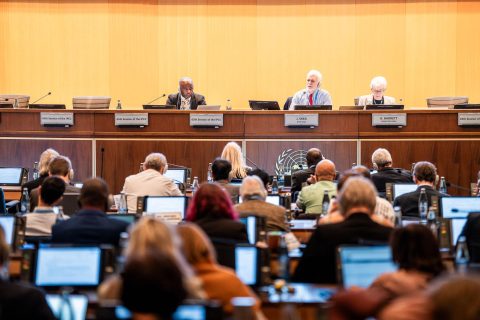

In July, PAICC said 12 countries had ignored its repeated attempts to discuss why they had not published an NDC as required every five years under the 2015 Paris accord.
Members of the committee had been divided over whether to name them, but at a September meeting decided to do so in their annual report to the annual climate COP summit.
By the time the report was published on Friday, only Congo, Senegal and North Korea “had not communicated an NDC or submitted a [Biennial Transparency Report] and had not yet responded to any of the Committee’s notifications, despite several reminders issued by the Committee in this regard”.
Rainforest and renewable energy ambitions
The silence from Congo and Senegal is notable because the former is home to much of the Congo Basin rainforest while the latter has sought billions of dollars in climate finance to support its renewable energy ambitions.
After Brazil, Congo has more rainforest than any country in the world. This forest, and the country’s peatlands, absorb huge amounts of greenhouse gas but are fast being lost to expanding farmland, charcoal production, logging and mining.
Senegal signed a Just Energy Transition Partnership with Canada and wealthy European nations in 2023, to help it meet its renewable energy targets under the-then government of Macky Sall. It was chair of the Least Developed Countries group between January 2022 and December 2023.

Tejas Rao, who is researching the PAICC as part of a doctoral thesis at Cambridge University, said the governments of the three countries should engage with the committee.
“Engagement costs these governments very little and the committee has shown it will listen,” he said.
“Silence leaves the committee with no basis to help, and it leaves the [governments] exposed to the narrative that they are simply disengaged,” he told Climate Home News.
Paris Agreement requirement
The 2015 Paris Agreement requires all parties to publish an NDC every five years outlining their emissions reduction targets, with each plan meant to be more ambitious than the country’s last NDC.
The latest set – the third round of plans, with new targets for 2035 – was due in February 2025. While most countries missed this deadline, all but around 30 – mostly small emitters but including Egypt, Vietnam and Argentina – have now submitted them.
Over the year, the PAICC – which is made up of government climate officials from developed and developing countries – has been communicating with governments that have not submitted NDCs and trying to overcome barriers to them doing so.
Some nations have cited exceptional circumstances as the reason for not submitting an NDC, a process that requires a significant amount of work in tracking emissions and consulting on how to curb them across the economy. For example, a letter from a Sudanese official to the PAICC, seen by Climate Home News, said that the country’s civil war had led to the suspension of its NDC preparation.
-
IPCC scientists vow to press on with climate reports despite political deadlock
After governments again failed to agree a timeline, nearly 120 IPCC authors pledged to complete their assessment on time and with full scientific rigour -
Under US pressure, World Bank says it will back gas “where appropriate”
The US wants the World Bank to expand its gas support while climate campaigners are pushing for it to end – its head spoke this week of limited backing for the fossil fuel