

Countries have agreed at the resumed COP16 talks in Rome to a strategy for “mobilising” at least $200bn per year by 2030 to help developing countries conserve biodiversity.
Nations also agreed for the first time to a “permanent arrangement” for providing biodiversity finance to developing nations, “future-proofing” the flow of funds past 2030.
Faced with a highly unstable geopolitical landscape and a previous set of talks that ended in disarray in Colombia, countries forged a path to consensus on a set of texts in what many nations celebrated as a win for multilateralism in uncertain times.
The agreement on finance comes despite the world’s largest biodiversity donor – the US, which has never been a formal party within these talks – recently deciding to withdraw most of its nature funding in a foreign-aid freeze under Donald Trump.
Many European countries who signed onto the agreement have also recently cut their aid budgets.
Nations also agreed on two texts for tracking their progress towards achieving the targets of the Kunming-Montreal Global Biodiversity Framework (GBF).
The GBF is a landmark deal first made in 2022 aiming to halt and reverse biodiversity loss by 2030.
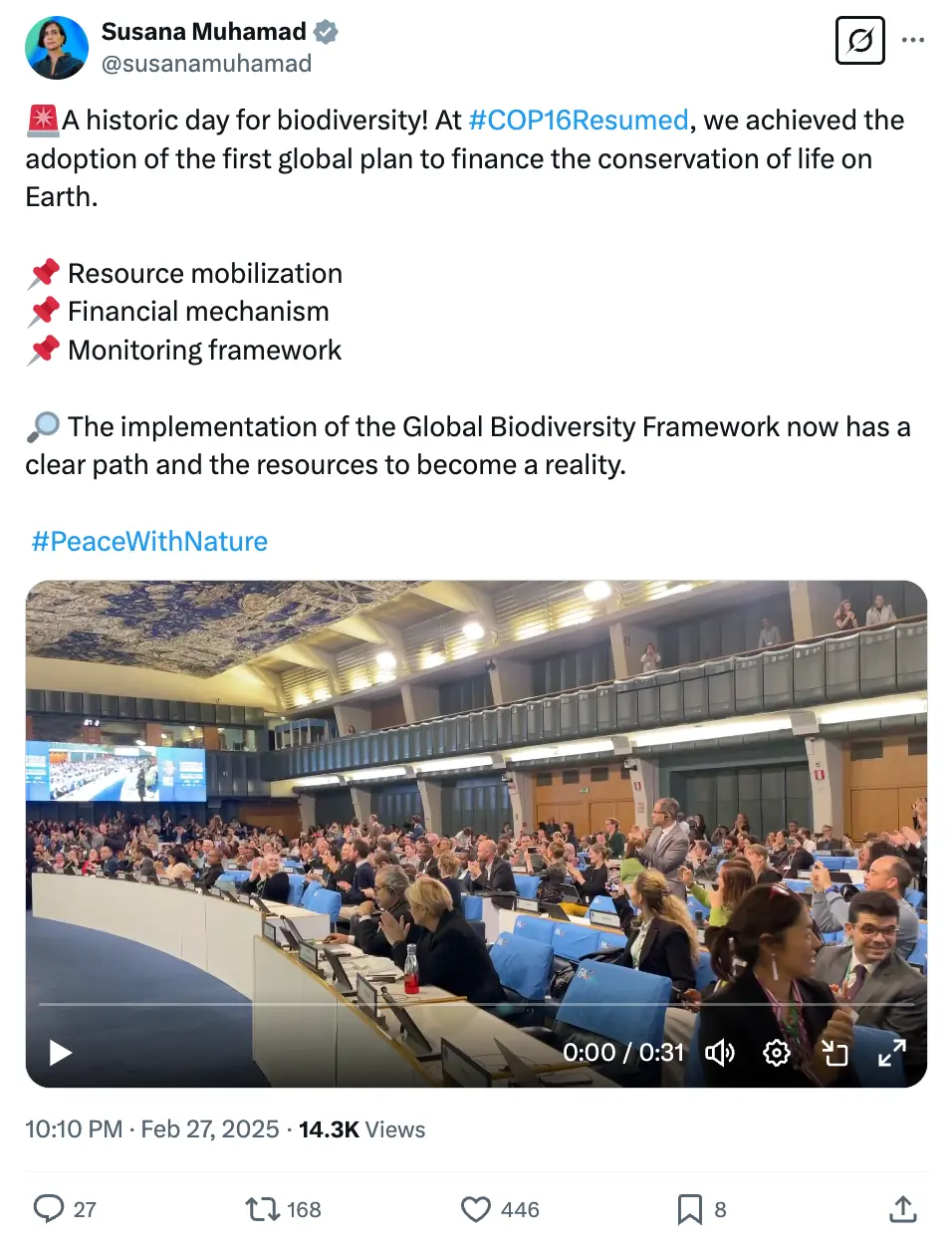
Colombian politician and COP16 president Susana Muhamad received a lengthy standing ovation for her role in guiding parties to consensus in the early hours of Friday morning in Rome.
But, amid celebrations, some countries cautioned that a vast amount of progress will be needed to have a chance of halting and reversing biodiversity loss in just five years.
Some three-quarters of nations have still not submitted their UN biodiversity plans for how they will achieve the targets of the GBF – four months after the deadline.
And a recent investigation by Carbon Brief and the Guardian revealed that more than half of nations that have submitted UN biodiversity plans do not commit to the GBF’s flagship target of protecting 30% of land and seas for nature by 2030.
- COP16’s back story
- Finance
- Global review
- Monitoring framework
- Cooperation with other conventions
- Around the COP
COP16’s back story
COP16 was the first UN biodiversity summit following the adoption in 2022 of a landmark agreement, known as the Kunming-Montreal Global Biodiversity Framework (GBF), at COP15. The overall goal of the GBF is to “halt and reverse biodiversity” loss by 2030, through four goals and 23 targets.
At COP16, many issues centred around the “means of implementation” of the GBF. Initially, the conference was set to take place in Turkey, but the country withdrew from hosting it after a series of destructive earthquakes. Colombia took on the organisation of the summit and Cali was named as host city in February 2024.
In Cali, countries agreed on a new fund for the sharing of benefits from the use of genetic data, the creation of a dedicated subsidiary body for Indigenous peoples and local communities and a new process to identify ecologically and biologically significant marine areas.
However, the final plenary ran through the night, owing to disagreements over biodiversity finance. With many delegations needing to catch flights home, COP16 was suspended the following morning due to a lack of the “quorum” needed to reach consensus.

Later that month, the COP16 presidency stated that the negotiations would be resumed in the new year to “address outstanding issues on finance and complete the mandate of this COP”.
Among the pending items left over from Cali was a new strategy for “resource mobilisation”, aimed at allocating $200bn annually for biodiversity conservation “from all sources” by 2030.
Alongside that, countries needed to agree on the mechanism for distributing funds. Global-south countries urged the creation of a new global fund for biodiversity, to be under the control of the COP. Meanwhile, global-north countries argued for maintaining the current fund, which is housed under the Global Environment Facility (GEF), a multilateral fund set up in the early 1990s to “support developing countries’ work to address the world’s most pressing environmental issues”.
Countries also had to revisit the monitoring framework for the implementation of the GBF, which seeks to “provide the common yardsticks that parties will use to measure progress against the 23 targets” of the GBF, according to the CBD.
Parties also failed to agree on a new text outlining the process for a global review of national biodiversity strategies and action plans (NBSAPs) at COP17 in Armenia in 2026 and COP19, four years later.
The CBD took up the remaining issues in two “resumed” sessions of COP16.
The first of these meetings, to approve the budget, was held in December under “silence procedure” – meaning the text was circulated and parties given a period of time to respond with any objections. The second resumed session was held in person at the headquarters of the UN Food and Agriculture Organization (FAO) in Rome, from 25 to 27 February 2025, to address all remaining decisions.
Finance
Post-2030 fund
The fight over a new, dedicated global biodiversity fund – the subject of fraught negotiations in Nairobi, Montreal and Cali – dominated the agenda at the resumed COP16 nature talks in Rome.
As a whole, COP16 was supposed to deliver a strategy for raising funds to assist countries in implementing the “ambitious” nature deal struck at COP15.
It was also expected to deliver a financial mechanism under the COP to provide developing countries with the means to meet biodiversity goals and targets.
At the resumed COP16 talks in Rome, countries made history by agreeing to set up a “permanent arrangement for the financial mechanism” under the COP by 2030 – a decision that is decades in the works.

While the decision does not establish a brand new fund immediately, it is “future proofing” global biodiversity finance beyond 2030, Georgina Chandler from the Zoological Society of London told a press briefing. The text leaves open the form that the finance will take – either under a new entity, or as part of existing funding instruments that biodiverse countries have been seeking to reform.
A permanent financial mechanism is the “unfinished business of the COP, 30 years in the making”, said Lim Li Ching from the Third World Network. While there is much to be debated at successive COPs, “at least the mechanism is locked in”, she told Carbon Brief.
The resumed COP16 also saw countries agree on a roadmap to develop the financial mechanism, reform existing financial institutions and mobilise funding from “all sources” to close the $200bn per year biodiversity funding gap.
To speed up raising these resources, the text asks the executive secretary of the CBD to “facilitate an international dialogue” of ministers of environment and finance from developing and developed countries.
This was a “highlight” of the outcome in Rome, Brian O’Donnell, director of the Campaign for Nature, said in a statement.

Per the roadmap, countries will have to decide on criteria for the mechanism by COP17 next year in Armenia. By COP18, they will have to decide whether this will take the form of a new fund and, if so, make it operational by COP19 in 2030.
At the same time, the COP has tasked its expert subsidiary body to look into “opportunities for broadening the contributor base”, accommodating a key ask from developed countries.
This means including more countries, such as China, as formal biodiversity finance providers, according to Laetitia Pettinotti from development finance thinktank ODI. Pettinotti told Carbon Brief:
“Countries have agreed to look into the contributor base. But, actually, many developing countries already contribute biodiversity finance via their funding to multilateral entities – the GEF, WB [World Bank], UN agencies, etc. So part of this discussion will need to look at recognising those contributions.”
Resource mobilisation: from Cali to Rome
The Rome talks were expected to pick up where Cali left off – with an ambitious, but divisive, draft decision on resource mobilisation issued by Muhamad in the early hours of 2 November last year.
That document contained a proposal to establish a new global biodiversity fund under the COP’s governance, to be ready by COP30.
This had been a key demand of developing countries in the run-up to the previous talks in Montreal. Instead, the final nature deal for this decade – gavelled through at COP15 in a hurry – gave the world an interim fund with a mandate to operate only until 2030.
Without enough countries in the room to pass the decision in Cali, the fight for a new fund had to wait until COP16 resumed in Rome.
Between the Cali and Rome talks, Muhamad held regional consultations and bilateral meetings with countries and ministers from around the world in an effort to find agreement.
On 14 February, Muhamad released a “reflection note” laying out the state of play in the finance negotiations. In this, she discussed some of the “important differences” remaining between countries on the resource mobilisation draft and areas of “broad agreement” that emerged in her consultations.

Some of these disagreements, she said, were partly rooted in “different interpretations of terms used”. To address this, the note contained a glossary defining terms used within the finance texts.
Muhamad put forward a roadmap towards improving global biodiversity finance architecture, which, she said, countries “broadly support[ed]” at that stage.
In an updated note on 21 February, the president issued “textual suggestions” on the most contentious paragraphs of the resource mobilisation text.

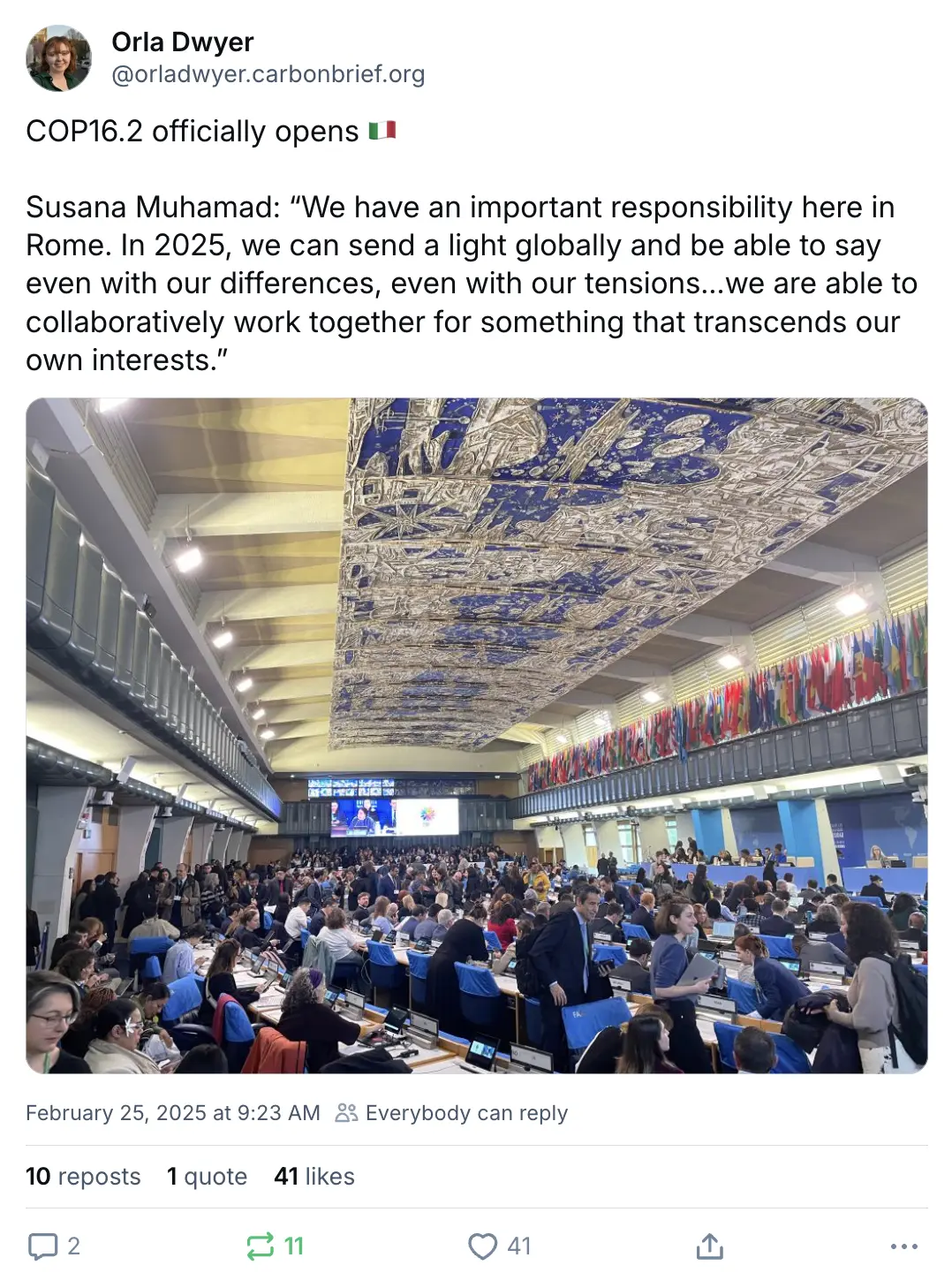
At the opening plenary on 25 February, minister Muhamad said the discussions at this COP were “not technical decisions”, but rather “political decisions”. She questioned whether countries were able to “transcend…old and outdated” institutional structures and move towards something new.
Some countries broadly supported the president’s suggestions, but were clear that more discussions were needed. Others, such as India, were sceptical and favoured the explicit language in the draft text from Cali.
Most developing countries called for establishing a dedicated financial instrument at the Rome talks, opposed expanding the donor base and highlighted the need to “honour” existing financial commitments.
In turn, most developed countries wanted to improve – not replace – existing funding instruments and broaden the list of donor countries and funding sources. They also favoured a process leading up to COP19 that would not “prejudge the outcome”.
Fiji noted in the opening plenary that adopting a clear and comprehensive resource mobilisation strategy is “critical” to the success of the GBF. They added that the future process and roadmap must be “efficient and streamlined”, given the urgency of financing needs.
Informal consultations on resource mobilisation took place on the evening of 25 February. The next morning, Muhamad thanked delegates for the “very open and frank discussion” on their various positions on the text.
The negotiations moved slowly for most of the three days. A third of the morning plenary on 26 February, for example, was taken up by a back-and-forth over a request from the DRC to change the agenda.
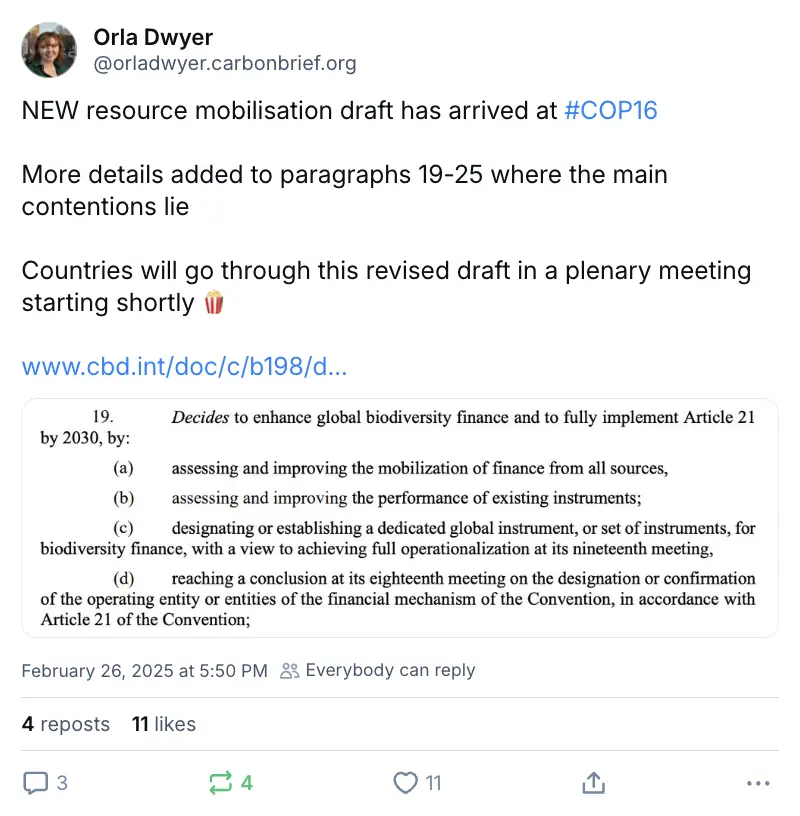
A revised resource mobilisation document was released by the presidency on the evening of 26 February. Minutes later, countries were invited to give their thoughts on the significantly updated text in plenary.

Many expressed their surprise at the revisions and requested more time to review the text, which was only available in English as it had not yet been translated into the other five UN languages.
Egypt and the DRC’s request to give the African Group a few minutes to consult on the text was denied by Muhamad, with countries instead encouraged to discuss the text and present their concerns as regional groupings the next morning.
“This is becoming a precedent that a region cannot ask for regional consultations,” said Daniel Mukubi Kikuni of the DRC at the evening plenary, adding that the draft resembled Muhamad’s “informal” reflection note more than its predecessor that was negotiated by all countries in Cali. Kikuni added:
“[This document has been] deeply changed, transformed and modified. We cannot accept it as a foundational document for our discussion.”
Panama said that it was concerned by a “lack of ambition” in the revised document. Other countries, including Ivory Coast and Egypt, expressed concern that the pace of the document’s proposed roadmap was “missing urgency” and was too “process-heavy”, given that 2030 is five years away.
While the EU, Norway and the UK appreciated the text as a “balanced package” and said it was “very close to the landing zone”, they were caught off-guard by text that suggested “possible direct allocation” of funds to countries.
The next morning, another plenary took place for regional groupings to provide consolidated feedback on the updated draft. Several blocs and countries suggested alternative text, including a “compromise” proposal submitted by Brazil on behalf of BRICS countries and Zimbabwe articulating Africa’s position.
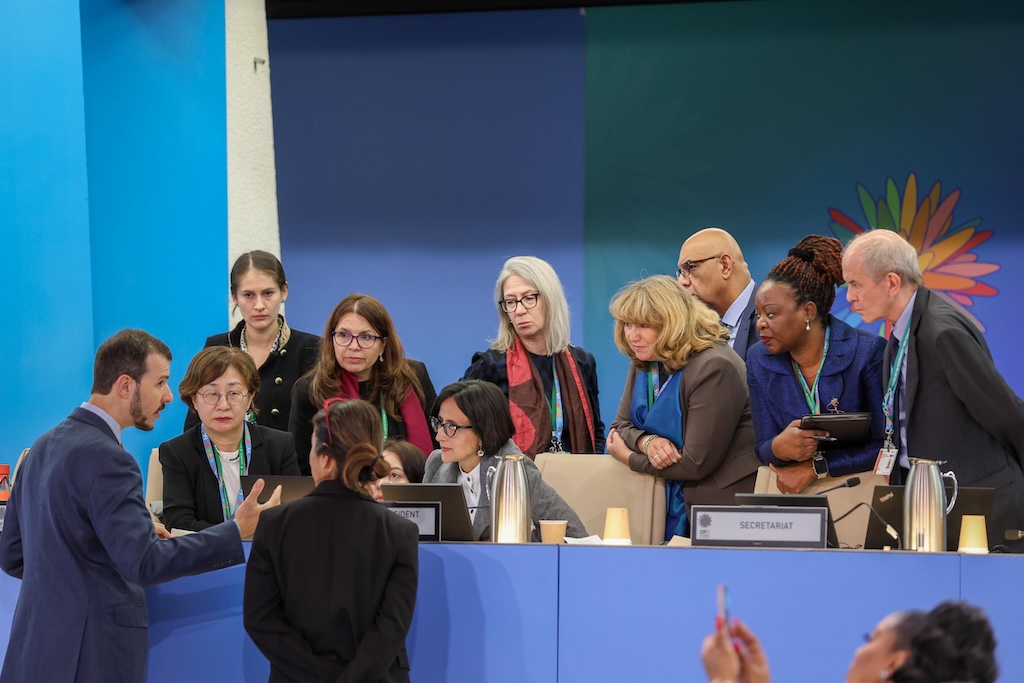
With the clock ticking and much to accomplish before midnight, Muhamad adjourned the plenary and asked up to five representatives from regions to work with her in a small group towards a consensus text to bring to the plenary.
After a six-hour closed door session, a new resource mobilisation non-paper emerged around 7pm on the final evening of talks.
The non-paper referred to the establishment of a “permanent arrangement for the financial mechanism”, mirroring text suggested by Brazil on behalf of BRICS countries earlier in the day. Instead of promising a new fund, the text said that the mechanism could be “entrusted to one or more entities, new, reformed or existing” – suggesting that a compromise had been struck between developed and developing countries
The non-paper had just one bracket in place (which, in UN documents, signals disagreement), stating that the final structure of the mechanism had to be “non-discriminatory”, which some delegates feared could potentially rule out certain funds that were limited by sanctions.

Bernadette Fischler Hooper, the head of international advocacy at WWF, told the press that this was a “make or break moment” to determine the levels of trust between countries, but that the text “showcased the high art of diplomacy”. She added:
“It doesn’t sound very exciting, but the fact that there will be [an instrument] from 2030 onwards is actually a huge step forward, because they haven’t managed to do that for the last five years. That was what nearly brought the COP15 in Montreal to fall.”
The presidency released a final revised document on resource mobilisation at 10:40pm, when the final plenary was already long-delayed.
This contained the same text as the non-paper, but with the final bracket removed. With no interventions, countries agreed and the final resource mobilisation text was gavelled through amid applause, cheers and tears in the plenary hall.
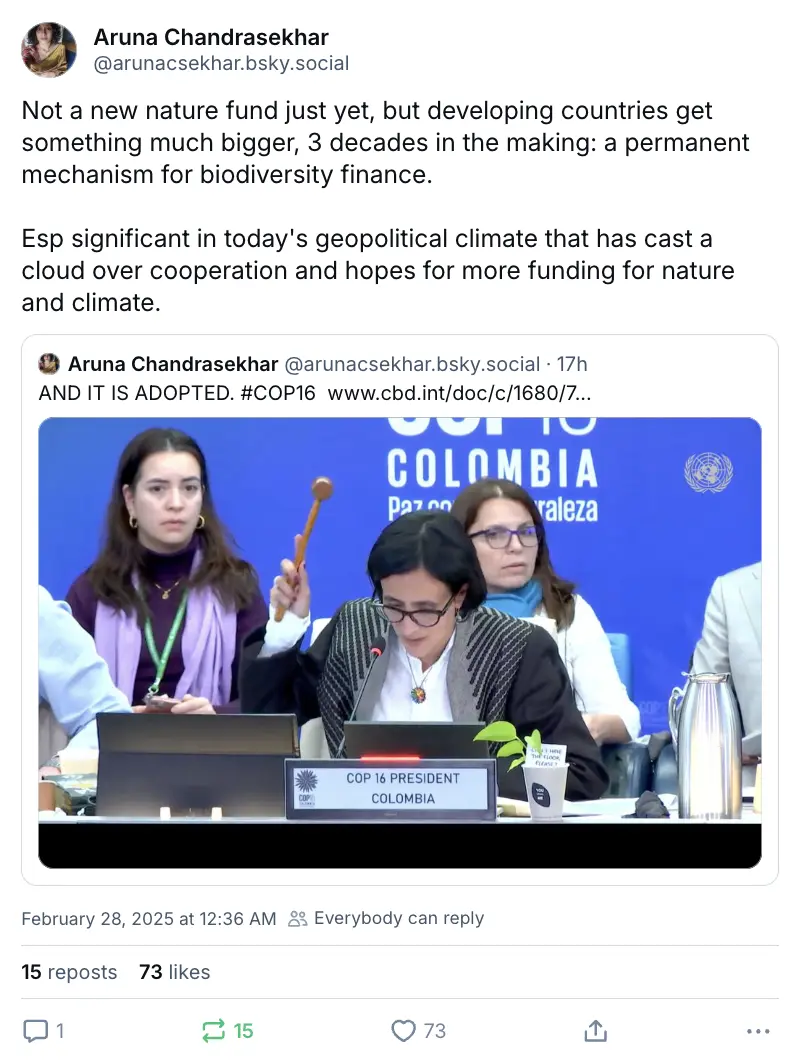
Minutes later, after interventions from the EU and Japan, Brazil cautioned against last-ditch changes to the closely related financial mechanism text, saying that “if we start to blow too close to [a castle of] cards, then everything starts to fall off”.
After a show of support from former COP-hosts Canada, the COP adopted the decision on the financial mechanism.
Juliette Landry of the Institute for Sustainable Development and International Relations (IDDRI) described the finance outcome to Carbon Brief as “a delicate balance” struck between “reluctant parties”. She added that countries had “agreed to lift polarised opposition” around a new fund in order to fix “systemic” gaps in existing biodiversity funding.
The figure below illustrates the development of language around a new financial instrument, in each iteration of the resource mobilisation text.


Successive iterations of language around the new financial instrument from Cali (left) to Rome (centre and right). Source: UN CBD (2024, 2025a, 2025b)
One of the drivers behind finance reform is that developing countries say they can struggle to access biodiversity finance. Ramson Karmushu from the International Indigenous Forum on Biodiversity told a press conference that submitting a funding proposal can be complicated and time-consuming.

He further noted that proposals which ask for data can be difficult for Indigenous peoples when the data is “in our minds, not in computers”.
Lim Li Ching from TWN, meanwhile, told Carbon Brief that despite the financial goals for 2025 and 2030 not being discussed in Rome, they remain “incredibly important”. She concluded:
“There’s still a long road ahead, but we live to fight another day.”
Global review
Another text that was adopted in Rome was on mechanisms for planning, monitoring, reporting and review (PMRR), including a global review of progress due to be conducted at COP17 in Armenia in 2026.
This is document outlines the schedule for how countries will assess their progress towards meeting the targets of the GBF in the coming years.
It is the first time in the history of biodiversity talks that countries have agreed to a text specifically on tracking their own progress. The groundwork for this was laid out in the GBF itself, which includes a section on “responsibility and transparency” from countries.
“Planning” refers to countries submitting national biodiversity strategies and action plans (NBSAPs). Countries were meant to submit new NBSAPs by October 2024, but, so far, three-quarters of countries have yet to do so.
“Monitoring” refers to countries using indicators set out in the monitoring framework (see below) to assess their progress towards meeting biodiversity targets.
“Reporting” refers to the need for countries to produce national reports detailing this progress by early 2026. Shortly after this, a “global report” will be produced, assessing NBSAPs and national targets to track whether countries are on track for the targets of the GBF.
“Review” refers to a global review of progress, which is due to take place at COP17.
In Cali, countries managed to produce a bracket-free version of the PMRR text.
At the time, observers said it was generally positive that nations had managed to agree to a way for tracking their own progress, but noted that the text lacked a clear follow-up procedure to ensure countries increase their efforts accordingly after the global review.
Some also lamented the lack of opportunities for all stakeholders, including civil society, to participate in the PMRR process.
Despite countries finalising the text, it was not adopted at the end of the Cali talks. This is because it was scheduled for adoption after the texts on finance, which countries ultimately failed to find consensus on.
In Rome, the CBD secretariat presented a new version of the PMRR text during a plenary on 25 February. This included an adjusted timeline reflecting that work towards the report and review will start following the end of the resumed talks, rather than December 2024 as previously set out.
A representative of the secretariat said the timeline for ensuring all the work is completed is now extremely “tight”, but still achievable.
Many nations expressed their support for the PMRR text and urged other countries to accept it without making any further changes.
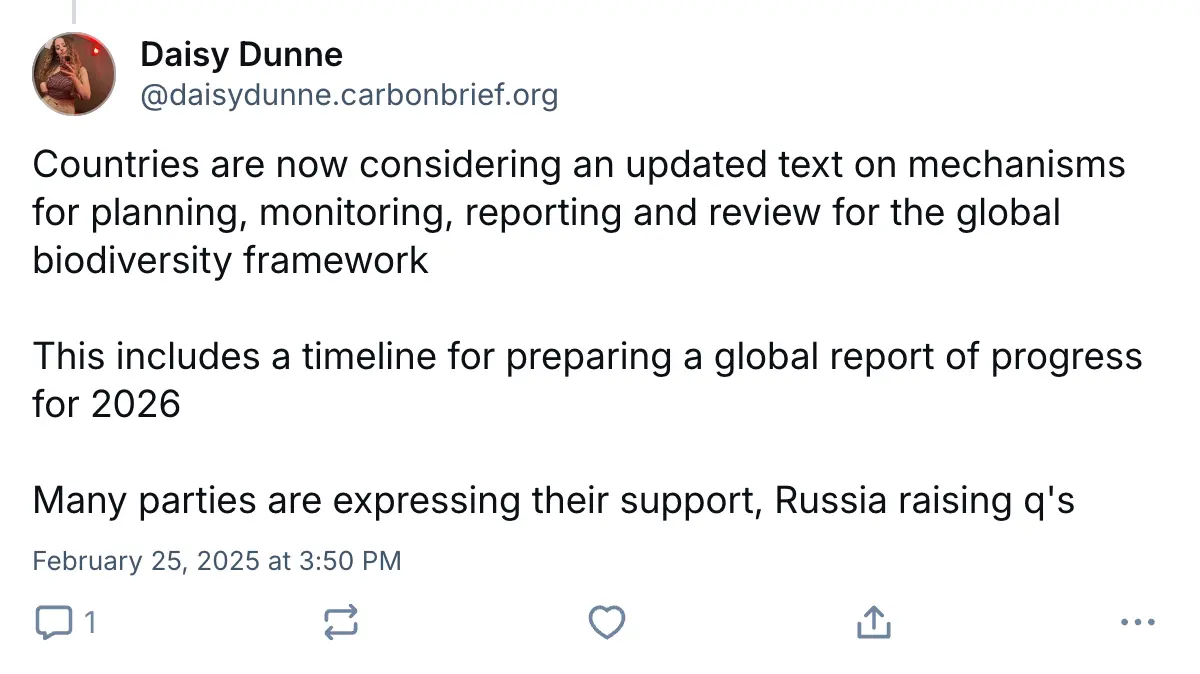
However, Russia and Zimbabwe both raised concerns with small details of the text. COP16 president Susana Muhamad said she would consult privately with parties that were not yet happy to accept the PMRR text.
In plenary on the following day, countries turned to the PMRR text again.
At this point, Zimbabwe suggested adding in a new footnote.
Zimbabwe’s specific concern was around a section of the text that invites non-state actors, such as NGOs and companies, to voluntarily contribute what they are doing to meet the targets of the GBF to the CBD’s online portal.

Zimbabwe called for a footnote noting that these submissions shall be subject to the consent and approval of the country that the non-state actor is based in.
This call was backed by Cameroon, Egypt, Indonesia, Russia, Ghana, the Ivory Coast, the DRC and Russia, according to the Earth Negotiations Bulletin. It was opposed by the European Union and Norway.
Explaining the possible motivations of including such a footnote in the text, one observer told Carbon Brief that, from a “positive” perspective, it might allow countries to block “greenwashing” from companies, adding:
“If you want to be a little bit more cynical about it, it gives countries an opportunity to be less open to hearing from voices they don’t necessarily want to hear criticism from.”
The next day, all nations agreed to include this new footnote – leaving no outstanding issues.
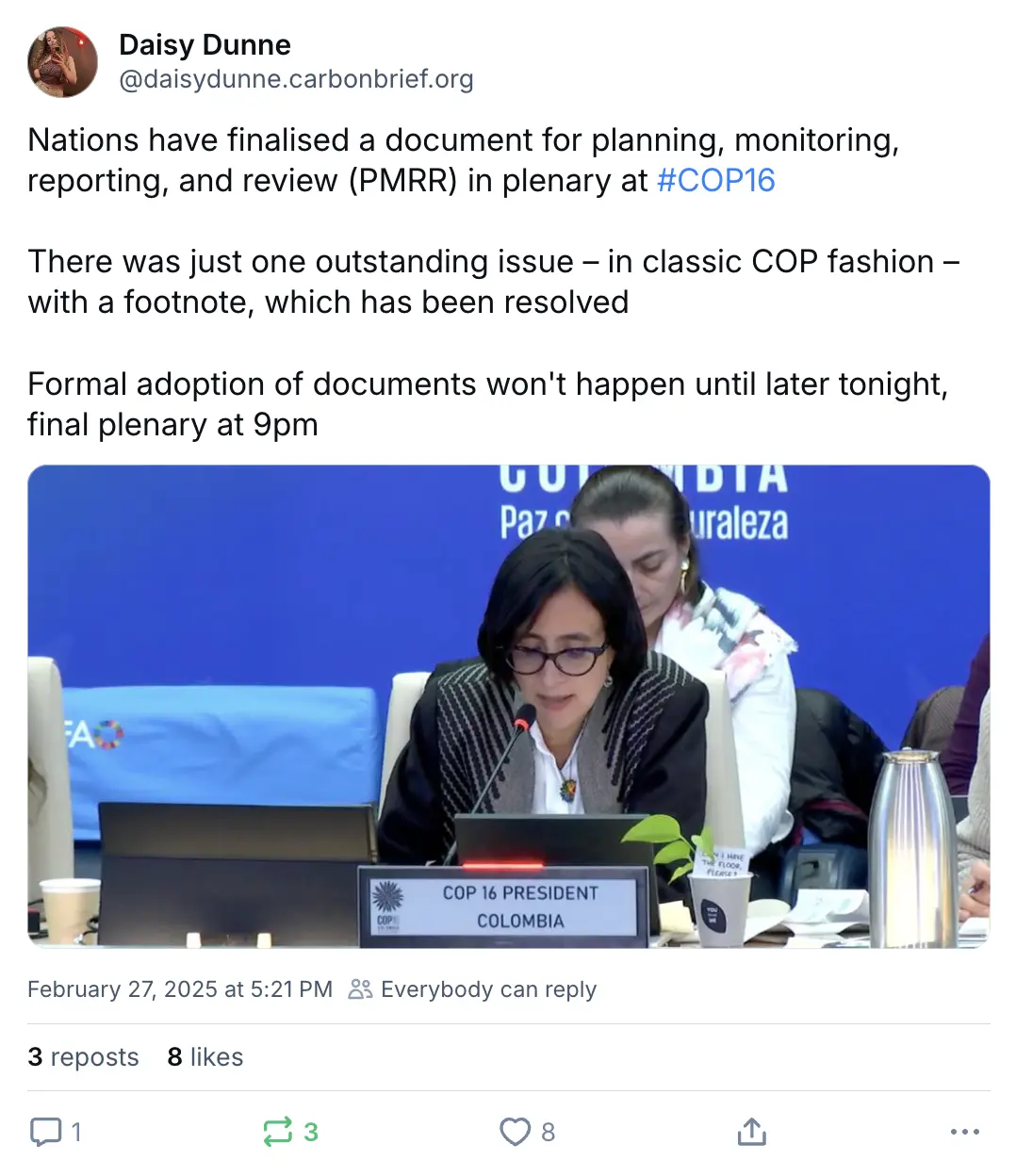
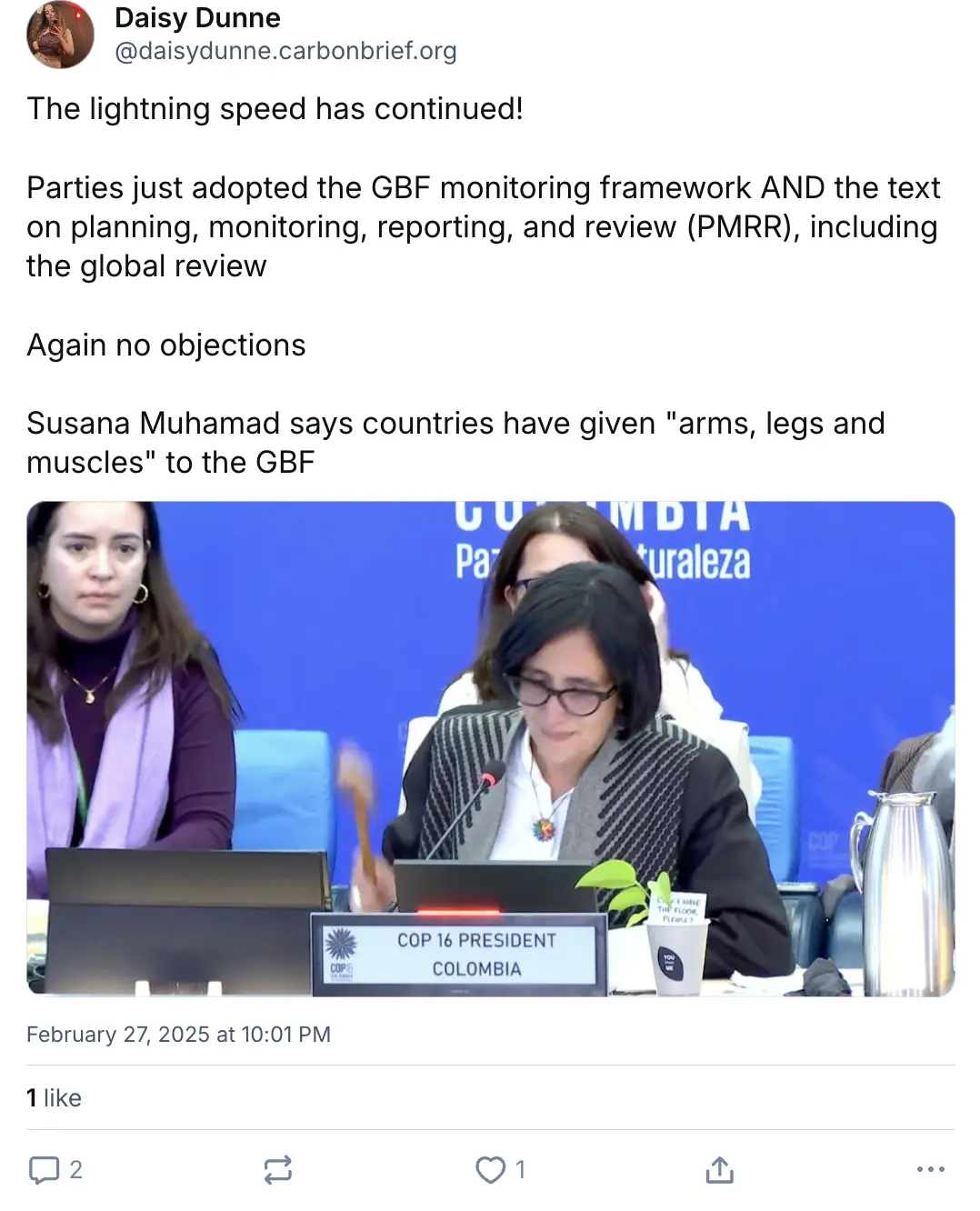
During the summit’s final plenary session, the PMRR text was gavelled through with no objections.
Monitoring framework
The monitoring framework is a document that lays out how countries will measure their progress towards the individual targets of the GBF, using four types of indicators: headline; binary; component; and complementary:
- Headline indicators: used to measure quantifiable progress towards a given target, such as the pledge to restore 30% of degraded ecosystems by 2030.
- Binary indicators: yes-or-no questions used to evaluate progress towards more qualitative goals, such as engagement with women and youth.
- Component indicators: used to measure progress towards specific parts of the targets of the GBF.
- Complementary indicators: used to measure progress towards related goals that are not made explicit in the GBF itself.
While headline and binary indicators are mandatory for countries to report, component and complementary indicators are optional.
During the Cali summit, Lim Li Lin, a senior legal and environment advisor at Third World Network, told Carbon Brief:
“Everyone’s doing a juggle, right? We want the good ones to go in the mandatory and we want the bad ones to go in the complementary, if we can’t get rid of them. And everyone’s doing the same thing from their own interest and perspective.”
Going into Rome, the entire monitoring framework was contained in brackets – meaning, in UN parlance, that the text had not been agreed. This was a result of manoeuvring by the DRC during Cali to ensure that the fate of the framework was tied to that of the finance deal.
Within the text, however, were two outstanding areas of disagreement: one on the indicator for target 7 on reducing harm from pollution, including pesticides; and one on the indicator for target 16 on enabling sustainable consumption.
On pesticide usage, parties were split between requiring countries to report their “pesticide environment concentration” and the “aggregated total applied toxicity”. The former was adopted as part of the monitoring framework during COP15, while the latter was proposed by the technical expert group that met in between COP15 and COP16.
In Colombia, parties converged on allowing both methods to be used as headline indicators, but could not reach agreement on an accompanying footnote explaining why both were being listed and how parties had to report.
In the plenary on 25 February, the UK proposed a compromise footnote text allowing parties to choose which headline indicator to use.

Although some countries suggested prioritising one indicator over the other, the proposal was approved “in the spirit of compromise”, Earth Negotiations Bulletin reported. A separate footnote explained that the FAO is working to “further develop and test the aggregated total applied toxicity headline indicator”.
On sustainable use, countries were split over non-binding component indicators on “global environmental impacts of consumption” and “ecological footprint”. Brazil suggested removing the indicator on global impacts of consumption, “noting that it cannot be validated at the national level”, according to the Earth Negotiations Bulletin.
Discussions on the sustainable-use indicators spilled over into the second day of the Rome talks. The compromise proposal, brought forward by the EU, was to remove the indicator on global environmental impacts of consumption, but retain the indicator on ecological footprint, along with a footnote on methodology and the availability of data.
The updated text was accepted with no objections during the final plenary on 27 February.
Cooperation with other conventions
A text highlighting the links between the Convention on Biological Diversity and other organisations was not discussed until the final hours of the Rome talks.
The text was not viewed as contentious near the start of the three-day summit. Amid the trickier negotiations, it was pushed down on the agenda until a dramatic finale in which the text was approved, un-approved and then gavelled through with last-minute amendments.
The Cook Islands and other countries expressed disappointment with the final tweaks, but said they agreed in order to get a deal over the line.
The agreement recognised, among other things, the ties between the three Rio Conventions – the UN treaties agreed in 1992 under which countries meet separately to negotiate on climate change, biodiversity and desertification.
The final COP16 cooperation decision “invites” countries to “strengthen synergies and cooperation in the implementation of each convention, in accordance with national circumstances and priorities”.
The presidency released a new version of the draft text on 27 February. Among the changes in this text from the previous December draft was the removal of two bracketed paragraphs stressing the importance of future collaboration between the CBD and the global treaty on governing the sustainable use and conservation of biodiversity beyond national jurisdiction (“BBNJ”, or the “High Seas Treaty”).
In the closing plenary, Iceland opposed the deletion of these “two very important paragraphs” referring to the BBNJ treaty “without any discussion”. Russia, supported later by Brazil, stood by the deletion, adding that they were “not in a position to bring [those paragraphs] back”.
The negotiations on this draft went on until close to midnight on 27 February when Muhamad said, much like “Cinderella”, they were running out of time. (The UN translators were supposed to work only until midnight, although they ended up staying through the end of the plenary.) In light of this constraint – and amid disagreement on BBNJ’s inclusion – Muhamad withdrew discussions on the text, pushing its agreement to COP17.
However, Switzerland, the EU and Zimbabwe intervened to push for the approval of the “really important” text. Iceland withdrew its intervention on BBNJ and Muhamad moved to adopt the document.
But Russia noted that the president had not addressed their proposal to delete paragraph 20, which discussed collaboration with the future UN plastic pollution treaty on the pollution-reducing target of the GBF.
After indications of support from India, Switzerland and the EU, the text was adopted by the plenary – now with paragraph 20 removed.

But it did not end there. Argentina took to the floor to suggest further amendments in three parts of the text. Muhamad said this interjection was too late, but Argentina argued that they requested to speak before the gavel fell.
Brazil backed Argentina and recalled the ending of COP15 in Montreal when the final GBF was gavelled through, despite objections by the DRC.
Brazil said this is a “wound that has not healed” for developing countries and that, while they disagree with Argentina’s position, they support their right to speak up.
Muhamad said she did not see Argentina’s request before dropping the gavel, but offered to postpone cooperation negotiations, if countries agreed. The EU did not want this and suggested deleting the paragraphs Argentina took issue with.
These included paragraph 7, referring to FAO work on a draft action plan on biodiversity for food and nutrition, and paragraph 12, discussing the rights of nature and other knowledge systems.
Georgia and Zimbabwe intervened to say that, while unfortunate to remove this text, they agreed with the EU. After more back-and-forth, the text was once again gavelled through, with the proposed amendments.
The final text also referenced outcomes from the UN Environment Programme, the World Health Organization and others.
Around the COP
The Rome COP was a more low-key affair than other summits. There were no side events, parallel meetings or working groups – just plenary sessions, followed by informal evening meetings between countries.
Around 1,000 people attended the talks, compared to 14,000 in Cali.
In the run-up to the summit, Muhamad’s COP16 presidency was called into question after she announced her resignation as Colombia’s environment minister on 9 February. The move was in protest of a controversial cabinet appointment by president Gustavo Petro, Reuters reported.
Muhamad asked Petro in her resignation letter to let her remain in the position until 3 March to allow her to conclude the COP16 talks, Climate Home News said.
In the end, she presided over the Rome talks, telling Carbon Brief in a press conference that she continued to have full capacity as environment minister.
Environment ministers and vice-ministers from Canada, Colombia, DRC, Guinea-Bissau, Madagascar, Peru, Armenia, Fiji, Germany, Suriname confirmed they would attend the talks.
The Cali Fund – a mechanism where companies can contribute money if they use digitally accessed genetic resources from nature in their products – was officially launched at a press conference in Rome on Tuesday 25 February.

The fund – which was one of the major successes of the Cali talks – is currently empty.
A number of companies are already “actively considering” paying into the fund, Astrid Schomaker said at the launch of the fund. (She would not name specific companies when asked by Carbon Brief.)
The CBD chief said the convention has actively contacted companies and business groups to discuss paying into the fund. Muhamad added at the press conference that the fund is not for “charity from the companies”, but “fair payment for the use of global biodiversity”.
The resumed nature talks came at a volatile time in climate and nature diplomacy. The new administration of the US – a major donor to climate and nature funds – caused turmoil and uncertainty across the globe when Donald Trump announced moves to shut down the US Agency for International Development (USAid).
The UN confirmed to Carbon Brief that the US did not send a delegation to Rome.
This was a first for biodiversity talks. Despite not being party to the CBD, US officials usually still attend talks to contribute to negotiations as observers.

At the opening plenary of the talks, Susana Muhamad spoke about the need for agreement amid the current “polarised, fragmented, divisive geopolitical landscape”. She added:
“We have an important responsibility here in Rome. In 2025, we can send a light globally and be able to say that still, even with our differences, even with our tensions…we are able to collaboratively work together for something that transcends our own interests.”
At the sidelines of the talks, the UK made a snap decision to belatedly publish its NBSAP, Carbon Brief reported.
Some three-quarters of nations still have not published their NBSAPs, four months after the UN deadline.
On the summit’s final day, youth activists held a demonstration in the corridors of the conference, in protest of their lack of opportunities to speak at the event.


The post COP16: Key outcomes agreed at the resumed UN biodiversity conference in Rome appeared first on Carbon Brief.
COP16: Key outcomes agreed at the resumed UN biodiversity conference in Rome

Israel’s bombardment of Gaza during the conflict that broke out in October 2023 has wrecked progress towards adapting the enclave to climate change and left two million Gazans vulnerable to heatwaves, drought and disease, the Palestinian Authority (PA) said in a new climate plan submitted to the United Nations.
Palestine’s third nationally determined contribution (NDC), uploaded to the UN climate body’s website this week, says that while “the aggression on the Gaza Strip did not make the climate worse”, “it removed the housing, water and sanitation systems, health facilities, energy networks, roads and livelihoods through which people absorb a climate they were already struggling with.”
The 91-page document lists the types of infrastructure it says Israel has destroyed and notes how the destruction will worsen the impacts of climate change. It says the bombing of hospitals and rising hunger have make it harder for Gazans to cope with the health impacts of climate-driven heatwaves and waterborne diseases.
The destruction of water tanks, boreholes and desalination plants, meanwhile, have left Gazans struggling with the effects of water shortages and drought, while mass unemployment reduces people’s ability to afford climate-driven price rises. The erasure of most of the Strip’s homes makes it more difficult for people to avoid the sun’s increasing heat, the NDC said.
Many Gazans are now living in the ruins of collapsed buildings or in makeshift shelters and tents that offer little or no protection from high temperatures.
Palestine’s previous goals to cut emissions and adapt to climate change in Gaza, expressed in its last NDC five years ago, were based on a pre-war baseline that “no longer describes anything that exists”, the NDC says. Progress made since 2021 has now been destroyed, it adds.
Green reconstruction of Gaza
Instead of continuing to aim for these adaptation and emissions-reduction goals, the PA is now calling for the green reconstruction of Gaza. It says buildings should be constructed again in an energy-efficient manner with solar panels and served with modern water, waste and transport systems.
While the PA, controlled by the Fatah political party, continues to claim legitimate control of Gaza, the strip was effectively governed by Fatah’s rival Hamas between 2007 and the recent war. Control is now split between Israel and the political wing of Islamist militant group Hamas, after a US-backed ceasefire took effect in October 2025, although a UN-backed committee plans to take over.
-
Germany uses funding to pressure climate groups on Israel-Gaza war
Many Global South climate groups are funded by the German government, a political ally of Israel, and feel unable to criticise Israel’s military action in Gaza -
Loss and damage fund urged to hold crisis meeting on Nepal
The new fund is coming under pressure from developing nations to respond quickly to climate disasters rather than just financing longer-term projects -
More support needed to power Africa’s food systems with renewables, experts say
Renewable energy could help African food businesses boost productivity and competitiveness, but the upfront cost, fragmented markets and limited financing stand in the way

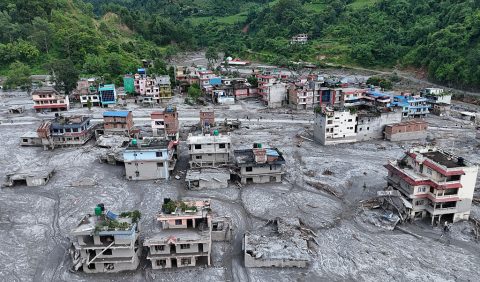

The United Nations, European Union and World Bank have jointly estimated that Gaza needs $71.4 billion of investment in the next two years to recover and build back. This process should be Palestinian-led, they said in April.
But US President Donald Trump has said the US should “take over” and “own” Gaza and redevelop it as the “Riviera of the Middle East”. Israel’s right-wing prime minister Benjamin Netanyahu has said that Israel should control the territory with civil administration managed by Palestinians favourable to Israel.
With occupation, targets conditional
In the other part of Palestine, the West Bank, the Palestinian Authority carries out some government functions, but ultimate control rests with Israel, which has occupied the West Bank since 1967.
Because Israel controls planning in most of the West Bank, the NDC argues that the PA cannot pursue all the climate projects it wants. In addition, Israel restricts the movement of PA officials, making data collection difficult, and controls the West Bank’s electricity supply meaning that the PA cannot control whether it comes from dirty or clean sources of energy.
Given this situation, the NDC says that all of Palestine’s new climate targets are conditional but it will aim to reduce emissions 12.8% below a business-as-usual baseline by 2035 and 17.1% by 2040. If the Israeli occupation ends and Palestine regains full sovereignty over its land and resources, it will aim for reductions of 15.1% and 19.1% by 2035 and 2040 respectively under an “independence pathway”.
That could allow, for example, for greater electrification and reducing emissions per unit of growth, the document said.
To achieve the 2035 emissions-reduction target and adapt to the impacts of climate change, the PA says it needs $8.6 billion in total. This funding would be spent on measures like encouraging solar farms and rooftop solar and scaling up solar water heating to cover four-fifths of households. To complement the planned increase in solar power, the authority wants to modernise the electricity grid and install battery storage.
In the transport sector, it aims to promote the uptake of electric vehicles, develop bus rapid transit corridors and scrap old polluting trucks and buses. In Gaza in particular, it wants to deploy 66 electric buses when the conflict ends.

To adapt to climate-driven drought, the NDC includes initiatives to reuse wastewater through treatment plants, build desalination plants in Gaza to remove salt from seawater, and promote irrigation for farmers.
The new climate plan was prepared by Palestine’s Environment Quality Authority, with support from the United Nations Development Programme and the governments of Britain and Spain.
The United Nations recognised Palestine’s statehood in 2012 and it joined the UN’s climate convention and signed the Paris climate agreement – which requires countries to submit more ambitious NDCs every five years – in 2016.
The Israeli foreign ministry did not respond to a request for comment. But in late 2024, then Israeli climate envoy Gideon Behar told Climate Home News that the war and the resulting environmental destruction in Gaza was the fault of Hamas.
The post Palestine: Israel’s bombing has left Gaza vulnerable to climate change appeared first on Climate Home News.
Palestine: Israel’s bombing has left Gaza vulnerable to climate change
Solar power generation in the UK reached a new record over the summer of 2026, as temperatures across the nation soared, according to new analysis by Carbon Brief.
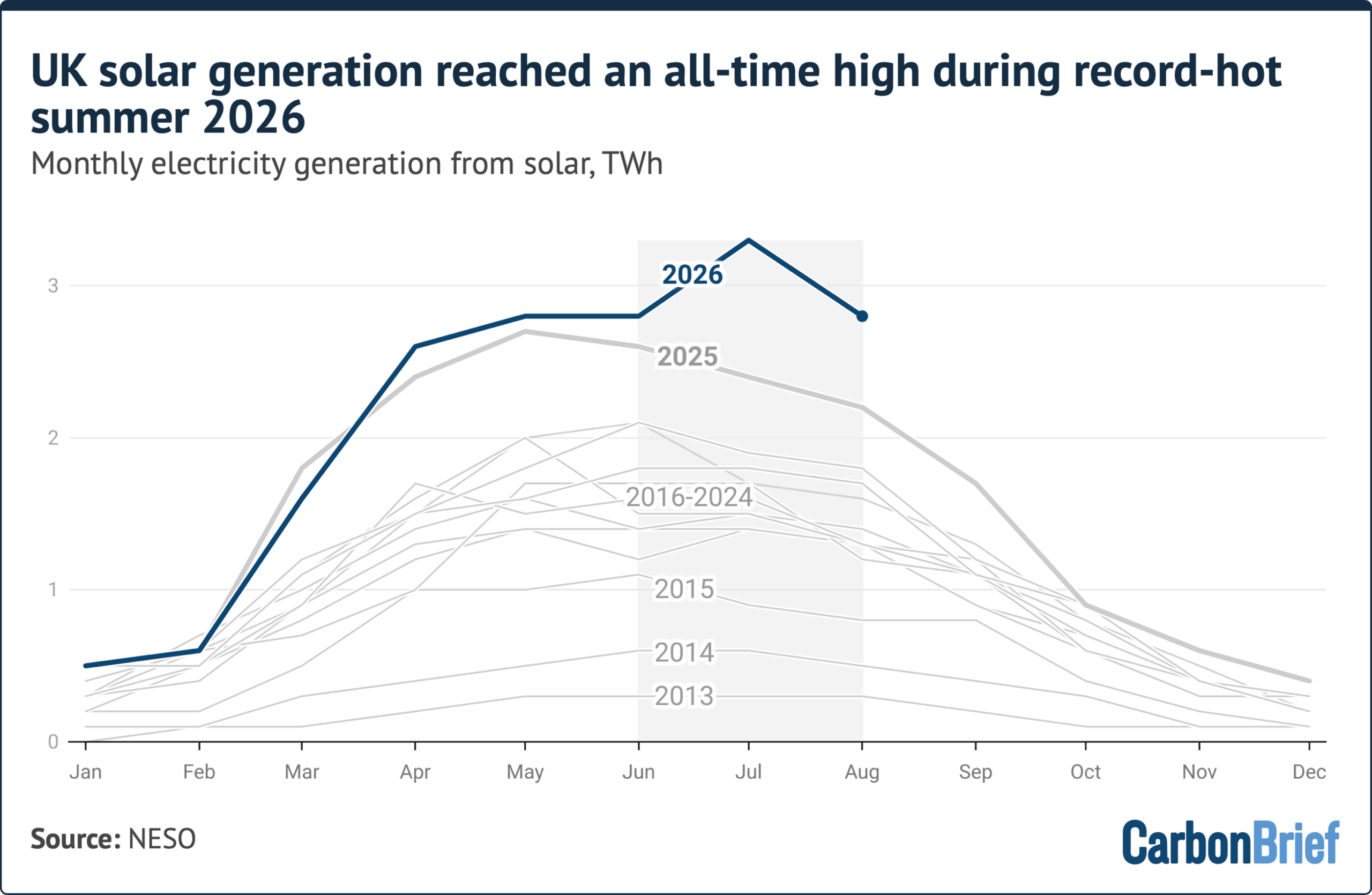
Collectively over June, July and August, solar farms and rooftops generated 8.8 terawatt-hours (TWh) of electricity in the UK*, as shown in the chart below.
Speaking to Carbon Brief, Chris Hewett, chief executive of trade association Solar Energy UK welcomed the new record, adding that it was driven by “clear skies and continued growth in deployment”.
This surge in generation took place amid the hottest summer on record in the UK, with five heatwaves between May and August.
Summer 2026 was the sixth sunniest on record, with more than 620 hours of sunshine, according to the Met Office. England and Wales – which experienced the most extreme heat – saw their second-sunniest summers on record.
June 2026 was the hottest June in England since records began in 1884, according to Met Office data, while Wales and the UK as a whole experienced their second-warmest June.
It was the driest July for England and Wales since records began in 1836, with some parts of London seeing no rain at all in the month, while Wisley in Surrey had no rain for 62 days.
In England, temperatures peaked at 38.1C at Kew Gardens in London on 13 August.
According to the Met Office, this summer’s record mean temperature was made 130 times more likely by climate change.
Amid these hot and sunny months, solar power generation increased 23% from the same period in 2025. This is double the level of solar generation over the summer of 2021, according to Carbon Brief analysis.
While solar panels can be affected by periods of extreme heat, the longer hours of daylight and higher levels of irradiation over the summer more than offset any efficiency losses.
June, July and August all saw solar set new monthly records for solar generation – July saw the highest solar generation in a calendar month ever, with 3.3TWh meeting 15% of overall electricity demand for the month.
As of the end of August, the total UK solar generation in 2026 stood at 17TWh – 13% higher than the same point in 2025.
The number of solar farms and rooftop installations has grown substantially in recent years, helping to boost generation. Domestic rooftop solar accounts for around 29% of total capacity.
In 2025, the UK’s solar capacity reached 21 gigawatts (GW) by the third quarter of the year, according to UK government figures. This is a jump of 3GW, or 18%, year-on-year, as Carbon Brief reported in January.
(Capacity is the maximum output possible from an electricity generation, whereas generation is what was produced over a certain time period, such as a day, month or year.)
According to the University of Sheffield, the installed solar capacity is now nearly 24GW.
This includes nearly 172,000 solar installations that have been fitted across the UK since the start of 2026, according to recent government figures. In July alone, more than 19,800 rooftop solar panels were installed – the equivalent of one installation every two minutes.
In total, nearly 1.7m households in the UK now have solar panels installed.
Over 26 heatwave days this summer – periods of at least three days when temperatures exceed the Met Office’s county-level heatwave temperature threshold – UK households with rooftop solar panels avoided an estimated £86.7m in electricity costs, according to analysis by Utility Bidder.
Talking about the surge in solar generation this summer, Hewett says:
“[It] not only kept bills down for people with solar and batteries in their homes, but helped keep overall power prices much lower than they would have been if Britain had been relying on more gas generation during the day”.
Despite the record generation, no new half-hourly solar power output record was set in the summer of 2026. This still stands at 15.2 megawatts (MW) on 23 April 2026.
* This article refers to the UK throughout, but strictly relates to the island of Great Britain, made up of England, Scotland and Wales. Northern Ireland is part of the separate, all-Ireland electricity system.
related
Factcheck: 10 flaws in the Conservative report on ‘cheap power’
Q&A: What is ‘long-duration energy storage’ – and why does the UK need it?
Q&A: What does China’s 15th ‘five-year plan’ for renewables mean for climate change?
Analysis: Wind and solar power overtake fossil fuels in Germany for first time ever
The post Analysis: UK solar power hits record high over summer 2026 appeared first on Carbon Brief.
Farmers around Europe are dealing with the aftermath of a summer of extreme heat, drought and wildfires that were exacerbated by climate change.
Human-caused climate change is increasing the severity and likelihood of many extreme weather events around the world, which is increasing volatility for food producers.
This summer resulted in, for example, shrunken potatoes in the Netherlands, reduced carrot harvests in France, dried-up rice fields in Italy and scorched olive groves in parts of the Mediterranean region.
Global food prices are currently at their highest level since early 2023 due to “heatwaves and energy price dynamics”, according to the UN Food and Agriculture Organization.
Other factors such as blocked fertiliser supplies in the Strait of Hormuz and high fuel costs have also played a role in this year’s agricultural outputs.
In the six charts below, Carbon Brief provides a snapshot of the impact this summer’s extremes are considered to have had on crop production and yields across Europe.
1. Most EU countries expect to see declines in cereal production this year
2. Most countries are recording reduced crop yields
3. Around €2bn worth of cereal losses after June heatwave
4. UK yields of wheat, barley and oats are all due to drop in 2026
5. Maize production in France is due to hit a four-decade low
1. Most EU countries expect to see declines in cereal production this year
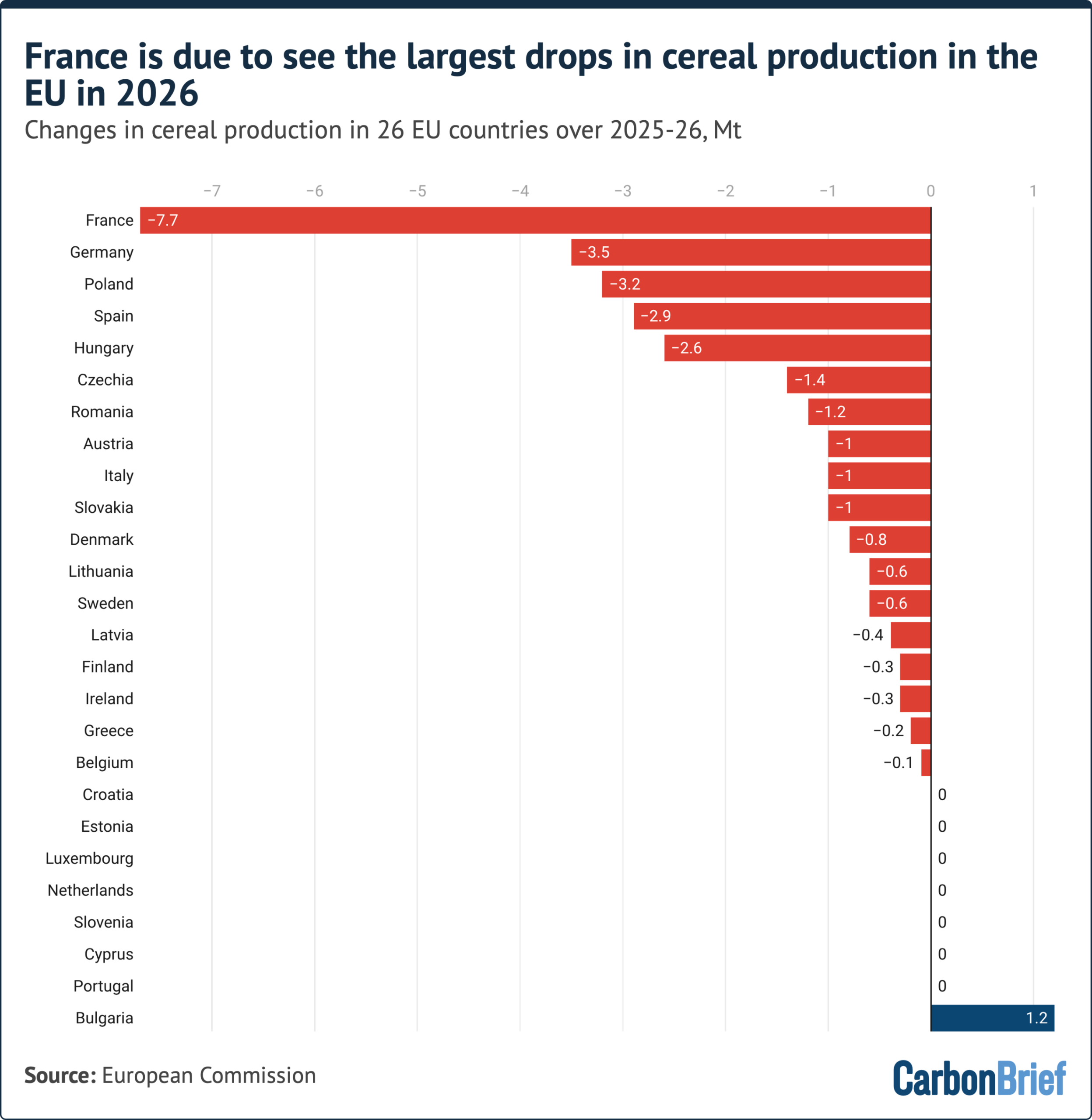
France, in particular, will see heavy losses in the amount of cereals – such as wheat, barley and oats – it produces this year, according to European Commission data.
French cereal production is expected to drop by almost 8 megatonnes (Mt) in 2026, compared to 2025.
The chart above shows that most European countries, aside from Bulgaria, will also see production losses this year.
Germany is due to see the second-largest losses in production, dropping by almost 4Mt compared to 2025.
Prof Til Feike, a cropping systems expert at the Julius Kühn-Institut, says many areas in Germany and Austria, as with other parts of Europe, have been “hit hard by a long-lasting dry period in combination with record-high heatwaves”.
This has resulted in dry grassland for animals and lower yields of maize, which is a “key fodder crop” for livestock. He tells Carbon Brief:
“In the long run, farming must adapt better to more extreme weather conditions, not only heat and drought, but also prolonged wet periods. So, there is no one-fits-all solution for climate change adaptation.”
2. Most countries are recording reduced crop yields
Heat and a lack of water have “substantially worsened” crop expectations this summer in western and most of central Europe, according to a recent bulletin from the EU Joint Research Centre.
Yields are expected to be “significantly reduced”, with local crop failures “likely” in areas such as France, southern Germany, northern and central Italy, and Hungary, it added.
The chart below shows that yields of cereal grains – which, here, refers to the tonnes of a grain grown per hectare of land – are expected to fall in most EU countries in 2026.
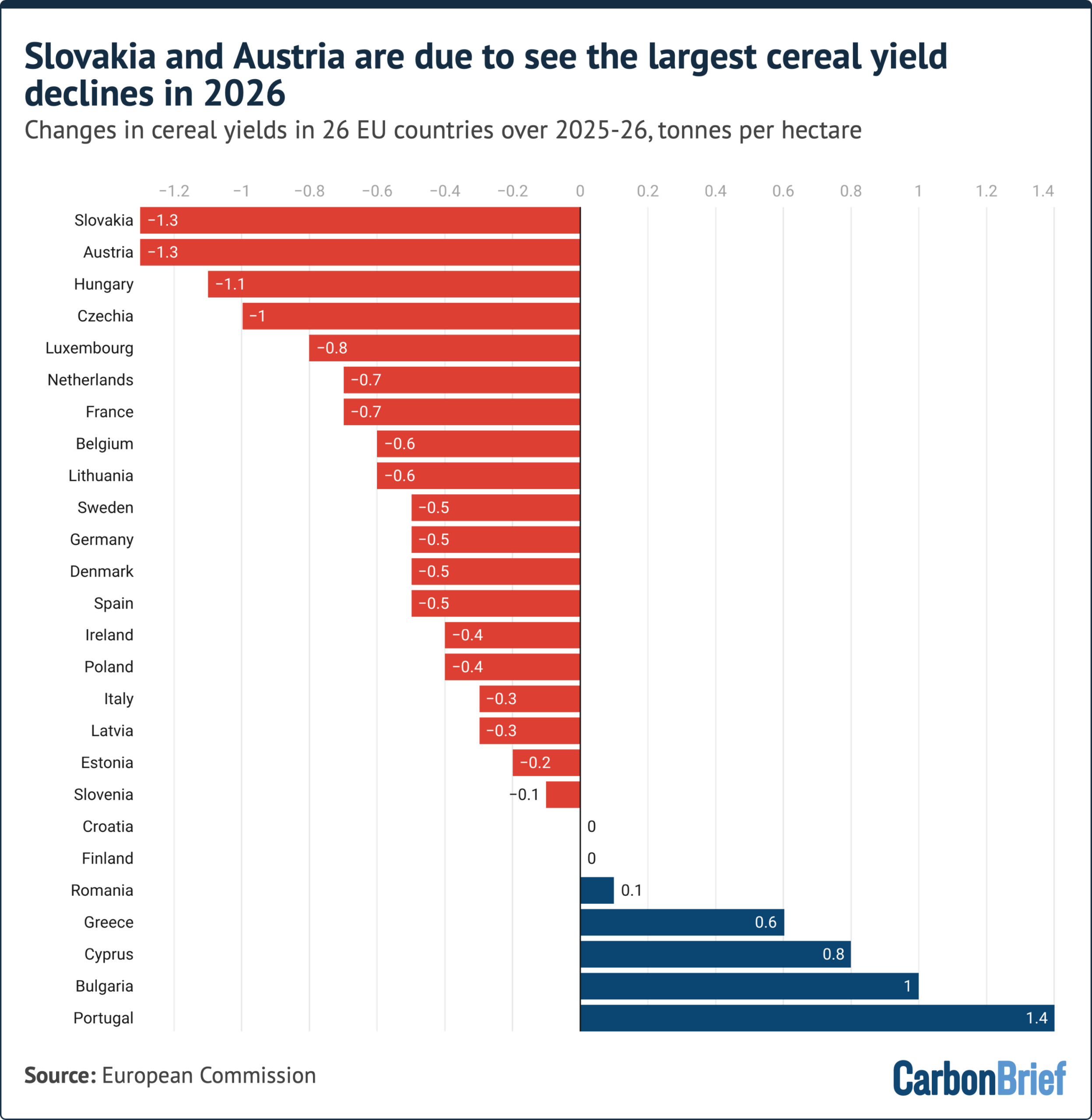
Slovakia, Austria and Hungary are expected to see the largest declines in cereal yields, reducing by more than one tonne per hectare in 2026 compared to 2025.
The recent EU bulletin noted that irrigated crops performed well in Portugal this summer – the country with the largest yield increases. Other crops relying on rainfall showed growing signs of heat stress, it added.
3. Around €2bn worth of cereal losses after June heatwave
The record heatwave that hit many parts of Europe in June contributed to an estimated €2-2.3bn in cumulative grain production losses, as shown in the chart below.
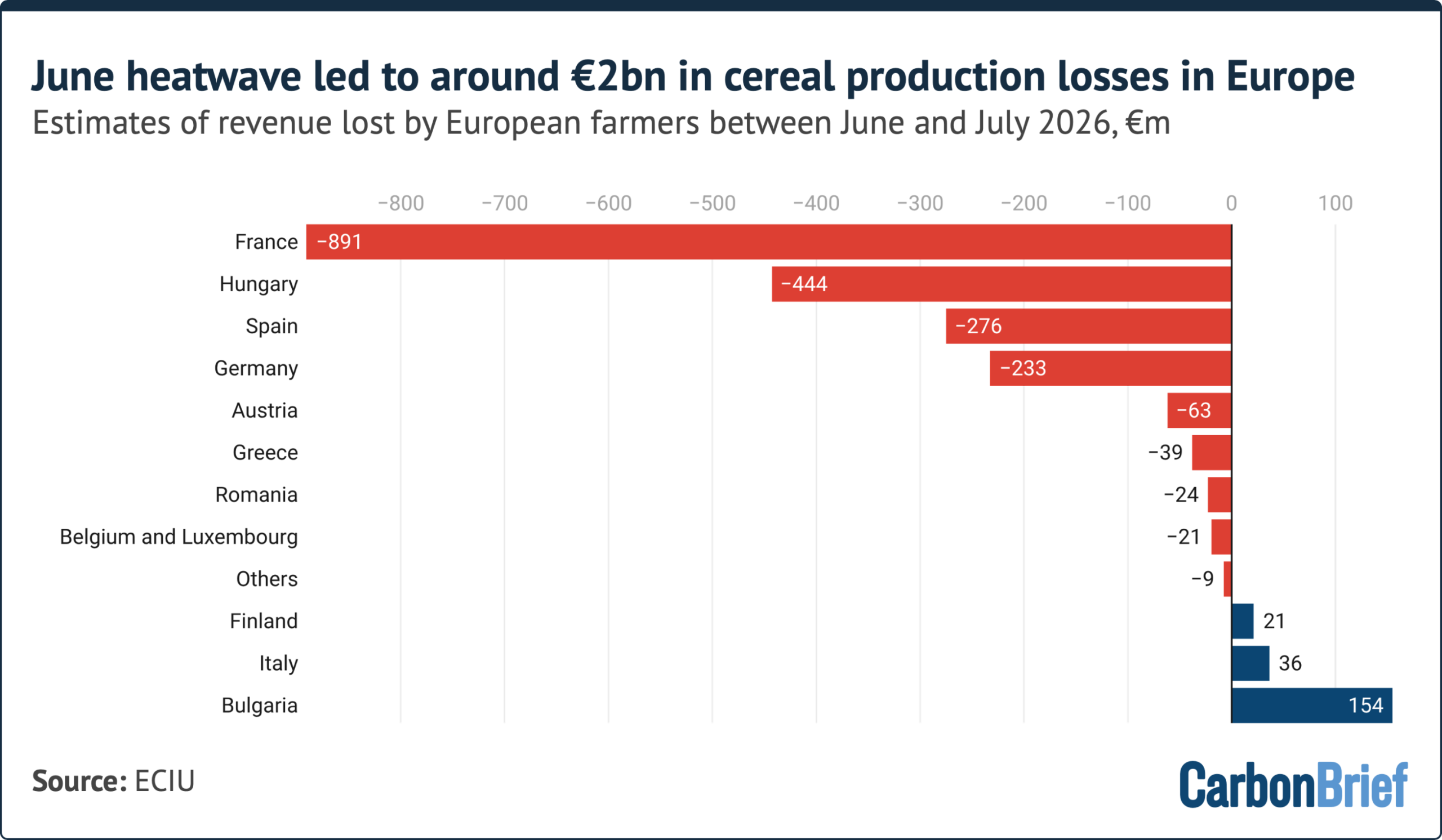
The intense June heat in western Europe would have been “virtually impossible” just 50 years ago, according to a rapid climate attribution study. It was the region’s hottest June on record.
The Energy & Climate Intelligence Unit (ECIU) thinktank analysed June and July 2026 grain forecasts from Coceral, a European grain traders association.
ECIU estimated lost supply by multiplying the change in tonnes of grains between these two months by prices for harvest delivery in 28 European countries.
Major grain producers France, Germany, Hungary and Spain accounted for 86% of the lost revenue, according to the ECIU.
Extreme heat is also expected to have a wider economic impact across the continent. Analysis from Triodos Bank found that this summer’s extreme weather could reduce the EU’s gross domestic product (GDP) by around 1% this year, or around €180bn.
4. UK yields of wheat, barley and oats are all due to drop in 2026
If current trends continue, the average yields for cereals and oilseeds will result in the UK’s worst harvest since detailed records began in 1984, according to ECIU.
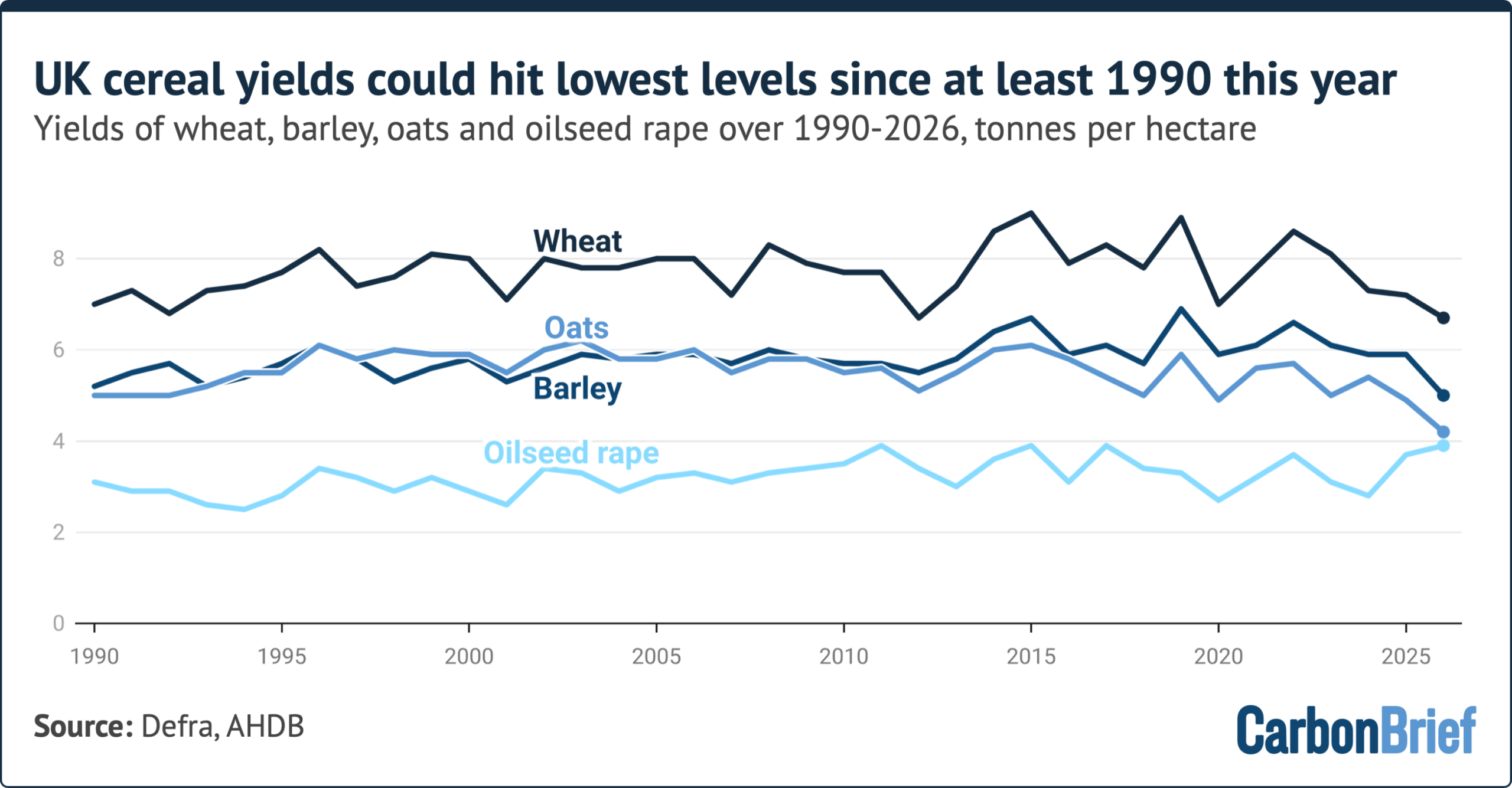
Barley yields could fall by 15%, oats by 14% and wheat yields by 6% year-on-year, according to 2026 harvest surveys from the Agriculture and Horticulture Development Board, a non-departmental public body that provides agricultural data to the UK government.
ECIU said that, even if the situation improves, this year is still expected to be one of the five worst harvests on record. This means that four of the five worst harvests in the UK have occurred in the past decade.
Consumers will likely see higher prices and/or smaller vegetables in supermarkets as a result, Tim O’Malley, chairman of UK company Nationwide Produce, told BBC News in August.
Other crops, such as berries, have grown successfully in the extreme heat. But the Guardian noted fears this could dip later this year “as plants become exhausted from heavy cropping during the heatwave”.
5. Maize production in France is due to hit a four-decade low
France has been acutely affected by this summer’s extreme weather, with more than 7,300 excess deaths during heatwaves and a record number of weather stations recording temperatures of above 40C.
The country is the EU’s largest agricultural producer, but heat, drought and wildfires have affected many crops.
The chart below shows that maize production is set to drop by more than one-third (35%) year-on-year.
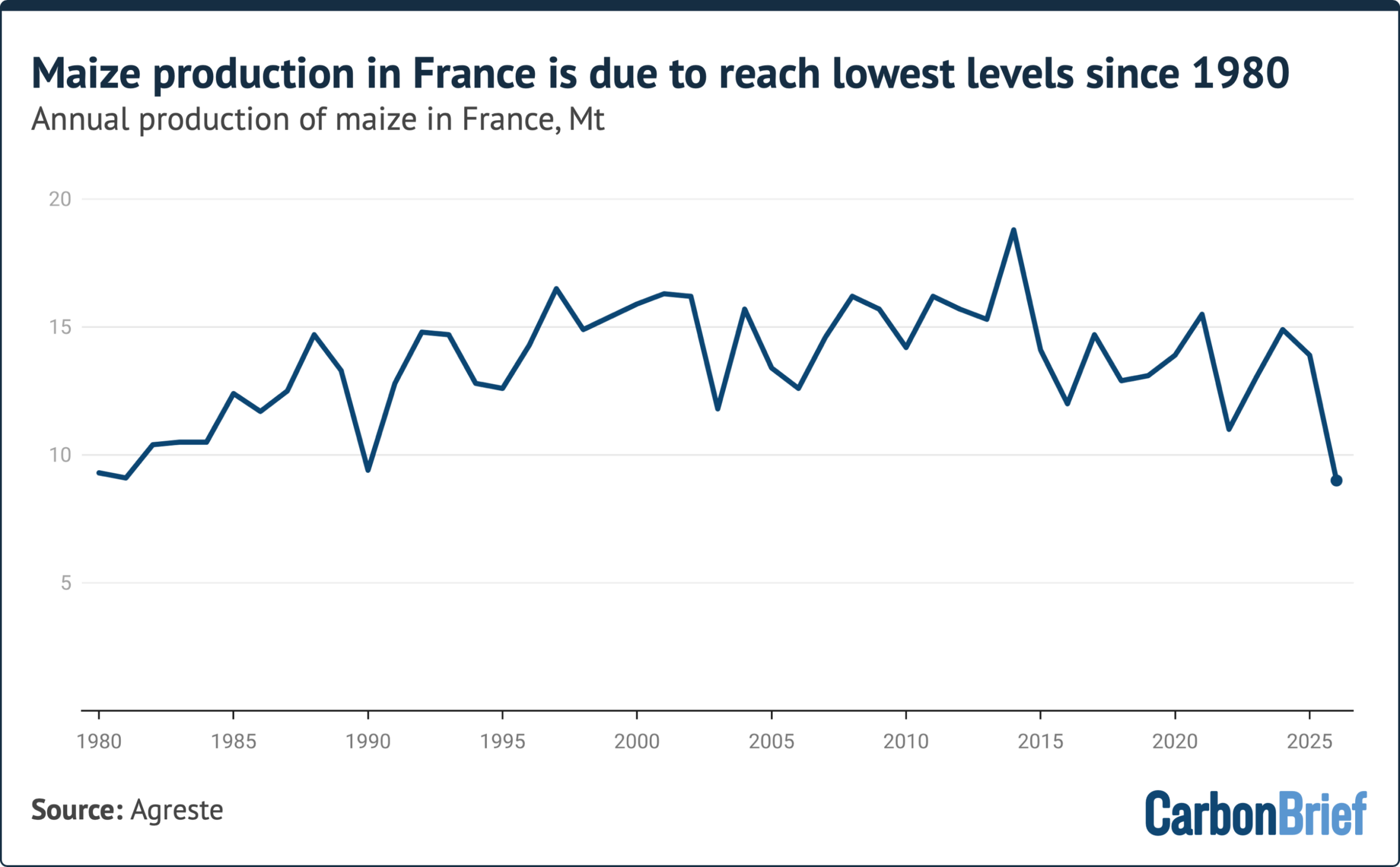
This could result in France’s lowest maize production since 1980, according to data from Agreste, the country’s agriculture ministry’s statistics service.
Due to the heat, “record-early” grape harvests have also been recorded in various parts of the nation since mid-July, reported Le Monde. In some cases, this means “smaller, less juicy grapes, which will yield less wine”, explained the newspaper.
6. Declines in EU grains since 2025
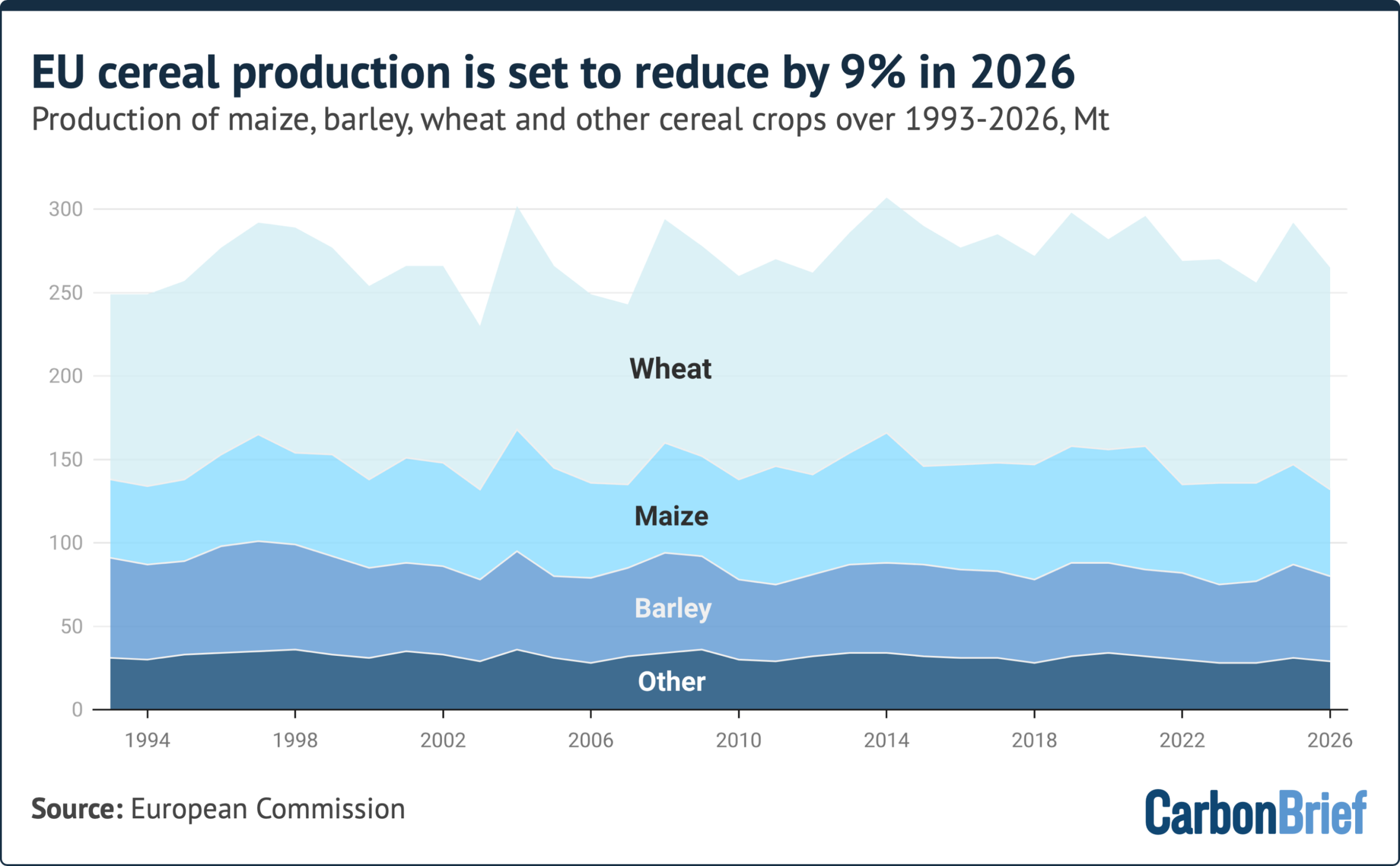
Overall in the EU, data and projections indicate declines in the output of cereal grains this year.
Cereal production is set to fall by 9% compared to 2025, according to the European Commission.
Just one year in the past decade – 2024 – recorded lower production levels.
Maize production is set to be particularly affected, with projections indicating a 13% drop, to 52Mt – the lowest level in the EU since 2007.
The post How this summer’s heat and drought impacted crops in Europe – in six charts appeared first on Carbon Brief.
How this summer’s heat and drought impacted crops in Europe – in six charts



-
Climate Change1 year ago
Guest post: Why China is still building new coal – and when it might stop
-

 Greenhouse Gases2 years ago
嘉宾来稿:满足中国增长的用电需求 光伏加储能“比新建煤电更实惠”
-
Greenhouse Gases1 year ago
Guest post: Why China is still building new coal – and when it might stop
-

 Climate Change2 years ago
嘉宾来稿:满足中国增长的用电需求 光伏加储能“比新建煤电更实惠”
-

 Renewable Energy11 months ago
Sending Progressive Philanthropist George Soros to Prison?
-
Climate Change2 years ago
Bill Discounting Climate Change in Florida’s Energy Policy Awaits DeSantis’ Approval
-
Greenhouse Gases1 year ago
嘉宾来稿:探究火山喷发如何影响气候预测
-

 Carbon Footprint2 years ago
US SEC’s Climate Disclosure Rules Spur Renewed Interest in Carbon Credits