Connect with us

Published

on

What Is the Climate Crisis?

The climate crisis refers to the destabilization of the climate conditions that have allowed human communities and current ecosystems to survive and thrive on Earth. It is caused by a rise in global temperatures that scientists conclude is “unequivocally” driven by human activity — primarily the burning of fossil fuels and secondarily the destruction of forests and other natural carbon sinks. Since humans began using fossil fuels in earnest at the start of the industrial revolution, global temperatures have risen to 1.1 degrees Celsius above the 1850 to 1900 average. Global heating has now reached a rate of increase of more than 0.2 degrees Celsius per decade. This warming has already led to the melting of Arctic sea ice, the retreat of glaciers, and more frequent and intense extreme weather events like heat waves, foods and droughts. These events have already claimed lives, driven species to extinction and forced more than 13 million people from their homes in Africa and Asia in 2019 alone. With every further warming increase, the risks of additional harms become ever more severe.

Luckily, there is something we can do about it, but we have to act quickly. The latest report from the Intergovernmental Panel on Climate Change (IPCC) found that we must curb greenhouse gas emissions by 60 percent of 2019 levels by 2035 in order to limit global temperature rise to 1.5 degrees Celsius above pre-industrial levels and save hundreds of millions from suffering and poverty by 2050. Unfortunately, temperature projections based on current policies and pledges put the world on track for 2 to 3.2 degrees of warming. The climate crisis is therefore a crisis in two senses of the word. It is both “a time of intense difficulty, trouble, or danger” and “a time when a difficult or important decision must be made.” We can choose to drive our gas-powered SUVs down what UN Secretary-General António Guterres called the “highway to climate hell,” or we can turn off the ignition, take our feet off the gas pedal and walk together down a greener path.

What Are Greenhouse Gases?

Sunset over Tuvalu, an island nation that scientists say could be the first country to disappear due to climate change and sea level rise. Ashley Cooper / Corbis via Getty Images

Greenhouse gases get their name because they contribute to something called the greenhouse effect. When the sun’s rays penetrate the Earth’s atmosphere, these gases stop some of the heat from escaping back into space, acting like the walls of a greenhouse. Greenhouse gases already exist in the atmosphere without human intervention, and this is normally a very good thing: Without the greenhouse effect, Earth’s surface temperatures would be around 33 degrees Celsius cooler. However, human activity has released more of these gases into the atmosphere in the last two centuries, throwing the system out of balance, trapping more heat and causing global temperatures to rise.

What Are the Main Greenhouse Gases That Contribute to the Climate Crisis?

There are four main greenhouse gases causing additional warming.

Carbon Dioxide

Workers commute as smoke billows from a coal-fired power plant in Shanxi, China on Nov. 25, 2015. Kevin Frayer / Getty Images

Carbon dioxide is the greenhouse gas most responsible for heating the planet. It is a naturally occurring molecule that can be released through events like volcanic eruptions. However, since 1750, carbon dioxide concentrations in the atmosphere from the burning of fossil fuels have increased by 50 percent to reach levels not seen since around four million years ago, when sea levels were as much as 25 meters higher (approximately 82 feet) than today. In 2021, carbon dioxide reached a record 415.7 parts per million. Humans also emitted record levels of carbon dioxide over the past decade — 54 gigatonnes a year between 2012 and 2021.

Methane

Flames from a flaring pit near a well in the Bakken Oil Field. Orjan F. Ellingvag / Corbis via Getty Images

Methane is a much more potent greenhouse gas than carbon dioxide — producing 28 times more warming than carbon dioxide over a 100 year period. At the same time, it lingers in the atmosphere for much shorter — around 12 years to carbon dioxide’s hundreds. The combination of methane’s potency and shorter lifespan makes reducing methane emissions a strategic priority for limiting global warming in the short term.

Methane is released both naturally — by plants decaying in wetlands — and by human activities including landfills, rice farming, the digestion of livestock animals like cows and the use of fossil fuels. Natural gas is 70 to 90 percent methane. These activities account for 50 to 65 percent of global methane emissions, and overall the gas has caused 30 percent of the post-industrial temperature hike. Indeed, the amount of methane in the atmosphere has more than doubled, reaching a record 1,908 parts per billion in 2021.

Nitrous Oxide

Tanks used to spray nitrogen fertilizers, which produce nitrous oxide emissions, at the Union of Rural Production Societies of Southern Sonora (USPRUSS) in Villa Juárez, Sonora, Mexico on May 6, 2021. Luis Antonio Rojas for The Washington Post via Getty Images

Nitrous oxide is a greenhouse gas primarily released by the production and use of agricultural fertilizers, though it is also emitted when fossil fuels or plant matter are burned. It is released naturally as part of the nitrogen cycle, but around 40 percent of current emissions comes from human activity. While it’s been called “a forgotten greenhouse gas” when compared to carbon dioxide and methane, it is still responsible for around 6 percent of greenhouse gas emissions. It’s also very powerful — a single molecule of nitrous oxide has 300 times the warming potential of a single molecule of carbon dioxide — and it persists in the atmosphere for around 114 years. In 2021, its atmospheric concentration reached a record 334.5 ppb, which is 124 percent of its pre-industrial levels.

Chlorofluorocarbons

Aerosol cans at a gas station in Los Angeles, Calfornia in 1990. Joe Sohm / Visions of America / Universal Images Group via Getty Images

Chlorofluorocarbons are the one greenhouse gas that does not occur naturally. They were created for industrial purposes and used as refrigerants, solvents and propellants for spray cans until it was discovered that they were burning a hole in the ozone layer. World leaders came together and agreed to phase out their use under the Montreal Protocol of 1987. It’s a good thing they did, because it turns out that CFCs are thousands of times more effective by mass at trapping heat than carbon dioxide. A study found that the agreement to restrict their use reduced global warming by as much as 25 percent. However, they are still occasionally emitted. A spike in 2013 was tied to illegal use in China that the nation later dealt with, but they are still released from CFC “banks” — pre-1987 insulation or cooling systems that continue to emit the chemicals.

What Are the Main Human Activities Causing the Climate Crisis?

Scientists often refer to “anthropogenic,” or human-caused, climate change. But there are really a few main human activities that are largely to blame.

Burning Fossil Fuels

Cars pass the coal-fired Stanton Energy Center in Orlando, Florida. Paul Hennessy / SOPA Images / LightRocket via Getty Images

The burning of fossil fuels is responsible for more than 75 percent of total greenhouse gas emissions and almost 90 percent of carbon dioxide emissions. This is because fossil fuels are made from dead and decaying lifeforms fossilized over millions of years — and carbon is the building block of life. The carbon that once helped form the DNA and proteins of ancient plants and animals is concentrated by time and pressure into coal, oil and natural gas. When these fuels are burned, that carbon once stored beneath the Earth enters the atmosphere as carbon dioxide. Leaks from fossil fuel extraction, production and transportation are also an important source of methane emissions. Many human activities currently rely on fossil fuels, from industry to heating and electricity generation to transportation. We need to find an alternative way to power these activities in order to stop overheating the atmosphere.

Land-Use Change

Logging near Clarkia, Idaho on Sept. 2, 2021. Don and Melinda Crawford / UCG / Universal Images Group via Getty Images

The second most important contribution to the climate crisis is deforestation, agriculture and other land use change, accounting for around a quarter of total greenhouse gas emissions and around 13 to 21 percent from 2010 to 2019. Trees and other plants store carbon in their trunks, leaves and roots and in the soil beneath them. When those trees are cut down or that soil is disturbed, the carbon ends up in the atmosphere and contributes to the climate crisis. What’s more, those trees and plants are no longer there to suck more carbon dioxide out of the atmosphere.

Agriculture

Livestock pastures made by deforestation in Brazil’s Amazon Rainforest. Marcio Isensee e Sa / iStock / Getty Images Plus

Tree clearing for agriculture drives more than 90 percent of tropical deforestation worldwide. In addition to getting rid of carbon sinks, the global food system emits greenhouse gases through the production and use of fertilizers and the methane-laden burps and manure of cows and other ruminants. The livestock sector as a whole is responsible for between 11.1 percent and 19.6 percent of global greenhouse gas emissions.

What Are the Main Impacts of the Climate Crisis Now and in the Future?

The climate crisis has already impacted every region on Earth. The latest IPCC report finds that both these current impacts and the risks of each increment of future warming are more severe than previously anticipated.

Hotter Temperatures

Pedal boats on the dry soil at the Sau water reservoir in Vilanova de Sau, Spain on Feb. 1, 2024. Catalonia declared a state of emergency as a drought saw reservoir levels drop below 16% of capacity. Davide Bonaldo / SOPA Images / LightRocket via Getty Images

The most obvious impact of the climate crisis is an increase in temperature. Since 1970, global temperatures have increased faster than during any other 50-year period during at least the last two centuries. The last nine years are the nine warmest since record keeping began 143 years ago, and all of the 10 warmest years on record have occurred since 2010. Some scientists think 2024 might be the hottest year yet. How much temperatures continue to rise will depend on how quickly we can wean ourselves off fossil fuels. Policies in place as of 2020 put the world on track for 3.2 degrees Celsius of warming by 2100, but that could be lowered to 2 degrees Celsius if we cut greenhouse gas emissions by 35 percent by 2035 and 1.5 degrees Celsius if we cut emissions by 60 percent by the same date.

More Extreme Weather Events

The climate crisis has already led to more frequent and extreme weather events. The IPCC says it is “virtually certain” that heat waves have become more common and intense in most regions since the 1950s, with climate change the “main driver.” These heat waves have already claimed tens of thousands of lives. Most marine heat waves since at least 2006 were also likely caused by climate change, and these have doubled since the 1980s.

People navigate a flooded street in Hollywood, Florida on June 12, 2024. Joe Raedle / Getty Images

Because warmer air holds more moisture, the climate crisis can also lead to more extreme precipitation events, which have increased in intensity and frequency over most land areas since the 1950s. Hurricanes and other tropical storms have become wetter and more intense. Climate change has led to more or longer droughts in some regions, making the megadrought in the U.S. West 42 percent more severe. Higher temperatures and drier conditions have led to more frequent, larger and longer-lasting wildfires. If the climate continues to warm, combined heat waves and droughts and ideal wildfire conditions are expected to become more frequent. Tropical storms will continue to become more intense.

Ice Melt and Sea Level Rise

Icebergs which calved from the Sermeq Kujalleq glacier in the Ilulissat Icefjord, Greenland on Sept. 5, 2021. Mario Tama / Getty Images

Warmer temperatures are melting ice in the world’s mountains and polar regions. The Arctic is warming nearly four times as fast as the global average, and the Greenland Ice Sheet has lost 255 gigatons of ice each year between 2008 and 2016, while Arctic sea ice has declined since 1978, with the rate of decline increasing in the last two decades and 95 percent of the oldest and thickest ice already gone. In Antarctica, ice sheets are melting at a rate of around 150 billion tons per year.

The polar ice sheets hold around two thirds of the globe’s fresh water. When they melt, that water enters the ocean, raising sea levels. To date, their melting has caused around a third of sea level rise since 1993. However, the melting of glaciers and ice sheets had driven the majority of accelerated sea level rise between 2006 and 2015. As of 2018, global sea levels had risen by 0.2 meters (approximately eight inches). In addition to polar melting, the sea level is rising because water expands as it warms. If the Greenland ice sheet were to melt entirely, it would raise sea levels by 23 feet, while the melting of all glaciers and ice sheets would raise them by more than 195 feet. While this would occur over a period of centuries, even relatively small amounts of sea level rise can threaten coastal communities with erosion, flooding, saltwater intrusion into aquifers, habitat loss and more powerful storm surges. Sea levels along the coastal U.S. are expected to rise by a foot by 2050 and two feet by 2100.

Mountain glaciers are melting as well — between 85.3 percent of Northern Hemisphere glaciers, including Greenland’s, retreated between 2000 and 2020, and nearly half of non-polar glaciers could melt by 2100 even if temperature rise is limited to 1.5 degrees. This would have devastating impacts on communities that rely on glaciers for water, power and cultural identity.

Ocean Impacts
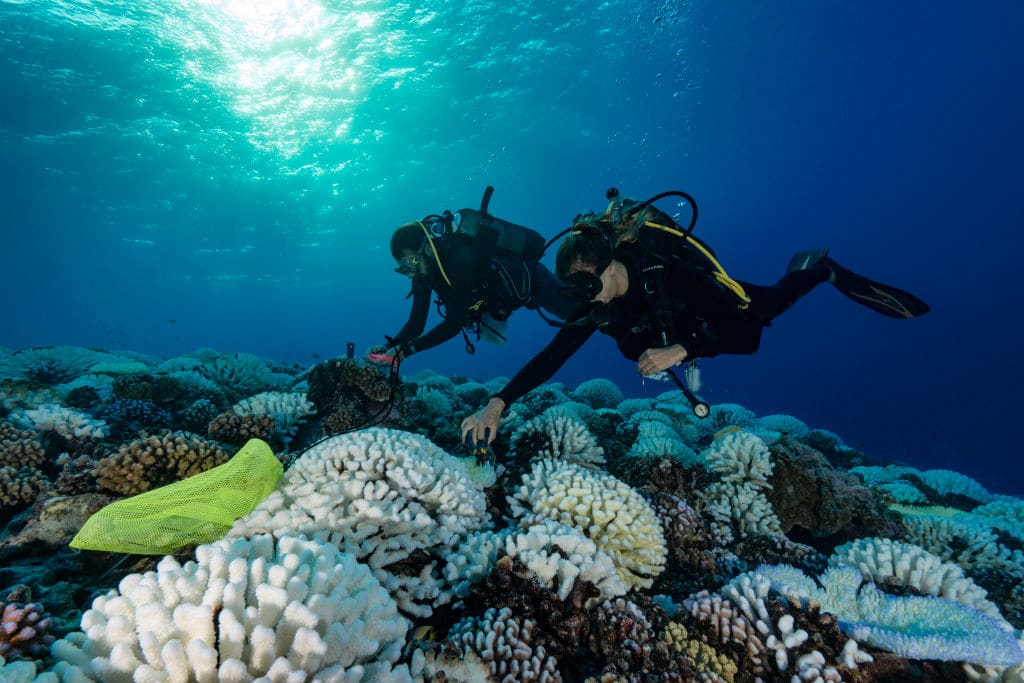
Coral bleaching on the Society Islands in French Polynesia in Moorea, French Polynesia on May 9, 2019. Alexis Rosenfeld / Getty Images

The ocean has absorbed 90 percent of the excess heat added to the planet in the last decades, with the past 10 years being the ocean’s warmest since the 19th century. Most of this heating is occurring between zero and 700 meters (approximately 2,297 feet) from the surface. In addition to contributing to sea level rise, more intense tropical storms and the melting of sea ice, the additional heat threatens marine biodiversity through deadly marine heat waves. One of the most infamous impacts of these heat waves is coral bleaching, when warmer than average temperatures compel corals to expel the algae that give them both color and food. If temperatures rise to 2 degrees, 99 percent of tropical reefs could be lost. In general, ocean warming last century has combined with the impacts of overfishing to reduce the amount of certain fish species available for fishers.

Heat isn’t the only product of fossil fuel emissions that the ocean absorbs. It takes in around 30 percent of the carbon dioxide added to the atmosphere, leading to something called ocean acidification. Carbon dioxide dissolves in seawater into carbonic acid, which further breaks down into hydrogen ions and bicarbonate ions. Through this process, the ocean has gotten about 30 percent more acidic since the industrial revolution. When there is more hydrogen floating around in the ocean, it easily bonds with the carbonate that shell-making animals like corals and oysters need to form their shells. The decrease in carbonate is already impacting these animals, and further acidification could actually dissolve their shells. A more acidic ocean could also harm other animals like clownfish, who struggle to find their ideal habitat during their larval stage when acidity increases.

Biodiversity Loss

An endangered desert bighorn ram stands near a sign warning hikers of extreme heat near Borrego Springs, California on Aug. 4, 2023. David McNew / Getty Images

The ocean isn’t the only habitat where the climate crisis threatens the abundance and variety of lifeforms. The Earth is currently in the midst of a sixth mass extinction driven by human activity — losing species at a rate 1,000 times greater than any other moment in written history – and the climate crisis is an important contributor to this loss. As many as a million plant and animal species face extinction, several of them within decades.

The climate crisis is making life harder for at least 10,967 species on the IUCN Red List of Threatened Species, hastening extinction through extreme weather events, wildfires, and the spread of pests and diseases. As conditions change within a species’ range, some will be able to move into better conditions but not all will be able to relocate quickly enough. A 2020 study found that plants and animals living in areas that saw a significant increase in maximum possible temperature were more likely to be wiped out locally. By 2070, 30 to 55 percent of those species could become entirely extinct depending on how successful we are at controlling emissions.
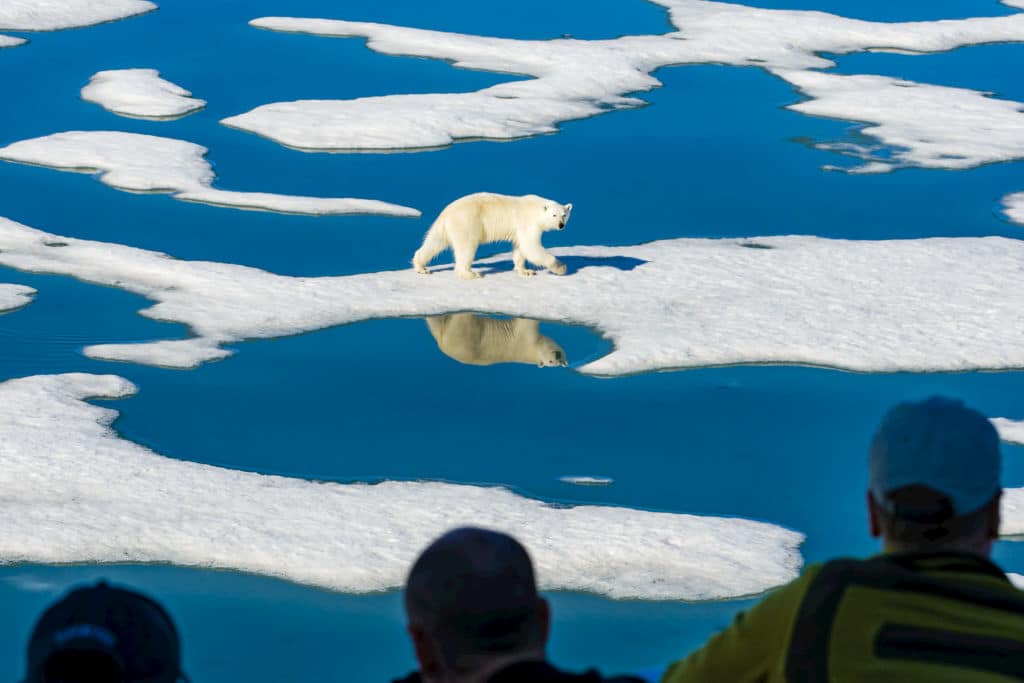
A polar bear walks on melting ice as tourists view from a ship in Svalbard, Norway on Jan. 2, 2022. Ralph Lee Hopkins / Design Pics Editorial / Universal Images Group via Getty Images

Food and Freshwater Scarcity

All of these changes to natural processes and ecosystems will not leave human society unaffected. Already, the climate crisis is increasing both food and water insecurity through drought, ocean warming and acidification and the loss of sea ice that Indigenous Arctic communities rely on for hunting. Partly because of climate change, around half of the world’s population endures “severe water scarcity” for at least some of the year.

The lakebed of China’s largest freshwater lake, Poyang, depleted due to high temperatures and drought in Jiujiang, Jiangxi Province of China on Aug. 19, 2022. Shen Junfeng / VCG via Getty Images

All of this will only get worse. Around 22 percent of the world’s population relies on glaciers for their primary source of drinking water, and future melting could deprive them of this essential resource. Saltwater intrusion from sea level rise also threatens to inundate the freshwater supply of people living on low-lying atolls. As crop yields decrease as temperatures rise, this could push 43 million people below the poverty line by 2030 just in Africa.

Poverty, Conflict and Displacement

Flooded homes on Mousuni Island in West Bengal, India on Nov. 17, 2016. Arka Dutta / Pacific Press / LightRocket via Getty Images

A decrease in water and food resources will inevitably push populations into poverty, exacerbate conflicts between them and force people from their homes in search of a better life. As the climate warms, its impacts will interact more often with other factors like resource competition or political tension to exacerbate conflict. For example, while the civil war in Syria cannot be blamed on climate change alone, there is evidence that it was inflamed by the worst multi-year drought the country had seen in 900 years.

The war sparked a refugee crisis, with 5.5 million Syrians now living in other countries after fleeing the violence. Between 2010 and 2019, extreme weather events directly displaced around 23.1 million people each year. A recent Somalia-based study found that a 50 millimeter reduction in monthly rainfall could increase displacement by a factor of two, and a monthly temperature rise of 1 degree Celsius could increase displacement by a factor of 10. Depending on how much is done to curb emissions, one billion people could be climate refugees by 2050.

Human Health

The Lancet’s 2022 report on climate change and health concluded that human health was already “at the mercy of fossil fuels.” The number of heat-related deaths for people older than 65 increased by around 68 percent from 2000 to 2004 and from 2017 to 2021. Extreme weather events expose people to health hazards like increased wildfire smoke and infectious diseases that spread when drought puts sanitation at risk. Heat waves and other extreme weather events can have a negative impact on mental health, not to mention the growing issue of climate anxiety.

High levels of air pollution impacted Bogotá and several regions of Colombia where more than 30 wildfires were registered amid record temperatures on Jan. 26, 2024. Diego Cuevas / Getty Images

The range of disease-carrying organisms is already expanding as temperatures warm. For example, between 2012 and 2021, the ideal climate for the transmission of dengue by the Aedes aegypti and Aedes albopictus mosquitoes increased by 11.5 percent and 12 percent respectively. In the future, even more climate change could interact with other factors like urbanization to increase the risk of future pandemics.

Who Is Most Responsible?

All of humanity is not equally responsible for the climate crisis. Certain nations, companies and individuals have emitted significantly more greenhouse gases than others.

Countries

An oil refinery near a highway in Houston, Texas on Jan. 21, 2022. Brandon Bell / Getty Images

Historically, the U.S. is the country that has emitted the most climate-warming emissions, contributing around 20 percent to the total between 1850 and 2021. It is followed by China at 11 percent, Russia at 7 percent, Brazil at 5 percent and Indonesia at 4 percent. The culpability of the latter two is largely because of deforestation. Former colonial and industrial powers Germany and the UK contributed 4 and 3 percent respectively, but this doesn’t include emissions from their overseas colonies. A different set of calculations found that the UK and EU were together responsible for 22 percent of emissions between 1751 and 2017, while the U.S. was responsible for a quarter.

Today, China emits the most of any nation followed by the U.S., India, the EU, Russia, Japan, Brazil, Indonesia, Iran and Canada. Together, these countries are responsible for more than two-thirds of global emissions, and the top three are responsible for 42.6 percent. In comparison, the 100 least-emitting countries only contribute a modest 2.9 percent.

A coal-fired power plant in Daqi, Inner Mongolia, China on Dec. 2, 2008. Ryan Pyle / Corbis via Getty Images

Companies

Certain companies — especially fossil fuel and meat and dairy companies — contribute disproportionately to the climate crisis because their business models are bound up with either burning oil, gas or coal or clearing biodiversity for agriculture. Only 100 fossil fuel companies — including ExxonMobil, Shell, BP and Chevron — have contributed 71 percent of global emissions since 1988, one study found. Not to be left out, the top five meat and dairy companies in the world have a carbon footprint equal to Exxon’s.

An oil refinery owned by Exxon Mobil in Baton Rouge, Louisiana on Feb. 28, 2020. Barry Lewis / InPictures via Getty Images

But the fossil fuel industry’s responsibility extends beyond its product. In recent years, evidence has emerged that most if not all of the major oil and gas companies were aware of the dangers posed by their actions in the 1970s and 80s but instead chose to fund climate denial and lobby politicians against shifting to renewable energy. Based on both their emissions and their political actions, a recent study calculated that the 21 largest fossil fuel companies owe the world at least $5.4 trillion in reparations.

Individuals

For the most part, individuals are not the driving force behind climate change. Even if you drive a gas-powered car an hour and back to work each day or heat your home with electricity from a coal-powered plant, your choices are largely shaped by the economic pressures and energy and transportation infrastructure that scaffolds your life. However, there is an exception: uber-wealthy individuals who ride in private jets and invest in polluting industries.

A 2022 study found that the wealthiest 10 percent of people on Earth were responsible for almost half of global emissions. While there is a large gap between the emissions of individuals in wealthier and poorer countries, there is now a greater gap between the emissions of wealthy and poorer individuals within the same country. The poorest 50 percent of the U.S population, for example, is actually emitting at close to the nation’s 2030 per capita emissions goal, while the richest 10 percent would need to slash their emissions by 86 percent to meet it.

Why Is the Climate Crisis a Social Justice Issue?

The disparity in responsibility for the climate crisis is why the IPCC emphasized climate justice in its most recent report. “Climate justice is crucial because those who have contributed least to climate change are being disproportionately affected,” report author Dr. Aditi Mukherji said in a statement upon its release. “Almost half of the world’s population lives in regions that are highly vulnerable to climate change. In the last decade, deaths from floods, droughts and storms were 15 times higher in highly vulnerable regions.”

A woman walks a long distance to collect drinking water from a freshwater source in a coastal area in Khulna, Bangladesh, on April 27, 2024. Zabed Hasnain Chowdhury / NurPhoto

What’s more, the climate crisis can exacerbate existing inequalities, making life harder for racial minorities trapped by historic redlining in urban heat islands, women in agriculture who already face pay discrimination before having to contend with climate shocks or low-income people in previously colonized countries who must now endure drought or severe storms. Responding urgently and equitably to the climate crisis is therefore essential from a social justice perspective, both to avoid the widening of existing gaps and to take the opportunity to close them as we reimagine society along more sustainable lines.

What Has Been Done About It So Far?

The international community has been talking about taking action on climate change since 1992, when the United Nations Framework Convention on Climate Change (UNFCCC) was adopted. Since then, world leaders have held 27 conferences of the parties to this convention, or COPs, at which they have made varying degrees of progress. Perhaps the most significant COP was COP 21, which met in Paris in 2015. It was here that nations negotiated the Paris Agreement to keep warming to “well below” 2 degrees Celsius above pre-industrial levels, and ideally limit it to 1.5 degrees. Nations were supposed to submit voluntary nationally determined contributions (NDC) every five years to say how much they would reduce emissions, with the end goal of reaching net zero emissions by 2050.

To date, the world is not on track to honor the Paris Agreement. For one thing, there is an “implementation gap” as current policies lag behind countries’ NDCs. Policies in place as of 2020 would put the world on track for 3.2 degrees Celsius of warming, while aligning policies with pre-COP26 NDCs through 2030 would limit it to around 2.8 degrees. Since COP26, nations have come forward with more ambitious pledges and net-zero promises. Accounting for these pledges could lower warming to 2.4 to 2.6 degrees Celsius. By considering longer term or net-zero pledges, Climate Action Tracker saw a possibility for 2 degrees of warming, and an even more optimistic 1.8 degrees when including net zero promises in effect or in discussion from around 140 countries.

While existing actions and policies are not sufficient, they have already made a difference. Policies to improve energy efficiency, halt deforestation or develop renewable energy sources have likely prevented several gigatons of carbon dioxide a year from entering the atmosphere. Progress already made has rendered the worst-case emissions scenario, which assumed a 500 percent increase in coal use and projected a 6-degree-Celsius temperature rise by 2100, “exceedingly unlikely.” That said, a 3-degree warmer world would still mean the near eradication of both coral reefs and Arctic sea ice and more days in which heat and humidity would reach dangerous levels for human survival. And the latest IPCC assessment cycle found that the temperature threshold for various risks — such as extreme weather events or threatened systems — was lower than previously estimated. Honoring the Paris Agreement goal is more urgent than ever.

What Still Needs to Be Done?

Climate action falls into two broad categories: mitigation and adaptation. Mitigation means actively reducing the amount of greenhouse gases in the atmosphere to stabilize global temperatures, while adaptation means adjusting to the changes in sea level or weather patterns that are already locked in.

Mitigation

The most important thing that can be done to stave off additional climate change is to stop burning fossil fuels as soon as possible. This means both not developing any new fossil fuel projects and even ceasing to exploit the deposits that already exist. The IPCC found that emissions from already existing fossil fuel infrastructure would gobble up the remaining carbon budget for limiting warming to 1.5 degrees Celsius, unless those emissions were somehow offset or removed from the atmosphere with still-unreliable carbon capture technology.

In order to have a 50 percent shot at the 1.5 target, greenhouse gas emissions must fall by 60 percent by 2035. This can be achieved by shifting rapidly to renewable sources of energy like wind and solar, replacing gas-fueled cars and trucks with electric vehicles and improved public transit, designing more sustainable cities, boosting the energy efficiency of buildings, decarbonizing industry, making agriculture more sustainable, protecting and restoring natural carbon sinks like forests and actively removing carbon dioxide from the atmosphere through carbon capture and storage.

Adaptation

Human activity has warmed the atmosphere enough that some climate impacts are already occurring and likely to continue. However, we can change how we design communities and infrastructure to make them more resilient to these changes. For example, the Billion Oyster Project in New York is restoring the city’s oyster reefs in part to protect it against storm surges and sea level rise, while the government of California is learning from the once-banned Indigenous practice of controlled burns to prevent larger fires. Farmers on the coast of Vietnam have begun keeping bees to help with mangrove restoration instead of gathering dwindling snails and crabs, while El Salvador is protecting itself from floods and landslides by restoring its surrounding forests.

When it comes to adaptation, there is still more work to be done. The 2022 UN Adaptation Gap report found that 84 percent of countries participating in the UN Framework Convention on Climate Change had some kind of adaptation plan, up 5 percent from the year before. However, funding for adaptation in the Global South is five to 10 times less than it needs to be, and the gap is widening instead of shrinking.

Political and Social Change

The climate crisis isn’t merely a technological problem caused by how we power our daily lives. It’s a political problem caused by an economic and political system that often prioritizes the short-term profits of large corporations over the long-term well-being of communities and ecosystems and considers nature as “resources” to be exploited for economic gain.

Therefore, solving the climate crisis means making fundamental changes to the way we write our laws and structure our society. This could include things like giving rights to nature, so that communities have a legal recourse to protect forests from destruction or waterways from pollution, or ideas like degrowth and doughnut economics that seek to reorganize the economy around meeting everyone’s essential needs without overtaxing our planetary support system. Many activists are calling for ideas like a Green New Deal or a just transition that would use mitigating and adapting to the climate crisis as an opportunity to address and resolve long-standing inequalities and make sure that when we transition to a new form of energy, no one is left behind.

Sen. Ed Markey (D-Mass.) and Rep. Alexandria Ocasio-Cortez (D-NY) attend a press conference on the five-year anniversary of the Green New Deal in front of the U.S. Capitol Building in Washington, DC on Feb. 6, 2024. Celal Gunes / Anadolu via Getty Images

Takeaway

The climate crisis may be the single greatest challenge humans have faced as a species. Every day seems to bring a new unprecedented weather event or another study warning about unsustainable emissions use or unavoidable climate impacts. But that doesn’t mean we should give up hope. While not everyone is equally to blame for climate change, everyone can play a role in the solution, from reducing one’s carbon footprint to experimenting with alternative, more sustainable forms of community to participating in climate activism to put pressure on world leaders or fossil fuel executives. The good news is that many climate solutions — from clean energy to urban trees — would make the world healthier, greener, more just and all around more pleasant to live in. Change is inevitable, but if we come together to stop burning fossil fuels and adapt in a way that prioritizes the most vulnerable among us, there’s still a chance that it can be change for the better.

Bookpurnong Road on River Murray in South Australia after flooding on Nov. 23, 2022. BeyondImages / iStock / Getty Images Plus

The post Climate Crisis 101: Everything You Need to Know appeared first on EcoWatch.

https://www.ecowatch.com/climate-crisis-facts-ecowatch.html

Continue Reading

Green Living

Outdoor Projects You Can DIY for Almost Nothing

Published

on

It always strikes us as amusing how many DIY projects you see online that seem to require more time and more money than it would take to simply buy the thing they’re trying to DIY in the first place. Are we missing the point?

We think that doing things ourselves and taking back the power to create instead of simply consuming is absolutely vital to the green movement. But if you don’t already have the materials and spend a lot of money purchasing craft supplies, does it really make sense to DIY?

These eight projects are true do-it-yourself masterpieces. One-of-a-kind outdoor projects you can make for almost nothing, with supplies you most likely already have or can easily pick up second hand for a song. Roll up your sleeves and let’s get started!

1. Teapot/Teacup Bird Feeder

Idea and photo credit: Dinah Wulf, DIY Inspired

Do you have one of Grandma’s old tea sets lying around that doesn’t quite fit into the sleek modern aesthetic you’ve been cultivating? Put it to great use by feeding the birds in your area — in style.

Thrift stores are always awash in old china, so if you don’t already have the old tea set, consider going wild and spending a few bucks for this DIY delight. You’ll find blogger Dinah Wulf’s instructions for the teacup bird feeder at DIY Inspired.

Safety note: Use sturdy twine or cord — not chain — to hang the feeder. Birds can catch their toes in chain links, which causes serious injury. The National Audubon Society also recommends cleaning seed feeders every two weeks (more often in hot, humid weather) by scrubbing with soap and water and soaking in a 50-50 vinegar-water solution to prevent the spread of avian disease.

2. Gardening Tool Storage

DIY rake gardening holder
Idea and photo credit: Beth Logan, Artstuff Ltd.

What on earth do you do with those rusty-as-heck, old-school garden rakes hanging around your garage? Well, if you’re any sort of DIY genius, you press them into service as a gardening tool holder.

The original inspiration for this project came from Beth Logan at Artstuff Ltd., whose blog has since gone offline. For a current walkthrough, see the Repurposed Rake Tool Rack tutorial at DIY n Crafts (project #14 in their roundup of 25 ways to reuse old garden tools). The concept is embarrassingly simple — remove the rake handle, mount the head tines-out on a fence or garage wall, and use the tines themselves as hooks for trowels, gloves, and pruners — but eye-catching enough to make you look like a DIY pro.

3. Bottle Tree

A bottle tree, image courtesy of Felderrushing.blog

Do you like wine? No, I mean do you really like wine? Do you want a reason to drink more of it? And does your garden need a cute border? This sustainable, upcycled garden border may be just the project for you. You might have to expand your drinking list to include bottles of various shapes, sizes, and colors — but variety is the spice of life.

When friends ask how you managed to collect so many bottles, just laugh gaily and then distract them with your dainty teacup bird feeder. The bottle tree tradition itself runs deep — Mississippi garden writer Felder Rushing traces the practice back through African American Southern folk art and, by his own research, as far as ancient Egypt and Mesopotamia. See his bottle tree gallery and history for inspiration, or jump straight to his how-to guide for building one out of a cedar snag, rebar, or just about anything else.

4. Colorful Outdoor “Tiles”

Painted Patio Tiles
Idea and photo credit: Elsie Larson, A Beautiful Mess

If your backyard isn’t perfectly landscaped and manicured, with an impeccably tiled “outdoor living space,” don’t despair. You can use up all those half-empty paint cans and create a Pinterest-worthy colorful backdrop for evenings spent clustered around a fire or barbecue.

Pop a few coats of paint on cement tiles and you have a one-of-a-kind flooring solution. If you rent, the same effect could be achieved on a more temporary basis by letting the kids go wild with sidewalk chalk and create a mosaic masterpiece. Check out Elsie’s Painted Patio Tiles at A Beautiful Mess for the back story on this DIY idea. (Heads up: the original author noted she had to touch up the paint each spring in Missouri winters — a porch and patio floor enamel will hold up better than wall paint.)

5. Home Sweet Gnome

Idea and photo credit: Jennifer Pilcher, Snapguide

Okay, this one might be the least practical idea of the bunch, but that may be why I love it oh so much. If you have a stump in your backyard and you’re not willing or able to pay the truly insane amount it costs to have it ground down and removed, how about making it into a little gnome home? This is the perfect outdoor project if you have small children in your life.

Construct the trappings of a little house — door, windows, winding garden path — from found objects or natural materials, and affix them to the stump. Bonus points if you don’t tell the kids about this particular DIY project and allow them to simply stumble upon it one day in the garden. My mind would have been blown if I had come across one of these as a seven-year-old. For a step-by-step build, see this Gnome Tree Stump Home tutorial on Instructables.

Safety note: Don’t use an angle grinder to gouge windows or doors into a stump. Use a chisel and mallet for shallow detail work, or attach decorative pieces (driftwood, bark, polymer clay) to the outside instead.

6. Mosaic Stepping Stones from Broken China

Image courtesy of Gardening.org.

Every household eventually accumulates a small graveyard of chipped mugs, a single survivor from a four-piece dinner set, or a beloved teapot with a hairline crack. Rather than tossing them — broken ceramics generally aren’t accepted in curbside recycling — embed them in concrete stepping stones for a garden path that’s genuinely one of a kind.

This pairs beautifully with the teacup project above: any teacups that don’t make it past Project #1 (you will break a few) can come back as paving. The DIY mosaic stepping stones tutorial at Gardening.org walks through the full process — breaking ceramics safely inside a drop cloth, sizing pieces to half-inch to one-inch fragments, pressing them into wet concrete, and sealing the surface so sharp edges don’t cause injury underfoot. Basic mold options include an old cake pan, a plastic plant saucer, or a purpose-built stepping stone form from a craft store.

Safety note: Wear safety glasses and heavy gloves when breaking ceramics. Once cured, run a finger over the surface to check for protruding edges and file or sand any down before placing the stone where bare feet might land.

7. Vertical Pallet Herb Garden

Shipping pallets are one of the world’s most abundant near-free materials. Small businesses, garden centers, and feed stores often have stacks of them out back, and asking politely beats the alternative of seeing them landfilled. Mounted vertically against a sunny wall or fence, a pallet becomes a stacked planter that holds enough herbs to keep a kitchen in basil, thyme, parsley, and chives all season.

Grit Magazine published a clear how-to for a vertical pallet planter — line the back and sides with landscape fabric or heavy plastic to hold soil, fill through the slats, and plant each gap as its own row. The gaps act as natural divisions, so different herbs don’t fight for the same root space.

Safety note: Use only heat-treated pallets for anything edible. Look for the IPPC stamp with the letters HT (heat treated) and avoid any stamped MB (methyl bromide — a fumigant restricted under the Montreal Protocol). Unstamped pallets are unknowns; skip them for food crops. The same heat-treated pallets are fine for ornamental flowers either way.

8. Punched Tin Can Lanterns

Steel food cans — soup, tomato, coffee — are one of the most recyclable materials on Earth, but the recycling-then-buying-something-decorative loop has plenty of slack in it. With nothing more than a hammer, a few nails of varying sizes, and the freezer, an empty can becomes an outdoor lantern that throws constellation patterns across a patio at dusk.

HGTV’s tin can lantern tutorial covers the trick that makes this project work: fill the can with water and freeze it solid before punching, so the ice supports the can wall and prevents denting. Sketch your pattern on paper, tape it to the frozen can, punch through with a nail at each marked dot, and let the ice thaw. Drop in a battery tealight (much safer outdoors than a real flame) and group them along a walkway or down the center of an outdoor table.

The Point of All This

None of these projects requires you to buy more than a tube of waterproof adhesive, a bag of concrete, or maybe a stepping stone mold. The materials — chipped china, leftover wine bottles, empty cans, a forgotten pallet, an old rake — are already in your house or someone else’s. That’s the point. The greenest project is the one that uses what already exists, and the best part is that yours will look like nobody else’s.

Editor’s Note: This article, originally authored by Madeleine Somerville on June 17, 2015, was updated with corrected links and new ideas in May 2026.

The post Outdoor Projects You Can DIY for Almost Nothing appeared first on Earth911.

https://earth911.com/diy/outdoor-projects-you-can-diy-for-almost-nothing/

Continue Reading

Green Living

Best of Sustainability In Your Ear: Author Nadina Galle on The Nature of Our Cities

Published

on


More than half the world’s population—4.4 billion people—live in cities today. That number is expected to rise to 80% by 2050. Our guest, Nadina Galle, is a trailblazing ecological engineer and author of The Nature of Our Cities. She is an ecological engineer who studies the intersection of nature and technology in urban environments. Nadina developed the concept of an Internet of Nature (IoN) that uses tools like artificial intelligence, automation, and sensors to support and enhance ecosystems within cities. Nadina’s book offers a transformative perspective on how urban spaces can be reimagined in the face of climate change and sprawling development. She shares the inspiring story of the Groene Loper project in Maastricht, Netherlands, where soil sensors were deployed to monitor tree health. The results were remarkable, with trees supported by this technology growing up to three times larger than those without it. This is a powerful example of how technology can not only protect trees but also transform urban spaces into healthier, greener environments.

Nadina Galle, an ecological engineer and author of The Nature of Our Cities, is our guest on .

From fire and the wheel to the reinforced concrete frames that define modern buildings, we are surrounded by technology. We tend to forget that technology emerged in response to nature — too often, we treated nature as the enemy, the chaos to be contained instead of recognizing that nature’s cycles and changes are the harmony we need to join to sustain society. The loss of any semblance of natural patterns, which ultimately leads to the depletion of the resources necessary for life, has inevitably led to the collapse of previous major civilizations. Modern society has more runway than previous societies because we have created a global economy, but that risks an even greater fall for our species when the ecological underpinnings of our prosperity collapse. The Nature of Our Cities, is a powerful, straightforward, and emotionally resonant book to help you think through your role and choices in the restoration of nature. You can find it on Amazon or Powell’s Books.

Editor’s Note: This episode originally aired in December 2024.

The post Best of Sustainability In Your Ear: Author Nadina Galle on The Nature of Our Cities appeared first on Earth911.

https://earth911.com/podcast/earth911-podcast-nadina-galle-on-the-nature-of-our-cities/

Continue Reading

Green Living

Sustainability In Your Ear: Trex Makes Circularity Work

Published

on

Less than 2% of Americans can put plastic film in their curbside recycling bin, according to The Recycling Partnership. Meanwhile, the country generates millions of pounds of bags, pallet wrap, bubble mailers, and dry cleaner sleeves every year that machinery at materials recovery facilities is designed to reject. The plastic film problem has been the recycling industry’s white whale for three decades — too contaminated for most processors, too light for most economics. But more than 30 years ago, Trex Company, then a small operation in the Shenandoah Valley of Virginia, decided to build its supply chain around exactly this material. By the end of 2024, Trex had upcycled more than 5.5 billion pounds of waste plastic film into composite decking and had become one of the largest plastic film recyclers in North America. On this episode of Sustainability In Your Ear, Amy Fernandez, Chief Legal and Sustainability Officer, and Zachary Lauer, Chief Operations Officer at Trex, discuss how the company designs an entire manufacturing process around feedstock variability, why Trex indexed its 2024 sustainability report to IFRS standards before any US regulator required it, and what has to happen for old Trex decks to become new Trex decks.
Trex Company Chief Sustainability & Chief Legal Officer, Amy Fernandez, and Chief Operating Officer Zach Lauer are our guests on Sustainability In Your Ear.
Most manufacturers spend their engineering effort narrowing input tolerances. Trex went the other direction. Zach described thousands of recipes the production lines can run through, swapping between cleaner stretch film one day and heavily contaminated industrial trimmings the next. Artificial intelligence reads each feedstock stream in real time and adjusts extrusion temperatures and line speeds to keep the finished board within specification. In 2024, the company sourced over 1 billion pounds of reclaimed PE film and wood scrap, including 377 million pounds of waste plastic, through a national collection network of more than 10,000 retail drop-off locations and hundreds of school and community partners enrolled in its NexTrex program. The company is also preparing for the first generation of Trex decks, which are reaching replacement age, and its manufacturing lines can reabsorb the company’s own boards. The recycling bottleneck is contractors pulling up old decks who don’t want to sort screws from boards. Underneath all of it is a point worth lingering on: Trex’s poly feedstock isn’t priced off a barrel of crude, which means in a period of reshoring, tariff volatility, and oil-market disruption, recycled supply chains are structurally more stable than virgin ones, not less.
To find out more about Trex and its sustainability work, visit trex.com. The 2024 Sustainability Report is available on the company’s investor relations site.

Interview Transcript

Mitch Ratcliffe  0:09

Hello, good morning, good afternoon, or good evening, wherever you are on this beautiful planet of ours. Welcome to Sustainability In Your Ear. This is the podcast conversation about accelerating the transition to a sustainable, carbon-neutral society. And I’m your host, Mitch Ratcliffe. Thanks for joining the conversation today.

Americans throw away roughly 100 billion plastic bags a year, and most curbside programs won’t take a single one of them. Plastic film, those bags, the pallet wrap in the back of the stores, the bubble mailers, the dry cleaner sleeves, the overwrap on a case of bottled water — all of this has been the recycling industry’s white whale for decades. It jams machinery at materials recovery facilities, contaminates other waste streams, and ends up in landfills and oceans, and increasingly that plastic, especially microplastic, ends up in human tissue.

Meanwhile, the lumber industry sends sawdust to landfills by the truckload, and old orchards full of dying trees become a disposal problem for farmers. Two waste streams nobody wants, generated at industrial scale with very few takers. But more than 30 years ago, a small company in the Shenandoah Valley of Virginia looked at both of those streams and saw raw material. Today, that company has upcycled more than 5.5 billion pounds of waste plastic film and sourced over a billion pounds of waste wood in 2024 alone, and as a consequence, they’ve built one of the largest plastic film recycling operations in North America, all in service of making something as ordinary as backyard decking.

The deck happens to last about 25 to 50 years, requiring no staining, no sealing, and competes head to head with pressure-treated lumber on a price and performance basis. The sustainability story isn’t a marketing layer on top of the product, it is the product. And we’re talking about Trex, Trex decking.

Our guests today run two of the most consequential functions inside Trex. Amy Fernandez is Senior Vice President, Chief Legal Officer and Secretary, and Chief Sustainability Officer at Trex Company Incorporated, the world’s largest manufacturer of wood-alternative composite decking and railing. She holds the unusual combination of legal and sustainability oversight at a moment when these two domains are converging fast, with the IFRS Sustainability Disclosure Standards, California’s climate disclosure laws, and the SEC’s evolving stance all reshaping what public companies must say about their environmental performance. In 2024, Trex indexed its sustainability report to the IFRS standards before being required to, which tells you something about how Amy thinks about the relationship between disclosure, governance, and competitive position.

She’ll be joined today by Zachary Lauer, who is Senior Vice President and Chief Operations Officer at Trex, where he oversees manufacturing, supply chain, engineering, and research and development. His teams run plants in Virginia and Nevada, and they’re bringing a major new facility online in Little Rock, Arkansas, having built the operational machinery that turns approximately 95% recycled and reclaimed content into a product that has to perform outdoors for half a century. The R&D side of his portfolio is where Trex has cracked feedstock streams that other recyclers can’t process, including industrial film trimmings, end-of-life packaging from food and chemical manufacturers, and dunnage returns from distribution partners. All this work happens at the intersection of material science, logistics, and the unglamorous reality that recycled inputs don’t behave like virgin ones. It’s more expensive sometimes to recycle this stuff.

We’ll talk with Amy and Zach about how Trex actually makes its products, where the materials come from, and what it has taken to build a national feedstock network through the NexTrex program, a collection program spanning more than 10,000 retail drop-off locations and nearly 1,000 schools and community organizations. We’ll dig into a harder question, too: why Trex’s absolute emissions rose alongside production growth in 2024, and what the company is doing about end-of-life recycling of Trex boards now that the first generation is reaching replacement age, and what other manufacturers can learn from a company that is building a recycling infrastructure before there’s a market to feed it.

To learn more about Trex and its sustainability work, visit trex.com. So, circularity is a word that gets thrown around a lot these days. Trex was practicing it before the word existed. Let’s find out what three decades of doing that work has taught Amy Fernandez and Zach Lauer, right after this.

Welcome to the show, Amy Fernandez and Zachary Lauer. How are you doing today?

Zachary Lauer  4:54

Doing great.

Amy Fernandez  4:55

Great, great. Thank you, Mitch.

Mitch Ratcliffe  4:57

Well, thank you for joining me. And Trex does such interesting work. I mean, you were demonstrating what circularity means before the word had any cultural traction. I know you weren’t there at the beginning, but was this framed internally as an environmental project or as a sourcing strategy? Just the recognition that there was this massive volume of feedstock there that could be used.

Zachary Lauer  5:16

It was initially an environmental initiative by our founder, Roger Wittenberg. You know, he was bothered by the fact that there was no way to recycle or reuse his bread bags, and he wanted to formulate a product of value from that. He went through a couple of iterations and partnered with some other people, and they decided to turn it into composite decking and market it that way. Ever since that, it’s been part of our DNA, and we were always looking to extract value out of waste streams, you know, that aren’t currently used, and we continue to develop the next generation of materials out there that we can extract value from and create a great product from.

Mitch Ratcliffe  6:09

These days — just last week, a couple of weeks ago, we talked with the CEO of Emerald Packaging, who’s also looking for recycled PE to use in their products. There’s competition for this feedstock now. How has that changed the way that Trex organizes its efforts to collect and bring this to the three different locations you manufacture the decking?

Zachary Lauer  6:30

So, you know, with opportunities and growth in this space, one of the things that has developed over time, over the last 10 to 15 years, is the growth in the availability of recycled polyethylene films from distributors. Right, as Amazon grows and direct shipments to homes grow, the materials that are used continue to expand. So that’s opened up markets for increased stretch film and those types of materials. But as those markets grow, we often go deeper and deeper into the stream, more contaminated into the stream, to go after material streams that most people can’t deal with or process.

Mitch Ratcliffe  7:17

Well, one of the benefits of this kind of recycling is that you don’t have a lot of health-quality, you know, food-contact kinds of restrictions, and so forth with the plastic. You mentioned contamination. Just how contaminated can the loads be for Trex in order to make a viable product?

Zachary Lauer  7:36

We grade our materials on a scale of 5 to 15% contamination. We can go deeper than that. The contamination that we typically find in our streams are metals, non-ferrous metals, other forms of plastic, polypropylene, polystyrene, and those types of material, paper, cardboard. And so we’re able to design processes that can accommodate those and process those materials. Out-sorting is still critical to the long-term viability.

Amy Fernandez  8:10

Oh, yes. And we can go more contaminated depending on what that contamination is. So if it’s paper, we can handle more of that. If it’s metal, it’s a bit harder to handle. So the type of contamination also matters in terms of, you know, at what level we can accept that contaminated poly.

Mitch Ratcliffe  8:31

Amy, the 2024 sustainability report describes the program as a win-win for both business and society at large. As we all know, we live in a time where that’s a contested idea — that sustainability is a good thing for the economy. What’s the most concrete way that you explain or demonstrate that the business case and the environmental case are genuinely the same for Trex, that this is an inseparable configuration?

Amy Fernandez  8:58

Yeah, you know, a really good example was our last earnings call. And during that call, you might have heard our CFO started talking about the price of PVC and virgin materials and the volatility associated because of their connection to oil. So that’s one very recent concrete example of the fact that, because our material is this poly that we recycle, we’re not as exposed to that volatility that you might get from those virgin streams. And so that is truly one of those competitive advantages that we have — that we recycle this material, and we can make a beautiful, well-performing product out of it. That is the business case. So you see it through these little examples.

Mitch Ratcliffe  9:51

So in an era of reshoring, you’re actually in a position to be even more competitively advantaged.

Amy Fernandez  9:56

Yes.

Mitch Ratcliffe  9:58

Amy, you stepped into the CSO role while also serving as Chief Legal Officer, and that’s a combination that’s becoming more common as sustainability disclosure is shifting from voluntary to regulated. How has all of the upheaval in the regulatory environment that we live in changed Trex’s approach over the past year or two in terms of what you report and what you tell customers?

Amy Fernandez  10:19

Trex has always been a highly ethical company, and so we do what’s right. And if you’re founded in doing the right thing, you’re not as subject to these whims of, you know, what’s happening either politically or, you know, with changes with government regulations, things like that. And so because we’re grounded in this reality of, we’re not going to go out there and start talking about targets that we don’t think are achievable — so when it was, you know, common to start saying “by 2030” or “by 2050” or whatever dates companies were out there saying “we’re going to get to this target” without actually having a plan to get there, Trex would never do that.

And so one of the things that you would see is that we get asked questions: “Why don’t you have targets?” And it’s because our target is to continuously keep improving from a very solid base that we have, but we’re not going to put an unrealistic number out there just to try to get points. So the regulatory changes don’t affect us as much when we start from that just basic ethical “do the right thing, disclose important information that we think our investors, our communities, others want to see, want to know that is true and not misleading in any way.”

Mitch Ratcliffe  11:39

From a marketing perspective, saying that you live by a higher standard is pretty effective. Do you think it’s necessary to be a lawyer to be a chief sustainability officer these days?

Amy Fernandez  11:49

No, not at all. And actually, I think the only reason that we did decide to put it this way — yes, of course, I do have the regulatory mindset, but I also have a passion for this, right? I mean, I joined this company because it is something that is important for me personally. And so the chief sustainability officer could have lived in other places and just been informed by legal the way that I inform other functions in this company. But I basically raised my hand for it and said, I think it lives well here, and I have a passion for it.

Zachary Lauer  12:22

It resided in other areas in our business as well, right, under other people that have that same passion.

Mitch Ratcliffe  12:29

So, Zach, what happens between the time when a plastic bag is dropped at one of the 10,000 grocery stores that collect bags and a finished Trex board leaving the factory? Can you walk us through that process?

Zachary Lauer  12:40

Yeah, you’ve kind of highlighted the ends of that value chain, right? From the pickup to the actual product that goes to the customer. We actually have over 15,000 collection points across this country that come back to centralized collection points, and then actually make their way to our recycling facilities, where the cleaner films are put directly into our production lines, and the more contaminated films go into a reprocessing operation that turns it back into a pellet.

But the most challenging engineering point for us in this entire value chain is actually at the extrusion production line, and managing variation in the streams. We call it recipes, and we have a rolodex of thousands of recipes that can be used in the production process. I liken it to a cooking analogy. Today we’re baking with wheat flour, and tomorrow we might be baking with almond flour.

And so we’ve used a lot of technology to help us — machine intelligence, artificial intelligence — to help us manage those recipes. And not only does it help us manage the streams coming into the production lines, those raw materials, but then it modifies the process parameters, the cooking temperatures, and the speeds in order to process those streams. So that’s where the complexity is for us.

Amy Fernandez  14:14

We design our own equipment. And I mean, we don’t — you can’t just buy this equipment from equipment manufacturers. So being able to design and set up this equipment to be able to process this changing raw material stream continues to be one of our areas of excellence.

Mitch Ratcliffe  14:35

That’s fascinating. The idea that if you had a different kind of fiber, for instance, coming in — you brought in a chipped orchard as a source — that you’d have a different recipe, but you’re producing a product that is consistent in its standards and specifications. That’s, I mean, Zach, that’s got to be very complicated. You mentioned AI. Was this possible before AI, or slower before AI?

Zachary Lauer  14:57

No, we still did it, but we had to program a lot more, right, and program the intelligence on the line a lot more. It’s just becoming more rapid as we can read those streams and read the variation in line. It just makes that reaction quicker and faster for us on those production lines to do that. But no matter what our recipe is for the day, to your point, Mitch, it comes out a consistent product at the end.

And it just shows that we design our product around variability. Whereas most people focus on reducing variation in their raw material streams, we’ve designed our whole manufacturing process around being flexible and adapting to material streams — not only the ones we use today, but the ones we’ll use in the future.

Mitch Ratcliffe  15:51

The other area where you’ve got that kind of volatility is in the volume of recycled polyethylene that you’re bringing in. You had a big year in 2022; it went down by almost 100 million — excuse me, 100 million pounds — the next year, and then recovered, not quite back to the 2022 range, in ’24. What’s behind that volatility? Is it competition for feedstock? The fact that retailer collection participation changes? The contamination rates?

Zachary Lauer  16:20

A lot of things go into it. But what I tell people is, don’t equate our collection volume to our consumption volume. You know, one of the unique challenges about being a recycler is the fact that it’s a winner-take-all market. When you pick up an account, maybe a large grocery store, it’s like picking up the trash — you have to be there and you have to collect it regularly. Service is key. So there could be times when there is more availability or more collection in a period, and you have to accept it.

So how we manage that volatility, or, you know, the changes that can occur from year to year or season to season, is we do a very good job of long-term demand and supply planning in this space, and combining that with our space planning, and then we kind of layer in anticipated regulatory, market, and consumer preference changes into that. And so there could be a period where we see maybe a deficit or a surplus, and we will go in and consume that and store it for a future period, or there just could be a surge in a particular market where there’s the availability and you just have to be willing to take it. And that’s difficult to absorb — those huge swings like you mentioned — into your supply chain without having a plan.

Mitch Ratcliffe  17:55

You just said “as a recycler,” but should we be thinking about this in general as simply part of the manufacturing process — going back to onshoring and keeping more materials in country and reusing them across a wider variety of production streams? How does Trex think about organizing the wider material flow rather than recycling programs in the United States? What have you learned that we should be applying as a nation?

Zachary Lauer  18:23

You know, I think you have to be intentional if you’re going to enter into a stream where you’re going to recycle or pull materials out there. We’ve focused our effort on North America, right? And we do take collection from other areas, but it’s rare. And we adapt our collection based on changing preferences. So, Mitch, what I mean by that is, you know, one year we could be doing a lot of store collection or distribution collection, but then all of a sudden in a region of the country, regulation changes, or things change, and we go more to the recyclers for our material.

We continuously monitor and adapt to the changes that we see there, because our desire is to keep our supply chains as close to our factories as possible. We bear the cost of the freight, right? And we bear the entire cost of the supply chain. We develop the supply chain, and so we’re continuously looking at ways to optimize that and keep our costs manageable.

Mitch Ratcliffe  19:34

As you say, you’ve built this vast alternative collection system — 10,000 retail drop-off locations, you’ve got 84 grassroots community partners, there’s 936 schools that were involved as of 2024. What strategies did you have to develop in terms of communicating to the public what they should put in those bins at stores so that you get a clean load? And does that actually impact the quality of the materials you receive?

Zachary Lauer  20:02

It does. From our foundation, education has been key, right? So this has been a marketing and supply chain integrated strategy from the very beginning. And so we utilize things like our NexTrex program to educate students, to educate communities, and motivate them to recycle and incentivize them to recycle. But we’ve also at the same time incentivized our value chain or our supply chain to collect and be a part of it.

And some of that education is based on teaching people what can be used and how it can be used, and to let them know it’s actually being turned into a product that they can later consume and use. But we also come alongside other businesses to support their environmental sustainability goals as well. Most of our partners want to do the right thing too, and sometimes it only takes a little bit of incentive to get them to participate in this program that we have.

Amy Fernandez  21:09

And Zach, why don’t you add also a little bit about the logistics piece of this, because — so you talked about marketing and supply chain, but part of the supply chain was the logistics with the trailers and how we track them, and time them, and send them out at appropriate, you know, to basically maximize our efficiency in getting the materials.

Zachary Lauer  21:30

Yeah. So we also help our supply chain collect this material. We provide those that are willing to collect with balers to bale this, so that we’re efficient in hauling materials back. We also are very good at calculating what collection will be like in certain areas, and where to leave trailers, and where to incentivize them to backhaul to certain locations.

Right, the grocery stores, for example, they’re backhauling anyway to their warehouses — corrugate, all these other materials — so we take advantage of that backhaul to get to their distribution centers, and then collect from those points where they can fill a trailer within a couple of days. And we manage that entire network of trailers and supply chain, and we ensure that they’re weighed out before they hit the road, so that we’re optimizing the cost of bringing those materials in as well.

Mitch Ratcliffe  22:36

Does that mean that you generally collect this material at a lower rate than most of the industry could possibly achieve at this point?

Zachary Lauer  22:43

That’s correct. Because we’re getting it directly from the source versus maybe through a waste collector or a municipal recycling facility where it’s already been handled a couple of times, and the cost could be higher.

Mitch Ratcliffe  22:59

Amy, it doesn’t sound like it, but I want to ask about this — do the partners also come to you asking about getting credit for this, ESG credit, carbon credits, and so forth? Are you starting to hear that kind of conversation about how we can create further incentives within the collection economy?

Amy Fernandez  23:17

So we’re not starting to hear that yet, unless it’s come through Zach’s team. But as far as I know, we’re not hearing that. We are, though, starting to explore, for example, those companies that do want to say that their plastic is recyclable, because, as you know, all these regulations are coming out around that. If they want to put, for example, the NexTrex logo on there, and can assure that we’re picking it up. If we pick it up, it gets to our manufacturing site. So people that have put those trackers and things like, “Is my bag actually going to get where it’s supposed to go?” — we find them, they get to us. And so that’s part of it, is to support their recycling claims. We’re starting to get some questions and conversations about that.

Zachary Lauer  24:04

The other incentive too, Mitch, is for a lot of these individuals: they have their own goals, and one of those is to minimize what goes to the landfill. And so they’re also incentivized to not throw it away, and so we can help in that process too — we can help meet that need.

Mitch Ratcliffe  24:25

I know neither of you is in the marketing organization, but when people encounter a Trex deck, do you want them to think about the fact that it’s recycled? Do you want them to identify with the circular process?

Zachary Lauer  24:36

We do, and it is meaningful to the consumer. You know, if you were to have asked that question when I just joined Trex — and I’ve only been here 10 years — that, you know, that may have been, you know, it was still in the top 10 of the consumer preference, but it was around eight or nine. That continued to climb up the ladder, and it is in the top five of what the consumer is looking for when they’re looking for a product.

It’s a luxury product that lasts an extremely long time, and they can feel good about the product that they’re purchasing when they do it. And Trex obviously leads in this space with our recycled content on our decking products.

Amy Fernandez  25:27

We still start with performance and aesthetics, but sustainability is right there, right along with it.

Mitch Ratcliffe  25:35

I have to admit, I do stand on my deck and think about the fact it’s recycled. This is a great place to take a quick commercial break, folks. We’re going to be right back to continue this conversation. Stay tuned.

Welcome back to Sustainability In Your Ear. We’re talking with two of Trex Company’s leadership team: Amy Fernandez, she’s Chief Sustainability Officer, Chief Legal Officer, and I’m forgetting one other at Trex, and Zachary Lauer, who’s Senior Vice President and Chief Operations Officer. We’re talking about how Trex has built one of the largest recycling systems in the United States to source materials for its composite decking products.

Amy, Trex in 2024 decided to embrace the IFRS Sustainability Disclosure Standards, which were not mandated by the federal government as a requirement. What drove that choice? Why are you getting ahead of the game?

Amy Fernandez  26:30

There’s a big difference between complying when you’re required to comply and adopting best practices proactively. And in looking at the IFRS disclosure standards, it is a best practice. It’s benchmarking using globally consistent frameworks. It’s, you know, well recognized. It is a good-faith process that shows rigor. And so we’re not going to wait for a US regulation to force us to do something when, again, like I mentioned before, it’s just the right thing to do, and it’s a good framework, because it’s recognized globally. So although we are a US company, we do still have, you know, investors, customers, and others globally that are connected with Trex, so we want to be able to reach them.

Mitch Ratcliffe  27:23

Did taking that higher road require more work? Were there things about your business that the IFRS framework forced you to confront and address that you wouldn’t have otherwise? And this obviously would be of interest to other companies that are thinking about whether or not to pursue them.

Amy Fernandez  27:42

Well, we are looking at some of the gaps in there, right? So our scope three, for example, we’re working on that now, and we’re going to get limited assurance from some auditors just to start. That’s something that isn’t required yet in the US, but under IFRS it is a best practice. So we’re starting to work on that now, because that is one of our gaps with alignment to that framework.

And then the other piece of this too is the rigor around any financial planning related to sustainability risk. So by doing that benchmarking, we were able to identify where we have maybe some best-practices gaps — not regulatory gaps, of course, because we’ve already talked about, this isn’t required — but best practices. And what do we want to start doing, and what might be helpful for everybody that’s looking at Trex, right? Our employees, our prospective applicants, our investors and our communities. So that is part of what we’re finding from this exercise.

Mitch Ratcliffe  28:43

I also noted that Trex’s scope one and two emissions — you mentioned scope three a moment ago — have risen about 17%, partly due to greater volume and partly due to greater energy use. As you grow as a business — and this is one of those challenges that I think the sustainably-minded confront, which is, these companies are going to produce more carbon but less carbon relative to other alternatives — how do you talk to investors and within the organization itself about that rising net impact, and how do you rationalize that given your desire to reduce environmental impact?

Amy Fernandez  29:25

Yeah. You hit the nail on the head, right? When we bring on more production lines — so we did bring more on in ’24 than what we had in ’23, which accounted for a big portion of that increase that you saw in ’24. And then we also, by adding Little Rock, the Little Rock plant into the network — although we don’t have production there, we’re still using energy while we’re, you know, bringing it up. And so you’re absolutely right that because we are running more, that is going to require more energy.

But we’re trying to improve our efficiency of what we’re using. We’re also looking at our network and the grids and the energy available across Nevada, Arkansas, and Virginia, because they’re not all the same. So we’re going to start looking at where we can optimize that as an entire network. And, you know, just be working on that equipment that we talked about earlier that we design ourselves — what else can we put in there in order to reduce the energy use there?

Mitch Ratcliffe  30:28

Zach, what are the carbon intensity goals? I know you don’t necessarily state public goals, but how do you work toward reducing carbon intensity as a continuous improvement operation?

Zachary Lauer  30:39

So we’re always looking at how we’re manufacturing, and throughout the entire supply chain how we’re — I mentioned before, are we getting the maximum weight per load that we’re hauling? And on a per-pound basis of raw materials, we will actually, Mitch, fine or reduce the cost of what we’ll pay if the loads aren’t maximized and optimized.

But when we look at our manufacturing, we want it to be the lowest possible consumption of energy, because energy is expensive, right? And we want to be as efficient with that equipment as possible. Technology is going to continue to help us get there with that. But also, we drive our facilities off of manufacturing efficiencies, and our goal every year is to keep on getting faster, better, and higher, so that content per pound, that content per linear foot — because it is better and better every year. And that’s a focus for us.

Mitch Ratcliffe  31:41

When you enter a new location like the Little Rock plant that you’ve launched, which is purportedly — I haven’t seen the results yet, but supposed to drive 7.4 million kilowatt-hours in annual energy savings and reduce the use of water through a closed-loop recycling system — how do you decide what efficiency investments are going to pay back fast enough to justify the initial investment?

Zachary Lauer  32:05

Well, you know, not everything we do has a great — you know, our goal is for everything we do to have a great return on invested capital, but there are some things that you do just because it’s the right thing to do. One of those areas that’s difficult to get tremendous payback on is water, right? Water is generally still relatively inexpensive in this country. Now, we all know that water is becoming more and more of a challenge.

But a lot of what we do is not just motivated by the return on invested capital, it’s that we’re motivated by doing the right thing. Our employees live in the communities that we operate in. They take a lot of pride. A lot of people come to work for Trex for what we’re doing. Our brand equity is enhanced by what we do and how we go about doing it — not just what, but how we go about doing it.

And our employee brand matters in the communities that we’re in, because labor is extremely competitive in this nation. And somebody that goes to work and feels the impact of what they’re doing is valuable to the community as well — is important to us, and helps us recruit. We have a lot of people that apply to Trex merely because we do things responsibly, we do recycle. So it doesn’t only matter to our consumers, it matters to our employees as well.

Mitch Ratcliffe  33:35

Does the board have a set of “we do the right things” heuristics that they apply to some of these decisions, when you come and say, “Well, we need to do this, and it’s going to be more expensive”? How do they, as a group, create a systematic approach to making the right decision?

Zachary Lauer  33:50

We’re looking at it on an enterprise level, Mitch, where we’re looking at that return on invested capital at an enterprise level. And we will more than offset with our efficiency projects and our cost savings projects and those items on capital that allow us to do these types of things. And so we, for lack of a better term, try to overachieve in some areas to make sure that we can cover our bases in other areas.

Amy Fernandez  34:22

And our nominating and corporate governance committee is the one that gets a sustainability report every quarter. So every meeting we’re reporting on these metrics. Some of these metrics being very important — like our 95% recycled and reclaimed content in our composite decking — maintaining that is something that we report to them every quarter. We also report to them what we just talked about, our energy use, so there’s various metrics that we’re reporting to them.

And so it’s not only just that board-level oversight of our capital, it’s also the nominating and corporate governance committee oversight of our sustainability targets. So you’ve got two lenses looking at it.

Mitch Ratcliffe  35:04

Do you tie executive compensation to success on those metrics as well?

Amy Fernandez  35:08

We do not. We do not. Our executive compensation — it’s in our proxy statement, but no, there is not a modifier or a target for that. No, it’s overall company performance.

Mitch Ratcliffe  35:22

One of the changes that I noticed recently is that between 2022 and 2024, the NexTrex program recovered six times as much material as it did just two years before. What drove that growth, and where do you see a ceiling, potentially, in what NexTrex can deliver?

Zachary Lauer  35:42

Yeah. So when it comes to the NexTrex program, in 2025 we collected over 4 million. In 2026 we’re on trend to get pretty close to 6 million. You know, as we continue to expand the opportunity to rural communities and other avenues to capture this material, it’s just part of our supply chain. As you mentioned before, as competition enters in the space, we’re already moving into the future on different collection points and then different materials.

And where we see — just this grassroots reference that you’re talking to — non-grocery, non-distribution, non-traditional space, this could get to 20 million pounds or greater for us over the next 10 years.

Mitch Ratcliffe  36:33

As extended producer responsibility laws come into effect in various states, does that represent competition for the material, or could Trex even become part of the producer responsibility organization solution to collection and processing of materials within the state?

Amy Fernandez  36:49

Yeah, I mean, we’re in conversations with some of those folks about what they think they might be doing in the states that are starting to implement some of these, or, you know, discussing implementing some of this legislation. But we haven’t really seen that we’re going to have significant impact at all to Trex. There’s just, you know, given where we source our materials from, we’re not really seeing competition resulting from that legislation.

Mitch Ratcliffe  37:18

How do you see the NexTrex model continuing to evolve? Do you want to expand geographically, or is there potential for collecting other materials?

Zachary Lauer  37:18

Yes, I mean, we’re continuously working on the next-gen and the gen-after-that materials. We have a very extensive materials program here to evolve that. But we will continue to reach out to rural communities and those communities that aren’t served as strongly with collection points, and continue to expand those collection efforts nationally.

There’s probably only five to six states that we don’t even have a grassroots collection point in — we’re almost nationally covered in every state with these. And we set targets every year for this team to grow those programs. We have specific people that are dedicated to establishing these programs in underserved collection areas, and they have aggressive targets, and they’re passionate people.

Mitch Ratcliffe  38:25

Let me ask about the other side of the recycling equation here, which is, with many of the earliest Trex decks coming to the end of their expected life, reaching replacement age, what do you have to do in terms of policy partnerships and pricing to create a closed-loop solution to recycle those materials as well, so that old Trex decks become new Trex decks?

Amy Fernandez  38:49

So we have the manufacturing capability to reuse our material, so that isn’t the hurdle. The hurdle is at that collection stage. And when you have a contractor that is replacing a deck, they don’t want to sort, so they want to just have everything in there. And right now that is the hurdle — it’s the sorting piece of it, because we can recycle our own decking, but we can’t take — we talked about metal earlier, right? That’s something that we’re not going to be able to use. So that’s where the challenge is.

And what we’ve done is we’ve partnered with, for example, one of our distributors. We partnered with them to bring back truckloads of material back for recycling. So we’re trying to work with our distribution network. We do merchandising, and so for those, we’re able to get that back from our merchandising vendor to send scrap back to us. And then we’re also able to implement some communication around — if there is a big job, let’s start trying to get that product back to Trex so that we can recycle it.

That being said, anecdotally, I hear from friends that have had their first-gen Trex deck, and it is still looking beautiful. So although the warranties are 25 to 50 years, you know, we don’t —

Mitch Ratcliffe  40:15

It could go longer.

Amy Fernandez  40:16

It could go much longer. And so it’s a matter of, you know, starting to see, well, how can we start to put in place a program for when these do start to get replaced or age out?

Zachary Lauer  40:28

But we would use our network to do that reverse collection, right? The network that distributed would be the means to recollect it back.

Mitch Ratcliffe  40:39

That makes complete sense. For years, Earth911 has worked with Owens Corning on driving collection of shingles, but it’s interesting because shingle collection has spikes — extreme weather events, hurricanes, and so forth. And so they focus on communities and regions that are subject to disaster. It gives them the opportunity to get people to sort at a time when there’s a vast volume of material. Have you analyzed opportunities for that kind of optimized, focused geographic collection? Maybe a little ticky-tacky question, but I’d be curious.

Amy Fernandez  41:17

I hadn’t thought of it, and now that you mention it, I will.

Zachary Lauer  41:20

We’ve typically looked at our partners in the value chain for that versus external, you know, for those opportunities. So, and taking advantage of those backhauls and those types of situations, we already have trucks delivering. Can we have trucks collecting? The other thing — as we talked about the rural communities too, we’ve looked at offering the opportunity at those rural collection sites to take back product as well, because we already have trucks and trailers there.

Mitch Ratcliffe  41:49

If you were speaking with a manufacturer in another category, say textiles or electronics or other kinds of building materials, and they asked you what the single most important thing Trex got right early on, what would you tell them?

Zachary Lauer  42:04

We designed the manufacturing process, and we designed the supply chain to support it, from the very onset. And we had the mindset from the very onset that the variation was going to be there — figure it out. And through the decades we have refined the ability to do that. So we always had that end in mind: no matter what, we were going to figure out a way to do this. And we specifically designed our manufacturing processes and our collection processes to support that end-to-end supply chain to do that.

And the other thing that’s unique, and what I would recommend, is we’ve never depended on a middle partner or middle player in this chain. So as our collection may change over time, as our material streams change, I don’t have to go find somebody that can do that for me, right? I’m just modifying what I do today to a different material stream.

Mitch Ratcliffe  43:08

Are there moves you made that you wouldn’t recommend that others copy, because maybe it worked only because of where Trex was at the time? Are there ways to get into a blind alley and get stuck there?

Zachary Lauer  43:19

I really can’t think of any. You know, regardless, we’ve always tried to locate our facilities close to our raw material streams that allow us to maintain our 95% recycled content of materials in our decking. And so we specifically saw where we locate our plants to optimize that feed of material.

Mitch Ratcliffe  43:50

Well, Amy and Zach, this has been a fascinating conversation. How can folks keep up with what Trex is doing?

Amy Fernandez  43:57

We’ll be publishing our sustainability report as usual, probably sometime in that July timeframe, so be on the lookout for that next one. Our website — NexTrex is on our website as well, so those are probably the best places.

Zachary Lauer  44:10

Yeah. I mean, our website, and especially the NexTrex link there, has, you know, great videos and just great learning for people, and social media, right, is powerful too, for our NexTrex and our branding. So those are all platforms that we utilize to inform and educate, so that people can participate in the value chain and participate in this endeavor.

Amy Fernandez  44:36

Yep. So trex.com, Why Trex? The first link under that is sustainability.

Mitch Ratcliffe  44:41

Well, we will point folks to that. This has been a fascinating conversation, and really so impressive — what Trex has accomplished. Thanks so much for your time today.

Amy Fernandez  44:50

Thank you, Mitch. It’s our pleasure.

Zachary Lauer  44:52

Thank you.

Mitch Ratcliffe  44:53

Welcome back to Sustainability In Your Ear. You’ve been listening to my conversation with Amy Fernandez, Chief Legal Officer and Chief Sustainability Officer, and Zach Lauer, Chief Operations Officer at Trex Company, the largest manufacturer of wood-alternative composite decking in the world. And you can learn more about Trex and NexTrex collection programs at trex.com — that’s T-R-E-X, folks, trex.com.

You know, for the second time in less than a month, we’ve spoken with a company whose leaders chose to do the right thing regarding their environmental impact, and as a result, built a successful business from it. Kevin Kelly, CEO of Emerald Packaging, explained how they use recycled polyethylene in food packaging just a couple of weeks ago. But Trex got there in 1996, before “circular economy” was a phrase that anyone used in a boardroom, or, well, almost anywhere outside of a small cadre of design and architectural thinkers. Three decades later, it’s upcycled more than 5.5 billion pounds of plastic film and runs roughly 95% recycled and reclaimed content into its products. And I think, most impressively, operates one of the largest plastic film recycling operations in North America.

The sustainability work and the business are the same thing. It’s not a different choice to become sustainable — it’s part of the underlying philosophy of the company, and that’s the headline here. The structural insight is that Trex designed its manufacturing processes around variations in feedstocks, instead of trying to standardize and therefore eliminate the use of most of the material that they would receive. Zach described a rolodex of thousands of recipes that the production lines run through, swapping feedstocks the way that a baker swaps wheat flour for almond flour, for instance. And machine intelligence is making it easier to read the stream in real time and adjust temperatures and speeds on the line.

Most manufacturers spend their time narrowing input tolerances, but Trex developed tolerance for inputs that nobody else wanted and made it profitable. That’s a different theory of operations, and it explains why the company can go deeper into contaminated film streams — the dunnage returns that we heard about, the industrial trimmings, the bubble mailers that went to landfill before. Other recyclers walk away from this stuff, but Trex embraces and uses it. The lesson for any building products, textile, maybe electronics manufacturer thinking about recycled content is that variability is the design constraint. Solve for that first, or the supply chain will keep breaking on you.

Trex’s poly feedstock isn’t priced off a barrel of crude, which means in a period of reshoring, tariff uncertainty, and due to the war in Iran, oil-price swings, the recycled-content company holds a competitive advantage the virgin-material companies cannot match. And this is the version of the climate story that doesn’t get told often enough: recycled supply chains can be more stable than virgin ones in a volatile economy, not less.

So it’s refreshing to hear Trex acknowledge that the loop isn’t closed yet. The first generation of Trex decks is reaching replacement age — though I have to admit that my deck is looking pretty good at almost 20 years old — and the manufacturing side can reabsorb this material, but the recycling bottleneck is contractors pulling up those old decks who don’t want to sort the screws from the boards. And Amy named this directly. That’s the kind of candor that builds trust with the audience, and it points to the next phase in the circular economy work that requires leaping into the messy human logistics of deconstruction, sorting incentives, and reverse-haul economics.

Trex’s instinct to use its existing distribution backhauls is the right one, and it’s the model that other durable-goods manufacturers will need to copy if extended producer responsibility laws keep expanding state by state.

Two interviews this month with companies that chose the harder path early and now hold more defensible market positions. That isn’t a coincidence. It’s a leading indicator of which businesses get to keep operating in the climate economy that’s arriving right now. We’ll keep tracking the manufacturers building the infrastructure before the regulations force them to, because they’re the ones writing the playbook that everyone else will be reading in five years.

So stay tuned, folks. And hey, if today’s conversation gave you something to think about, share this episode with someone in your life who’s wondering whether sustainability and business strategy can actually be the same thing. And it turns out, in some companies, they already are. Folks, you’re the amplifiers — to spread more ideas to create less waste. And there are more than 550 episodes in our archive waiting for you on Apple Podcasts, Spotify, iHeartRadio, Audible, and other purveyors of podcast goodness, whatever you prefer.

Thanks for your support. I’m Mitch Ratcliffe. This is Sustainability In Your Ear, and we will be back with another innovator interview soon. In the meantime, folks, take care of yourself, take care of one another, and of course, let’s all take care of this beautiful planet of ours. Have a green day.

The post Sustainability In Your Ear: Trex Makes Circularity Work appeared first on Earth911.

https://earth911.com/podcast/sustainability-in-your-ear-trex-makes-circularity-work/

Continue Reading

Trending

Copyright © 2022 BreakingClimateChange.com