Welcome to Carbon Brief’s China Briefing.
China Briefing handpicks and explains the most important climate and energy stories from China over the past fortnight. Subscribe for free here.
Key developments
Tariffs and trade restrictions
US BAN: China has placed an export ban on shipments to the US of gallium, germanium and antimony, plus further restricted exports of certain types of graphite to the country, in a “rapid retaliation by Beijing against new export controls from Washington”, the Financial Times said. It added that “the immediate impact of the measures was unclear, given that the US had been diversifying its supply chains”. Analysis by Carbon Brief found that previous country-agnostic export controls on the minerals, all of which are used in low-carbon technologies, had a limited impact on supply chains, with Chinese exports either resuming after a short dip or remaining stable. Analysis by consultancy Trivium China stated that one of China’s motives with the ban could be to “warn the incoming Trump administration” against “ramping up economic and trade pressure”.
SOLAR TARIFFS: Meanwhile, the US has also imposed a “new round of tariffs on solar panel imports” from Malaysia, Cambodia, Vietnam and Thailand, following accusations by a US industry lobby of Chinese-owned factories in the four nations “dumping products into the [global] market”, Reuters reported. In response, China’s commerce ministry expressed its “concern over the US’ intention to politicise and weaponise trade investigations”, the state-run newspaper China Daily said. It cited a commerce ministry spokesperson saying that Chinese solar companies in southeast Asia have made “positive contributions to the local economic and social development”. Another Reuters article noted that Malaysia has “urged” Chinese companies not to use it “as a base to rebadge products to avoid US tariffs”.
-
Sign up to Carbon Brief’s free “China Briefing” email newsletter. All you need to know about the latest developments relating to China and climate change. Sent to your inbox every Thursday.
CHINA ‘HAWK’: On 6 December, president-elect Donald Trump nominated China “hawk” senator David Perdue for US ambassador to China, BBC News reported. Perdue wrote in the Washington Examiner in September 2024: “China continues to laugh at US attempts to partner with it on climate change…We should withdraw from the Paris climate agreement, as it commits the US to fund it primarily while giving China a free pass.”
CONTENT REQUIREMENTS: Meanwhile, according to Nikkei Asia, the EU is “adding restrictions to its [European Hydrogen Bank] subsidy program for ‘green’ hydrogen production that effectively lock out Chinese-made equipment” by stating that projects “will not be eligible if electrolyser stacks…sourced from China account for more than 25% of output capacity”. The Financial Times reported that the EU’s new €4.6bn tender for “technologies for decarbonisation” will only be accessible to Chinese companies that “agree to transfer intellectual property rights to the EU”, according to Teresa Ribera, the EU’s new executive vice president for a “clean, just and competitive transition”.
Carbon concentrations reporting
CLIMBING CO2: The amount of carbon dioxide (CO2) in the atmosphere above China’s land area rose in 2023, reaching approximately 421 parts per million (ppm), according to the country’s newly released greenhouse gas bulletin for 2023, reported the Communist party-affiliated newspaper People’s Daily. This rise of 2.3ppm was “slightly lower” than the average annual growth in concentrations of 2.4ppm over the past decade, the newspaper added. The 21st Century Herald, a business newspaper, also covered the bulletin’s launch, noting that the average concentrations of methane and nitrous oxide in 2023 rose year-on-year at a rate “lower than the global [average]”.
EXPERT WARNING: Separately, a new report found that, “while the civil sector has achieved significant synergistic emission reductions of CO2 and air pollutants”, the power and heating sectors are seeing “dual-growth” of carbon emissions and air pollution, while the emissions reductions of industry and transport “need to be further unleashed”, finance newspaper the Economic Daily reported. The study, released by the China Clean Air Policy Partnership – a consortium of leading universities, government-linked research institutes, industry associations and other stakeholders – assesses the “challenges China faces on the road to carbon neutrality and clean air synergy and proposes solutions”, current affairs news outlet China News said. It quoted professor He Kebin, dean of the Tsinghua University Institute for Carbon Neutrality, saying at the launch event that the upcoming shift from “dual-control of energy” to “dual-control of carbon” marks a “critical period” in China’s “green transformation”.
WEATHER IMPACT: Meanwhile, China “reported its warmest autumn this year since records began”, with average temperatures standing at “1.5C higher than the average year”, Agence-France Presse said. Scientists in China are searching for ways to develop climate-resilient potatoes – given the plants are “particularly vulnerable to heat” – in order to “protect [the country’s] food supplies”, Reuters reported. Also, “continued rains followed by extreme high temperatures” have severely damaged China’s kiwi harvest, according to Bloomberg.
Grid reform efforts continue
UNIFIED GRID: The China Electricity Council (CEC) launched a “blue book” – the term used for research reports or policy proposals issued by government departments or government-affiliated organisations – outlining a “strategic roadmap for future development” of a national unified power market, industry news outlet International Energy Net reported. It quoted a deputy director of the National Energy Administration (NEA) saying a unified power market is crucial for “deepening power sector reforms” and promoting the energy transition. Energy news outlet BJX News also covered the document’s release, which outlined a timetable for the plan: namely, that “preliminary construction [of a unified market] will be completed in 2025, full construction will be completed in 2029, and improvements and upgrading will be completed in 2035”. It added that key elements of the plan include “convergence” of provincial mechanisms, “participation” of large-scale renewable energy bases and “market adaptation” to the energy transition.
GREEN GRID: Separately, the CEC also reported that China’s electrification rate – the share of energy demand met by electricity – was “expected to reach 34% by 2030”, financial news outlet Yicai reported. Separately, China will “set another record” for solar capacity growth this year, with new installations expected to climb from last year’s 217 gigawatts (GW) to reach 230-260GW in 2024, according to an announcement by the China Photovoltaic Industry Association covered by Bloomberg. In addition, China’s installed wind capacity has exceeded 500 gigawatts (GW) and now accounts for 50% of the global total, state broadcaster CCTV reported.
STABLE GRID: The NEA released guiding opinions that aim to “clarify the scope of new businesses” in the energy sector and “facilitate [their] connection to the grid and operation”, following the rapid expansion of China’s renewable energy sector, an NEA official told International Energy Net. Finance newspaper Securities Times quoted Lin Boqiang, dean of the China Energy Policy Research Institute at Xiamen University, saying the new rules “aim to lessen pressure on the grid and ensure safe and stable operation of the power system”.
‘Green growth’ at the fore of key economic meeting
XI’S ‘KEY TASKS’: President Xi Jinping told policymakers that “synergistically promoting carbon reduction, pollution reduction and green growth” was one of nine “key tasks” for 2025 at the central economic work conference (CEWC), an annual high-level economic policy meeting that ended on 12 December, Xinhua reported. The state news agency added that Xi’s speech underscored the need to “step up the overall green transformation of economic and social development” and “deepen reform of the ecological civilisation system”, in part by creating a “healthy ecosystem” for low-carbon industries and “cultivating new growth points, such as green buildings”. It said the speech also mentioned that China will “establish a number of zero-carbon parks, promote the construction of a national carbon market, and establish a product carbon footprint management system and a carbon labelling certification system”. These themes had been raised in a meeting of the Politburo, the decision-making body of the Chinese communist party, a few days prior, according to China Daily.
GROWING PAINS: The CEWC meeting included “pledges to take a more proactive approach” in stimulating economic growth, “but gave no details on new stimulus measures”, the Associated Press reported, adding that China would “raise its fiscal deficit”, “stabilise the property market” and “boost consumer spending”. The International Energy Agency “lifted next year’s oil-demand estimates” in response to the anticipated “impact of China’s stimulus measures”, although it added “the pace of growth is expected to remain subdued”, the Wall Street Journal said. Reuters reported that “Chinese leaders signalled…they are ready to deploy whatever stimulus is needed to counter the impact of expected US trade tariffs on next year’s economic growth”, adding that the exact size of the stimulus will “depend on” the Trump administration’s tariffs and other policy measures against China.
HIGH-QUALITY GROWTH: China is “planning a fresh set of policies to propel growth in the equipment manufacturing sector, focusing on nurturing new growth engines such as new energy vehicles”, China Daily said, in tandem with calls from the CEWC and Politburo meetings to “nurture technological innovation”. A China Daily editorial argued that “Chinese policymakers are exercising tremendous prudence” to minimise risks and uncertainties while pursuing “new quality productive forces and innovation”.
Spotlight
How China’s renewables rollout boosts its ‘war on sand’
At the ongoing COP16 UN summit on desertification in Riyadh, Saudi Arabia, Carbon Brief hears from experts on the links between China’s rapidly expanding desert solar farms and Beijing’s decades-long efforts to keep sand in check.
China’s effort to build large solar power “bases” in and around the desert is a major part of its current renewable plan.
The initiative, which has expanded rapidly in the country’s arid north and northwest, is also part of its campaign to combat desertification, an issue increasingly exacerbated by climate change.
For more than four decades, Beijing has been trying to prevent sand from degrading its land with an afforestation programme called the “Three-North Shelterbelt” (三北防护林).
Over the past two years, the programme – described as China’s “war on sand” by the media – has been boosted by the development of large-scale solar bases in far-flung regions, such as Xinjiang and Inner Mongolia.
Installing solar panels in the desert can not only generate power, but also help prevent sand dunes from moving, according to Dr He Jijiang, executive deputy director of the Research Center for Energy Transition and Social Development at Tsinghua University, Beijing.
Energy companies’ investments also provide financial support to many regions’ sand-control campaigns – an apparent obstacle in the past – Dr He told Carbon Brief at a side event in the China pavilion at the ongoing COP16 talks.
Taming of the sand
China is one of the worst-hit countries by desertification, which essentially means land degradation in dry lands.
Nearly 18% of China’s landmass – roughly seven times the size of the UK – is affected by the issue, according to statistics reported by Guan Zhi’ou, director of China’s National Forestry and Grassland Administration and the head of the Chinese delegation to COP16, in November.
China’s effort to combat desertification has a strong link with its – and the world’s – climate actions.
Soil is the second largest natural carbon sink on Earth after oceans and stores a large amount of carbon. When land degrades, not only does it lose the ability to store as much carbon, it can also release carbon into the atmosphere, driving further climate change.
On the other hand, climate change accelerates land degradation and China is on the front line. The country has seen the largest total area shift from non-dryland into drylands over the past three decades, according to a major scientific report published by the UNCCD at COP16.
Since the introduction of the Three-North Shelterbelt programme in 1978, China has adopted a series of measures to fight desertification, from planting sand-blocking vegetation to laying straw on the ground in the shape of checkerboards to prevent its vast deserts from expanding.
Solar solution
China’s plan for renewable energy from 2021 to 2025 calls for the “large-scale development” of its sand-plus-solar anti-desertification method.
The concept centres around managing arid areas via building and maintaining solar farms. It stems from years of experience accumulated by Chinese solar developers, which have built solar farms in the desert for more than a decade – with varying degrees of success.
“Building solar farms needs a lot of space. China has vast deserts, so [companies] wanted to take advantage of it,” Dr He explained.
But to operate solar farms in such harsh conditions, these companies must first take various protective measures – and these measures helped combat desertification, too.
For example, companies need to put up fences around their solar farms to stop animals from entering, install anti-dust nets to prevent sand from gathering on equipment and make straw checkerboards around their bases to prevent nearby sand dunes from shifting, Dr He said.
Solar panels also bring benefits to the ground underneath. For example, they can reduce water evaporation by blocking out direct sunshine, according to Dr Chen Siyu, a professor at the college of atmospheric sciences at Lanzhou University in Lanzhou, a city situated on the edge of the Gobi desert in China.
Solar panels can “significantly increase” the soil moisture of dry regions and, therefore, help plants to grow, Dr Chen told Carbon Brief. A 2021 study conducted in northwest China projected that the soil moisture would increase by up to 113.6% when it is sheltered.
“Solar panels can also form a natural barrier, helping to shed wind speed and prevent dust storms from occurring and spreading,” she said.
Ramping up transition
The construction of solar farms also injects financial support to many regions’ sand-control campaigns, providing incentives for them to carry on, Dr He noted.
“In the past, planting trees only brought ecological benefits, not economic returns,” he said. “Now, if a company wants to build a solar power station, it needs to cover all related costs, from hiring equipment to growing plants.”
Ramping up the solar-plus-sand method can scale up China’s renewable deployment, as well as improving soil conditions by bringing greenery, vegetable plots and livestock to the desert and barren land. Because of this, dryland has become “a type of resource”, Dr He said.
This Spotlight is by freelance climate journalist Xiaoying You for Carbon Brief. A full-length version of the article is available on the Carbon Brief website.
Watch, read, listen
LOW-BALLING: Chinese climate envoy Liu Zhenmin, in a lengthy interview with China Newsweek, reflected on the “disappoint[ing]” $300bn finance goal and pushed back against questions of China “playing a stronger leadership role” in climate negotiations.
LOOKING AHEAD: The Asia Society Policy Institute wrote that, against the backdrop of an economic slowdown, China’s international climate pledge next year, coal trajectory and renewables buildout are “key things to watch” in a forecast for 2025.
PUTIN’S PIPELINE: State news agency Xinhua visited a hub of the recently completed China-Russia east-route gas pipeline to explore how it supplies Shanghai and other eastern provinces.
TRUMP EFFECT: A podcast by the Oxford Institute for Energy Studies discussed how the next Trump administration’s China policy could affect China’s own energy activities and climate action.
17%
The share of China’s greenhouse gas emissions produced by the steel industry, according to Reuters. The newswire added that China has published draft rules for comment on greenhouse gas emissions reporting for steel-makers, in preparation for the industry’s entry into the national emissions trading scheme.
New science
Global and Planetary Change
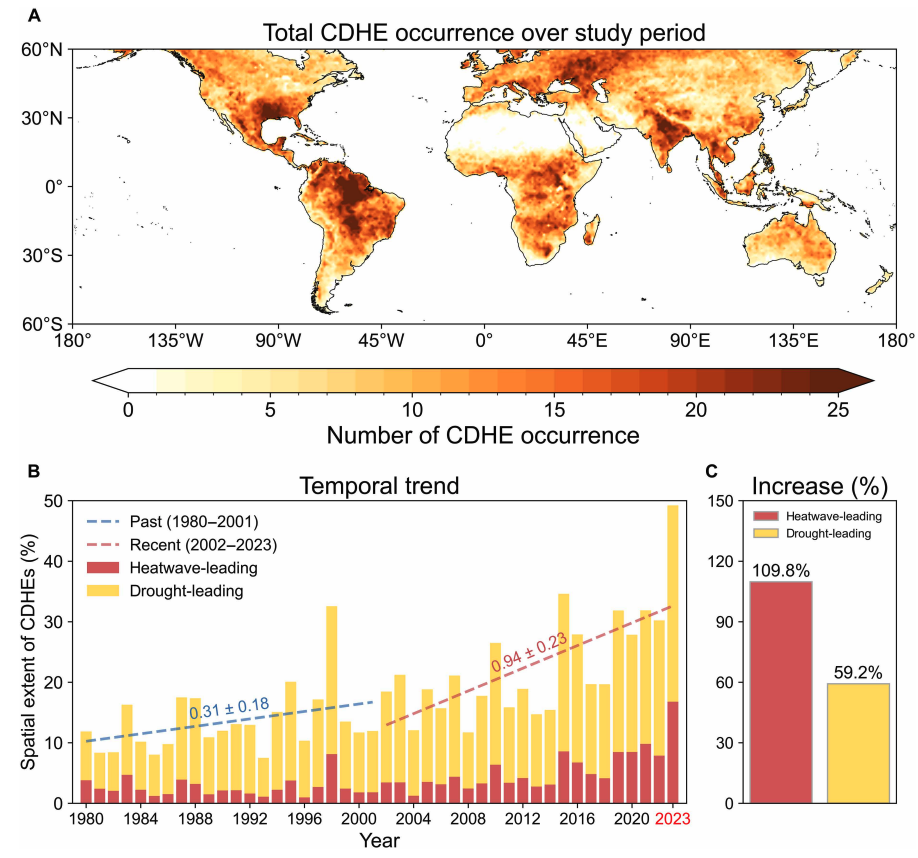
Compound drought and hot extremes (CDHEs) will increase across many regions of China over the coming century, especially in the eastern and central Songnen Plain and northern Sichuan Basin, a new study found. The authors evaluated changes in CDHEs across multiple croplands in China between 1961-2010 and 2031-80, using a large ensemble model, rainfall data and temperature data. “These results underscore the high risk of the spatial compounding of extremes at multiple croplands in China in the future,” the study said.
Impact of computing infrastructure on carbon emissions in China
Scientific Reports
A new paper found an upside-down “U” shaped relationship between carbon emission intensity – the emissions per unit of economic output – and computing infrastructure in Chinese cities, with emissions intensity initially increasing with a rise in computing infrastructure, before plateauing and then decreasing. The authors used data from 279 prefecture-level cities collected between 2008 to 2021. The findings are “particularly pronounced in central regions, hub cities and moderately digitally developed cities”, they said.
China Briefing is compiled by Wanyuan Song and Anika Patel. It is edited by Wanyuan Song and Dr Simon Evans. Please send tips and feedback to china@carbonbrief.org

The post China Briefing 12 December 2024: Export controls; Carbon concentration figures; ‘War on sand’ appeared first on Carbon Brief.
China Briefing 12 December 2024: Export controls; Carbon concentration figures; ‘War on sand’
Greenhouse Gases
Analysis: What are the causes of recent record-high global temperatures?
The past three years have been exceptionally warm globally.
In 2023, global temperatures reached a new high, after they significantly exceeded expectations.
This record was surpassed in 2024 – the first year where average global temperatures were 1.5C above pre-industrial levels.
Now, 2025 is on track to be the second- or third-warmest year on record.
What has caused this apparent acceleration in warming has been subject to a lot of attention in both the media and the scientific community.
Dozens of papers have been published investigating the different factors that could have contributed to these record temperatures.
In 2024, the World Meteorological Organization (WMO) discussed potential drivers for the warmth in a special section of its “state of the global climate” report, while the American Geophysical Union ran a session on the topic at its annual meeting.
In this article, Carbon Brief explores four different factors that have been proposed for the exceptional warmth seen in recent years. These are:
- A strong El Niño event that developed in the latter part of 2023.
- Rapid declines in sulphur dioxide emissions – particularly from international shipping and China.
- An unusual volcanic eruption in Tonga in 2022.
- A stronger-than-expected solar cycle.
Carbon Brief’s analysis finds that a combination of these factors explains most of the unusual warmth observed in 2024 and half of the difference between observed and expected warming in 2023.
However, natural fluctuations in the Earth’s climate may have also played a role in the exceptional temperatures, alongside signs of declining cloud cover that may have implications for the sensitivity of the climate to human-caused emissions.
An unusually warm three years
Between 1970 and 2014, average surface temperatures rose at a fairly steady rate of around 0.18C per decade.
Set against this long-term trend, temperature increases during the period from 2015 to 2022 were on the upper end of what would be expected.
The increases seen in 2023, 2024 and 2025 were well outside of that range.
The high temperatures of the past three years reflect a broader acceleration in the rate of warming over the past decade.
However, the past three years were unusually warm, even when compared to other years in the 2010s and 2020s.
Record-breaking warmth in 2023 meant that it beat the prior warmest year of 2016 by 0.17C – the largest magnitude of a new record in the past 140 years.
The year 2024 then swiftly broke 2023’s record, becoming the first year where average global temperatures exceeded 1.5C above pre-industrial levels.
The 10 months of data available for 2025 indicates that the year is likely to be slightly cooler than 2023 – though it is possible it may tie or be slightly warmer.
The figure below shows global surface temperatures between 1970 and 2025. (The figures for 2025 include uncertainty based on the remaining three months of the year.)
It includes a smoothed average based on temperature data for 1970-2022 that takes into account some acceleration of warming – and then extrapolates that smoothed average forward to 2023-25 to determine what the expected temperature for those years would have been. (This follows the approach used in the WMO’s “state of the global climate 2024” report.)

This approach calculates how much warmer the past three years were than would be expected given the long-term trend in temperatures.
It shows that 2023 was around 0.18C warmer than expected, 2024 was a massive 0.25C warmer and 2025 is likely to be 0.11C warmer.
Researchers have identified a number of potential drivers of unexpected warmth over 2023-25. Here, Carbon Brief looks at the evidence for each one.
A weirdly behaving El Niño event
El Niño is a climate pattern of unusually warm sea surface temperatures (SSTs) in the tropical Pacific that naturally occurs every two to seven years. Strong El Niño years generally have warmer global temperatures, with the largest effect generally occurring in the months after El Niño conditions peak (when SSTs reach their highest levels in the tropical Pacific).
A relatively strong El Niño event developed in the latter half of 2023, peaking around November before fading in the spring of 2024.
This event was the fourth-strongest El Niño ever recorded, as measured according to SSTs in the Niño 3.4 region in the central tropical Pacific. However, it was notably weaker than the El Niño events in both 1998 and 2016.
This can be seen in the chart below, which shows the strength of El Niño events (red shading) since the 1980s. (The blue shading indicates La Niña events – the opposite part of the cycle to El Niño, which results in cooler SSTs in the tropical Pacific.)

(It is worth noting that measuring the strength of El Niño events is not entirely straightforward. Other tools used by scientists to monitor changes to El Niño – such as the US National Oceanic and Atmospheric Administration’s (NOAA’s) multivariate ENSO index – show the 2023-24 event was much weaker than indicated in the Niño 3.4 dataset.)
Global surface air temperatures tend to be elevated by around 0.1-0.2C in the six months after the peak of a strong El Niño event – defined here as when SSTs in the Niño 3.4 region reach 1.5C above normal.
The figure below shows the range of global temperature change for the 12 months before and 22 months after the peak of all 10 strong El Niño events since 1950. The light line represents the average of past strong El Niño events, the dark blue line the temperature change observed during the 2023-24 event and the shaded blue area the 5-95th percentile range.

The figure shows the 2023-24 El Niño was quite unusual compared to other strong El Niño events since 1970. Global temperatures rose to around 0.4C above expected levels – which is on the high side of previous El Niños.
The heat also came early, with high temperatures showing up around four months before the El Niño event peaked. This early heat is unlike any other El Niño event in modern history and is one of the reasons why 2023’s global temperatures were so unexpectedly warm.
Global temperatures remained elevated for a full 18 months after the El Niño peaked, well after conditions in the tropical Pacific shifted into neutral conditions – and even after mild La Niña conditions developed at the end of 2024 and into early 2025.
This figure does not explain how much of this unusual heat was actually caused by El Niño, compared to other factors, but it does suggest that El Niño behaviour alone does not fully explain unusually high temperatures in recent years.
Based on the historical relationship between El Niño and global temperatures, Carbon Brief estimates that El Niño contributed a modest 0.013C to 2023 temperatures and a more substantial 0.128C to 2024 temperatures, albeit with large uncertainties. (See “methodology” section at the end for details.)
However, it is possible that this 2023 estimate is too low. There are some suggestions in the literature that 2023-24 El Niño’s early warmth may have been caused by the rapid transition out of a particularly extended La Niña event. There are indications that temperatures have spiked in similar situations further back in the historical temperature record.
Falling sulphur dioxide emissions
Sulphur dioxide (SO2) is an aerosol that is emitted into the lower atmosphere by the burning of coal and oil. It has a powerful climate cooling effect – Carbon Brief analysis shows that global emissions of SO2 have masked about one-third of historical warming.
Global SO2 emissions have declined around 40% over the past 18 years, as countries have increasingly prioritised reducing air pollution, including through the installation of scrubbers at coal plants.
These declines have been particularly concentrated in China, which has seen a 70% decline in SO2 emissions since 2007. In addition, a rule introduced for international shipping in 2020 by the International Maritime Organization (IMO) has resulted in an 80% decline in the sulphur content of shipping fuel used around the world.
The decline of SO2 emissions is shown in the figure below.

Shipping in particular has been suggested as a potential culprit for recent temperatures, given that ships emit SO2 over oceans where the air tends to be cleaner and so emissions have a bigger effect.
Seven of the eight studies that have explored the temperature impact of the IMO regulations have suggested a relatively modest effect, in the range of 0.03-0.08C. However, one study – led by former NASA scientist Dr James Hansen – calculated a much stronger effect of 0.2C that would explain virtually all the unusual warmth of recent years.
The figure below shows Carbon Brief’s estimate of the global average surface temperature changes caused by the low-sulphur shipping fuel rules, using the estimates produced by all eight studies. The central estimate (dark blue line) is relatively low, at around 0.05C, but the uncertainty range (light blue shading) across the studies remains large.

Overall, Carbon Brief’s analysis finds that around 0.04C of warming over 2020-23 and 0.05C of warming over 2020-24 can be attributed to SO2 declines from shipping and other sources.
However, this approach might slightly overstate the effects of SO2 on the exceptional temperatures of the past three years, as shipping and other SO2 declines would have had some effect on 2021 and 2022 as well.
It is also worth noting that the total effects of SO2 declines on global temperatures have been considerably larger and are estimated to be responsible for around one-quarter of all warming since 2007.
However, these SO2 decreases occurred over a long period of time and do not clearly explain the recent spike in temperatures.
An unusual volcanic eruption in Tonga
In early 2022, the Hunga Tonga-Hunga Ha’apai underwater volcano erupted spectacularly, sending a plume 55km into the atmosphere. This was by far the most explosive volcanic eruption since Mount Pinatubo erupted in 1991.
This was a highly unusual volcanic eruption, which vaporised vast amounts of sea water and lofted it high into the atmosphere. Overall, around 146m metric tonnes of water vapour ended up in the stratosphere, which is the layer of the atmosphere above the troposphere.
Water vapour is a powerful greenhouse gas. While it is short-lived in the lower atmosphere, it can stick around for years in the stratosphere, where it has a significant warming effect on the climate.
The figure below shows the concentration of water vapour in the stratosphere between 2005 and mid-2025. It shows how the 2022 eruption increased atmospheric concentrations of the greenhouse gas by around 15%. More than half the added water vapour has subsequently fallen out of the upper atmosphere.

Most early studies of the Hunga Tonga-Hunga Ha’apai volcano focused specifically on the effects of stratospheric water vapour. These tended to show strong warming in the lower stratosphere and cooling in the middle-to-upper stratosphere, but only a slight warming effect on global surface temperatures of around 0.05C.
Hunga Tonga-Hunga Ha’apai had much lower sulphur emissions than prior explosive eruptions, such as Pinatubo and El Chichon. However it put 0.5–1.5m tonnes of sulphur into the stratosphere – the most from an eruption since Pinatubo.
Studies that included both sulphur and water vapour effects tend to find that the net effect of the eruption on surface temperatures was slight global cooling, concentrated in the southern hemisphere.
By using the estimates published in a 2024 study published in Geophysical Research Letters, which used the FaIR climate emulator model, Carbon Brief estimates that the Hunga Tonga-Hunga Ha’apai eruption cooled global surface temperatures by -0.01C in 2023 and -0.02C in 2024.
This suggests that the eruption was likely only a minor contributor to recent global surface temperatures.
A stronger-than-expected solar cycle
The source of almost all energy on Earth is the sun. Over hundreds of millions of years, variations in solar output have a big impact on the global climate.
Thankfully, over shorter periods of time the sun is remarkably stable, helping keep the Earth’s climate habitable for life. (Big changes – such as ice ages – have more to do with variations in the Earth’s orbit than changes in solar output.)
However, slight changes in solar output do occur – and when they do, they can influence climate change over shorter periods of time. The most important of these is the roughly 11-year solar cycle, which is linked with the sun’s magnetic field and results in changes in the number of sunspots and amount of solar energy reaching Earth.
The figure below shows a best-estimate of changes in total solar irradiance since 1980, based on satellite observations. Total solar irradiance is a measure of the overall amount of solar energy that reaches the top of the Earth’s atmosphere and is measured in watts per metre squared.

The 11-year solar cycle is relatively modest compared to the sun’s total output, varying only a few watts per metre squared between peak and trough – amounting to around 0.01% of solar output. However, these changes can result in variations of up to 0.1C in global temperatures within a decade.
The most recent solar cycle – solar cycle 25 – began around 2020 and has been the strongest solar cycle measured since 1980. It was stronger than most models had anticipated and likely contributed to around 0.04C global warming in 2023 and 0.07C in 2024.
Putting together the drivers
By combining earlier estimates of different factors contributing to 2023 and 2024 global surface temperatures, about half of 2023’s unusual warmth and almost all of 2024’s unusual warmth can be effectively explained.
This is illustrated in the figure below, which shows the five different factors discussed earlier – El Niño, shipping SO2, Chinese SO2, the Hunga Tonga-Hunga Ha’apai volcano and solar cycle changes – along with their respective uncertainties.
The sum of all the factors is shown in the “combined” bar, while the actual warming compared to expectations is shown in red.
The upper chart shows 2023, while the lower one shows 2024.

It is important to note that the first bar includes both El Niño and natural year-to-year variability; the height of the bar reflects the best estimate of El Niño’s effects, while the uncertainty range encompasses year-to-year variability in global temperatures that may be – at least in part – unrelated to El Niño.
The role of natural climate variability
Large natural variability to the Earth’s climate is one of the main reasons why the combined value of the different drivers of expected warmth in 2023 has an uncertainty range that exceeds the observed warming – even though the best-estimate of combined factors only explains half of temperatures.
Or, to put it another way, there is up 0.15C difference in global temperatures year-on-year that cannot be explained solely by El Niño, human-driven global warming, or natural “forcings” – such as volcanoes or variations in solar output.
The figure below shows the difference between actual and expected warming in the global temperature record for every year in the form of a histogram. The vertical zero line represents the expectation given long-term global warming and the other vertical lines indicate the warming seen in 2023, 2024 and 2025.
The height of each blue bar represents the number of years over 1850-2024 when the average global temperature was that far (above or below) the expected level of warming.

Based on the range of year-to-year variability, temperatures would be expected to spike as far above the long-term trend as they did in 2023 once every 25 years, on average. The year 2024 would be a one-in-88 year event, whereas 2025 would be a less-unusual, one-in-seven year event.
These likelihoods for the past three years are sensitive to the approach used to determine what the longer-term warming level should be.
In this analysis, Carbon Brief used a local smoothing approach (known as locally estimated scatterplot smoothing) to determine the expected temperatures, following the approach used in the WMO “state of the climate 2024” report.
This approach results in a warming of 1.28C in 2023 and 1.30C in 2024, against which observed temperatures are compared.
Other published estimates put the longer-term warming in 2024 notably higher.
Earlier this year, the scientists behind the “Indicators of Global Climate Change” (IGCC) report estimated that human activity caused 1.36C of recent warming in 2024. They also found a slightly lower overall warming level for 2024 – 1.52C, as opposed to the WMO’s 1.55C – because they looked exclusively at datasets used by IPCC AR6. (This meant estimates from the Copernicus/ECMWF’s ERA5 dataset were not included.)
Based on climate simulations, the IGCC report finds the likelihood of 2024’s warmth to be a one-in-six year event and 2023’s a one-in-four event.
Using the same assumptions as the IGCC, Carbon Brief’s approach calculates that 2024 would be a less-common, one-in-18 year event.
However, the IGCC estimate of current human-induced warming is based on the latest estimates of human and natural factors warming the climate. That means that it already accounts for additional warming from low-sulphur shipping fuel, East Asian aerosols and other factors discussed above.
Therefore, the results from these two analyses are not necessarily inconsistent: natural climate variability (including El Niño) played a key role – but this came in addition to other factors. Natural fluctuations in the Earth’s climate alone would have been unlikely to result in the extreme global temperatures seen in 2023, 2024 and 2025.
A cloudy picture
Even if unusual recent global warmth can be mostly attributed to a combination of El Niño, falling SO2 emissions, the Hunga Tonga-Hunga Ha’apai volcano, solar cycle changes and natural climate variability, there are a number of questions that remain unanswered.
Most important is what the record warmth means for the climate going forward. Is it likely to revert to the long-term average warming level, or does it reflect an acceleration in the underlying rate of warming – and, if so, what might its causes be?
As explained by Carbon Brief in a 2023 article, climate models have suggested that warming will speed up. Some of this acceleration is built into the analysis presented here, which includes a slightly faster rate of warming in recent years than has characterised the period since 1970.
But there are broader questions about what – beyond declining SO2 and other aerosols – is driving this acceleration.
Research recently published in the journal Science offered some potential clues. It found a significant decline in planetary reflectivity – known as albedo – over the past decade, associated with a reduced low-level cloud cover that is unprecedented in the satellite record.
The authors suggest it could be due to a combination of three different factors: natural climate variability, changing SO2 and other aerosol emissions and the effects of global warming on cloud reflectivity.
Natural climate variability seems unlikely to have played a major role in reduced cloud cover, given that it was relatively stable until 2015. However, it is hard to fully rule it out given the relatively short satellite record.
Reductions in SO2 emissions are expected to reduce cloud reflectivity, but the magnitude of the observed cloud reflectivity changes are much larger than models simulate.
Models might be underestimating the impact of aerosols on the climate. But, if this were the case, it would indicate that climate sensitivity might be on the higher end of the range of model estimates, because models that simulate stronger aerosol cooling effects tend to have higher climate sensitivity.
Finally, cloud cover might be changing and becoming less reflective as a result of warming. Cloud responses to climate change are one of the largest drivers of uncertainty in future warming. One of the main reasons that some climate models find a higher climate sensitivity is due to their simulation of less-reflective clouds in a warming world.
The Science study concludes that the 2023 heat “may be here to stay” if the cloud-related albedo decline was not “solely” caused by natural variability. This would also suggest the Earth’s climate sensitivity may be closer to the upper range of current estimates, it notes.
Methodology
Carbon Brief built on work previously published in the IGCC 2024 and WMO state of the global climate 2024 reports that explores the role of different factors in the extreme temperatures in 2023, 2024 and 2025.
The impact of El Niño Southern Oscillation (ENSO) on the temperatures was estimated using a linear regression of the annual mean global temperature anomaly on the Feb/Mar Niño 3.4 index. This resulted in an impact of −0.07C, 0.01C and 0.13C for 2022, 2023 and 2024 respectively (with a 95% confidence interval of ±0.13 ºC).
It is important to note that the uncertainties in the ENSO response estimated here also incorporate other sources of unforced internal (modes of variability in other basins such as AMV), and potentially some forced variability. The bar in the combined figure is labelled “El Niño and variability” to reflect this.
For details on calculations of the temperature impact of shipping and Chinese SO2 declines, see Carbon Brief’s explainer on the climate impact of changing aerosol emissions.
Solar cycle 25 was both slightly earlier and slightly stronger than prior expectations with a total solar irradiance anomaly of 0.97 watts per metre squared in 2023 relative to the mean of the prior 20 years. This resulted in an estimated radiative forcing of approximately 0.17 watts per metre squared and an estimated global surface temperature increase of 0.07C (0.05C to 0.10C) with a one- to two-year lag based on a 2015 study. Thus, the impact on 2023 and 2024 is around 0.04C and 0.07C, respectively (+/- 0.025C). This is a bit higher warming than is given by the FaIR model, as the 2015 study is based on global models that have ozone responses to the UV changes, which amplifies the temperature effects a bit.
The Hunga Tonga-Hunga Haʻapai volcanic eruption added both SO2 and water vapour to the stratosphere (up to 55km in altitude). The rapid oxidation of SO2 to sulphate aerosol dominated the radiative forcing for the first two years after the eruption. As a result, the net radiative forcing at the tropopause was likely negative; −0.04 watts per metre squared and −0.15 watts per metre squared in 2022 and 2023, respectively, implying a temperature impact of -0.02C (-0.01C to -0.03C) calculated using the FaIR model.
The post Analysis: What are the causes of recent record-high global temperatures? appeared first on Carbon Brief.
Analysis: What are the causes of recent record-high global temperatures?
Greenhouse Gases
Interview: How ‘mid-level bureaucrats’ are helping to shape Chinese climate policy
Local officials are often viewed as relatively weak actors in China’s governance structure, largely implementing policies issued from the central level.
However, a new book – “Implementing a low-carbon future: climate leadership in Chinese cities” – argues that these officials play an important role in designing innovative and enduring climate policy.
The book follows how four cities – Shenzhen, Zhenjiang, Xiamen and Nanchang – approached developing low-carbon policies over the course of almost a decade.
It identifies “bridge leaders” – mid-level local bureaucrats who have a strong interest in a specific policy area and who are unlikely to move often between different posts – as key to effective local climate policymaking.
Carbon Brief interviews author Weila Gong, non-resident scholar at the UC San Diego School of Global Policy and Strategy’s 21st Century China Center and visiting scholar at UC Davis, on her research.
The interview has been edited for length and clarity.
- Gong on why cities are important: “Over 85% of China’s carbon emissions come from cities. The majority of Chinese people live in cities, so the extent to which cities can become truly low-carbon will also influence China’s climate success.”
- On what motivates local policymakers: “Mid-level bureaucrats need to think about how to create unique, innovative and visible policy actions to help draw attention to their region and their bosses.”
- On cities as a way to test new policies: “Part of the function of local governments in China is to experiment with policy at a local level, thereby helping national-level officials develop responses to emerging policy challenges.”
- On how local policymakers get results: “Even though we tend to think that local officials are very constrained in terms of policy or financial resources, they can often have the leverage and space to build coalitions.”
- On uneven city-level engagement: “To begin with, all regions received political support if they joined the [low-carbon city] pilot programme. But over the years, different regions have engaged very differently.”
- On the need for ‘entrepreneurial bureaucrats’: “China will always need local officials willing to introduce new legislations or try new policy instruments…For that, it needs entrepreneurial bureaucrats who are willing to turn ideas into actions.”
- On international cooperation: “Even with how geopolitics is really complicating things, many cities continue to have common challenges. For example, collaboration between Shanghai and Los Angeles on green shipping corridors is still ongoing”.
- On the effectiveness of mid-level bureaucrats: “They are creative, they know how to convince their boss about the importance of climate action and they know how that can bring opportunities for themselves and their boss. And because of how long they have worked in one area, they understand the local politics, policy processes and the coalitions needed to provide solutions.”
Carbon Brief: You’ve just written a book about climate policy in Chinese cities. Could you explain why subnational governments are important for China’s climate policy in general?
Weila Gong: China is the world’s largest carbon emitter, so the extent to which global efforts to address climate change can actually reach their goal is largely influenced by China’s efforts.
If you look at the structure of China’s carbon emissions, over 85% of China’s carbon emissions come from cities. The majority of Chinese people live in cities, so the extent to which cities can become truly low-carbon will also influence China’s climate success. That’s why I started to look at this research area.
We tend to think of China as a centralised, big system and a unitary state – state-run and top-down – but it actually also has multi-level governance. No climate action or national climate targets can be achieved without local engagement.
We also tend to think subnational level [actors], including the provincial, city and township levels, are barriers for environmental protection, because they are focused on promoting economic growth.
But I observed these actors participating in China’s low-carbon city pilot programme [as part of my fieldwork spanning most of the 2010s]. I was really surprised to see so many cities wanted to participate in the pilot, even though at the time there was no specific evaluation system that would reward their efforts.
We think of local governments just as implementers of central-level policy. When it comes to issues like climate change and also low-carbon development – in 2010 [policymakers found these concepts] very vague…So I was curious why those local officials would want to take on this issue, given that there was no immediate reward, either in terms of career development or in terms of increasing financial support from the central government.
CB: Could you help us understand the mindset of these bureaucrats? How do local-level officials design policies in China?
WG: The role of different local officials in promoting low-carbon policy is not very well understood. We tend to focus on top political figures, such as mayors or [municipal] party secretaries, because we see them as the most important policymakers.
But that is not entirely true. Those top local politicians are very important in supporting efforts to tackle problem areas…but the focus in my book is the mid-level bureaucrats.
Unlike mayors and party secretaries, mid-level officials tend to stay in one locality for their entire career. That helps us to understand why climate policy can become durable in some places and not others.
Mayors and party secretaries are important for [pushing through policy solutions to problem] issues, but they can also be key barriers for ensuring continuation of those policies – particularly when they change positions…as they tend to move to another locality every three to five years.
Therefore, these top-level officials are not the ones implementing low-carbon policies. That’s why I looked at the mid-level bureaucrats instead.
The conventional understanding of these bureaucrats is that they are obedient and only follow their bosses’ guidance. But actually, when low-carbon policies emerged as an important area for the central government in 2010, opportunities appeared for local governments to develop pilot projects.
Mid-level local officials saw this as a way to help their bosses – the mayors and party secretaries – increase their chances of getting promoted, which in turn would help the mid-level bureaucrats to advance their own career.
Impressing central government officials isn’t really a consideration for these officials…but their bosses need visible or more reliable local actions to show their ability to enforce low-carbon development.
As such, mid-level bureaucrats need to think about how to create unique, innovative and visible policy actions to help draw attention to their region and their bosses.
Secondly, mid-level bureaucrats are more interested in climate issues if it is in the interest of their agency or local government.
For example, Zhenjiang [a city in east China] came to be known as a leader in promoting low-carbon development due to a series of early institutional efforts to establish low-carbon development. In particular, in part because of this, it was chosen for a visit by president Xi Jinping in 2014.
As a result, the city created a specialised agency [on low-carbon development]. This made it one of the first regions to have full-time local officials that followed through on low-carbon policy implementation.
This increased their ability to declare their regulatory authority on low-carbon issues, by being able to promote new regulations, standards and so on, as well as enhancing the region’s and the local policymakers’ reputations by building institutions to ensure long-term enforcement.
Another motivation for many local governments is accessing finance through the pilot programmes. If their ideas impress the central-level government, local policymakers could get access to investment or other forms of financial resources from higher levels of government.
In the city of Nanchang, for example, officials were trying to negotiate access to external investment, because the main central government fund for low-carbon initiatives only provided minimal finance.
Nanchang officials tried to partner with the Austrian government on sustainable agriculture, working through China’s National Development and Reform Commission (NDRC).
It didn’t materialise in the end, but they still created a platform to attract international investment, and gathered tens of millions of yuan [millions of dollars] in central-level support because the fact they showed they were innovating allowed them to access more money through China’s institutional channels.
CB: Could you give an example of what drives innovative local climate policies?
WG: National-level policies and pilot programme schemes provide openings for local governments to really think about how and whether they should engage more in addressing climate change.
The national government has participated in international negotiations on climate for decades…but subnational-level cities and provinces only joined national efforts to address climate issues from the 2010s – starting with the low-carbon city programme.
So we can see that local responses to addressing climate change have been shaped by the opportunities provided by the national government, [who in turn] want more local-level participation to give them successful case studies to take to international conferences.
Local carbon emission trading systems (ETSs) are an example of giving local governments opportunities to experiment.
In my book, I look at the case of Shenzhen, which launched China’s first local ETS. [Shenzhen was one of seven regions selected to run a pilot ETS, ahead of the national ETS being established in 2018.]
Part of the function of local governments in China is to experiment with policy at a local level, thereby helping national-level officials develop responses to emerging policy challenges.
I remember a moment during my field research in 2012, when I was with a group of officials from both the national and local government.
The national government officials asked the local officials to come up with some best practices and solutions, to help them envision what could be done at the national level.
Then there are drivers at the international level, which I think is very interesting.
I observed that the officials particularly willing to take on climate issues usually had access to international training.
During the early stages of subnational climate engagement, organisations such as the German Agency for International Cooperation (GIZ) worked with the NDRC and other national-level agencies to train local officials across the country.
This created more opportunities to help local officials understand what climate change and carbon markets were, and how to use policy instruments to support low-carbon development.
In Shenzhen, local bureaucrats also turned to their international partners to help them design policy.
The city created a study group to visit partners working on the EU ETS and learn how it was designed. They learned about price volatility in the EU ETS and pushed legislation through the local people’s congress [to mitigate this in their own system].
One thing that made the Shenzhen ETS so successful is what I call “entrepreneurial bureaucrats” [who have the ability to design, push through and maintain new local-level climate policies].
Shenzhen’s vice mayor worked with the local people’s congress to push the ETS legislation through. This was the first piece of legislation in China to require compulsory participation by more than 600 local industrial actors. It also granted the local government authority to decide the quotas and scope of the ETS.
These 600 entities also included Shenzhen’s public building sector[, a powerful local interest group].
This shows that, even though we tend to think that local officials are very constrained in terms of policy or financial resources, they can often have the leverage and space to build coalitions – even in China’s more centralised political system – and know how to mobilise political support.
CB: You chose to look at the effectiveness of four cities – Shenzhen, Zhenjiang, Xiamen and Nanchang – in climate policymaking. Why did you choose these cities and how representative are they of the rest of China?
WG: We tend to believe that only economically-advanced areas or environmentally-friendly cities will become champions for low-carbon development…But I was surprised, because Zhenjiang and Nanchang are not known for having an advanced economy, but [they nevertheless built impactful climate] institutions – regulations, standards and legislation that shape individual and organisational behaviours in the long term. I thought they were interesting examples of how local regions can really create those institutions.
Then there was Xiamen, which is seen as an environmentally-friendly city and economically is comparable to Shenzhen when you look at GDP per capita. Xiamen actually did not turn its low-carbon policy experimentation into long-term institutions, instead randomly proposing new initiatives [that were not sustained].
I conducted more than 100 interviews, talking with policy-practitioners inside and outside of government about specific policies, their processes and implementation.
I found that, over the course of eight years, these [cities] showed very different levels of engagement.
Some I categorised into substantive engagement, where the local government delivered on their climate goals. [Shenzhen falls into this category.]
Then there is performative engagement – such as in the case of Nanchang – where the local government was more interested in [using climate policies to] attract external investment and access projects from higher levels of government.
But they were not able to enforce the policies, because impressing higher levels of government became the primary motivation.
Zhenjiang was a case of symbolic engagement. It actually created a lot of institutions, such as a specialised agency and a screening system to ensure new [low-carbon] investment. When I was observing Zhenjiang, from 2012 to 2018, officials recognised they needed to be carbon-constrained.
The problem was that Zhenjiang has a very strong power sector – mainly coal power – which supplies the whole eastern coast. That meant, even though the government was very determined to promote low-carbon policies, they faced [opposition from] very strong local actors – meaning the government could only partially implement the targets they set.
Then there is sporadic engagement, as seen in Xiamen. [The city’s approach to climate policy was incremental and cautious] because of a lack of political support [from officials in Xiamen], as well as local coalitions between key actors. So instead, we find random initiatives being promoted.
This explains the uneven policy implementation in China. To begin with, all regions received political support if they joined the pilot programme. But over the years, different regions have engaged very differently, in terms of the regulations, standards and legislation they have introduced, and whether those were paired with enforcement by a group of trained personnel to follow through on those initiatives.
CB: What needs to be done to strengthen sub-national climate policy making?
WG: It’s very important to have groups of personnel trained on climate policy. Since 2010, when I started studying the low-carbon pilot programme, there were no provincial-level people or agencies fully responsible for climate change. Back then, there was only the [central-level] department of climate change under the NDRC.
By the time I finished the book, provincial-level departments of climate change had been created across all provinces. But almost nothing has been established at the city level, so most city-level climate initiatives are being managed under the agencies responsible for air quality.
That means climate change is only one of those local officials’ day-to-day responsibilities. Only a handful of cities have dedicated staff working on climate issues: Beijing, Shanghai, Zhenjiang, Shenzhen and Guiyang.
Nanchang devised some of China’s first legislation to include an annual [financial] budget for low-carbon development. But when I revisited the city, officials were not actually sure about how and whether that budget was being used, because there wasn’t a person responsible for it.
Therefore, even if there are resources available, they can go unused because local officials at the city level are so busy. If climate policy is not prioritised, or written into their job responsibilities, that can be a challenge for sustaining implementation.
In China’s governance structure, the national government comes up with ideas, and the provincial level transfers these ideas down to local-level governments. City-level governments are the ones implementing these ideas.
So we need full-time staff to follow through on policies from the beginning right up to implementation.
Secondly, while almost all cities have now made carbon-peaking plans, one area in which the Chinese government can make further progress is in data.
China has recently emphasised the need to strengthen carbon-emissions data collection and monitoring. But when I was conducting my research, most Chinese cities had not yet established regular carbon-accounting systems.
As such, inadequate energy statistics and insufficient detail remain key barriers to effective climate-policy implementation.
In addition, the relevant data usually is owned by China’s National Bureau of Statistics (NBS), which does not always share it with other agencies. Local agencies can’t always access detailed data.
When I visited Xiamen, officials told me the local government is now improving emissions monitoring systems. But there should be more systematic and rigorous data collection, covering both carbon emissions and non-CO2 greenhouse gases. Also, much of the company-level data is self-reported, which could affect the accuracy of carbon-emissions statistics.
For continued climate action, it’s also important that the central government ensures that local officials have the institutional support needed to experiment and propose new ideas.
…China will always need local officials willing to introduce new legislations or try new policy instruments – like Shenzhen with its ETS, or establishing new carbon-monitoring platforms.
For that, it needs entrepreneurial bureaucrats who are willing to turn ideas into actions. Ensuring that local governments have the right set of conditions to do this is very important.
CB: What did you find most surprising when researching this book?
WG: That international collaboration is still very important. I found that many officials learnt about climate change through international engagement.
In the current situation, I think international engagement is still very important – particularly given how, even with how geopolitics is really complicating things, many cities continue to have common challenges. For example, collaboration between Shanghai and Los Angeles on green shipping corridors is still ongoing.
That can bring opportunities for continuing climate action at the city level in the face of rising international tensions, as long as national governments give them space to be involved in international climate action.
Another surprise was the factors of what exactly made climate action durable. I was really surprised that many of the cities that I revisited were still involved in the pilot programmes, despite the central government restructuring that shifted the climate change portfolio from the NDRC to the Ministry of Ecology and Environment – which created challenges for the local governments who had to navigate this.
I also thought that the change in mayors for all four cities would lead to climate initiatives falling off the agenda.
But actually, Zhenjiang, Xiamen and Nanchang all maintained their low-carbon initiatives, despite these changes. This showed it isn’t only strong mayors that bring success, but rather a group of trained personnel building and enforcing regulations and standards. So the importance of bureaucrats and bureaucracy in making climate action durable was actually way beyond my initial expectations.
I was also surprised that bureaucrats can be entrepreneurial, even though they work in a centralised system. They are creative, they know how to convince their boss about the importance of climate action and they know how that can bring opportunities for themselves and their boss. And because of how long they have worked in one area, they understand the local politics, policy processes and the coalitions needed to provide solutions.
The post Interview: How ‘mid-level bureaucrats’ are helping to shape Chinese climate policy appeared first on Carbon Brief.
Interview: How ‘mid-level bureaucrats’ are helping to shape Chinese climate policy
Greenhouse Gases
The Big Bet to Fix the Rio Grande Sewage Problem
Nuevo Laredo was dumping millions of gallons of sewage a day into the Rio Grande. The U.S. and Mexico worked together to find a solution.
For years, raw sewage has flowed into the Rio Grande from a beleaguered wastewater treatment plant in Nuevo Laredo, Mexico.
-
Climate Change4 months ago
Guest post: Why China is still building new coal – and when it might stop
-
Greenhouse Gases4 months ago
Guest post: Why China is still building new coal – and when it might stop
-
Climate Change2 years ago
Spanish-language misinformation on renewable energy spreads online, report shows
-
Greenhouse Gases2 years ago嘉宾来稿:满足中国增长的用电需求 光伏加储能“比新建煤电更实惠”
-
Climate Change Videos2 years ago
The toxic gas flares fuelling Nigeria’s climate change – BBC News
-
Climate Change2 years ago嘉宾来稿:满足中国增长的用电需求 光伏加储能“比新建煤电更实惠”
-
Carbon Footprint2 years agoUS SEC’s Climate Disclosure Rules Spur Renewed Interest in Carbon Credits
-
Climate Change2 years ago
Why airlines are perfect targets for anti-greenwashing legal action