

Welcome to Carbon Brief’s China Briefing.
Carbon Brief handpicks and explains the most important climate and energy stories from China over the past fortnight. Subscribe for free here.
Key developments
China needs record drop in CO2 emissions to meet 2025 target
RECORD FALL NEEDED: New analysis for Carbon Brief revealed that China’s carbon dioxide (CO2) emissions increased by 12% between 2020 and 2023, due to a “highly energy- and carbon-intensive response” to the economic slowdown during the Covid-19 pandemic. Total energy consumption grew 5.7% in 2023, “the first time since at least 2005 that energy demand has grown faster than GDP”, while CO2 emissions grew “at an average of 3.8% per year in 2021-23, up from 0.9% a year in 2016-20”, despite slowing economic growth. As a result, China’s carbon intensity – its emissions per unit of GDP – “has only fallen 5% in the 14th five-year plan period”, and CO2 emissions “would need to fall by 4-6% by 2025” to meet the carbon intensity target of 18% set in the 14th five-year plan.
OFF-TARGET: China is also “at risk” of failing to meet other key climate goals. Despite pledges to “strictly limit” coal demand growth and “strictly control” new coal power capacity, both “coal consumption and new coal power projects” accelerated “sharply” from 2020 to 2023. The share of China’s energy demand met by non-fossil sources “has increased by 1.8 percentage points from 2020 to 2023, against a target of 4.1 points by 2025”. The analysis concluded that government pressure to hit these targets – many of which are included in China’s most recent international climate pledge – means it is “more likely that China’s CO2 emissions will peak before 2025”.
OFFICIAL STATS: The head of the national energy administration (NEA), Zhang Jianhua, recently wrote in an article posted on the NEA’s official WeChat account that China’s annual growth of energy consumption between 2021 and 2023 was 1.8 times higher than annual energy consumption growth from 2016 to 2020 – and equalled the total annual energy consumption of the UK. He added that “solid growth” is expected for the foreseeable future, which will make it “more difficult to coordinate energy security guarantees and the low-carbon transformation”.
China plans ‘comprehensive green transformation’
‘GREEN TRANSFORMATION’: State news agency Xinhua reported that President Xi Jinping hosted a meeting of the central commission for deepening reform (CCDR, see below), during which policymakers passed the “opinions on promoting comprehensive green transformation of socioeconomic development”. The full text of the opinions has not yet been released. Xi also stated at the meeting that achieving this transformation “is the foundational policy to resolve problems around resources, the environment and ecology”, the outlet said. An Anhui News editorial republished by the state-run China Daily shortly after the meeting said that China should “incorporate the concept of green development into all aspects of economic and social development”.
POLITICAL HEAVYWEIGHT: The meeting of the CCDR, on the first day after the lunar new year holiday, underscores the importance of the legislation included. The CCDR, which was formed in 2013 and subsequently chaired by Xi, is the “primary mechanism for top-level policymaking and advancing reform and opening-up”, according to the state-supporting Global Times. The thinktank MERICS described it as a “supra-ministry used to accelerate priority reforms of the Xi leadership” that is the foremost of the existing leading small groups. According to MERICS, “policies passed by the CCDR are regarded as taking immediate effect [by ministries]”.
Climate policy momentum to pick up in 2024?
2024 GOALS: In the latter half of 2023, a “number of important environmental and energy policies have either set tighter and more specific targets or called out the need for faster progress towards existing goals”, a new paper by the Oxford Institute for Energy Studies (OIES) said. The reemergence of language to “cut carbon emissions, reduce pollution, expand green development and pursue economic growth” suggests that “these priorities have risen” for 2024, it added.
TURF WAR: While top-level directives favour bolder action on environmental policy, the picture is “complicated” by “bureaucratic fragmentation”, the report said. This is illustrated by the delays in operationalising China’s carbon markets due to frictions between the ministry of environment and ecology (MEE) and the national development and reform commission (NDRC) and national energy administration (NEA), in addition to “a sharp policy dispute” between the NEA and the MEE on transitioning from a policy of “dual control” of energy to dual control of carbon, it added.
LOCAL POLITICS: Meanwhile, despite the signals coming from central leadership, local governments may not be incentivised to similarly prioritise environmental protection, the OIES said. Instead, local officials may be “keen to boost investment in large infrastructure projects to support economic activity and maintain tax revenues, which can work against environmental goals”.
Reducing ‘dependency’ on China ‘could add 20%’ to transition costs
PRICE WAR: It could cost $6tn – an “additional 20% of the original energy transition bill” – to reduce “critical dependencies on China” for clean technology products, reported Quartz, citing new analysis from consultancy Wood Mackenzie. Industry players are “openly talking about” convincing consumers to pay more for non-Chinese minerals needed for powering electric vehicles, it added. In response to western countries seeking “greater diversity in supply amid a glut of Chinese imports” of clean-energy technologies, the vice-president of the world’s top solar panel manufacturer, Longi Green Energy Technology, warned that restrictions on Chinese companies would slow decarbonisation of European and US economies, in an interview given to the Financial Times. Dennis She stated that solar panels produced in the US without Chinese involvement would cost “double” and that EU protectionism would “kill most of the jobs [in] the [solar industry] downstream”.
SPLITS IN EUROPE: Meanwhile, another Financial Times article reported that a new Chinese solar panel factory being built in Ohio, US, by Longi is facing pushback by local residents suspicious of China’s “involvement”. The Financial Times – in an article carried on the frontpage of its international edition – also quoted senior US treasury officials as saying that “the US and its allies will take action if China tries to ease its industrial overcapacity problem by dumping goods on international markets”, with particular concerns around clean-energy sectors. EU climate chief Wopke Hoekstra warned of the bloc’s “problematic” dependence on China for clean-energy technology, reported Euractiv. European clients have asked battery suppliers in China to “to start producing in Europe as soon as possible”, according to Yicai, due to a new EU regulation “imposing significant obligations on battery manufacturers, importers and distributors”. Meanwhile, “splits” among EU countries are emerging on China, with France and Germany at odds on “everything” from solar energy and electric vehicles to trade deals and supply chains, reported the South China Morning Post. France is typically in favour of restricting Chinese imports of clean-energy technology, the outlet added, while Germany “strongly opposes such measures”. The UK’s Trade Remedies Authority announced that it is ready to “follow” Brussels on the issue of launching an investigation into Chinese electric vehicles, which have “flooded” the global market, reported the Guardian.
Spotlight
The Carbon Brief Interview: Prof Pan Jiahua
At COP28 in Dubai, Carbon Brief’s Anika Patel spoke with Prof Pan Jiahua, vice-chair of the national expert panel on climate change of China, about his ideas for how to move to a zero-carbon future.
China’s national expert committee on climate change, of which Prof Pan is vice-chair, is an advisory body under the national leaders group on climate change, energy-saving and emissions reduction.
He is also a member of the Chinese Academy of Social Sciences and director of its Research Center for Sustainable Development, as well as director of Beijing University of Technology’s Institute of Eco-Civilization Studies.
Below are highlights from the wide-ranging conversation, which covered coal phaseout, the usefulness of a global “loss-and-damage fund”, and prospects for distributed solar and power market reform in China. The full interview can be found on the Carbon Brief website.
New modes of thinking about climate
On the philosophy of ‘ecological civilisation’: “Human beings, for their own benefit – they ignored the benefit of nature. The welfare of nature. We expose nature, we deplete our natural resources…[Under ecological civilisation] the basic idea [is] that [if we can achieve] harmony with nature [and] harmony among our nations, then we can go long into the future.”
On the success of UN climate summits: “COP is the only thing that [has lasted] over 30 years…We have different views, different arguments, different interests but, all in all, we’ve come a long way…We agreed the Paris targets – in 1990 nobody would believe that [was possible].”
On the COP28 summit
On the ‘loss-and-damage fund’: “Losses and damages should be compensated, but not in a way that we divert our energy and resources for [the sake of] compensation. We should use all our energy, resources, spirits – everything – for the zero-carbon transition.”
On the ‘climate paradox’: “If you divert the limited resources for compensating losses and damages, then the zero-carbon transition would be delayed. And if you delay such a transition, there will be more and more losses and damages. I call this the climate paradox.”
On tripling renewable energy: “Tripling renewable energy is not enough. Why are we only tripling? Why not more and more, the more the better. Because look at China – [we] doubled and doubled and doubled [our renewable energy] all the time. This year we doubled installed capacity over the last year. Why shouldn’t we do more than just tripling?”
On western suspicion: “Why did China suddenly become number one in zero-carbon renewables? It’s simply because the United States and Europe used anti-dumping subsidies and section 301 investigations in 2010. Then the Chinese competitive products, solar panels, were not able to go to the world market, so we thought we should…install everything inside of China and immediately China became number one in the world. Now you see the United States and Europe again say ‘no, it’s [a question of] supply chain security’. Right? This is really self-conflicting. On one hand they say ‘climate security’, on the other they say their ‘own security’.”
Investing in renewable energy
On replacing energy infrastructure: “Renewables would not require a huge amount of investment in infrastructure. Fossil fuels, coal electricity generation – the investment is very capital intensive…right? Waste of money.”
On subsidies and industrial policy: “Like a plant – in the very beginning when it’s a seed then you need to take care of it. But when it grows and becomes mature, then it can stand on its own and be competitive.”
Accelerating the energy transition through ‘prosumerism’
On an alternative to a centralised electricity grid: “I use the term ‘prosumerism’. Production, consumption and storage all in one, right? You do not require a very capital intensive power grid…And also, this is consumer sovereignty – when you have your own system, you have a say and then…you are not totally reliant on the power grid.”
On the future of fossil fuels: “Fossil fuels are fossils. They are a thing of the past.”
On phasing out fossil fuels: “We want to have everything competitive enough to phase out fossil fuels, through the market process. Not command and control.”
On abating fossil fuels: “I think that abated fossil fuels is a false statement. Because abated is not compatible, they have no competitiveness. When you abate it, it is more expensive. You think the consumers are silly? They will simply vote for competitive[ly priced] electricity.”
On the challenges of power market reform: “Only the monopoly people will [call for] ‘reform’, and through reform they gain more power, they gain more monopoly. The prosumerism system will destroy such monopolies.”
On the urgency of ‘global boiling’: “Global warming is not global warming, it’s global boiling…Renewables are good for welfare, for wellbeing, for growing the economy, for a better environment. It’s for everybody and for the future. Fossil fuels are not for the future.”
Watch, read, listen
‘GREENING’ ASEAN: A new paper by the Grantham Research Institute found that China plays a positive role in the “development of supply chains for renewable energy technology” in the Association of Southeast Asian Nations (ASEAN) region.
CAPACITY VS GENERATION: Our World In Data deputy editor Hannah Ritchie wrote in her Sustainability by Numbers newsletter that, although China is building more coal-fired power plants, their “capacity factor…has been dropping over the last 15 years”.
ESG: The Environment China podcast discussed research on corporate climate disclosures in China, with authors Erica Downs, Ned Downie and Lou Yushan.
UN SPEECH: State broadcaster CCTV published a recording of Chinese UN permanent representative Zhang Jun’s speech that, to improve climate resilience and food security, the world must avoid “unilateral sanctions, decoupling and technological blockades”.
New science
Exploring phase-out path of China’s coal power plants with its dynamic impact on electricity balance
Energy Policy
New research into the impact of phasing out coal-fired power plants in China on electricity shortages identified the potential for electricity shortfalls of 6-12 terawatt-hours (TWh) per month before 2027 “if China phases out coal plants at their 30-years technical lifespan”. Instead, it said, under an accelerated phase-out pathway, China could “decrease its electricity consumption per GDP by at least 5%” through greater energy efficiency to avoid electricity shortages, or follow a flexible phase-out pathway to both reduce CO2 emissions and “significantly reduce the electricity shortage risk”.
Optimal carbon emission reduction path of the building sector: Evidence from China
Science of The Total Environment
Modelling of China’s building sector found that “in a business-as-usual scenario, building carbon emissions will peak at 6,393m tonnes of CO2 in 2041, missing the 2030 carbon peaking target”. Decarbonisation technologies will make the 2030 carbon peaking target “attainable, though at a considerably high cost”, the researchers said, with emissions “forecasted to peak in 2030 at 5,139m tons of CO2” in an “optimal” scenario.
China Briefing is compiled by Anika Patel and edited by Wanyuan Song and Simon Evans. Please send tips and feedback to china@carbonbrief.org

The post China Briefing 22 February: Interview with Chinese govt climate advisor; missing emissions targets; the cost of excluding China appeared first on Carbon Brief.

Drought and heatwaves occurring together – known as “compound” events – have “surged” across the world since the early 2000s, a new study shows.
Compound drought and heat events (CDHEs) can have devastating effects, creating the ideal conditions for intense wildfires, such as Australia’s “Black Summer” of 2019-20 where bushfires burned 24m hectares and killed 33 people.
The research, published in Science Advances, finds that the increase in CDHEs is predominantly being driven by events that start with a heatwave.
The global area affected by such “heatwave-led” compound events has more than doubled between 1980-2001 and 2002-23, the study says.
The rapid increase in these events over the last 23 years cannot be explained solely by global warming, the authors note.
Since the late 1990s, feedbacks between the land and the atmosphere have become stronger, making heatwaves more likely to trigger drought conditions, they explain.
One of the study authors tells Carbon Brief that societies must pay greater attention to compound events, which can “cause severe impacts on ecosystems, agriculture and society”.
Compound events
CDHEs are extreme weather events where drought and heatwave conditions occur simultaneously – or shortly after each other – in the same region.
These events are often triggered by large-scale weather patterns, such as “blocking” highs, which can produce “prolonged” hot and dry conditions, according to the study.
Prof Sang-Wook Yeh is one of the study authors and a professor at the Ewha Womans University in South Korea. He tells Carbon Brief:
“When heatwaves and droughts occur together, the two hazards reinforce each other through land-atmosphere interactions. This amplifies surface heating and soil moisture deficits, making compound events more intense and damaging than single hazards.”
CDHEs can begin with either a heatwave or a drought.
The sequence of these extremes is important, the study says, as they have different drivers and impacts.
For example, in a CDHE where the heatwave was the precursor, increased direct sunshine causes more moisture loss from soils and plants, leading to a drought.
Conversely, in an event where the drought was the precursor, the lack of soil moisture means that less of the sun’s energy goes into evaporation and more goes into warming the Earth’s surface. This produces favourable conditions for heatwaves.
The study shows that the majority of CDHEs globally start out as a drought.
In recent years, there has been increasing focus on these events due to the devastating impact they have on agriculture, ecosystems and public health.
In Russia in the summer of 2010, a compound drought-heatwave event – and the associated wildfires – caused the death of nearly 55,000 people, the study notes.

The record-breaking Pacific north-west “heat dome” in 2021 triggered extreme drought conditions that caused “significant declines” in wheat yields, as well as in barley, canola and fruit production in British Columbia and Alberta, Canada, says the study.
Increasing events
To assess how CDHEs are changing, the researchers use daily reanalysis data to identify droughts and heatwaves events. (Reanalysis data combines past observations with climate models to create a historical climate record.) Then, using an algorithm, they analyse how these events overlap in both time and space.
The study covers the period from 1980 to 2023 and the world’s land surface, excluding polar regions where CDHEs are rare.
The research finds that the area of land affected by CDHEs has “increased substantially” since the early 2000s.
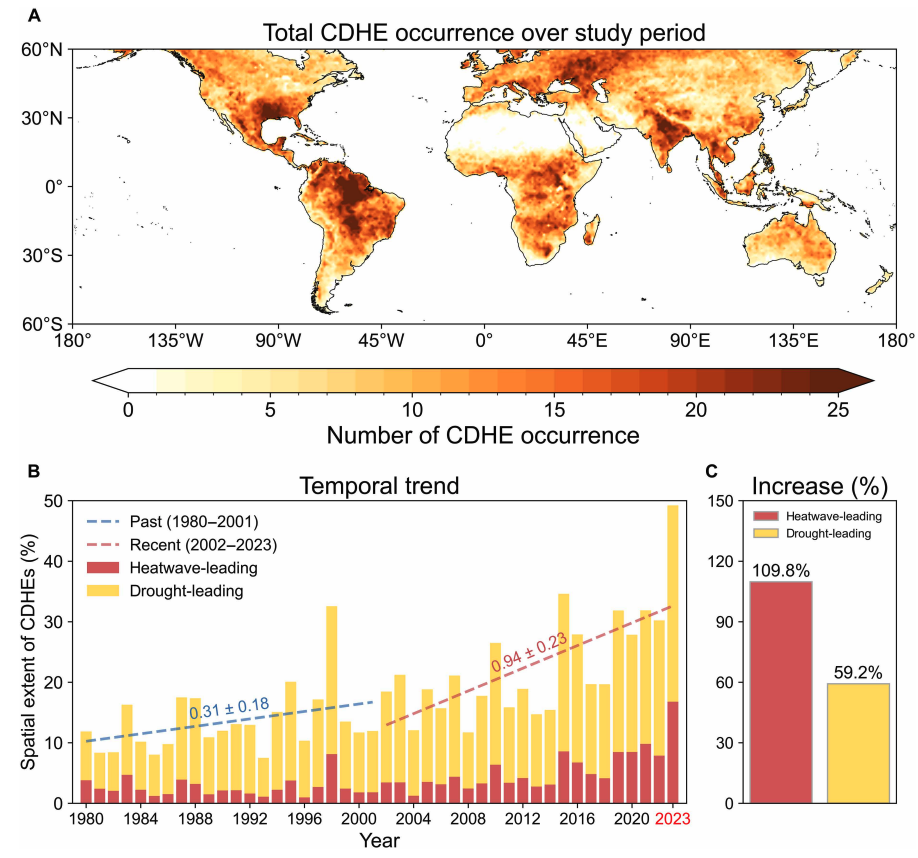
Heatwave-led events have been the main contributor to this increase, the study says, with their spatial extent rising 110% between 1980-2001 and 2002-23, compared to a 59% increase for drought-led events.
The map below shows the global distribution of CDHEs over 1980-2023. The charts show the percentage of the land surface affected by a heatwave-led CDHE (red) or a drought-led CDHE (yellow) in a given year (left) and relative increase in each CDHE type (right).
The study finds that CDHEs have occurred most frequently in northern South America, the southern US, eastern Europe, central Africa and south Asia.
Threshold passed
The authors explain that the increase in heatwave-led CDHEs is related to rising global temperatures, but that this does not tell the whole story.
In the earlier 22-year period of 1980-2001, the study finds that the spatial extent of heatwave-led CDHEs rises by 1.6% per 1C of global temperature rise. For the more-recent period of 2022-23, this increases “nearly eightfold” to 13.1%.
The change suggests that the rapid increase in the heatwave-led CDHEs occurred after the global average temperature “surpasse[d] a certain temperature threshold”, the paper says.
This threshold is an absolute global average temperature of 14.3C, the authors estimate (based on an 11-year average), which the world passed around the year 2000.
Investigating the recent surge in heatwave-leading CDHEs further, the researchers find a “regime shift” in land-atmosphere dynamics “toward a persistently intensified state after the late 1990s”.
In other words, the way that drier soils drive higher surface temperatures, and vice versa, is becoming stronger, resulting in more heatwave-led compound events.
Daily data
The research has some advantages over other previous studies, Yeh says. For instance, the new work uses daily estimations of CDHEs, compared to monthly data used in past research. This is “important for capturing the detailed occurrence” of these events, says Yeh.
He adds that another advantage of their study is that it distinguishes the sequence of droughts and heatwaves, which allows them to “better understand the differences” in the characteristics of CDHEs.
Dr Meryem Tanarhte is a climate scientist at the University Hassan II in Morocco, and Dr Ruth Cerezo Mota is a climatologist and a researcher at the National Autonomous University of Mexico. Both scientists, who were not involved in the study, agree that the daily estimations give a clearer picture of how CDHEs are changing.
Cerezo-Mota adds that another major contribution of the study is its global focus. She tells Carbon Brief that in some regions, such as Mexico and Africa, there is a lack of studies on CDHEs:
“Not because the events do not occur, but perhaps because [these regions] do not have all the data or the expertise to do so.”
However, she notes that the reanalysis data used by the study does have limitations with how it represents rainfall in some parts of the world.
Compound impacts
The study notes that if CDHEs continue to intensify – particularly events where heatwaves are the precursors – they could drive declining crop productivity, increased wildfire frequency and severe public health crises.
These impacts could be “much more rapid and severe as global warming continues”, Yeh tells Carbon Brief.
Tanarhte notes that these events can be forecasted up to 10 days ahead in many regions. Furthermore, she says, the strongest impacts can be prevented “through preparedness and adaptation”, including through “water management for agriculture, heatwave mitigation measures and wildfire mitigation”.
The study recommends reassessing current risk management strategies for these compound events. It also suggests incorporating the sequences of drought and heatwaves into compound event analysis frameworks “to enhance climate risk management”.
Cerezo-Mota says that it is clear that the world needs to be prepared for the increased occurrence of these events. She tells Carbon Brief:
“These [risk assessments and strategies] need to be carried out at the local level to understand the complexities of each region.”



The post Heatwaves driving recent ‘surge’ in compound drought and heat extremes appeared first on Carbon Brief.
Heatwaves driving recent ‘surge’ in compound drought and heat extremes
Greenhouse Gases
DeBriefed 6 March 2026: Iran energy crisis | China climate plan | Bristol’s ‘pioneering’ wind turbine
Welcome to Carbon Brief’s DeBriefed.
An essential guide to the week’s key developments relating to climate change.
This week
Energy crisis
ENERGY SPIKE: US-Israeli attacks on Iran and subsequent counterattacks across the Middle East have sent energy prices “soaring”, according to Reuters. The newswire reported that the region “accounts for just under a third of global oil production and almost a fifth of gas”. The