

Welcome to Carbon Brief’s China Briefing.
Carbon Brief handpicks and explains the most important climate and energy stories from China over the past fortnight. Subscribe for free here.
Key developments
More funding for ‘green development’ on China’s ‘belt and road’
BIRTHDAY SPENDING: The third belt and road forum for international cooperation was held on 17-18 October, marking the 10th anniversary of China’s global infrastructure project, known as the belt and road initiative (BRI). At the forum, China’s president Xi Jinping announced an eight-point action plan to strengthen “high-quality” cooperation in the BRI, reported state news agency Xinhua, one of which was “promoting green development”. He pledged that China’s policy banks will “each set up a 350bn yuan ($47.8bn) financing window” to fund “small but beautiful” projects, reported Hong-Kong based South China Morning Post (SCMP), with “an additional 80bn yuan ($10.9bn) injected into the Silk Road Fund”.
‘GREEN DEVELOPMENT’: China will also organise “training for 100,000 people from developing countries” to advance “green development”, SCMP added. Other outcomes include development of “green investment standards” and “$97.2bn of deals across a handful of sectors including clean energy”, said Bloomberg. Xi also pledged to “deepen green infrastructure, energy and transport cooperation”, reported Xinhua, calling the forum “the most important diplomatic event hosted by China this year” and noting that representatives from more than 140 countries confirmed their attendance. Nikkei Asia, however, reported that fewer heads of state were present compared to the last BRI forum in 2019.
PARTY LINES: Ahead of the forum, China Daily published an article written by legal NGO ClientEarth stating that China’s “vision” for supporting the global energy transition “could be further clarified by setting timeframes for targets”. On the same day, the Communist party-affiliated People’s Daily said that China had “promoted green consensus among governments, enterprises and the public” in a Chinese-language article, while its English-language platform carried a commentary stating that the BRI “fully demonstrates the…appeal of open, green and clean cooperation”.
CLIMATE RISKS: Boston University’s Global Development Policy Center released a new report finding that the BRI brought significant benefits to host countries in the form of additional resources for development and “creation of a new model of south-south cooperation”. However, it said the BRI had “increased carbon dioxide emissions” by 245m tonnes per year from fossil-fuel power plant projects.
EU calls on China to join global methane and renewable goals
AMBITION CALL: EU energy commissioner Kadri Simson called on China to commit to global targets on cutting methane emissions and tripling renewable energy capacity by 2030, during a three-day visit to Beijing, the South China Morning Post reported. She made the statement at an annual high-level energy dialogue, the first held in-person since 2019, the paper added. Simson “stopped short” of calling for higher ambitions on China’s carbon emissions, Reuters reported, adding that she also held talks with China’s National Energy Administration chief Zhang Jianhua. In a speech, Simson highlighted the significance of the EU-China “global collaboration in establishing a global energy system”, reported the state-supporting newspaper Global Times. It added that her visit to China came ahead of one by Josep Borell, EU foreign policy chief.
SUBSIDY PROBES: Simson’s visit came shortly after the EU had launched a probe into Chinese subsidies for electric car manufacturing, Reuters noted. Just days before her visit, the Financial Times said the EU was also considering whether to “investigate China’s use of subsidies to promote the country’s wind turbine manufacturers in the same way as electric vehicles”. European turbine makers have been “lobbying for more support” to
counter cheap Chinese imports that are pushing them “to the brink of collapse”, the paper added. Simson planned to decide on the wind subsidy probe after her visit, Recharge reported.
KERRY-XIE DIALOGUE: Meanwhile, the US and China have “quietly” continued behind-the-scenes climate talks, with climate envoys of both countries holding a video conference, reported Politico. During the call, Xie Zhenhua, China’s special envoy for climate, and John Kerry, the US special presidential envoy for climate, discussed the “key topics for COP28”, reported the state-run newspaper China Daily. It added that they also discussed “practical cooperation” in areas outlined by two joint climate statements issued by the pair before and during COP26 in 2021.
China signals expansion of national carbon market
CARBON COUNTING: China’s ministry of ecology and the environment (MEE) released a policy document, republished by Chinese energy news outlet BJX News, that calls for companies in the chemical, petrochemical, construction materials, iron and steel, non-ferrous metals, papermaking and civil aviation industries to report and verify their greenhouse gas emissions. The text stated that regulators aim to “accelerate the construction of the national carbon emissions trading market…and standardise the management of greenhouse gas emissions data of enterprises in key industries”. Only enterprises with “annual greenhouse gas emissions of 26,000 tonnes of carbon dioxide equivalent” or above will be covered.
MARKET EXPANSION: Energy newspaper Jiemian explained that the release signals MEE has begun “basic work” on expanding the national carbon market to cover these sectors. [Since it was first established in 2021, the market has only covered heat and power generation.] Yan Qin, carbon analyst at data provider Refinitiv, highlighted a potential conflict with existing policy. The MEE release said green electricity certificates (GECs) “are not recognised as proof of zero emission electricity” and cannot be used on the national carbon market, contrary to a policy on GECs released by other regulators, Qin wrote on X, the social media platform formerly known as Twitter.
CBAM INFLUENCE? Also writing on X, Lauri Myllyvirta, lead analyst at the Centre for Research on Energy and Clean Air, pointed out that the inclusion of steel, cement and aluminium has a “clear connection to the EU’s carbon tariffs (CBAM)” as the sectors included in the policy “correspond exactly with the coverage of the CBAM”. He added that “this means…that the CBAM is working exactly as it’s supposed to – pushing other economies to catch up with the EU”.
China hit with 308bn yuan bill for extremes in 2023
TYPHOON KOINU: On 8 October, typhoon Koinu turned south off China’s coast and headed for Hainan island after battering Taiwan with rain and wind, Reuters reported. China’s ministry of water resources issued a “flood scenario report”, warning of heavy rainfall that could overwhelm rivers in Fujian and Guangdong, according to Xinhua.
ECONOMIC LOSSES: The Chinese government said the country suffered 308bn yuan ($42bn) of economic losses from extreme weather such as torrential rains, landslides, hailstorms and typhoons between January and September 2023, Reuters reported. These events left hundreds of people dead, with more than 89 million people and 10m hectares of crops affected, the outlet added. Separately, CGTN said Chinese experts predict global warming may “intensify Mei-yu” season, “a rainy weather phenomenon” in the Yangtze river valley every summer affecting agriculture, economy and people’s lives. Nature published an article quoting economist Jun Rentschler from the World Bank, who said that developers often build settlements on “flood-prone” areas despite knowing about the increasing risk of climate change. Architect Yu Kongjian, who coined the “sponge city” concept, also found 70% of China’s new developments between 1980 and 2010 were in flood plains, the outlet added.
‘BOILING’ CITIES: A report by Sixth Tone revealed how Chinese cities have experienced prolonged periods of higher temperatures over the past 60 years, adding that there has been a correlation between warming and increased heavy rainfall. The outlet said “boiling” is more fitting to describe the “severity of the extreme heat” that Chinese cities endure.
Spotlight
How is China thinking about the just transition as coal jobs decline?
New analysis has found that more than half a million Chinese coal miners could lose their jobs by 2050. In this issue, Carbon Brief explores if and how China’s energy transition could mitigate these job losses – and how that calculus affects local government planning.
How many people work in China’s coal industry?
A new report from thinktank Global Energy Monitor (GEM) estimates that China’s coal industry currently employs more than 1.5 million workers.
This is down from the last official census, conducted in 2018, which counted 3.5 million employees in coal mining and “washing”. (Other estimates put current jobs at 2.6 million.)
Coal job losses are not a new phenomenon in China, with China Dialogue noting that more than 5 million people worked in the industry in 2013. It found that during the “golden decade” of coal between 2004 and 2013, efficiency improvements more than halved the average number of employees per 10,000 tonnes of coal produced.
The colossal scale of the Chinese coal industry was powered by a combination of policies that incentivised rapid expansion, allowing it to gain significant political influence.
In Shanxi, for example, it contributed 29% of the province’s GDP and 46% of tax revenues in 2018, as well as creating significant numbers of jobs.
However, the new analysis by GEM estimates that China could lose more than 500,000 additional coal jobs by 2050, of which more than 240,000 will be in Shanxi alone.
“As China aims to reduce the number of coal mines…it becomes increasingly urgent for the government to…support a just transition in the coal industry,” Dorothy Mei, a co-author of the report, told Caixin.
Alex Clark, PhD researcher at the University of Oxford, told Carbon Brief that coal jobs would be lost even if some local decision-makers prioritise coal expansion and economic growth over decarbonisation.
How have coal job losses affected workers so far?
The challenges facing laid-off coal workers can be seen in the city of Fuxin, once home to Asia’s largest open cast mine. The area was hit by a spate of mine closures in the 2000s.
A photo essay published in 2017 found that former miners in Fuxin found it hard to gain new employment and preferred to give the compensation they received for the closures to their children.
There are “many middle-aged people with little to do”, it added, given the lack of other major employers in the area.
Moving coal workers to other sectors can be challenging, Tim Wright, former professor at the University of Sheffield, wrote, since they are typically older, better paid and based in more remote locations than other low-skilled workers.
NPR reported on a similar decision to close a mine in the northern town of Dalianhe, which led to the loss of 4,000 jobs and wiped out “the town’s main source of revenue”. The mine operator later confirmed its “bold” decision, despite worker protests.
Are coal job losses being replaced by new low-carbon industries?
Although China’s policymakers do not use the term “just transition”, Mengye Zhu, assistant research professor at the University of Maryland’s Center for Global Sustainability (CGS), told Carbon Brief that “does not mean that unemployment is not an important issue”.
In 2016, the central government established a 100bn yuan ($13.7bn) fund to relocate laid-off workers to other sectors. Zhu also pointed to the important function of state-owned enterprises (SOEs) as stable providers of employment.
Meanwhile, local governments are trying to replace coal with low-carbon industry growth. For example, the Fuxin local government invested 600bn yuan ($82bn) in low-carbon energy expansion, which has “created over 5,500 jobs in the region”.
Cambridge Econometrics, expanding on a guest post written for Carbon Brief, calculated that there could be a net creation of 5 million jobs by China’s energy transition nationwide.
But the Asia Pacific Foundation of Canada found that energy transition projects generally have “little interest in centring affected workers and their communities”.
Furthermore, simply moving coal workers into the wind sector, as in Fuxin, may not be replicated with further coal job losses. The Global Wind Energy Council estimated that to meet its wind power targets, China only needs 7,000 additional jobs by 2027.
Zhu stated that, while wind and solar manufacturing could drive job creation, operating the average wind or solar farm needed only 30 employees, compared to around 100 for a 100-200 megawatt coal power plant.
She observed that local governments sometimes resist transition policies “because wind farms employ fewer people than coal”.
Nevertheless, she said, according to unpublished research by CGS, provinces including Yunnan, Gansu, Xinjiang, Inner Mongolia, Qinghai and Sichuan will still gain jobs from the energy transition.
Watch, read, listen
BRI REVIEW: The Environment China podcast featured a discussion with Griffith Asia Institute director Prof Christoph Nedopil-Wang on the effectiveness of the BRI’s shift to focus on low-carbon projects,.
RESOURCE INTENSITY: Newsletter The East is Read translated a speech by Peking University’s Prof Huang Jikun, who argued that “with green development high on the agenda, China’s economic growth needs to shift away from heavy reliance on excessive inputs of resources”.
ASIA GEOPOLITICS: The Oxford Institute for Energy Studies discussed the impact of energy geopolitics on China’s relations with other Asian nations with Muyi Yang, associate director at the Asia Society Policy Institute, and Mohua Mukherjee, OIES senior research fellow.
MANAGING COOPERATION: Journalist and Institute for Human Sciences rector Misha Glenny interviewed China Dialogue founder Isabel Hilton on Chinese politics, competition between China and the west, the need for climate cooperation, the BRI and more.
New science
Researchers have found that the karst areas of southwest China have a greater carbon sequestration potential. Using the Carnegie–Ames–Stanford Approach (CASA) model, they calculated that the development of carbon sinks in the karst areas, enhanced by ecological restoration projects, are more effective at absorbing carbon dioxide from the atmosphere than the broader region. 58.5% of carbon sinks across the karst area exhibited either “increasing trends” in net carbon sequestration or “positive reversals”, which is larger than the overall average of 45.1% for Southwest China.
Emergent constrained projections of mean and extreme warming in China
Geophysical Research Letters
A new study found that its own calculations for 2080–2099 temperatures in China are lower than “raw projections” under the intermediate-emission scenario developed through Coupled Model Intercomparison Project Phase 6 (CMIP6) models. It used an “emergent constraint” framework to obtain constrained average and daily maximum temperature warming figures. This implies that the impact of extreme heat could be lower than that suggested by current raw CMIP6 projections, the study said.
China Briefing is compiled by Anika Patel and edited by Wanyuan Song and Simon Evans. Please send tips and feedback to china@carbonbrief.org.
The post China Briefing 19 October: BRI funding; coal job losses; extreme weather damage appeared first on Carbon Brief.
China Briefing 19 October: BRI funding; coal job losses; extreme weather damage

The launch of the Africa Energy Bank (AEB) has been put back yet again, raising doubts about the institution’s future ability to finance fossil fuel projects – its main objective – as global lenders retreat from such investments over climate concerns, experts told Climate Home News.
The bank, which had been billed to launch in September after a series of delays, is now scheduled to begin operations in November, according to the head of the African Energy Chamber, an advocacy body for the continent’s oil and gas sector.
Even as the world aims to transition away from fossil fuels, many African leaders have made clear they want to continue exploring and extracting the continent’s large oil and gas deposits – estimated at around 125 billion barrels of crude and over 600 trillion cubic feet of gas – to boost economic development.
As a group, Africa sided with a number of powerful oil-and-gas producing nations in blocking progress on negotiations to craft a global roadmap to transition away from fossil fuels at last year’s UN COP30 climate talks, although some countries did individually support the proposal.
-
Campaigners oppose Dangote’s planned Kenya refinery over climate and ecological risks
Plans to build Africa’s second largest oil refinery in ecologically sensitive region criticised as “environmental recklessness” -
Tanzania pushed African nations to oppose fossil fuel transition at COP30
While chairing the African group at the summit, the gas-dependent nation advised the continent’s ministers to block language on transitioning away from fossil fuels


Meanwhile, major projects under development across the continent – including the 1,443-km East African Crude Oil Pipeline (EACOP) and Dangote’s 700,000-barrel-per-day Kenyan refinery – show that African governments see oil and gas as playing a significant role in meeting their energy and economic needs for many years to come.
In 2022, at a gathering of the African Petroleum Producers’ Organization (APPO) in oil-rich Angola, ministers from its member states adopted a resolution to create the Africa Energy Bank to finance projects for the production, use and trade of oil, gas and broader energy sources.
African control over energy resources
An article on the APPO website explains that the bank was conceived as a way to overcome “disenchantment” with fossil fuels among “the international community” which it said had crystallised around the “energy transition” concept.
“If Western countries, after having long taken advantage of the energy sources they now revile to develop, can afford the luxury of abandoning them, this is not the case in Africa,” it adds, noting that many of the continent’s economies are still largely dependent on oil and gas revenues.
A separate web page about the bank, also hosted on APPO’s website, says its objectives include financing the exploration, production and refining of oil and gas, as well as supporting member states in transitioning from fossil fuels to cleaner energy sources “while ensuring energy security”.
Said Addi, a former executive with Shell and energy commodities trading house Gunvor, said the new bank was judged necessary because financing for hydrocarbons from many traditional international lenders has become constrained.
In trying to fill this financing gap, Africa is not simply setting up another fund to support oil and gas, he added. “It is also an attempt to give African countries greater control over how their energy resources and infrastructure are financed,” he explained.
Nigeria to host the AEB
The energy bank – a joint initiative of APPO and the African Export–Import Bank (Afreximbank) – has so far suffered several delays and is almost two years behind schedule. The initial plan was to start operations in January 2025, with Nigeria as the host country, but the bank’s opening was delayed to June of that year to allow Nigeria time to finalise the construction of the bank’s headquarters in Abuja.
After the government announced the completion of the offices in late November 2025, a new launch date was set for January 2026, which was moved back to April, June and then September. Now it has shifted again to November, raising concerns that the institution may be losing momentum.
Former Shell executive Addi said that if the capital is eventually paid in, the bank becomes operational and its first projects are commercially credible, then the delays will be regarded as normal teething troubles in setting up a multilateral institution. But, he added, scepticism will be justified if it continues to stall.
Uganda may see lower oil revenues than expected as costs rise and demand falls
Baron Lamarré, an oil and gas expert and former Petronas oil trader, said that missing “three deadlines in a row is not normal”, and warned that if the timeline slips again, “the story flips from ‘ambitious institution finding its footing’ to ‘good idea that lost momentum before it found any’.”
The Nigerian government, APPO and Afreximbank did not respond to requests for comment by the time of publication.
The funding challenge
The Africa Energy Bank is targeting base capital of $5 billion, with plans to scale up to $120 billion within five years by mobilising private-sector funds. However, it is expected to start operations with initial seed capital of $500 million.
The funding plan is to have the 18 member countries of the APPO contribute $83 million each to the bank as equity for a combined $1.5 billion. Afreximbank, other non-APPO African countries and investors outside the continent are expected to provide the remaining $3.5 billion.
But even the initial $500 million has not been easy to mobilise. In May, APPO Secretary-General Farid Ghezali called on members to deliver on their pledges towards the startup goal before the end of June. But the delays suggest this may not have been met, with experts saying Africa may be finding it difficult to self-fund its oil and gas projects in the absence of international capital.
Lamarré said every extension of the deadline points to the fact that “raising fossil fuel capital in Africa without the majors and their financing networks is brutally hard”.
Why the global electrification agenda misses the point on Africa’s energy crisis
Since 2020, Western lenders, export credit agencies and insurers have been in steady retreat from African hydrocarbons, he said, while oil majors are divesting their African assets, handing over fields to smaller local operators whose credit ratings are not high enough to borrow cheaply.
Even capital from China and the Gulf, which has partially filled the gap, cannot match the volume, tenor or pricing that Western investors once offered, Lamarré argued.
“If mobilising the first $500 million of seed capital [for the AEB] has taken this long, that’s the clearest signal yet of how steep the climb to $120 billion looks,” he said, noting that the continent’s energy financing gap is as large as $30 billion-$45 billion per year.
Africa’s investment landscape, meanwhile, has been shifting. While foreign direct investment dropped from a 2024 peak, inflows remained roughly one-third above the continent’s long-term average in 2025, according to the 2026 World Investment Report from UN Trade and Development (UNCTAD). They are concentrated in a few sectors including critical minerals needed for renewable energy technologies, battery manufacturing and advanced industrial production.
At the same time, data on global energy investment from the International Energy Agency (IEA) shows that fossil fuel investment in Africa has declined over the last decade.

“Trojan horse” for fossil fuels
While the Africa Energy Bank struggles to get off the ground, climate campaigners have criticised its primary aim of financing oil and gas on the continent at a time when the world is starting to move away from high-carbon fuels to cleaner alternatives.
Bhekumuzi Dean Bhebhe, founder of Africa Change Lab, described the bank as a “Trojan horse”, arguing that its focus on fossil fuel financing runs counter to the global energy transition and the African Union’s Agenda 2063 goals of sustainable development and inclusive growth.
The energy bank, he warned, “risks locking Africa into a new cycle of debt, dependency and fossil fuel entrenchment”, adding that its financing blueprint does not pave the way for a climate-resilient future. “In truth, it is to deepen the same extractive, carbon-heavy pathways that the continent should be moving away from,” he added.
Ugandan farmers use British court to try to stop East Africa oil pipeline
Kenya-based climate and energy expert Joab Okanda said the AEB’s plan to finance oil and gas is “a misplaced priority” and it should instead back clean energy in line with the policies of some of Africa’s major export markets like Europe.
In addition, the new bank could struggle to mobilise enough resources to advance large-scale oil and gas projects, he added, noting that its proposed $5-billion initial capital is equivalent to the cost of the East African Crude Oil Pipeline alone.
The AEB’s aim of backing more fossil fuels should be flipped “to support countries that are oil-dependent to start working on their transition plans”, Okanda said.
The post Launch of Africa Energy Bank delayed again in blow to oil and gas hopes appeared first on Climate Home News.
Launch of Africa Energy Bank delayed again in blow to oil and gas hopes
A booklet published by the UK’s opposition Conservative party includes a “cost of net-zero” that appears to have been doubled by a spreadsheet error.
The “common sense” policy document argues that “what people ultimately want is a government competent enough to solve the problems for which it takes responsibility”.
In a section that says “sophisticat[ed]…modelling” should not be a substitute for “political judgement”, the “Right Way” document disparages various estimates of the cost of net-zero.
The Conservative document then claims – incorrectly – that the government’s official adviser, the Climate Change Committee (CCC), had put the cost of net-zero at close to £1tn. It says:
“In 2020, the CCC estimated that its route to net-zero would cost £957bn.”
In fact, the CCC’s 2020 estimate was exactly half this amount – £478bn – and last year it published a revised figure of £108bn, largely as a result of the falling cost of electric vehicles (EVs).
Spreadsheet error
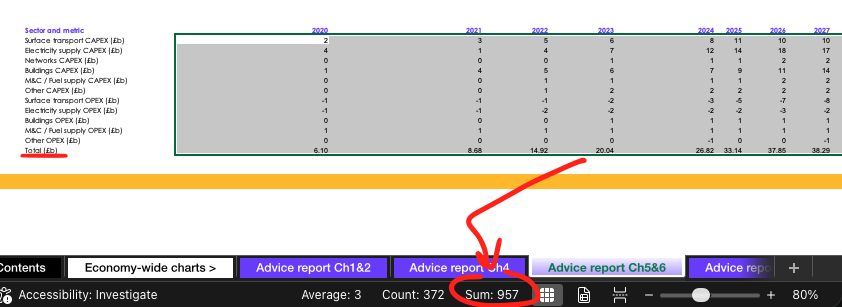
The Conservative party’s erroneous claim appears to stem from another report that had accidentally added up numbers twice, using a spreadsheet published by the CCC in 2020.
The 2020 spreadsheet contains a table listing the additional investments that would be needed to build a net-zero economy, from low-carbon electricity generation through to heat pumps and EVs.
These extra capital expenditures, listed as “CAPEX”, add up to a total of £1.38tn over the 30 years of 2020-50. They are set against operational savings, listed as “OPEX”, of £0.90tn.
Added up over 2020-50, the combined CAPEX and OPEX figures come to a total of £478bn.
In addition to the annual sectoral CAPEX and OPEX figures, the CCC’s 2020 spreadsheet also has a line giving combined totals for each year. It appears that someone has added all of these numbers together, resulting in the savings and costs being counted twice.
This double-counted total for the cost of net-zero amounts to £957bn – as shown in the image below – and it appears to be the source of the claim in the Conservative booklet.
At the time of publication in 2020, the CCC said that the £478bn net cost of net-zero amounted to less than 1% of GDP over 30 years – and that the large investment needed would not only result in savings due to lower fossil-fuel imports, but that it would boost GDP overall, by around 2%.
In 2025, the CCC revised its estimates for investment costs and operating savings to £670bn and £562bn respectively, giving a net total of £108bn over 2025-50, or less than 0.2% of GDP.
Earlier this year, the committee said that cutting emissions to net-zero would cost less than a single fossil-fuel price shock and that doing so would have benefits worth £110bn per year.
Paper trail
The erroneous claim in the Conservative document is referenced to the CCC’s 2020 advice on the UK’s sixth “carbon budget”, which, as explained, does not contain the £957bn figure.
The earliest online use of the £957bn figure found by Carbon Brief is a 12 January 2026 article in the Spectator, by retired engineer and self-described “accidental energy analyst” David Turver.
A day later,