


The voluntary carbon market is booming in 2025. Allied Offsets data showed that in the first quarter of 2025, around 780,000 CDR credits were contracted — a surge of 122% compared to the same period in 2024.
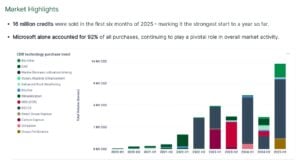
Additionally, 16 million credits were sold in the first six months of 2025 – marking it the strongest start to a year so far. The momentum is fueled by major buyers like Microsoft, aiming to be carbon negative by 2030, and by a surge in biomass-based removal methods that are reshaping corporate offset strategies.
Why Carbon Dioxide Removal Credits Are Surging
Businesses are racing to hit climate targets faster, and carbon dioxide removal (CDR) is emerging as the go-to solution. The biggest boost this year comes from biomass-based methods — like turning farming and forestry waste into tools for trapping CO₂. These projects are cheaper, easier to scale, and more accessible than high-cost tech such as direct air capture (DAC).
By early 2025, biomass CDR accounted for about 40% of credit volumes. Microsoft and other big players are securing large volumes, setting quality benchmarks, and pushing the market toward transparent, high-integrity projects.
Source: Zion Market Research
Technology Shifts in CDR
-
Biomass-based CDR — including BECCS, biochar, bio-oil, and biomass burial — made up a massive 94% of total volumes in the first half of 2025.
-
Investment focus, however, is still heavily skewed toward DAC and carbon utilization projects, despite other scalable and cost-effective CDR options.
-
More public awareness and funding diversity are needed to unlock the full potential of multiple CDR pathways.
New innovations are also redefining CDR. About 30% of new projects now use methods such as advanced soil carbon storage, bio-oil injection, and marine carbon removal, which can store CO₂ for hundreds or even thousands of years.
Digital MRV platforms are also transforming the space, offering real-time tracking to boost transparency, prevent fraud, and speed up purchase decisions. Meanwhile, integrated projects like agroforestry, regenerative agriculture, and biodiversity restoration are gaining traction for their multi-benefit environmental impact.
Environmental Benefits of Biomass CDR
Biomass approaches like biochar and BECCS offer cost-effective solutions, often ranging from $80–$200 per ton.
These methods work within a circular economy model — repurposing agricultural and forestry waste into long-term carbon storage. BECCS delivers a dual benefit by producing renewable energy while storing CO₂ underground.
However, without strict MRV protocols, poorly managed biomass projects risk deforestation or biodiversity loss. Global removal capacity is still only 41 million tons CO₂/year, yet it needs to grow 25–100x by 2030 to meet climate goals.
Market Segmentation
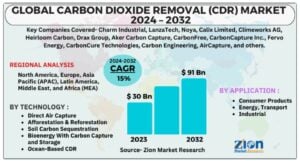
By technology: DAC, afforestation & reforestation, soil carbon sequestration, BECCS, ocean-based CDR, and enhanced weathering.
-
DAC, holding 67% of global revenue in 2023, is set for the fastest growth thanks to flexible deployment and industrial CO₂ utilization.
By application: Consumer products, energy, transport, and industrial sectors.
-
The industrial sector leads due to rising emissions from cement, steel, and chemicals.
CDR Buyer Trends in 2025
-
Financial services firms led in the number of unique buyers, while technology companies dominated purchase volumes with over 50 million credits bought so far.
-
Half of all buyers in early 2025 were first-time participants, collectively purchasing around 6 million credits which is a promising sign of market expansion.
Market Momentum and Future Projections
The CDR market hit $3.9 billion in Q2 2025, with biomass projects making up 99% of transactions. Microsoft continues to drive momentum by locking in long-term purchase agreements that help projects scale.
Market forecasts suggest CDR’s value will grow from $842 million in 2025 to $2.85 billion by 2034, while durable carbon credits could soar to $14 billion by 2035, growing 38% annually.
Rising buyer expectations — around permanence, transparency, and quality — are further reinforced by new regulations, particularly in Europe, pushing out low-integrity credits.
Opportunities and Challenges Ahead
The CDR market stands to benefit from government-backed carbon incentives, increasing demand for carbon credits, and the potential to create new jobs in sectors such as farming, engineering, and construction. However, its growth faces hurdles, including limited public awareness of CDR’s advantages and the risk of political instability slowing adoption.
What’s Next for Carbon Dioxide Removal?
The market is at a turning point. Experts predict a blend of nature-based and durable removals, with the latter gaining ground toward 2050 as quality demands rise. The future will rely on smarter investments, high-fidelity data tracking, and clear global standards.
Corporate leaders like Microsoft are already showing the way — proving that transparency, permanence, and innovation will define the next era of climate action.
- READ MORE: MOL Becomes the First Japanese Shipping Firm to Retire Tech-Based CDR Credits Through NextGen
The post CDR Credit Sales Hit Record High, Powering Market Growth in 2025 appeared first on Carbon Credits.

EU carbon credit claims changed on 27 September 2026, the day the Directive (EU) 2024/825 began to apply across the European Union. The change is narrow. It changes how a company can talk about the credits it buys. A product can no longer be called neutral on the strength of compensation alone; however, every specific, evidenced statement about what a company measured, reduced, and funded stays fully available.

The post Promoting Improved Cooking Practices in Nigeria appeared first on Terrapass.



-
Climate Change1 year ago
Guest post: Why China is still building new coal – and when it might stop
-

 Greenhouse Gases2 years ago
嘉宾来稿:满足中国增长的用电需求 光伏加储能“比新建煤电更实惠”
-
Greenhouse Gases1 year ago
Guest post: Why China is still building new coal – and when it might stop
-

 Climate Change2 years ago
嘉宾来稿:满足中国增长的用电需求 光伏加储能“比新建煤电更实惠”
-

 Renewable Energy12 months ago
Sending Progressive Philanthropist George Soros to Prison?
-
Climate Change2 years ago
Bill Discounting Climate Change in Florida’s Energy Policy Awaits DeSantis’ Approval
-
Greenhouse Gases1 year ago
嘉宾来稿:探究火山喷发如何影响气候预测
-

 Climate Change2 years ago
Analysis: China’s CO2 falls 1% in Q2 2024 in first quarterly drop since Covid-19