

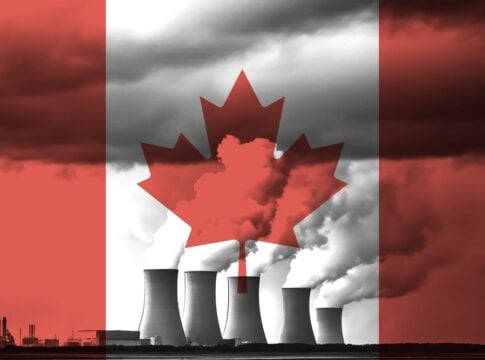
Canada has taken a major step toward becoming a global leader in nuclear innovation. Prime Minister Mark Carney announced a C$3 billion joint federal-provincial investment to advance small modular reactor (SMR) technology at Ontario Power Generation’s (OPG) Darlington New Nuclear Project (DNNP).
When finished, Canada will be the first G7 nation to launch an SMR. This milestone could change how countries power their economies and reduce emissions. PM Carney remarked:
“The Darlington New Nuclear Project will create thousands of high-paying careers and power thousands of Ontario homes with clean energy. This is a generational investment that will build lasting security, prosperity and opportunities. We’re building big things to build Canada Strong.”
A C$3 Billion Spark for Canada’s Nuclear Comeback
The investment includes $2 billion from the Canada Growth Fund and $1 billion from Ontario’s Building Ontario Fund. Together, they will finance four GE Hitachi BWRX-300 reactors at the Darlington site east of Toronto.
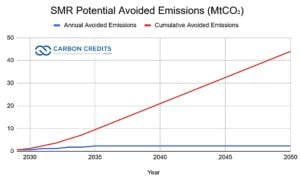
The first reactor is scheduled to start operating by late 2029. When all four are built, the facility will provide 1,200 megawatts (MW) of clean electricity — enough to power 1.2 million homes. Over its lifetime, the project could avoid up to 2.3 million tonnes of CO₂ each year between 2029 and 2050.
The Darlington SMR project can create 18,000 construction jobs and 3,700 permanent positions in operations and supply. It will also inject around $500 million annually into Ontario’s nuclear supply chain once it reaches full capacity.
Government officials say this initiative supports three goals at once: economic growth, energy security, and emissions reduction. Canada aims to boost its power grid through modular nuclear technology. This also supports clean tech manufacturing and export opportunities.
Canada’s SMR Action Plan sets out a national path to develop and deploy small modular reactors across the country. It unites federal and provincial governments, industry, Indigenous communities, research institutions, and utilities under one framework.
The plan aims to help Canada reach net-zero emissions by 2050, decarbonize industry and power generation, and create jobs. It aims to build trust in the community, ensure safe waste management, and boost exports of Canadian SMR technology worldwide.
Why Small Reactors Are a Big Deal
Small modular reactors represent the next generation of nuclear power. Each unit is smaller and easier to build than traditional reactors. The BWRX-300 design, created by GE Hitachi Nuclear Energy, features advanced safety systems. It can be built in factories and then shipped to a site for installation.
SMRs offer several advantages:
- Lower capital cost: Each module can be built and added in stages.
- Faster deployment: Factory assembly reduces on-site construction time.
- Grid flexibility: SMRs can supply remote areas or industrial zones that large plants cannot easily serve.
- Clean power: They generate consistent electricity without carbon emissions.
READ MORE: What is SMR? The Ultimate Guide to Small Modular Reactors
The Darlington reactors will serve as the flagship for this new model. Experts see it as a test case for how nuclear can complement renewables like wind and solar, especially during periods of low generation.
Nicolle Butcher, OPG (the majority owner and operator of DNNP) president and CEO, stated:
“The Darlington New Nuclear Project will help meet growing demand for low-carbon energy, and provide significant economic benefits for Ontarians and Canadians, creating jobs and securing contracts across the province’s robust nuclear supply chain.”
Strengthening Energy Security and Supply
Electricity demand in Canada is rising quickly. The Canadian Electricity Association estimates that power demand may rise by 40 percent by 2050. This increase is due to electric vehicles, heat pumps, and the growing needs of data centers.
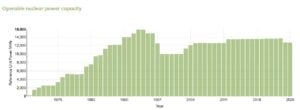
Ontario, in particular, will need more reliable, low-carbon energy as old reactors and natural gas plants close. The province gets about 60% of its electricity from nuclear power. SMRs will help replace this capacity and support net-zero goals.
Federal and provincial leaders say nuclear power is key to balancing the grid. This is especially important as more renewable sources, which vary in output, are added. Unlike solar or wind, SMRs can run 24 hours a day, providing what grid planners call “baseload” or “firm” power.
Economic and Industrial Ripple Effects
Beyond electricity, SMR development supports a broad industrial base. The project will use Canadian engineering, fabrication, and construction skills. These have been developed over six decades of nuclear operations.
The Canadian Nuclear Association states that the nuclear sector supports around 76,000 jobs. It also contributes $17 billion to the GDP every year. The Darlington expansion might boost those numbers even more. It could create a lasting supply chain for SMR parts, fuel, and maintenance.
The new reactors will also use low-enriched uranium fuel sourced and processed domestically. This matches Ottawa’s aim to boost independence in critical minerals and fuels. This is important due to global supply chain risks.
Canada’s Nuclear Edge in a Global Race
Canada’s SMR plan positions it ahead of other major economies. In the United States, NuScale Power is still working on SMR projects. However, cost overruns and cancellations have pushed back its deployment.

The U.K. is funding a competition to build the first domestic SMR fleet, but commercial operations are not expected before the early 2030s.
If Darlington’s first reactor enters service on schedule in 2029, it will be the first grid-connected SMR in the developed world. Analysts believe that Canada’s early-mover advantage may help it export SMR technology and expertise. This is especially true for countries with smaller or remote grids.
The International Atomic Energy Agency (IAEA) predicts that global nuclear capacity needs to double by 2050. This is essential to reach net-zero targets. SMRs are set to drive significant growth. By 2040, their market value could hit US$120 billion, based on Allied Market Research data. 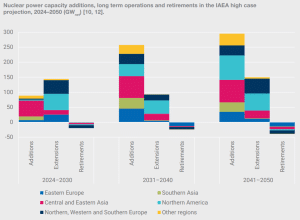
The Darlington project could help Canada play a major role in the global clean energy market.
Cleaner Power, Smaller Footprint
Each SMR at Darlington will reduce greenhouse gas emissions by replacing fossil fuel generation. When all four reactors are running, the country can save 2.3 million tonnes of CO₂ each year. That’s like taking about 500,000 cars off the road annually.
Unlike large hydro or coal plants, SMRs use much less land and water. Their modular design allows units to be added without major ecosystem disruption. The reactors have passive safety features. This means they can cool themselves in emergencies without needing external power or human help.
From an ESG viewpoint, Canada’s investment shows that nuclear energy is key to reaching net-zero goals. Many international financial institutions now see advanced nuclear as a sustainable asset. This gives investors more confidence to fund new projects.
Industry and Market Reactions
Market analysts and clean energy experts see the Darlington announcement as a sign that nuclear is gaining global attention again. The World Nuclear Association says that over 80 SMR designs are in development globally. More than 30 projects are already being built or are in advanced planning.
Canada’s commitment could attract private capital and accelerate partnerships with firms in the U.S., Europe, and Asia. GE Hitachi has teamed up with Ontario Power Generation, SaskPower, and TVA. They aim to commercialize the BWRX-300 model worldwide.
Economic analysts say success at Darlington could help regional manufacturing hubs in Ontario and Saskatchewan. These areas are also studying new SMR sites.
A Defining Step for Canada’s Clean Energy Future
Investors and regulators will be closely watching the success of this first-of-its-kind SMR. The project’s modular approach means later units could be built faster and at a lower cost. If the model works well, Canada might use it in other provinces. This could boost industrial hubs and clean hydrogen production.
The Darlington SMR investment marks a turning point for Canada’s energy policy. It merges technology, sustainability, and economic growth in a single strategy.
If it works, this initiative could change how countries decarbonize power grids. As the first G7 nation to bring SMRs to market, Canada is both following the clean energy transition and it is helping lead it.
The post Canada Goes Nuclear Again: This Time It’s a C$3 Billion Bet on SMR appeared first on Carbon Credits.

EU carbon credit claims changed on 27 September 2026, the day the Directive (EU) 2024/825 began to apply across the European Union. The change is narrow. It changes how a company can talk about the credits it buys. A product can no longer be called neutral on the strength of compensation alone; however, every specific, evidenced statement about what a company measured, reduced, and funded stays fully available.

The post Promoting Improved Cooking Practices in Nigeria appeared first on Terrapass.



-
Climate Change1 year ago
Guest post: Why China is still building new coal – and when it might stop
-

 Greenhouse Gases2 years ago
嘉宾来稿:满足中国增长的用电需求 光伏加储能“比新建煤电更实惠”
-
Greenhouse Gases1 year ago
Guest post: Why China is still building new coal – and when it might stop
-

 Climate Change2 years ago
嘉宾来稿:满足中国增长的用电需求 光伏加储能“比新建煤电更实惠”
-

 Renewable Energy12 months ago
Sending Progressive Philanthropist George Soros to Prison?
-
Climate Change2 years ago
Bill Discounting Climate Change in Florida’s Energy Policy Awaits DeSantis’ Approval
-
Greenhouse Gases1 year ago
嘉宾来稿:探究火山喷发如何影响气候预测
-

 Climate Change2 years ago
Analysis: China’s CO2 falls 1% in Q2 2024 in first quarterly drop since Covid-19