

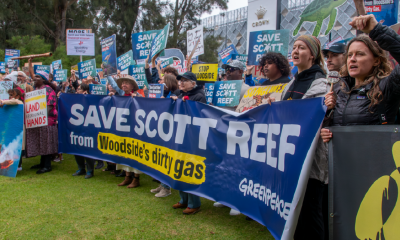
Greenpeace activists have been arrested after taking action at a major gas conference this morning in Sydney.
Earlier today, brave activists disrupted the Australian Domestic Gas Outlook conference at the Sheraton Grand Hotel, dropping a banner with a simple message: Gas Execs Profit. We Pay The Price.
They were also holding banners calling to Tax Gas Profits, making it clear that Australians have had enough.
Following the peaceful protest, two activists were arrested by police.
Watch and share the video to see what’s happening.

Why this matters
Gas corporations are raking in billions in profit from global crises – from Ukraine to Iran – while everyday Australians are left paying the price with higher energy bills and climate damage.
At the same time, these companies continue to avoid paying their fair share of tax.
That’s why Greenpeace activists took action.
A message from the activists
Alex Saurin, Greenpeace activist who dropped the banner, said:
“It feels powerful to take a stand against these gas corporations that have been trampling over the Australian people and our environment for far too long.
Gas giants like ExxonMobil and Santos have spent years blocking renewable energy and dodging fair taxes to protect their record profits. While families struggle to pay the bills and the climate crisis accelerates, these companies continue to demand free right to do whatever they want.
It is beyond time for our leaders to shake off the gas industry’s grip and start taxing these corporations fairly while clearing the path for the renewable energy we desperately need. They need to start making decisions for our people and our planet – not just for us now, but for the generations to come.”
These are ordinary people taking extraordinary action, standing up to an industry that continues to put profits ahead of people and the planet.
Standing up to Big Gas
Today’s arrests are a reminder of what it takes to challenge this industry.
As Greenpeace Campaigner, Solaye Snider, said:
“Gas corporations in Australia are ripping us off. From Ukraine to Iran, these corporations treat global conflict as an opportunity to line their pockets and drill for more gas – but while gas executives profit, we pay the price with more climate pollution, more environmental destruction, and soaring bills for Australian households.
“It’s in Australia’s interest to unhook from volatile, polluting and expensive sources of energy like gas. The fastest path to cheaper power bills and a safer climate is clear: start taxing gas exports properly and speed up the transition toward homegrown renewable energy.
“As long as we are dependent on fossil fuels like gas, our electricity bills and our climate are at the mercy of global instability and greedy corporations who put their profits over people and planet.”
What needs to happen now
Gas is expensive. It’s volatile. And it ties our energy system to global instability. But there is a better way.
The government is already considering introducing a tax on gas corporations before the May budget – now we need to make sure they follow through.
That’s an important first step, but it’s just the beginning.
Renewable energy is already cheaper, more reliable, and made right here in Australia. It’s the fastest path to lower bills, real energy security and a safer climate.
To invest in a better future, we need to:
- properly tax gas corporations and their exports,
- stop expanding gas, and
- speed up the transition to homegrown renewable energy.
This is just the beginning
This action, and the arrests that followed, are part of a growing movement to stand up to Big Gas and challenge the power it holds over our government and society. The Federal Government has a role to play – starting by taxing gas corporations properly and then accelerating the transition to homegrown renewable energy.
Together, we can show just how much support there is for change, and make it impossible for decision-makers to ignore.
What you can do
- Follow along on our social channels.
- Share the video far and wide to show your support.
- Sign the petition to tell Albo to stand up to Big Gas.
- Sign up to find out how you can become a volunteer and take action.
BREAKING: Greenpeace activists arrested after standing up to Big Gas in Sydney


For the first time, new-energy vehicles (NEVs) made up 67% of new car sales in China in September, according to the latest data from the China Passenger Car Association (CPCA).
The figures show that NEVs, which include battery electric cars and plug-in hybrids, captured a record share of sales, even though fewer were sold than last year.
This is because sales of combustion-engine cars are falling steeply, a trend that the CPCA has attributed to rising petrol prices following the start of the Hormuz crisis.
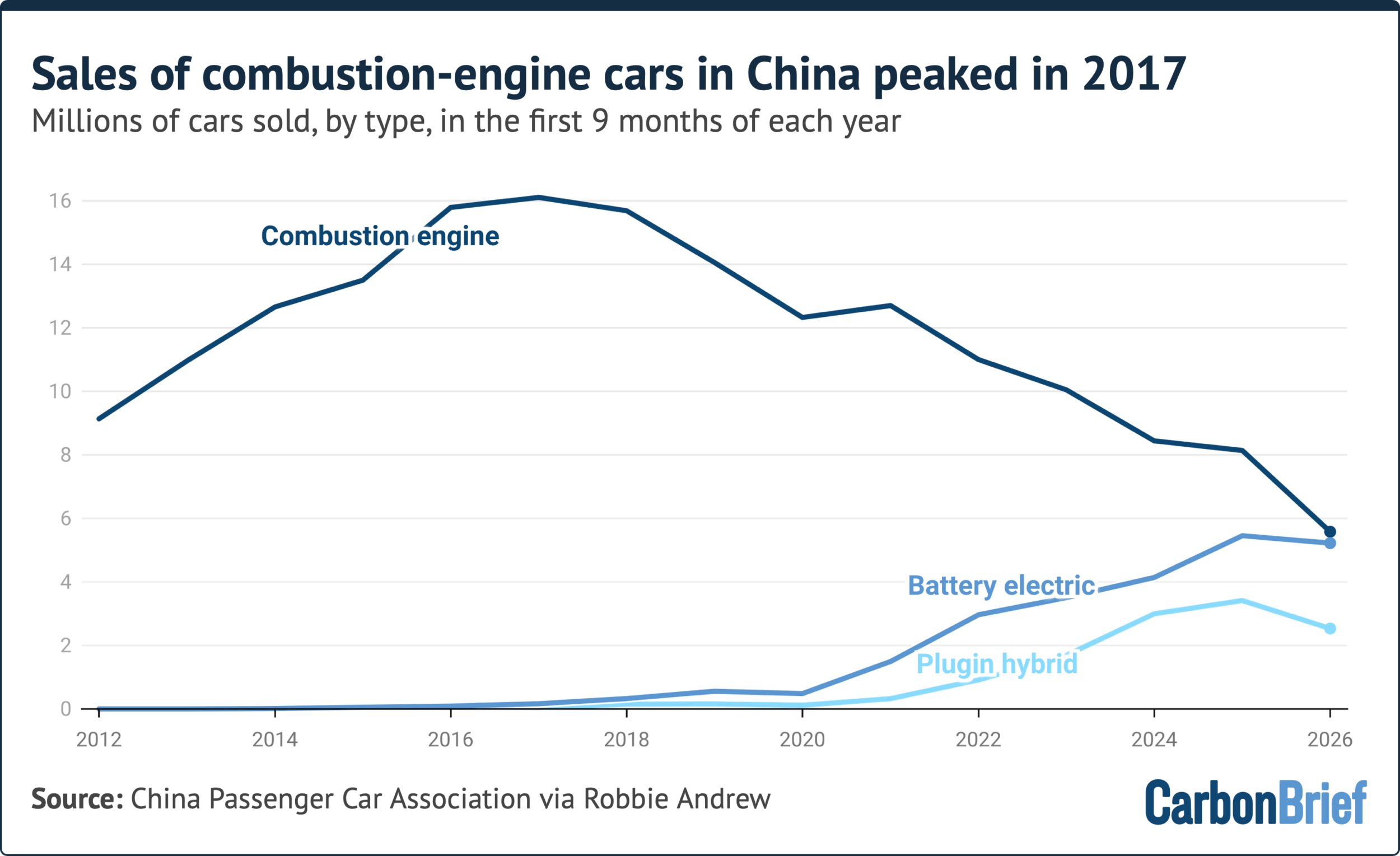
Indeed, sales of fuel-only cars were down 31% year-on-year in the first nine months of 2026, with plug-in hybrid sales down 26% – whereas battery EV sales were only down 4%.
One analyst tells Carbon Brief that China’s rapidly growing EV fleet has offset demand for 143m barrels of oil since the start of the Hormuz crisis.
Another says that the crisis is “reinforcing China’s electrification of road transport”.
Meanwhile, amid slowing domestic sales, Chinese carmakers’ exports of NEVs more than doubled [in 2026 to date / in September] from a year earlier.
NEV record
A record two out of every three cars sold in September in China were NEVs, according to CPCA data, as shown in the figure below.
(NEVs predominantly include battery electric vehicles – BEVs – and plug-in hybrids – PHEVs. BEVs only run on electricity, whereas PHEVs also have a combustion engine.)
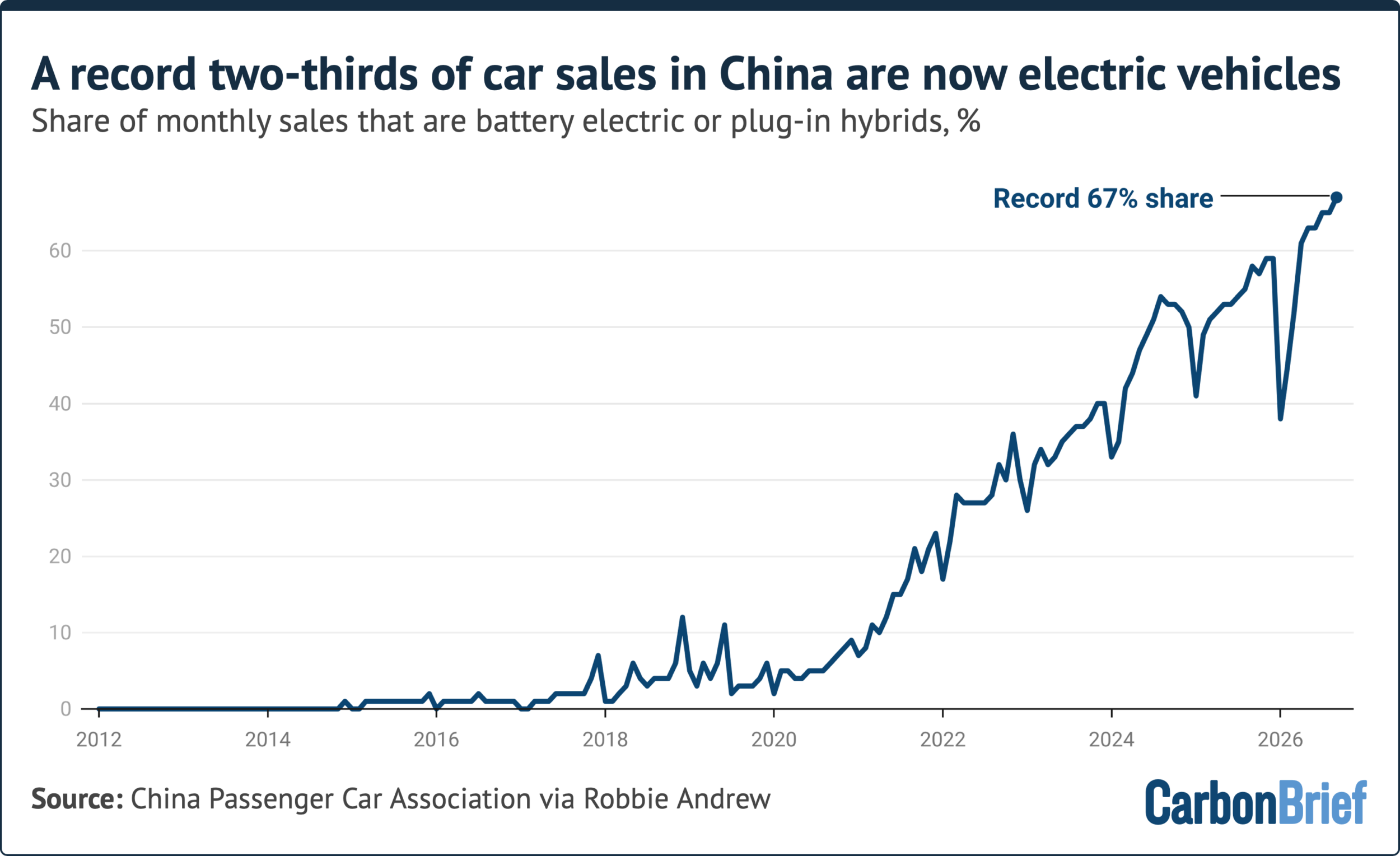
This marks a rapid rise for NEVs from just 6% of new car sales in 2020 up to 58% in 2026 to date – and a record 67% in the month of September.
This year, NEVs’ share of sales has also bounced back from a low of 39% in January, after the full purchase tax exemption that had been in place for more than a decade came to an end in December 2025.
The gain in NEV share in 2026 has come amid a slowdown across the wider domestic passenger-car market, which has hit sales of combustion-engine vehicles particularly hard.
This September, passenger-car retail sales across all categories declined, with overall sales volumes falling 28% year-on-year.
The contraction was led by combustion-engine vehicles, which saw sales fall 43% year-on-year in September and 31% in 2026 to date.
However, sales of PHEVs also fell by 36% year-on-year in September and by 26% in 2026 to date. By comparison, BEVs performed better, although sales still declined 8.5% from a year earlier in September and 4% in 2026 to date.
As a result, NEV sales overall fell by 17% in September and 13% in 2026 to date.
While the market changes in 2026 to date were particularly dramatic, they reflect a broad continuation of trends seen over the past decade.
Indeed, sales of combustion-engine cars in China peaked in 2017 and they have been declining ever since, shown in the figure below.
Impact of Hormuz
Part of the reason for the advance of NEVs in 2026, said Chinese technology news outlet OFweek, was petrol cars “giving up market share” as they were outperformed by electric alternatives.
Cui Dongshu, secretary-general of the CPCA, cited higher petrol prices as an explanation for September’s weak combustion-car sales, in comments to financial news outlet National Business Daily.
Imports of oil into China in January-September have fallen 15% compared to 2025, equivalent to 470m barrels, as ongoing conflict tightened supply and drove up prices.
China’s passenger-car NEV fleet has displaced 143m barrels of oil so far during the strait of Hormuz crisis, Euan Graham, senior energy analyst at thinktank Ember, tells Carbon Brief.
EVs “accounted for 12% of the decrease in China’s oil use post-Hormuz”, according to an estimate provided to thinktank the Brookings Institute by an unnamed analyst.
Erica Downs, a senior research scholar at Columbia University’s Center on Global Energy Policy, tells Carbon Brief that the strait of Hormuz crisis and higher oil prices are “reinforcing China’s electrification of road transport”.
She says the “world’s largest oil supply disruption” vindicates China’s early bet on EVs, which was partly driven by concerns about oil-supply security.
NEV demand down
Nevertheless, NEV sales have fallen year-on-year, albeit at a slower rate than overall car sales. The growth in NEV market share has also been decelerating.
Zhang Yichao, a partner at consulting firm AlixPartners, tells Carbon Brief that NEVs benefit from government trade-in policies and a “strong pipeline” of new models, particularly those involving innovation.
He says these factors help explain why NEVs sales have fallen at a slower rate to their combustion-car counterparts.
Cui told the state-run China National Radio that the fall for NEVs and for cars overall in September 2026, is also due to a high baseline of sales from the same month in 2025, as well as changes to trade-in policies and disruptions from the holiday period.
Other factors, says consulting firm Wood Mackenzie, are the weakened demand due to “demand pull-forward” in 2025 caused by the end of subsidies, as well as “tighter financing conditions”.
Zhang tells Carbon Brief he does not “see much more room ahead” for further growth in NEVs’ market share.
He adds that, in his view, their share in China is unlikely to exceed 80%, as some premium-market segments and specific use cases will continue to require combustion-engine vehicles.
Exports surge
Meanwhile, while domestic NEV retail sales fell 17% in September 2026, exports more than doubled, increasing 164% year-on-year, according to the CPCA.
This extends the decline in domestic sales and very strong growth in exports seen across 2026 to date, as shown in the figure below.
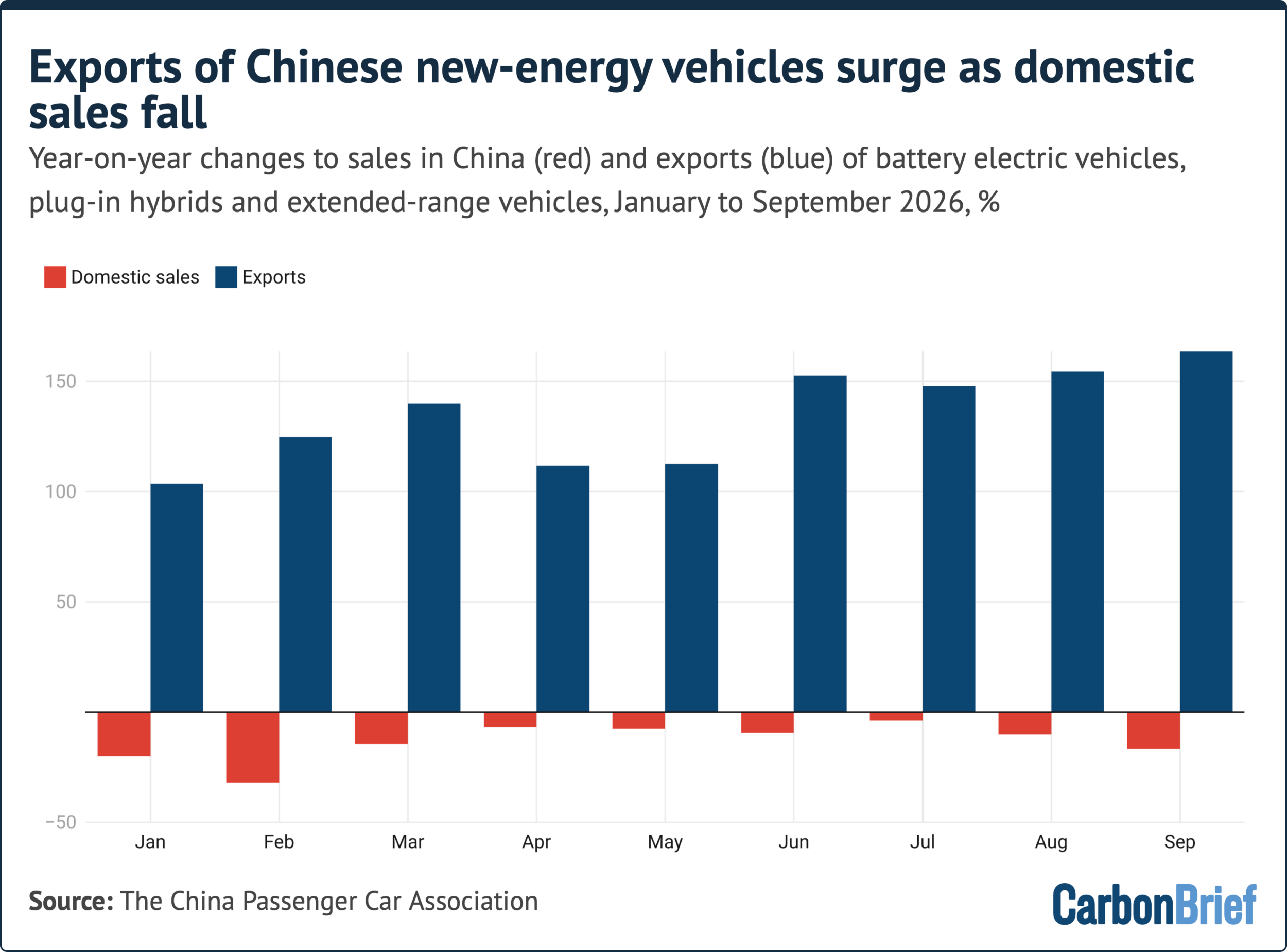
In September, 1,084,000 NEVs were sold domestically in China, while 558,000 NEVs were exported.
Exports are becoming increasingly important to Chinese carm