

This week marks a major moment in Australia’s long and frustrating struggle to fix its broken national nature laws. The federal government has finally tabled long-awaited reforms to the Environment Protection and Biodiversity Conservation (EPBC) Act, a piece of legislation that has, ever since it was enacted, failed to protect Australia’s unique wildlife and ecosystems.
But the bill the government has put forward, while offering some positive new legal architecture, unfortunately falls far too short. Critical gaps in addressing deforestation and climate impacts from big coal and gas projects remain, and there is far too much leeway in how the federal environment minister is allowed to apply the law under the proposed new provisions. We’re calling on the Australian Parliament to fix these significant problems and pass laws that properly protect nature.
The Background: A Broken System Finally Gets Attention
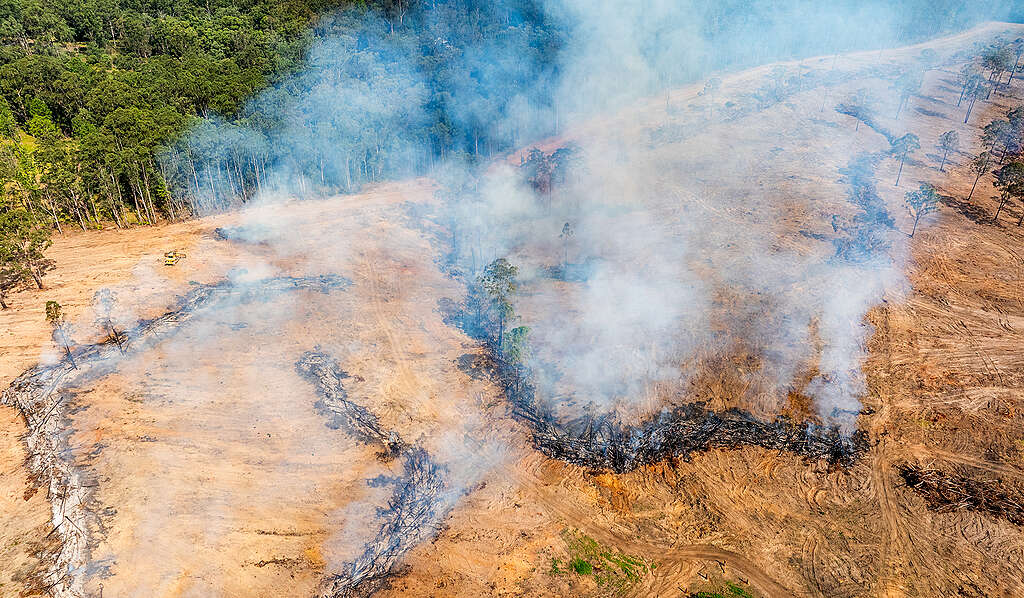
It’s been widely acknowledged for over a decade that the EPBC Act is deeply flawed. Despite being Australia’s key environmental law, it has done little to stop habitat loss, species decline, and the relentless clearing of native forests. Native habitat equal to an area the size of Tasmania has been bulldozed in Australia since the EPBC Act came into force in 2000—a stark reminder of the ineffectiveness of the laws.
A major independent review five years ago laid out a roadmap for reform, recommending stronger protections for nature and streamlined approvals for business, including renewable energy projects. The idea was simple: if we establish strong, science-based rules up front and create an independent environmental regulator, we can both protect nature and provide greater certainty for ecologically sustainable development.
Last term the government attempted a partial reform, mainly to establish a national EPA (Environment Protection Authority), but unfortunately this did not eventuate. Now, under new Federal Environment Minister Murray Watt, Labor is trying again and attempting to move at great speed to deliver a full package of legislative reforms before the end of the year.

What’s in the Reform Package?
While there is new legal architecture that could be made strong (new rules and standards and a national Environment Protection Authority), ultimately the current package falls well short of what is actually needed to protect nature. Major improvements are essential to the Bill that is now before the parliament.
At Greenpeace we have four major tests of success:
1. Closing the Deforestation Loopholes
In the current laws, agriculture (particularly beef) and native forest logging remain virtually exempt from the Act, even though deforestation is one of Australia’s major drivers of species extinction and carbon emissions. The current provisions in the Bill do not close these glaring loopholes. Without reform here, Australia’s forests, and the wildlife that depend on them remain hideously vulnerable to the mass destruction of bulldozers and chainsaws that currently has our country recognised as a global deforestation hotspot.
This is a big issue we need to keep pushing on to fix—these reforms are not credible without action to close the loopholes around deforestation
2. Stronger Upfront Protections
- The government is introducing stronger upfront environmental tests (the “unacceptable impacts” test), giving the Minister the power to reject development projects outright before assessment if they are going to do serious damage to nature.
This could be made into a strong element of reformed laws
- They are proposing to introduce ‘national environmental standards’ for those projects and regional plans which do get assessed and developed.
This could give clearer delineation of what needs to be done to protect nature but details are yet to be released and there’s too much wriggle room proposed for how these standards are applied
- There will be higher penalties and the power to halt projects that breach conditions are excellent additions.
This is good and has been a long time coming, but does not work as a standalone if the rest of the laws don’t do what’s needed.
- They are proposing to overhaul the biodiversity offset scheme, introducing a ‘net gain’ test where developers are meant to ensure improved overall nature protection and the ‘mitigation hierarchy’ where they have to prove they have tried to avoid and mitigate nature impacts before buying offsets.
But they are planning an offset fund which risks becoming a way for businesses to circumvent obligations, enabling developers to just buy their way out of responsibility- not a good thing.
- A proposal for a system of ‘accreditation’ which would allow states that meet new rules and standards to undertake assessment and approval of development projects.
This is deeply concerning. The Commonwealth should retain its approval powers-especially over damaging fossil fuel projects
- A proposal to expand on a ‘national interest’ exemption, giving the Environment Minister greater scope to circumvent the new proposed rules.
This is also deeply concerning. This exemption should be tightened to emergencies and security purposes only.
3. A Strong and Independent National Regulator
We will finally see the creation of a National Environment Protection Authority (EPA) — a long-overdue step. However, the Minister will still retain the power to override some decisions.
The proposed level of ministerial discretion risks undermining the regulator’s independence and the overall protective functioning of the Act, and would extend one of the core failures of the current system.
4. Embedding Climate Considerations
Astonishingly, the new national nature law still does not require decision-makers to consider climate impacts. The government has ruled out a ‘climate trigger’ that would require assessment of projects with significant emissions. This omission leaves Australia’s environment exposed to worsening heat, drought, bushfires, and floods driven by fossil fuel expansion. In order to be credible, the EPBC must be meaningfully cognizant of the physical reality of the impact of global warming on the environment and biodiversity that it is intended to protect.
This is another big issue on which we need to keep pushing
As our CEO David Ritter put it:
“The Albanese government was returned to power promising to fix Australia’s broken nature laws and the Bills as they stand do not deliver on that promise. We strongly support overhauling Australia’s broken nature laws. But the Bills as tabled fail to address the two key drivers of extinction and the destruction of nature-deforestation and climate change”

The Road Ahead
The Bills have been tabled in Parliament, and debate is about to heat up. Now the reforms head to a Senate Inquiry — where key negotiations with the Greens, the Coalition and crossbenchers will determine the final shape of the law.
If the Senate moves quickly, the reforms could pass by late November. Alternatively the process could carry into the new year when Parliament next sits.

What Needs to Happen Next
Parliament must now work together to fix the gaps in these Bills. Australia needs a nature law that actually protects nature. One that:
- Closes the loopholes that allow deforestation and logging to continue unchecked
- Embeds climate considerations into the functioning of the Act
- Limits ministerial discretion and strengthens the independence of the EPA
- Ensures there are strong upfront nature protections in place
Meaningful action to address the climate and nature crises will not only safeguard ecosystems, it will secure a safer, more liveable future for all Australians and reinforce our global reputation as a clean, green country.
After years of advocacy, research, and tireless campaigning, we’re closer than ever to real change. But the coming weeks will be crucial. The decisions made now will shape the fate of Australia’s forests, wildlife, and climate for generations to come.
So strap in–the fight for Australia to have effective national nature laws is entering its most important phase yet.

Continue Reading
Three countries have been named by the Paris Agreement’s compliance committee for failing to submit a nationally determined contribution (NDC) and repeatedly snubbing offers of help with their climate plans.
After months of internal debate over whether to identify serial non-responders, the Paris Agreement’s Implementation and Compliance Committee (PAICC) named the three countries which have failed to engage with it over their NDCs on Friday.
It named Democratic Republic of Congo, Senegal and North Korea in a footnote of its annual report, adding that it decided to name them “with a view to facilitating engagement”, adding that representatives of the three nations had been invited to its meeting in early 2027 “with the purpose of identifying any challenges and constraints”.
“The Committee noted the importance of Parties engaging with the Committee in a timely manner, while noting that some delays may be due to the national capabilities and circumstances of the Parties”, the report said.
-
Under US pressure, World Bank says it will back gas “where appropriate”
The US wants the World Bank to expand its gas support while climate campaigners are pushing for it to end – its head spoke this week of limited backing for the fossil fuel -
IPCC scientists vow to press on with climate reports despite political deadlock
After governments again failed to agree a timeline, nearly 120 IPCC authors pledged to complete their assessment on time and with full scientific rigour -
Paris Agreement committee snubbed over missing NDC climate plans
Many governments have still not submitted a nationally determined contribution to the UN, breaching a key requirement of the Paris Agreement

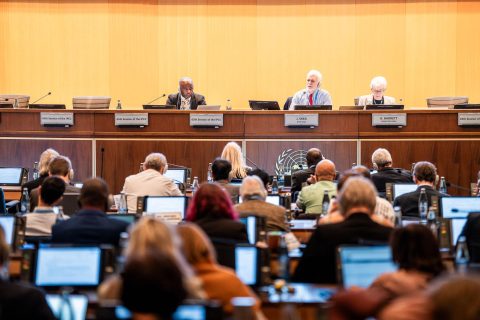

In July, PAICC said 12 countries had ignored its repeated attempts to discuss why they had not published an NDC as required every five years under the 2015 Paris accord.
Members of the committee had been divided over whether to name them, but at a September meeting decided to do so in their annual report to the annual climate COP summit.
By the time the report was published on Friday, only Congo, Senegal and North Korea “had not communicated an NDC or submitted a [Biennial Transparency Report] and had not yet responded to any of the Committee’s notifications, despite several reminders issued by the Committee in this regard”.
Rainforest and renewable energy ambitions
The silence from Congo and Senegal is notable because the former is home to much of the Congo Basin rainforest while the latter has sought billions of dollars in climate finance to support its renewable energy ambitions.
After Brazil, Congo has more rainforest than any country in the world. This forest, and the country’s peatlands, absorb huge amounts of greenhouse gas but are fast being lost to expanding farmland, charcoal production, logging and mining.
Senegal signed a Just Energy Transition Partnership with Canada and wealthy European nations in 2023, to help it meet its renewable energy targets under the-then government of Macky Sall. It was chair of the Least Developed Countries group between January 2022 and December 2023.

Tejas Rao, who is researching the PAICC as part of a doctoral thesis at Cambridge University, said the governments of the three countries should engage with the committee.
“Engagement costs these governments very little and the committee has shown it will listen,” he said.
“Silence leaves the committee with no basis to help, and it leaves the [governments] exposed to the narrative that they are simply disengaged,” he told Climate Home News.
Paris Agreement requirement
The 2015 Paris Agreement requires all parties to publish an NDC every five years outlining their emissions reduction targets, with each plan meant to be more ambitious than the country’s last NDC.
The latest set – the third round of plans, with new targets for 2035 – was due in February 2025. While most countries missed this deadline, all but around 30 – mostly small emitters but including Egypt, Vietnam and Argentina – have now submitted them.
Over the year, the PAICC – which is made up of government climate officials from developed and developing countries – has been communicating with governments that have not submitted NDCs and trying to overcome barriers to them doing so.
Some nations have cited exceptional circumstances as the reason for not submitting an NDC, a process that requires a significant amount of work in tracking emissions and consulting on how to curb them across the economy. For example, a letter from a Sudanese official to the PAICC, seen by Climate Home News, said that the country’s civil war had led to the suspension of its NDC preparation.
-
IPCC scientists vow to press on with climate reports despite political deadlock
After governments again failed to agree a timeline, nearly 120 IPCC authors pledged to complete their assessment on time and with full scientific rigour -
Under US pressure, World Bank says it will back gas “where appropriate”
The US wants the World Bank to expand its gas support while climate campaigners are pushing for it to end – its head spoke this week of limited backing for the fossil fuel -
Who shapes climate science? The equity question facing the IPCC
Early completion of the next global climate science assessment reports risks excluding research from the Global South, which is key to ensuring the findings are fair
The US and Iran are not signed up to the Paris Agreement and so do not have active NDCs, nor does Taiwan, which is not a UN member state.
Rao said that because the PAICC is “facilitative and non-punitive”, naming the countries “is meant to open a door, not close one – the invited consultation is the point”.
“In recent months, governments that explained their constraints, whether capacity, finance or domestic process, have been met with follow-up and support rather than sanction, and the number of silent governments has fallen sharply,” Rao said.
The post Paris Agreement committee names three countries snubbing it over NDCs appeared first on Climate Home News.
Paris Agreement committee names three countries snubbing it over NDCs