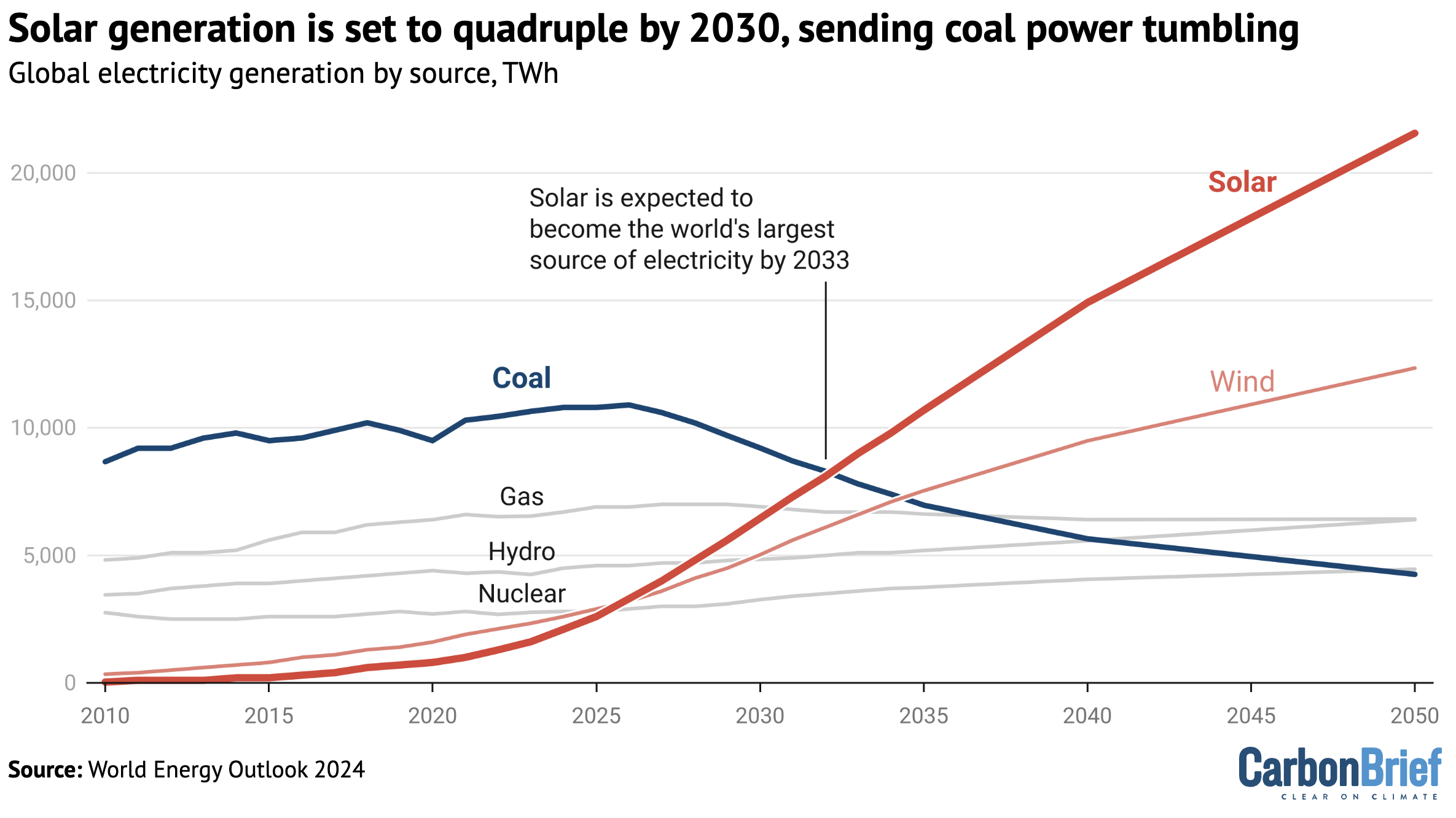
Global electricity generation from solar will quadruple by 2030 and help to push coal power into reverse, according to Carbon Brief analysis of data from the International Energy Agency (IEA).
The IEA’s latest World Energy Outlook 2024 shows solar overtaking nuclear, wind, hydro, gas and, finally, coal, to become the world’s single-largest source of electricity by 2033.
This solar surge will help kickstart the “age of electricity”, the agency says, where rapidly expanding clean electricity and “inherently” greater efficiency will push fossil fuels into decline.
As a result, the world’s energy-related carbon dioxide (CO2) emissions will reach a peak “imminently”, the IEA says, with its data indicating a turning point in 2025.
Other highlights from Carbon Brief’s in-depth examination of the IEA’s latest outlook include:
- Renewables will grow 2.7-fold by 2030, short of the “tripling” goal set at COP28.
- Still, clean energy is growing at an “unprecedented rate”, and will overtake coal, gas and then oil, to become the world’s largest source of energy “in the mid-2030s”.
- Low-carbon energy, including renewables and nuclear, will grow 44% by 2030, adding 48 exajoules (EJ) to global energy supplies.
- Global energy demand will only rise by 34EJ (5%) over the same period.
- This means clean energy will push each of the fossil fuels past their peak by 2030.
- Electric vehicles (EVs) are now expected to displace 6m barrels of oil per day (mb/d) by 2030, up from a figure of 4mb/d by 2030 in last year’s outlook.
Despite these changes, the world is on track to cut CO2 emissions to just 4% below 2023 levels by 2030, the agency warns, resulting in warming of 2.4C above pre-industrial temperatures.
It says there is an “increasingly narrow, but still achievable” path to staying below 1.5C, which would need more clean electricity, faster electrification and a 33% cut in emissions by 2030.
This year, in light of heightened geopolitical risks and uncertainties, the IEA explores “sensitivities” around its core outlook. These include slower (or faster) uptake of electric vehicles (EVs), as well as faster growth in data-centre loads and more heatwave-driven demand for air conditioning.
The agency maintains that, even when these sensitivities are combined, global demand for coal, oil and gas – as well as CO2 emissions – would peak no more than a few years later than expected.
(See Carbon Brief’s coverage of previous IEA world energy outlooks from 2023, 2022, 2021, 2020, 2019, 2018, 2017, 2016 and 2015.)
World energy outlook
The IEA’s annual World Energy Outlook (WEO) is published every autumn. It is widely regarded as one of the most influential annual contributions to the understanding of climate and energy trends.
The outlook explores a range of scenarios, representing different possible futures for the global energy system. These are developed using the IEA’s “Global Energy and Climate Model”.
The 1.5C-compatible “net-zero emissions by 2050” (NZE) scenario was introduced in 2021 and updated in September 2023. The NZE is revised again in the WEO 2024 to reflect the fact that global CO2 emissions reached another record high last year, rather than falling.
The report says that the path to 1.5C is “increasingly narrow, but still achievable”. However, it adds:
“Every year in which global emissions rise and actions fall short of what is needed for the future makes this pathway steeper and harder to climb.”
Alongside the NZE is the “announced pledges scenario” (APS), in which governments are given the benefit of the doubt and assumed to meet all of their climate goals on time and in full.
Finally, the “stated policies scenario” (STEPS) represents “the prevailing direction of travel for the energy system, based on a detailed assessment of current policy settings”. Here, the IEA looks not at what governments are saying, but what they are actually doing.
Annex B of the report breaks down the policies and targets included in each scenario. In effect, the IEA is judging the seriousness of each target and whether it will be followed through.
For example, the provisions of the European Green Deal are included in the STEPS. But the EU target to cut emissions to 55% below 1990 levels by 2030 is only met under the APS.
Since last year’s report, some 38 countries responsible for a third of global energy-related CO2 emissions have introduced new clean-energy measures, the IEA says.
It mentions South Korea’s 11th electricity plan, which “includes a significant expansion of nuclear, wind and solar”, and the new UK government “lift[ing] the de-facto ban on new onshore wind”.
(It says there have also been “some rollbacks” of climate policy over the past year, such as Javier Milei’s reforms in Argentina, but the global impact of these is “relatively small”.)

The report emphasises that “none of the scenarios should be viewed as a forecast”. It adds:
“Our scenario analysis is designed to inform decisionmakers as they consider options, not to predict how they will act.”
Earlier this year, some US politicians and analysts criticised the IEA’s work, in particular, its suggestion in WEO 2023 that demand for oil, coal and gas would each peak before 2030. They also argued that the IEA was straying from its core focus on energy security.
At the time, the agency defended its approach in a response to Senate Republicans.
This year’s edition goes on to reiterate the IEA’s view that fossil fuels will peak this decade – and pushes back on the idea that climate change and clean energy are outside its mission.
It says that “more efficient, cleaner energy systems can reduce energy security risks” and that a “comprehensive approach to energy security…needs to extend beyond traditional fuels”.
In his foreword to the report, IEA executive director Fatih Birol adds:
“The concept of energy security goes well beyond safeguarding against traditional risks to oil and natural gas supplies, as important as that remains for the global economy.”
He says that, in addition to those issues, energy security includes access to affordable energy supplies, secure supply chains for clean-energy technologies and dealing with the rising threat of extreme weather disruption to energy systems. Birol’s foreword continues:
“The analysis in this year’s outlook reinforces my long-held conviction that energy security and climate action go hand-in-hand…This is because deploying cost-competitive clean energy technologies represents a lasting solution not only for bringing down emissions, but also for reducing reliance on fuels that have been prone to volatility and disruption.”
Discussing the controversy over fossil-fuel peaking in a press briefing to launch this year’s report, Birol said that the latest data – and the outlooks of several major international oil and gas companies – had “confirmed and reconfirmed” the IEA’s position on oil demand.
Birol said press reports had described the latest data as “vindication” for the IEA’s forecast of minimal growth in oil demand this year. But he added: “It’s not a vindication of the IEA, it’s a vindication of numbers and objective analysis.”
Nevertheless, this year’s outlook puts extra emphasis on the uncertainty surrounding its scenarios. It devotes an entire chapter to exploring “sensitivities”, such as slower growth in EV sales or a more rapid escalation of heatwaves driving demand for air conditioning.
Even when these sensitivities are combined in ways that would slow climate action, however, the IEA says that oil demand still peaks and begins to decline by 2035. Similarly, global CO2 emissions would be less than 2% higher in 2030 and 1% in 2035 than in the core outlook.
‘Age of electricity’
A central theme of this year’s outlook is the idea that the global energy system is entering a new era, defined by rapid growth in electricity demand and a surge in clean electricity supplies.
In a press release accompanying the report, Birol calls this new era the “age of electricity”, in contrast to the earlier “age of coal” and “age of oil”. (The “golden age of gas”, predicted by the IEA in 2012, was prematurely brought to an end by the global energy crisis, driven by high gas prices.)
Birol says “the future of the energy system is electric” and that it is “moving at speed” towards “increasingly be[ing] based on clean sources of electricity”. In the report foreword he adds:
“The latest outlook also confirms that the contours of a new, more electrified energy system are becoming increasingly evident, with major implications on how we meet rising demand for energy services. Clean electricity is the future, and one of the striking findings of this outlook is how fast demand for electricity is set to rise, with the equivalent of the electricity use of the world’s ten largest cities being added to global demand each year.”
The IEA says that electricity demand is set to rise six times faster than global energy demand overall, in the years out to 2035, having only been twice as fast since 2010.

Moreover, despite a rapid acceleration in recent years, clean electricity has not yet grown fast enough to meet rising demand, leaving space for fossil-fueled power to continue expanding.
Global solar capacity is now 40-times larger than it was in 2010 and wind six times larger, the outlook notes, and a record 560 gigawatts (GW) of renewables were added in 2023.
Yet growth in clean electricity supplies has still fallen short of rising demand, meaning coal power has climbed 23% since 2010 and gas by 36%, raising emissions in the sector by 20%.
This is now set to change. The report says:
“It is now cheaper to build onshore wind and solar power projects than new fossil-fuel plants almost everywhere around the world, and the economic arguments remain strong even when considering the accompanying investment required to cope with their variability of generation.”
Renewables are only on track to expand 2.7-fold from 2022 to 2030 – short of the tripling target set at COP28 – but clean electricity will still outstrip rising demand, out to 2030 and beyond.
The IEA data shows that the amount of electricity generated from solar power alone is set to quadruple from 2023 levels by 2030 – and to climb more than nine-fold by 2050.
This means that solar will overtake nuclear, hydro and wind in 2026, gas in 2031 – and then coal by 2033 – to become the world’s largest source of electricity, as shown in the figure below.
Along with a doubling of wind generation and more modest gains for nuclear and hydro by 2030, clean electricity will push coal power into reverse, declining 13% by 2030 and 34% by 2035.
(The outlook sees modest growth of 6% by 2030 for gas power, but most of this would be erased by 2035 as clean electricity supplies continue to expand.)
The IEA says that China was responsible for 60% of worldwide renewable installations last year – and will add 60% of new capacity out to 2030. This means that by the early 2030s, solar generation in China alone is set to exceed the US’ current total electricity demand.
Notably, this year’s report includes another significant boost to the outlook for solar under current policy settings.
The IEA now sees global solar capacity exceeding 16,000GW by 2050, some 30% higher than expected last year and nearly 11-times higher than it thought in 2015, as shown in the figure below.
By 2023, the world had already installed 1,610GW of solar capacity. This comfortably exceeded the 1,405GW of capacity that the IEA had expected in 2050, under prevailing policy settings in its 2015 world energy outlook, released before the Paris Agreement later that year.

Similarly, this year’s outlook says battery storage capacity will reach 1,630GW by 2030. Only two years ago, it had said battery capacity would reach just 1,296GW by 2050.
In addition to raising the outlook for solar and storage, however, this year’s report also includes significantly higher global electricity demand, which has been revised upwards by 5% in 2030.
This 1,700 terawatt-hour (TWh) revision to global demand in 2030 – nearly equivalent to current electricity use in India – is much larger than the 1,000TWh adjustment for solar.
As a result, the IEA has also raised its outlook for coal power in 2030 by nearly 900TWh.
The IEA says that higher electricity demand is “mainly” down to “increased light industry activity, notably in China, much of it associated with a rapid rise in clean-technology manufacturing”.
Other factors include faster-than-expected adoption of EVs, more rapid electrification in industry in developing countries and the rise of data centres.
(The IEA, nevertheless, pours cold water on over-hyped reporting of AI-driven growth in data-centre electricity demand, which it sees accounting for barely 3% of growth to 2030, overall.)
Alongside growth in wind and solar, the report stresses the need for “a wide set of dispatchable low-emissions sources, including hydropower, bioenergy and nuclear power”.
It also emphasises the need for rising investment in electricity grids and storage. Spending in these areas is currently only two-thirds of investment in renewables, whereas parity will be needed to facilitate clean electricity expansion and ensure resilience to extreme weather and cyberattacks.
Fossil fuels peak by 2030
The “age of electricity” will have important implications for the current fossil-fuelled energy system, the report says. These include a reduction in the rate of global energy demand growth, even as demand for “energy services” – such as heat and mobility – rises rapidly in the developing world.
Explaining this apparent paradox, the IEA says that much of the energy released by burning fossil fuels is lost as waste heat. In contrast, a “more electrified, renewables-rich system is inherently more efficient”. This means less energy will be required to deliver the same energy services.
For example, electric technologies such as EVs and heat pumps deliver mobility and heat much more efficiently than internal combustion engines or fossil fuel boilers, the report says.
As the “age of electricity” gains pace, sources of energy demand across all sectors of the economy will be increasingly electrified, including heating, cooling, mobility and industrial processes.
This means the share of final energy consumption met by electricity will rise from 17% in 2010 and 20% in 2023 to 24% by 2030 and 32% by 2050, the outlook says – a more than 50% rise on current levels of electrification.
(Earlier this year, the Rocky Mountain Institute said China had “leapfrogged” other major countries in terms of rapid electrification, becoming what it termed the “first major electrostate”. Electricity already accounts for 26% of its energy consumption and will reach nearly 45% by 2050.)
Notably, the IEA has also been edging up its outlook for electrification, reflecting repeated boosts to its view on the deployment of electric technologies such as EVs and heat pumps. In 2015, it only expected electricity to meet 26% of final demand in 2050.
The rise of electrification, fed by expanding clean electricity sources, is now on the cusp of sending fossil fuels into decline, the outlook shows. As noted above, this year’s report reiterates the agency’s view that coal, oil and gas will each reach a peak this decade. It says:
“In the STEPS, coal demand begins to decline around 2025, while oil and natural gas demand both peak towards the end of the decade.”
Indeed, the outlook data shows global energy supply growing 34EJ (5%) by 2030, with this growth easily outpaced by clean-energy expansion of 48EJ (44%). As a result, fossil fuels in aggregate will be pushed into decline, as shown in the figure below.

The chart above shows how shifts in the global policy and technology landscape since the 2015 Paris Agreement have transformed the outlook for fossil-fuel growth.
Instead of the continuation of historical growth rates expected before Paris, the IEA has in recent years shifted its outlook, to a peak and increasingly steep decline in fossil-fuel demand.
Indeed, this year’s report points to fossil-fuel demand under current policy settings declining at a rate that is nearly in line with the climate pledges countries had made in 2021.
For example, the report says that China’s rapid uptake of EVs is spurring a “major slowdown” in oil demand growth globally, which is “wrong-footing oil producers”. It explains:
“China has been the engine of oil-market growth in recent decades, but that engine is now switching over to electricity.”
Indeed, the rise of electric mobility around the world is set to displace 6mb/d of oil demand by 2030, the outlook says, up from the 4mb/d it expected last year.
It notes that despite negative reporting, global EV sales were up 25% in the first half of 2024, with China accounting for 80% of the increase, but the rest of the world’s market also up 10%.
Nevertheless, the chart above illustrates the large gap between the current trajectory of the global energy system and what would be needed to meet existing national climate pledges, let alone the Paris Agreement target of limiting warming to “well-below” 2C or 1.5C.
Insufficient progress on emissions
This year’s outlook puts the gap between climate ambition and the world’s current trajectory into stark relief, saying that prevailing policy settings would likely see warming reach 2.4C this century.
Reflecting the marginally higher outlook for coal use in the short term, but more rapid fossil fuel declines in the medium and longer terms, this 2.4C assessment is the same as last year’s report.
This combination of changes is illustrated in the figure below, showing how the outlook for global energy-related CO2 emissions (grey line) has changed since 2015 (dashes). The IEA now says CO2 emissions will peak “imminently”, with its data pointing towards a peak in 2025.
(Last year, the outlook said emissions would peak by 2025 at the latest.)

The chart above illustrates how new policies and technological progress since the Paris Agreement are bending the curve of global CO2 emissions away from the 3.5C of warming expected in 2015.
Still, it also shows the massive gap that would need to be bridged in order to meet national climate pledges for 2030 and for reaching net-zero emissions by mid-century (blue line). And it shows the huge scale of the gap to the “increasingly narrow, but still achievable” path to 1.5C.
While current policy settings would cut global CO2 emissions to 4% below 2023 levels by 2030, according to the IEA, a far larger 33% reduction would be needed for 1.5C.
A separate report from the IEA, published last month, shows how countries could close most of this gap “by fully implementing the 2030 goals they agreed at COP28”.
These goals included doubling the rate of energy efficiency improvements and tripling global renewable capacity by 2030. Together, these two elements “could provide larger emissions reductions by 2030 than anything else”, the outlook says.
It reinforces the key changes that would be needed to get on track for current climate pledges – which would limit warming in 2100 to around 1.7C – or to limit warming to 1.5C.
In broad terms, this would mean even faster electrification and deployment of clean-energy technologies, as well as taking rapid action to cut methane emissions from the oil and gas industry.
(Instead of electricity’s share of final energy use increasing from 20% to 32% by 2050, as under current policy settings, electrification rates would double to 42% by 2050, if climate pledges are met, and would nearly triple to 55%, if the world gets on track for 1.5C.)
More specifically, the IEA points to “seven key clean-energy technologies”: solar; wind; nuclear; EVs; heat pumps; low-emissions hydrogen; and carbon capture and storage.
The report says the world has “the need and the capacity to go much faster” in these areas, which – unlike the current trajectory – would bring global emissions into a “meaningful decline”.
Spotlighting the need for a positive outcome in upcoming climate-finance discussions at the COP29 UN summit in November in Baku, Azerbaijan, the IEA says that high financing costs and project risks are limiting the spread of these clean-energy technologies in developing countries.
Concluding his report foreword, the IEA’s Birol emphasises the choices facing governments, investors and consumers. He writes:
“This WEO highlights, once again, the choices that can move the energy system in a safer and more sustainable direction. I urge decision makers around the world to use this analysis to understand how the energy landscape is changing, and how to accelerate this clean energy transformation in ways that benefit people’s lives and future prosperity.”
The outlook warns that decisionmakers “too often entrench the flaws in today’s energy system, rather than pushing it towards a cleaner and safer path”. It adds: “[L]ocking in fossil fuel use has consequences…the costs of climate inaction…grow higher by the day.”

The post Analysis: Solar surge will send coal power tumbling by 2030, IEA data reveals appeared first on Carbon Brief.
Analysis: Solar surge will send coal power tumbling by 2030, IEA data reveals
Climate Change
China Briefing 22 January 2026: 2026 priorities; EV agreement; How China uses gas
Welcome to Carbon Brief’s China Briefing.
China Briefing handpicks and explains the most important climate and energy stories from China over the past fortnight. Subscribe for free here.
Key developments
Tasks for 2026
‘GREEN RESOLVE’: The Ministry of Ecology and Environment (MEE) said at its annual national conference that it is “essential” to “maintain strategic resolve” on building a “beautiful China”, reported energy news outlet BJX News. Officials called for “accelerating green transformation” and “strengthening driving forces” for the low-carbon transition in 2026, it added. The meeting also underscored the need for “continued reduction in total emissions of major pollutants”, it said, as well as for “advancing source control through carbon peaking and a low-carbon transition”. The MEE listed seven key tasks for 2026 at the meeting, said business news outlet 21st Century Business Herald, including promoting development of “green productive forces”, focusing on “regional strategies” to build “green development hubs” and “actively responding” to climate change.
CARBON ‘PRESSURE’: China’s carbon emissions reduction strategy will move from the “preparatory stages” into a phase of “substantive” efforts in 2026, reported Shanghai-based news outlet the Paper, with local governments beginning to “feel the pressure” due to facing “formal carbon assessments for the first time” this year. Business news outlet 36Kr said that an “increasing number of industry participants” will have to begin finalising decarbonisation plans this year. The entry into force of the EU’s carbon border adjustment mechanism means China’s steelmakers will face a “critical test of cost, data and compliance”, reported finance news outlet Caixin. Carbon Brief asked several experts, including the Asia Society Policy Institute’s Li Shuo, what energy and climate developments they will be watching in 2026.
COAL DECLINE: New data released by the National Bureau of Statistics (NBS) showed China’s “mostly coal-based thermal power generation fell in 2025” for the first time in a decade, reported Reuters, to 6,290 terawatt-hours (TWh). The data confirmed earlier analysis for Carbon Brief that “coal power generation fell in both China and India in 2025”, marking the first simultaneous drop in 50 years. Energy news outlet International Energy Net noted that wind generation rose 10% to 1,053TWh and solar by 24% to 1,573TWh.

EV agreement reached
‘NORMALISED COMPETITION’?: The EU will remove tariffs on imports of electric vehicles (EV) made in China if the manufacturers follow “guidelines on minimum pricing” issued by the bloc, reported the Associated Press. China’s commerce ministry stated that the new guidelines will “enable Chinese exporters to address the EU’s anti-subsidy case concerning Chinese EVs in a way that is more practical, targeted and consistent with [World Trade Organization] rules”, according to the state-run China Daily. An editorial by the state-supporting Global Times argued that the agreement symbolised a “new phase” in China-EU economic and trade relations in which “normalised competition” is stabilised by a “solid cooperative foundation”.
SOLAR REBATES: China will “eliminate” export rebates for solar products from April 2026 and phase rebates for batteries out by 2027, said Caixin. Solar news outlet Solar Headlines said that the removal of rebates would “directly test” solar companies’ profitability and “fundamentally reshape the entire industry’s growth logic”. Meanwhile, China imposed anti-dumping duties on imports of “solar-grade polysilicon” from the US and Korea, said state news agency Xinhua.
OVERCAPACITY MEETINGS: The Chinese government “warned several producers of polysilicon…about monopoly risks” and cautioned them not to “coordinate on production capacity, sales volume and prices”, said Bloomberg. Reuters and China Daily covered similar government meetings on “mitigat[ing] risks of overcapacity” with the battery and EV industries, respectively. A widely republished article in the state-run Economic Daily said that to counter overcapacity, companies would need to reverse their “misaligned development logic” and shift from competing on “price and scale” to competing on “technology”.
High prices undermined home coal-to-gas heating policy
SWITCHING SHOCK: A video commentary by Xinhua reporter Liu Chang covered “reports of soaring [home] heating costs following coal-to-gas switching [policies] in some rural areas of north China”. Liu added that switching from coal to gas “must lead not only to blue skies, but also to warmth”. Bloomberg said that the “issue isn’t a lack of gas”, but the “result of a complex series of factors including price regulations, global energy shocks and strained local finances”.
-
Sign up to Carbon Brief’s free “China Briefing” email newsletter. All you need to know about the latest developments relating to China and climate change. Sent to your inbox every Thursday.
HEATED DEBATE: Discussions of the story in China became a “domestically resonant – and politically awkward – debate”, noted the current affairs newsletter Pekingnology. It translated a report by Chinese outlet Economic Observer that many villagers in Hebei struggled with no access to affordable heating, with some turning back to coal. “Local authorities are steadily advancing energy supply,” People’s Daily said of the issue, noting that gas is “increasingly becoming a vital heating energy source” as part of China’s energy transition. Another People’s Daily article quoted one villager saying: “Coal-to-gas conversion is a beneficial initiative for both the nation and its people…Yet the heating costs are simply too high.”
DEJA-VU: This is not the first time coal-to-gas switching has encountered challenges, according to research by the Oxford Institute for Energy Studies, with nearby Shanxi province experiencing a similar situation. In Shanxi, a “lack of planning, poor coordination and hasty implementation” led to demand outstripping supply, while some households had their coal-based heating systems removed with no replacement secured. Others were “deterred” from using gas-based systems due to higher prices, it said.
More China news
- LOFTY WORDS: At Davos, vice-premier He Lifeng reaffirmed commitments to China’s “dual-carbon” goals and called for greater “global cooperation on climate change”, reported Caixin.
- NOT LOOKING: US president Donald Trump, also at Davos, said he was not “able to find any windfarms in China”, adding China sells them to “stupid” consumers, reported Euronews. China installed wind capacity has ranked first globally “for 15 years consecutively”, said a government official, according to CGTN.
- ‘GREEN’ FACTORIES: China issued “new guidelines to promote green [industrial] microgrids” including targets for on-site renewable use, said Xinhua. The country “pledged to advance zero-carbon factory development” from 2026, said another Xinhua report.
- JET-FUEL MERGER: A merger of oil giant Sinopec with the country’s main jet-fuel producer could “aid the aviation industry’s carbon reduction goals”, reported Yicai Global. However, Caixin noted that the move could “stifl[e] innovation” in the sustainable air fuel sector.
- NEW TARGETS: Chinese government investment funds will now be evaluated on the “annual carbon reduction rates” achieved by the enterprises or projects they support, reported BJX News.
- HOLIDAY CATCH-UP: Since the previous edition of China Briefing in December, Beijing released policies on provincial greenhouse gas inventories, the “two new” programme, clean coal benchmarks, corporate climate reporting, “green consumption” and hydrogen carbon credits. The National Energy Administration also held its annual work conference.
Spotlight
Why gas plays a minimal role in China’s climate strategy
While gas is seen in some countries as an important “bridging” fuel to move away from coal use, rapid electrification, uncompetitiveness and supply concerns have suppressed its share in China’s energy mix.
Carbon Brief explores the current role of gas in China and how this could change in the future. The full article is available on Carbon Brief’s website.
The current share of gas in China’s primary energy demand is small, at around 8-9%.
It also comprises 7% of China’s carbon dioxide (CO2) emissions from fuel combustion, adding 755m tonnes of CO2 in 2023 – twice the total CO2 emissions of the UK.
Gas consumption is continuing to grow in line with an overall uptick in total energy demand, but has slowed slightly from the 9% average annual rise in gas demand over the past decade – during which time consumption more than doubled.
The state-run oil and gas company China National Petroleum Corporation (CNPC) forecast in 2025 that demand growth for the year may slow further to just over 6%.
Chinese government officials frequently note that China is “rich in coal” and “short of gas”. Concerns of import dependence underpin China’s focus on coal for energy security.
However, Beijing sees electrification as a “clear energy security strategy” to both decarbonise and “reduce exposure to global fossil fuel markets”, said Michal Meidan, China energy research programme head at the Oxford Institute for Energy Studies.
A dim future?
Beijing initially aimed for gas to displace coal as part of a broader policy to tackle air pollution.
Its “blue-sky campaign” helped to accelerate gas use in the industrial and residential sectors. Several cities were mandated to curtail coal usage and switch to gas.
(January 2026 saw widespread reports of households choosing not to use gas heating installed during this campaign despite freezing temperatures, due to high prices.)
Industry remains the largest gas user in China, with “city gas” second. Power generation is a distant third.
The share of gas in power generation remains at 4%, while wind and solar’s share has soared to 22%, Yu Aiqun, research analyst at the thinktank Global Energy Monitor, told Carbon Brief. She added:
“With the rapid expansion of renewables and ongoing geopolitical uncertainties, I don’t foresee a bright future for gas power.”
However, gas capacity may still rise from 150 gigawatts (GW) in 2025 to 200GW by 2030. A government report noted that gas will continue to play a “critical role” in “peak shaving”.
But China’s current gas storage capacity is “insufficient”, according to CNPC, limiting its ability to meet peak-shaving demand.
Transport and industry
Gas instead may play a bigger role in the displacement of diesel in the transport sector, due to the higher cost competitiveness of LNG – particularly for trucking.
CNPC forecast that LNG displaced around 28-30m tonnes of diesel in the trucking sector in 2025, accounting for 15% of total diesel demand in China.
However, gas is not necessarily a better option for heavy-duty, long-haul transportation, due to poorer fuel efficiency compared with electric vehicles.
In fact, “new-energy vehicles” are displacing both LNG-fueled trucks and diesel heavy-duty vehicles (HDVs).
Meanwhile, gas could play a “more significant” role in industrial decarbonisation, Meidan told Carbon Brief, if prices fall substantially.
Growth in gas demand has been decelerating in some industries, but China may adopt policies more favourable to gas, she added.
An energy transition roadmap developed by a Chinese government thinktank found gas will only begin to play a greater role than coal in China by 2050 at the earliest.
Both will be significantly less important than clean-energy sources at that point.
This spotlight was written by freelance climate journalist Karen Teo for Carbon Brief.
Watch, read, listen
EV OUTLOOK: Tu Le, managing director of consultancy Sino Auto Insights, spoke on the High Capacity podcast about his outlook for China’s EV industry in 2026.
‘RUNAWAY TRAIN’: John Hopkins professor Jeremy Wallace argued in Wired that China’s strength in cleantech is due to a “runaway train of competition” that “no one – least of all [a monolithic ‘China’] – knows how to deal with”.
‘DIRTIEST AND GREENEST’: China’s energy engagement in the Belt and Road Initiative was simultaneously the “dirtiest and greenest” it has ever been in 2025, according to a new report by the Green Finance & Development Center.
INDUSTRY VOICE: Zhong Baoshen, chairman of solar manufacturer LONGi, spoke with Xinhua about how innovation, “supporting the strongest performers”, standards-setting and self-regulation could alleviate overcapacity in the industry.
$574bn
The amount of money State Grid, China’s main grid operator, plans to invest between 2026-30, according to Jiemian. The outlet adds that much of this investment will “support the development and transmission of clean energy” from large-scale clean-energy bases and hydropower plants.
New science
- The combination of long-term climate change and extremes in rainfall and heat have contributed to an increase in winter wheat yield of 1% in Xinjiang province between 1989-2023 | Climate Dynamics
- More than 70% of the “observed changes” in temperature extremes in China over 1901-2020 are “attributed to greenhouse gas forcing” | Environmental Research Letters
China Briefing is written by Anika Patel and edited by Simon Evans. Please send tips and feedback to china@carbonbrief.org
The post China Briefing 22 January 2026: 2026 priorities; EV agreement; How China uses gas appeared first on Carbon Brief.
China Briefing 22 January 2026: 2026 priorities; EV agreement; How China uses gas
Climate Change
Guest post: 10 key climate science ‘insights’ from 2025
Every year, understanding of climate science grows stronger.
With each new research project and published paper, scientists learn more about how the Earth system responds to continuing greenhouse gas emissions.
But with many thousands of new studies on climate change being published every year, it can be hard to keep up with the latest developments.
Our annual “10 new insights in climate science” report offers a snapshot of key advances in the scientific understanding of the climate system.
Produced by a team of scientists from around the world, the report summarises influential, novel and policy-relevant climate research published over the previous 18 months.
The insights presented in the latest edition, published in the journal Global Sustainability, are as follows:
- Questions remain about the record warmth in 2023-24
- Unprecedented ocean surface warming and intensifying marine heatwaves are driving severe ecological losses
- The global land carbon sink is under strain
- Climate change and biodiversity loss amplify each other
- Climate change is accelerating groundwater depletion
- Climate change is driving an increase in dengue fever
- Climate change diminishes labour productivity
- Safe scale-up of carbon dioxide removal is needed
- Carbon credit markets come with serious integrity challenges
- Policy mixes outperform stand-alone measures in advancing emissions reductions
In this article, we unpack some of the key findings.
A strained climate system
The first three insights highlight how strains are growing across the climate system, from indications of an accelerating warming and record-breaking marine heatwaves, to faltering carbon sinks.
Between April 2023 and March 2024, global temperatures reached unprecedented levels – a surge that cannot be fully explained by the long-term warming trend and typical year-to-year fluctuations of the Earth’s climate. This suggests other factors are at play, such as declining sulphur emissions and shifting cloud cover.
(For more, Carbon Brief’s in-depth explainer of the drivers of recent exceptional warmth.)
Ocean heat uptake has climbed as well. This has intensified marine heatwaves, further stressing ecosystems and livelihoods that rely on fisheries and coastal resources.
The exceptional warming of the ocean has driven widespread impacts, including massive coral bleaching, fish and shellfish mortality and disruptions to marine food chains.
The map below illustrates some of the impacts of marine heatwaves from 2023-24, highlighting damage inflicted on coral reefs, fishing stocks and coastal communities.

Land “sinks” that absorb carbon – and buffer the emissions from human activity – are under increasing stress, too. Recent research shows a reduction in carbon stored in boreal forests and permafrost ecosystems.
The weakening carbon sinks means that more human-caused carbon emissions remain in the atmosphere, further driving up global temperatures and increasing the chances that warming will surpass the Paris Agreement’s 1.5C limit.
This links to the fourth insight, which shows how climate change and biodiversity loss can amplify each other by leading to a decrease in the accumulation of biomass and reduced carbon storage, creating a destabilising feedback loop that accelerates warming.
New evidence demonstrates that climate change could threaten more than 3-6 million species and, as a result, could undermine critical ecosystem functions.
For example, recent projections indicate that the loss of plant species could reduce carbon sequestration capacity in the range of 7-145bn tonnes of carbon over the coming decades. Similarly, studies show that, in tropical systems, the extinction of animals could reduce carbon storage capacity by up to 26%.
Human health and livelihoods
Growing pressure on the climate system is having cascading consequences for human societies and natural systems.
Our fifth insight highlights how groundwater supplies are increasingly at risk.
More than half the global population depends on groundwater – the second largest source of freshwater after polar ice – for survival.
But groundwater levels are in decline around the world. A 2025 Nature paper found that rapid groundwater declines, exceeding 50cm each year, have occurred in many regions in the 21st century, especially in arid areas dominated by cropland. The analysis also showed that groundwater losses accelerated over the past four decades in about 30% of regional aquifers.
Changes in rainfall patterns due to climate change, combined with increased irrigation demand for agriculture, are depleting groundwater reserves at alarming rates.
The figure below illustrates how climate-driven reductions in rainfall, combined with increased evapotranspiration, are projected to significantly reduce groundwater recharge in many arid regions – contributing to widespread groundwater-level declines.

These losses threaten food security, amplifying competition for scarce resources and undermining the resilience of entire communities.
Human health and livelihoods are also being affected by changes to the climate.
Our sixth insight spotlights the ongoing and projected expansion of the mosquito-borne disease dengue fever.
Dengue surged to the largest global outbreak on record in 2024, with the World Health Organization reporting 14.2m cases, which is an underestimate because not all cases are counted.
Rising temperatures are creating more favourable conditions for the mosquitoes that carry dengue, driving the disease’s spread and increasing its intensity.
The chart below shows the regions climatically suitable for Aedes albopictus (blue line) and Aedes aegypti (green line) – the primary mosquitoes species that carry the virus – increased by 46.3% and 10.7%, respectively, between 1951-60 and 2014-23.
The maps on the right reveal how dengue could spread by 2030 and 2050 under an emissions scenario broadly consistent with current climate policies. It shows that the climate suitable for the mosquito that spreads dengue could expand northwards in Canada, central Europe and the West Siberian Plain by 2050.

The ongoing proliferation of these mosquito species is particularly alarming given their ability to transmit the zika, chikungunya and yellow fever viruses.
Heat stress is also a growing threat to labour productivity and economic growth, which is the seventh insight in our list.
For example, an additional 1C of warming is projected to expose more than 800 million people in tropical regions to unsafe heat levels – potentially reducing working hours by up to 50%.
At 3C warming, sectors such as agriculture, where workers are outdoors and exposed to the sun, could see reductions in effective labour of 25-33% across Africa and Asia, according to a recent Nature Reviews Earth & Environment paper.
Meanwhile, sectors where workers operate in shaded or indoor settings could also face meaningful losses. This drain on productivity compounds socioeconomic issues and places a strain on households, businesses and governments.
Low-income, low-emitting regions are set to shoulder a greater relative share of the impacts of extreme heat on economic growth, exacerbating existing inequalities.
Action and policy
Our report illustrates not only the scale of the challenges facing humanity, but also some of the pathways toward solutions.
The eighth insight emphasises the critical role of carbon dioxide removal (CDR) in stabilising the climate, especially in “overshoot” scenarios where warming temporarily surpasses 1.5C and is then brought back down.
Scaling these CDR solutions responsibly presents technical, ecological, justice, equity and governance challenges.
Nature-based approaches for pulling carbon out of the air – such as afforestation, peatland rewetting and agroforestry – could have negative consequences for food security, biodiversity conservation and resource provision if deployed at scale.
Yet, research has suggested that substantially more CDR may be needed than estimated in the scenarios used in the Intergovernmental Panel on Climate Change (IPCC’s) last assessment report.
Recent findings showed that a pathway where temperatures remain below 1.5C with no overshoot would require up to 400Gt of cumulative CDR by 2100 in order to buffer against the effect of complex geophysical processes that can accelerate climate change. This figure is roughly twice the amount of CDR assessed by the IPCC.
This underscores the need for robust international coordination on the responsible scaling of CDR technologies, as a complement to ambitious efforts to reduce emissions. Transparent carbon accounting frameworks that include CDR will be required to align national pledges with international goals.
Similarly, voluntary carbon markets – where carbon “offsets” are traded by corporations, individuals and organisations that are under no legal obligation to make emission cuts – face challenges.
Our ninth insight shows how low-quality carbon credits have undermined the credibility of these largely unregulated carbon markets, limiting their effectiveness in supporting emission reductions.
However, emerging standards and integrity initiatives, such as governance and quality benchmarks developed by the Integrity Council for Voluntary Carbon Markets, could address some of the concerns and criticism associated with carbon credit projects.
High-quality carbon credits that are verified and rigorously monitored can complement direct emission reductions.
Finally, our 10th insight highlights how a mix of climate policies typically have greater success than standalone measures.
Research published in Science in 2024 shows how carefully tailored policy packages – including carbon pricing, regulations, and incentives – could consistently achieve larger and more durable emission reductions than isolated interventions.
For example, in the buildings sector, regulations that ban or phase out products or activities achieve an average effect size of 32% when included in a policy package, compared with 13% when implemented on their own.
Importantly, policy mixes that are tailored to the country context and with attention to distributional equity are more likely to gain public support.
These 10 insights in our latest edition highlight the urgent need for an integrated approach to tackling climate change.
The science is clear, the risks are escalating – but the tools to act are available.
The post Guest post: 10 key climate science ‘insights’ from 2025 appeared first on Carbon Brief.
Climate Change
Climate at Davos: Clean tech powers on despite policy wobbles
The annual World Economic Forum is underway in the Swiss ski resort of Davos, providing a snowy backdrop for leaders and CEOs to opine on international affairs, including close to 65 heads of state and government On Wednesday afternoon, US President Donald Trump is set to speak, with all eyes on whether he will further stoke a potential US-European trade war over his bid to grab Greenland.
Despite geopolitics grabbing the limelight, there are panels addressing issues including electric vehicles, energy security and climate policy. Keep up with top takeaways from those discussions and other climate news from Davos in our bulletin, which we’ll update throughout the day.
In energy transition’s “messy phase”, climate policy falters but clean tech marches on
Politicians may be struggling to free themselves from the clutches of fossil fuel interests, but that won’t slam the brakes on the march of clean tech and renewables worldwide, former US Vice-President and longtime climate advocate Al Gore said at Davos on Wednesday.
Moderating one of the first panels on day two in an almost empty room, he made a stab at answering the question posed by the World Economic Forum: “How do we avoid a climate recession?”
Gore said he sees “a climate policy recession, but not a recession in the energy transition”. That, he explained, is because policy is controlled by governments – “and too many governments are now, unfortunately, controlled by special interests”, namely the fossil fuel industry which is “significantly better at capturing politicians than at capturing emissions”.
The result has been “schizophrenic” policy on addressing climate change in some countries, including in the US, he said, with periods of slamming on the brakes and “going back to the dirty fossil fuels” to satisfy the industry.
In the real world, however, the advantages of renewable energy have become obvious, as have the consequences of the climate crisis, he added, listing a litany of recent impacts.
On the technology front, Gore pointed out that in 2025, of all new electricity generation installed worldwide, 93% was renewables, and “the only thing coming down faster in price than solar panels is utility-scale batteries, because the production is doubling every year”. “So we don’t have a recession in the movement toward this energy transition, in my opinion,” he added.
Entrepreneur Zhang Lei, founder and CEO of Envision, which develops technology for clean energy systems and AI-powered energy digital platforms, said there may be some swings in climate policy but “the fundamental physics is actually improving”.
He pointed to an 80% drop in the price of energy storage in the last three years, which he said opens up a lot of opportunities to increase the penetration of wind and solar. That, he added, is exactly what is needed to meet the upsurge in electricity demand driven by the advent of artificial intelligence (AI), describing renewables as “infinite and inexpensive energy resources”.
Fossil fuels, by contrast, are “finite” and therefore not up to the job of powering an AI-based future, with electricity supply expected to increase by 10 times in the next 15 years. Renewables, however, are competitive and approaching “zero marginal cost”, he noted.
“We are so lucky to have renewable energy ready” to take advantage of “great prosperity” driven by AI, Zhang Lei added, noting China’s pivotal role in providing the necessary clean tech to much of the world.
Investment by China is making the renewable energy transition “irreversible”, argued Elizabeth Thurbon, professor of international political economy and director of the Green Energy Statecraft Project at the University of New South Wales.
China will stay on this path, she added, because the government understands that the energy transition “is a massive national security multiplier” by boosting economic security, energy security, environmental security, social security through jobs and geo-strategic security.
Globally, however, she warned that the transition is “in a really messy, messy phase”, due largely to poor governance, especially across a lot of Western countries.
Carsten Schneider, Germany’s environment minister, argued that the European Union, for one, has not taken its foot off the climate policy pedal, agreeing a new emissions reduction goal of 90% by 2040 last December. But that was a hard-fought win, amid pressure from some coal-reliant Eastern European countries to soften the target.
EU’s new climate target lines up multibillion-dollar boost for carbon markets
On Tuesday afternoon, in a separate panel, Andrew Forrest, executive chairman and founder of Australian mining company Fortescue, advised politicians and business people not to waver in their commitment to the energy transition – from an economic perspective, if nothing else.
He spoke of his company’s plan to save up to a billion dollars per year in operating costs by removing over a billion litres of diesel from its supply chains by 2030, replacing the dirty fuel used by trucks, trains and ships with renewable energy and batteries. This will improve Fortescue’s efficiency and competitiveness, and cut pollution, Forrest added, enabling it to outperform its peers.
He appealed to fellow business and political leaders to follow economic sense, urging them not to turn away from renewables in 2026 “because the winds of politics blew your values over”.
The post Climate at Davos: Clean tech powers on despite policy wobbles appeared first on Climate Home News.
Climate at Davos: Clean tech powers on despite policy wobbles
-
Climate Change5 months ago
Guest post: Why China is still building new coal – and when it might stop
-
Greenhouse Gases5 months ago
Guest post: Why China is still building new coal – and when it might stop
-
Greenhouse Gases2 years ago嘉宾来稿:满足中国增长的用电需求 光伏加储能“比新建煤电更实惠”
-
Climate Change2 years ago
Spanish-language misinformation on renewable energy spreads online, report shows
-
Climate Change2 years ago
Bill Discounting Climate Change in Florida’s Energy Policy Awaits DeSantis’ Approval
-
Climate Change Videos2 years ago
The toxic gas flares fuelling Nigeria’s climate change – BBC News
-
Climate Change2 years ago嘉宾来稿:满足中国增长的用电需求 光伏加储能“比新建煤电更实惠”
-
Carbon Footprint2 years agoUS SEC’s Climate Disclosure Rules Spur Renewed Interest in Carbon Credits