

Adam Anthony is executive director of the Tanzanian NGO HakiRasilimali, which works for transparency, accountability and human rights in the extractive sector. He is also chair of the Africa Steering Committee of Publish What You Pay (PWYP), the global movement for transparency in mining, oil and gas.
For too long, Africa has supplied the raw materials which drive development abroad, while Africans remain locked in endless cycles of poverty at home.
This has been happening even before Western European colonial powers carved up the African continent in the 19th century’s “scramble for Africa”, exporting rubber, diamonds, gold, ivory, palm oil and other wealth, to process and transform it into saleable commodities.
Today, this damaging pattern remains intact, as wealth continues to haemorrhage from Africa in this way.
To take just one graphic example: 600 million people in sub-Saharan Africa – or 53% of the region’s population — still don’t have access to electricity on a continent that possesses all the minerals needed to build its own energy infrastructure.
Now a new “scramble for Africa” has begun. This time, it is for the African minerals that will be crucial for the world to have any chance of halting climate chaos.
Q&A: What you need to know about clean energy and critical minerals supply chains
The African continent holds vast quantities of the transition minerals – such as cobalt, lithium and nickel – which are used to help produce, transport, store and use electricity generated from cleaner sources such as wind and sun – and which are a prerequisite for a clean energy future.
Tanzania, for instance, possesses huge reserves of nickel which is a key ingredient in the lithium-ion batteries that power everything from mobile phones to electric vehicles.
As the world rushes to secure these precious materials, Africans must break with the past.
The wealth these minerals generate must spur African development, giving our citizens the roads, hospitals, schools, electricity and other basic services so many of them desperately need.
“New” partnerships?
Many of Africa’s historic exploiters are among the Western powers which are now rushing to secure transition minerals.
The US-led “Mineral Security Partnership,” which includes the European Union and other most powerful economies from the OECD block, is positioning itself in Africa’s resource-rich countries.
Concurrently, the EU is supposedly redesigning its ties with Africa and other mineral-rich nations through “Strategic Partnerships“.
All those initiatives are committed to “bring economic benefits to local communities”, allowing partner countries to “move up the value chain” – but are effectively enveloping the continent from multiple angles in a concerted push for resources.
And it is no secret that mineral exports are ruled by international trade policies set up, influenced and dominated by Western powers, allowing them to access African resources at a good price.
Zimbabwe looks to China to secure a place in the EV battery supply chain
In this realm, it remains an open question whether these partnerships will pave the way for genuine development, or – as so often in the past – merely serve foreign interests.
In other words, will they simply be a means of continuing business as usual – keeping Africa trapped in ‘extractivism’ – or offer Africa a path to self-determination?
Challenging the status quo
The OECD Forum on Responsible Minerals Supply Chains, taking place this week in Paris, is a crucial opportunity for African leaders to assert their vision for a new era of mineral resource management.
This event remains a forum dominated by consumer regions’ representatives and priorities, but we Africans need to make ourselves heard.
We cannot wait any longer. African leaders must challenge the status quo and advocate for deals and trade policies that empower producer nations.
They can also insist that mining companies respect the rights of the Indigenous and local communities most impacted by mining – peoples whose way of life protects priceless ecosystems that are crucial for preventing climate change, biodiversity loss and the risk of future pandemics emerging from deforested landscapes.
Calls for responsible mining fail to stem rights abuses linked to transition minerals
Free trade rules favour already industrialised regions. One of the ways to counter this is by creating a web of preferential trade agreements among African countries. This would allow them to access their neighbours’ transition minerals at lower prices, to help them build their own clean energy technologies.
Regional collaboration is the key to ensuring that Africa gains its rightful place in the new power map drawn by the energy transition. The African Union, the Southern African Development Community and other regional blocs could play a pivotal role in this process, promoting intra-regional trade and economic cohesion.
African civil society works across borders to ensure that deals signed by African governments with consumer regions reflect the continent’s collective interests. But we can’t do this alone.
We need to unite with our leaders around a just vision for our minerals. Only then can the continent truly benefit from them, turning the page on a history of exploitation and underdevelopment.
The post Africa must reap the benefits of its energy transition minerals appeared first on Climate Home News.
Africa must reap the benefits of its energy transition minerals

For the first time, new-energy vehicles (NEVs) made up 67% of new car sales in China in September, according to the latest data from the China Passenger Car Association (CPCA).
The figures show that NEVs, which include battery electric cars and plug-in hybrids, captured a record share of sales, even though fewer were sold than last year.
This is because sales of combustion-engine cars are falling steeply, a trend that the CPCA has attributed to rising petrol prices following the start of the Hormuz crisis.
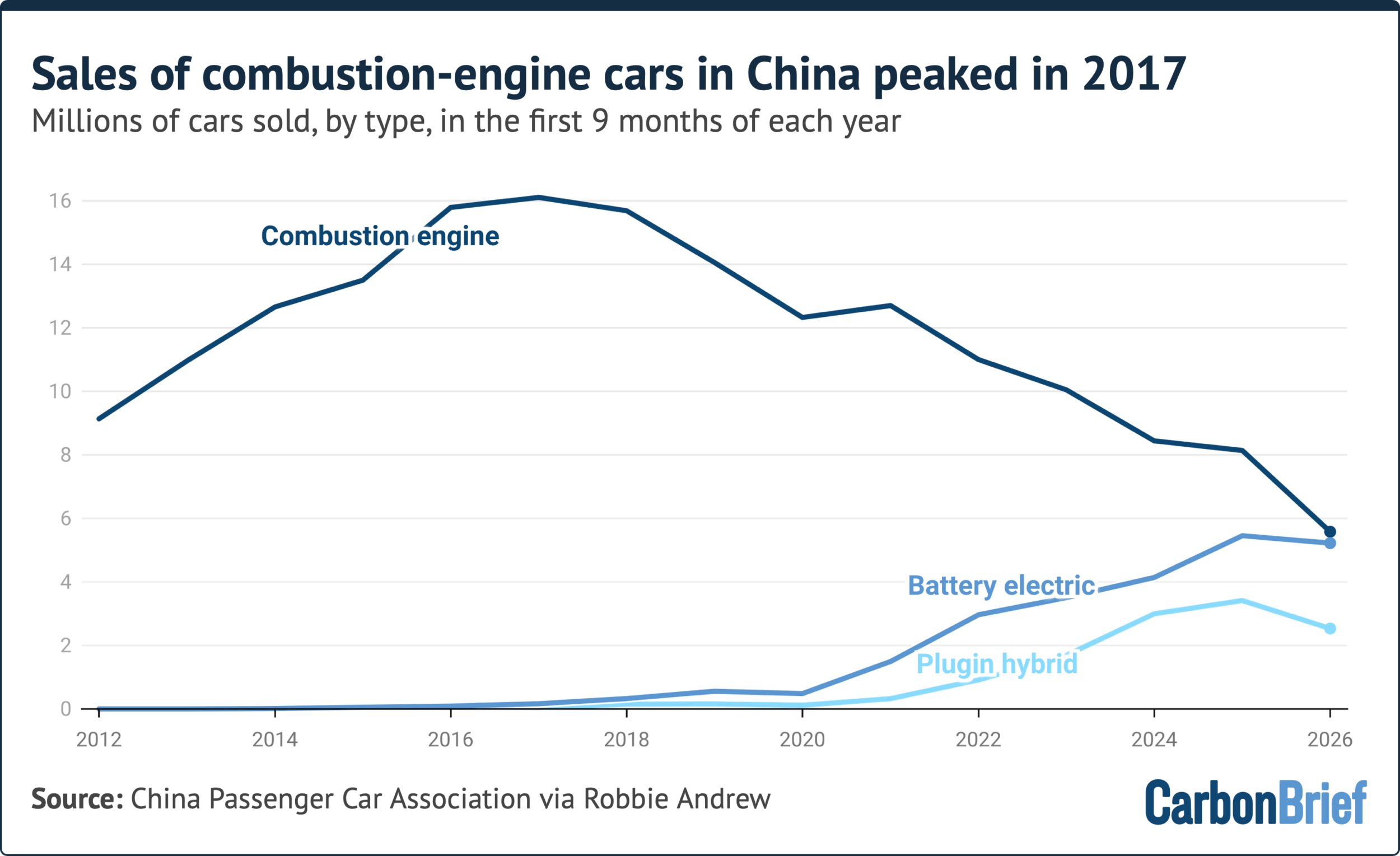
Indeed, sales of fuel-only cars were down 31% year-on-year in the first nine months of 2026, with plug-in hybrid sales down 26% – whereas battery EV sales were only down 4%.
One analyst tells Carbon Brief that China’s rapidly growing EV fleet has offset demand for 143m barrels of oil since the start of the Hormuz crisis.
Another says that the crisis is “reinforcing China’s electrification of road transport”.
Meanwhile, amid slowing domestic sales, Chinese carmakers’ exports of NEVs more than doubled [in 2026 to date / in September] from a year earlier.
NEV record
A record two out of every three cars sold in September in China were NEVs, according to CPCA data, as shown in the figure below.
(NEVs predominantly include battery electric vehicles – BEVs – and plug-in hybrids – PHEVs. BEVs only run on electricity, whereas PHEVs also have a combustion engine.)
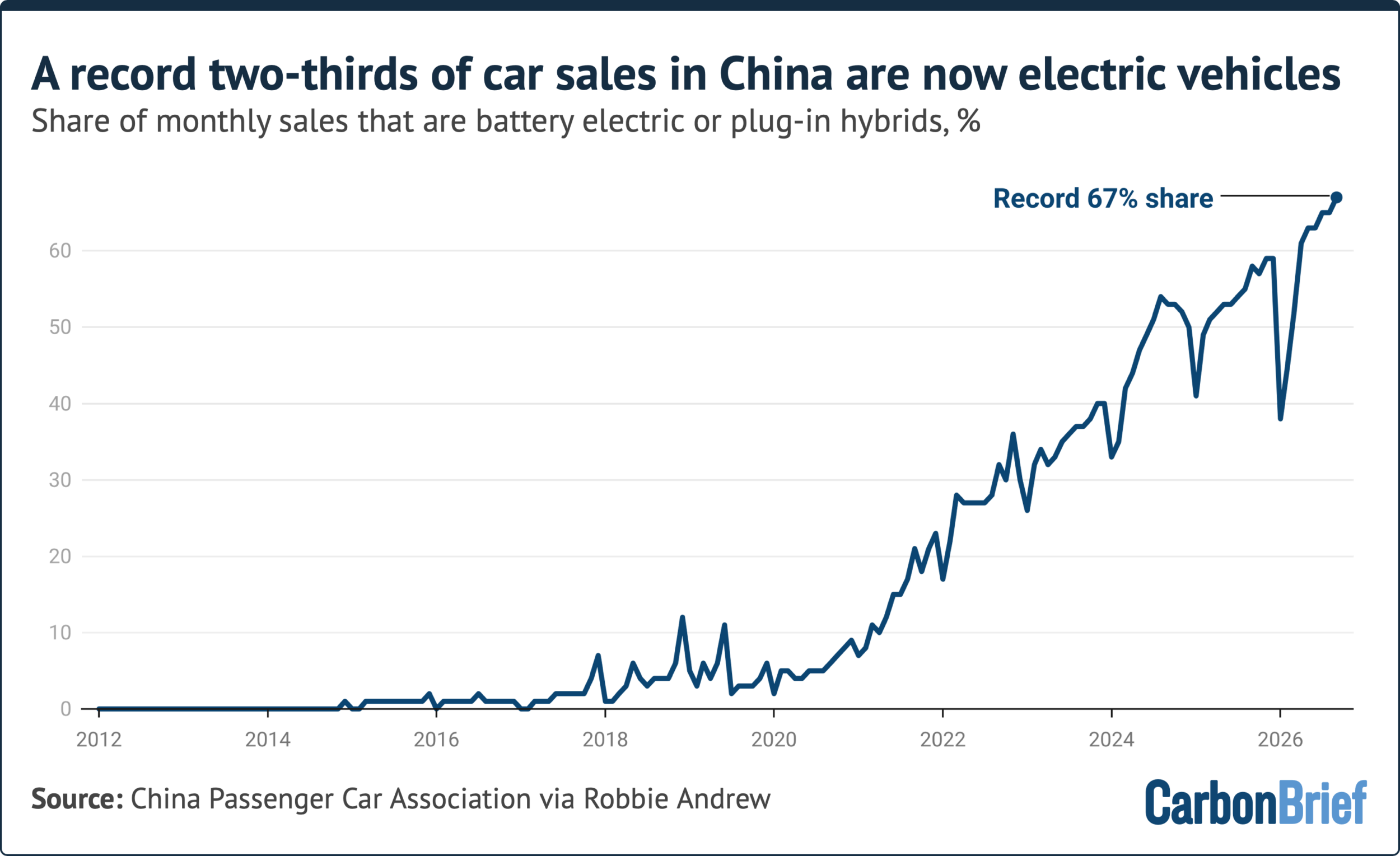
This marks a rapid rise for NEVs from just 6% of new car sales in 2020 up to 58% in 2026 to date – and a record 67% in the month of September.
This year, NEVs’ share of sales has also bounced back from a low of 39% in January, after the full purchase tax exemption that had been in place for more than a decade came to an end in December 2025.
The gain in NEV share in 2026 has come amid a slowdown across the wider domestic passenger-car market, which has hit sales of combustion-engine vehicles particularly hard.
This September, passenger-car retail sales across all categories declined, with overall sales volumes falling 28% year-on-year.
The contraction was led by combustion-engine vehicles, which saw sales fall 43% year-on-year in September and 31% in 2026 to date.
However, sales of PHEVs also fell by 36% year-on-year in September and by 26% in 2026 to date. By comparison, BEVs performed better, although sales still declined 8.5% from a year earlier in September and 4% in 2026 to date.
As a result, NEV sales overall fell by 17% in September and 13% in 2026 to date.
While the market changes in 2026 to date were particularly dramatic, they reflect a broad continuation of trends seen over the past decade.
Indeed, sales of combustion-engine cars in China peaked in 2017 and they have been declining ever since, shown in the figure below.
Impact of Hormuz
Part of the reason for the advance of NEVs in 2026, said Chinese technology news outlet OFweek, was petrol cars “giving up market share” as they were outperformed by electric alternatives.
Cui Dongshu, secretary-general of the CPCA, cited higher petrol prices as an explanation for September’s weak combustion-car sales, in comments to financial news outlet National Business Daily.
Imports of oil into China in January-September have fallen 15% compared to 2025, equivalent to 470m barrels, as ongoing conflict tightened supply and drove up prices.
China’s passenger-car NEV fleet has displaced 143m barrels of oil so far during the strait of Hormuz crisis, Euan Graham, senior energy analyst at thinktank Ember, tells Carbon Brief.
EVs “accounted for 12% of the decrease in China’s oil use post-Hormuz”, according to an estimate provided to thinktank the Brookings Institute by an unnamed analyst.
Erica Downs, a senior research scholar at Columbia University’s Center on Global Energy Policy, tells Carbon Brief that the strait of Hormuz crisis and higher oil prices are “reinforcing China’s electrification of road transport”.
She says the “world’s largest oil supply disruption” vindicates China’s early bet on EVs, which was partly driven by concerns about oil-supply security.
NEV demand down
Nevertheless, NEV sales have fallen year-on-year, albeit at a slower rate than overall car sales. The growth in NEV market share has also been decelerating.
Zhang Yichao, a partner at consulting firm AlixPartners, tells Carbon Brief that NEVs benefit from government trade-in policies and a “strong pipeline” of new models, particularly those involving innovation.
He says these factors help explain why NEVs sales have fallen at a slower rate to their combustion-car counterparts.
Cui told the state-run China National Radio that the fall for NEVs and for cars overall in September 2026, is also due to a high baseline of sales from the same month in 2025, as well as changes to trade-in policies and disruptions from the holiday period.
Other factors, says consulting firm Wood Mackenzie, are the weakened demand due to “demand pull-forward” in 2025 caused by the end of subsidies, as well as “tighter financing conditions”.
Zhang tells Carbon Brief he does not “see much more room ahead” for further growth in NEVs’ market share.
He adds that, in his view, their share in China is unlikely to exceed 80%, as some premium-market segments and specific use cases will continue to require combustion-engine vehicles.
Exports surge
Meanwhile, while domestic NEV retail sales fell 17% in September 2026, exports more than doubled, increasing 164% year-on-year, according to the CPCA.
This extends the decline in domestic sales and very strong growth in exports seen across 2026 to date, as shown in the figure below.