

The second Africa Climate Summit wrapped up in Ethiopia with a bold assertion of the continent’s ability to chart a path to green growth with homegrown resources, but climate campaigners expressed disappointment that leaders had not swung behind the COP28 pledge to transition away from fossil fuels.
While a copy of the final declaration from the three-day summit in Addis Ababa had yet to be released a day after it ended, Ethiopian President Taye Atske Selassie told the closing ceremony on Wednesday that the summit had re-positioned Africa “not as victims of a crisis it never created but as a global centre for climate solutions, renewable energy and green growth”.
Selassie said it is an injustice that 600 million Africans live without electricity access, adding that the continent is no longer waiting for charity but will use the abundant sun it has and the critical minerals beneath its soils to drive its own progress.
According to a statement from the summit organisers, the leaders’ declaration calls for “strengthened and sustained support” to scale up African-led climate initiatives such as the 8,000-km Great Green Wall across the Sahel and the African Forest Landscape Restoration Initiative.
It also noted that the Africa Climate Innovation Compact (ACIC) and the African Climate Facility (ACF) had been set up to to mobilise $50 billion annually in catalytic finance to deliver “1,000 solutions” for climate challenges in energy, agriculture, water, transport and resilience by 2030.
To meet Africa’s clean energy goals, investors urged to tolerate higher risk
Ethiopia’s Prime Minister Abiy Ahmed described the new compact as a “bold, continent-wide partnership uniting our universities, research institutions, startups, rural communities and innovators”.
The announcement came after African financial institutions on Monday backed a green industrialisation initiative for the continent with $100 billion from a range of development and commercial banks to support renewable energy projects and new green industry sectors.
-
Ethiopia’s preparedness puts it ahead of Nigeria in bid to host COP32, campaigners say
Ethiopia’s logistics, infrastructure and climate diplomacy make it seem better placed to host the 2027 UN climate talks than its West African rival – for now -
Digging beyond oil: Saudi Arabia bids to become a hub for energy transition minerals
The top crude exporter is using its oil riches to position itself as a major player in clean energy supply chains. Investors are interested, but hurdles remain -
China on course to peak fossil fuel power as soon as this year, reports say
The Asian nation’s energy transition is entering a new phase, with soaring renewables reducing demand for fossil fuels, analysis shows


Backing for “transitional energy sources” draws fire
Despite these major green growth programmes, civil society groups criticised the summit declaration for recognising “the role of transitional energy sources in ensuring a just transition that safeguards the energy security of developing countries”. On the other hand, it did not mention the COP28 promise to transition away from fossil fuels in energy systems.

Activists said the wording leaves room for the use of fossil gas in Africa’s transition to a low-carbon, climate-resilient economy.
“Fossil gas is a false solution that cannot drive development agenda across the African continent,” said Dean Bhebhe, a senior advisor at think-tank Power Shift Africa. A path grounded in gas is not “just” because Africa “risks further trapping itself into a cycle of debt, wants, needs and fears in the African continent”, he added.
The Nairobi declaration from the first Africa Climate Summit in 2023 recognised the need to phase down unabated coal power and phase out inefficient fossil fuel subsidies, but it is “disappointing” to see that those were not featured in the Addis decision while messaging on transitional fuel was sneaked in, Bhebhe added.
Ethiopia’s preparedness puts it ahead of Nigeria in bid to host COP32, campaigners say
Nafi Quarshie, Africa director at the Natural Resource Governance Institute (NRGI), said that despite the sufferings of oil and gas communities in parts of Africa and the realities of the transition, including pressure on local economies and livelihoods, “the declaration made no reference to these impacts”.
“African governments must now use COP30 to ensure that they move toward a just, orderly and equitable transition that responds to the needs of the communities behind every oil field,” she added.
International finance sought
In addition to the climate finance announced by African funders, the international community still has an obligation to provide support, said Richard Muyungi, chair of the African Group of Negotiators (AGN) at the UN climate talks.
The climate negotiator added that Africa’s demand “is not charity but our just rights under the [UN Climate] Convention and the Paris Agreement: adequate, accessible, and grant-based finance, alongside technology transfer and debt relief”.
Few pledges were made at the summit by donors, apart from Denmark announcing $79 million for supporting agricultural transformation and Italy reaffirming a commitment of $4.2 billion to the Italian Climate Fund, of which around 70% will be allocated to Africa.
Ahead of November’s COP30 climate summit, the Addis declaration highlighted an urgent need for new, innovative climate finance mechanisms adapted to Africa’s sustainable development priorities, including blended finance mechanisms, debt-for-climate project swaps and strategic public-private partnerships.
Digging beyond oil: Saudi Arabia bids to become a hub for energy transition minerals
Carlos Lopes, special envoy of the Brazilian COP30 presidency to Africa, said Africa had shown commitment by coming up with initiatives and also strengthening its continental institutions, “but true progress requires developed countries to lead with predictable, accessible, and just climate finance”.
African leaders asked for international support to implement Africa’s key energy access and transition initiatives including Mission 300 to provide 300 million people with electricity by 2030, clean cooking programmes and efforts to scale up renewables to meet a goal of 300 gigawatts of capacity by 2030.
“Climate finance is the critical enabler: without it, our people cannot thrive and our economies cannot grow,” said Dion George, South Africa’s minister of forestry, fisheries and the environment and head of the country delegation at the Addis summit. “With it, Africa can drive a just transition, create jobs, and play a central role in the global effort to address the climate crisis.”
The post Addis summit trumpets African climate solutions, while quietly backing gas appeared first on Climate Home News.
Addis summit trumpets African climate solutions, while quietly backing gas

Continue Reading
Three countries have been named by the Paris Agreement’s compliance committee for failing to submit a nationally determined contribution (NDC) and repeatedly snubbing offers of help with their climate plans.
After months of internal debate over whether to identify serial non-responders, the Paris Agreement’s Implementation and Compliance Committee (PAICC) named the three countries which have failed to engage with it over their NDCs on Friday.
It named Democratic Republic of Congo, Senegal and North Korea in a footnote of its annual report, adding that it decided to name them “with a view to facilitating engagement”, adding that representatives of the three nations had been invited to its meeting in early 2027 “with the purpose of identifying any challenges and constraints”.
“The Committee noted the importance of Parties engaging with the Committee in a timely manner, while noting that some delays may be due to the national capabilities and circumstances of the Parties”, the report said.
-
Under US pressure, World Bank says it will back gas “where appropriate”
The US wants the World Bank to expand its gas support while climate campaigners are pushing for it to end – its head spoke this week of limited backing for the fossil fuel -
IPCC scientists vow to press on with climate reports despite political deadlock
After governments again failed to agree a timeline, nearly 120 IPCC authors pledged to complete their assessment on time and with full scientific rigour -
Paris Agreement committee snubbed over missing NDC climate plans
Many governments have still not submitted a nationally determined contribution to the UN, breaching a key requirement of the Paris Agreement

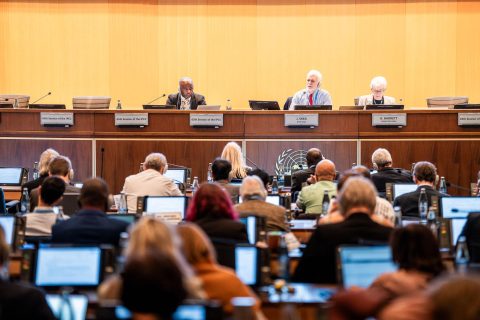

In July, PAICC said 12 countries had ignored its repeated attempts to discuss why they had not published an NDC as required every five years under the 2015 Paris accord.
Members of the committee had been divided over whether to name them, but at a September meeting decided to do so in their annual report to the annual climate COP summit.
By the time the report was published on Friday, only Congo, Senegal and North Korea “had not communicated an NDC or submitted a [Biennial Transparency Report] and had not yet responded to any of the Committee’s notifications, despite several reminders issued by the Committee in this regard”.
Rainforest and renewable energy ambitions
The silence from Congo and Senegal is notable because the former is home to much of the Congo Basin rainforest while the latter has sought billions of dollars in climate finance to support its renewable energy ambitions.
After Brazil, Congo has more rainforest than any country in the world. This forest, and the country’s peatlands, absorb huge amounts of greenhouse gas but are fast being lost to expanding farmland, charcoal production, logging and mining.
Senegal signed a Just Energy Transition Partnership with Canada and wealthy European nations in 2023, to help it meet its renewable energy targets under the-then government of Macky Sall. It was chair of the Least Developed Countries group between January 2022 and December 2023.

Tejas Rao, who is researching the PAICC as part of a doctoral thesis at Cambridge University, said the governments of the three countries should engage with the committee.
“Engagement costs these governments very little and the committee has shown it will listen,” he said.
“Silence leaves the committee with no basis to help, and it leaves the [governments] exposed to the narrative that they are simply disengaged,” he told Climate Home News.
Paris Agreement requirement
The 2015 Paris Agreement requires all parties to publish an NDC every five years outlining their emissions reduction targets, with each plan meant to be more ambitious than the country’s last NDC.
The latest set – the third round of plans, with new targets for 2035 – was due in February 2025. While most countries missed this deadline, all but around 30 – mostly small emitters but including Egypt, Vietnam and Argentina – have now submitted them.
Over the year, the PAICC – which is made up of government climate officials from developed and developing countries – has been communicating with governments that have not submitted NDCs and trying to overcome barriers to them doing so.
Some nations have cited exceptional circumstances as the reason for not submitting an NDC, a process that requires a significant amount of work in tracking emissions and consulting on how to curb them across the economy. For example, a letter from a Sudanese official to the PAICC, seen by Climate Home News, said that the country’s civil war had led to the suspension of its NDC preparation.
-
IPCC scientists vow to press on with climate reports despite political deadlock
After governments again failed to agree a timeline, nearly 120 IPCC authors pledged to complete their assessment on time and with full scientific rigour -
Under US pressure, World Bank says it will back gas “where appropriate”
The US wants the World Bank to expand its gas support while climate campaigners are pushing for it to end – its head spoke this week of limited backing for the fossil fuel -
Who shapes climate science? The equity question facing the IPCC
Early completion of the next global climate science assessment reports risks excluding research from the Global South, which is key to ensuring the findings are fair
The US and Iran are not signed up to the Paris Agreement and so do not have active NDCs, nor does Taiwan, which is not a UN member state.
Rao said that because the PAICC is “facilitative and non-punitive”, naming the countries “is meant to open a door, not close one – the invited consultation is the point”.
“In recent months, governments that explained their constraints, whether capacity, finance or domestic process, have been met with follow-up and support rather than sanction, and the number of silent governments has fallen sharply,” Rao said.
The post Paris Agreement committee names three countries snubbing it over NDCs appeared first on Climate Home News.
Paris Agreement committee names three countries snubbing it over NDCs