Connect with us

Published

on

The year 2025 was in the top-three warmest years on record, with average surface temperatures reaching around 1.44C above pre-industrial levels across eight independent datasets.

The different temperature records confirm that last year was either the second or third warmest since observations began in the mid-1800s, with razor-thin margins between 2025 and 2023.

Last year also set a new record for ocean heat content, with the oceans absorbing more than 90% of the heat trapped by increasing greenhouse gas concentrations in the atmosphere.

Here, Carbon Brief examines the latest data across the Earth’s oceans, atmosphere, cryosphere and surface temperature. (Use the links below to navigate between sections.)

Noteworthy findings from this 2025 review include…

  • Ocean heat content: It was the warmest year on record for ocean heat content and one of the largest year-over-year increases in ocean heat content. In 2025, the oceans added 35 times more heat than all annual human energy use.
  • Global surface temperatures: The year 2025 is effectively tied with 2023 as the second-warmest year on record – coming in at between 1.33C and 1.53C above pre-industrial levels across different temperature datasets and 1.44C in the synthesis of all groups.
  • Second warmest over land: Global temperatures over the world’s land regions – where humans live and primarily experience climate impacts – were 2C above pre-industrial levels, just below the record set in 2024.
  • Third warmest over oceans: Global sea surface temperatures were 1C above pre-industrial levels, dropping from 2024 record levels due to fading El Niño conditions.
  • Regional warming: It was the warmest year on record in areas where, collectively, more than 9% of the global population lives.
  • Unusual warmth: The exceptionally warm, record-setting temperatures over the past three years (2023-25) were driven by continued increases in human emissions of greenhouse gases, reductions in planet-cooling sulphur dioxide aerosols, variability related to a strong El Niño event and a strong peak in the 11-year solar cycle.
  • Comparison with climate models: Observations for 2025 were nearly identical to the central estimate of climate model projections in the Intergovernmental Panel on Climate Change (IPCC) sixth assessment report (AR6).
  • Heating of the atmosphere: It was the second warmest year in the lower troposphere – the lowest part of the atmosphere.
  • Sea level rise: Sea levels reached record highs, continuing a notable acceleration over the past three decades.
  • Shrinking glaciers and ice sheets: Cumulative ice loss from the world’s glaciers and from the Greenland ice sheet reached a new record high in 2025, contributing to sea level rise.
  • Greenhouse gases: Concentrations reached record levels for carbon dioxide (CO2), methane and nitrous oxide.
  • Sea ice extent: Arctic sea ice saw its lowest winter peak on record as well as its 10th-lowest summer minimum extent, while Antarctic sea ice saw its third-lowest minimum extent.
  • Looking ahead to 2026: Carbon Brief predicts that global average surface temperatures in 2026 are likely to be between the second and fourth warmest on record, similar to 2023 and 2025, at around 1.4C above pre-industrial levels.

Ocean heat content sets a new record

The year 2025 was the warmest on record for the heat content of the world’s oceans.

Ocean heat content (OHC) increased by around 500 zettajoules – billion trillion joules – since the 1940s.

The heat increase in 2025 alone compared to 2024 – about 23 zettajoules – is around 39 times as much as the total energy produced by all human activities on Earth in 2023 (the latest year in which global primary energy statistics are available). It was also the largest increase in ocean heat content since 2017 (following the strong El Niño event of 2016).

Human-emitted greenhouse gases trap extra heat in the atmosphere. While some of this warms the Earth’s surface, the vast majority – around of 93% – goes into the oceans. About two-thirds of this accumulates in the top 700 metres, but some also ends up in the deep oceans.

The figure below shows annual OHC estimates from the Chinese Institute for Atmospheric Physics (IAP) between 1950 and present for the upper 700 metres (light blue shading) and 700-2,000 metres (dark blue) of the ocean.

Chart showing global ocean heat content 1950-2025
Annual global ocean heat content (in zettajoules – billion trillion joules, or 10^21 joules) for the 0-700 metre and 700-2,000 metre layers. Data updated from Cheng et al. (2024). Chart by Carbon Brief.

In a new paper published last week, researchers found that the rate of OHC increase over the past 15 years is unprecedented over the observational record in the IAP dataset. More broadly, there has been a distinct acceleration in OHC after 1991 – and recent OHC growth rates are generally consistent with satellite measurements of Earth energy imbalance (EEI).

(Energy imbalance is a measure of how much surplus heat there is in the Earth’s climate system. It is the difference between how much energy enters Earth’s atmosphere from the sun and how excess heat is radiated back into space as the world warms.)

In many ways, OHC represents a much better measure of climate change than global average surface temperatures, because it is where most of the extra heat ends up and is much less variable on a year-to-year basis than surface temperatures.

Surface temperatures tied at second warmest

To assess global surface temperatures in 2025, Carbon Brief uses eight independent datasets: NASA, NOAA, the Met Office Hadley Centre/University of East Anglia’s (UEA) HadCRUT5, Berkeley Earth, Copernicus ERA5, Japan’s JRA-3Q, DCENT and China-MST.

The analysis reveals that global surface temperatures were between the second and third warmest since records began in the mid-1800s. Temperatures effectively tied with 2023 within the margin of uncertainty, below the record set last year in 2024.

The figure below shows global surface temperature records from the eight datasets.

Chart showing global surface temperature records, 1850-2025
Annual global average surface temperatures over 1850-2025. Data from NASA GISTEMP, NOAA GlobalTemp, Hadley/UEA HadCRUT5, Berkeley Earth, Copernicus ERA5, JRA-3Q, DCENT, and China-MST. Temperature records are aligned over the 1981-2010 period and use the WMO approach to calculate warming relative to the pre-industrial (1850-1900) baseline. Chart by Carbon Brief.

Global surface temperature records can be calculated back to 1850, though some groups such as NASA GISTEMP choose to start their records in 1880 when more data was available.

Prior to 1850, records exist for some specific regions, but are not sufficiently widespread to calculate global temperatures with high accuracy (though newly published research has attempted to extend this back to 1781).

These longer surface temperature records are created by combining ship- and buoy-based measurements of ocean sea surface temperatures with temperature readings of the surface air temperature from weather stations on land. (Copernicus ERA5 and JRA-3Q are an exception, as they use weather model-based reanalysis to combine lots of different data sources over time.)

Some differences between temperature records are apparent early in the record, particularly prior to 1900 when observations are more sparse and results are more sensitive to how different groups fill in the gaps between observations. However, there is strong agreement between the different temperature records for the period since 1970, as shown in the figure below.
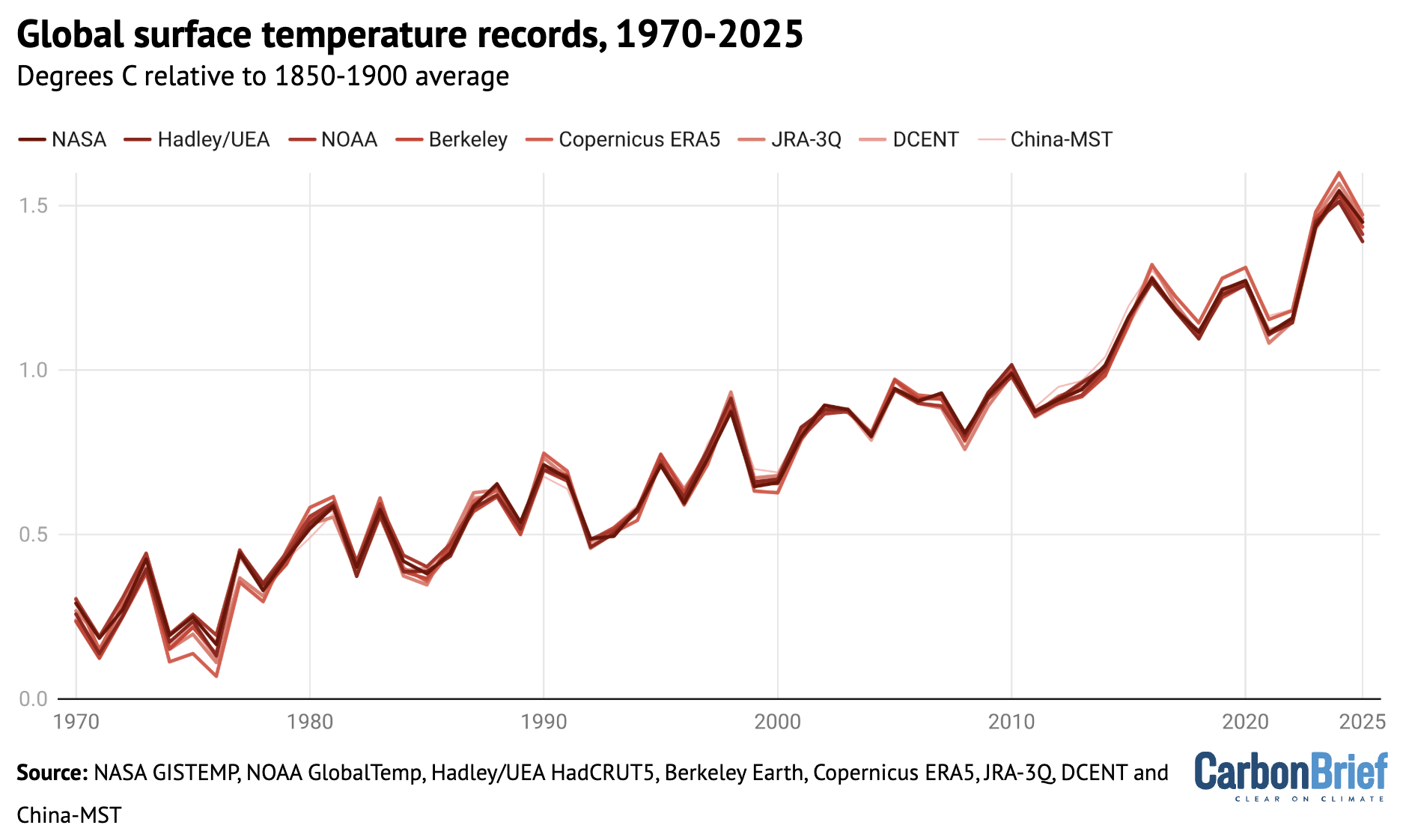
Chart showing global surface temperature records, 1970-2025
Annual global average surface temperatures as in the prior chart, but showing the period from 1970-2025. Chart by Carbon Brief.

Global temperatures over the past three years clearly stand out as much warmer than anything that has come before, well above the prior record set in 2016. More broadly, the 11 warmest years on record all happened in the past 11 years.

Two of the eight datasets analysed by Carbon Brief – NASA and DCENT – had 2025 as the second-warmest year behind 2024, while six of the datasets had 2025 as the third-warmest year behind both 2023 and 2024.

However, in nearly all cases the difference between 2023 and 2025 falls within each dataset’s published uncertainty range, making it effectively a tie between the two years.

The table below shows the reported 2025 global temperature anomalies (relative to each group’s 1850-1900 pre-industrial baseline), as well as a 2025 value using a common pre-industrial baseline between the 1850-1900 and 1981-2010 periods across the five groups with data back to 1850 (NOAA, Hadley/UAE, Berkeley Earth, DCENT and China-MST).

Dataset 2025 Reported 2025 With common baseline Ranking
NASA GISTEMP 1.39 1.45 Second
Hadley/UAE HadCRUT5 1.41 1.39 Third
NOAA GlobalTemp 1.33 1.41 Third
Berkeley Earth 1.44 1.44 Third
Copernicus ERA5 1.47 1.47 Third
JRA-3Q 1.46 1.46 Third
DCENT 1.53 1.44 Second
China-MST 1.39 1.42 Third

Reported temperature anomalies range from as low as 1.33C (NOAA) to as high as 1.53C (DCENT), primarily reflecting differences in the early part of the record. The 2025 values with a common baseline have a much smaller range, from 1.41C (NOAA) to 1.47C (Copernicus).

Separate land and ocean temperatures are not available yet from all of these groups. However, Berkeley Earth reports that global land temperatures in 2025 were the second warmest on record, at 2.03C above pre-industrial levels, while ocean temperatures were the third warmest at 1.03C.
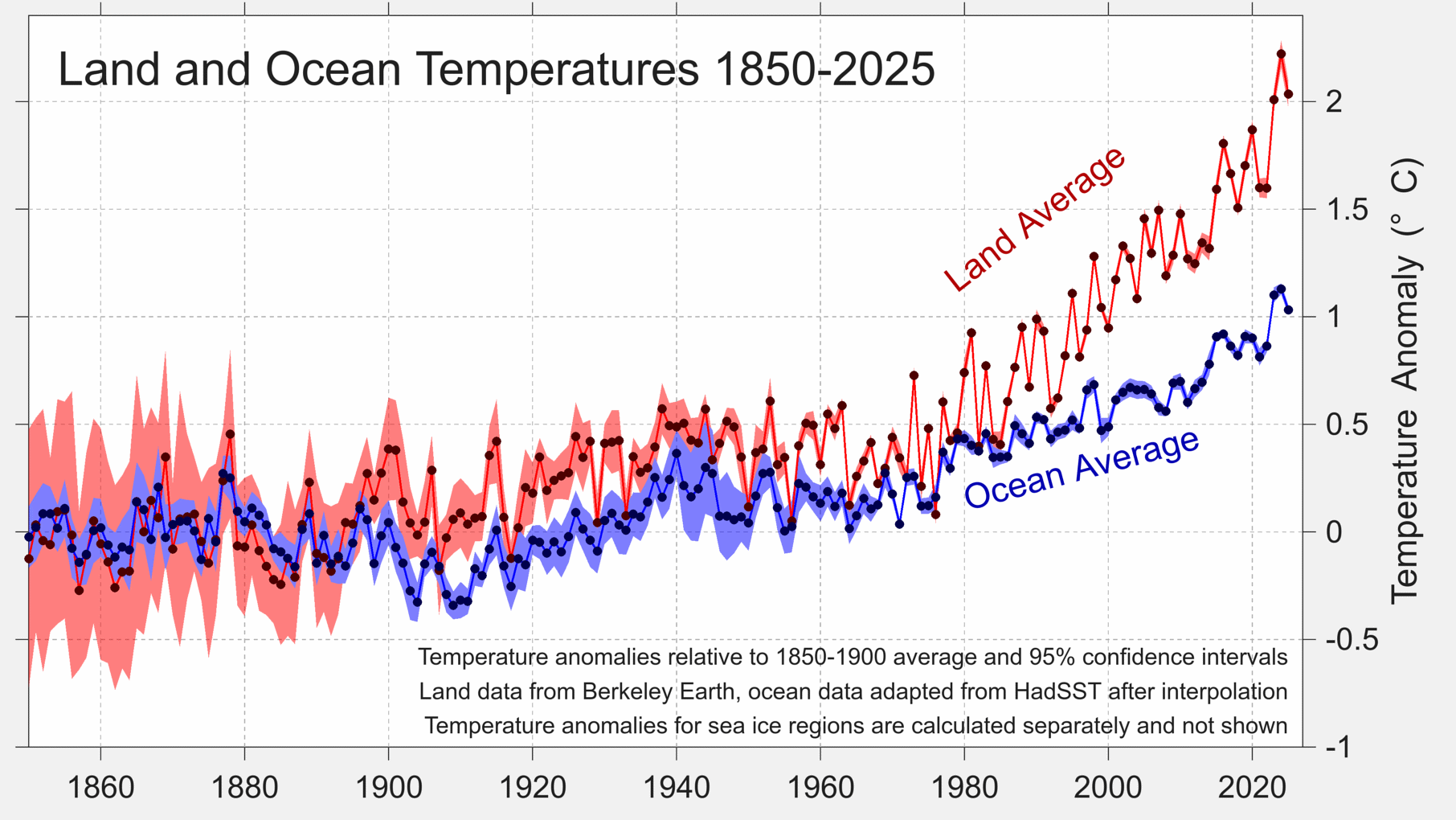
Land and ocean temperature rise since the pre-industrial 1850-1900 period. Figure from Berkeley Earth.

Global land regions – where the global human population lives – has generally been warming around 70% faster than the oceans and 40% faster than the global average since 1970.

The year started off quite hot, with January 2025 setting a new record as the warmest January. All other months of the year ended up being either the second or third warmest on record after 2024 and 2023.

The figure below shows each month of 2025 in dark red, compared to all prior years since 1850. Each year is coloured based on the decade in which it occurred, with the clear warming over time visible, as well as the margin by which both 2023, 2024 and 2025 exceeded past years.
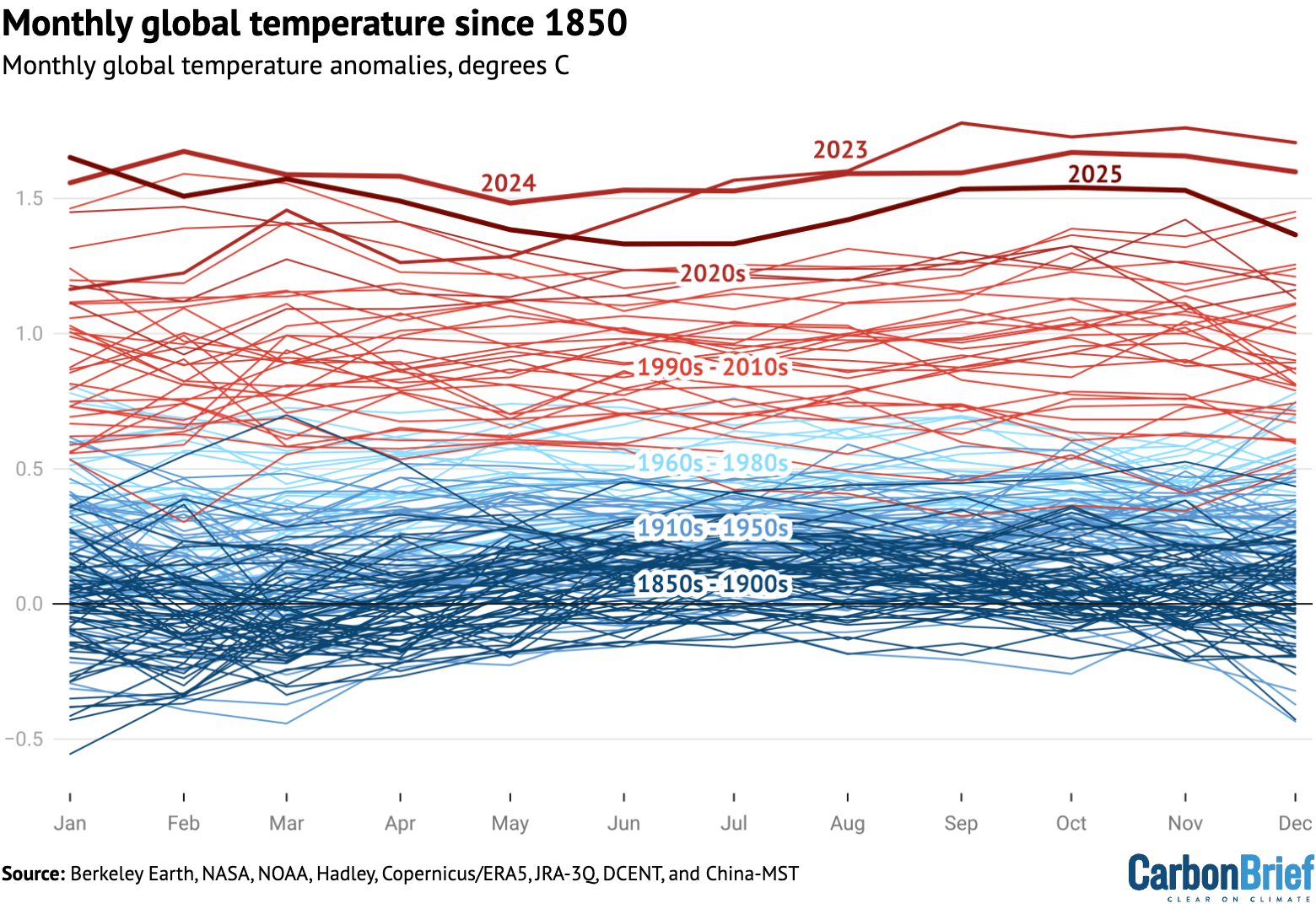
Chart showing monthly global temperature since 1850
Monthly global surface temperatures for each year since 1850, using the average of the eight different temperature datasets assessed by Carbon Brief. Anomalies are shown relative to the pre-industrial 1850-1900 period.

Extreme regional temperatures

While the globe as a whole was tied as the second warmest on record, many different regions of the planet set new records in 2025.

The figure below shows how global temperature deviated from the average in 2025 across the world. Areas shaded in red were warmer than the baseline period (1951-80) used by Berkeley Earth, whereas the few blue areas experienced cooler temperatures.
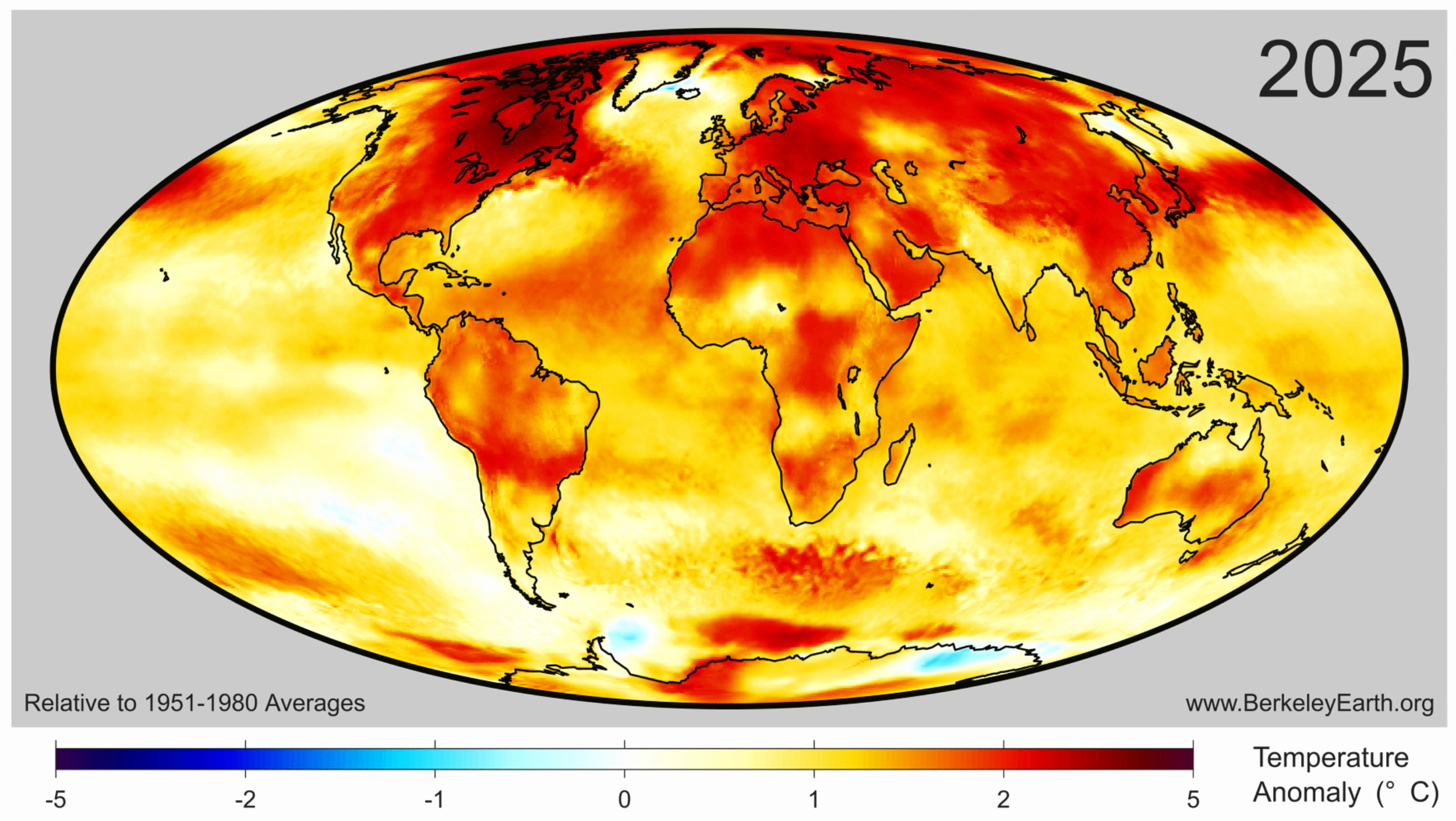
Surface temperature anomalies for 2025 from Berkeley Earth. Note that Berkeley uses a 1951-80 baseline here to show anomalies.

Collectively, approximately 770 million people – 9.3% of Earth’s population – live in places that experienced their warmest year on record in 2025. This was mostly concentrated in Asia, including around 450 million people in China.

The figure below highlights regions of the planet that experienced their top-five warmest (red shading) or coldest (blue) temperatures on record in 2025. Overall, around 9% of the planet set a new record, including 11% of the land and 8% of the ocean. No location on the planet experienced record cold temperatures – or even top-five record cold temperatures – for the year as a whole.
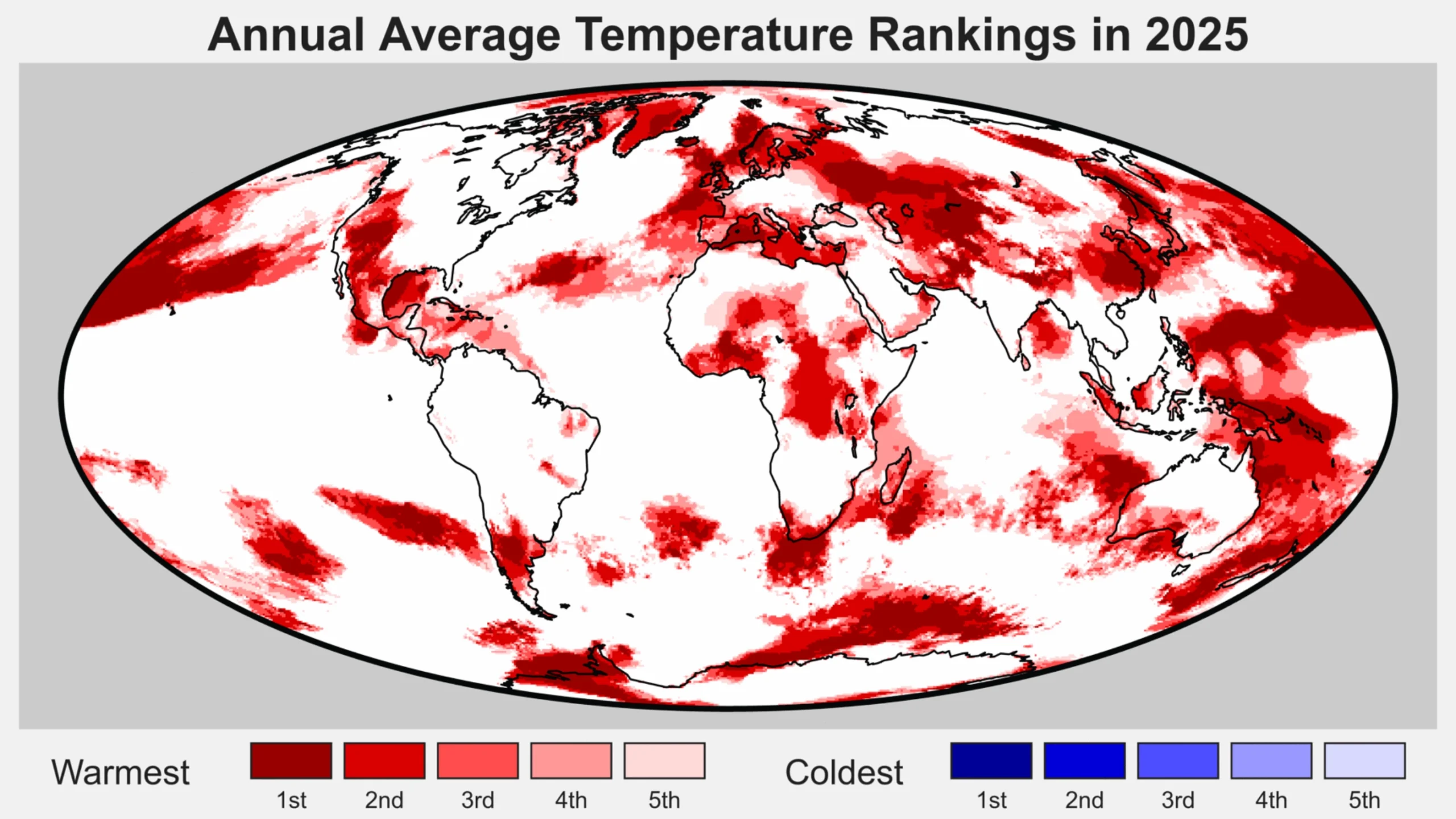
Regions of the world among the five warmest (reds) of five coolest (blues) on record for average annual temperatures in 2025. Figure from Berkeley Earth.

Drivers of recent record warmth

Global temperatures over the past three years have been unusually warm, well above what would be expected given the long-term warming trend of around 0.2C per decade since the 1970s.

Recent research has found that global warming has accelerated in recent years to around 0.27C per decade, though this acceleration is largely in-line with climate model projections under scenarios where greenhouse gas emissions continue to rise while emissions of planet cooling aerosols are reduced.

According to analysis from Berkeley Earth, the odds of global temperatures over 2023-25 occurring as a result of greenhouse gas emissions and natural variations in the Earth’s climate alone “is less than one-in-100” and “likely indicates that recent years have been impacted by additional warming factor(s)”.

The figure below shows how the exceptional warming spike of 2023-25 compares to the longer-term warming trend and historical climate variability.
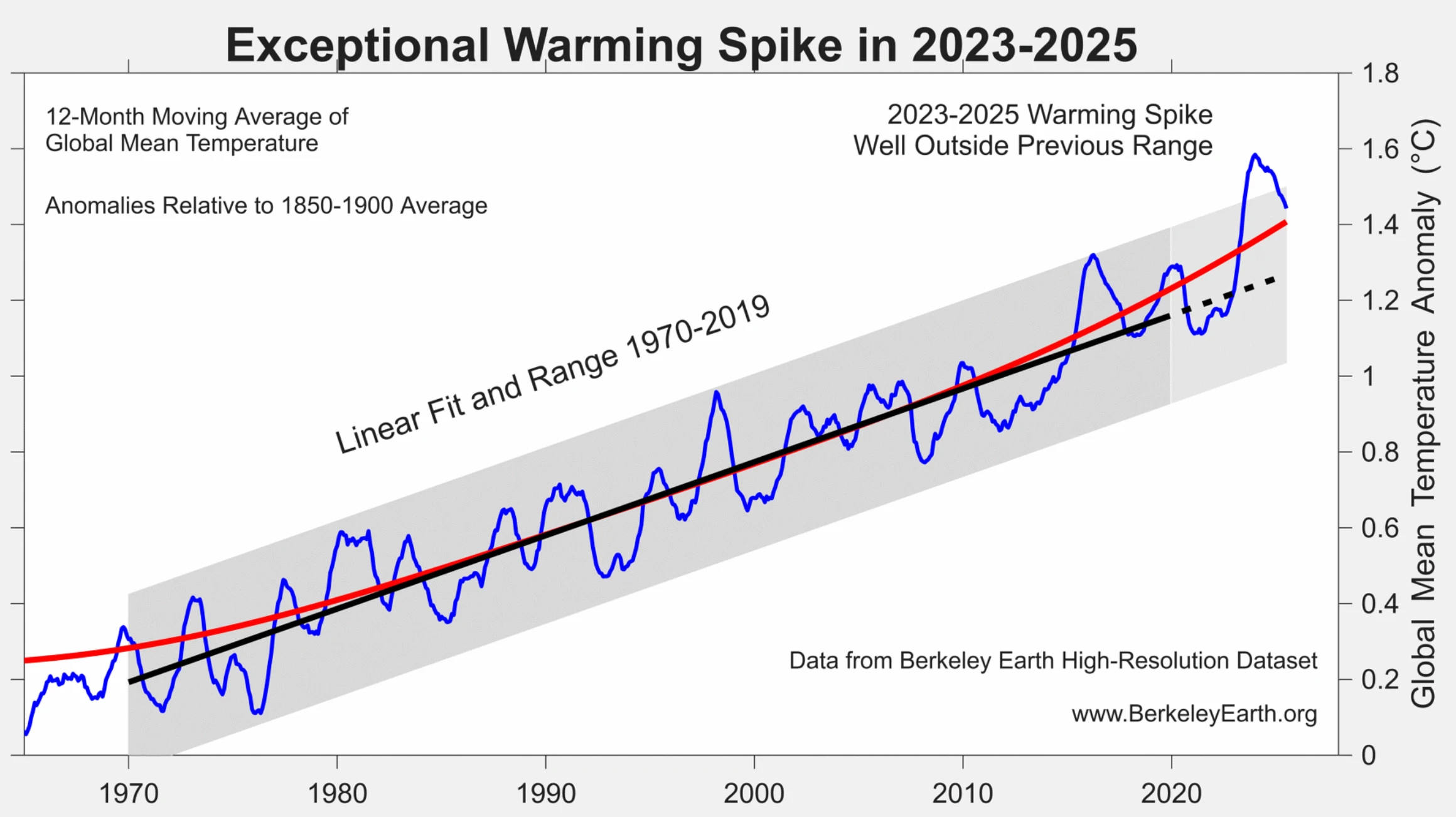
Global surface temperatures between 1965 and 2025 (blue) along with the linear trend (black) and range (grey) from 1970-2019. The red line shows a locally linear regression that captures recent acceleration. Figure from Berkeley Earth.

Carbon Brief recently explored the drivers of recent warmth in more detail, finding that it is likely to have been driven by a combination of:

This is illustrated in the figure below, which provides an estimate of the impact of each of these different factors on 2023 and 2024 temperatures, along with their respective uncertainties.

The sum of all the factors is shown in the “combined” bar, while the actual warming compared to expectations is shown in red. The upper chart shows 2023, while the lower one shows 2024.
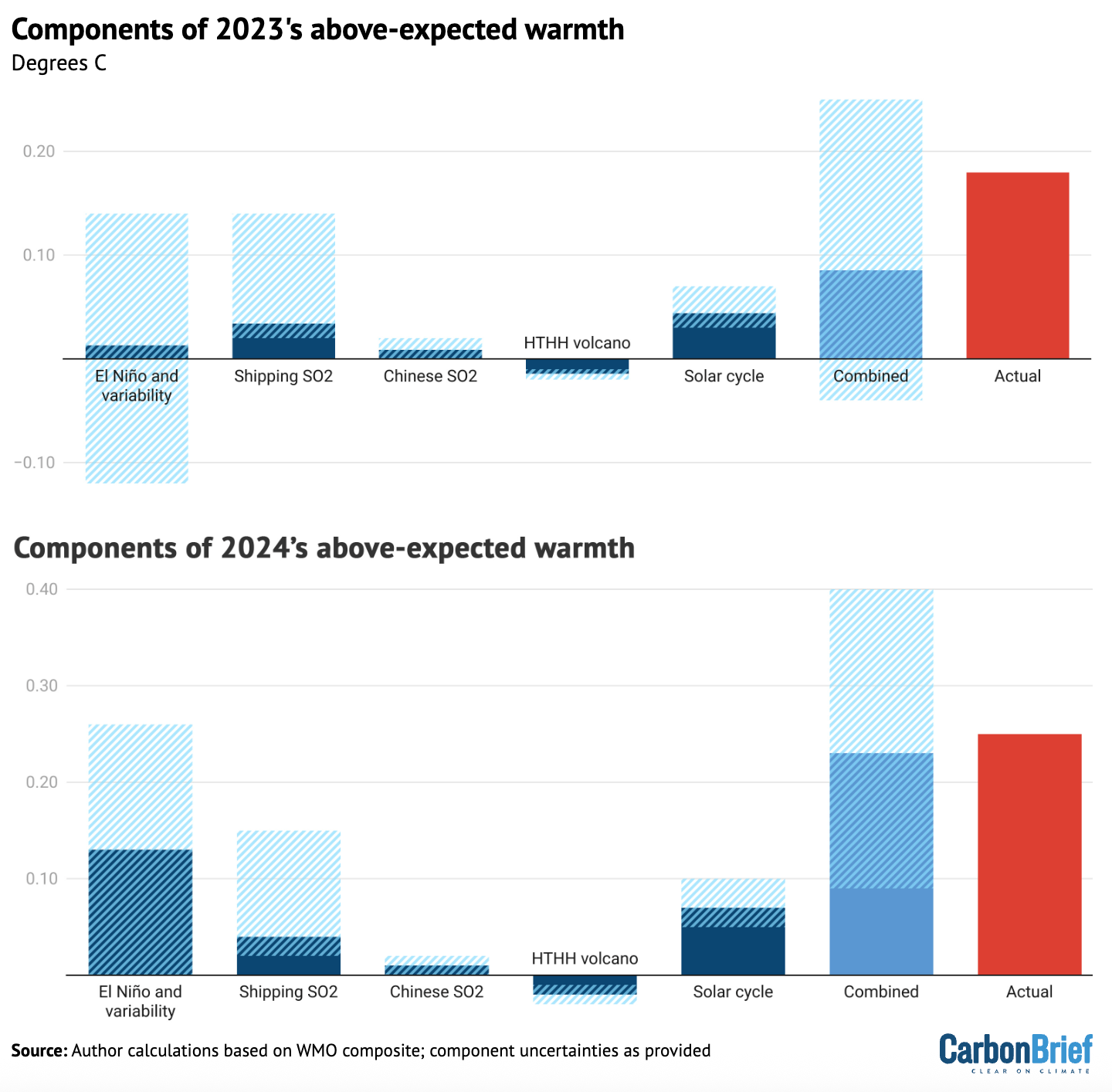
Chart showing components of 2023's above-expected warmth
Attribution of 2023 and 2024 unusual warmth. Light blue bars show individual factors and their uncertainties, the dark blue bar shows the combined effects and combination of uncertainties and the red bar shows the actual warming compared with expectations. HTHH refers to the Hunga Tonga-Hunga Ha’apai volcano. Adapted from Figure 12 in WMO’s state of the global climate 2024 report.

The first bar includes both El Niño and natural year-to-year climate variability; the height of the bar reflects the best estimate of El Niño’s effects, while the uncertainty range encompasses year-to-year variability in global temperatures that may be – at least in part – unrelated to El Niño.

While a similar analysis has yet to be undertaken for 2025, the end of El Nino conditions and the development of a modest La Nina would have driven temperatures down, while the warming impact of shipping, Chinese aerosol declines would have slightly increased. The warming effect of the solar cycle would likely have remained flat or slightly declined as solar cycle 25 passed its peak.

Finally, a World Meteorological Organization (WMO) assessment of the Hunga Tonga-Hunga Ha’apai volcano found that “the record-high global surface temperatures in 2023-24 were not due to the Hunga eruption”.

The report suggested that the volcano had a small cooling effect (-0.03C) globally in 2023 and 2024. This might switch to a small warming effect (+0.03C) in 2025 and 2026 as the planet-cooling aerosols from the volcano fall back down to the surface but some of the stratospheric water vapour remains, it noted.

However, it added, these effects are “indistinguishable from background variability in the current climate”.

El Niño and La Niña are generally the largest drivers of year-to-year variability in global temperatures. The figure below shows the El Niño (red shading) and La Niña (blue) conditions over the past 40 years (collectively referred to as the El Niño-Southern Oscillation, or “ENSO”).
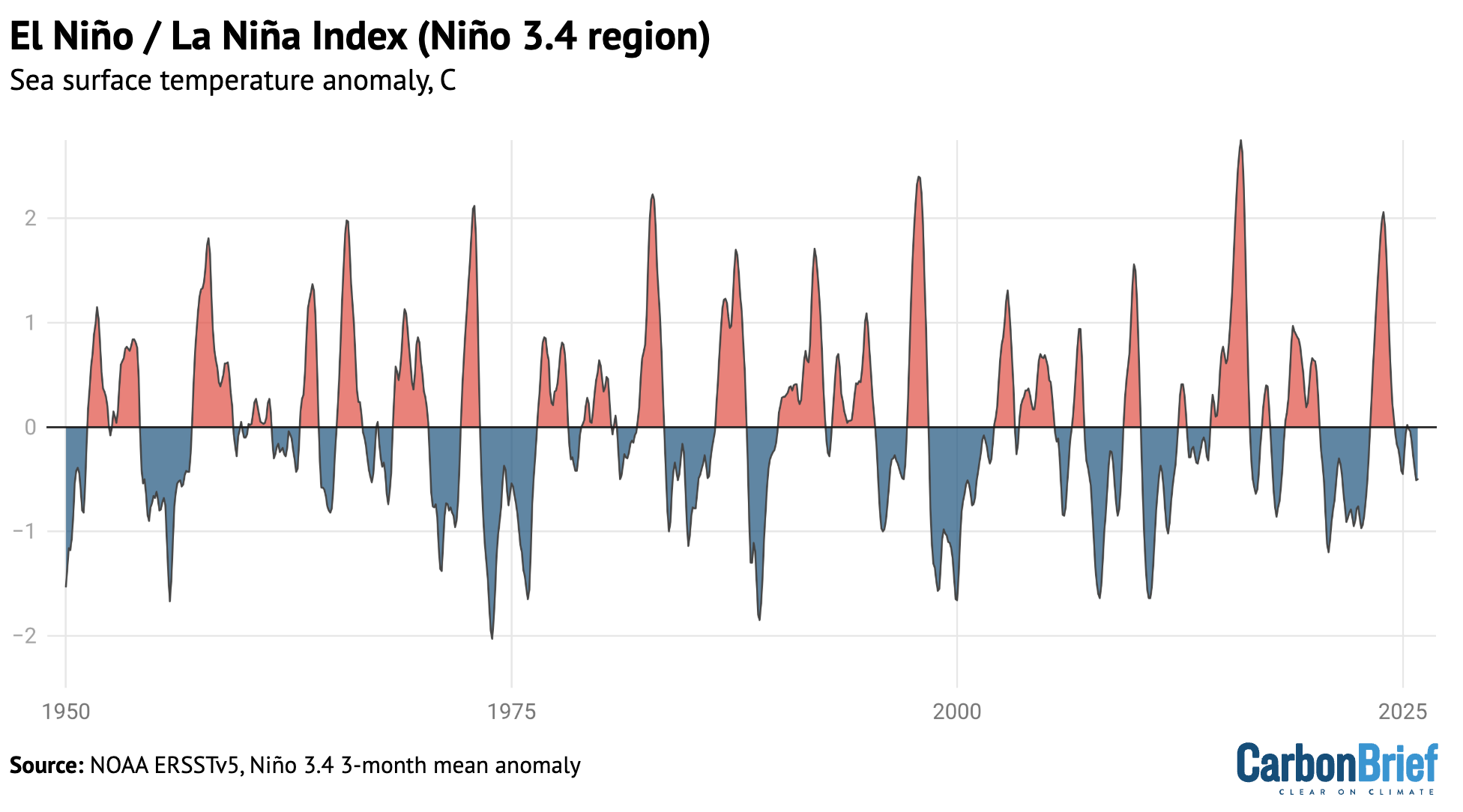
Chart showing El Nino / La Nina index (nino 3.4 region)
NOAA’s Niño 3.4 region Oceanic Niño Index using detrended data from ERSSTv5.

Carbon Brief has used the historical relationship between ENSO conditions and temperature to effectively remove the effects of El Niño and La Niña events from global temperatures, as shown in the figure below.

This analysis indicates that El Niño cooled global temperatures in 2025 around -0.05C, following a boost to global temperatures of around 0.12C in 2024, compared to the estimate of global temperatures with both El Niño and La Niña events removed.
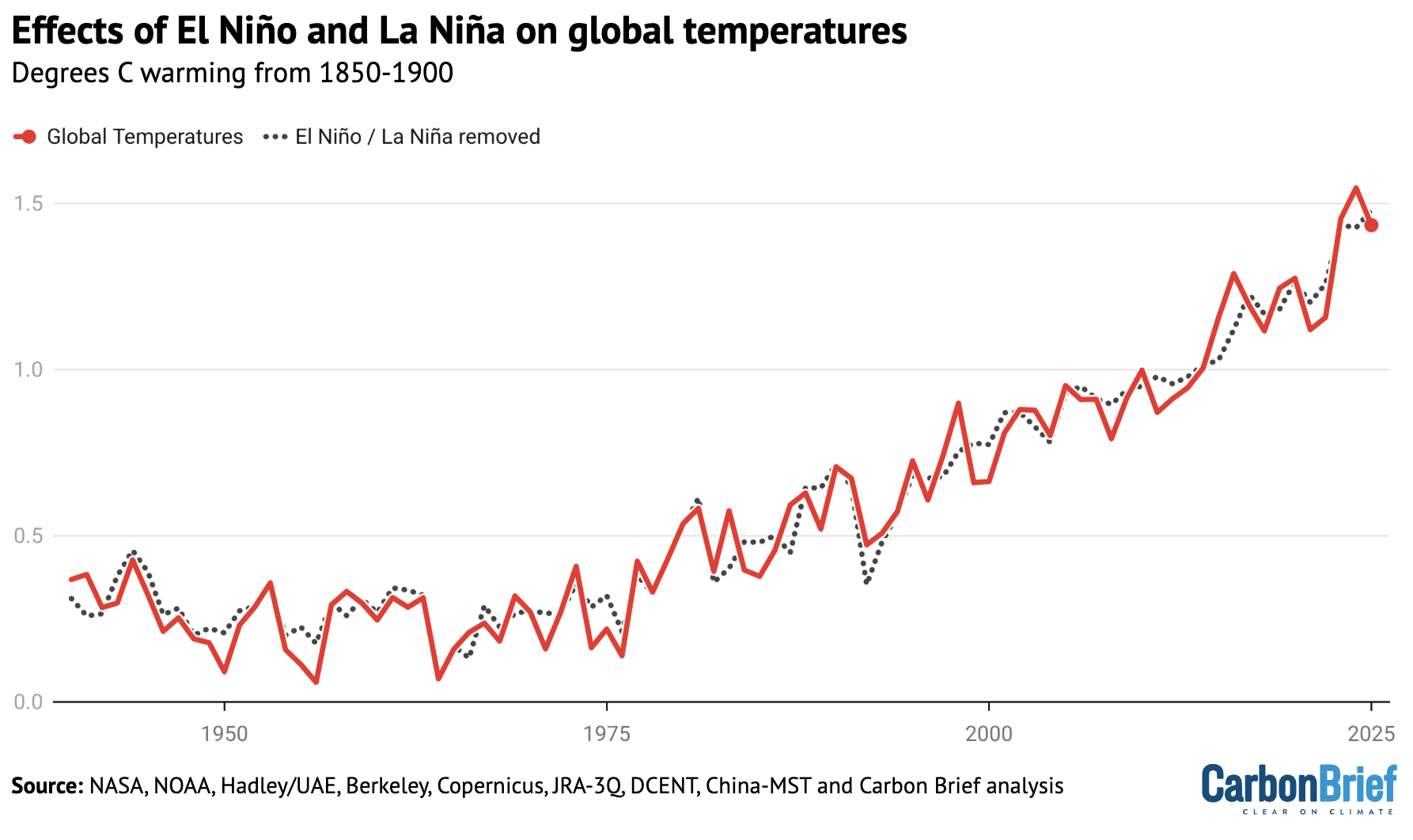
Chart showing effects of El Niño and La Niña on global temperatures
Annual global average surface temperatures from the average of the eight datasets, as well as Carbon Brief’s estimate of global temperatures with the effect of El Niño and La Niña (ENSO) events removed using the Foster and Rahmstorf (2011) approach. Chart by Carbon Brief.

This suggests that the shift from El Nino to La Nina conditions can fully explain the decline in global temperatures between 2024 and 2025 and that 2025 would have likely been the warmest year in the observational record if it had not been for the effects of ENSO.

Scientists provided estimates of where they expected 2025 temperatures to end up at the start of the year.

The figure below shows estimates by four different groups that provided temperature predictions for the year prior to any data being collected – the Met Office, NASA’s Dr Gavin Schmidt, Berkeley Earth and Carbon Brief’s own estimate — compared to what actually transpired.
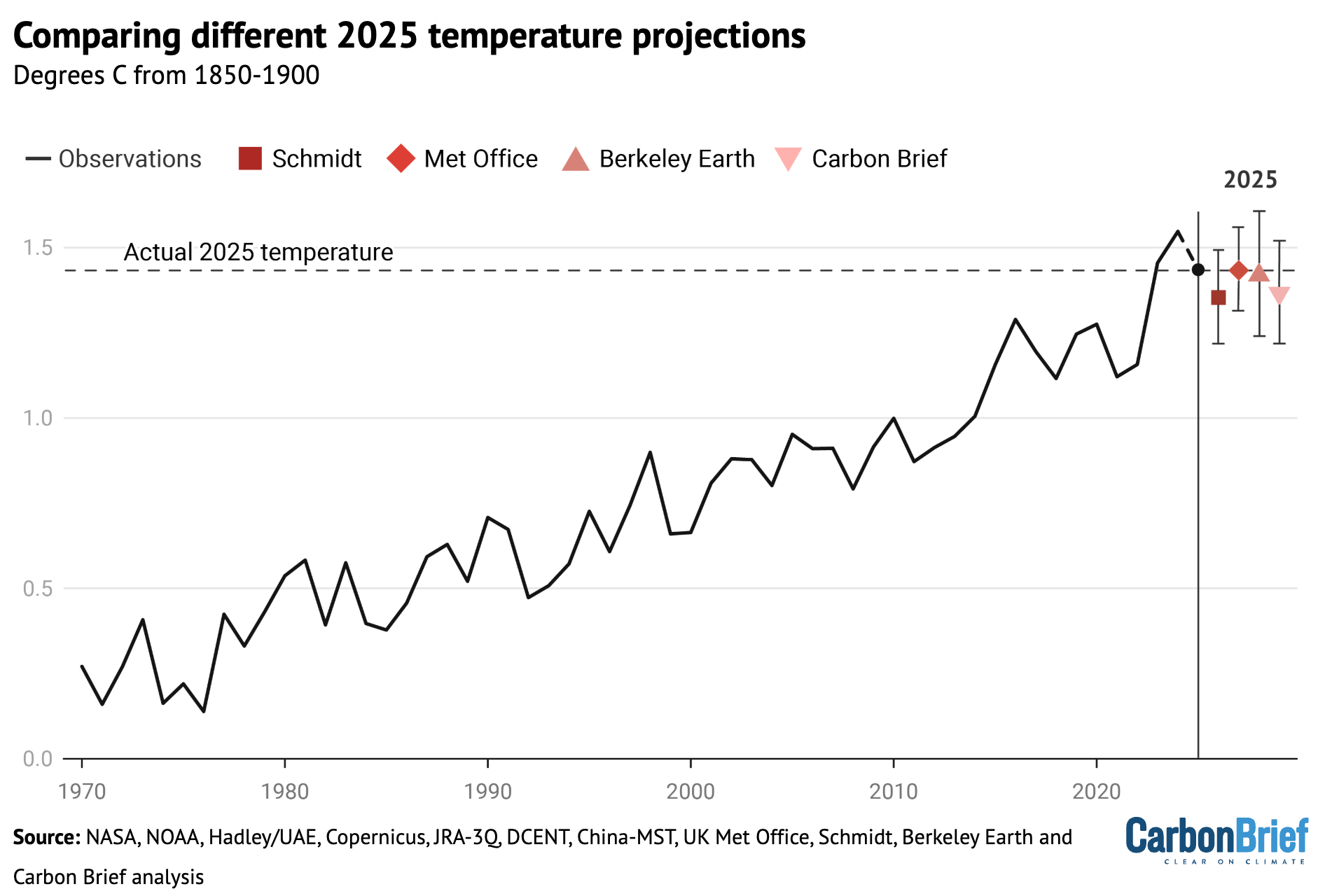
Chart comparing different 2025 temperature projections
Temperature predictions for 2025 from UK Met Office, NASA’s Dr Gavin Schmidt, Berkeley Earth and Carbon Brief’s estimate relative to pre-industrial (1850-1900) temperatures and compared to the historical average of the eight observational datasets. Chart by Carbon Brief.

Unlike in 2023 –and, to a lesser extent, 2024 –when start-of-year predictions were notably low, 2025 fell reasonably in-line with what was expected. The Met Office estimate was nearly exactly on target, with Berkeley Earth’s being close as well. Carbon Brief and Schmidt’s estimates were a little on the low side, but actual temperatures were well within the estimated error bars.

Observations in-line with climate model projections

Climate models provide physics-based estimates of future warming given different assumptions about future emissions, greenhouse gas concentrations and other climate-influencing factors.

Here, Carbon Brief examines a collection of climate models – known as CMIP6 – used in the 2021 science report of the IPCC’s sixth assessment.

In CMIP6, model estimates of temperatures prior to 2015 are a “hindcast” using known past climate influences, while temperatures projected from 2015 onward are a “forecast” based on an estimate of how things might change.

The figure below shows how observations compare to the full ensemble of 37 CMIP6 models under the middle-of-the-road SSP2-4.5 emissions scenario for future projections. The red line represents the average of all the models and the red areas showing the 5th to 95th percentile range. The average of the eight observational temperature datasets are plotted as dots on top of the climate model data.

The chart illustrates how observations have generally been a bit below the model average over the past two decades, were slightly above model average in 2024 and are more or less dead on in 2025.
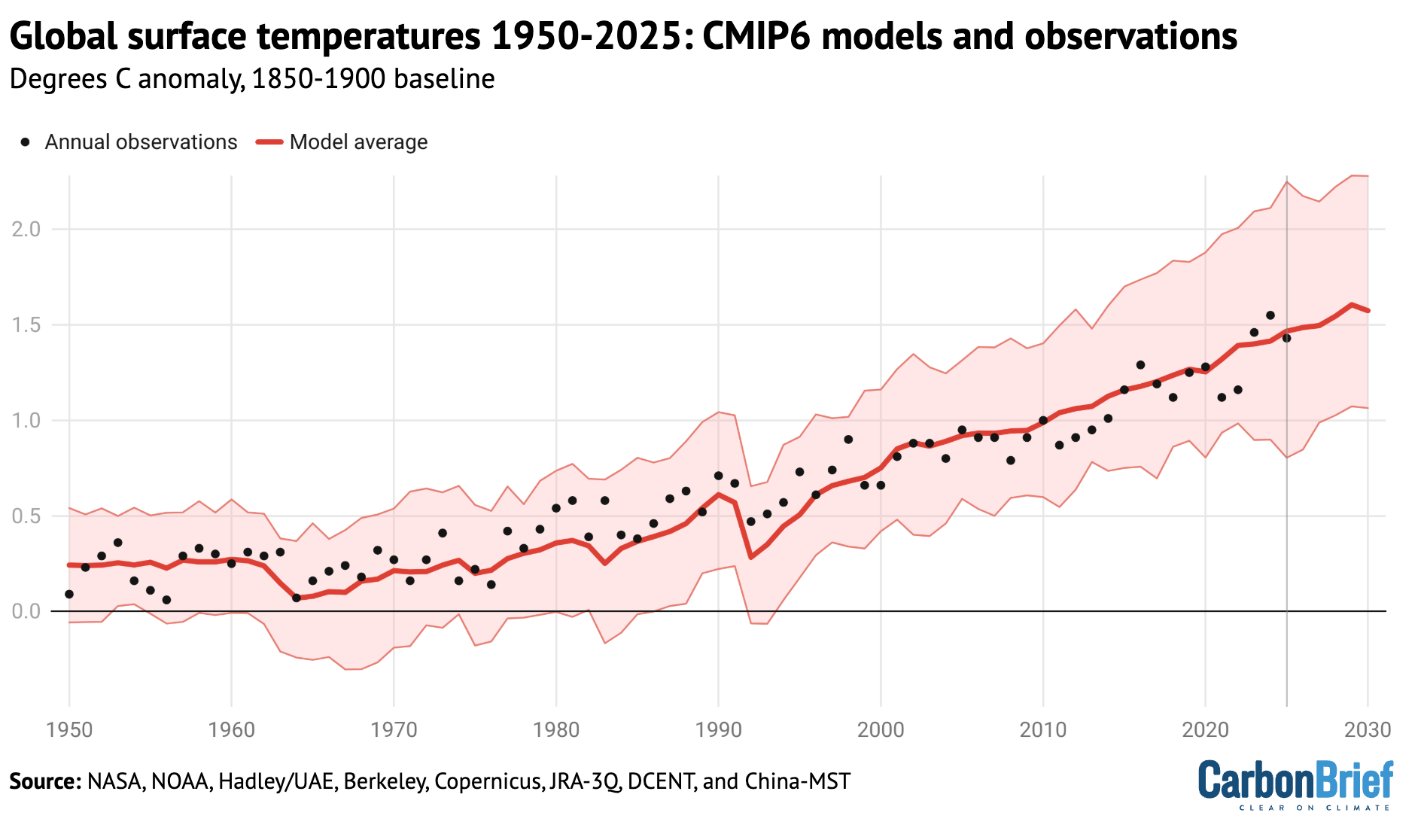
Chart showing global surface temperatures from 1950 to 2025: CMIP6 models and observations
Annual global average surface temperatures from CMIP6 models and observations between 1950 and 2030 (through 2025 for observations). Models use the SSP2-4.5 scenario after 2015. Anomalies plotted with respect to a 1850-1900 baseline. Chart by Carbon Brief.

However, the ensemble of CMIP6 models differs from the main projection of future warming in the recent IPCC AR6 report. A subset of CMIP6 models have unrealistically high climate sensitivity and they reproduce historical observations poorly.

To account for this, rather than simply averaging all the models – as had been done in prior assessments – the IPCC employed an approach that effectively weights models by their performance. As a result, the models align better with the range of climate sensitivity derived from multiple different lines of evidence.

The chart below shows the assessed warming projections from the IPCC AR6 report in red, with historical observations since 1850 as black dots.

Chart showing observations compared to the IPCC AR6 assessed warming projection
Annual global average surface temperatures from the average of eight datasets (black dots) along the 30-year LOWESS fit (red line), combined the AR6 assessed warming projection for SSP2-4.5 as published and without any baseline alignment. Chart by Carbon Brief.

The chart reveals that observed global surface temperatures (black dots) are further above the modeled central estimate 2023-25, but generally remain within the IPCC assessed range.

Climate models broadly expect an acceleration of warming in the current period in a scenario like SSP2-4.5 where emissions of CO2 and other greenhouse gases continue to modestly increase, but emissions of planet-cooling aerosols like sulphur dioxide are rapidly reduced.

Second-warmest atmospheric temperatures

In addition to surface measurements over the world’s land and oceans, satellite microwave sounding units have been providing estimates of temperatures at various layers of the atmosphere since 1979.

The lowest layer of the atmosphere that satellite microwave units provide temperature estimates for is the lower troposphere. This data reflects temperatures a few kilometres above the Earth’s surface. It reveals a pattern of warming in the lowest troposphere that is similar – though not identical – to surface temperature changes.

The records produced by Remote Sensing Systems (RSS), the University of Alabama, Huntsville (UAH) and NOAA show 2025 as the second warmest year on record in the lower troposphere, after 2024. The chart below shows the three records for the lower troposphere, using a more recent baseline period (1981-2010) given the absence of satellite data before 1979.
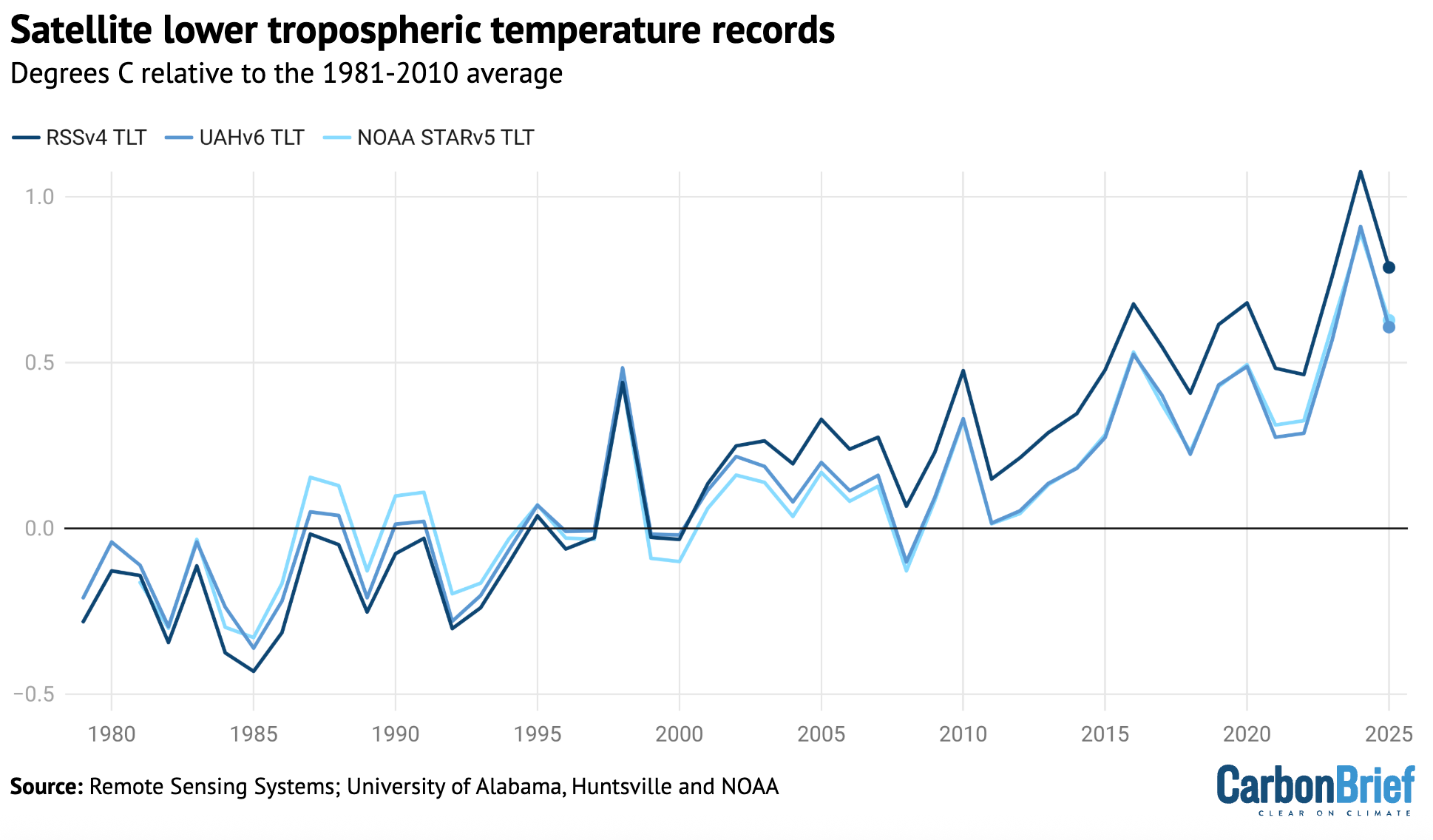
Chart showing satellite lower tropospheric temperature records
Global average lower-troposphere temperatures from RSS version 4 (dark blue), UAH version 6 (mid-blue) and NOAA STAR version 5 (light blue) for the period from 1979-2025, relative to a 1981-2010 baseline. Chart by Carbon Brief.

The lower troposphere tends to be influenced more strongly by El Niño and La Niña events than the surface. Therefore, satellite records show correspondingly larger warming or cooling spikes during these events. This explains why there was both a bigger increase between 2023 and 2024 and a bigger decline between 2024 and 2025 in the satellite record than in surface records.

The lower-tropospheric temperature records show large differences after the early 2000s. RSS shows an overall rate of warming quite similar to surface temperature records, while UAH and NOAA show considerably slower warming in recent years than has been observed on the surface.

Greenhouse gas concentrations reach new highs

Greenhouse gas concentrations reached a new high in 2025, driven by human-caused emissions from fossil fuels, land use and agriculture.

Three greenhouse gases – CO2, methane (CH4) and nitrous oxide (N2O) – are responsible for the bulk of additional heat trapped by human activities. CO2 is by far the largest factor, accounting for roughly 42% of the increase in global surface temperatures since the pre-industrial era (1850-1900).

Methane accounts for 28%, while nitrous oxide accounts for around 5%. The remaining 25% comes from other factors including carbon monoxide, black carbon and halocarbons, such as chlorofluorocarbons (CFCs).

Human emissions of greenhouse gases have increased atmospheric concentrations of CO2, methane and nitrous oxide to their highest levels in at least a few million years – if not longer.

The figure below shows concentrations of these greenhouse gases – in parts per million (ppm) for CO2 and parts per billion (ppb) for methane and nitrous oxide – from the early 1980s through to October 2025 for CO2 and September 2025 for CH4 and N2O (the most recent data currently available).
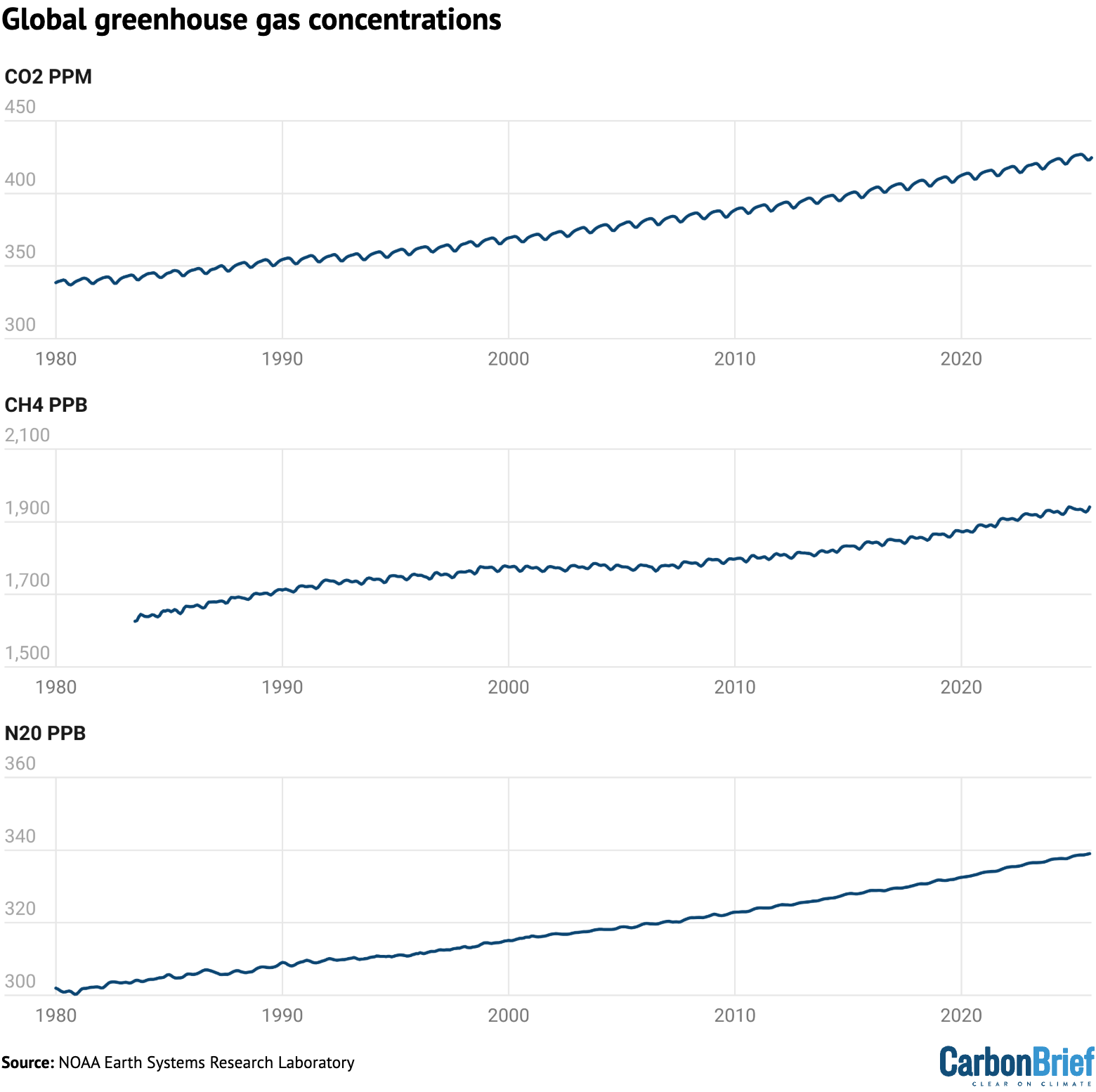
Chart showing global greenhouse gas concentrations
Global concentrations of CO2, methane (CH4) and nitrous oxide (N2O). Based on data from NOAA’s Earth Systems Research Laboratory. Note that the y-axes do not start at zero. Chart by Carbon Brief.

Sea level is rising rapidly

Modern-day sea levels have risen to a new high, due to a combination of melting land ice (such as glaciers and ice sheets), the thermal expansion of water as it warms and changes in land water storage.

In recent years, there have been larger contributions to sea level rise from melting ice sheets and glaciers, as warmer temperatures accelerate ice sheet losses in Greenland and Antarctica.

Since the early 1990s, the increase in global sea level has been estimated using altimeter data from satellites. Earlier global sea levels have been reconstructed from a network of global tide gauge measurements. This allows researchers to estimate how sea level has changed since the late 1800s.

The chart below shows five different modern sea level rise datasets (blue lines), along with satellite altimeter measurements as assessed by AVISO (in black) after 1993. (As sea level rise data has not yet been released for the whole year, the 2025 value is estimated based on data through to November.)
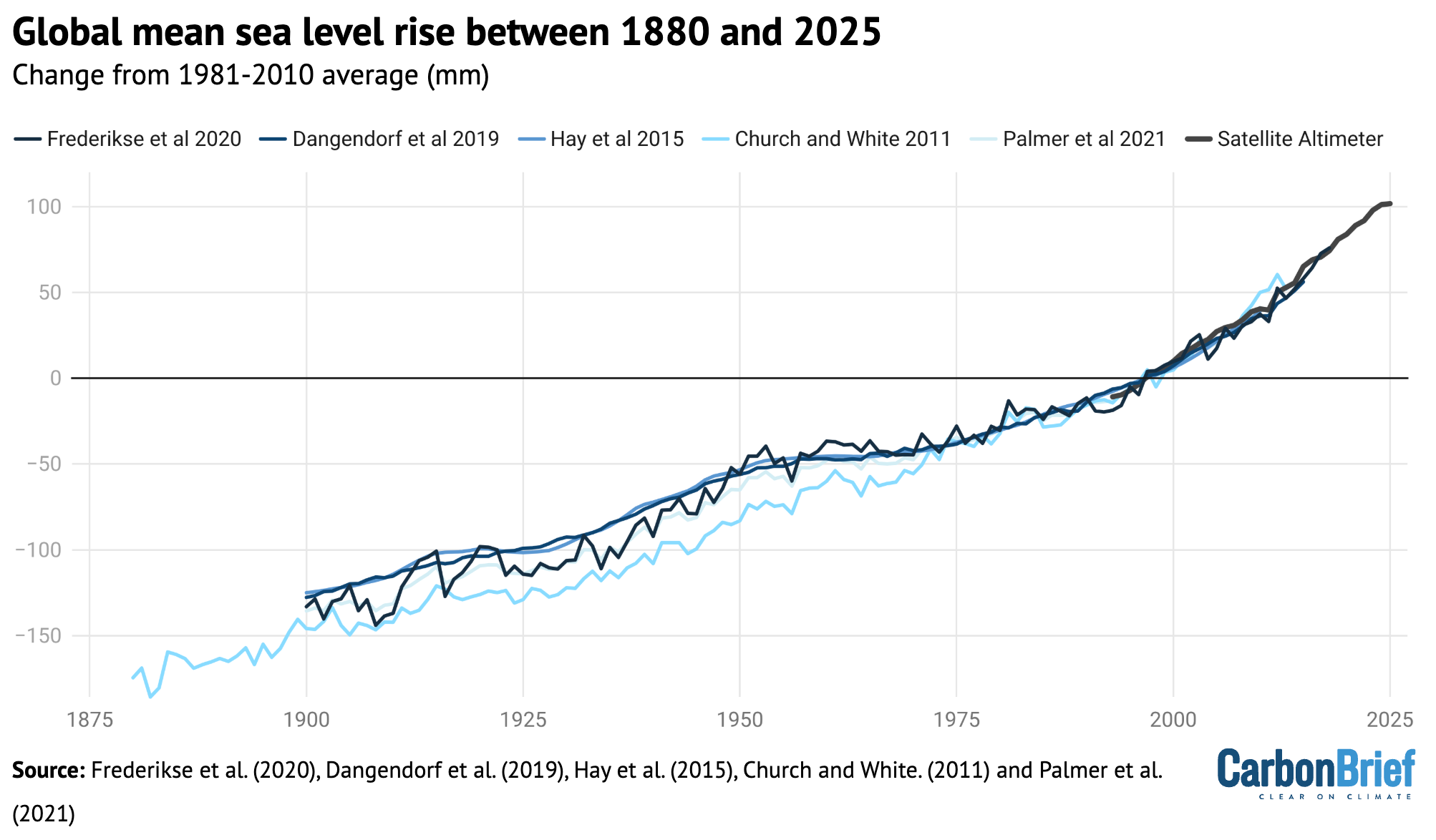
Chart showing global mean sea level rise between 1880 and 2025
Global average sea level rise reconstructed from tide gauge data between 1880 and 2025 from Frederikse et al. (2020), Dangendorf et al. (2019), Hay et al. (2015), Church and White (2011), and Palmer et al. (2021). Satellite altimeter data from 1993 (black) to present is taken from AVISO. Chart by Carbon Brief.

Sea levels have risen by over 0.2 metres (200mm) since 1900. While sea level rise estimates mostly agree in recent decades, larger divergences are evident before 1980. There is also evidence of accelerating sea level rise over the post-1993 period when high-quality satellite altimetry data is available.

(To understand more on how climate change is accelerating sea level rise, read Carbon Brief’s explainer.)

Shrinking glaciers and ice sheets

A significant portion of global sea level rise is being driven by melting glaciers on land.

Scientists measure the mass of glaciers around the world using a variety of remote-sensing techniques, as well as through GRACE measurements of the Earth’s gravitational field. The balance between snow falling on a glacier and ice loss through melting and the breaking off – or “calving” – of icebergs determines if glaciers grow or shrink over time.

The World Glacier Monitoring Service is an international consortium that tracks more than 130 different glaciers in 19 different regions around the world. The figure below shows the change in global average glacier mass from 1950 through to the end of 2024. (2025 values are not yet available.) Note that glacier melt is reported in metres of water equivalent, which is a measure of how much mass has been lost on average.

Chart showing global glacier melt, 1950-2024
Global average glacier melt over the 1950-2024 period from the World Glacier Monitoring Service, in metres of water equivalent. Carbon Brief.

Greenland ice sheets have become a larger contributor to sea level rise in recent years due to accelerating loss of mass. The year 2025 was the 29th in a row where Greenland lost ice overall, with 105bn tonnes of ice lost over the 12 months from September 2024 to August 2025. Greenland last saw an annual net gain of ice in 1996.

The figure below shows the cumulative mass balance change – that is, the net ice loss – from Greenland between 1970 and 2025. The authors find that Greenland has lost around 6tn tonnes of ice over the past 50 years – more than 700 tonnes lost per person for every person on the planet.

Chart showing greenland ice sheet mass balance, 1970-2025
Cumulative ice loss from Greenland in billion metric tonnes (gigatonnes) between 1970 and 2025 from Mankoff et al 2021. Chart by Carbon Brief.

Lowest winter Arctic sea ice extent

Arctic sea ice saw its lowest winter peak on record as well as its 10th-lowest summer minimum extent, while Antarctic sea ice saw its third-lowest minimum extent.

Both the Arctic and Antarctic were at the low end of the historical (1979-2010) range for most of 2025, with new daily lows recorded for Arctic sea ice extent in January, February, March, June and December.

The figure below shows both Arctic (red line) and Antarctic (blue line) sea ice extent for each day of the year, along with how it compares to the historical range (corresponding shading).

Chart showing Arctic and Antarctic sea ice in 2025
Arctic and Antarctic daily sea ice extent from the US National Snow and Ice Data Center. The bold lines show daily 2025 values, the shaded area indicates the two standard deviation range in historical values between 1979 and 2010. The dotted black lines show the record lows for each pole. Chart by Carbon Brief.

Looking ahead to 2026

There is reason for caution when estimating likely temperatures for 2026.

In 2023, temperatures were significantly higher than predictions made at the start of the year, while 2024 temperatures were towards the high end of annual predictions. Temperatures in 2025 were more in-line with predictions, albeit still on the higher side for three out of the four predictions included above.

There are currently weak La Niña conditions currently present in the tropical Pacific, which are expected to extend through February. This would somewhat suppress temperatures in the first half of the year. However, the latest forecasts suggest a growing likelihood of El Niño conditions developing by June, which may lead to warmer temperatures in late 2026 – and potentially much warmer temperatures in 2027.

Carbon Brief predicts that global average surface temperatures in 2026 are likely to be between the second and fourth warmest on record, similar to 2023 and 2025, at around 1.4C above pre-industrial levels.

This is the fourth published temperature prediction for 2026, after those already produced by the Met Office, NASA’s Dr Gavin Shmidt and Berkeley Earth.

The figure below shows the four different 2026 predictions compared to the average of eight different temperature records explored in this article. (These have been “normalised” to show 2026 warming relative to the 2023-25 average to allow a clear comparison, given that each of the predictions was originally presented for a different temperature record.)

Carbon Brief’s prediction of likely 2026 temperatures is based on a statistical model using the average temperature of the past year, the latest monthly temperature and projections of ENSO conditions over the first three months of 2026.

Chart comparing different 2026 temperature projections
Temperature projections for 2026 from the Met Office, NASA’s Dr Gavin Schmidt, Berkeley Earth and Carbon Brief, relative to pre-industrial (1850-1900) temperatures and compared to the historical average of eight different surface temperature datasets. Chart by Carbon Brief.

The Met Office, Dr Schmidt, Berkeley Earth and Carbon Brief estimates all have 2026 ending up as somewhere between the second- and fourth-warmest year on record, with the best estimate as being more or less tied with 2023 and 2025.

There is a very small chance that 2026 could end up beating 2024 as the warmest year on record, or end up below 2016 as the fifth or sixth warmest year.

However, with the growing likelihood of El Niño conditions developing in the second half of 2026, it is increasingly likely that 2027 will challenge 2024 for the title of the warmest year on record. The rate of warming has notably accelerated over the past 15 years and the period of exceptionally warm years that started in 2023 shows no signs of abating.

The post State of the climate: 2025 in top-three hottest years on record as ocean heat surges appeared first on Carbon Brief.

State of the climate: 2025 in top-three hottest years on record as ocean heat surges

Continue Reading

Greenhouse Gases

DeBriefed 6 February 2026: US secret climate panel ‘unlawful’ | China’s clean energy boon | Can humans reverse nature loss?

Published

on

Welcome to Carbon Brief’s DeBriefed.
An essential guide to the week’s key developments relating to climate change.

This week

Secrets and layoffs

UNLAWFUL PANEL: A federal judge ruled that the US energy department “violated the law when secretary Chris Wright handpicked five researchers who rejected the scientific consensus on climate change to work in secret on a sweeping government report on global warming”, reported the New York Times. The newspaper explained that a 1972 law “does not allow agencies to recruit or rely on secret groups for the purposes of policymaking”. A Carbon Brief factcheck found more than 100 false or misleading claims in the report.

DARKNESS DESCENDS: The Washington Post reportedly sent layoff notices to “at least 14” of its climate journalists, as part of a wider move from the newspaper’s billionaire owner, Jeff Bezos, to eliminate 300 jobs at the publication, claimed Climate Colored Goggles. After the layoffs, the newspaper will have five journalists left on its award-winning climate desk, according to the substack run by a former climate reporter at the Los Angeles Times. It comes after CBS News laid off most of its climate team in October, it added.

WIND UNBLOCKED: Elsewhere, a separate federal ruling said that a wind project off the coast of New York state can continue, which now means that “all five offshore wind projects halted by the Trump administration in December can resume construction”, said Reuters. Bloomberg added that “Ørsted said it has spent $7bn on the development, which is 45% complete”.

Around the world

  • CHANGING TIDES: The EU is “mulling a new strategy” in climate diplomacy after struggling to gather support for “faster, more ambitious action to cut planet-heating emissions” at last year’s UN climate summit COP30, reported Reuters.
  • FINANCE ‘CUT’: The UK government is planning to cut climate finance by more than a fifth, from £11.6bn over the past five years to £9bn in the next five, according to the Guardian.
  • BIG PLANS: India’s 2026 budget included a new $2.2bn funding push for carbon capture technologies, reported Carbon Brief. The budget also outlined support for renewables and the mining and processing of critical minerals.
  • MOROCCO FLOODS: More than 140,000 people have been evacuated in Morocco as “heavy rainfall and water releases from overfilled dams led to flooding”, reported the Associated Press.
  • CASHFLOW: “Flawed” economic models used by governments and financial bodies “ignor[e] shocks from extreme weather and climate tipping points”, posing the risk of a “global financial crash”, according to a Carbon Tracker report covered by the Guardian.
  • HEATING UP: The International Olympic Committee is discussing options to hold future winter games earlier in the year “because of the effects of warmer temperatures”, said the Associated Press.

54%

The increase in new solar capacity installed in Africa over 2024-25 – the continent’s fastest growth on record, according to a Global Solar Council report covered by Bloomberg.


Latest climate research

  • Arctic warming significantly postpones the retreat of the Afro-Asian summer monsoon, worsening autumn rainfall | Environmental Research Letters
  • “Positive” images of heatwaves reduce the impact of messages about extreme heat, according to a survey of 4,000 US adults | Environmental Communication
  • Greenland’s “peripheral” glaciers are projected to lose nearly one-fifth of their total area and almost one-third of their total volume by 2100 under a low-emissions scenario | The Cryosphere

(For more, see Carbon Brief’s in-depth daily summaries of the top climate news stories on Monday, Tuesday, Wednesday, Thursday and Friday.)

Captured

A blue and grey bar chart on a white background showing that clean energy drove more than a third of China's economic growth in 2025. The chart shows investment growth and GDP growth by sector in trillions of yuan. The source is listed at the bottom of the chart as CREA analysis for Carbon Brief.

Solar power, electric vehicles and other clean-energy technologies drove more than a third of the growth in China’s economy in 2025 – and more than 90% of the rise in investment, according to new analysis for Carbon Brief (shown in blue above). Clean-energy sectors contributed a record 15.4tn yuan ($2.1tn) in 2025, some 11.4% of China’s gross domestic product (GDP) – comparable to the economies of Brazil or Canada, the analysis said.

Spotlight

Can humans reverse nature decline?

This week, Carbon Brief travelled to a UN event in Manchester, UK to speak to biodiversity scientists about the chances of reversing nature loss.

Officials from more than 150 countries arrived in Manchester this week to approve a new UN report on how nature underpins economic prosperity.

The meeting comes just four years before nations are due to meet a global target to halt and reverse biodiversity loss, agreed in 2022 under the landmark “Kunming-Montreal Global Biodiversity Framework” (GBF).

At the sidelines of the meeting, Carbon Brief spoke to a range of scientists about humanity’s chances of meeting the 2030 goal. Their answers have been edited for length and clarity.

Dr David Obura, ecologist and chair of Intergovernmental Science-Policy Platform on Biodiversity and Ecosystem Services (IPBES)

We can’t halt and reverse the decline of every ecosystem. But we can try to “bend the curve” or halt and reverse the drivers of decline. That’s the economic drivers, the indirect drivers and the values shifts we need to have. What the GBF aspires to do, in terms of halting and reversing biodiversity loss, we can put in place the enabling drivers for that by 2030, but we won’t be able to do it fast enough at this point to halt [the loss] of all ecosystems.

Dr Luthando Dziba, executive secretary of IPBES

Countries are due to report on progress by the end of February this year on their national strategies to the Convention on Biological Diversity [CBD]. Once we get that, coupled with a process that is ongoing within the CBD, which is called the global stocktake, I think that’s going to give insights on progress as to whether this is possible to achieve by 2030…Are we on the right trajectory? I think we are and hopefully we will continue to move towards the final destination of having halted biodiversity loss, but also of living in harmony with nature.

Prof Laura Pereira, scientist at the Global Change Institute at Wits University, South Africa

At the global level, I think it’s very unlikely that we’re going to achieve the overall goal of halting biodiversity loss by 2030. That being said, I think we will make substantial inroads towards achieving our longer term targets. There is a lot of hope, but we’ve also got to be very aware that we have not necessarily seen the transformative changes that are going to be needed to really reverse the impacts on biodiversity.

Dr David Cooper, chair of the UK’s Joint Nature Conservation Committee and former executive secretary of the Convention on Biological Diversity

It’s important to look at the GBF as a whole…I think it is possible to achieve those targets, or at least most of them, and to make substantial progress towards them. It is possible, still, to take action to put nature on a path to recovery. We’ll have to increasingly look at the drivers.

Prof Andrew Gonzalez, McGill University professor and co-chair of an IPBES biodiversity monitoring assessment

I think for many of the 23 targets across the GBF, it’s going to be challenging to hit those by 2030. I think we’re looking at a process that’s starting now in earnest as countries [implement steps and measure progress]…You have to align efforts for conserving nature, the economics of protecting nature [and] the social dimensions of that, and who benefits, whose rights are preserved and protected.

Neville Ash, director of the UN Environment Programme World Conservation Monitoring Centre

The ambitions in the 2030 targets are very high, so it’s going to be a stretch for many governments to make the actions necessary to achieve those targets, but even if we make all the actions in the next four years, it doesn’t mean we halt and reverse biodiversity loss by 2030. It means we put the action in place to enable that to happen in the future…The important thing at this stage is the urgent action to address the loss of biodiversity, with the result of that finding its way through by the ambition of 2050 of living in harmony with nature.

Prof Pam McElwee, Rutgers University professor and co-chair of an IPBES “nexus assessment” report

If you look at all of the available evidence, it’s pretty clear that we’re going to keep experiencing biodiversity decline. I mean, it’s fairly similar to the 1.5C climate target. We are not going to meet that either. But that doesn’t mean that you slow down the ambition…even though you recognise that we probably won’t meet that specific timebound target, that’s all the more reason to continue to do what we’re doing and, in fact, accelerate action.

Watch, read, listen

OIL IMPACTS: Gas flaring has risen in the Niger Delta since oil and gas major Shell sold its assets in the Nigerian “oil hub”, a Climate Home News investigation found.

LOW SNOW: The Washington Post explored how “climate change is making the Winter Olympics harder to host”.

CULTURE WARS: A Media Confidential podcast examined when climate coverage in the UK became “part of the culture wars”.

Coming up

Pick of the jobs

DeBriefed is edited by Daisy Dunne. Please send any tips or feedback to debriefed@carbonbrief.org.

This is an online version of Carbon Brief’s weekly DeBriefed email newsletter. Subscribe for free here.

The post DeBriefed 6 February 2026: US secret climate panel ‘unlawful’ | China’s clean energy boon | Can humans reverse nature loss? appeared first on Carbon Brief.

DeBriefed 6 February 2026: US secret climate panel ‘unlawful’ | China’s clean energy boon | Can humans reverse nature loss?

Continue Reading

Greenhouse Gases

China Briefing 5 February 2026: Clean energy’s share of economy | Record renewables | Thawing relations with UK

Published

on

Welcome to Carbon Brief’s China Briefing.

China Briefing handpicks and explains the most important climate and energy stories from China over the past fortnight. Subscribe for free here.

Key developments

Solar and wind eclipsed coal

‘FIRST TIME IN HISTORY’: China’s total power capacity reached 3,890 gigawatts (GW) in 2025, according to a National Energy Administration (NEA) data release covered by industry news outlet International Energy Net. Of this, it said, solar capacity rose 35% to 1,200GW and wind capacity was up 23% to 640GW, while thermal capacity – which is mostly coal – grew 6% to just over 1,500GW. This marks the “first time in history” that wind and solar capacity has outranked coal capacity in China’s power mix, reported the state-run newspaper China Daily. China’s grid-related energy storage capacity exceeded 213GW in 2025, said state news agency Xinhua. Meanwhile, clean-energy industries “drove more than 90%” of investment growth and more than half of GDP growth last year, said the Guardian in its coverage of new analysis for Carbon Brief. (See more in the spotlight below.)

上微信关注《碳简报》

DAWN FOR SOLAR: Solar power capacity alone may outpace coal in 2026, according to projections by the China Electricity Council (CEC), reported business news outlet 21st Century Business Herald. It added that non-fossil sources could account for 63% of the power mix this year, with coal falling to 31%. Separately, the China Renewable Energy Society said that annual wind-power additions could grow by between 600-980GW over the next five years, with annual additions of 120GW expected until 2028, said industry news outlet China Energy Net. China Energy Net also published the full CEC report.

STATE MEDIA VOICE: Xinhua published several energy- and climate-related articles in a series on the 15th five-year plan. One said that becoming a low-carbon energy “powerhouse” will support decarbonisation efforts, strengthen industrial innovation and improve China’s “global competitive edge and standing”. Another stated that coal consumption is “expected” to peak around 2027, with continued “growth” in the power and chemicals sector, while oil has already peaked. A third noted that distributed energy systems better matched the “characteristics of renewable energy” than centralised ones, but warned against “blind” expansion and insufficient supporting infrastructure. Others in the series discussed biodiversity and environmental protection and recycling of clean-energy technology. Meanwhile, the communist party-affiliated People’s Daily said that oil will continue to play a “vital role” in China, even after demand peaks.

Starmer and Xi endorsed clean-energy cooperation

CLIMATE PARTNERSHIP: UK prime minister Keir Starmer and Chinese president Xi Jinping pledged in Beijing to deepen cooperation on “green energy”, reported finance news outlet Caixin. They also agreed to establish a “China-UK high-level climate and nature partnership”, said China Daily. Xi told Starmer that the two countries should “carry out joint research and industrial transformation” in new energy and low-carbon technologies, according to Xinhua. It also cited Xi as saying China “hopes” the UK will provide a “fair” business environment for Chinese companies.

Subscribe: China Briefing
  • Sign up to Carbon Brief’s free “China Briefing” email newsletter. All you need to know about the latest developments relating to China and climate change. Sent to your inbox every Thursday.

OCTOPUS OVERSEAS: During the visit, UK power-trading company Octopus Energy and Chinese energy services firm PCG Power announced they would be starting a new joint venture in China, named Bitong Energy, reported industry news outlet PV Magazine. The move “marks a notable direct entry” of a foreign company into China’s “tightly regulated electricity market”, said Caixin.

PUSH AND PULL: UK policymakers also visited Chinese clean-energy technology manufacturer Envision in Shanghai, reported finance news outlet Yicai. It quoted UK business secretary Peter Kyle emphasising that partnering with companies “like Envision” on sustainability is a “really important part of our future”, particularly in terms of job creation in the UK. Trade minister Chris Bryant told Radio Scotland Breakfast that the government will decide on Chinese wind turbine manufacturer Mingyang’s plans for a Scotland factory “soon”. Researchers at the thinktank Oxford Institute for Energy Studies wrote in a guest post for Carbon Brief that greater Chinese competition in Europe’s wind market could “help spur competition in Europe”, if localisation rules and “other guardrails” are applied.

More China news

  • LIFE SUPPORT: China will update its coal capacity payment mechanism, which will raise thresholds for coal-fired power plants and expand to cover gas-fired power and pumped and new-energy storage, reported current affairs outlet China News.
  • FRONTIER TECH: The world’s “largest compressed-air power storage plant” has begun operating in China, said Bloomberg.
  • PARTNERSHIP A ‘MISTAKE’: The EU launched a “foreign subsidies” probe into Chinese wind turbine company Goldwind, said the Hong Kong-based South China Morning Post. EU climate chief Wopke Hoekstra said the bloc must resist China’s pull in clean technologies, according to Bloomberg.
  • TRADE SPAT: The World Trade Organization “backed a complaint by China” that the US Inflation Reduction Act “discriminated against” Chinese cleantech exports, said Reuters.
  • NEW RULES: China has set “new regulations” for the Waliguan Baseline Observatory, which provides “key scientific references for the United Nations Framework Convention on Climate Change”, said the People’s Daily.

Captured

New or reactivated proposals for coal-fired power plants in China totalled 161GW in 2025, according to a new report covered by Carbon Brief

Spotlight

Clean energy drove China’s economic growth in 2025

New analysis for Carbon Brief finds that clean-energy sectors contributed the equivalent of $2.1tn to China’s economy last year, making it a key driver of growth. However, headwinds in 2026 could restrict growth going forward – especially for the solar sector.

Below is an excerpt from the article, which can be read in full on Carbon Brief’s website.

Solar power, electric vehicles (EVs) and other clean-energy technologies drove more than a third of the growth in China’s economy in 2025 – and more than 90% of the rise in investment.

Clean-energy sectors contributed a record 15.4tn yuan ($2.1tn) in 2025, some 11.4% of China’s gross domestic product (GDP)

Analysis shows that China’s clean-energy sectors nearly doubled in real value between 2022-25 and – if they were a country – would now be the 8th-largest economy in the world.

These investments in clean-energy manufacturing represent a large bet on the energy transition in China and overseas, creating an incentive for the government and enterprises to keep the boom going.

However, there is uncertainty about what will happen this year and beyond, particularly due to a new pricing system, worsening industrial “overcapacity” and trade tensions.

Outperforming the wider economy

China’s clean-energy economy continues to grow far more quickly than the wider economy, making an outsized contribution to annual growth.

Without these sectors, China’s GDP would have expanded by 3.5% in 2025 instead of the reported 5.0%, missing the target of “around 5%” growth by a wide margin.

Clean energy made a crucial contribution during a challenging year, when promoting economic growth was the foremost aim for policymakers.

In 2024, EVs and solar had been the largest growth drivers. In 2025, it was EVs and batteries, which delivered 44% of the economic impact and more than half of the growth of the clean-energy industries.

The next largest subsector was clean-power generation, transmission and storage, which made up 40% of the contribution to GDP and 30% of the growth in 2025.

Within the electricity sector, the largest drivers were growth in investment in wind and solar power generation capacity, along with growth in power output from solar and wind, followed by the exports of solar-power equipment and materials.

But investment in solar-panel supply chains, a major growth driver in 2022-23, continued to fall for the second year, as the government made efforts to rein in overcapacity and “irrational” price competition.

Headwinds for solar

Ongoing investment of hundreds of billions of dollars represents a gigantic bet on a continuing global energy transition.

However, developments next year and beyond are unclear, particularly for solar. A new pricing system for renewable power is creating uncertainty, while central government targets have been set far below current rates of clean-electricity additions.

Investment in solar-power generation and solar manufacturing declined in the second half of the year.

The reduction in the prices of clean-energy technology has been so dramatic that when the prices for GDP statistics are updated, the sectors’ contribution to real GDP – adjusted for inflation or, in this case deflation – will be revised down.

Nevertheless, the key economic role of the industry creates a strong motivation to keep the clean-energy boom going. A slowdown in the domestic market could also undermine efforts to stem overcapacity and inflame trade tensions by increasing pressure on exports to absorb supply.

Local governments and state-owned enterprises will also influence the outlook for the sector.

Provincial governments have a lot of leeway in implementing the new electricity markets and contracting systems for renewable power generation. The new five-year plans, to be published this year, will, therefore, be of major importance.

This spotlight was written for Carbon Brief by Lauri Myllyvirta, lead analyst at Centre for Research on Energy and Clean Air (CREA), and Belinda Schaepe, China policy analyst at CREA. CREA China analysts Qi Qin and Chengcheng Qiu contributed research.

Watch, read, listen

PROVINCE INFLUENCE: The Institute for Global Decarbonization Progress, a Beijing-based thinktank, published a report examining the climate-related statements in provincial recommendations for the 15th five-year plan.

‘PIVOT’?: The Outrage + Optimism podcast spoke with the University of Bath’s Dr Yixian Sun about whether China sees itself as a climate leader and what its role in climate negotiations could be going forward.

COOKING FOR CLEAN-TECH: Caixin covered rising demand for China’s “gutter oil” as companies “scramble” to decarbonise.

DON’T GO IT ALONE: China News broadcast the Chinese foreign ministry’s response to the withdrawal of the US from the Paris Agreement, with spokeswoman Mao Ning saying “no country can remain unaffected” by climate change.


$6.8tn

The current size of China’s green-finance economy, including loans, bonds and equity, according to Dr Ma Jun, the Institute of Finance and Sustainability’s president,in a report launch event attended by Carbon Brief. Dr Ma added that “green loans” make up 16% of all loans in China, with some areas seeing them take a 34% share.


New science

  • China’s official emissions inventories have overestimated its hydrofluorocarbon emissions by an average of 117m tonnes of carbon dioxide equivalent (mtCO2e) every year since 2017 | Nature Geoscience
  • “Intensified forest management efforts” in China from 2010 onwards have been linked to an acceleration in carbon absorption by plants and soils | Communications Earth and Environment

Recently published on WeChat

China Briefing is written by Anika Patel and edited by Simon Evans. Please send tips and feedback to china@carbonbrief.org

The post China Briefing 5 February 2026: Clean energy’s share of economy | Record renewables | Thawing relations with UK appeared first on Carbon Brief.

China Briefing 5 February 2026: Clean energy’s share of economy | Record renewables | Thawing relations with UK

Continue Reading

Greenhouse Gases

Analysis: Clean energy drove more than a third of China’s GDP growth in 2025

Published

on

Solar power, electric vehicles (EVs) and other clean-energy technologies drove more than a third of the growth in China’s economy in 2025 – and more than 90% of the rise in investment.

Clean-energy sectors contributed a record 15.4tn yuan ($2.1tn) in 2025, some 11.4% of China’s gross domestic product (GDP) – comparable to the economies of Brazil or Canada.

The new analysis for Carbon Brief, based on official figures, industry data and analyst reports, shows that China’s clean-energy sectors nearly doubled in real value between 2022-25 and – if they were a country – would now be the 8th-largest economy in the world.

Other key findings from the analysis include:

  • Without clean-energy sectors, China would have missed its target for GDP growth of “around 5%”, expanding by 3.5% in 2025 instead of the reported 5.0%.
  • Clean-energy industries are expanding much more quickly than China’s economy overall, with their annual growth rate accelerating from 12% in 2024 to 18% in 2025.
  • The “new three” of EVs, batteries and solar continue to dominate the economic contribution of clean energy in China, generating two-thirds of the value added and attracting more than half of all investment in the sectors.
  • China’s investments in clean energy reached 7.2tn yuan ($1.0tn) in 2025, roughly four times the still sizable $260bn put into fossil-fuel extraction and coal power.
  • Exports of clean-energy technologies grew rapidly in 2025, but China’s domestic market still far exceeds the export market in value for Chinese firms.

These investments in clean-energy manufacturing represent a large bet on the energy transition in China and overseas, creating an incentive for the government and enterprises to keep the boom going.

However, there is uncertainty about what will happen this year and beyond, particularly for solar power, where growth has slowed in response to a new pricing system and where central government targets have been set far below the recent rate of expansion.

An ongoing slowdown could turn the sectors into a drag on GDP, while worsening industrial “overcapacity” and exacerbating trade tensions.

Yet, even if central government targets in the next five-year plan are modest, those from local governments and state-owned enterprises could still drive significant growth in clean energy.

This article updates analysis previously reported for 2023 and 2024.

Clean-energy sectors outperform wider economy

China’s clean-energy economy continues to grow far more quickly than the wider economy. This means that it is making an outsize contribution to annual economic growth.

The figure below shows that clean-energy technologies drove more than a third of the growth in China’s economy overall in 2025 and more than 90% of the net rise in investment.

Contributions to the growth in Chinese investment (left) and GDP overall (right) in 2025 by sector, trillion yuan.
Contributions to the growth in Chinese investment (left) and GDP overall (right) in 2025 by sector, trillion yuan. Source: Centre for Research on Energy and Clean Air (CREA) analysis for Carbon Brief.

In 2022, China’s clean-energy economy was worth an estimated 8.4tn yuan ($1.2tn). By 2025, the sectors had nearly doubled in value to 15.4tn yuan ($2.1tn).

This is comparable to the entire output of Brazil or Canada and positions the Chinese clean-energy industry as the 8th-largest economy in the world. Its value is roughly half the size of the economy of India – the world’s fourth largest – or of the US state of California.

The outperformance of the clean-energy sectors means that they are also claiming a rising share of China’s economy overall, as shown in the figure below.

Share of China’s GDP contributed by clean-energy sectors, %.
Share of China’s GDP contributed by clean-energy sectors, %. Source: CREA analysis for Carbon Brief.

This share has risen from 7.3% of China’s GDP in 2022 to 11.4% in 2025.

Without clean-energy sectors, China’s GDP would have expanded by 3.5% in 2025 instead of the reported 5.0%, missing the target of “around 5%” growth by a wide margin.

Clean energy thus made a crucial contribution during a challenging year, when promoting economic growth was the foremost aim for policymakers.

The table below includes a detailed breakdown by sector and activity.

Sector Activity Value in 2025, CNY bln Value in 2025, USD bln Year-on-year growth Growth contribution Value contribution Value in 2025, CNY trn Value in 2024, CNY trn Value in 2023, CNY trn Value in 2022, CNY trn
EVs Investment: manufacturing capacity 1,643 228 18% 10.4% 10.7% 1.6 1.4 1.2 0.9
EVs Investment: charging infrastructure 192 27 58% 2.9% 1.2% 0.192 0.122 0.1 0.08
EVs Production of vehicles 3,940 548 29% 36.4% 25.6% 3.94 3.065 2.26 1.65
Batteries Investment: battery manufacturing 277 38 35% 3.0% 1.8% 0.277 0.205 0.32 0.15
Batteries Exports: batteries 724 101 51% 10.1% 4.7% 0.724 0.48 0.46 0.34
Solar power Investment: power generation capacity 1,182 164 15% 6.3% 7.7% 1.182 1.031 0.808 0.34
Solar power Investment: manufacturing capacity 506 70 -23% -6.5% 3.3% 0.506 0.662 0.95 0.51
Solar power Electricity generation 491 68 33% 5.1% 3.2% 0.491 0.369 0.26 0.19
Solar power Exports of components 681 95 21% 4.9% 4.4% 0.681 0.562 0.5 0.35
Wind power Investment: power generation capacity, onshore 612 85 47% 8.1% 4.0% 0.612 0.417 0.397 0.21
Wind power Investment: power generation capacity, offshore 96 13 98% 2.0% 0.6% 0.096 0.048 0.086 0.06
Wind power Electricity generation 510 71 13% 2.4% 3.3% 0.51 0.453 0.4 0.34
Nuclear power Investment: power generation capacity 173 24 18% 1.1% 1.1% 0.17 0.15 0.09 0.07
Nuclear power Electricity generation 216 30 8% 0.7% 1.4% 0.216 0.2 0.19 0.19
Hydropower Investment: power generation capacity 54 7 -7% -0.2% 0.3% 0.05 0.06 0.06 0.06
Hydropower Electricity generation 582 81 3% 0.6% 3.8% 0.582 0.567 0.51 0.51
Rail transportation Investment 902 125 6% 2.1% 5.8% 0.902 0.851 0.764 0.714
Rail transportation Transport of passengers and goods 1,020 142 3% 1.3% 6.6% 1.02 0.99 0.964 0.694
Electricity transmission Investment: transmission capacity 644 90 6% 1.5% 4.2% 0.64 0.61 0.53 0.5
Electricity transmission Transmission of clean power 52 7 14% 0.3% 0.3% 0.052 0.046 0.04 0.04
Energy storage Investment: Pumped hydro 53 7 5% 0.1% 0.3% 0.05 0.05 0.04 0.03
Energy storage Investment: Grid-connected batteries 232 32 52% 3.3% 1.5% 0.232 0.152 0.08 0.02
Energy storage Investment: Electrolysers 11 2 29% 0.1% 0.1% 0.011 0.009 0 0
Energy efficiency Revenue: Energy service companies 620 86 17% 3.8% 4.0% 0.62 0.528003 0.52 0.45
Total Investments 7,198 1001 15% 38.2% 46.7% 7.20 6.28 6.00 4.11
Total Production of goods and services 8,216 1,143 22% 61.8% 53.3% 8.22 6.73 5.58 4.32
Total Total GDP contribution 15,414 2144 18% 100.0% 100.0% 15.41 13.01 11.58 8.42

EVs and batteries were the largest drivers of GDP growth

In 2024, EVs and solar had been the largest growth drivers. In 2025, it was EVs and batteries, which delivered 44% of the economic impact and more than half of the growth of the clean-energy industries. This was due to strong growth in both output and investment.

The contribution to nominal GDP growth – unadjusted for inflation – was even larger, as EV prices held up year-on-year while the economy as a whole suffered from deflation. Investment in battery manufacturing rebounded after a fall in 2024.

The major contribution of EVs and batteries is illustrated in the figure below, which shows both the overall size of the clean-energy economy and the sectors that added the most to the rise from year to year.

Contribution of clean-energy sectors to China’s GDP and GDP growth, trillion yuan, 2022-2025.
Contribution of clean-energy sectors to China’s GDP and GDP growth, trillion yuan, 2022-2025. Source: CREA analysis for Carbon Brief.

The next largest subsector was clean-power generation, transmission and storage, which made up 40% of the contribution to GDP and 30% of the growth in 2025.

Within the electricity sector, the largest drivers were growth in investment in wind and solar power generation capacity, along with growth in power output from solar and wind, followed by the exports of solar-power equipment and materials.

Investment in solar-panel supply chains, a major growth driver in 2022-23, continued to fall for the second year. This was in line with the government’s efforts to rein in overcapacity and “irrational” price competition in the sector.

Finally, rail transportation was responsible for 12% of the total economic output of the clean-energy sectors, but saw relatively muted growth year-on-year, with revenue up 3% and investment by 6%.

Note that the International Energy Agency (IEA) world energy investment report projected that China invested $627bn in clean energy in 2025, against $257bn in fossil fuels.

For the same sectors as the IEA report, this analysis puts the value of clean-energy investment in 2025 at a significantly more conservative $430bn. The higher figures in this analysis overall are therefore the result of wider sectoral coverage.

Electric vehicles and batteries

EVs and vehicle batteries were again the largest contributors to China’s clean-energy economy in 2025, making up an estimated 44% of value overall.

Of this total, the largest share of both total value and growth came from the production of battery EVs and plug-in hybrids, which expanded 29% year-on-year. This was followed by investment into EV manufacturing, which grew 18%, after slower growth rates in 2024.

Investment in battery manufacturing also rebounded after a drop in 2024, driven by new battery technology and strong demand from both domestic and international markets. Battery manufacturing investment grew by 35% year-on-year to 277bn yuan.

The share of electric vehicles (EVs) will have reached 12% of all vehicles on the road by the end of 2025, up from 9% a year earlier and less than 2% just five years ago.

The share of EVs in the sales of all new vehicles increased to 48%, from 41% in 2024, with passenger cars crossing the 50% threshold. In November, EV sales crossed the 60% mark in total sales and they continue to drive overall automotive sales growth, as shown below.

Production of combustion-engine vehicles and EVs in China, million units. EVs include battery electric vehicles and plug-in hybrids.
Production of combustion-engine vehicles and EVs in China, million units. EVs include battery electric vehicles and plug-in hybrids. Source: China Association of Automobile Manufacturers data via Wind Financial Terminal.

Electric trucks experienced a breakthrough as their market share rose from 8% in the first nine months of 2024 to 23% in the same period in 2025.

Policy support for EVs continues, for example, with a new policy aiming to nearly double charging infrastructure in the next three years.

Exports grew even faster than the domestic market, but the vast majority of EVs continue to be sold domestically. In 2025, China produced 16.6m EVs, rising 29% year-on-year. While exports accounted for only 21% or 3.4m EVs, they grew by 86% year-on-year. Top export destinations for Chinese EVs were western Europe, the Middle East and Latin America.

The value of batteries exported also grew rapidly by 41% year-on-year, becoming the third largest growth driver of the GDP. Battery exports largely went to western Europe, north America and south-east Asia.

In contrast with deflationary trends in the price of many clean-energy technologies, average EV prices have held up in 2025, with a slight increase in average price of new models, after discounts. This also means that the contribution of the EV industry to nominal GDP growth was even more significant, given that overall producer prices across the economy fell by 2.6%. Battery prices continued to drop.

Clean-power generation

The solar power sector generated 19% of the total value of the clean-energy industries in 2025, adding 2.9tn yuan ($41bn) to the national economy.

Within this, investment in new solar power plants, at 1.2tn yuan ($160bn), was the largest driver, followed by the value of solar technology exports and by the value of the power generated from solar. Investment in manufacturing continued to fall after the wave of capacity additions in 2023, reaching 0.5tn yuan ($72bn), down 23% year-on-year.

In 2025, China achieved another new record of wind and solar capacity additions. The country installed a total of 315GW solar and 119GW wind capacity, adding more solar and two times as much wind as the rest of the world combined.

Clean energy accounted for 90% of investment in power generation, with solar alone covering 50% of that. As a result, non-fossil power made up 42% of total power generation, up from 39% in 2024.

However, a new pricing policy for new solar and wind projects and modest targets for capacity growth have created uncertainty about whether the boom will continue.

Under the new policy, new clean-power generation has to compete on price against existing coal power in markets that place it at a disadvantage in some key ways.

At the same time, the electricity markets themselves are still being introduced and developed, creating investment uncertainty.

Investment in solar power generation increased year-on-year by 15%, but experienced a strong stop-and-go cycle. Developers rushed to finish projects ahead of the new pricing policy coming into force in June and then again towards the end of the year to finalise projects ahead of the end of the current 14th five-year plan.

Investment in the solar sector as a whole was stable year-on-year, with the decline in manufacturing capacity investment balanced by continued growth in power generation capacity additions. This helped shore up the utilisation of manufacturing plants, in line with the government’s aim to reduce “disorderly” price competition.

By late 2025, China’s solar manufacturing capacity reached an estimated 1,200GW per year, well ahead of the global capacity additions of around 650GW in 2025. Manufacturers can now produce far more solar panels than the global market can absorb, with fierce competition leading to historically low profitability.

China’s policymakers have sought to address the issue since mid-2024, warning against “involution”, passing regulations and convening a sector-wide meeting to put pressure on the industry. This is starting to yield results, with losses narrowing in the third quarter of 2025.

The volume of exports of solar panels and components reached a record high in 2025, growing 19% year-on-year. In particular, exports of cells and wafers increased rapidly by 94% and 52%, while panel exports grew only by 4%.

This reflects the growing diversification of solar-supply chains in the face of tariffs and with more countries around the world building out solar panel manufacturing capacity. The nominal value of exports fell 8%, however, due to a fall in average prices and a shift to exporting upstream intermediate products instead of finished panels.

Hydropower, wind and nuclear were responsible for 15% of the total value of the clean-energy sectors in 2025, adding some 2.2tn yuan ($310bn) to China’s GDP in 2025.

Nearly two-thirds of this (1.3tn yuan, $180bn) came from the value of power generation from hydropower, wind and nuclear, with investment in new power generation projects contributing the rest.

Power generation grew 33% from solar, 13% from wind, 3% from hydropower and 8% from nuclear.

Within power generation investment, solar remained the largest segment by value – as shown in the figure below – but wind-power generation projects were the largest contributor to growth, overtaking solar for the first time since 2020.

Value of new clean-power generation capacity, billion yuan, by year added.
Value of new clean-power generation capacity, billion yuan, by year added. Source: CREA analysis for Carbon Brief.

In particular, offshore wind power capacity investment rebounded as expected, doubling in 2025 after a sharp drop in 2024.

Investment in nuclear projects continued to grow but remains smaller in total terms, at 17bn yuan. Investment in conventional hydropower continued to decline by 7%.

Electricity storage and grids

Electricity transmission and storage were responsible for 6% of the total value of the clean-energy sectors in 2025, accounting for 1.0 tn yuan ($140bn).

The most valuable sub-segment was investment in power grids, growing 6% in 2025 and reaching $90bn. This was followed by investment in energy storage, including pumped hydropower, grid-connected battery storage and hydrogen production.

Investment in grid-connected batteries saw the largest year-on-year growth, increasing by 50%, while investments in electrolysers also grew by 30%. The transmission of clean power increased an estimated 13%, due to rapid growth in clean-power generation.

China’s total electricity storage capacity reached more than 213GW, with battery storage capacity crossing 145GW and pumped hydro storage at 69GW. Some 66GW of battery storage capacity was added in 2025, up 52% year-on-year and accounting for more than 40% of global capacity additions.

Notably, capacity additions accelerated in the second half of the year, with 43GW added, compared with the first half, which saw 23GW of new capacity.

The battery storage market initially slowed after the renewable power pricing policy, which banned storage mandates after May, but this was quickly replaced by a “market-driven boom”. Provincial electricity spot markets, time-of-day tariffs and increasing curtailment of solar power all improved the economics of adding storage.

By the end of 2025, China’s top five solar manufacturers had all entered the battery storage market, making a shift in industry strategy.

Investment in pumped hydropower continued to increase, with 15GW of new capacity permitted in the first half of 2025 alone and 3GW entering operation.

Railways

Rail transportation made up 12% of the GDP contribution of the clean-energy sectors, with revenue from passenger and goods rail transportation the largest source of value. Most growth came from investment in rail infrastructure, which increased 6% year-on-year

The electrification of transport is not limited to EVs, as rail passenger, freight and investment volumes saw continued growth. The total length of China’s high-speed railway network reached 50,000km in 2025, making up more than 70% of the global high-speed total.

Energy efficiency

Investment in energy efficiency rebounded strongly in 2025. Measured by the aggregate turnover of large energy service companies (ESCOs), the market expanded by 17% year-on-year, returning to growth rates last seen during 2016-2020.

Total industry turnover has also recovered to its previous peak in 2021, signalling a clear turnaround after three years of weakness.

Industry projections now anticipate annual turnover reaching 1tn yuan in annual turnover by 2030, a target that had previously been expected to be met by 2025.

China’s ESCO market has evolved into the world’s largest. Investment within China’s ESCO market remains heavily concentrated in the buildings sector, which accounts for around 50% of total activity. Industrial applications make up a further 21%, while energy supply, demand-side flexibility and energy storage together account for approximately 16%.

Implications of China’s clean-energy bet

Ongoing investment of hundreds of billions of dollars into clean-energy manufacturing represents a gigantic economic and financial bet on a continuing global energy transition.

In addition to the domestic investment covered in this article, Chinese firms are making major investments in overseas manufacturing.

The clean-energy industries have played a crucial role in meeting China’s economic targets during the five-year period ending this year, delivering an estimated 40%, 25% and 37% of all GDP growth in 2023, 2024 and 2025, respectively.

However, the developments next year and beyond are unclear, particularly for solar power generation, with the new pricing system for renewable power generation leading to a short-term slowdown and creating major uncertainty, while central government targets have been set far below current rates of clean-electricity additions.

Investment in solar-power generation and solar manufacturing declined in the second half of the year, while investment in generation clocked growth for the full year, showing the risk to the industries under the current power market set-ups that favour coal-fired power.

The reduction in the prices of clean-energy technology has been so dramatic that when the prices for GDP statistics are updated, the sectors’ contribution to real GDP – adjusted for inflation or, in this case deflation – will be revised down.

Nevertheless, the key economic role of the industry creates a strong motivation to keep the clean-energy boom going. A slowdown in the domestic market could also undermine efforts to stem overcapacity and inflame trade tensions by increasing pressure on exports to absorb supply.

A recent CREA survey of experts working on climate and energy issues in China found that the majority believe that economic and geopolitical challenges will make the “dual carbon” goals – and with that, clean-energy industries – only more important.

Local governments and state-owned enterprises will also influence the outlook for the sector. Their previous five-year plans played a key role in creating the gigantic wind and solar power “bases” that substantially exceeded the central government’s level of ambition.

Provincial governments also have a lot of leeway in implementing the new electricity markets and contracting systems for renewable power generation. The new five-year plans, to be published this year, will therefore be of major importance.

About the data

Reported investment expenditure and sales revenue has been used where available. When this is not available, estimates are based on physical volumes – gigawatts of capacity installed, number of vehicles sold – and unit costs or prices.

The contribution to real growth is tracked by adjusting for inflation using 2022-2023 prices.

All calculations and data sources are given in a worksheet.

Estimates include the contribution of clean-energy technologies to the demand for upstream inputs such as metals and chemicals.

This approach shows the contribution of the clean-energy sectors to driving economic activity, also outside the sectors themselves, and is appropriate for estimating how much lower economic growth would have been without growth in these sectors.

Double counting is avoided by only including non-overlapping points in value chains. For example, the value of EV production and investment in battery storage of electricity is included, but not the value of battery production for the domestic market, which is predominantly an input to these activities.

Similarly, the value of solar panels produced for the domestic market is not included, as it makes up a part of the value of solar power generating capacity installed in China. However, the value of solar panel and battery exports is included.

In 2025, there was a major divergence between two different measures of investment. The first, fixed asset investment, reportedly fell by 3.8%, the first drop in 35 years. In contrast, gross capital formation saw the slowest growth in that period but still inched up by 2%.

This analysis uses gross capital formation as the measure of investment, as it is the data point used for GDP accounting. However, the analysis is unable to account for changes in inventories, so the estimate of clean-energy investment is for fixed asset investment in the sectors.

The analysis does not explicitly account for the small and declining role of imports in producing clean-energy goods and services. This means that the results slightly overstate the contribution to GDP but understate the contribution to growth.

For example, one of the most important import dependencies that China has is for advanced computing chips for EVs. The value of the chips in a typical EV is $1,000 and China’s import dependency for these chips is 90%, which suggests that imported chips represent less than 3% of the value of EV production.

The estimates are likely to be conservative in some key respects. For example, Bloomberg New Energy Finance estimates “investment in the energy transition” in China in 2024 at $800bn. This estimate covers a nearly identical list of sectors to ours, but excludes manufacturing – the comparable number from our data is $600bn.

China’s National Bureau of Statistics says that the total value generated by automobile production and sales in 2023 was 11tn yuan. The estimate in this analysis for the value of EV sales in 2023 is 2.3tn yuan, or 20% of the total value of the industry, when EVs already made up 31% of vehicle production and the average selling prices for EVs was slightly higher than for internal combustion engine vehicles.

The post Analysis: Clean energy drove more than a third of China’s GDP growth in 2025 appeared first on Carbon Brief.

Analysis: Clean energy drove more than a third of China’s GDP growth in 2025

Continue Reading

Trending

Copyright © 2022 BreakingClimateChange.com