The United States is moving fast to rebuild its nuclear fuel supply chain, revive dormant facilities, and accelerate next-generation nuclear technologies. These efforts come as electricity demand surges from artificial intelligence (AI), data centers, and industrial electrification.
Recent announcements from the U.S. Department of Energy (DOE) show a coordinated push to strengthen uranium enrichment, revive legacy nuclear infrastructure, and deepen international collaboration on fusion power. Together, these developments highlight how nuclear energy is becoming central to U.S. energy security, economic competitiveness, and climate goals.
Hanford’s FMEF Gets a Second Life in the Nuclear Fuel Cycle
The DOE Office of Environmental Management announced a new partnership with American nuclear fuel company General Matter to explore the reuse of the Fuels and Materials Examination Facility (FMEF) at the Hanford Site in Washington State.
FMEF is a 190,000-square-foot facility originally built to support the Liquid Fast Breeder Reactor Program. However, it never operated in a nuclear role and has been idle since 1993 under surveillance and maintenance status.
Under the new lease, General Matter will evaluate the facility for potential upgrades, conduct site characterization, and engage local communities and stakeholders. The goal is to determine whether the facility can be returned to service for advanced nuclear fuel cycle technologies and materials research.
Reviving FMEF could help the U.S. rebuild critical infrastructure that was lost after decades of underinvestment in nuclear fuel production. It also fits into the Trump administration’s broader agenda to expand domestic energy production and reduce reliance on foreign nuclear fuel services.
General Matter CEO Scott Nolan said:
“Rebuilding America’s nuclear fuel capabilities is critical to strengthening our nuclear industrial base, reducing our reliance on foreign providers and lowering energy costs for utilities and consumers. We thank our partners in Hanford and the Department of Energy for supporting us in the development of a stronger, more secure nuclear fuel supply chain built here in the United States.”
General Matter’s Role in Rebuilding U.S. Uranium Enrichment
The Hanford project complements General Matter’s plans to develop a uranium enrichment facility at the former Paducah Gaseous Diffusion Plant in Kentucky. Construction is expected to begin in 2026, with enrichment operations targeted before the end of the decade.
This privately funded facility aims to supply fuel for commercial nuclear reactors, national security reactors, and research institutions. It is part of a broader effort to restore U.S. uranium enrichment capacity, which has declined sharply over the past few decades.
As part of the lease agreement, General Matter will receive at least 7,600 cylinders of uranium hexafluoride (UF6). Reprocessing this material could save U.S. taxpayers about $800 million in avoided disposal costs while providing a reliable domestic feedstock for reenrichment.
General Matter was also selected in October 2024 as one of four companies to provide enrichment services for establishing a U.S. supply of high-assay low-enriched uranium (HALEU). HALEU is a key fuel for advanced reactors and small modular reactors (SMRs), which are expected to play a major role in future power systems.
U.S.–Japan Fusion Partnership Marks a New Era of Cooperation
In another major development, the DOE and Kyoto Fusioneering (KF) announced a landmark partnership to advance fusion power technology and reduce commercialization risks.
The collaboration centers on breeding blanket systems, which produce tritium fuel needed for fusion reactors. A key project is UNITY-3, a next-generation fusion testing facility planned at Oak Ridge National Laboratory (ORNL). This facility will validate breeding blanket performance using realistic neutron environments and component designs.
The partnership also includes Idaho National Laboratory and Savannah River National Laboratory. Together, they will leverage KF’s UNITY-1 and UNITY-2 facilities in Japan and Canada to test thermal systems, tritium fuel cycles, and non-nuclear components.
This coordinated approach aims to systematically increase technology readiness levels and accelerate the path toward commercial fusion power. The initiative has already gained strong industry support, with multiple U.S. fusion companies endorsing the program.
DOE officials described fusion as a transformational opportunity for the energy sector and a critical pillar for long-term competitiveness. The partnership also strengthens U.S.–Japan strategic ties in clean energy and advanced technology.
AI, Data Centers, and Electrification Drive Nuclear Demand
Rising electricity demand is a key driver behind the renewed interest in nuclear power. AI workloads, cloud computing, electric vehicles, and industrial electrification are pushing power consumption to record levels.
According to the U.S. Energy Information Administration (EIA), total U.S. electricity consumption is expected to increase from 4,198 billion kilowatt-hours (kWh) in 2025 to about 4,256 billion kWh in 2026. This steady growth reflects expanding data centers, manufacturing, and population-driven demand.
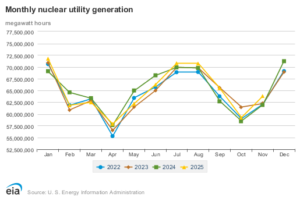
Nuclear power remains a critical source of reliable baseload electricity. EIA forecasts that nuclear generation will remain stable through 2026, accounting for roughly 18% to 19% of total U.S. electricity generation. While renewables such as solar and wind are growing rapidly, nuclear continues to provide round-the-clock power that complements intermittent clean energy sources.
This reliability is especially important for AI data centers, which require constant power and cannot rely solely on variable renewable generation.
Uranium Production and Fuel Cycle Challenges
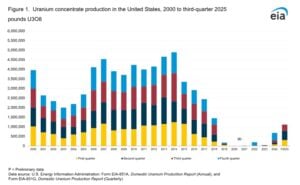
Despite strong policy support, the U.S. nuclear fuel sector faces significant challenges. Domestic uranium production has been volatile, highlighting the difficulty of rebuilding a mining industry after decades of decline.
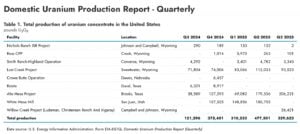
EIA highlighted that, in the third quarter of 2025, U.S. uranium concentrate production totaled 329,623 pounds of U3O8, a 44% decline from the previous quarter. This drop underscores the need for sustained investment and policy support to stabilize domestic supply.
Beyond mining, the U.S. must also expand conversion, enrichment, and fuel fabrication capacity. Much of the global enrichment market is dominated by foreign suppliers, including Russia, Europe, and China. Rebuilding domestic capabilities will require large capital investments and regulatory approvals.
Trump Targets Massive Nuclear Expansion
U.S. policy is increasingly aligned with nuclear expansion. The United States currently operates 96 nuclear reactors with a total gross capacity of about 102 gigawatts, according to the World Nuclear Association.
In May 2025, President Donald Trump signed executive orders targeting 400 gigawatts of nuclear capacity by 2050. The policy includes uprates at existing reactors, construction of new large reactors by 2030, and major investments in fuel cycle infrastructure.
The strategy also emphasizes domestic supply chains for uranium mining, enrichment, fuel fabrication, and waste management. Building these supply chains is seen as critical for energy security, especially as geopolitical tensions affect global uranium and enrichment markets.
Analysts expect SMRs and advanced reactors to play a growing role, particularly for industrial facilities, hydrogen production, and large data centers seeking long-term power contracts.
Fusion and Advanced Reactors: Long-Term Game Changers
While traditional nuclear reactors are expanding, fusion and advanced fission technologies represent the long-term future of the sector.
Fusion promises abundant, low-waste energy, but it remains technologically complex and expensive. The DOE-Kyoto Fusioneering partnership aims to close key technology gaps and accelerate commercialization timelines.
Advanced fission reactors, including fast reactors and SMRs, are closer to deployment. These designs offer improved safety, lower costs, and flexibility for industrial applications. They also require new fuel types such as HALEU, reinforcing the importance of domestic enrichment capacity.
Why This Matters for US Nuclear Infrastructure
The U.S. push to revive nuclear infrastructure, expand enrichment, and accelerate fusion reflects a strategic shift in energy policy. Nuclear power is becoming a cornerstone of the digital economy and clean energy transition.
For investors, these developments could reshape uranium markets, nuclear technology companies, and infrastructure spending. Rising electricity demand from AI and electrification could support long-term growth in nuclear capacity, even as renewables continue to scale.
With AI, data centers, and electrification driving record electricity demand, nuclear power is emerging as a strategic asset for reliable, low-carbon energy. Policy support is strong, but rebuilding the full nuclear fuel cycle will require sustained investment, regulatory reform, and public acceptance.
In conclusion, the DOE’s recent partnerships with General Matter and Kyoto Fusioneering highlight a coordinated effort to rebuild the U.S. nuclear ecosystem—from mining and enrichment to advanced reactors and fusion research.
The post DOE’s Nuclear Fuel and Fusion Partnership Signals a New Era for U.S. Power Markets appeared first on Carbon Credits.
Carbon Footprint
Climate-Linked Supply Chain Risk Is Already in Your P&L
The earnings calls that quietly reframed climate from sustainability question to operating risk.
Three earnings calls in the last 18 months tell the story without any help from a press release.
Hershey, May 2024: cocoa price exposure compresses margin, and the company attributes part of the cost shock to West African weather. Olam, July 2024: coffee climate exposure quantified in the annual report. JBS, January 2025: supply chain climate disclosures expanded materially in response to investor pressure and regulatory expectation. None of these companies issued the announcement as climate news. They issued it as financial news. The climate-linked supply chain risk did not arrive with a sustainability framing; it arrived as a P&L line.
You are probably reading this article because you suspect the same thing is happening to your business. This piece walks through what is showing up on which earnings calls, how procurement and finance leaders are quantifying the exposure, and what serious corporates are doing about it before the regulator asks.
Where climate risk has already appeared in earnings
The pattern is consistent across resource-intensive sectors. A weather event compresses supply, the price spikes, the cost flows through the income statement, and the analyst on the call asks whether the event is anomalous or structural. Increasingly, the honest answer is the second one.
Cocoa is the cleanest example. The 2023 to 2024 West African harvest fell sharply on the back of erratic rainfall and disease. Cocoa futures more than tripled. Companies with concentrated West African sourcing absorbed the cost; companies with diversified sourcing absorbed less. The exposure was not climate as ESG topic. It was climate as cost of goods.
Coffee follows the same pattern. Brazilian and Vietnamese harvests have moved on weather more sharply across the last several seasons. Roasters with long-tenor supplier relationships and origin diversification have managed the volatility; roasters with spot-market exposure have not. Wheat, sugar, palm oil, beef: the same dynamic in different commodities, a pattern the IPCC AR6 Working Group II report projects will intensify across agricultural systems through mid-century.
What this means: climate risk is no longer a footnote in the 10-K. It is a line item the CFO has to explain on the call.
The three commodity exposures that hit margin first
For most companies with material Scope 3 exposure, three exposures dominate the near-term P&L risk.
- Concentrated single-origin sourcing in a climate-vulnerable region. If your tier-one supply for any material commodity sits in one geography, you have a concentration risk that climate amplifies. Diversification across origins is the obvious hedge, but it takes years to build and requires relationships you cannot acquire by tender.
- Supplier financial fragility under climate stress. Smallholder farmers, who supply a large share of the global cocoa, coffee, and palm oil market, do not carry the balance sheets to absorb yield shocks. When yields collapse, they exit. When they exit, your supply base shrinks, and the surviving suppliers raise prices. The risk is structural, not cyclical.
- Logistics and storage exposure to extreme weather. Hurricane disruptions to Gulf shipping, drought-driven Panama Canal restrictions, flooding in European inland waterways: each of these has moved input costs in the last three years, a pattern documented in Munich Re’s natural catastrophe data. The exposure shows up as a one-quarter event in the financial press but accumulates over time on the cost line.
TCFD and ISSB disclosure changes
The disclosure architecture has now caught up with the risk. The Task Force on Climate-related Financial Disclosures, whose recommendations are now embedded in the ISSB’s IFRS S2 climate standard, requires companies to disclose climate-related risks across physical and transition categories, with quantification where possible.
For physical risk specifically (the climate-linked supply chain risk you are reading about), the disclosure must address both acute exposures (extreme weather events) and chronic exposures (gradual changes in temperature, precipitation, and growing seasons). The disclosure must address the time horizon over which the risk is material, the parts of the value chain exposed, and the financial impact under different scenarios.
The CSRD imposes similar requirements under European law, with double materiality (both financial and impact materiality) embedded in the assessment. The practical effect: your auditors and your investor relations team now need a defensible answer to the climate-linked supply chain risk question, and the answer needs to be quantified.
What procurement and finance can do now
Three actions matter near-term.
Map your exposure. Most companies do not have a clear view of which tier-one and tier-two suppliers sit in which climate-vulnerable geographies. Without the map, you cannot quantify the risk, and without the quantification, you cannot disclose it credibly. The map is the foundation, and World Resources Institute climate risk research provides useful public tooling to start.
Diversify and deepen, in that order. Diversification across origins reduces concentration risk, but the deeper move is to invest in the resilience of the suppliers you already have. Regenerative practices, agroforestry, soil health interventions: these reduce yield volatility under climate stress and protect your input cost trajectory.
Embed the climate spend inside procurement, not outside it. Treating climate risk as a sustainability cost line subordinates it to the ESG budget. Treating it as a procurement and resilience investment puts it in the budget that matters, which is the cost-of-goods budget that the CFO defends quarterly.
Nature-based supply chain investments are the asset class designed for exactly this purpose. They sit inside the value chain, they reduce climate-linked supply risk, they generate verifiable Scope 3 reductions, and they produce the documentation an auditor and a regulator can both test.
If you are quantifying climate-linked supply chain risk in advance of the next earnings cycle or the next disclosure period, the carbon and sustainability experts at Carbon Credit Capital can help you map your exposure and structure a Dual-Value Model response that addresses reduction, resilience, and disclosure-readiness in a single program. Schedule a consultation.
Carbon Footprint
Where should an SME start with a carbon action plan?
More and more small and medium-sized businesses are hearing the same question from their larger customers: What is your carbon footprint? That question now travels down entire supply chains, and it arrives next to tender requirements, certification criteria, and rising customer expectations.
![]()
Carbon Footprint
Insetting vs Offsetting: Which Actually Counts Toward Your Scope 3 Targets
The accounting differences that decide whether your nature investment shows up in inventory, in BVCM, or nowhere at all.
The question reaches a procurement team about three weeks before the next sustainability committee meeting. Someone has read about insetting. Someone else has just signed off on an offset purchase. The CSO wants to know if the two are interchangeable. The answer is no, and the GHG Protocol Land Sector and Removals Standard is the reason why.
This article walks through what each term means at audit-grade specificity, what the standards actually say about how each gets counted, and how to decide which tool fits which target. The insetting vs offsetting question is one of the most-searched in corporate climate strategy, and one of the most poorly answered. By the end of this piece, you should be able to brief a committee on the difference without notes.
The two definitions, in plain English
Offsetting means buying carbon credits generated outside your value chain and retiring them against your residual emissions. The reduction happens somewhere else, financed by you, and the credit is the receipt.
Insetting means investing in emission reductions or removals inside your own value chain, typically with suppliers, where the reduction is directly linked to the products and services you buy. The reduction happens inside the boundary of your Scope 3 inventory, and the accounting treatment is fundamentally different.
The shorthand from the University of Oxford’s Nature-based Insetting Initiative is useful: insetting is what you do with the supply chain you have; offsetting is what you do with the supply chain you do not have.
What the GHG Protocol Land Sector Standard actually says
The GHG Protocol Land Sector and Removals Standard, finalised in 2024 after a multi-year pilot, sets the rules for how land-based emission reductions and removals enter corporate inventories. The Standard distinguishes between inventory accounting (Scope 1, 2, and 3) and project or intervention accounting (a separate methodology for crediting).
For insetting, the practical implication is that supplier-level interventions, when properly measured and attributed, can reduce your Scope 3 category 1 (purchased goods and services) emissions in your inventory. The reduction is not a credit retired against the inventory; it is a lower inventory number, period.
For offsetting, the credit is retired separately. It can be reported as a contribution toward a net-zero claim under the SBTi Beyond Value Chain Mitigation framework or as part of a VCMI Carbon Integrity claim, but it does not lower the inventory number.
A practical consequence: if your Science Based Target requires a 50% absolute reduction in Scope 3 emissions by 2030, insetting moves you toward the target. Offsetting does not. This single point of difference reshapes the procurement decision.
When insetting counts toward Scope 3 (and when it does not)
Insetting counts toward Scope 3 only when several conditions are met:
- The intervention must occur with an entity in your value chain.
- The emissions reduction or removal must be measured against a defensible baseline.
- The reduction must be attributed to your share of that supplier’s output, not double-counted with other buyers.
- It must follow the inventory accounting rules in the GHG Protocol Land Sector Standard, not the project accounting rules used to generate credits.
The most common failure mode is double counting. If your supplier sells the same reduction as a credit on the voluntary market and also reports it to you as a Scope 3 reduction, the math breaks. The Standard requires you to address this risk, typically by purchasing and retiring the supplier-issued credit as part of your inventory or by contractual provisions that prevent the supplier from selling the reduction twice.
When insetting does not count toward Scope 3: when the intervention sits with a supplier you do not buy from, when the baseline is not defensible, when the attribution is unclear, or when the documentation does not survive audit. Those cases default to Beyond Value Chain Mitigation, which is still useful but operates on a different ledger.
The procurement and supplier engagement question
Insetting is harder than offsetting. That is the unfashionable truth most buyers eventually confront. Offsetting is a transaction; insetting is a relationship.
To run an insetting program, you need supplier mapping precise enough to know which farms or facilities sit at which Scope 3 boundary. You need an engagement model that gets suppliers to participate, which usually requires multi-year commitments and shared economics. You need an MRV architecture that measures the right things and produces audit-ready documentation. And you need a contractual structure that prevents double counting and protects both sides.
The trade-off you receive in return is significant. Reductions count against your inventory rather than your residual. Supplier relationships deepen, which protects sourcing continuity. Yield and quality improvements often follow regenerative interventions, which reduces your input cost over time. And the regulatory file, under CSRD, CSDDD, EUDR, and the SBTi FLAG Guidance, is materially stronger.
Choosing the right tool for the right target
A practical decision rule. If your target is a science-based Scope 3 reduction and you operate in a FLAG sector or source FLAG commodities, insetting is the structurally correct tool. If your target is a net-zero claim that includes neutralising hard-to-abate residual emissions outside your value chain, BVCM via high-integrity offsets is the structurally correct tool. Most companies with material Scope 3 exposure need both, in different proportions, sequenced over time.
The sequencing matters. Insetting takes longer to stand up but produces a permanent reduction in the inventory. Offsetting can be transacted faster but does not change the inventory and now sits under tighter claim restrictions. Treat them as complementary tools with different jobs, not as substitutes. The Accountability Framework Initiative and the IUCN Global Standard for Nature-based Solutions both provide useful guardrails for the insetting side, with biodiversity, human rights, and benefit-sharing requirements that go beyond carbon math.
If you are mapping a Scope 3 reduction roadmap and need to scope which interventions count toward your inventory versus which sit in Beyond Value Chain Mitigation, the carbon and sustainability experts at Carbon Credit Capital can help you structure a nature-based supply chain investment program that fits your FLAG exposure, your target architecture, and your audit horizon. Schedule a consultation.
-
Climate Change1 year ago
Guest post: Why China is still building new coal – and when it might stop
-
Greenhouse Gases1 year ago
Guest post: Why China is still building new coal – and when it might stop
-
Greenhouse Gases2 years ago嘉宾来稿:满足中国增长的用电需求 光伏加储能“比新建煤电更实惠”
-

Climate Change2 years ago嘉宾来稿:满足中国增长的用电需求 光伏加储能“比新建煤电更实惠”
-
Climate Change2 years ago
Bill Discounting Climate Change in Florida’s Energy Policy Awaits DeSantis’ Approval
-
Renewable Energy10 months agoSending Progressive Philanthropist George Soros to Prison?
-
Greenhouse Gases1 year ago
嘉宾来稿:探究火山喷发如何影响气候预测
-
Carbon Footprint2 years agoUS SEC’s Climate Disclosure Rules Spur Renewed Interest in Carbon Credits

