

Welcome to Carbon Brief’s DeBriefed.
An essential guide to the week’s key developments relating to climate change.
This week
EU leaders agreed climate goal ‘truce’
‘BREAKTHROUGH’: EU leaders have reached a “breakthrough” on climate issues that “increases the likelihood” that the bloc will be able to sign off on its 2040 climate goal before COP30 in November, reported Bloomberg. Leaders reached a “truce” after agreeing to a raft of “enabling conditions”, designed to support carmakers and other energy-intensive industries through a “green transition”, it added.
‘COMPETING GOALS’: Reuters reported that leaders agreed “to proceed with the 2040 target, but [to] leave details for ministers to approve at a 4 November meeting”. It added that the European Commission had “promised to amend some climate measures” to win support from member states, including “controlling” carbon prices in the upcoming market for heat and transport fuels. France24 noted that leaders discussed how to manage the bloc’s “competing goals” of supporting business while playing a “lead role in the climate fight”.
Shipping industry delayed carbon price
NEGOTIATIONS COLLAPSE: Just hours after the previous issue of DeBriefed was published, member states of the UN’s International Maritime Organization agreed to delay a vote on whether to formally adopt a global carbon price for shipping by a year, reported the National. It said the negotiations “collapsed under US pressure”, meaning they were unable to finalise a deal agreed in April that would have “made shipping the first global industry subject to a carbon pricing system”. [Carbon Brief covered the deal and what it would have meant for shipping emissions at the time.]
‘MAJOR VICTORY’: The Financial Times described the delay as a “major victory” for US president Donald Trump’s “campaign to block a climate agreement for the global shipping industry” and “part of the wider Trump administration drive to sell more of its oil, coal and gas”. According to Agence France-Presse, the UN called the delay a “missed opportunity” and the European Commission said it was “regrettable”
‘REGRETABLE DERAILMENT’: A Financial Times editorial said the outcome was a “regrettable derailment” and “one of Trump’s most successful attempts yet to force all countries, rich and poor, to back his push to prolong the era of fossil fuels”. Elsewhere, US secretary of state Marco Rubio wrote a letter to the Wall Street Journal, outlining how the administration had “thwarted the UN’s tax”, dubbing the delay a “diplomatic victory” for the US.
Around the world
- DISASTER ALERTS: A new report from the UN’s World Meteorological Organization has called for a worldwide disaster alerts system as extreme weather events are leaving millions of people vulnerable, reported Al Jazeera.
- FOREST FUND: The World Bank has agreed to host the Tropical Forest Forever Fund (TFFF), being pushed by the Brazilian COP30 presidency Brazil, according to Folha de São Paulo. Separately, the country’s state-owned oil company Petrobras has been granted permission to drill for oil near the mouth of the Amazon, reported the Guardian.
- ‘GREEN JOBS’: The UK government announced a national clean-energy jobs plan, designed to “create…an extra 400,000 green jobs” in the next five years, the Guardian said. Meanwhile, UK prime minister Keir Starmer made a “last-minute decision” to attend COP30 in Brazil in November, the Financial Times reported.
- ‘BEAUTIFUL CHINA’: After a meeting in Beijing, top Chinese policymakers have listed “building a Beautiful China” as a “primary objective” for the 15th five-year plan covering 2026-2030, said International Energy Net. The concept, described in Carbon Brief’s glossary, covers tackling pollution and meeting China’s carbon neutrality targets..
$101bn
The record-high cost of “climate disasters” in the US in the first half of 2025, according to new research from the Climate Central group reported by the Guardian.
Latest climate research
- Between 1997 and 2021, Antarctic ice shelves saw a decrease in “damaged area” | Nature Climate Change
- Reducing food waste and dietary shifts could help halve emissions related to meat consumption in US cities | Nature Climate Change
- In an “overshoot” scenario, where the world temporarily passes 1.5C of warming, permafrost area may “effectively recover” once temperatures fall, but carbon losses will be “largely irreversible” | Earth System Dynamics
(For more, see Carbon Brief’s in-depth daily summaries of the top climate news stories on Monday, Tuesday, Wednesday, Thursday and Friday.)
Captured
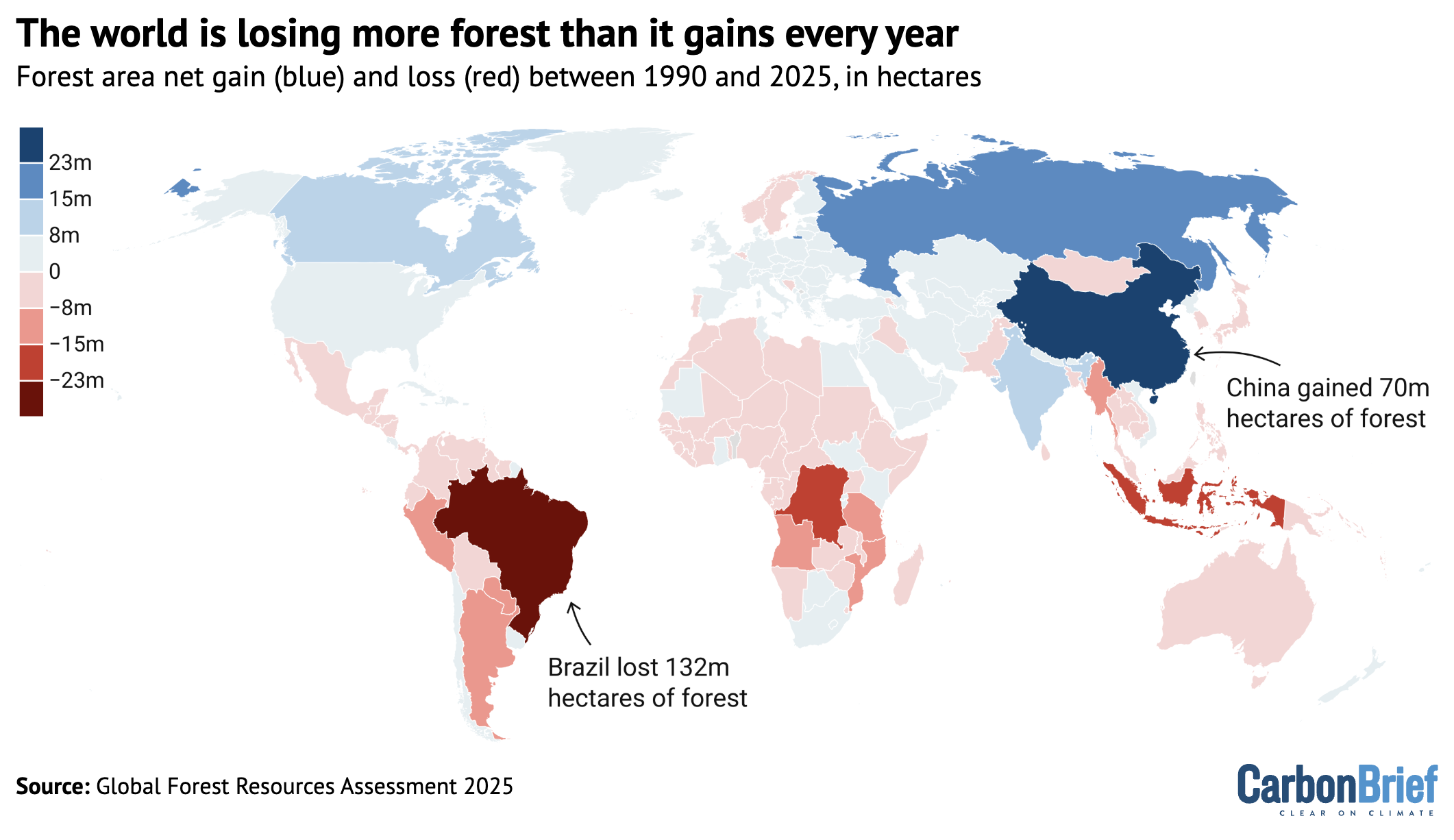
The amount of forest being lost around the world has reduced by millions of hectares each year in recent decades, Carbon Brief reported, based on the Global Forest Resources Assessment from the UN’s Food and Agriculture Organization. The report found that an estimated 10.9m hectares (Mha) of land was deforested each year between 2015 and 2025, nearly 7Mha less than the annual loss over 1990-2000. However, as the map above shows, more forest is still lost than gained each year. Between 2015 and 2025, there was an average 6.8Mha of forest growth each year, but 10.9Mha of loss.
Spotlight
The Sámi people take Finland to court
This week, Carbon Brief reports on the launch of a “landmark” legal claim by the Indigenous Sámi people against the government of Finland, focused on the interplay between climate change and cultural traditions.
In June, 33 members of the Muddusjärvi Reindeer Herders’ Cooperative (MPLK), a Sámi community in northern Finland, brought a legal complaint to the UN human rights committee in Geneva.
It alleged that the Finnish government had allowed multiple breaches of the International Covenant on Civil and Political Rights (ICCPR), which sets out the right to enjoy one’s culture, family life, non-discrimination and self-determination.
The MPLK has practised “nature-based Sámi reindeer herding” for centuries in Finland, as part of one of three remaining herding communities that use the endangered Inari Sámi language. The Sámi are the only Indigenous people recognised in Europe.

Changing conditions
Within its complaint, the MPLK said it is being dispossessed from land traditionally used for reindeer herding, as a result of climate change and decades of intensive logging by the Finnish state-owned forestry agency Metsähallitus. These have “severely damaged” the land they depend on, the group’s lawyers Hogan Lovells said.
In particular, the loss of lichen-rich, old-growth forests and changes to snow conditions have made it harder for reindeer to access natural food sources, creating an “existential threat” that “places in jeopardy the viability of the MPLK community’s way of life”, according to the complaint.
While there are additional funds provided by the Finnish government to compensate reindeer herders during harsh winters, this does not go far enough, the MPLK argued. For example, herders lost €32m between 2019 and 2020, but the MPLK only received €6m in compensation.
There have already been a number of lawsuits brought by the Sámi people across the Nordic countries, in an effort to protect their lands and traditions.
This includes the Norwegian government having to pay out millions to Sámi reindeer herders, an ongoing case in Sweden and two UN committees finding that Finland had violated Sámi rights to culture and land through mineral exploration permits on their territory.
A new precedent
For the MPLK case, Hogan Lovells are relying on a precedent set at the committee in 2022 in a case brought by an indigenous group in Australia, whereby the government was ordered to compensate Torres Straits islanders who argued that climate change had a direct harmful consequence on their livelihood, culture and traditional ways of life.
Finnish human rights law professor and human rights practitioner Martin Scheinin was involved in that case and is now co-counsel for the MPLK complaint. He told Carbon Brief that he had been “thrilled” by the 2022 outcome:
“The [UN committee] broke [a] new path by focusing on Australia’s adaptation obligations as positive human rights obligations. As the committee also established that the right of minorities and Indigenous peoples to enjoy their own culture includes the right to transmit a distinctive way of life to new and even future generations, it was natural that the Indigenous Sámi people in Finland…want to build upon all these elements in their own case before the same committee.”
A formal response from the Finnish government to the complaint is expected this month.
Watch, read, listen
INDONESIA’S ‘ENERGY PARADOX’: A new episode of the China-Global South Podcast discussed how China sits at the heart of Indonesia’s “energy paradox”.
‘RARE-EARTHS TRAP’: Simon Nixon, former chief leader writer for the Times, wrote on his Substack about how the “west lost” to China, after the country “spent decades laying its rare-earths trap”.
ANIMAL OBSTRUCTION: The latest episode of the Drilled podcast discussed how the animal agriculture industry has – and still does – “obstruct…climate policy”.
Coming up
- 28 October: NDC 3.0 synthesis report
- 28 October: Tanzania, presidential and parliament elections
- 29 October: UNEP Adaptation Gap Report 2025
- 29 October: Netherlands, parliamentary elections
- 29 October: UK’s “carbon budget delivery plan”
Pick of the jobs
- Imperial College London, project manager | Salary: £41,005-£45,616pa. Location: London, England.
- UN Food and Agriculture Organization, policy officer (environment and climate change) | Salary: Unknown. Location: Santiago, Chile
- Nature Energy, associate or senior editor | Salary: $80,000-$95,000. Location: New York, US.
- EBRD, analyst, climate risk | Salary: Unknown. Location: London, England.
- Local Storytelling Exchange, freelance associate storytellers | Salary: £12,000 for 60 days. Location: Wales.
DeBriefed is edited by Daisy Dunne. Please send any tips or feedback to debriefed@carbonbrief.org.
This is an online version of Carbon Brief’s weekly DeBriefed email newsletter. Subscribe for free here.


The post DeBriefed 24 October 2025: EU 2040 climate goal progress; Shipping industry carbon price delayed; Europe’s indigenous people take Finland to court appeared first on Carbon Brief.

June Rubis is a steering group committee member for the Cali Fund, from Sarawak in Malaysian Borneo.
At COP16 in Cali, governments made a significant commitment: at least half of the funding from the new Cali Fund should support the self-identified needs of Indigenous Peoples and local communities, including women and youth. It was a watershed moment for multilateral benefit-sharing.
The challenge now is to translate that commitment into access arrangements that recognise the different institutions, priorities and decision-making processes of Indigenous Peoples and local communities.
For generations, biodiversity and traditional Indigenous knowledge have provided significant value to companies who depend on nature’s genetic diversity to discover new drugs that fight diseases, create products that improve health, and grow crops resilient to extreme heat and flooding events. While some compounds are sampled directly from the source country, increasingly the digital blueprints are held in online public databases which are freely accessible to use for innovation and research.
Countries urged to ramp up “insufficient” nature policies at COP17
The Cali Fund was established at COP16 to encourage commercial users of Digital Sequence Information, or DSI, to share benefits arising from its use. Estimates suggest it could generate over $3.5 billion a year – a stark contrast to the modest $10,656 currently committed to the fund from just five SMEs, underlining how much progress must be made at COP17 over the next two weeks.
The COP16 decision that set up the fund offers two routes for money to reach Indigenous Peoples and local communities: through government authorities, and through direct payments to institutions identified by Indigenous Peoples and local communities themselves.
Varied ways of organising
Indigenous Peoples and local communities organise through a wide range of institutions. Some have national or regional organisations experienced in managing international grants. Others work through territorial organisations, customary institutions, community associations, cooperatives or networks. Some have professional finance teams and audited accounts; others have extensive experience governing territories, collective resources or conservation work without having been organised around international funding requirements.
For direct access, some questions are already apparent. Which institutions should be able to receive funds? How should they be identified? What fiduciary standards should apply? How should safeguards and accountability work where institutional capacities differ? What support may be needed where institutions have strong community mandates but less experience with international finance?
Comment: Protecting nature is a public duty, not a Wall Street profit opportunity
If access is designed mainly around institutions that already meet the expectations of large international finance mechanisms, early funding will tend to favour those already familiar to funders. They will gain further experience and become better positioned for future funding, while institutions with less administrative capacity may remain outside the system despite strong community mandates and long histories of stewardship.
These first decisions matter most, because they set the terms for everyone who follows.
The role of intermediaries requires care. Some Indigenous organisations may want a fiscal host to hold and manage funds on their behalf. Communities may choose to work through an NGO they trust. Government-facilitated arrangements may work well in particular national contexts.
What matters is the function an intermediary performs and the authority that comes with it. Providing administrative support is different from deciding which Indigenous organisations qualify, which priorities can receive support, or how success will be assessed. Direct access means communities keep that decision-making authority.
Decision-making power
The COP16 decision refers to institutions that Indigenous Peoples and local communities identify. But authority among Indigenous Peoples does not sit in one kind of body. It may sit with territorial organisations, customary institutions, community associations or combinations of these. Legal recognition and customary authority do not always align neatly.
Global deforestation slowed in 2025 but Brazil’s election could undo “fragile” gains
An important feature of the Cali Fund’s governance is that Indigenous Peoples and local communities participate as full members of the Steering Committee, rather than as observers. Seven Indigenous Peoples and local community representatives, one from each of the seven socio-cultural regions, participate in consensus-based decision-making alongside representatives of governments and UN entities. Six additional representatives from civil society, scientific institutions and the private sector participate as observers.
That representation carries responsibility. Institutional legitimacy, access and representation take different forms across the seven socio-cultural regions. Indigenous Peoples and local communities members therefore have an important role in bringing those differences into the Fund’s governance and in ensuring that arrangements developed for one context do not become the assumed model for everyone else.
Safeguards and clear responsibilities
COP17 can establish the core principles and direction, while allowing operational pathways to develop in ways that respond to different regional contexts. The decisions countries take in Yerevan will shape how that flexibility is realised in practice.
The choices made around access will influence which institutions are able to participate, which routes become established and which forms of authority are recognised within the funding architecture. The aim should be an architecture with enough structure to maintain confidence while allowing for different forms of Indigenous and community governance.
A credible direct-access pathway will need safeguards, financial oversight and clear responsibilities. This would give the 50% commitment a stronger institutional foundation.
The Cali Fund’s importance will ultimately depend not only on how much funding reaches Indigenous Peoples and local communities, but on whether they are able to determine how the money is accessed, governed and used. This requires access pathways that recognise their institutions, priorities and decision-making processes, rather than requiring them to conform to a single predetermined model.
The post COP17 must settle who decides how Cali Fund money is disbursed appeared first on Climate Home News.
COP17 must settle who decides how Cali Fund money is disbursed
The UK government has approved extraction at the Jackdaw gas field in the North Sea, despite acknowledging that this decision could make it harder for Britain to convince other countries to move away from fossil fuel production.
UK energy secretary Miatta Fahnbulleh approved the drilling on Wednesday after months of high-profile debate, fuelled in part by interventions from US President Donald Trump. She argued that the project would boost energy security in the wake of the Middle East fossil fuel crisis, protect hundreds of jobs and add £2.9 billion ($3.88bn) to the UK economy.
She said Jackdaw’s gas would be cleaner than imported gas and would not prevent the UK from meeting its legally-binding carbon targets and its goal of net zero by 2050. As the field is already licensed, she said extraction was consistent with the Labour Party’s 2024 manifesto promise not to issue any new oil and gas licenses.
The same morning, the government announced a new Energy Wealth Fund to reinvest oil and gas revenues in the climate transition. It will start with £2 billion ($2.67bn) from the government and be topped up over time with tax revenues from offshore oil and gas production.
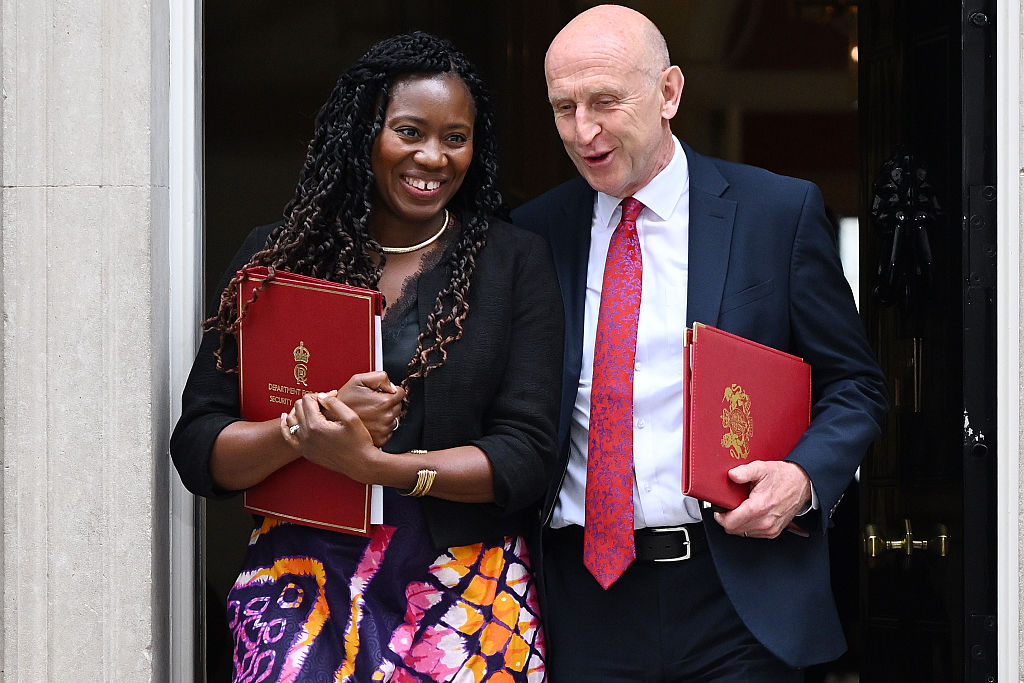
Climate campaigners in the UK and abroad were quick to condemn the decision, while a leading legal expert told Climate Home News it goes against the advice of the International Court of Justice. Meanwhile, the government’s own documents reveal that it recognises the drilling could damage the UK’s reputation and its ability to push forward the global transition away from fossil fuels.
“Climate leadership” blow
The 92-page decision document says Fahnbulleh “acknowledges that international standing on climate is important and accepts that a decision to grant consent may not further the UK’s international climate leadership.”
It adds: “She acknowledges concerns about the potential implications for the UK’s credibility and influence – including the difficulty inherent in encouraging other states to move away from fossil fuel production while the UK continues, in a limited and transitional way, to draw on its own domestic resources.”
While noting that Jackdaw has not been issued with a new license – just permission to extract gas – the document says Fahnbulleh “accepts this does not fully resolve the underlying tension in the UK’s position” but “considers this alongside the substance of the UK’s wider record [on emissions reduction], which remains significant”.
It continues that she accepts these concerns are “legitimate” and weigh against approving gas extraction, but only gives this argument a “moderate negative weight” set against the benefits of gas production.
“Huge” wrong signal
In international climate talks, the UK has long supported the transition away from fossil fuels and is one of very few major oil and gas producers to ban new licenses. Across the North Sea, the Norwegian government continues to make offshore areas available for oil and gas exploration through annual licensing rounds.
Climate experts and campaigners shared the concern, acknowledged in the decision document, that approving Jackdaw could set a precedent for fossil fuel production elsewhere. Sam Fankhauser, professor of climate change economics at Oxford University, said the direct climate impact of Jackdaw is “much smaller than the debate around it would suggest” but the “wrong signal it sends, however, is huge”.