

Deep Sky, Canada’s leading carbon removal project developer, has kicked off operations at Deep Sky Alpha, its flagship commercialization center in Innisfail, Alberta. The facility has achieved a major industry milestone—North America’s first-ever underground storage of CO₂ captured directly from the atmosphere.
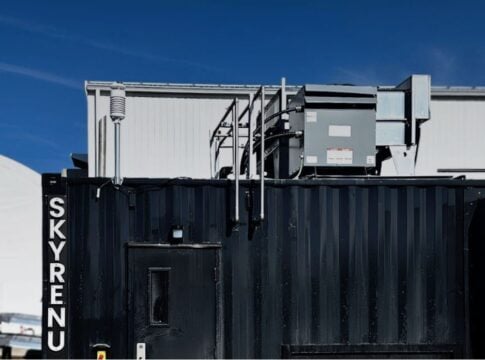
This breakthrough was made possible through a partnership with Skyrenu Technologies, a Quebec-based startup specializing in direct air capture (DAC). Skyrenu’s system successfully removed CO₂ from the air and, working with Deep Sky, permanently stored it underground. The event marks the first complete carbon removal cycle using a Canadian-developed DAC solution.
Alex Petre, Deep Sky CEO, commented,
“This is exactly what Deep Sky Alpha was built for. A product of Sherbrooke University, Skyrenu’s achievement shows that Canadian climate tech can lead on a global stage and that carbon removal is ready to scale today.”
Skyrenu: A Canadian Climate Tech Success Story
Skyrenu is not just another climate startup. Born out of Sherbrooke University and spun from the XPRIZE Carbon Removal competition, the company first gained attention after winning the student prize in 2021. It later ranked among the top 20 finalists worldwide in the competition.
The company builds compact, modular DAC systems designed for:
-
Low energy consumption
-
Scalable deployment
-
Rapid commercialization
By developing cost-efficient and flexible technology, Skyrenu is positioning itself as one of Canada’s strongest climate technology innovators. Its DAC unit, now operating at Deep Sky Alpha, has the capacity to remove 50 tonnes of CO₂ per year.
Gabriel Vézina, Skyrenu CEO,
“We’re incredibly proud to lead the way as the first Quebec-based DAC technology to capture CO₂ for permanent storage in North America. Our partnership with Deep Sky is a powerful example of how to accelerate DAC to climate-relevant scale. Deep Sky’s ability to integrate the full value chain—from CO₂ capture to sequestration—perfectly complements Skyrenu’s focus on designing and producing high-performance DAC units. Together, we can deliver impactful projects faster, generate high-quality carbon removal, and set a new benchmark for the industry. This first win proves that we have the model to lead the way in Canada and beyond.”
Deep Sky’s Vision: Gigaton-Scale Carbon Removal
Montreal-based Deep Sky has quickly emerged as a global leader in carbon removal project development. Unlike single-technology players, Deep Sky is tech-agnostic—bringing together multiple DAC and ocean carbon capture technologies under one roof.
With $130 million in funding from high-profile backers like Investissement Québec, OMERS Ventures, BDC Climate Fund, Breakthrough Energy Catalyst, and leading Canadian banks, Deep Sky is building the world’s largest pipeline of high-quality carbon credits.
Its long-term mission is clear: remove gigatons of carbon from the atmosphere and permanently store it underground.
Deep Sky Alpha: Canada’s First Carbon Removal Commercialization Center
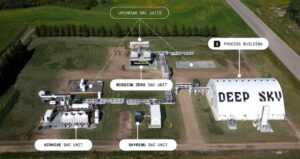
Located on five acres in Innisfail, Alberta, Deep Sky Alpha represents a world first in cross-technology carbon removal testing. The facility runs entirely on solar energy and is built to accelerate the transition from prototype to full commercialization.
Key highlights of the Alpha project include:
-
3,000 tonnes of CO₂ capture per year capacity
-
100% renewable power supply
-
Permanent underground storage in Alberta’s saline aquifers, 2 kilometers below ground
-
Rapid deployment timeline—built in just 12 months
-
Economic impact—over 110 construction jobs created and 15 permanent roles
By combining several DAC technologies under identical conditions, Alpha enables real-world validation, scalability testing, and generation of verifiable carbon credits.
Why Alberta Is the Perfect Location?
Alberta’s geology makes it a prime site for permanent CO₂ storage. The province has abundant deep saline aquifers, rock formations capable of holding carbon safely for thousands of years.
Innisfail was chosen not only for its geology but also for its proximity to renewable energy sources and industrial infrastructure. This strategic setup supports cost-effective scaling of carbon removal projects while maintaining transparency and safety.
The First Step Toward a Global Carbon Removal Network
Deep Sky Alpha is more than just a standalone project—it’s the first step in a larger global rollout.
The company is already advancing large-scale carbon removal projects across Quebec, Alberta, and beyond. Its international ambitions are also backed by recent deals, including:
-
A $40 million grant from Breakthrough Energy Catalyst
-
Carbon credit purchase agreements with major buyers such as Microsoft and Royal Bank of Canada
With these partnerships, Deep Sky is laying the foundation for a global network of carbon removal hubs.
High-Quality Carbon Removal: Essential for Net Zero
As governments and corporations work toward net-zero goals, permanent carbon removal is becoming a non-negotiable part of climate action.
Unlike emission reductions alone, carbon dioxide removal (CDR) technologies provide a way to actively pull CO₂ out of the atmosphere. For hard-to-abate sectors like aviation, shipping, and heavy industry, solutions like DAC and geological storage are critical.
Skyrenu’s deployment at Deep Sky Alpha highlights the importance of homegrown, scalable, and verifiable CDR solutions. Each tonne of CO₂ captured and stored is measurable, permanent, and market-ready as a carbon credit.
Also moving on, Deep Sky’s selection of Skyrenu reflects the company’s rigorous criteria for technology partnerships. It seeks solutions that are:
-
Electrified: Must run entirely on clean electricity without relying on fossil-based heat sources.
-
Low-energy: Targeting 1,000 kWh per tonne of CO₂ or less to maximize efficiency.
-
Simple and focused: Technologies that concentrate purely on CO₂ capture rather than producing multiple byproducts, reducing logistical complexity.
This focus on scalability, simplicity, and efficiency helps Deep Sky fast-track technologies from lab prototypes to commercial solutions.
The Global Direct Air Capture (DAC) Market: Growing at Record Speed
Deep Sky’s work comes at a time when the Direct Air Capture market is booming.
-
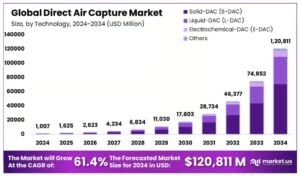
The global DAC market is projected to reach USD 120,811 billion by 2034, up from USD 1,007 billion in 2024.
-
That’s a staggering CAGR of 61.4% between 2025 and 2034.
-
North America is leading the sector, with 48.3% market share.
This growth reflects rising demand for high-quality carbon credits and the urgent need to balance global emissions. Deep Sky Alpha positions Canada as a leader in this emerging trillion-dollar industry.
The post Deep Sky and Skyrenu Launch North America’s First Direct Air Capture (DAC) Storage Facility appeared first on Carbon Credits.

EU carbon credit claims changed on 27 September 2026, the day the Directive (EU) 2024/825 began to apply across the European Union. The change is narrow. It changes how a company can talk about the credits it buys. A product can no longer be called neutral on the strength of compensation alone; however, every specific, evidenced statement about what a company measured, reduced, and funded stays fully available.

The post Promoting Improved Cooking Practices in Nigeria appeared first on Terrapass.



-
Climate Change1 year ago
Guest post: Why China is still building new coal – and when it might stop
-

 Greenhouse Gases2 years ago
嘉宾来稿:满足中国增长的用电需求 光伏加储能“比新建煤电更实惠”
-
Greenhouse Gases1 year ago
Guest post: Why China is still building new coal – and when it might stop
-

 Climate Change2 years ago
嘉宾来稿:满足中国增长的用电需求 光伏加储能“比新建煤电更实惠”
-

 Renewable Energy12 months ago
Sending Progressive Philanthropist George Soros to Prison?
-
Climate Change2 years ago
Bill Discounting Climate Change in Florida’s Energy Policy Awaits DeSantis’ Approval
-
Greenhouse Gases1 year ago
嘉宾来稿:探究火山喷发如何影响气候预测
-

 Climate Change2 years ago
Analysis: China’s CO2 falls 1% in Q2 2024 in first quarterly drop since Covid-19