


Bitcoin price surged past $124,000 upon writing, setting a new all-time high. Analysts credit several factors:
- strong institutional buying,
- increased inflows into Bitcoin ETFs,
- favorable regulatory changes allowing crypto assets in 401(k) retirement accounts, and
- growing market optimism over expected Federal Reserve interest rate cuts.

The rally reflects both a recovery from previous market downturns and a renewed appetite for digital assets among mainstream investors.
Ethereum, the second-largest cryptocurrency by market capitalization, is also on the rise. It is now approaching its all-time high of around $4,800, last seen in November 2021.

Investor sentiment is rising because of Ethereum’s role in decentralized finance (DeFi) and NFT marketplaces. Its better environmental profile, thanks to the switch to a proof-of-stake (PoS) model, also helps.
With both tokens in focus, let’s look at their energy use and carbon footprint. This matters for investors and policymakers who care about their climate and environmental impact.
How Bitcoin’s Proof-of-Work Consumes Energy
Bitcoin’s network runs on a process called proof-of-work (PoW). Miners around the world compete to solve complex mathematical puzzles. The first to solve it gets to add a block of transactions to the blockchain and earn newly minted Bitcoin. This process secures the network but demands enormous computing power.
That computing power uses a lot of electricity. Bitcoin’s annual energy use is estimated at about 138–178 terawatt-hours (TWh). This is similar to the electricity consumption of countries like Poland or Thailand, and even greater than Norway.
The carbon footprint is equally large, at around 40 million tonnes of CO₂ equivalent per year. To put that into perspective, that’s similar to the emissions of Greece or Switzerland.
On a per-transaction basis, a single Bitcoin payment can use as much energy as a typical U.S. household does in one to two months.
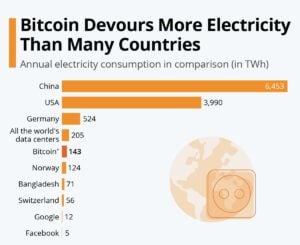
Beyond electricity, Bitcoin mining also generates significant electronic waste. Specialized mining hardware, called ASICs, becomes obsolete quickly—often within two to three years—because faster, more efficient models keep being developed. This turnover contributes thousands of tonnes of e-waste annually.
Ethereum’s Post-Merge Energy Transformation
Before 2022, Ethereum also used proof-of-work, with high energy demands. But in September 2022, the network completed the Merge, switching to proof-of-stake.
Ethereum now uses validators instead of miners. These validators “stake” their ETH tokens as collateral. This helps confirm transactions and secure the network.
This change cut Ethereum’s energy use by over 99.9%. Today, the network consumes an estimated 2,600 megawatt-hours (MWh) annually—roughly 0.0026 TWh. That’s less electricity than a small town of 2,000 homes might use in a year.
The carbon footprint is also tiny compared to Bitcoin—under 870 tonnes of CO₂ equivalent annually. That’s about the same as the yearly emissions of 100 average U.S. households. In environmental terms, Ethereum has gone from being one of the largest blockchain energy consumers to one of the most efficient.

Beyond Electricity: Hidden Environmental Costs
While electricity use is the biggest factor, it’s not the only environmental concern for both cryptocurrencies. Here are the other environmental impacts:
- Water Use:
Large-scale Bitcoin mining facilities often require substantial cooling, which can consume millions of liters of water annually. This can put pressure on local water supplies, particularly in drought-prone regions. Ethereum’s low energy profile greatly reduces such needs. - Heat Output:
Mining facilities generate significant heat. In some cases, waste heat is reused for industrial or agricultural purposes, but in most situations, it is simply released into the environment, adding to local thermal loads. - Land and Infrastructure:
Bitcoin mining operations require large warehouses and access to high-capacity electrical infrastructure. This can limit available industrial space for other uses and put stress on local grids.
By using proof-of-stake, Ethereum avoids most of these impacts. It just needs standard server equipment. This can run in data centers with other low-impact computing tasks.

How the Industry Is Addressing Bitcoin’s Footprint
The crypto industry is aware of Bitcoin’s environmental challenges and is taking steps to address them. Some of the actions taken include:
- Renewable Mining: Some mining operations use only hydro, wind, or solar energy. This is common in areas with plenty of renewable resources.
- Waste Heat Recovery: A few miners capture and reuse waste heat for agriculture (e.g., greenhouse farming) or district heating systems.
- Carbon Offsetting: Companies and mining pools are buying carbon credits to offset emissions. However, how well this works depends on the quality of those credits.
- Policy Proposals: Governments may require Bitcoin miners to share their energy sources or meet renewable energy goals.
SEE MORE: Top 5 Sustainable Bitcoin Mining Companies To Watch Out For
While these efforts are promising, the core challenge remains: proof-of-work’s high energy requirement is built into Bitcoin’s security model.
Why This Matters for ESG-Minded Investors
For investors who care about environmental, social, and governance (ESG) factors, the difference between Bitcoin and Ethereum is stark. Ethereum’s low-energy proof-of-stake model makes it easier to align with climate goals. Bitcoin’s high energy use and emissions, while partially mitigated by renewable adoption, remain a significant concern.
These factors may influence where ESG-focused funds allocate capital. Companies and institutions wanting exposure to blockchain technology without a large carbon footprint might prefer Ethereum or other PoS networks.
Bitcoin may still attract investors because of its market dominance and value as a store. However, it will likely keep facing environmental concerns.
The Road Ahead for Crypto and Climate
Bitcoin and Ethereum’s price rallies show that investor interest in crypto remains strong. As climate change and sustainability gain importance in policy and investment, environmental performance may play a larger role in the long-term value and acceptance of digital assets.
For now, Ethereum sets the standard for energy efficiency among major blockchains, while Bitcoin represents the ongoing challenge of balancing security, decentralization, and sustainability. Can Bitcoin cut its environmental impact without losing its key features? This will be an important question in the coming years.
The post Bitcoin Price Hits $124,000 Record High vs Ethereum Price Near $4,800: Which Crypto Is Greener? appeared first on Carbon Credits.

EU carbon credit claims changed on 27 September 2026, the day the Directive (EU) 2024/825 began to apply across the European Union. The change is narrow. It changes how a company can talk about the credits it buys. A product can no longer be called neutral on the strength of compensation alone; however, every specific, evidenced statement about what a company measured, reduced, and funded stays fully available.

The post Promoting Improved Cooking Practices in Nigeria appeared first on Terrapass.



-
Climate Change1 year ago
Guest post: Why China is still building new coal – and when it might stop
-

 Greenhouse Gases2 years ago
嘉宾来稿:满足中国增长的用电需求 光伏加储能“比新建煤电更实惠”
-
Greenhouse Gases1 year ago
Guest post: Why China is still building new coal – and when it might stop
-

 Climate Change2 years ago
嘉宾来稿:满足中国增长的用电需求 光伏加储能“比新建煤电更实惠”
-

 Renewable Energy12 months ago
Sending Progressive Philanthropist George Soros to Prison?
-
Climate Change2 years ago
Bill Discounting Climate Change in Florida’s Energy Policy Awaits DeSantis’ Approval
-
Greenhouse Gases1 year ago
嘉宾来稿:探究火山喷发如何影响气候预测
-

 Climate Change2 years ago
Analysis: China’s CO2 falls 1% in Q2 2024 in first quarterly drop since Covid-19