

Welcome to Carbon Brief’s China Briefing.
China Briefing handpicks and explains the most important climate and energy stories from China over the past fortnight. Subscribe for free here.
Key developments
Floods killed 60 people after ‘year of rain in a week’
HUMAN TOLL: Heavy rainfall in late July killed at least 60 people across northern China, with flooding and landslides affecting Beijing and neighbouring Hebei province, Reuters reported, adding that “meteorologists link an increase in extreme weather…to climate change”. In some areas, a “year’s worth of rain fell in less than a week”, another Reuters article said. China’s “usually arid north has seen record rains in recent years”, but Beijing’s topography “amplif[ied] the deluge” that killed more than 30 people in the capital, the newswire added. Other affected regions included Shanxi, Shaanxi, Liaoning, Shandong, Tianjin and Inner Mongolia, according to various news outlets.
PERSISTENT HEAT: Five people were killed in southern Guangdong province due to “torrential rain”, said the state-run newspaper China Daily. Shanghai evacuated “around 280,000 people” as storm Co-may brought “strong winds and heavy rainfall”, Bloomberg said. Elsewhere, China Daily reported on “persistent high temperatures” in central China, adding that multiple regions faced intense heat or rainfall this week. The southern city of Chongqing “elevated its heatwave warning to the highest level” following temperatures “exceeding 40C for a week”, Reuters said.

RELIEF FUNDS: State broadcaster CGTN said China allocated more than one billion yuan ($139m) to areas across China for flood and drought relief efforts. Beijing and its neighbouring provinces received 550m yuan ($77m) for flood relief, reported the Hong Kong-based South China Morning Post (SCMP).
NEW OUTBREAK: Meanwhile, thousands of residents in southern China’s Guangdong province have contracted chikungunya, a mosquito-borne disease, Bloomberg reported, quoting an expert saying the “surge in chikungunya cases is likely due to favorable climatic conditions”. The outbreak “is the latest sign that tropical diseases…are expanding their reach, as climate change lets mosquitoes live in new territories”, it added.
Government tackled ‘Industrial Cthulhu’
OVERCAPACITY POLICIES: Regulators released a “draft amendment” to China’s pricing law that aims to “rein in price wars”, Reuters said. China will “name and shame” companies that continue to implement “ruinous competition”, said Bloomberg. Draft “guidance” was also issued on deploying government funds, SCMP reported, to prevent continued “overconcentrat[ion]” of local government investment in the “new three” and other sectors. China’s leadership also called for “reducing excess competition” and regulating “local government practices in attracting investment”, said Xinhua. According to Bloomberg, this showed “China’s leaders see the dangers” of China’s manufacturing strength “clearly”. (It added that some netizens had nicknamed the sector “Industrial Cthulhu”, in a “tongue-in-cheek” comparison that it said was meant to imply that “China’s manufacturing power is a beast”.)
SUPERCHARGING DEMAND: Domestic sales of new-energy vehicles (NEVs) between January and June 2025 rose 40% year-on-year to just under seven million units – 44% of total car sales – reported the Communist party-affiliated People’s Daily, while exports “surged” by 75%. Energy news outlet International Energy Net quoted a National Energy Administration (NEA) official saying China expects 2025 power demand for EV charging alone to equal the “annual power generation of the Three Gorges dam”.
HIDDEN FIGURES: While the figures show that 2025 is “shaping up to be another stellar year” for China’s EV industry “on paper”, Caixin said, “overcapacity” and fierce price wars mean the industry’s mood is “far from celebratory”. Separately, Reuters found it is “increasingly common” for automakers in China, including EV manufacturers and foreign brands, to “inflate car sales”.
EV TARIFFS: Meanwhile, Chinese EVs exports to the EU have made a “full comeback from tariffs set in place last year”, with Chinese automakers’ share in Europe’s EV market surpassing 10%, according to Bloomberg. Elsewhere, Thailand has “adjusted” EV subsidies to encourage exports as surging Chinese investment creates excess domestic “capacity”, said finance news outlet Caixin. EV manufacturer BYD has been offered a “short-term tariff break” in Brazil, but will face aggressive “hikes…in the long run”, SCMP reported.
Forecast for solar growth in 2025 rose to 300GW
GENERATION SHARE: Renewable energy accounted for “almost 40% of total power generation” in the first half of 2025, NEA officials said at a press conference covered by BJX News. New solar and wind generation also covered “total growth in electricity demand”, the energy news outlet added. BJX News also added that, according to the NEA officials, non-fossil fuel sources now account for 60% of China’s electricity mix. Meanwhile, the China Photovoltaic Industry Association “raised its forecast for new domestic solar installations this year” to 270-300 gigawatts (GW), citing the “minimal impact” of “new policies such as document 136” on large-scale clean-energy bases, reported business news outlet Jiemian. China had already installed 212GW of new solar capacity in the first half of the year, said China Daily.
-
Sign up to Carbon Brief’s free “China Briefing” email newsletter. All you need to know about the latest developments relating to China and climate change. Sent to your inbox every Thursday.
INDUSTRY INSPECTIONS: The government will conduct “energy conservation inspections” on polysilicon manufacturers, Jiemian said. It quoted an anonymous “industry insider” as saying the targeted companies are “not all…polysilicon projects for photovoltaic use”, adding that the inspections likely aim to identify “projects that consume resources without creating actual value”. Meanwhile, Reuters found “China’s biggest solar firms shed nearly one-third of their workforces last year”, illustrating the “pain from the vicious price wars”, while “more than 40 solar firms have delisted, gone bankrupt or been acquired” since 2024.
‘ORDERLY’ DEVELOPMENT: China issued a new policy on “further regulating the use of farmland for solar projects”, calling for better management and strict supervision of “solar projects involving the use of farmland”, reported International Energy Net. The NEA also pledged to “guide the orderly development of distributed [solar] projects and ensure safe and efficient consumption”, said another International Energy Net article.
Central bank boosted finance for ‘future energy’
NEW ENERGY FINANCE: China’s central bank, alongside several government ministries, released guidance on financing “new industrialisation”, BJX News reported, adding that it encouraged supporting sectors such as “new energy” in “raising capital” and encouraged state-run investment funds to focus on “future energy” and other “future industries”. The guidance also called for more support for “green and low-carbon transformation” and clean-energy technologies. Separately, China will evaluate the energy consumption and potential carbon emissions of “fixed asset” investments over a certain threshold of energy or coal consumption, said International Energy Net.
‘CLIMATE THREATS’: The CMA launched a new “initiative” to “establish a global early warning service network in the face of escalating climate threats”, CGTN said. China also issued a plan to “create greener, safer and more livable environments” in the face of “intensifying global climate change”, said People’s Daily. China’s agriculture ministry also released a work plan to “ensure a bountiful autumn grain harvest” in the face of an “above-average number of extreme weather and climate events this year”, Xinhua reported.
NDRC ON HIGH DEMAND: The National Development and Reform Commission (NDRC), China’s top economic planning agency, commented on recent high power demand, reported International Energy Net. It explained that the NDRC said China will “ensure an adequate and stable [power] supply” through effective management of coal production and will “integrate new energy’s supporting role” with coal’s role as a “bottom-line guarantee” (兜底保障) for power generation. Separately, the NDRC also highlighted “promoting…comprehensive transformation under dual-control of carbon mechanisms” as one of its “key tasks” for the rest of 2025, according to China Energy Net.
Spotlight
Guest spotlight: What an ‘ambitious’ 2035 electricity target looks like for China
A new study has found that China must at least double its wind and solar capacity by 2035 to align its power sector with a 2C global warming target.
In this issue, co-authors Zhenhua Zhang and Michael R Davidson, a PhD student and associate professor at the University of California, San Diego, respectively, explain how China could encourage climate ambition by setting power-sector targets.
The full article is available on Carbon Brief’s website.
China’s power sector is both the world’s largest emitter and the largest source of clean-energy growth.
This means it will be a key part of China’s next nationally determined contribution (NDC) – its climate pledge under the Paris Agreement for 2035.
In our new study, co-authored with experts from Tsinghua University, we model pathways for China’s power system up to 2035 that are consistent with its wider climate goals.
China has already surpassed its 2030 renewable deployment target, due to recent record-breaking annual additions.
However, new coal-power developments and rapid growth in electricity demand pose a threat to meeting China’s other targets.
Our research looks at the rate of growth from clean energy that would be required to not only meet China’s rapidly rising demand for electricity, but also to push down its coal generation and squeeze emissions from the power sector.
Staying below 2C
We simulate a range of scenarios for 2035, based around two different scenarios for China that are compatible with a global limit of 2C warming this century.
The basic 2C trajectory would see China’s power-sector emissions fall to 36% below 2024 levels by 2035, whereas the more ambitious 2C trajectory has a 42% decline.
It shows wind and solar energy would need to supply around 40% of China’s electricity by 2030, if the country aims to remain on track for 2C of global warming.
Solar and wind power generation would need to then rise to 50% by 2035, up from 17.9% in 2024.
This growth would substantially reduce the system’s reliance on coal and other fossil fuels, which would decrease to 35% of generation in 2030 and 25% in 2035.
The more ambitious scenario, which targets limiting global warming since the pre-industrial period to 1.5-2C, would see even higher wind and solar generation shares of 44% by 2030 and 54% by 2035.
Under the different scenarios, China’s wind and solar capacity would rise from around 1,700GW today to 2,350-2,780GW by 2030 and 2,910-3,800GW by 2030, requiring annual additions of 120-220GW.
Recent wind and solar additions have already exceeded this pace.
Challenges with grid integration and supporting infrastructure could slow future large-scale buildouts, meaning battery and grid capacity would need to rise by 6% and 5% per year to 2035, respectively to better integrate renewables into the grid.
The NDC and beyond
Due to the rapidly evolving economic and geopolitical situation, there are good reasons to expect that China’s topline emissions number in its NDC may be underwhelming. But there is an opportunity to emphasise and expand ambition within the power sector through additional sectoral targets.
While China has previously set a target for the absolute capacity of wind and solar, a goal for the share of electricity generation would set a narrower range for future power sector emissions.
Given current uncertainties around the pace of power demand growth, for example, a target for clean energy share might provide greater confidence than a capacity target alone.
Regardless of what targets are set, achieving the growth of clean energy modelled in our study would support China’s long-term climate commitments and demonstrate the nation’s intent to be a clean-energy powerhouse.
Watch, read, listen
‘UNSHAKEABLE’ GOAL: President Xi Jinping told attendees of the 2023 National Conference on Ecological and Environmental Protection that China’s commitment to its “dual-carbon” goals is “unshakeable”, according to a speech published in full, for the first time, by top ideological journal Qiushi.
CLIMATE REFUGEES: The United Nations Refugee Agency assistant high commissioner Raouf Mazou spoke with China Daily about China’s role in addressing “climate change-linked displacement”.
FINANCE FLOWS: The Environment China podcast explored what impact China’s push to develop “green finance” has had on the country’s energy transition.
PROVINCIAL PROGRESS: The Institute of Public & Environmental Affairs published a report assessing different provinces’ progress in reaching China’s “dual-carbon” goals.
1.35 billion
In tonnes per annum, the amount of coal-mine capacity that is “at various stages of development” in China, according to updated data from thinktank Global Energy Monitor – more capacity than “all other countries combined”.
New science
Communications Earth & Environment
A new study found a “significant increase” in both dry-hot and wet-hot extremes in China during the May-September warm season. The authors investigated changes in hot extremes in 136 Chinese cities over 1981-2022. They found that wet-hot extremes accounted for 36% of all hot days, while dry-hot days accounted for only 4%. The authors said their findings “underscore the urgent need for adaptive urban strategies to mitigate the growing risk of compound temperature-humidity extremes under ongoing urbanisation and climate change”.
China’s nationwide streamflow decline driven by landscape changes and human interventions
Science Advances
The amount of water running through rivers, or “streamflow”, has declined at more than 70% of Chinese hydrological stations over the past six decades, according to a new study. The authors combined data from more than 1,000 hydrological stations with climate models to produce a “comprehensive national assessment” of streamflow across China. They found that decreases in streamflow were mainly in northern China and were driven by changes in land use, but that increases in streamflow were found in the south, mainly driven by “climate change and variability”.
China Briefing is compiled by Wanyuan Song and Anika Patel, with contributions from Svetlana Onye. It is edited by Wanyuan Song and Dr Simon Evans. Please send tips and feedback to china@carbonbrief.org

The post China Briefing 7 August 2025: Deadly floods; ‘Industrial Cthulhu’; Higher solar forecast appeared first on Carbon Brief.
China Briefing 7 August 2025: Deadly floods; ‘Industrial Cthulhu’; Higher solar forecast

Drought and heatwaves occurring together – known as “compound” events – have “surged” across the world since the early 2000s, a new study shows.
Compound drought and heat events (CDHEs) can have devastating effects, creating the ideal conditions for intense wildfires, such as Australia’s “Black Summer” of 2019-20 where bushfires burned 24m hectares and killed 33 people.
The research, published in Science Advances, finds that the increase in CDHEs is predominantly being driven by events that start with a heatwave.
The global area affected by such “heatwave-led” compound events has more than doubled between 1980-2001 and 2002-23, the study says.
The rapid increase in these events over the last 23 years cannot be explained solely by global warming, the authors note.
Since the late 1990s, feedbacks between the land and the atmosphere have become stronger, making heatwaves more likely to trigger drought conditions, they explain.
One of the study authors tells Carbon Brief that societies must pay greater attention to compound events, which can “cause severe impacts on ecosystems, agriculture and society”.
Compound events
CDHEs are extreme weather events where drought and heatwave conditions occur simultaneously – or shortly after each other – in the same region.
These events are often triggered by large-scale weather patterns, such as “blocking” highs, which can produce “prolonged” hot and dry conditions, according to the study.
Prof Sang-Wook Yeh is one of the study authors and a professor at the Ewha Womans University in South Korea. He tells Carbon Brief:
“When heatwaves and droughts occur together, the two hazards reinforce each other through land-atmosphere interactions. This amplifies surface heating and soil moisture deficits, making compound events more intense and damaging than single hazards.”
CDHEs can begin with either a heatwave or a drought.
The sequence of these extremes is important, the study says, as they have different drivers and impacts.
For example, in a CDHE where the heatwave was the precursor, increased direct sunshine causes more moisture loss from soils and plants, leading to a drought.
Conversely, in an event where the drought was the precursor, the lack of soil moisture means that less of the sun’s energy goes into evaporation and more goes into warming the Earth’s surface. This produces favourable conditions for heatwaves.
The study shows that the majority of CDHEs globally start out as a drought.
In recent years, there has been increasing focus on these events due to the devastating impact they have on agriculture, ecosystems and public health.
In Russia in the summer of 2010, a compound drought-heatwave event – and the associated wildfires – caused the death of nearly 55,000 people, the study notes.

The record-breaking Pacific north-west “heat dome” in 2021 triggered extreme drought conditions that caused “significant declines” in wheat yields, as well as in barley, canola and fruit production in British Columbia and Alberta, Canada, says the study.
Increasing events
To assess how CDHEs are changing, the researchers use daily reanalysis data to identify droughts and heatwaves events. (Reanalysis data combines past observations with climate models to create a historical climate record.) Then, using an algorithm, they analyse how these events overlap in both time and space.
The study covers the period from 1980 to 2023 and the world’s land surface, excluding polar regions where CDHEs are rare.
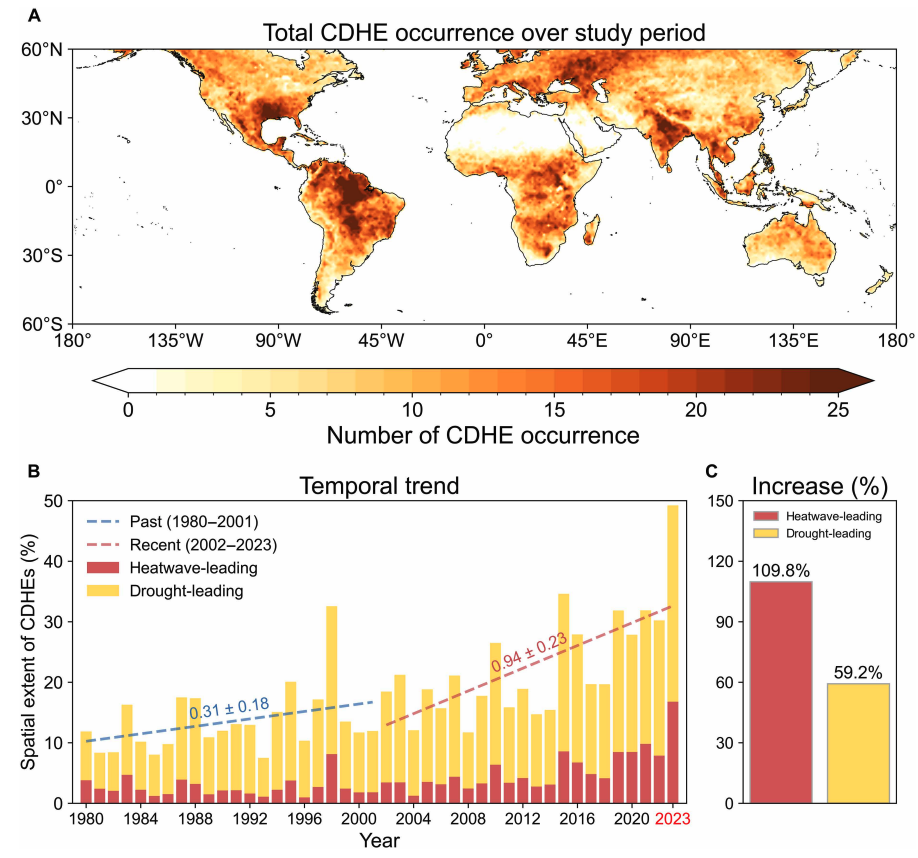
The research finds that the area of land affected by CDHEs has “increased substantially” since the early 2000s.
Heatwave-led events have been the main contributor to this increase, the study says, with their spatial extent rising 110% between 1980-2001 and 2002-23, compared to a 59% increase for drought-led events.
The map below shows the global distribution of CDHEs over 1980-2023. The charts show the percentage of the land surface affected by a heatwave-led CDHE (red) or a drought-led CDHE (yellow) in a given year (left) and relative increase in each CDHE type (right).
The study finds that CDHEs have occurred most frequently in northern South America, the southern US, eastern Europe, central Africa and south Asia.
Threshold passed
The authors explain that the increase in heatwave-led CDHEs is related to rising global temperatures, but that this does not tell the whole story.
In the earlier 22-year period of 1980-2001, the study finds that the spatial extent of heatwave-led CDHEs rises by 1.6% per 1C of global temperature rise. For the more-recent period of 2022-23, this increases “nearly eightfold” to 13.1%.
The change suggests that the rapid increase in the heatwave-led CDHEs occurred after the global average temperature “surpasse[d] a certain temperature threshold”, the paper says.
This threshold is an absolute global average temperature of 14.3C, the authors estimate (based on an 11-year average), which the world passed around the year 2000.
Investigating the recent surge in heatwave-leading CDHEs further, the researchers find a “regime shift” in land-atmosphere dynamics “toward a persistently intensified state after the late 1990s”.
In other words, the way that drier soils drive higher surface temperatures, and vice versa, is becoming stronger, resulting in more heatwave-led compound events.
Daily data
The research has some advantages over other previous studies, Yeh says. For instance, the new work uses daily estimations of CDHEs, compared to monthly data used in past research. This is “important for capturing the detailed occurrence” of these events, says Yeh.
He adds that another advantage of their study is that it distinguishes the sequence of droughts and heatwaves, which allows them to “better understand the differences” in the characteristics of CDHEs.
Dr Meryem Tanarhte is a climate scientist at the University Hassan II in Morocco, and Dr Ruth Cerezo Mota is a climatologist and a researcher at the National Autonomous University of Mexico. Both scientists, who were not involved in the study, agree that the daily estimations give a clearer picture of how CDHEs are changing.
Cerezo-Mota adds that another major contribution of the study is its global focus. She tells Carbon Brief that in some regions, such as Mexico and Africa, there is a lack of studies on CDHEs:
“Not because the events do not occur, but perhaps because [these regions] do not have all the data or the expertise to do so.”
However, she notes that the reanalysis data used by the study does have limitations with how it represents rainfall in some parts of the world.
Compound impacts
The study notes that if CDHEs continue to intensify – particularly events where heatwaves are the precursors – they could drive declining crop productivity, increased wildfire frequency and severe public health crises.
These impacts could be “much more rapid and severe as global warming continues”, Yeh tells Carbon Brief.
Tanarhte notes that these events can be forecasted up to 10 days ahead in many regions. Furthermore, she says, the strongest impacts can be prevented “through preparedness and adaptation”, including through “water management for agriculture, heatwave mitigation measures and wildfire mitigation”.
The study recommends reassessing current risk management strategies for these compound events. It also suggests incorporating the sequences of drought and heatwaves into compound event analysis frameworks “to enhance climate risk management”.
Cerezo-Mota says that it is clear that the world needs to be prepared for the increased occurrence of these events. She tells Carbon Brief:
“These [risk assessments and strategies] need to be carried out at the local level to understand the complexities of each region.”



The post Heatwaves driving recent ‘surge’ in compound drought and heat extremes appeared first on Carbon Brief.
Heatwaves driving recent ‘surge’ in compound drought and heat extremes
Greenhouse Gases
DeBriefed 6 March 2026: Iran energy crisis | China climate plan | Bristol’s ‘pioneering’ wind turbine