

UK chancellor Rachel Reeves has unveiled the first spending review under the current Labour government, announcing funding for nuclear power, energy efficiency and carbon capture and storage (CCS).
A spending review establishes each ministry’s spending limits and priorities for the rest of the parliamentary term.
The Department of Energy Security and Net Zero (DESNZ) received one of the largest jumps in capital spending, despite energy secretary Ed Miliband reportedly being one of the last to agree to a spending settlement.
Before the final details had been announced, the Times was describing Miliband as one of the “biggest winners” from the process.
High-profile funding announcements in the Treasury’s spending review include £14.2bn for the Sizewell C new nuclear power plant in Suffolk, the first state-backed nuclear power station for decades.
Elsewhere, two new CCS clusters – Acorn and Viking – were allocated funding and railways across the nation were given a boost.
Below, Carbon Brief runs through the key announcements.
- Departmental spending
- Energy efficiency
- Energy infrastructure investment
- Transport
- Other announcements
Departmental spending
Spending reviews are an opportunity for governments to stake out their priorities by setting the budgets for departments over the rest of this parliament.
Reeves’ spending review has been viewed by experts and media commentators as an opportunity to boost Labour’s flagging popularity and pursue some of its key manifesto commitments, including net-zero.
It covers plans for departmental “resource” spending – including day-to-day running costs – out to 2028-29 and “capital” spending out to 2029-30.
The latter includes injections of funding for infrastructure and public services, such as major clean-energy and transport projects.
In her speech launching the review, Reeves did not specifically mention the terms net-zero or climate change, but stressed the importance of achieving energy security via domestic, low-carbon power. “Clean energy” also featured prominently in the review document itself.

Overall, total departmental budgets are set to grow by 2.3% in real terms across the spending review period.
The Department for Energy Security and Net Zero (DESNZ) is expected to see a 16% increase in overall departmental spending, reaching £12.6bn in 2028-29.
(This does not include the boost in funding for Sizewell C nuclear plant, which will see a 15.6% increase thanks to a £14.2bn investment over the next five years. See: New nuclear.)
The chart below – taken from the spending review document – shows that while the absolute increase in spending on areas such as health, defence and education is higher, DESNZ is among the most highly prioritised in relative terms.
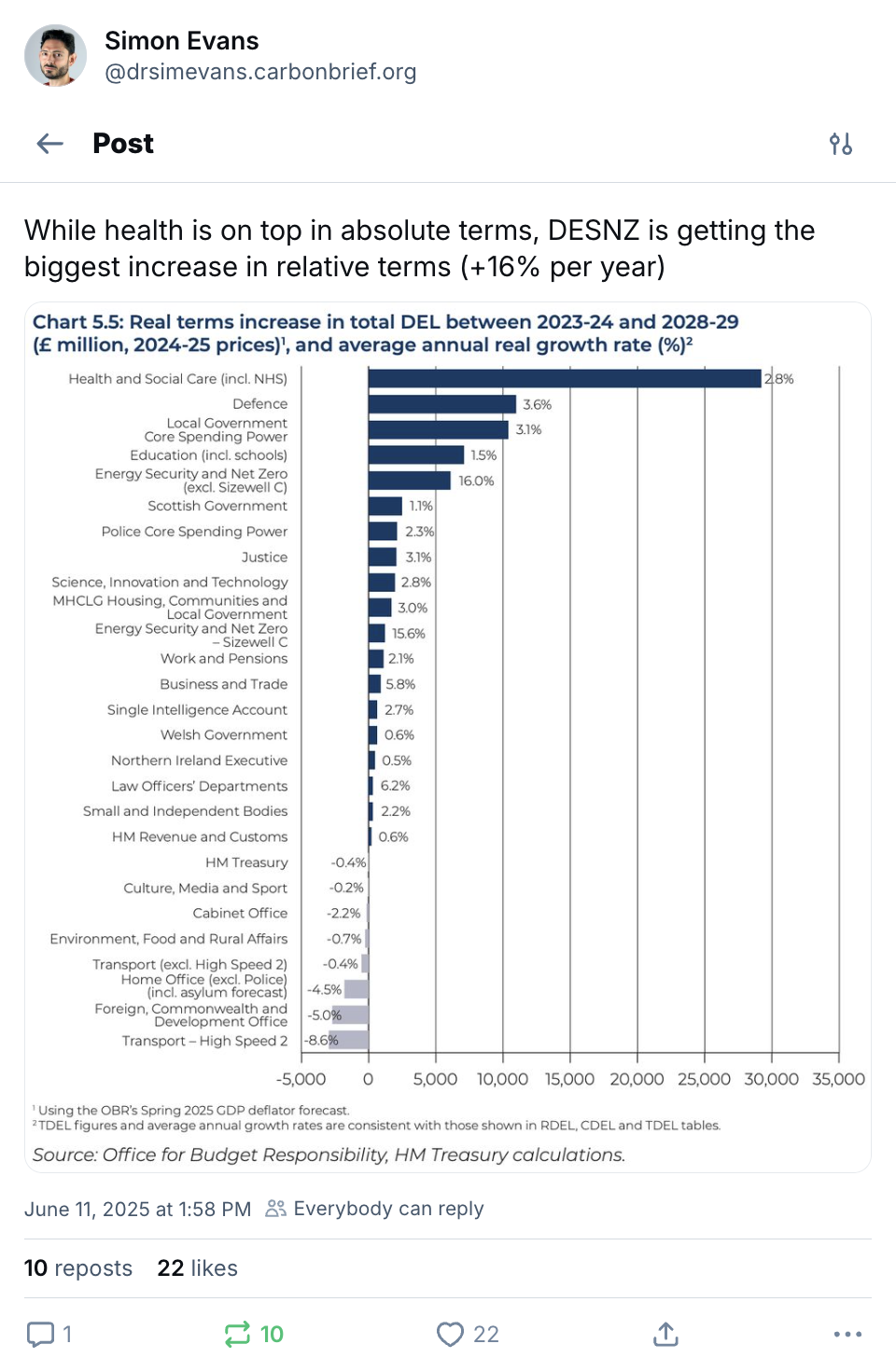
The review document emphasises that this increase in public money is necessary to mobilise private investment and “secure the UK’s electricity system with homegrown, clean power by 2030”.
Other departments that are also relevant for climate action have not seen the same overall increases in budget.
The Department for Transport (DfT) is set to see its overall departmental spending drop by 0.4%. However, the review notes that capital spending will increase, including more money for local low-carbon transport options and major rail projects.
The Department for Environment, Food and Rural Affairs (Defra) budget is also expected to fall overall, but support for “nature-friendly farming” is set to more than double over the review period.
Energy efficiency
Leading up to the spending review, there had been speculation that the government might cut plans to invest £13.2bn on upgrading the nation’s homes under its “warm homes plan”, which had been a manifesto commitment ahead of last year’s election.
Such a move could have cost households more than £1.4bn a year in avoidable energy bills, according to analysis from thinktank the Energy and Climate Intelligence Unit (ECIU).
However, the spending review confirmed the pledged £13.2bn in funding for the scheme, covering spending between 2025-26 and 2029-30.
The government says this will help to cut bills by up to £600 per household through energy efficiency measures, heat pumps, solar panels and batteries. It will also help support tens of thousands of jobs across the country, the spending review adds.
According to innovation agency Nesta, the warm homes funding is roughly double the previous government’s commitment, amounting to a £6.6bn increase in government spending on home upgrades over the current parliament, compared with the previous one.
It will see around one-fifth of the nation’s housing stock upgraded by 2029, although to a varying degree.
Responding to the announcement, trade association Energy UK’s chief executive Dhara Vyas said in a statement:
“It’s also very important that millions of customers will see a direct benefit from today’s announcements. By reaffirming the funding to improve the energy efficiency of millions of homes and supporting the switch to cleaner heating alternatives, customers can expect warmer and more comfortable homes, cleaner air and cheaper bills – showing how the energy transition can improve their daily lives.”
Funding for the warm homes plan in the spending review follows £3.4bn in investment announced for the scheme at the autumn budget in 2024. At the time, Labour had said that this was just the “first step” in investment for decarbonisation and household energy efficiency within the scheme.
Further details for the warm homes plan will be confirmed in October, the spending review says.
Beyond energy efficiency, Reeves announced what she called the “biggest boost to investment in social and affordable housing in a generation”, confirming £39bn in funding for a 10-year affordable homes programme.
This will nearly double government spending on affordable housing, according to reporting earlier this week.
Miliband recently announced changes to the “future homes standard” that will mean almost all new homes will have to be built with rooftop solar as a default, high levels of energy efficiency and low-carbon heating, such as heat pumps.
As such, new properties built under the affordable homes programme will largely have to include energy efficiency measures and low-carbon energy technologies.
Energy infrastructure investment
GB Energy
The spending review also confirms that it will allocate £8.3bn in funding for Great British Energy (GB Energy) and the linked GB Energy – Nuclear, another manifesto commitment.
It says this has been achieved by allocating £9.6bn in “additional financial transactions, such as loans and equity investments, to support growth”.
(It explains that “financial transactions” are designed to “allow government to invest alongside the private sector, through equity investments, loans and guarantees”. The document also says that GB Energy will be designated as a “public financial institution”.)
In addition to this top-line confirmation for GB Energy, the spending review also gives it an extra £300m in support for offshore wind supply chains.
This forms part of the “government’s investment in resilient and clean energy security, boosting domestic jobs, mobilising additional private investment and securing manufacturing facilities for critical clean energy supply chains such as floating offshore platforms”, it notes.
The spending review confirms up to £80m for port investment to support floating offshore wind deployment in Port Talbot in Wales, subject to final due diligence.
GB Energy funding follows on from Labour’s manifesto, promising investment into technologies such as floating offshore wind, as well as partnering with local authorities and the private sector to support the deployment of mature technologies.
New nuclear
Ahead of the spending review, the chancellor announced a £14.2bn investment in the planned Sizewell C new nuclear power plant in Suffolk.
The plant is being jointly developed by the UK government with French state-owned utility firm EDF Energy, which is already building the Hinkley C plant in Somerset.
Each new plant will have a capacity of 3.2 gigawatts (GW), enough to power six million homes. During its construction, Sizewell C will provide 10,000 jobs, including 1,500 apprenticeships, according to the government.
In a statement earlier this week, energy secretary Ed Miliband said new nuclear was needed for energy security, lower bills and to help cut emissions. He said:
“We need new nuclear to deliver a golden age of clean-energy abundance, because that is the only way to protect family finances, take back control of our energy, and tackle the climate crisis.
“This is the government’s clean energy mission in action- investing in lower bills and good jobs for energy security.”
Speaking on BBC Radio 4’s Today programme following the investment announcement, Miliband stated that China would not be able to invest in the new nuclear plant in Suffolk. He further clarified that, while the majority of the investment would come from the UK government, there will also be private investment announced at a later date.
Sizewell C will be one of the first new nuclear power stations in the UK in decades, with no new nuclear power plants having opened since 1995 and all but one of the existing fleet expected to retire by the early 2030s.
The under-construction plant at Hinkley Point C is also being developed by EDF and is expected to serve as a “blueprint” for Sizewell C.
The Hinkley C plant is being funded via a “contract for difference” (CfD), under which EDF is responsible for the upfront investment costs, but will receive £92.50 per megawatt hour (MWh, 2012 prices) for each unit of electricity generated. (This will drop to £89.50/MWh in 2012 prices as a result of the Sizewell C project going ahead.)
EDF has reportedly accepted that Hinkley C will cost more than £40bn to complete, but has “rejected claims” that the Sizewell C scheme would cost a similar amount.
Sizewell C is due to be funded under the “regulated asset base” (RAB) model and so will not receive a CfD, but the details of this deal are not yet available. The final investment decision on the project is due later this summer, according to reports.
Additionally, the government announced Rolls-Royce has been selected to build small modular nuclear reactors (SMRs) following a “rigorous” two-year competition.
Rolls-Royce will partner with Great British Energy – Nuclear as part of the government’s industrial strategy, which will see £2.5bn invested over the spending review period.
The firm is expected to build three SMRs, with the first connecting to the grid “in the mid-2030s”, according to Rolls-Royce.
The spending review also included over £2.5bn for nuclear fusion. This will include support for the design and build of a prototype energy plant in Nottinghamshire.
The document notes that the government is providing a “pathway for privately led advanced nuclear technologies”, although details are not elaborated.
Great British Energy – Nuclear will shortly publish a new framework with the National Wealth Fund for exploring further investment opportunities for viable nuclear projects.
The spending review includes £13.9bn for the Nuclear Decommissioning Authority, to keep “former nuclear sites and facilities safe and secure as it decommissions sites and manages nuclear waste”.
Carbon capture and storage
The UK has already pledged “up to” £21.7bn of funding over 25 years to support five carbon capture and storage (CCS) projects, involving “clusters” of connected facilities.
Most of this funding will come from levies on consumers, but the government has also been gradually announcing chunks of public investment to get these initiatives off the ground.
The spending review allocates another £9.4bn of capital spending by 2029. This will partly go towards “maximis[ing] deployment to fill the [CO2] storage capacity” of the first two funded clusters.
At the same time, the government also confirmed its support for the next two clusters – Acorn in north-east Scotland and Viking in the Humber in the spending review. These projects are set to be up and running in the 2030s.
The review states that the government is providing the “development funding to advance [the] delivery” of these clusters, with a final investment decision expected “later this parliament, subject to project readiness and affordability”.
Pathways set out by government advisors at the Climate Change Committee (CCC) suggest CCS is required to meet the UK’s net-zero targets.
However, the government has faced intense scrutiny over its investments in CCS. A report by the influential Public Accounts Committee earlier this year said investing public funds in this relatively undeveloped technology was a “high risk” approach.
Transport
The spending review includes a number of commitments for regional transport projects that could help cut UK emissions, including rail upgrades, bus lanes and cycleways.
Overall, the Department for Transport (DfT) settlement will reach total funding of £31.5bn in 2028-29, a slight increase from current levels. This includes support for the HS2 high-speed rail project.
HS2, which had its second phase out to Manchester cancelled under the Conservatives in 2023, will see its funding drop over the spending period.
Meanwhile, capital spending on transport projects around the country is set to experience a 4% real-terms growth rate each year out to 2029-30.
Regional transport projects receiving funding include the TransPennine Route Upgrade between York and Manchester, with £3.5bn, as well as £2.5bn for East-West Rail between Oxford and Cambridge and £300m for rail investment in Wales.
(For comparison, despite the declining funds, HS2 will receive £25.3bn over the period.)
Other relevant investments in the spending review include a commitment to “more than double” city region transport spending per year by 2029-30, by providing a total of £15.6bn for elected mayors across England. The review says this could go towards local transport priorities, including “zero-emission buses, trams and local rail”.
Additionally, there is another £2.3bn allocated for investment in local transport grants to support “bus lanes, cycleways and congestion improvement measures” for areas outside the larger regions with mayors.
The review includes a relatively small sum – £2.6bn – of capital investment that is set aside to “decarbonise transport” as “part of the government’s clean energy mission”.
This is made up of £1.4bn to “support continued uptake” of electric vehicles, in particular vans and heavy goods vehicles (HGVs), as well as £400m for charging infrastructure and £616m for walking and cycling infrastructure.
Some of these funds will also support the production of “sustainable” aviation fuel (SAF) in the UK by extending the government’s advanced fuels fund.
The spending review also includes funding for transport projects that may not help to decarbonise the nation’s transport. Notably, there is £24bn of funding by 2030 to “maintain and improve motorways and local roads across the country”.
Also, while the project is not mentioned in the spending review document itself, Reeves’s speech mentioned “backing Doncaster airport” alongside “investment to connect our cities and our towns”. (The airport is currently closed, but there has been a local political effort to reopen it.)
Other announcements
R&D funding
The government is increasing research and development (R&D) funding to £22.6bn per year by 2029-2030.
This will include funding for the UK’s science base, the spending review says, such as the non-departmental public body UK Research and Innovation and research initiative Horizon Europe.
Part of this funding will go to the government’s new R&D missions accelerator programme. Some £500m of public funds are intended to leverage a further £1.5bn of private investment in innovation that supports the government’s “missions”.
(One of the five key “missions” announced by the Labour government in its manifesto is to “make Britain a clean-energy superpower”.)
Additionally, R&D funding will include up to £750m for a new supercomputer at Edinburgh University, the largest in the UK. This will be used to support a broad range of fields, including climate and weather predictions and research into fusion power.
In a statement, secretary of state for Scotland Ian Murray welcomed the funding for the supercomputer, adding:
“This will see Scotland playing a leading role in creating breakthroughs that have a global benefit – such as new medicines, health advances and climate change solutions.”
Ahead of the publication of the delayed UK industrial strategy, the spending review lists relevant R&D commitments.
It says over £3bn in R&D and capital funding over the next four years will go to advanced manufacturing across the UK, “anchoring the supply chain of zero emission vehicles, batteries and ultra-low and zero-carbon emissions aircraft[s]”.
Clean-energy industries will also receive “significant additional funding”, it adds.
Flood defences and farming funds
As part of the spending review, the government announced investment in climate adaptation and the natural environment to “increase the UK’s resilience to the effects of climate change and protect the ecosystems that underpin the economy and food security”.
This includes £2.7bn in sustainable farming and nature recovery funding until 2028-29, as well as £4.2bn to build and maintain flood defences from 2026-27 to 2028-29.
According to the spending review, farmers will benefit from £2.3bn through the farming and countryside programme and up to £400m from additional nature schemes
There will be increasing support for “nature-friendly farming” through environmental land management schemes, which will grow from £800m in 2023-24 to £2bn by 2028-29. This will be sustained by “rapidly winding down” other subsidy payments.
The spending review states that this will make a “significant contribution” to the Environment Act targets, including improvements to water and air quality and creating spaces for wildlife to support biodiversity.
Funding for both flood defences and farm schemes follows the government stating that it was facing “significant funding pressures” of almost £600m in 2024-25 in the autumn budget.
Foreign aid and climate finance
The government announced in February that it would further cut aid spending to 0.3% of gross national income (GNI) by 2027 in order to fund higher defence spending.
This came just three months after the UK, alongside other developed countries, had committed to raising at least $300bn a year for climate action in developing countries at the COP29 climate summit.
Developed countries have traditionally used their aid budgets to meet such “climate finance” goals.
But observers have noted that scaling up climate finance to meet this new target will be difficult, as nations cut back their overseas spending and the world faces overlapping humanitarian crises.
When announcing the cut earlier this year, prime minister Keir Starmer said that the UK would retain its focus on “tackling climate change” in its aid spending. The government also acknowledged that the decision to cut aid would require “many hard choices”.
The government has a pledge to spend £11.6bn over five years on climate finance in developing countries, which ends in 2025-26. Beyond that, it is expected to announce a new pledge to feed into the $300bn goal.
The spending review does not provide details of precisely what this goal will be, or whether it will be more ambitious as other aid programmes undergo swingeing cuts.
It states that the funding plan “prioritises UK multilateral investment across issues where the international system needs to deliver at scale and to reform”, including the “climate and nature crisis”.
It also says the three departments that provide nearly all UK climate finance – the Foreign, Commonwealth and Development Office, DESNZ and Defra – will “maintain progress” on the nation’s international climate goals.
However, the amounts of aid channelled via all three of these departments will be lower in the coming years than they are now, according to the government’s figures.
Response to climate-risks report
In a separate document published alongside the spending review, the government also set out its response to the latest “fiscal risks and sustainability” (FRS) report, published by the Office for Budget in September 2024.
Within this, the government reiterates its intention to “accelerate to net-zero”, including via its target for clean power by 2030.
The response adds that, alongside this, the government recognises that it “must also take action to build resilience and ensure the UK is well-prepared for the changing climate”.
It says that FRS identified flooding and extreme heat as areas that need particular attention, before setting out its spending commitments in these areas.
The response also confirms two important dates for UK climate-policy watchers.
First, the response says the government will, in October 2025, publish its “carbon budget delivery plan”. This will set out the plans and policies the government will put in place in order to meet the first six carbon budgets, covering the years out to 2037.
Second, it says that the government will legislate for the seventh UK “carbon budget” by June 2026. This is a legally binding limit on emissions covering five years from 2038 to 2042. The CCC has recommended an 87% reduction below 1990 levels.



The post UK spending review 2025: Key climate and energy announcements appeared first on Carbon Brief.
UK spending review 2025: Key climate and energy announcements

Next week, diplomats from around the world will descend on Yerevan, Armenia, to negotiate a series of decisions under the UN Convention on Biological Diversity (CBD).
Between 19 and 30 October, 196 parties will gather to hammer out the precise wording of the dozens of legal texts that make up the decisions under the Conference of the Parties (COP) to the CBD.
This year’s summit is particularly significant, as it marks the halfway point between the agreement of the Kunming-Montreal Global Biodiversity Framework and the deadline for achieving its targets.
The CBD has found that countries are currently not on track to meet 22 out of the framework’s 23 targets.
During the fortnight, delegates will also be negotiating decisions relating to the two supplemental protocols to the CBD: the Cartagena Protocol, which covers biosafety; and the Nagoya Protocol, which covers access and benefit-sharing for the use of genetic resources.
(The Cartagena and Nagoya Protocols, which are each governed by a “meeting of the parties”, or “MOP”, have fewer parties than the CBD as a whole, with 173 and 141, respectively.)
Carbon Brief is tracking the progress of countries towards consensus on dozens of negotiating texts using the interactive table below.
The tracker includes texts from the COP, as well as the MOPs for the Cartagena and Nagoya protocols. It also includes draft decisions from the most recent subsidiary body meetings, as these form the starting point for the negotiations in Yerevan.
The CBD has three subsidiary bodies: the subsidiary body on scientific, technical and technological advice (SBSTTA), the subsidiary body on implementation (SBI) and the subsidiary body on article 8(j) and other provisions (SB8J).
SB8J focuses on issues related to the Indigenous peoples and local communities. It was established at COP16 in Cali, Colombia, in 2024.
The first two columns of the interactive tracker list the topic of each agenda item and the relevant body, with subsequent columns including dates, page counts and links to the original documents.
The table is searchable and can be sorted using the arrows in the header.
Areas of disagreement in UN draft texts are denoted by square brackets. Counting the brackets in a particular iteration of a text therefore gives a sense of how far parties are from reaching consensus.
The bracket column is colour-coded, with dark green indicating a low number of brackets and red indicating a high number of brackets remaining.
Texts can also present parties with choices using “options” or alternatives (“alt”), which are counted together in the sixth column of the table.
The key discussions in Yerevan will centre around two agenda items in particular. The first is the global review, which will assess progress towards the GBF and make recommendations for accelerating action.
The second is finance, which can be separated into two parts: resource mobilisation and the financial mechanism. On resource mobilisation, biodiverse global south countries are likely to push for an increased amount of international finance for conservation.
Disagreement over the creation of the financial mechanism led to the suspension of COP16 in Cali in October 2024, as parties failed to find agreement on the mobilisation of finance before the end of the summit.
Global south countries want the establishment of a separate financial mechanism under the control of the CBD; global north countries largely prefer to maintain the existing mechanism, which sits under the Global Environment Facility.
At the resumed session of COP16 in Rome in early 2025, countries agreed on a roadmap that would lead to the establishment of a permanent mechanism.