


Uber Technologies Inc. kicked off 2025 with strong financial results, reflecting both business growth and effective cost management. Beyond its financial success, Uber is advancing its sustainability goals, with targets to become fully zero-emission by 2040.
The company is committed to supporting EV adoption and switching to sustainable packaging. It also continues its broader Environmental, Social, and Governance or ESG initiatives. This shows Uber’s focus on both growth and environmental impact.
This article discusses Uber’s financial performance, sustainability efforts, and its path toward becoming a leader in zero-emission mobility.
Riding High: Uber’s Blockbuster Q1 2025 Results
For the quarter ending March 31, 2025, Uber reported revenue of $11.53 billion, a 13.8% increase compared to the same period in 2024. The revenue growth was fueled by steady increases in both its Mobility and Delivery segments. Here’s the breakdown of its total revenue by segment:
- Mobility revenue rose by 15% to $6.5 billion
- Delivery revenue rose by 18% to $3.8 billion
- Freight revenue, however, dipped by 2% to $1.26 billion
Overall Gross Bookings, a key indicator of demand on Uber’s platform, grew 14% year-over-year to $42.8 billion. Notably, total trips completed climbed 18% to 3.04 billion, underlining strong consumer engagement.

On profitability, adjusted EBITDA or earnings surged 35% to $1.87 billion, surpassing expectations. Operating income jumped to $1.2 billion, up from just $172 million a year earlier. Free cash flow soared 66% to $2.25 billion, reflecting Uber’s focus on controlling costs and driving operational efficiencies.
CEO Dara Khosrowshahi said:
“We kicked off the year with yet another quarter of profitable growth at scale, with trips up 18% and even stronger user retention. Supported by the consistent strength of our core business, we continue to build towards the future, including five new autonomous vehicle announcements in just the last week.”
Uber expects Q2 2025 gross bookings between $45.75 billion and $47.25 billion. They also project adjusted earnings of $2.02 billion to $2.12 billion. This shows they are still growing, even with challenges like regulatory changes and higher driver costs.
Full Speed to Zero: Uber’s Bold Emissions Goals
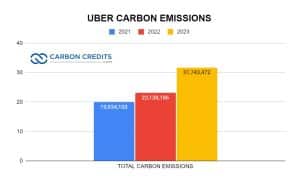
Alongside financial progress, Uber continues to push forward its sustainability agenda. As shown above, the company’s emissions have been rising from 2021 to 2023, putting more pressure on its emission reductions.
The company has set a clear long-term goal:
- Become a fully electric, zero-emission mobility platform by 2040 globally, with a closer target of 100% zero-emission rides in the U.S., Canada, and Europe by 2030.
To achieve this, Uber is investing in several strategies to help drivers transition to electric vehicles (EVs) and make sustainable transportation more accessible.
Progress on Electrification (as of late 2024)
- 182,000 ZEV drivers globally — up 75% YoY
- 86 million zero-emissions trips completed globally — up 70% YoY
- 11.7% of on-trip miles in Europe from ZEVs
- 8.8% of on-trip miles in the U.S. and Canada from ZEVs
Uber ZEV Drivers

By the end of 2025, Uber aims to achieve several key sustainability goals. One is to make all rides in London and Amsterdam zero-emission. Also, ensure that half of all mobility kilometers in seven European capitals use electric vehicles (EVs).
Also, 80% of restaurant orders on Uber Eats in Europe and Asia Pacific will switch from single-use plastics to sustainable packaging. This includes options like reusable, recyclable, or compostable materials. Uber has already achieved a 100% renewable energy match in its U.S. offices, which was completed in 2023.
Looking further ahead, Uber’s goal by the end of 2030 is to make 100% of rides in Canada, Europe, and the U.S. zero-emission. Also, it aims to have 100% of deliveries in seven European capitals be zero-emission.
Moreover, all Uber Eats restaurant merchants will use sustainable packaging worldwide. By 2040, Uber aims for all rides and deliveries to use zero-emission vehicles, micromobility options, or public transit.
Uber launched Uber Green to speed up adoption. It allows riders to request low- or zero-emission rides in more than 100 cities around the world. Uber also partners with automakers like Nissan, Hyundai, and GM. They provide discounts and incentives for drivers buying EVs.
Since 2020, Uber has put in $439 million of its planned $800 million to help drivers switch to electric vehicles. Support includes:
- Incentives and bonuses for EV drivers
- Discounted EV charging through partners like BP and EVgo
- Vehicle rental programs featuring EVs
- Upfront cash grants for switching to EVs
All these efforts resulted in a lower passenger carbon intensity. This metric measures the grams of CO₂ per passenger mile traveled, including emissions from empty “deadhead” miles. Uber and other companies use this annual metric to track climate impact and efficiency in ridesharing and on-demand mobility services.

Broader ESG Strategy: Beyond Carbon Reduction
Uber’s sustainability vision extends beyond just decarbonization. The company’s ESG commitments span across climate action, social equity, governance, and community engagement.
Social Impact
- Diversity & Inclusion. Uber releases a yearly People & Culture Report. It shows more women and underrepresented groups in leadership roles.
- Accessibility. Expanded options like Uber WAV (Wheelchair Accessible Vehicles) and Uber Assist for riders with mobility needs.
- Driver Support. Programs aim to boost driver safety, health, and earnings stability. They include real-time safety features and in-app resources.
Governance & Ethics
- Ethics & Compliance Program Charter: Sets standards for corporate conduct, anti-corruption, and data privacy.
- Transparency Reporting: Uber discloses data on safety incidents, law enforcement requests, and other governance matters
Uber also supports local communities through initiatives like:
- Uber Health: Helping healthcare providers arrange rides for patients
- Emergency Response: Partnering with authorities to support evacuation or relief efforts in disasters
- Food Access: Collaborations with food banks and nonprofits to address food insecurity
Aligning Growth with Sustainability
Uber’s strategy recognizes that long-term financial success and sustainability go hand-in-hand. CEO Dara Khosrowshahi stated,
“Our goal is to help people move and eat sustainably, while supporting drivers and couriers to thrive.”
By embedding ESG into core operations — whether that’s decarbonizing rides, improving driver livelihoods, or engaging with communities — Uber is positioning itself as a responsible, forward-looking mobility leader.
Uber’s Q1 2025 results highlight a company balancing strong financial performance with bold sustainability ambitions. The mobility company is in a strong position. It has record cash flow, more trips, and increasing electrification efforts. This will help the company handle challenges in the market and with regulations.
Looking ahead to Q2 and beyond, a strong focus on financial durability and environmental leadership will define Uber’s role in the changing mobility sector.
The post Uber’s Billion-Dollar Ride to Bigger Profits in Q1 and Zero Emissions by 2040 appeared first on Carbon Credits.

EU carbon credit claims changed on 27 September 2026, the day the Directive (EU) 2024/825 began to apply across the European Union. The change is narrow. It changes how a company can talk about the credits it buys. A product can no longer be called neutral on the strength of compensation alone; however, every specific, evidenced statement about what a company measured, reduced, and funded stays fully available.

The post Promoting Improved Cooking Practices in Nigeria appeared first on Terrapass.



-
Climate Change1 year ago
Guest post: Why China is still building new coal – and when it might stop
-

 Greenhouse Gases2 years ago
嘉宾来稿:满足中国增长的用电需求 光伏加储能“比新建煤电更实惠”
-
Greenhouse Gases1 year ago
Guest post: Why China is still building new coal – and when it might stop
-

 Climate Change2 years ago
嘉宾来稿:满足中国增长的用电需求 光伏加储能“比新建煤电更实惠”
-

 Renewable Energy12 months ago
Sending Progressive Philanthropist George Soros to Prison?
-
Climate Change2 years ago
Bill Discounting Climate Change in Florida’s Energy Policy Awaits DeSantis’ Approval
-
Greenhouse Gases1 year ago
嘉宾来稿:探究火山喷发如何影响气候预测
-

 Climate Change2 years ago
Analysis: China’s CO2 falls 1% in Q2 2024 in first quarterly drop since Covid-19