


The global energy sector is transitioning, with major oilfield service companies under pressure to cut emissions while staying profitable. Baker Hughes, Halliburton, and Schlumberger (SLB) recently reported their earnings.
However, here we reveal how each company is balancing investments in oil, gas, and low-carbon initiatives. Thus, beyond financials, their sustainability goals and net-zero targets set them apart.
Let’s dive in.
Baker Hughes Reports Mixed Q1 2025 Results
Baker Hughes reported $6.43 billion in revenue for the first quarter of 2025. This marked a 13% drop from the previous quarter but a slight increase of $9 million compared to a year ago. The year-over-year growth was mainly due to stronger performance in Industrial & Energy Technology (IET), partially offset by weaker results in Oilfield Services & Equipment (OFSE).
Net income under U.S. GAAP was $402 million, down $777 million from the previous quarter and $53 million lower year-over-year. However, adjusted net income, which excludes certain items, stood at $509 million. This was also down 27% from the previous quarter but up 19% compared to last year.

Advances in Pipeline Compression and Data Center Power
It also secured a major pipeline project in North America, supplying two compression stations with 10 Frame 5/2E turbines and compressors.
Additionally, in data centers, the company won contracts for over 350 MW of NovaLT™ turbines. It partnered with Frontier Infrastructure to deliver large-scale carbon capture and clean power solutions using its full technology suite.
Lorenzo Simonelli, Baker Hughes chairman and chief executive officer, said,
“Baker Hughes started the year strong, building on the positive momentum from 2024 and setting multiple first-quarter records. Our continued transformation initiatives and strong execution continue to drive structural margin improvement across both segments. The operational transformation and streamlining efforts have created a solid foundation to optimize margins and enhance returns, even in a challenging environment.”
Driving Sustainability Forward: Baker Hughes’ 2024 Progress
Baker Hughes continues to lead the energy transition by striving to become a sustainable pioneer across all its operations. It aims to reduce Scope 1 and 2 emissions by 50% by 2030 compared to 2019 levels.
Major Progress on Emissions Reduction

The company reported strong environmental achievements this year:
- Scope 1 and 2 emissions dropped 29.3 percent compared to the 2019 base year, reaching 564,728 metric tons of CO2e.
- Scope 1 emissions, covering fleet, field activities, and facilities, declined by 22.6 percent to 386,367 metric tons of CO2e.
- Scope 2 emissions from purchased electricity decreased by 40.6 percent (market-based) and 30.7 percent (location-based).
Despite these achievements, it recorded a 16.5% increase in Scope 3 emissions intensity, mainly due to higher demand for high-efficiency gas turbines and electric motors.
Hands-On Approach to Emissions Reduction
Baker Hughes prioritizes direct emissions reduction over carbon offsets or virtual power purchase agreements. It improves energy efficiency, integrates renewable electricity across facilities, and deploys low-carbon technologies.
Additionally, it supports ecosystem projects through the Baker Hughes Foundation. However, these initiatives are not used for carbon credits. This hands-on approach ensures tangible, measurable progress and strengthens the company’s commitment to sustainability.
Carbon-Free Clean Energy

- In 2024, Baker Hughes advanced clean energy adoption using renewable or zero-carbon electricity. Its use rose from 13.5% in 2019 to 34.2% in 2024.
- On-site solar has expanded to 15 sites, and renewable and nuclear energy use has cut emissions by 89,734 metric tons of CO2e since 2019.
Key Highlights:
- The Woodlands, Texas, and Broussard, Louisiana, sites fully transitioned to 100% renewable electricity.
- In Thailand, the partnership with Cleantech enabled on-site solar panels to generate about 18% of the site’s annual electricity.
Nuclear energy plays a huge role in the company’s low-carbon future. It supports conventional nuclear power and small modular reactors. It emphasizes safety, community involvement, and efficient waste management while ensuring reliable operations.
Thus, the strategic use of renewable energy credits, Zero-Emission Certificates, and local certificates supported these improvements.
Halliburton Posts Lower Q1 2025 Earnings as North America Revenue Falls
Halliburton Company reported a net income of $204 million, or $0.24 per diluted share, for the first quarter of 2025. This marked a sharp decline from $606 million, or $0.68 per share, in the same period last year.
When adjusted for impairments and other charges, Q1 2025 net income came in at $517 million, or $0.60 per share, down from $679 million, or $0.76 per share, in Q1 2024.
Total revenue for the quarter dropped to $5.4 billion from $5.8 billion last year. Operating income was $431 million, down from $987 million a year ago.

Geographical Revenue Highlights
In North America, revenue dropped 12% to $2.2 billion due to lower stimulation activity in the US Land and fewer tool sales in the Gulf.
International revenue dipped 2% to $3.2 billion. Latin America revenue fell 19% to $896 million from slower activity in Mexico and lower tool sales. However, Europe/Africa revenue rose 6% to $775 million, driven by stronger activity in Norway, Namibia, and the Caspian.
Jeff Miller, Chairman, President, and CEO, said,
“I am pleased with our performance in the first quarter. We delivered total company revenue of $5.4 billion and adjusted operating margin of 14.5%. Our first quarter international tender activity was strong, Halliburton won meaningful integrated offshore work extending through 2026 and beyond. Customers awarded Halliburton several contracts that demonstrate the strength of our value proposition and the power of our service quality execution.”
Halliburton’s Emissions and Clean Energy Progress
Halliburton is committed to reducing emissions to help the oil and gas industry become cleaner.

It aims to:
- Cut Scope 1 and 2 emissions by 40% by 2035 from 2018 levels
- Work with top suppliers to track and reduce Scope 3 emissions
Low-Carbon Electric Fracturing Fleets
Hydraulic fracturing made up 80% of its emissions. As demand in North America rose, total Scope 1 and 2 emissions increased by 2% from the previous year. However, since 2018, it has lowered its emissions per operating hour by 16% by investing in electric fracturing fleets.
The company now uses smarter fracturing tools that give customers more power options and better efficiency. It’s also reusing older equipment in smarter ways to lower emissions and boost returns.
Strong Climate Commitments
Last year, the company focused on three areas to lower its carbon footprint. They were:
- Helping oil and gas customers lower their emissions
- Using its skills for low-carbon projects like carbon capture and geothermal
- Backing startups through Halliburton Labs to support new energy ideas
Notably, they are also using the carbon assessment tool on big projects in Mexico, Norway, Iraq, and Namibia. It identified possible emissions from equipment, transport, and its products. This helps customers plan cleaner operations from the start.
Growing in Low-Carbon Solutions
Halliburton has invested largely in carbon capture, geothermal, and other low-carbon energy projects. Some notable projects in these fields include:
Carbon Capture (CCUS)
As said before, it works with customers to offer full CCUS solutions. These include tools like the NeoStar™ CS safety valve and CorrosaLock™ cement, built for harsh CO₂ storage conditions. Halliburton is also teaming up with other energy players to develop more CCUS options.
Geothermal Energy
Being a pioneer in geothermal, it supports every stage of a geothermal project from testing and drilling to production. In 2024, it offered tools like GeoESP® pumps and Thermalock™ cement for hot, tough environments. It also provided strong drill bits, smart drilling fluids, and custom well designs for deep, complex projects.
Schlumberger (SLB) Q1 Update: Revenue Drops, But Digital and Cash Flow Stay Strong
SLB reported $8.49 billion in revenue for the quarter, down 3% compared to last year. Net income also dropped 25%, landing at $797 million.
- GAAP earnings per share (EPS) came in at $0.58, down 22%.
- Adjusted EPS, excluding one-time items, was $0.72, a 4% decrease.
- Adjusted EBITDA stood at $2.02 billion, down 2%.
However, cash flow from operations surged to $660 million, up $333 million year on year. The board also approved a $0.285 per share quarterly dividend.

SLB Chief Executive Officer, Olivier Le Peuch, commented,
“First-quarter adjusted EBITDA margin was slightly up year on year despite softer revenue as we continued to navigate the evolving market dynamics.
It was a subdued start to the year as revenue declined 3% year on year. Higher activity in parts of the Middle East, North Africa, Argentina and offshore U.S., along with strong growth in our data center infrastructure solutions and digital businesses in North America, were more than offset by a sharper-than-expected slowdown in Mexico, a slow start to the year in Saudi Arabia and offshore Africa, and steep decline in Russia.”
Core Business Shows Bright Spots Amid Slowdown
While overall revenue in SLB’s core divisions slipped 4%, some segments performed well.
- Production Systems revenue rose 4% with growing demand for surface production systems, completions, and artificial lift.
- Margins improved by nearly 2 percentage points.
- Reservoir Performance benefited from strong international stimulation and intervention work, though lower evaluation activity held it back.
CEO Olivier Le Peuch noted that despite lower rig activity, SLB’s diverse portfolio helped soften the blow.
Digital and AI Business Keeps Gaining Momentum
SLB’s digital division continued to grow strongly, separate from the usual ups and downs of the oil and gas cycle.
- Digital revenue jumped 17% year on year.
- Overall, Digital & Integration revenue rose 6%.
Le Peuch said more energy companies are investing in digital tools and AI to boost performance and unlock value from their data. SLB plans to keep expanding its offerings in AI, cloud, and digital operations.
Shareholder Returns Set to Rise in 2025
Looking ahead, SLB promised to return at least $4 billion to shareholders in 2025 through dividends and buybacks.
- The company plans to give back more than half of its free cash flow.
Even with market uncertainties, such as shifting economic conditions and oil price changes, SLB remains focused on protecting margins, maintaining strong cash flow, and delivering steady value.
SLB’s Clear Climate Goals with Measurable Progress
SLB is firmly committed to achieving net-zero emissions by 2050 and has laid out clear targets to guide its journey. The company aims to cut its Scope 1 and 2 emissions by 30% by 2025 and by 50% by 2030. It also targets a 30% reduction in Scope 3 emissions by the end of the decade.
Progress Highlights in 2024:

- Scope 1 and 2 market-based emissions intensity dropped by 11%. They stood at 990 thousand metric tons and 373 thousand metric tons, respectively.
- Scope 3 emissions intensity reduced by 18%. They were 34,855 thousand metric tons.
- 38% of the electricity used at SLB’s global sites came from renewable sources

Cleaner Operations, Smarter Tools
In 2024, SLB cut Scope 1 emissions by rolling out its Field Fuel Playbook. This guide helped teams monitor fuel use, cut idling, and choose cleaner fuels. Employees used it to improve planning and reduce waste across operations.
For example, PumpIRIS™ was rolled out to cut pump idling in field jobs. The pilot avoided over 3,000 metric tons of CO₂e and saved nearly $1 million annually.
The company also helped clients avoid more than 950,000 metric tons of CO₂e in 2024. Its new Digital Sustainability tools support climate action in industries that are hard to decarbonize
Building the Future with Clean Tech
The company’s New Energy business moved forward in 2024, focusing on key technologies that support the energy transition:
- SLB Capturi, a joint venture with Aker Carbon Capture, launched to scale up carbon capture using modular systems. Three projects are underway, and two sites near Norway’s Northern Lights carbon storage hub are already using SLB services.
- In Nevada, a lithium demo plant showed how to make battery-grade lithium carbonate with 96% recovery from brine, using 90% less land and far less water. The plant combines direct lithium extraction with advanced processing, and it’s now ready to scale up.
- New modeling tools were launched to help clients manage lithium-brine resources more efficiently and sustainably.
Boosting Geothermal in the Philippines
Using CoilTools™, SLB revived five geothermal wells in Leyte without drilling. This added 14 MW of power and supports the Philippines’ 2030 target of 3,200 MW.
These goals reflect SLB’s long-term strategy to lower its carbon footprint and support the global transition to clean energy.
We can see that scope 3 emissions are a major concern for the oilfield service companies, and their sustainability approach is significantly strong. Even though their revenues are moderately down, we expect the top oilfield giants like Baker Hughes, Halliburton, and Schlumberger to drive a sustainable change in this sector.
The post Oilfield Giants Walk a Tightrope: Q1 Profits, Emissions & the Race to Net Zero appeared first on Carbon Credits.

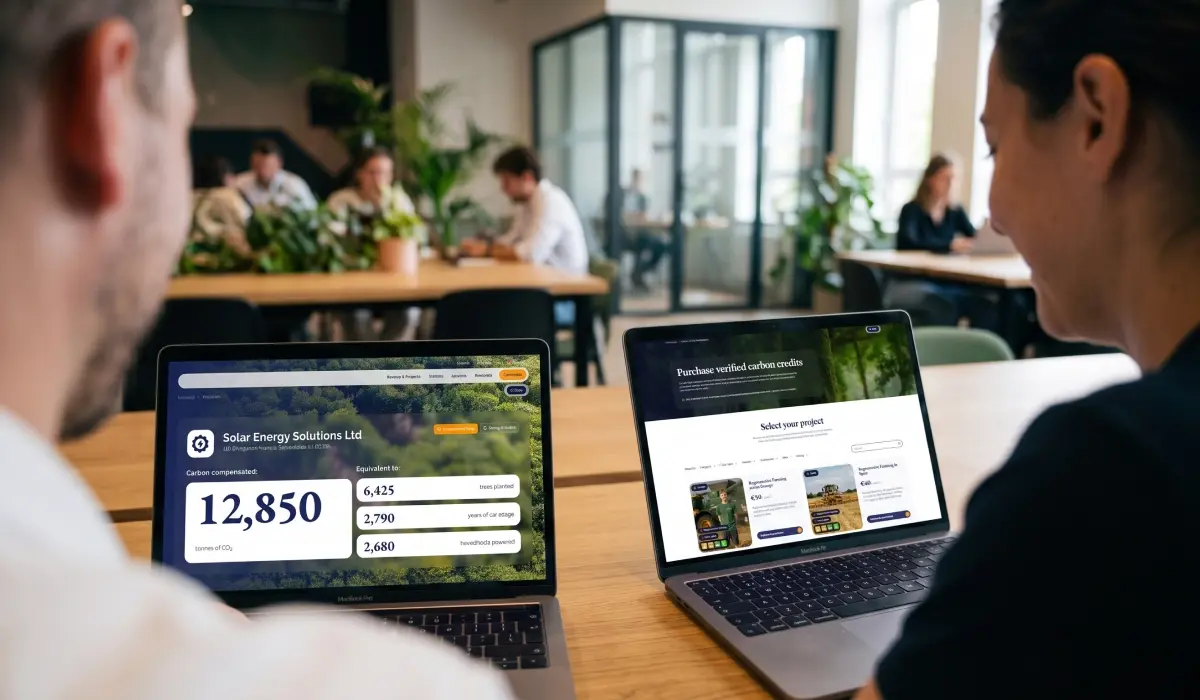
Most businesses that decide to act on their net-zero targets reach the same point of friction. Buying carbon credits has meant tracking down brokers, sitting through sales calls, and requesting a quote just to learn a price, sometimes with limited proof of what you are buying.

The earnings calls that quietly reframed climate from sustainability question to operating risk.
Three earnings calls in the last 18 months tell the story without any help from a press release.
Hershey, May 2024: cocoa price exposure compresses margin, and the company attributes part of the cost shock to West African weather. Olam, July 2024: coffee climate exposure quantified in the annual report. JBS, January 2025: supply chain climate disclosures expanded materially in response to investor pressure and regulatory expectation. None of these companies issued the announcement as climate news. They issued it as financial news. The climate-linked supply chain risk did not arrive with a sustainability framing; it arrived as a P&L line.
You are probably reading this article because you suspect the same thing is happening to your business. This piece walks through what is showing up on which earnings calls, how procurement and finance leaders are quantifying the exposure, and what serious corporates are doing about it before the regulator asks.
Where climate risk has already appeared in earnings
The pattern is consistent across resource-intensive sectors. A weather event compresses supply, the price spikes, the cost flows through the income statement, and the analyst on the call asks whether the event is anomalous or structural. Increasingly, the honest answer is the second one.
Cocoa is the cleanest example. The 2023 to 2024 West African harvest fell sharply on the back of erratic rainfall and disease. Cocoa futures more than tripled. Companies with concentrated West African sourcing absorbed the cost; companies with diversified sourcing absorbed less. The exposure was not climate as ESG topic. It was climate as cost of goods.
Coffee follows the same pattern. Brazilian and Vietnamese harvests have moved on weather more sharply across the last several seasons. Roasters with long-tenor supplier relationships and origin diversification have managed the volatility; roasters with spot-market exposure have not. Wheat, sugar, palm oil, beef: the same dynamic in different commodities, a pattern the IPCC AR6 Working Group II report projects will intensify across agricultural systems through mid-century.
What this means: climate risk is no longer a footnote in the 10-K. It is a line item the CFO has to explain on the call.
The three commodity exposures that hit margin first
For most companies with material Scope 3 exposure, three exposures dominate the near-term P&L risk.
- Concentrated single-origin sourcing in a climate-vulnerable region. If your tier-one supply for any material commodity sits in one geography, you have a concentration risk that climate amplifies. Diversification across origins is the obvious hedge, but it takes years to build and requires relationships you cannot acquire by tender.
- Supplier financial fragility under climate stress. Smallholder farmers, who supply a large share of the global cocoa, coffee, and palm oil market, do not carry the balance sheets to absorb yield shocks. When yields collapse, they exit. When they exit, your supply base shrinks, and the surviving suppliers raise prices. The risk is structural, not cyclical.
- Logistics and storage exposure to extreme weather. Hurricane disruptions to Gulf shipping, drought-driven Panama Canal restrictions, flooding in European inland waterways: each of these has moved input costs in the last three years, a pattern documented in Munich Re’s natural catastrophe data. The exposure shows up as a one-quarter event in the financial press but accumulates over time on the cost line.
TCFD and ISSB disclosure changes
The disclosure architecture has now caught up with the risk. The Task Force on Climate-related Financial Disclosures, whose recommendations are now embedded in the ISSB’s IFRS S2 climate standard, requires companies to disclose climate-related risks across physical and transition categories, with quantification where possible.
For physical risk specifically (the climate-linked supply chain risk you are reading about), the disclosure must address both acute exposures (extreme weather events) and chronic exposures (gradual changes in temperature, precipitation, and growing seasons). The disclosure must address the time horizon over which the risk is material, the parts of the value chain exposed, and the financial impact under different scenarios.
The CSRD imposes similar requirements under European law, with double materiality (both financial and impact materiality) embedded in the assessment. The practical effect: your auditors and your investor relations team now need a defensible answer to the climate-linked supply chain risk question, and the answer needs to be quantified.
What procurement and finance can do now
Three actions matter near-term.
Map your exposure. Most companies do not have a clear view of which tier-one and tier-two suppliers sit in which climate-vulnerable geographies. Without the map, you cannot quantify the risk, and without the quantification, you cannot disclose it credibly. The map is the foundation, and World Resources Institute climate risk research provides useful public tooling to start.
Diversify and deepen, in that order. Diversification across origins reduces concentration risk, but the deeper move is to invest in the resilience of the suppliers you already have. Regenerative practices, agroforestry, soil health interventions: these reduce yield volatility under climate stress and protect your input cost trajectory.
Embed the climate spend inside procurement, not outside it. Treating climate risk as a sustainability cost line subordinates it to the ESG budget. Treating it as a procurement and resilience investment puts it in the budget that matters, which is the cost-of-goods budget that the CFO defends quarterly.
Nature-based supply chain investments are the asset class designed for exactly this purpose. They sit inside the value chain, they reduce climate-linked supply risk, they generate verifiable Scope 3 reductions, and they produce the documentation an auditor and a regulator can both test.
If you are quantifying climate-linked supply chain risk in advance of the next earnings cycle or the next disclosure period, the carbon and sustainability experts at Carbon Credit Capital can help you map your exposure and structure a Dual-Value Model response that addresses reduction, resilience, and disclosure-readiness in a single program. Schedule a consultation.

More and more small and medium-sized businesses are hearing the same question from their larger customers: What is your carbon footprint? That question now travels down entire supply chains, and it arrives next to tender requirements, certification criteria, and rising customer expectations.




-
Climate Change1 year ago
Guest post: Why China is still building new coal – and when it might stop
-

 Greenhouse Gases2 years ago
嘉宾来稿:满足中国增长的用电需求 光伏加储能“比新建煤电更实惠”
-
Greenhouse Gases1 year ago
Guest post: Why China is still building new coal – and when it might stop
-

 Climate Change2 years ago
嘉宾来稿:满足中国增长的用电需求 光伏加储能“比新建煤电更实惠”
-
Climate Change2 years ago
Bill Discounting Climate Change in Florida’s Energy Policy Awaits DeSantis’ Approval
-

 Renewable Energy11 months ago
Sending Progressive Philanthropist George Soros to Prison?
-
Greenhouse Gases1 year ago
嘉宾来稿:探究火山喷发如何影响气候预测
-

 Carbon Footprint2 years ago
US SEC’s Climate Disclosure Rules Spur Renewed Interest in Carbon Credits