

The vast majority of Australians and all mainstream nature protection groups—including Greenpeace—agree that Australia should end native forest logging, and that governments should create vast new national parks to protect and manage some of our most magnificent remaining forests. But there is significant disagreement about how this transition should come about and now a decision is coming up before the Australian Parliament.
On 15 September the Australian Senate is due to vote on a motion about a new carbon credit method for forest protection—the “Improved Native Forest Management” (INFM) Method. Lifelong forest protection champions and people of good will and intentions find themselves on opposing sides of this debate. That’s okay–people of good faith can have legitimate differences of view, and this should be honoured in our democracy.
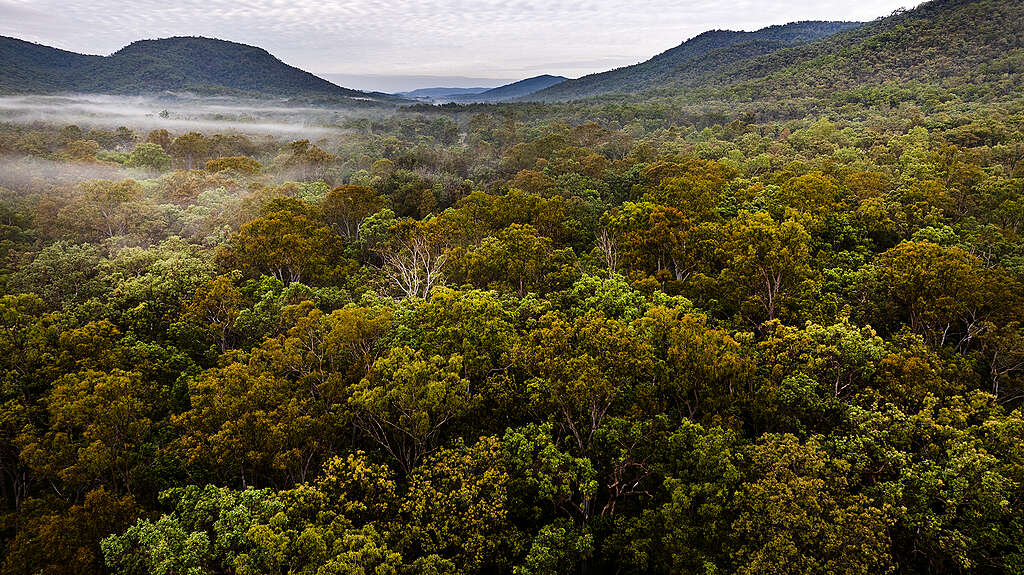
The NSW government has promised to create the Great Koala National Park on the Mid North Coast of the state. The government has also said that the final creation of the park is dependent on the successful registration of a carbon project under the Improved Native Forest Management (INFM) Method. The creation of the park will effectively mean an end to native forest logging in the region.

Native forest logging is not something on which Greenpeace has actively campaigned on in Australia for some decades, but we are making our position clear on this issue now, because it is a matter of significant public note that falls clearly within our environmental mission remit.
After careful consideration, Greenpeace believes this method should not be voted down by the Senate, and we call on Senators of all parties to vote against the disallowance motion.
To be abundantly clear, Greenpeace holds longstanding opposition to the carbon credit system, but in these circumstances we cannot in good conscience conflate that position with de facto opposition to the creation of massive new national parks. Although it is uncomfortable to do so, our position here is to recognise that suboptimal architecture can still be turned to good ends. We genuinely rejoice in the imminent possibility of new national parks, including the Great Koala National Park in NSW which so many community members and scientists have tenaciously argued for, over very many years, and which are so desperately needed for the forests and the wildlife which inhabits them.
In reaching our view, we also take strong notice of the opinion of the INFM among leading forest scientists, including leading forest ecologist Professor David Lindenmayer who supports the INFM as do a range of other experts. We have also taken special note of the position of the peak body for nature in New South Wales, the NSW Nature Conservation Council, and of local forest activist conservation groups, who support the INFM not being voted down in the Senate.
The politically fraught nature of forest protection
The fight to save Australia’s magnificent native forests from logging has been a decades-long battle. It has reshaped both the ecological and political landscape of the nation as vast forests have been levelled or–thankfully–sometimes saved, and political parties and leaders have risen and fallen on the back of moves to ruin or protect them.
It is no surprise then that the latest chapter in Australian forest protection has become politically fraught.
In 2024 Western Australia and Victoria officially ended native forest logging on the back of both overwhelming public pressure to do so combined with the clearly unviable financial state of the industry. This forest protection has not been bullet proof—some areas still being targeted under the guise of fire management and “salvage logging”–and other drivers of deforestation including for bauxite mining–remain a significant problem. Nonetheless, these announcements were still a very significant leap forward for forest conservation and to the credit of the advocates, communities, and scientists who fought for these outcomes–and the governments who made the decisions.
But native forests continue to fall to logging in Tasmania, New South Wales and to an extent in Queensland. So the political battle has now concentrated mostly on these states, with a renewed push by communities and environment groups to finally end native forest logging once and for all, including via the creation of large new national parks for the benefit of the whole community and for nature to flourish.
Protection with or without carbon markets?
In New South Wales, thanks to the extraordinary effort and vision of forest advocates and ecologists, proposals have been drawn up for two large national parks to protect forests currently targeted for logging and link them up with already protected areas—the Great Koala National Park in the north and the Great Southern Forest National Park in the south.
The creation of national parks requires resources. In the step up phase, the provision of public funding enables workers and communities to be supported to exit the logging industry. Significant funding is then required on a permanent basis to manage the National Parks that are created, including crucially to carefully manage fire to support forest health and regeneration, particularly as global warming continues to raise the risk of repeated catastrophic bushfires.
Along with many others, Greenpeace has a long held and strong view that nature should be protected for its own sake (rather than having to justify a monetary benefit) and that this funding should be provided by governments as a public good. Many forests and extraordinary places across Australia have been protected on this very basis for decades. Public funds for the shared good of nature protection for all Australians. Yet it is also the case that far too little public money is spent on taking care of nature.
Australians are not only justifiably proud of and love our natural heritage–our iconic wildlife and fantastic wild places–we also depend on the web of life for our own flourishing. And yet significantly less than 1% of all public money in Australia is spent on taking care of nature across our magnificent continent. It is inadequate to do what is needed in the face of the extinction crisis and the severe climate damage caused by global warming.
So, it is on the question of sources of revenue where fierce disagreement has emerged amongst forest champions. As noted above, the position taken by the New South Wales Government is that the creation of the Great Koala National Park hinges on raising the necessary funds by selling carbon credits to companies as an offset to the greenhouse gas emissions they are producing (recognising the value of carbon stored in forests). For this reason, whether the Great Southern National Park proposal progresses or not is also likely to depend on the ability to create carbon credits from it.
Some advocates are understandably steadfastly opposed and outraged that the creation of a National Park would rely on carbon credits to be established, while others see this a reluctantly pragmatic yet effective pathway to a rapid end to native forest logging, not just in New South Wales but also in Tasmania and elsewhere. People of good will can disagree–and on this, they do.
We also recognise that it is a difficult debate to have in the public realm–because those not across the debates over policy and principle will be fairly inclined to bewilderment that anyone who cares about nature could possibly oppose the creation of new national parks on what might seem like quite arcane grounds.

Australia’s troubled and troubling carbon market
Like forest protection, curbing Australia’s climate pollution has been another politically vexed problem for decades. Climate policies have come and gone, taking political leaders with them.
In 2011 the Carbon Farming Initiative was established by the Gillard Labor government and supported by the Greens (then led by Bob Brown and Christine Milne). This set up a system whereby farmers and Indigenous communities could generate carbon credits to better manage forests (including with better fire management) to receive funding from the Federal Government or corporations as a means of storing or reducing carbon emissions on the land, while also (ostensibly) protecting nature and creating regional jobs.
This scheme then morphed into the Abbott Coalition government’s Emissions Reduction Fund and Safeguard Mechanism in 2014. This policy was cynical in nature, designed to do virtually nothing given Tony Abbott’s aggressive rejection of the need for greenhouse gas emission reduction, essentially expanding a voluntary market where carbon polluters could buy carbon credits to offset their emissions. There was very little obligation for polluters to actually reduce emissions at site or be forced to buy carbon credits at all.
Then, in 2023 the Albanese government reformed the Safeguard Mechanism, setting stricter emission baselines for polluters and forcing many to buy carbon credits to offset their emissions.
The problem is this latest reform of the Safeguard Mechanism has not worked. This is partly due to the emission baselines being set too low but also because many polluters have simply been buying up carbon credits rather than attempting to actually reduce their emissions.
Furthermore, the very concept of carbon credits is highly problematic. Unlike fossil fuels found in their natural state, carbon and greenhouse gases stored in forests and the land are more volatile and exposed to rapidly being released to the atmosphere from fires, disease, floods and other natural or global heating-driven events. Greenpeace holds a longstanding position of deep scepticism about the efficacy of carbon credits. That has not changed.
In practice most of the existing carbon credit methods have been under sustained criticism from experts and scientists with deep knowledge of the system, arguing that currently, most projects are receiving credits for little or no actual storing of carbon in the land.
So when advocates for forest protection and climate action raise concerns about protecting forests via carbon credits, it’s clear why.

The INFM method
Chief public critic and whistleblower of the historic carbon credit system in Australia, Professor Andrew Macintosh, has been the lead architect behind the creation of the Improved Native Forest Management (INFM) which has been developed in partnership with the New South Wales Government. This is because despite having been a critic of the carbon credit system as it was operating, Professor Macintosh is not against carbon credits per se, but rather a poorly designed and executed system.
Regardless of what one thinks of the morality or efficacy of the method; the fiscal truth is that the INFM would create a new means for state governments to generate significant revenue by ending native forest logging in key areas and protecting and managing the forests.
Professor Macintosh and other supporters of the method argue that unlike other carbon credit methods, the INFM is of the highest integrity possible. That’s because the carbon that is credited is conservative, accounting for approximately 1/10th of potential carbon stored, a regional cap prevents logging simply commencing elsewhere, and significant financial penalties apply for non delivery of credits. If all the forests threatened by logging were protected by this method that would represent about 5% of carbon credits in the system. Significantly, the New South Wales Government has also pledged that no carbon credits from the Great Koala National Park would be sold to fossil fuel companies.
Leading ecologist and staunch forest advocate Professor David Lindenmayer also supports the method. Other prominent ecologists Professor Brendan Mackey, Dr Don Butler and Dr Heather Keith also provided input into the method.
Key environmental groups in New South Wales such as the North East Forest Alliance and South East Forest Alliance as well as the Nature Conservation Council of NSW (which is the peak body for nature in NSW) strongly support the INFM and see it as key to creating large forest National Parks in the state and effectively ending native forest logging.
The logging industry is vehemently opposed to the method because they are rightly worried it will shut down what remains of this industry. They are supported by One Nation and the Nationals, both of which have pledged to vote against the method down when it comes to a vote in the Senate on September 15th.
The opponents to forest protection are also joined in the against camp by some climate and forest advocates, including the Australia Institute and Wilderness Australia, who are strongly against carbon credits overall, in particular relying on them to protect forests and are concerned at the potential for perverse outcomes in the context of the broader need to reduce Australia’s greenhouse gas emissions.

The Greenpeace Position
Greenpeace opposes carbon credits and accepts the analysis that the Safeguard Mechanism is failing. The creation of new forest National Parks should not be contingent on the commodification of nature and the sale of carbon credits. Nature should be protected for nature’s sake. Much more public funding should be available for the protection of nature. Our position will not change on the intrinsic value of ecology. Our mission is to secure an earth capable of nurturing life in all of its magnificent diversity.
However, we cannot in good conscience de facto oppose the creation of a massive new national park in these circumstances—especially when Australia’s leading forest ecologists, the foremost critic of carbon credits, and the grassroots forests activists from the jurisdiction in question support the outcome of moving ahead with the INFM to secure massive new national parks.
For that reason, in our view is that in these circumstances the Senate should not vote down the INFM method.
Further, fossil fuel companies should not have access to the INFM credits. The existing sham carbon credit methods should be urgently taken out of the system. The fight for more public funding for the protection of nature must go on until common sense prevails. And the Safeguard Mechanism should be substantially overhauled to significantly constrain the use of carbon credits more broadly and force polluters to rapidly reduce emissions on site. We believe that this is the fight which forest and climate advocates should be focussed on, together.

Muhammad Zulfikar Rakhmat is director of the China-Indonesia Desk at the Center of Economic and Law Studies (CELIOS). Bhima Yudhistira Adhinegara is executive director of CELIOS.
Indonesia bills its plans to mix wood with coal at dozens of power plants as a way to cut electricity generation emissions as the country transitions towards clean energy. But look closer, and the biomass co-firing plan could do far more harm than good.
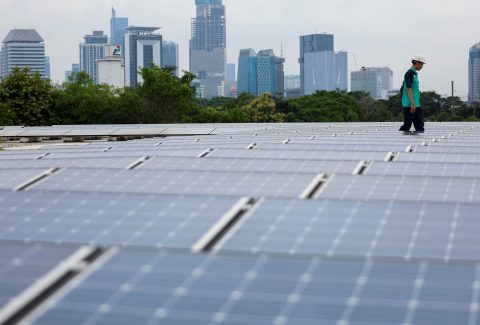
Biomass co-firing involves mixing a small amount of wood or other plant matter, usually wood chips or wood pellets, into the coal that a power plant burns.
State electricity company PLN wants to use it at 52 coal-fired plants across the Southeast Asian nation – a target set out in its national electricity supply business plan and tied to Indonesia’s pledge, under its Nationally Determined Contribution to the Paris Agreement, to raise renewables to 23% of the energy mix. PLN originally aimed to secure 10.2 million tonnes of biomass a year by 2025; that target has already slipped to 2031, as the country struggles to line up enough supply.
Most plants only mix in a small amount of wood, often between 1% and 5% of the fuel load, meaning they do not even have to change machinery. In truth, it lets coal plants keep doing what they have always done, just with a little wood added to the mix.
That presents two big problems.
-
SE Asia speeds up plan for connected clean power grid after oil shock
Countries are redoubling efforts to link their grids to bolster energy security and reduce their dependence on fossil fuels – but many challenges remain -
China keeps Indonesia’s battery dream afloat but future less certain
Chinese capital and technology turned Indonesia into the world’s top nickel supplier, but its dependence on China and the rise of nickel-free batteries could upset its battery ecosystem plans -
Southeast Asia’s fragile grids threaten billions in clean energy investment
Renewables developers need reliable electricity infrastructure and stable policies to help the region meet climate goals and surging demand for power


Firstly, creating additional demand for wood would put further deforestation pressure on the country’s thick and biodiverse tropical forests, already at risk from mining and palm oil plantations.
Secondly, by making old coal plants look a little greener on paper, the plan could hand them a reason to keep operating well beyond when they would otherwise be retired, meaning the fleet keeps emitting for longer than a genuine phase-out would allow.
This is not a real climate solution. It is coal wearing a green mask.
A threat to forests
To meet its co-firing mandate, Indonesia would need more than 10 million tonnes of wood pellets every year, an area of forest equivalent to 3.27 million football fields, according to a 2024 assessment by a group of NGOs.
The same report warned this could push deforestation as high as 2.1 million hectares a year, and found that a 10% cut in coal use through co-firing could threaten 10 million hectares of untouched forest in the areas where wood is collected. At Indonesia’s biggest power plants alone, switching just 10% of coal to wood could clear an area of forest roughly 35 times the size of Jakarta.
PLN and the forestry companies that supply it insist the wood comes from dedicated “energy plantation forests” – land set aside to grow fast-growing trees for fuel, not from clearing natural forest. But the same assessment found that of the 1.2 million hectares already designated for these plantations, more than 400,000 hectares still contain undisturbed tropical forest, which will come under growing pressure as demand rises. The claim that this wood comes from already-degraded land does not hold up to scrutiny.
Advocates of co-firing say wood is a clean fuel because trees can grow back. But when old natural forests are cleared to make way for fast-growing forestry plantations to grow trees for fuel, they release carbon that took decades or centuries to build up.
One study, by the Centre for Research on Energy and Clean Air (CREA), estimated that co-firing with just 10% wood across 52 power plants could create up to 26.5 million tonnes of carbon dioxide-equivalent emissions each year, once the clearing of land and the production of wood pellets are counted.
Wood pellets for export
Government rules have made this easier, not harder. Companies that already hold industrial timber plantation permits can convert them into energy plantations, giving them a ready-made legal route into the wood pellet business without applying for new forest land.
Indroyono Soesilo, chairman of the Indonesian Forestry Entrepreneurs Association (APHI), has publicly called on the government for tax breaks and relief from state forestry levies in exchange for making that switch.
Research by Trend Asia found that the push into energy plantations for biomass is dominated not by small or informal loggers but by large companies already notorious for deforestation, including APP Group, Korindo Group, Barito Pacific and Wilmar International. In short, some of the same companies long associated with clearing forests are being given an easier path and a green label to keep doing it.
-
COP30 roadmap to end deforestation will invite countries to draft domestic plans
After promising at COP30 to produce a voluntary global roadmap to stop forest loss by 2030, Brazil provided an update on the consultations this week -
Big banks’ lending to coal backers undermines Indonesia’s green plans
Foreign banks involved in Indonesia’s $20-billion Just Energy Transition Partnership have also funded companies working on coal power expansion, a TBIJ and Climate Home News investigation reveals -
Indonesia and Vietnam set for surge in coal use this decade despite transition deals
Rising demand in Southeast Asia and India is expected to prevent coal use from falling significantly this decade, the International Energy Agency predicts


Much of this wood does not even stay in Indonesia. Japan and South Korea have bought more than 99% of Indonesia’s wood pellet exports since 2021, using them to meet their own clean energy targets.
Perhaps the biggest risk in Indonesia’s co-firing plan is what it could do to the coal fleet itself. Mixing in a small amount of wood does not require a plant to shut down or upgrade. It simply gives the plant a reason to keep running, dressed up as progress. Every year a coal plant stays open because of a paper-thin green label is a year that real clean energy, such as solar and wind, is pushed further down the road.
None of this means biomass is always bad. Using leftover farm waste or city waste to make power can make sense.
But the scale of Indonesia’s co-firing plan cannot be met by leftovers alone, which is exactly why forests are being pulled into the supply chain. The countries and banks funding Indonesia’s energy transition, along with Japan and South Korea, should stop counting co-firing as a climate win.
Real progress means closing coal plants, not feeding them wood.
The post Coal in a green mask: Indonesia’s co-firing plan will harm, not help, the climate appeared first on Climate Home News.
Coal in a green mask: Indonesia’s co-firing plan will harm, not help, the climate