


The global energy landscape is undergoing a seismic shift, with 2025 poised to mark a pivotal year for clean energy technologies. According to S&P Global Commodity Insights’ latest report, cleantech energy supply investments will surpass upstream oil and gas spending for the first time, underscoring the growing dominance of renewables in shaping energy production and consumption.
A Billion-Dollar Leap: Clean Energy Investments Overtake Oil & Gas
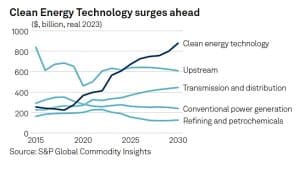
In 2025, cleantech energy supply spending is forecast to reach $670 billion, a historic milestone in the energy transition as shown below by S&P Global analysis. That figure will further increase by 2030, creating a huge gap between clean energy technology and upstream oil and gas investments.
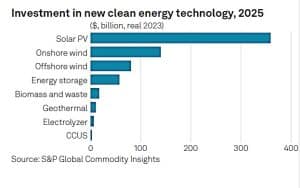
Solar PV alone is expected to account for half of this investment and two-thirds of installed megawatts. It is then followed by onshore wind investment.
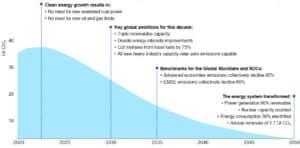
However, despite this financial commitment, current investment levels fall short of the climate goal to triple renewable capacity by 2030. The International Energy Agency’s (IEA) net zero roadmap specifically outlines this as a crucial climate ambition to achieve.
IEA’s Roadmap to Net Zero by 2050
Regionally, China’s capital efficiency in renewable energy investments leads the charge. Projections indicate nearly twice the gigawatts added per dollar spent compared to the U.S. This advantage solidifies China’s role as a major player in renewable energy expansion, even as global supply chain tensions present challenges.
Cleantech Supply Chain Tensions
China remains a dominant force in solar, wind, and battery manufacturing. However, its expansive supply chain faces pressures from a slowing domestic economy. The oversupply of equipment from China continues to drive prices down globally, reshaping industry dynamics.
S&P Global projections further suggest that by 2030, China’s market share in PV module production will decline to 65%, and battery cell manufacturing will drop to 61%. While this diversification may alleviate dependence on a single market, it also raises questions about how other nations will scale their production capabilities.
Battery Storage: The Missing Piece to Renewable Viability
Battery energy storage is becoming indispensable for renewable energy projects, particularly in regions with high solar PV penetration. While solar costs have declined significantly, developers face economic hurdles due to low power purchase agreement (PPA) expectations and the “cannibalization” effect—where midday energy overproduction drives prices to negligible levels.
To address these challenges, integrating battery energy storage has emerged as a critical strategy. Storage solutions enable renewable projects to stabilize energy output and optimize market participation, making investments more financially viable.
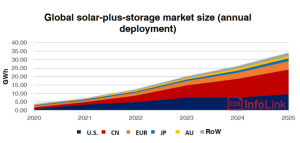
A good example that many call solar-plus-storage system is beginning to gain attention in the U.S. This system is transforming the renewable energy landscape.
By pairing solar panels with battery storage, solar-plus-storage systems address solar power’s intermittency and timing challenges. These hybrid systems provide a steady energy supply, boost grid reliability, and open new revenue streams for solar plants.
Solar facilities can earn through capacity payments and arbitrage—buying energy at lower prices, storing it, and selling when demand drives prices higher. China and the U.S. will continue to dominate this market.
Smart Grids and Smarter Strategies: AI’s Role in the Energy Evolution
Artificial intelligence (AI) is revolutionizing the cleantech sector, particularly in grid planning and renewable energy forecasting. Accurate predictions of intermittent renewable energy generation are crucial to maintaining grid stability.
For instance, AI-driven predictive maintenance for wind farms reduces downtime and increases energy production by up to 30%. AI also improves grid performance, reducing congestion and integrating more renewables without costly infrastructure upgrades.
Moreover, AI-powered trading applications help mitigate risks arising from forecast discrepancies, which can vary by as much as 700%. By enhancing energy management, AI facilitates smoother integration of renewables into the grid.
AI’s impact on grid-enhancing technologies has helped increase grid capacity by 20%, supporting the growing share of clean energy. Additionally, companies like Google, Microsoft, and Tesla are investing heavily in AI, with Tesla’s AI-driven energy storage solutions improving battery performance and extending lifespan by 15%.
However, the rise of AI also introduces risks, including cybersecurity vulnerabilities and ethical concerns, which will require proactive governance to address.
Meanwhile, data centers are also becoming a driving force in corporate clean energy procurement. Currently, these energy-intensive facilities account for 200 TWh, or 35%, of global corporate clean energy purchases. By 2030, their demand is projected to rise to 300 TWh annually, with North America leading this surge.
The growing role of data centers reflects the broader corporate commitment to sustainability, as businesses increasingly prioritize renewable energy to meet climate goals and manage operational costs.
Charging Ahead: 2025 and the Clean Energy Revolution
2025 represents a transformative year for clean energy technologies, with investments and innovations accelerating the global energy transition. From renewable energy expansion to advances in storage systems, the sector is rapidly evolving to meet ambitious climate targets.
Though challenges such as supply chain tensions, economic hurdles, and investment gaps persist, the collective commitment to sustainability and decarbonization signals a promising future for cleantech. As AI, storage solutions, and corporate procurement strategies redefine the energy landscape, 2025 will solidify clean energy’s role as the cornerstone of a sustainable, resilient global economy.
The post 2025: The Year Clean Energy Dominates with Record $670 Billion Investment, Trumping Oil & Gas appeared first on Carbon Credits.

EU carbon credit claims changed on 27 September 2026, the day the Directive (EU) 2024/825 began to apply across the European Union. The change is narrow. It changes how a company can talk about the credits it buys. A product can no longer be called neutral on the strength of compensation alone; however, every specific, evidenced statement about what a company measured, reduced, and funded stays fully available.

The post Promoting Improved Cooking Practices in Nigeria appeared first on Terrapass.


-
Climate Change1 year ago
Guest post: Why China is still building new coal – and when it might stop
-

 Greenhouse Gases2 years ago
嘉宾来稿:满足中国增长的用电需求 光伏加储能“比新建煤电更实惠”
-
Greenhouse Gases1 year ago
Guest post: Why China is still building new coal – and when it might stop
-

 Climate Change2 years ago
嘉宾来稿:满足中国增长的用电需求 光伏加储能“比新建煤电更实惠”
-

 Renewable Energy12 months ago
Sending Progressive Philanthropist George Soros to Prison?
-
Climate Change2 years ago
Bill Discounting Climate Change in Florida’s Energy Policy Awaits DeSantis’ Approval
-
Greenhouse Gases1 year ago
嘉宾来稿:探究火山喷发如何影响气候预测
-

 Climate Change2 years ago
Analysis: China’s CO2 falls 1% in Q2 2024 in first quarterly drop since Covid-19