


Tesla delivered better-than-expected 3rd-quarter earnings and profits, bringing relief to investors while reversing a trend of declining earnings. The electric vehicle (EV) maker saw its first year-over-year profit growth in 2024, beating expectations in its 2024 Q3 report.
More remarkably, Tesla shows an impressive $739 million carbon credit, also called regulatory credits, revenue for the said quarter. The company reaffirmed its plans to make its EVs more affordable, which added to investor enthusiasm.
Tesla Recharges Earnings with Cash Flow from Carbon
The EV giant’s revenue rose 7.8% year-over-year to $25.18 billion, although this fell short of analyst forecasts. However, the company outperformed on its bottom line.
It reported adjusted earnings of $0.72 per share versus the $0.60 expected, up from $0.66 a year ago, with a net income of $2.5 billion. This beat analyst expectations, which had an estimated $0.59 per share and $2.01 billion in net income.
Tesla’s operating margin climbed to 10.8% of sales, up from 6.3% in the previous quarter and 7.6% in Q3 of last year. The company’s net income grew by 8% compared to last year, breaking a streak of four consecutive quarters of declining profits.
Tesla noted that it is currently between “two major growth waves,” suggesting optimism for the future. It also shared an upbeat outlook on vehicle deliveries, predicting “slight growth” this year. This came as a surprise since market forecasts had expected deliveries to dip from 1.81 million in 2023 to 1.78 million.
Following this announcement, Tesla’s stock jumped about 12% in after-hours trading, adding about $81 billion to the company’s market value.
Another big standout from the earnings report is Tesla’s carbon credit revenue totaling $739 million. The figure is well above the $539 million analysts had predicted and an increase of 33% year-over-year.

How Carbon Credit Sales Boosted Tesla’s Profits
More notably, these credits bring full profits to the company and account for almost 34% of its net income ($2,183 million). This Q3 carbon credit sale is the second-highest since Tesla started selling them in 2009. The highest was during the previous quarter.
These credits, which Tesla sells to traditional carmakers to help them meet emissions obligations, provide significant profits as they can be sold at 100% full margins. Thus, carbon credits have played a pivotal role in Tesla’s overall financial performance.
Since the EV maker began selling carbon credits to other companies, this revenue stream has turned into a billion-dollar opportunity. In the past year, Tesla earned $1.79 billion from carbon credits, marking its highest-ever annual income from automotive regulatory credit sales.
While details about Tesla’s carbon credit buyers are often undisclosed, Chrysler is known to have purchased $2.4 billion worth of credits by 2022. Stellantis, a major auto group, has also been involved, buying significant credits to offset emissions as it targets zero emissions by 2038. This highlights the challenges automakers face in reducing carbon footprints, given the high emissions associated with key EV components like batteries, steel, and aluminum.
China remains another vital market for Tesla’s carbon credit sales. Reports indicate that a joint venture between Volkswagen and FAW Group in China might have purchased credits from Tesla, potentially earning Tesla around $390 million in 2021. However, details about specific buyers in China remain unclear.
Driving Forward: Tesla Eyes 25-30% Delivery Growth
The positive momentum continued as CEO Elon Musk addressed investors during the earnings call. Musk forecasted a 25% to 30% increase in Tesla deliveries for next year and announced plans to roll out a self-driving taxi, Robotaxi, service in California and Texas by 2025.
Tesla had previously announced that it delivered 462,890 vehicles in Q3, with production totaling 469,796 units. About 3% of these deliveries were under operating lease accounting.
This figure compares to 443,956 vehicles delivered in Q2 of this year and 435,059 in Q3 of last year. Tesla’s all-time delivery record remains at 484,507 units, achieved in Q4 2023.
Looking forward, Tesla emphasized that its plans to produce new, more affordable vehicle models remain on track, with production expected to begin in the first half of 2025.
Beyond EVs: Energy Storage Sets New Records
Tesla’s energy storage business also showed strong performance. Although energy storage deployments decreased sequentially in Q3, they hit a record 6.9 GWh, up 75% year-over-year.
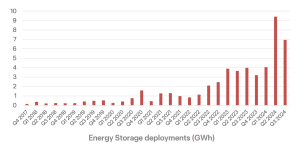
Tesla highlighted that energy services and other segments are increasingly contributing to the company’s profitability. It anticipates continued profit growth from these segments as energy storage products scale up and its vehicle fleet expands.
Additionally, Tesla advanced its efforts at Gigafactory Texas, where it is building a high-performance 29,000 H100 cluster, aiming for 50,000 H100 capacity by the end of October.
The energy storage market significantly influences Tesla’s strategy, especially as it diversifies into energy solutions beyond EV manufacturing. This shift is evident in Tesla’s growth in energy storage deployments, with key products like the Powerwall and Megapack battery systems.
- In 2023 alone, Tesla deployed 14.7 GWh of energy storage, generating $6.035 billion in revenue—a 3x increase since 2020.
Tesla’s energy storage segment’s growth aligns with the broader clean energy transition, especially as demand for storage solutions rises to balance renewable energy production.
Tesla’s Q3 2024 earnings report reaffirms that carbon credit revenue remains a crucial part of its financial performance. It allows the carmaker to boost earnings while continuing its push toward more affordable EVs and expanded energy solutions.
The post Tesla’s $739 Million Carbon Credit Revenue Fuels Q3 Earnings Surge appeared first on Carbon Credits.


Most businesses that decide to act on their net-zero targets reach the same point of friction. Buying carbon credits has meant tracking down brokers, sitting through sales calls, and requesting a quote just to learn a price, sometimes with limited proof of what you are buying.

The earnings calls that quietly reframed climate from sustainability question to operating risk.
Three earnings calls in the last 18 months tell the story without any help from a press release.
Hershey, May 2024: cocoa price exposure compresses margin, and the company attributes part of the cost shock to West African weather. Olam, July 2024: coffee climate exposure quantified in the annual report. JBS, January 2025: supply chain climate disclosures expanded materially in response to investor pressure and regulatory expectation. None of these companies issued the announcement as climate news. They issued it as financial news. The climate-linked supply chain risk did not arrive with a sustainability framing; it arrived as a P&L line.
You are probably reading this article because you suspect the same thing is happening to your business. This piece walks through what is showing up on which earnings calls, how procurement and finance leaders are quantifying the exposure, and what serious corporates are doing about it before the regulator asks.
Where climate risk has already appeared in earnings
The pattern is consistent across resource-intensive sectors. A weather event compresses supply, the price spikes, the cost flows through the income statement, and the analyst on the call asks whether the event is anomalous or structural. Increasingly, the honest answer is the second one.
Cocoa is the cleanest example. The 2023 to 2024 West African harvest fell sharply on the back of erratic rainfall and disease. Cocoa futures more than tripled. Companies with concentrated West African sourcing absorbed the cost; companies with diversified sourcing absorbed less. The exposure was not climate as ESG topic. It was climate as cost of goods.
Coffee follows the same pattern. Brazilian and Vietnamese harvests have moved on weather more sharply across the last several seasons. Roasters with long-tenor supplier relationships and origin diversification have managed the volatility; roasters with spot-market exposure have not. Wheat, sugar, palm oil, beef: the same dynamic in different commodities, a pattern the IPCC AR6 Working Group II report projects will intensify across agricultural systems through mid-century.
What this means: climate risk is no longer a footnote in the 10-K. It is a line item the CFO has to explain on the call.
The three commodity exposures that hit margin first
For most companies with material Scope 3 exposure, three exposures dominate the near-term P&L risk.
- Concentrated single-origin sourcing in a climate-vulnerable region. If your tier-one supply for any material commodity sits in one geography, you have a concentration risk that climate amplifies. Diversification across origins is the obvious hedge, but it takes years to build and requires relationships you cannot acquire by tender.
- Supplier financial fragility under climate stress. Smallholder farmers, who supply a large share of the global cocoa, coffee, and palm oil market, do not carry the balance sheets to absorb yield shocks. When yields collapse, they exit. When they exit, your supply base shrinks, and the surviving suppliers raise prices. The risk is structural, not cyclical.
- Logistics and storage exposure to extreme weather. Hurricane disruptions to Gulf shipping, drought-driven Panama Canal restrictions, flooding in European inland waterways: each of these has moved input costs in the last three years, a pattern documented in Munich Re’s natural catastrophe data. The exposure shows up as a one-quarter event in the financial press but accumulates over time on the cost line.
TCFD and ISSB disclosure changes
The disclosure architecture has now caught up with the risk. The Task Force on Climate-related Financial Disclosures, whose recommendations are now embedded in the ISSB’s IFRS S2 climate standard, requires companies to disclose climate-related risks across physical and transition categories, with quantification where possible.
For physical risk specifically (the climate-linked supply chain risk you are reading about), the disclosure must address both acute exposures (extreme weather events) and chronic exposures (gradual changes in temperature, precipitation, and growing seasons). The disclosure must address the time horizon over which the risk is material, the parts of the value chain exposed, and the financial impact under different scenarios.
The CSRD imposes similar requirements under European law, with double materiality (both financial and impact materiality) embedded in the assessment. The practical effect: your auditors and your investor relations team now need a defensible answer to the climate-linked supply chain risk question, and the answer needs to be quantified.
What procurement and finance can do now
Three actions matter near-term.
Map your exposure. Most companies do not have a clear view of which tier-one and tier-two suppliers sit in which climate-vulnerable geographies. Without the map, you cannot quantify the risk, and without the quantification, you cannot disclose it credibly. The map is the foundation, and World Resources Institute climate risk research provides useful public tooling to start.
Diversify and deepen, in that order. Diversification across origins reduces concentration risk, but the deeper move is to invest in the resilience of the suppliers you already have. Regenerative practices, agroforestry, soil health interventions: these reduce yield volatility under climate stress and protect your input cost trajectory.
Embed the climate spend inside procurement, not outside it. Treating climate risk as a sustainability cost line subordinates it to the ESG budget. Treating it as a procurement and resilience investment puts it in the budget that matters, which is the cost-of-goods budget that the CFO defends quarterly.
Nature-based supply chain investments are the asset class designed for exactly this purpose. They sit inside the value chain, they reduce climate-linked supply risk, they generate verifiable Scope 3 reductions, and they produce the documentation an auditor and a regulator can both test.
If you are quantifying climate-linked supply chain risk in advance of the next earnings cycle or the next disclosure period, the carbon and sustainability experts at Carbon Credit Capital can help you map your exposure and structure a Dual-Value Model response that addresses reduction, resilience, and disclosure-readiness in a single program. Schedule a consultation.

More and more small and medium-sized businesses are hearing the same question from their larger customers: What is your carbon footprint? That question now travels down entire supply chains, and it arrives next to tender requirements, certification criteria, and rising customer expectations.




-
Climate Change1 year ago
Guest post: Why China is still building new coal – and when it might stop
-

 Greenhouse Gases2 years ago
嘉宾来稿:满足中国增长的用电需求 光伏加储能“比新建煤电更实惠”
-
Greenhouse Gases1 year ago
Guest post: Why China is still building new coal – and when it might stop
-

 Climate Change2 years ago
嘉宾来稿:满足中国增长的用电需求 光伏加储能“比新建煤电更实惠”
-

 Renewable Energy11 months ago
Sending Progressive Philanthropist George Soros to Prison?
-
Climate Change2 years ago
Bill Discounting Climate Change in Florida’s Energy Policy Awaits DeSantis’ Approval
-
Greenhouse Gases1 year ago
嘉宾来稿:探究火山喷发如何影响气候预测
-

 Carbon Footprint2 years ago
US SEC’s Climate Disclosure Rules Spur Renewed Interest in Carbon Credits