
Walmart was the first U.S. retailer to make a zero-emissions commitment by 2040, without relying on carbon offsets. However, the company’s latest news release revealed that the retail giant is most likely to miss its greenhouse gas emissions targets. It aimed to cut absolute scope 1 and 2 GHG emissions by 35% by 2025 and by 65% by 2030 from 2015 levels. But these numbers now look foggy.
The company revealed,
“We anticipate achieving our near-and mid-term emissions reduction targets later than our 2025 and 2030 target dates.”
Walmart’s Operational Emissions: Gains and Setbacks
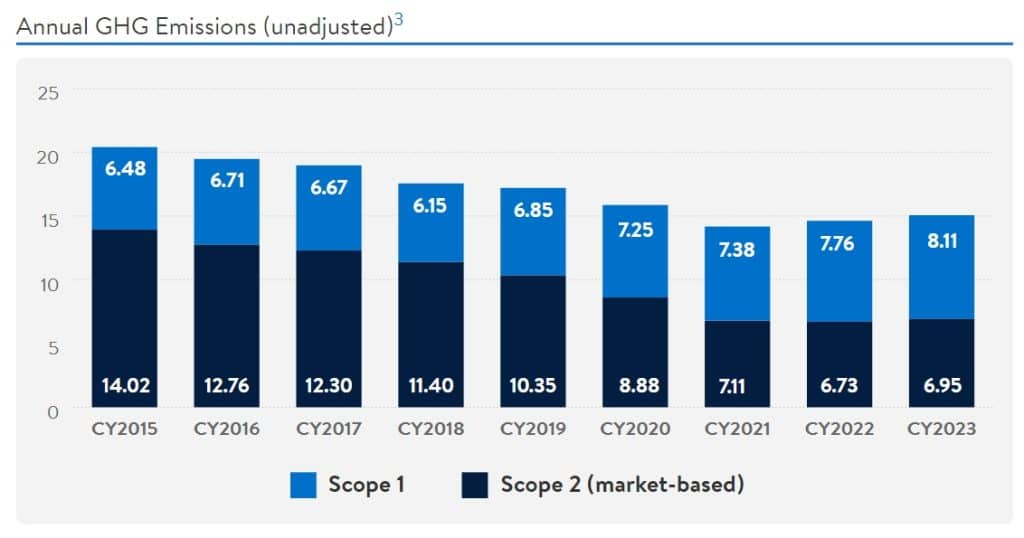
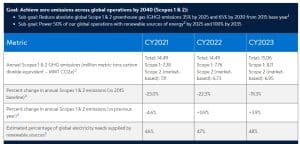
By the end of 2023, Walmart reduced its operational emissions (Scopes 1 and 2) by 19.3% compared to its 2015 baseline. Its carbon intensity declined by an impressive 45% in the same timeline. But despite these long-term gains, annual emissions in 2023 increased by 3.9%. This rise became the reason behind Walmart pushing its pre-determined target.
Most importantly, it showcased the challenges of balancing commercial expansion with sustainability.
Source: Walmart
What Slowed Walmart’s Progress?
Coming to the analysis directly, external factors played a significant role in stalling the retail giant’s sustainability journey. The three factors that Walmart has cited led to the rise in emissions were:
- Pollution from old and aging refrigeration equipment
- Fuel emissions from transportation in the U.S., including fleet expansion and third-party route changes.
- Slow adoption of renewable energy compared to its business growth.
Out with the Old, In with the New
The company has realized that achieving its net zero goals won’t be a straight path. There will be inevitable hurdles due to business growth and external factors. While the company will continue with its 2040 net zero emission goals, its interim targets might take longer to achieve.
Walmart’s statement stressed that curbing emissions relies on policies and infrastructure across global markets. For instance, reducing refrigeration emissions and HVAC systems or reducing emissions in heavy transportation require systemic solutions.
Additionally, broader sectoral shifts in transportation, materials, and agriculture can significantly reduce value chain emissions.
Source: Walmart
Renewable Energy Adoption
Walmart wants to power 50% of its operations with renewables by 2025 and 100% by 2035. Notably last year, 48% of its electricity came from renewable sources, with 30% directly procured through contracts.
The strategies to further bring down Scope 2 emissions are:
- Add 1 GW of solar and storage capacity by 2030, building on 600 projects already in progress.
- Since 2020, Walmart has facilitated over 2 GW of renewable projects through Power Purchase Agreements and is exploring international investments.
The company also reached a major milestone with its flagship “Project Gigaton” through which it aims to mitigate 1 billion metric tons of emissions in its value chain by 2030. The best part they achieved it six years early. Notably, the company credits supplier partnerships and continued innovation for this success.
Despite progress, achieving these goals depends on accessing renewable capacity, especially in international markets with regulatory challenges. The company is working to unlock opportunities but faces uncertainties in some regions.
Tackling Refrigerant Emissions
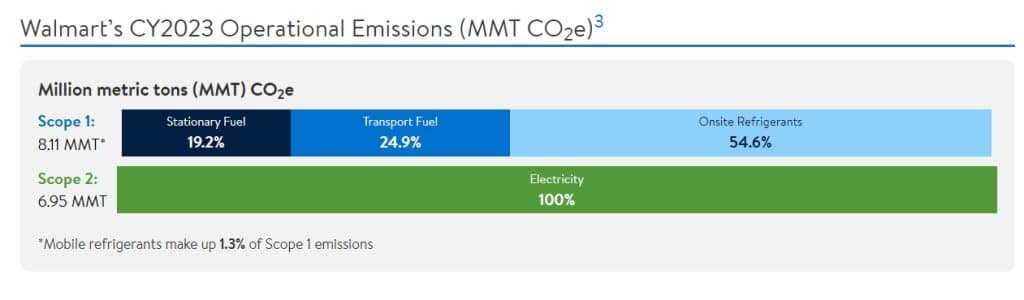
Refrigerant emissions accounted for 55% of Walmart’s Scope 1 emissions in 2023 mostly due to leaks in aging equipment. To address this, Walmart is working on:
- Annual preventive maintenance of the equipment, technician training, machine learning for detection of leaks, and reusing gases.
- Upgrading systems by transitioning to low-GWP refrigerants in new and existing facilities. Over 290 U.S. locations now use ultra-low GWP alternatives like CO2 and ammonia.
- Advocating policy changes and supporting legislation to phase out high-GWP refrigerants.
These efforts are a part of their continued progress aligned to equipment upgrades and technology availability.
Source: Walmart
Supporting EV Adoption
Walmart plans to build an EV fast-charging network at thousands of U.S. stores and Sam’s Clubs by 2030. This will be an addition to its existing 1,300 chargers at 280 locations. The company’s stats show that with 90% of Americans living within 10 miles of a Walmart, the initiative will make EVs more accessible and convenient.
Drivers can shop while charging- which shows how convenient that would be for customers. Additionally, they are testing zero-emission vehicles in its supply chain, with EV deliveries already in place for many customers.
Thus, despite challenges related to a possible delay in achieving its net zero emissions target, Walmart stays committed to its 2040 goal. This will require affordable low-carbon solutions, strong policies, and better infrastructure for a sustainable future.
- READ MORE: Walmart Issues $2 Billion Green Bonds
The post Is Walmart’s Net Zero Emissions Target Slipping Away? appeared first on Carbon Credits.
Carbon Footprint
Indigo Carbon Surpasses 2 Million Soil Carbon Credits in Landmark 1.1 Million Issuance
Indigo Carbon announced it has now passed 2 million metric tons of verified climate impact from U.S. croplands. The company reached the milestone after issuing its fifth U.S. “carbon crop.” The new issuance includes 1.1 million independently verified carbon credits issued through the Climate Action Reserve (CAR).
Indigo describes the milestone in its announcement as a sign that soil-based carbon programs can scale. It also points to rising corporate demand for credits that meet stricter quality rules.
Indigo’s latest issuance is important because it is linked to a major registry method that now carries an additional integrity label. Max DuBuisson, Head of Impact & Integrity, Indigo, remarked:
“Indigo continues to set the standard for high-integrity soil carbon removals that corporate buyers can trust. Soil carbon is uniquely positioned to scale as a climate solution because it captures and stores carbon while also improving water conservation and crop resilience. By combining world-class science and technology with farmer-driven practice change, we’re proving that agricultural soil carbon is an immediate, durable, high-integrity solution capable of helping global companies meet their climate commitments.”
Inside the 1.1M Credit Issuance and CCP Label
Indigo says its fifth issuance includes 1.1 million carbon credits verified and issued through CAR. These credits come from Indigo’s U.S. soil carbon project, listed on the Climate Action Reserve under the Soil Enrichment Protocol (SEP) Version 1.1.
CAR’s SEP is designed to quantify and verify farm practices that increase soil carbon and reduce net emissions. It covers changes in soil carbon storage and also includes reductions in certain greenhouse gases tied to farm management.
CAR’s SEP Version 1.1 has the ICVCM Core Carbon Principles (CCP) label. This means the method meets the standards set by the CCP framework.

Indigo’s disclosures also describe long-term monitoring rules. The company reports that its U.S. project includes 100 years of project-level monitoring after credit issuance, in line with CAR requirements. This mix of independent verification, registry issuance, and long monitoring periods is central to the case Indigo makes for credit quality.
Breaking Down the 2 Million Ton Milestone
Indigo says its total verified impact now exceeds 2 million metric tons of carbon removals and reductions across U.S. croplands.
In carbon markets, one credit equals one metric ton of CO₂ equivalent. Indigo’s latest issuance is very large by soil carbon standards. It also builds on earlier “carbon crop” issuances.
Indigo’s project disclosures include a quantified impact figure for its U.S. project. The company reports 927,367 tCO₂e reduced or removed through Dec. 31, 2023, for the project listed as CAR1459.

Indigo announced it has saved 118 billion gallons of water. It has also paid farmers $40 million through its programs so far. These points matter because many buyers now look beyond carbon totals. They also want evidence of farmer payments, monitoring rules, and co-benefits like water conservation.
Corporate Demand Shifts Toward Verified Removals
One reason soil carbon is getting more attention is the growing demand from buyers for removals. Many companies now focus more on carbon removal credits, not only avoidance credits.
Indigo’s largest recent buyer example is Microsoft. In January 2026, the carbon ag company announced a 12-year agreement under which Microsoft will purchase 2.85 million soil carbon removal credits from them.
- The soil carbon producer said this is Microsoft’s third transaction with the company, following purchases of 40,000 tonnes in 2024 and 60,000 tonnes in 2025.
The tech giant’s purchases show how corporate buyers may use long-term offtake deals to secure future supply of credits. This matters for soil carbon programs because credits are typically generated over multiple years. And they also depend on practice changes and verification cycles.
Indigo also says its program works across eight million acres, which signals how it is trying to scale participation across U.S. farms.
Soil Carbon Credits: Market Trends and Forecast
Soil carbon credits are gaining attention as buyers shift toward higher-quality credits and clearer verification rules. Ecosystem Marketplace reports that the voluntary carbon market is entering a new phase. This phase emphasizes integrity, even though trading activity has slowed down.
In its 2025 market update, Ecosystem Marketplace noted a 25% drop in transaction volumes. This decline shows lower liquidity as buyers are becoming more selective.

At the same time, demand for higher-quality credits is rising. Sylvera’s State of Carbon Credits 2025 reported that retirements dropped to 168 million credits in 2025, a 4.5% decrease.
Still, the market value climbed to US$1.04 billion due to rising prices. It also found that higher-rated credits (BBB+) made up 31% of retirements, and traded at higher average prices than lower-rated supply.
For soil carbon, buyers are also watching methodology quality. The ICVCM has approved two sustainable agriculture methods as CCP-approved. These are the Climate Action Reserve’s Soil Enrichment Protocol v1.1 and Verra’s VM0042. This can support stronger buyer confidence and may increase demand for soil credits that meet CCP rules.
Looking ahead, Sylvera projects compliance-linked demand will keep growing and could exceed voluntary demand by 2027. That trend may favor credits with stronger verification and compliance alignment, including higher-integrity soil carbon credits. However, integrity issues still occur, and this is where Indigo comes in.
Tackling Permanence and MRV Head-On
Soil carbon credits face a key challenge: carbon stored in soil can be reversed. A drought, land use change, or a shift in farm practices can reduce stored carbon.
This is why monitoring and reversal rules matter. CAR’s protocol is built to quantify, monitor, report, and verify practices that increase soil carbon storage.
Indigo’s project disclosure notes that projects are monitored for 100 years after they are issued. This shows the durability rules tied to their method and registry approach.
The company also positions its program as “outcome-based,” meaning it pays for verified carbon outcomes rather than paying only for adopting a practice. This messaging is designed to reassure buyers that credits are not only modeled. It stresses verification and the registry process.
A Scale Test for High-Integrity Soil Carbon
Indigo’s fifth issuance lands at a time when voluntary carbon markets are placing more weight on integrity labels and independent verification.
Two parts stand out:
- First, volume. An issuance of 1.1 million credits through a registry is large for an agricultural soil carbon program.
- Second, method approval. CAR’s SEP Version 1.1 carries the ICVCM CCP label, which is meant to signal alignment with a global integrity benchmark.
That combination may make it easier for corporate buyers to justify purchases internally. Many companies now face stronger scrutiny from auditors, regulators, investors, and civil society groups.
At the same time, more supply does not automatically mean market confidence rises. Buyers still assess risks such as permanence, additionality, and measurement uncertainty.
Even so, the milestone shows how fast some parts of the removals market are trying to scale. Large buyers are also helping drive this shift through multi-year offtake deals, like the Microsoft agreement for 2.85 million credits.
For Indigo, the new issuance supports its claim that soil carbon is moving from small pilot volumes toward larger, repeatable issuances. For the market, it adds another real-world data point: a major soil carbon program has now completed five issuance cycles and passed 2 million metric tons of verified climate impact.
The post Indigo Carbon Surpasses 2 Million Soil Carbon Credits in Landmark 1.1 Million Issuance appeared first on Carbon Credits.
Carbon Footprint
Meta, Amazon, Google, and Microsoft Dominate Clean Energy Deals as Global Buying Slips in 2025
For nearly a decade, global companies have been racing to buy clean energy from wind farms, solar parks, and other green power projects. But 2025 marked the first decline in this trend in almost ten years — a surprising shift that signals a changing landscape for corporate sustainability.
The latest report from BloombergNEF (BNEF) shows that corporate clean energy purchasing dropped about 10% in 2025, falling from roughly 62.2 gigawatts (GW) in 2024 to 55.9 GW last year.
Let’s break down why this happened, what it means, and how the market could evolve in the coming years.
Clean Energy Buying: The Big Picture
Corporate clean energy buying usually happens through power purchase agreements (PPAs). They are long-term contracts where companies agree to buy electricity directly from renewable energy projects, often wind or solar farms.
For years, this was one of the fastest-growing parts of the clean energy market. Companies like Google, Amazon, Meta, and Microsoft drove most of the demand, helping build huge amounts of renewable capacity. But 2025 interrupted that streak.
Even though 55.9 GW is still one of the largest annual totals ever, the fact that it is lower than the year before shows a real shift in how companies approach renewable energy deals.
Why Corporate Clean Energy Buying Fell
There are several reasons why corporate clean energy buying slowed in 2025:
Corporate buyers are sensitive to electricity market rules and government policies. In many regions, uncertain policy environments made it harder to finalize long-term clean energy contracts. In the United States, for example, uncertainty about future clean energy incentives and carbon accounting standards caused many smaller corporations to hold off on signing new deals.
In some power markets, especially in parts of Europe, there were long hours of negative electricity prices. This happens when supply exceeds demand and power becomes so cheap that producers pay buyers to take it.
These price swings make standalone solar and wind contracts less attractive, especially for companies that want predictable, long-term value from their clean energy purchases.

Dominance of Big Tech
Another key point in the BloombergNEF findings is that the market is becoming more concentrated. As said before, four major tech firms, like Meta, Amazon, Google, and Microsoft, signed nearly half of all clean energy deals in 2025.
Meta and Amazon alone contracted over 20 GW of clean power last year, including deals that cover not just solar or wind, but also nuclear power — something unusual in past corporate PPA markets.
While this heavy concentration helps maintain volume, it also means that smaller companies are scaling back, which lowers the total number of buyers and contributes to the overall slowdown.

- READ MORE: Clean Energy Investment Hits Record $2.3T in 2025 Says BloombergNEF: What Leads the Surge?
Regional Differences: Where Things Slowed and Where They Didn’t
Corporate clean energy markets didn’t all move in the same direction last year. Bloomberg’s data shows clear regional patterns:
United States
The U.S. remained the largest single market for corporate clean energy deals, signing a record 29.5 GW of commitments. Much of this came from major technology companies looking to match their growing electricity needs with zero-carbon power sources.
Yet despite these high numbers, the number of unique corporate buyers in the U.S. dropped by about 51%, as many smaller firms pulled back from signing new PPAs.
Europe, Middle East & Africa (EMEA)
In the EMEA region, corporate PPAs fell around 13% in 2025, slipping back to levels closer to 2023. In Europe, in particular, rising negative prices and unstable policy conditions discouraged many new deals.
Asia Pacific
Asia had a mixed story. Some markets like Japan and Malaysia continued to attract corporate clean energy buyers, thanks to mature PPA markets and supportive regulations. But slower activity in countries like India and South Korea contributed to a drop in total volumes in the region.

The Rise of Hybrid and Firm Power Deals
One interesting trend that emerged in 2025 is that companies are looking beyond just wind and solar. Because of the limitations with standalone renewable deals, many buyers are now exploring hybrid power contracts that mix renewables with storage, or even nuclear and geothermal sources.
Hybrid deals like solar paired with battery storage give companies more reliable power and help manage price and supply risks. BloombergNEF tracked nearly 6 GW of these hybrid agreements in 2025, and expects this share to grow.
- According to a report by SEIA and Benchmark Mineral Intelligence, the United States added a record 28 gigawatts (GW) / 57 gigawatt-hours (GWh) of battery energy storage systems (BESS) in 2025. It reflected a 29% year-over-year increase.
Cheaper battery costs are part of this trend. Recent data shows that the cost of four-hour battery storage projects fell about 27% in 2025, reaching record lows. This makes storage-based renewable contracts more financially compelling.

Big Companies Still Push the Market
Even with the overall slowdown, corporate clean energy buying remains strong, especially among large technology firms.
In fact, while smaller companies took a step back, the major tech buyers helped keep total volumes near all-time highs. In other words, the market didn’t crash; it just shifted shape.
This becomes even clearer when we look at individual company progress. Microsoft reported recently that it now matches 100% of its global electricity use with renewable energy, an achievement that required decades of energy contracts and partnerships.
The Clean Energy Market Is Resetting, Not Retreating
The IEA projects that renewables will provide 36% of global electricity in 2026. This shows that the energy transition is moving forward, even if corporate clean energy purchases dipped in 2025. The slowdown does not signal failure. Instead, it reflects a market that is adapting as companies, technologies, policies, and economics evolve together.

Growth in corporate renewable deals is not always steady. A single year of lower volumes does not erase the gains of the past decade. Instead, it highlights the natural adjustments markets go through as strategies shift and conditions change.
In this transitioning phase, policy and regulation remain critical. Clear rules, incentives, and supportive frameworks encourage smaller companies to participate. Additionally, regions that provide stability, such as parts of the Asia Pacific, are seeing continued growth in corporate clean energy demand.
In conclusion, even with the dip in 2025, corporate renewable energy purchasing is far larger than it was ten years ago. The market is shifting rather than shrinking, and companies continue to find ways to power growth with clean energy. This slowdown may serve as a wake-up call, encouraging smarter, more flexible strategies that can sustain the energy transition for years to come.
- ALSO READ: Renewables 2025: How China, the US, Europe, and India Are Leading the World’s Clean Energy Growth
The post Meta, Amazon, Google, and Microsoft Dominate Clean Energy Deals as Global Buying Slips in 2025 appeared first on Carbon Credits.
Carbon Footprint
Navigating Nature Based Solutions – The 2026 Forecast
-
Greenhouse Gases7 months ago
Guest post: Why China is still building new coal – and when it might stop
-
Climate Change7 months ago
Guest post: Why China is still building new coal – and when it might stop
-
Greenhouse Gases2 years ago嘉宾来稿:满足中国增长的用电需求 光伏加储能“比新建煤电更实惠”
-

Climate Change2 years ago
Bill Discounting Climate Change in Florida’s Energy Policy Awaits DeSantis’ Approval
-
Climate Change2 years ago
Spanish-language misinformation on renewable energy spreads online, report shows
-
Climate Change2 years ago嘉宾来稿:满足中国增长的用电需求 光伏加储能“比新建煤电更实惠”
-
Climate Change Videos2 years ago
The toxic gas flares fuelling Nigeria’s climate change – BBC News
-
Carbon Footprint2 years agoUS SEC’s Climate Disclosure Rules Spur Renewed Interest in Carbon Credits


